Sunday, 10 January 2021

Loughborough cemetery Part 1

Memorials to World War Two PoWs

During one of my recent walks around Loughborough, I found myself returning from a very muddy walk around Charnwood Water, via the newer part of the Loughborough cemetery. As has happened on many occasions whilst I’ve been out walking, I’ve accidentally socially-distancly bumped into a wide variety of friends who during this pandemic I wouldn’t otherwise have seen.

And so it was that on this walk through the cemetery a chance meeting with one friend piqued my interest in some specific graves in the newer part of the cemetery, namely the headstones associated with some German men who died around the time of the Second World War. Several of these men were well-known about and new headstones had been placed in their memory, but there were half a dozen headstones relating to German men who had died, if not towards the end of the war in 1945, then a little afterwards, up until May 1947.

As it is not long since we’ve had a major anniversary of the beginning and ending of the First World War, I know a little bit about that conflict and Loughborough’s, and its people’s part in it, but not so for the Second World War. When I was first asked about these graves, I remembered that I’d seen somewhere information about a prisoner of war (PoW) who escaped from Donington Hall: it came back to me that this had been at the museum in Ashby, and on checking I realised that this event was from the First World War, so had nothing to do with Loughborough (apart from the fact that Donington Hall was once home of members of the Hastings family, who were at one time lords of the manor Loughborough), nor with the headstones in question.

I also remembered seeing something at the Shepshed watermill about a bridge being constructed by prisoners of war, but I wasn’t sure if I’d remembered this, or imagined it, nor whether this was WW1 or WW2. Looking back at my photographs of my day out at the watermill revealed that the bridge-building really had taken place, and it was during WW2, so I knew that prisoners of war must have been held nearby, in WW2.

Sure enough, a little research pulled up some very interesting information on PoW camps in the area.

Firstly, a camp a little over the border, in Nottinghamshire …

A site at Sutton Bonington, now home to the agricultural science college of Nottingham University, had been used to imprison PoWs during WW1. But was this also the case in WW2? According to this newspaper article, the Sutton Bonington site was also used as a camp in World War Two, and the article goes on to describe an escape that allegedly took place on the night of 17 September 1941, when a group of 22 prisoners dug an escape tunnel and used it to leave the camp. Most of the escapees were later found fairly close to Sutton Bonington, but a few made it as far as Chesterfield before they were re-captured. However, an article, with no attribution but with a Nottingham University URL, suggested that Sutton Bonington was only used as a PoW camp during WW1, and that the escape was made on 17 September 1917, through a tunnel which had been dug by the prisoners.

My search through contemporary newspaper reports confirmed that this escape actually took place in 1917.

And a camp just down the road towards Leicester, at Quorn

Quorn Camp, was situated on Wood Lane, in the village of Quorn, and was numbered No.9/183, being a Base Camp, standard type. Many folk will remember the 505th Parachute Infantry Regiment of the US 82nd Airborne Division who arrived in Quorn on February 14th, 1944 and who were based at the Quorn Camp on Wood Lane. This camp later became a PoW camp, which firstly held Italian prisoners, and later German ones, the site being vacated by 1948.

And a camp just down the road in Shepshed

This was housed in the former Liberal Club on Charnwood Road, which is now a nursing home. At the time of its use to hold PoWs, it was a relatively new building, its foundation stone being laid in 1901 and the building opened in 1902.

Another nearby camp was at Hathern

Hathern Camp, based off Pear Tree Lane, close to Dishley Cottage was No. 590, and probably a sub-camp of Garendon Camp which was in Loughborough. The Hathern Camp housed Italian PoWs, from about 1942-1948, after which it became the basis of what was known as the Hathern Bungalow Estate, used as housing for families, when housing was in short supply directly after the war. 


Leaving the environs of Loughborough for a moment, and looking further afield, in Stoughton on the outskirts of Leicester, there was a camp at
Shady Lane, now known as an arboretum. Interesting memories from children who grew up near the camp have been shared, but there is one story that brings us quickly back from Shady Lane to Loughborough.


On 22 May 1947, the Leicester Evening Mail carried the following report:

P.o.W. FOUND HANGED IN SPINNEY

A 25-year-old German prisoner of war at the Stoughton camp has been found dead. He was Ernest Hilbert, and he was discovered hanging in the spinney adjoining the camp yesterday.”

I do not know why, but Ernst Hilbert has a memorial in Loughborough cemetery, one of the half a dozen that were brought to my attention on my recent walk.


You are welcome to quote passages from any of my posts, with appropriate credit. The correct citation for this looks as follow:

Dyer, Lynne (2021). Loughborough cemetery part 1. Available fromhttps://lynneaboutloughborough.blogspot.com/2021/01/loughborough-cemetery-part-1.html [Accessed 10 January 2021]

Take down policy:
I post no pictures that are not my own, unless I have express permission so to do. All text is my own, and not copied from any other information sources, printed or electronic, unless identified and credited as such. If you find I have posted something in contravention of these statements, or if there are photographs of you which you would prefer not to be here, please contact me at the address listed on the About Me page, and I will remove these.

You can leave comments below, but do check back as my reply will appear here, below your comment.

Thank you for reading this blog. 
Lynne             

Sunday, 3 January 2021

A strange year in Loughborough

The year 2020 is surely one that most of us will remember forever, when in March the whole country came to a standstill, in order to beat a virus. Life as we knew it changed and after just over nine months later we have not been able to go back to the way things once were, and a new normal has become, well, the norm!

Writing this blog over the past year has been rather interesting, and has been rather different. Originally the intention for the year was to post an article by a guest blogger once a month, and this started well, with a post about what happened to the Captain of the Zeppelin airship that dropped bombs on Loughborough in January 1916. This was followed by a post about art and artists in Loughborough, Leicestershire and Rutland. And then, the pandemic began.

Stuck at home, I struggled to write posts, as my prompts had all but disappeared. No trips out to places that would remind me things about Loughborough that I could then research and write about, so I had to rely on looking through my collection of books about Loughborough, and take my cues from there. And now I say that, there's one I missed, as I actually have a book written in 2000 called "When my cue comes: the autobiography of Rev Sidney Y. Richardson", a methodist minister in Loughborough whom I met when I was having some printing done by Team Print, and it's been 20 years since I last read it, so I should give it another go.

Other blog posts were prompted by friends and acquaintances asking me if I knew anything about something specific, and this led to a series of posts in relation to Fairmount Drive, Arthur Edward Shepherd, and Glebe House, amongst other things.

So, over the past nine months I've done more walking around the outskirts of Loughborough than I would normally have done, so please find below a selection of photographs taken during the year.

Happy New Year to you all.

January 2020

Former Geoff's Toys

Church Gate

February 2020
Flooded Queen's Park

House on Storer Road

March 2020
Former pub on Nottingham Road bridge

Mountsorrel granite, Burton Street

April 2020
Deserted Granby Street car park

Southfields Park, closed

May 2020
Celebrating VE Day

Gate pier on Forest Road

June 2020
New style market

Rainbow stones on Tuckers Road

Poppies on Bowling Green Way

July 2020
Harry Cook's place, Epinal Way

Messenger in the pavement

August 2020
Hopper on Storer Road

Mucklin Lodge

New housing adjacent to the GCR

September 2020
Burleigh Brook Ashby Road

Empty Poundstretcher

October 2020
Autumn leaves on Shelthorpe Road

Gate piers on Forest Road

November 2020
Houses on Toothill Road

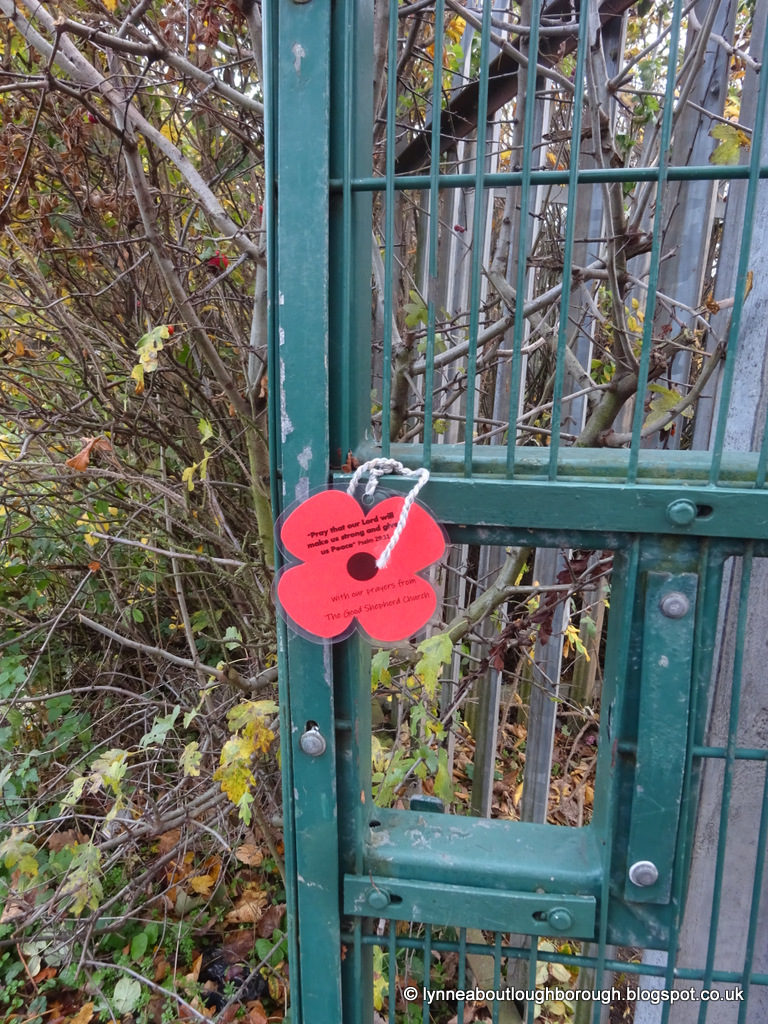
Remembrance poppy at the cemetery

Waymarker on new estate Epinal Way

December 2020
Canal near Nottingham Road bridge

Christmas lights in the market place

Winter Wonderland

You are welcome to quote passages from any of my posts, with appropriate credit. The correct citation for this looks as follow:

Dyer, Lynne (2021). A strange year in Loughborough. Available fromhttps://lynneaboutloughborough.blogspot.com/2021/01/a-strange-year-in-loughborough.html  [Accessed 3 January 2021]

Take down policy:
I post no pictures that are not my own, unless I have express permission so to do. All text is my own, and not copied from any other information sources, printed or electronic, unless identified and credited as such. If you find I have posted something in contravention of these statements, or if there are photographs of you which you would prefer not to be here, please contact me at the address listed on the About Me page, and I will remove these.

You can leave comments below, but do check back as my reply will appear here, below your comment.

Thank you for reading this blog. 
Lynne             

Sunday, 27 December 2020

Bellfoundry and church bells

Taylors Bellfoundry and the bells of the Loughborough parish church

One of the sounds that one can’t fail to have missed during the past 9 months is that of church bells ringing out – for all sorts of occasions, as well as calling people to a regular service. Whether or not you are a member of a church, whether or not this is your religion, the ringing of church bells is something that would normally permeate every village, town and city in the country. This is the first time since the Second World War that church bells have fallen silent.

In Loughborough, the irony of the silence of the church bells is that the town is home to the country’s last remaining bellfoundry, Taylors, as the Whitechapel bellfoundry closed in May 2017. Taylors has been an integral part of Loughborough’s industrial history since 1839, when the foundry moved here. Initially, the yard behind the Packhorse pub (now the Organ Grinder) served the bellfounders well, when they arrived in the town to re-cast the bells of the parish church, but by 1859, a larger, purpose-built factory had been created in the area around Freehold and Cobden Streets.

Bellfoundry buildings

Bellfoundry buildings


As a working factory, the bellfoundry has an extensive private archive and some of the history of the bellfoundry is shared on the internet, via the bellfoundry website, and that of the Loughborough Bellfoundry Trust. The trust has been in existence since about 2016 and was created to protect the buildings, the archives, and the museum within the bellfoundry for future generations.

A visit to the museum is a real treat as the work of the bellfoundry is showcased not only in a dedicated museum space, but also through an organised tour of the actual foundry where on casting days it’s possible to observe bells being made.

Bells


Although church bells may have fallen silent during this pandemic, work at the foundry has continued, and work to create a new museum for the 21st century has also forged ahead, with the appointment of a new museum director:

The new Museum Director for the Bellfoundry Trust, courtesy of Twitter

Also during the pandemic, the bell foundry has been in receipt of grants from the government’s Culture Recovery Fund, and, just before Christmas it was announced that the bellfoundry’s application to the Heritage Lottery Fund for a substantial grant had finally been approved. This success made the national news, and was reported on the BBC website, as well as being featured on the Heritage Fund websiteand on the website of Ingham Pinnock the economic and regeneration consultants who have been working with the bellfoundry since about 2014.  

The last time I visited Loughborough parish church, in February 2020, was to assist with keeping the church open whilst a ringing event took place, from 2pm, with an expected completion time of 5.45pm. This was a successful challenge - for the bellringers and myself!

Church belltower
Loughborough parish church tower


Inside the parish church Feb 2020


Inside the parish church, Feb 2020

Inside the parish church, Feb 2020


More recently, on Christmas Day, 2020, a small band of bellringers were able to ring the bells of the parish church. This was a momentous occasion as it was the first time the bells had been rung since 15th March 2020, just before the national lockdown. Several important safety inspections were carried out before this COVID-safe peal was allowed to go ahead, but those involved were absolutely thrilled to be able to ring, and people in the neighbourhood were thrilled to hear that iconic sound of church bells.

Let’s hope 2021 brings more opportunities for bellringers to ring, for townsfolk to hear the familiar sounds, for the bellfoundry works to flourish, and the bellfoundry's museum plans to develop.  

Posted by lynneaboutloughborough 27 December 2020

You are welcome to quote passages from any of my posts, with appropriate credit. The correct citation for this looks as follow:

Dyer, Lynne (2020). Bellfoundry and church bells. Available fromhttps://lynneaboutloughborough.blogspot.com/2020/12/bellfoundry-and-church-bells.html [Accessed 27 December 2020]

Take down policy:
I post no pictures that are not my own, unless I have express permission so to do. All text is my own, and not copied from any other information sources, printed or electronic, unless identified and credited as such. If you find I have posted something in contravention of these statements, or if there are photographs of you which you would prefer not to be here, please contact me at the address listed on the About Me page, and I will remove these.
You can leave comments below, but do check back as my reply will appear here, below your comment.

Thank you for reading this blog. 

Lynne        

Sunday, 20 December 2020

Spotlight on Glebe House Part 2

History of Glebe House part 2


In the previous post about Glebe House, we looked at the period during which it acted as the rectory associated with the Emmanuel Church, before moving on to look at who the rectors of Emmanuel were. In this post, let’s look at how Glebe House was used after the rector from 1904-1923, Richard H. Fuller, completed his incumbency.


In 1923 Rev. Douglas R. Robson accepted the position of Rector of Loughborough, and came from the small parish of Par, in Cornwall, but rather than coming to live at the impressive Glebe House, Rev. Robson moved into no.57 Forest Road, where in June 1923 Mrs Robson was advertising for the services of a cook / general servant.


So, who was now living at the beautiful Glebe House, in its lovely setting?

Prior to moving to Glebe House, William Shirley Northcote Toller, known to his family as Shirley lived in Stafford Lodge, Quorn. Toller had taken part in the First World War, and in March 1918, at the age of 40, he was taken prisoner of war: shortly after the Armistice was declared, he returned to England. From 1921 to 1926, he was Lt. Colonel of the 1/5th Battalion of the Leicestershire Regiment and it was during this period that he moved from Quorn to Glebe House, where he continued to live until around 1930, when he moved to Quorn Court.


The family that moved into Glebe House following Toller, were the Barthels. Albert Gustave Vincent Barthel was born the year before Toller, in 1887, to parents Louis and Edla [sic], in London. Barthel started his career as a bank clerk, but at the time of his marriage in 1917 to Eva Bigwood, he was an export manager. The couple continued to live in London, sharing the home of Eva’s parents in Battersea. However, in 1920 they registered the birth of their daughter, Joan, in Chepstow. By 1925, the family had moved to 31 Park Road, in Loughborough for a few years, before taking up residence in Glebe House.

On the 1939 register, Barthel is described as the managing director of a public limited company. A newspaper report from June 1940 describes the plight of the couple’s twin sons, Paul and Peter, the outcome of which was that Peter Vincent died in 1942. At the time, father Gilbert was the managing director of Genatosan, a firm which was begun in 1906 in London, as part of Sanatogen, and which in 1937 was taken over by Fisons.

Although there is no information on when Barthel retired, he and his family continued to live at Glebe House until about 1952, after which they moved to Storrington near Horsham in West Sussex, where Albert died in 1982.

Meanwhile, back in Loughborough, William Davis moved into Glebe House in around 1962. Prior to this, he and his wife Kathleen had been living at 24 William Street since at least as early as 1939. In 1935, William Davis had established his house-building company, who built their first houses on Edelin Road, the year the couple’s first child, Edelin was born. By the time of the move to Glebe House, the company was extremely successful.


Sadly, resources beyond 1962 are not available to me at the moment, so I am not sure when the Leicestershire County Council bought Glebe House, but I do know that the project known as Glebe House rented Glebe House from the council in 1982, and opened the building in 1983, offering a pre-school playgroup, and a holiday playscheme, amongst other things. In 1992, the project became a charity in its own right.

In 2004 Glebe House was added to Charnwood Borough Council’s register of locally listed buildings. The Glebe House charity continued to operate from Glebe House until 2010, when it moved to the former Magistrate’s Court on Wood Gate. In 2013 the Hardwick House School moved into Glebe House, and opened in 2014, and remains there to this day. Hardwick House School offers a curriculum that is rich and inspiring, and aims to provide an enjoyable learning experience for children and young people. It is a specialist independent school which is part of the group known as Cavendish Education.

Posted by lynneaboutloughborough 20 December 2020

You are welcome to quote passages from any of my posts, with appropriate credit. The correct citation for this looks as follow:

Dyer, Lynne (2020). Spotlight on Glebe House Part 2. Available from:https://lynneaboutloughborough.blogspot.com/2020/12/spotlight-on-glebe-house-part-2.html [Accessed 20 December 2020]

Take down policy:
I post no pictures that are not my own, unless I have express permission so to do. All text is my own, and not copied from any other information sources, printed or electronic, unless identified and credited as such. If you find I have posted something in contravention of these statements, or if there are photographs of you which you would prefer not to be here, please contact me at the address listed on the About Me page, and I will remove these.
You can leave comments below, but do check back as my reply will appear here, below your comment.

Thank you for reading this blog. 

Lynne        

Sunday, 13 December 2020

Winter Wonderland on the GCR

Been rather a busy week, so the concluding part of Glebe House will be published here next week. In the meantime, some of my very recent evening walks have obviously taken place in the dark, so I've managed to take some slightly different pictures.

First some photos of Christmas lights around Loughborough


 And some photos of the Winter Wonderland GCR event


You are welcome to quote passages from any of my posts, with appropriate credit. The correct citation for this looks as follow:

Dyer, Lynne (2020). Winter Wonderland on the GCR. Available from:https://lynneaboutloughborough.blogspot.com/2020/12/winter-wonderland-on-gcr.html [Accessed 13 December 2020]

Take down policy:
I post no pictures that are not my own, unless I have express permission so to do. All text is my own, and not copied from any other information sources, printed or electronic, unless identified and credited as such. If you find I have posted something in contravention of these statements, or if there are photographs of you which you would prefer not to be here, please contact me at the address listed on the About Me page, and I will remove these.
You can leave comments below, but do check back as my reply will appear here, below your comment.

Thank you for reading this blog. 
Lynne