While I'd heard of the Reverend James Bickham, Rector of Loughborough, and his library which he left for future generations of Loughborough clergy, I didn't get involved in a project to make his books more well-known and accessible until November 2022, and that is also when I met Ursula. The Manuscripts and Special Collections at the University of Nottingham hold quite a few collections that are relevant to Loughborough, Bickham's Library being one of them, and Ursula is keen to promote these. In her guest post, Ursula tells us about the metaphysical poet from Loughborough, John Cleveland.
A Blue Plaque for John Cleveland?
by Ursula Ackrill
Librarian at Manuscripts and Special
Collections, University of Nottingham
 |
| Engraving by James Basire (1730–1802) after a portrait by Isaac Fuller (1606-1672), published 1781. © National Portrait Gallery, London |
Loughborough
was the birthplace of the poet and Royalist John Cleveland (1613–1658).
According to the Oxford Dictionary of National Biography he “was baptized
on 20 June 1613 at Loughborough, the son of Thomas Cleveland (d. 1652) and
Elizabeth Hebbe (d. 1649). He was the second of their eleven children, not all
of whom survived, and their eldest son. Thomas Cleveland was then assistant to
the rector of the parish church as well as usher at Burton's Grammar School.”
For
the first seven years of his life John Cleveland lived in Loughborough. He
attended the Grammar School where his father was usher. His early memories
would have been of All Saints Church and the Old Rectory, where his father assisted the Rector John
Browne, and he would have minded his Ps and Qs for headmasters Mr Spong and Mr
Woodmansey, to whom his father reported as usher.
Right
next to the church stood the manor house of Loughborough, owned by the Hastings
family [now an Italian restaurant]. They possessed a large portion of the
town until Henry Hastings, younger brother of Ferdinando Hastings, Earl of
Huntingdon, threw his fate in with the Royalists and ended up losing the family
seat: Ashby-de-la-Zouch Castle. The castle was rendered uninhabitable by the
Parliamentarians in 1648 and the family forced to sell land to recover its war
debts. All this upheaval lay in a distant future as the child John Cleveland
ran his first errands in the triangle between church, manor house and rectory.
When the Earl and his Lady passed through town bellringers announced his coming
and the town offered hospitality, pouring out wine and beer for the Earl’s gentlemen
and followers (White 1969, p.79). Children would have banged about amid the
peals of the bells to make the cortege halt on the road.
In
1621 the Cleveland family moved to Hinckley, where John attended Hinckley
Grammar School for the next six years. On 4 September 1627 he was then admitted
to Christ's College, Cambridge. Cleveland spent a long and productive stint at
Cambridge; critics presume that his love poetry (more on that later) was
written in College. He left Cambridge under pressure in June 1642, just before
the outbreak of the Civil War in August that year; the town supported the
Parliamentarian side. He joined the King at his headquarters, established at
Oxford in November 1642. There Cleveland wrote The Rebell Scot, his most
famous poem, and part of a larger body of satirical works in which political
enemies are skewered with wit and “critical intelligence”, “hauteur” and “bitterness”
(Cousins, 1981, p.61). Cleveland’s poetry lives in the tradition of
metaphysical poetry established under the influence of John Donne (1572-1631).
What
is metaphysical poetry, you ask? It aims to reflect on experience truthfully in
figures of speech that no other poets have used before and prefers to do this
with paradoxes, bringing - or even forcing - together opposing concepts into
startling, mind-stretching formulations. Cleveland found fertile ground for his
poetry in imbalances of power, and it is because of his use of inequalities
that his readers should be made aware that Cleveland’s poetry is due content
warnings. [1]
There
are instances where the lyrical subject speaks from a place of powerlessness,
artfully self-erasing their power to uplift the power of the addressee, by
contrast, to towering heights. In The Hecatomb to his Mistresse the
subject plays the tongue-tied poet putting into verse his inability to express
how great his mistress is, calling the very idea of praising her “sacrilege” as
her femininity baffles poets as much as tropical infections confound medics.
Physicians, Cleveland tells us, cannot cure quartans, a recurring malarial
fever. But Cleveland argues all this in verses which prove the opposite as we
read through them. We read accomplished poetry in print [2]:
“Say
the Astrologer, who spells the Stars,
In
that fair Alphabet reads Peace and Wars,
Mistakes
his Globe, and in her brighter eye
Interprets
Heavens physiognomy.
Call
her the Metaphysics of her Sex,
And
say she tortures wits, as Quartans vex
Physitians;
call her the Square Circle, say
She
is the very rule of Algebra.
What
ere thou understand’st not, say’t of her,
For
that’s the way to write her Character.
Say
this and more, and when thou hop’st to raise
Thy
fansie so as to inclose her praise,
Alas
poor Gotham with thy Cookko hedge,
Hyperboles
are here but sacriledge.”
It
is worth noting that the south Notts village of Gotham lies only some 8 miles
away from Loughborough and Cleveland may have heard the stories about the mad
men of Gotham as a child. The first printing that introduced The Merry Tales
of the Mad Men of Gotham to a wider audience, dates from 1630, when
Cleveland was at Cambridge. [3]
Having
seen the conceit of speaking praise to “power” only to empower the subject by
stealth, we ought to look at one of Cleveland’s poems that needs to be tagged
with content warnings for misogyny and ageism: A young Man to an old Woman
Courting him. The poem is a variation on a theme that was popular in
northern European art and literature during the 16th and 17th centuries: the
ill-matched couple. The term comprises both the coupling of old men with young
women or old women with young men. To begin with, in the 16th century, painters
used caricature and stereotypical conventions to make people laugh and to
caution against such mismatches. A convention is for instance an inane smile
painted on the older partner’s face, revealing their predatory assuredness
together with missing teeth. Conventional in the depiction of the younger
partner is a glazed, dead-eyed expression, whilst hands are grasping coins.
Today’s workplaces call it “quiet quitting”. [4]
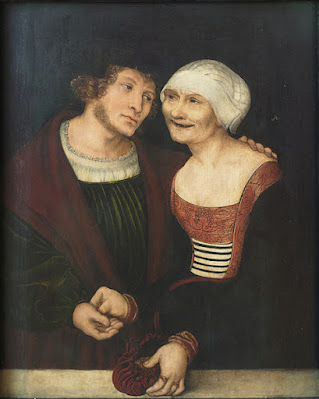 |
| Painting by Lucas Cranach the Elder (Budapest Museum of Fine Arts): Ill-Matched Couple: Young Man and Old Woman between 1520 and 1522. Courtesy of Wikimedia Commons |
However,
in the 17th century we see painters’ attempts to humanise the genre by bringing
nuance to set pieces: in de Cordua’s painting [below] the old woman is shown
holding the money purse firmly shut, whilst the young man’s bright white hand
is used to highlight her face. She looks wise and more heedful rather than
foolish.
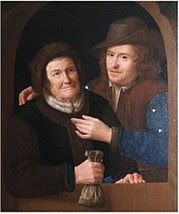 |
| Painting by Johann de Cordua (Museum: Bavarian State Painting Collections): The ill-matched couple, 1676. Courtesy of Wikimedia Commons |
The
genre evolved. The painting by Simon Vouet uses the conventions of the
ill-matched couple-genre to tell a story of connection despite the ill match,
the old man and the young woman looking equally vulnerable in the presence of
the skull, which sits on their table. |
| Painting by Simon Vouet (Museum: National Museum in Warsaw): Ill matched (Couple mal assorti), c.1621. Courtesy of Wikimedia Commons |
Were
it not for the superfine scarf surrounding the woman’s outline like a band of
gold - and which the man’s right-hand ring finger touches intently, - we might
not place this painting inside the genre. The painter has created a window of
possibility in which whatever goes on is actually alright. The effect is the
exact opposite to what earlier ill-matched couples-images wanted us viewers to
think. Unsurprisingly, should you search for paintings of an equivalent
“alright” match with a woman as the older partner, none such seem to exist.
Post a Comment if you know better …
Cleveland’s
poem ridicules the belief that an old woman can be desirable. At the beginning
of the poem stands the young man’s refusal:
“Peace
Beldam Eve: surcrease thy suit,
There’s
no temptation in such fruit.”
However,
the poem is more than a suite of rejections morphing from stereotype to
original invention and back again; it is Cleveland’s virtuoso show of talent.
The ill-matched coupling is a vehicle for working with contrasts, challenging
himself to outdo all previous attempts by coining new similes, such as:
“I
love to weare cloathes that are flush,
Not
prefacing old rags with plush:
Like
Aldermen, or Monster Shreeves,
With
Canvas Backs and Velvet Sleeves.
And
just such discord there would be
Betwixt
thy Skeleton and me.”
Cleveland
draws on his knowledge of the classics he studied at Cambridge, when he writes:
“If
my affection thou would’st win,
First
cast thy Hieroglyphick skin.
My
modern lips know not (alack)
The
old Religion of thy smack.
I
count that primitive embrace,
As
out of fashion as thy face.
And
yet so long ‘tis since thy fall,
Thy
Fornication’s Classicall.”
Cleveland’s
ambition to contrast and counterbalance went as far as the creation of another
poem titled On an Alderman who married a very young wife, which
nevertheless remained unpublished. It is overall a weaker poem and much cruder
in its humour. The topic does not seem to have exerted the same hold on
Cleveland’s imagination. Ideally, we would like to know what Cleveland would
make of a real person who lived both scenarios in succession, such as Margarete
Cranmer, second wife of the reformation Archbishop of Canterbury, Thomas Cranmer.
Cranmer
met his wife in 1532 when he was aged 43. We do not know her age, but we can
assume she would have been a lot younger than Cranmer. As a widow 32 years
later, in 1564, Margarete married Bartholomew Scott, a friend of her
son-in-law, and therefore presumably some 15-20 years her junior. According to the Dictionary of National
Biography quoted in Wikipedia “Scott had won Margaret, it was alleged, by
flattery and expressions of deepest sympathy, but after marriage he dissembled
no more. The marriage was without love, comfort, or mutuality”. In her youth
and up until she married Cranmer, Margarete had lived under the care of her
aunt in the house of the German theologian and reformer Andreas Osiander in
Nuremberg. She would have been surrounded by newly printed protestant
literature and art prints must have laid around in heaps. She may even have
laughed at the popular cautionary ill-matched couples’ prints, back then. It
would be interesting to know whether the idea of someone like Margarete
entertained Cleveland’s imagination.
During
the Civil War Cleveland stood by his King and returned to the East Midlands on
this duty. He served as judge advocate with the royal garrison at Newark from
spring 1645 to spring the following year. Cleveland was in the presence of the
King at least twice, according to the Oxford Dictionary of National Biography.
He delivered a speech to the King in March 1642, whilst still at Cambridge, and
he certainly would have seen the King at Newark in November 1645. Newark was
besieged by the Scots in that month and the King left in secrecy shortly before
the siege was laid. It was Cleveland who wrote in refusal of a demand for the
city's surrender.
However,
on 5 May 1646 the King surrendered himself to the Scots at Southwell, not far
from Newark. The interim days spent by the King in a state of limbo, straying
in disguise, expecting capture, preyed on Cleveland’s mind. He wrote a
disquieting poem about this, The King’s Disguise, pre-empting the loss
of identity and foothold in the world that he himself was to experience in the
aftermath of the war. Cleveland remained unreconciled with the shift in
government, unable to justify or even admit the Parliamentarian cause. He
survived on the charity and goodwill of friends and died in London of an
intermittent fever on 29 April 1658. As far as surviving records go, he never
returned to Loughborough.
 |
| Frontispiece of the book Eikōn basilikē : the pourtraicture of His Sacred Majestie in his solitudes and sufferings: together with his private prayers used in the time of his restraint, and delivered to Dr. Juxon, Bishop of London, immediately before his death. |
The book in the photograph above is a purported spiritual autobiography attributed to King Charles I
of England. It was published on 9 February 1649, ten days after the King was
beheaded by Parliament. The heavily allegorical frontispiece of the Eikōn basilikē depicts the King as a Christian martyr, an image
Cleveland would have found entirely relatable. This particular print is from
the copy of Eikōn basilikē which
belonged to Rev. James Bickham, curator of the Loughborough Parish Library.
Rev. Bickham lived in the Old Rectory between 1761-1785. His library is kept at
Manuscripts and Special Collections, University of Nottingham. [5]
____________________________________
NOTES
[1]
Issuing a content warning has become de rigueur in the world of metadata: it’s simply a way of alerting
potential readers/watchers/listeners that what they are about to consume contains topics, ideas, and beliefs that are no longer popular, and as such,
may cause offence, or be upsetting. Of course, at the time the resource was
created this would not have been the case.
[2] Full text of the poem is available.
[3]
Mad Men of Gotham – rest assured the men of Gotham were most certainly not mad,
but rather feigned madness in order to deter King John from building a hunting
lodge in their village, which would deprive the villagers of valuable land. See
https://www.historic-uk.com/CultureUK/Wise-Men-of-Gotham/
[4]
Quiet quitting as applied to the working environment means putting in the
minimum amount of effort to retain a job, but not going any extra mile for an
employer, so perhaps not speaking up in meetings, not volunteering for some tasks,
and refusing to work overtime.
[5]
You can find more information about the Reverend James Bickham in several posts
on this blog:
Who Was Reverend Bickham?
Reverend James Bickham’s Library
Letters to, from, and related to Loughborough
Reverend James Bickham’s home
A short account of John Cleveland also appears in 'A-Z of Loughborough'
____________________________________
Sources
Brian
Morris and Eleanor Withington (eds.), The poems of John Cleveland (1967)
A.D.
Cousins: The Cavalier World and John Cleveland, in Studies in
philology, 1981, Vol.78 (1), p.61-86
Alfred
White, A history of Loughborough endowed schools (1969)
Oxford Dictionary of National Biography: in association with the British Academy. Oxford: OUP, 2004. 9780198614111 [Set]
____________________________________
About Ursula
As a librarian at Nottingham University with Manuscripts and Special Collections, Ursula has developed a wide range of skills that enable her to promote and interrogate unique collections of material, sharing them widely with people who are interested. Ursula has recently joined the Loughborough Archaeological and Historical Society, and can be found at the Old Rectory on some Saturdays during the opening season of the museum. Ursula also gives talks and presentations to groups about her work, for example on 27th February 2024, Ursula will talk about Parish Libraries at St Helen's Heritage Centre, Ashby.
____________________________________
Posted by
lynneaboutloughborough
With apologies for
typos which are all mine!
_______________________________________________
Thank you for
reading this blog.
Copyright:
The copyright
© of all content on this blog rests with me, or in the case of guest
blogposts, with the named Guest Blogger. However, you are welcome to quote
passages from any of my posts, with appropriate credit. The correct citation
for this looks as follows:
Ackrill, Ursula (2023). A blue plaque for John Cleveland? Available from: https://lynneaboutloughborough.blogspot.com/2023/08/a-blue-plaque-for-john-cleveland.html [Accessed 22 August 2023]
Take down
policy:
I post no
pictures that are not my own, unless I have express permission so to do. All
text is my own, and not copied from any other information sources, printed or
electronic, unless identified and credited as such. If you find I have posted
something in contravention of these statements, or if there are photographs of
you which you would prefer not to be here, please contact me at the address
listed on the About Me page, and I will remove these.
Blog
archive and tags:
If you are
viewing this blog in mobile format, you will not be able to easily access the
blog archive, or the clickable links to various topics. These can be accessed
if you scroll to the bottom of the page, and click 'View Web Version'.
Alternatively, there is also a complete list of posts, which when clicked will
take you to the page you are interested in.
Searching
the blog:
You can
search the blog using the dedicated search box that appears near the top of the
blog when viewed in the web version. Alternatively, you can search using your
usual search engine (e.g. Bing, Google, DuckDuckGo etc.) by following this
example:
site: https://lynneaboutloughborough.blogspot.com/ “Radmoor
House”
NOTE – the words you’re actually looking
for must be in “” and the first of these must be preceded by a space
Thank you for
reading this blog.
Lynne


