Showing posts with label Stag and pheasant. Show all posts

Sunday, 24 November 2024

Loughborough Pub Licence Transfers

Over the past couple of weeks I’ve been so busy on the blog, sharing the story of the Barkers the Builders, and Remembrance 2024, that I had forgotten that the first anniversary of the publication of my book ‘Loughborough Pubs’ – inspired by and dedicated to my friend Bill Wells, who was one of a few people who encouraged me in the early days of my local history journey – was mid-November 2024!

Around this time last year, I shared some relevant legislation around pubs, and the use of pubs as meeting spacesThis time, let’s have a look at a few selected licence transfers …

Half Moon to Hunters Moon 1959 / 1961

Half Moon (previously the Half Moon Inn) on Pinfold Street, closed in 1959 and the licence was transferred to the Hunter’s Moon which opened on Monday 11th September 1961, on the junction of Walnut Road and Poplar Road in Shelthorpe. It was opened as an Ind Coope house, and that brewery had just joined a group of other brewers – Ansells (Birmingham) and Tetley (Leeds) – to become Allied Breweries. Hunter’s Moon closed and was re-opened first as a Nisa then as a Spar mid-2015, but the pub name remains on the side of the building.


Bull’s Head to Bull’s Head 1927 / 1928

The Bull’s Head on High Street had originally been a coaching inn. It closed in 1927, and the licence was transferred to the new Bull’s Head in Shelthorpe in 1928. The Shelthorpe pub itself closed in X and is now a fast-food burger restaurant.


Nelson to Maxwells 1986 / 1987

The Nelson closed in 1986, and since that time has been home to various retail shops, and is currently a mobile phone shop. The licence was transferred in 1987 to Maxwells on Maxwell Drive, which was built to serve the residents of the new housing estate in that area.


Stag and Pheasant to The Beacon 1962 / 1963

As reported in the 'Loughborough Echo' of 6th December 1963, when the Stag and Pheasant on Nottingham Road closed in 1962, the licence was transferred in 1963 to The Beacon on Beacon Road, which served the growing population of that area. In recent years, The Beacon has had a major refurbishment, a side extension, and marquees erected in the grounds. However, both The Beacon and the Stag and Pheasant are listed in the 4th edition of a CAMRA listing - 'Real Ale in Leicestershire and Rutland' - which was published in November 1981 by the Leicester and Loughborough branch of CAMRA. Was the Stag and Pheasant still operating beyond 1962? Was a licence transferred from another pub to keep the S&P going for a while? Conversations with friends leads us to believe the licence really was transferred from the one to the other, and they were not open at the same time!


Nag's Head, Swan Street to the Ring O' Bells, Derby Road 1956 / 1956

Along with the Half Moon, the Nag’s Head is the only other pub mentioned here which no longer stands. It was situated where the former Wilkinsons building is now. Of course, the Wilkinsons building was only built around 2000, and replaced a Co-operative food store which had only been built around 1960, after the demolition of the Nag’s Head. The licence was transferred to the Ring O’ Bells on Derby Road when the Nag’s Head closed in 1956.


____________________________________

Loughborough Pubs’ is available from W H Smith in Loughborough, through various online retailers, and - for Loughborough residents - from the author upon request. 

____________________________________

Posted by lynneaboutloughborough

With apologies for typos which are all mine!

_______________________________________________

Thank you for reading this blog.

Copyright:

The copyright © of all content on this blog rests with me, however, you are welcome to quote passages from any of my posts, with appropriate credit. The correct citation for this looks as follows:

Dyer, Lynne (2024). Loughborough Pub Licence Transfers. Available from: https://lynneaboutloughborough.blogspot.com/2024/11/loughborough-pub-licence-transfers.html [Accessed 24 November 2024]

Take down policy:

I post no pictures that are not my own, unless I have express permission so to do. All text is my own, and not copied from any other information sources, printed or electronic, unless identified and credited as such. If you find I have posted something in contravention of these statements, or if there are photographs of you which you would prefer not to be here, please contact me at the address listed on the About Me page, and I will remove these.

External Links:

By including links to external sources I am not endorsing the websites, the authors, nor the information contained therein, and will not check back to update out-of-date links. Using these links to access external information is entirely the responsibility of the reader of the blog.

Blog archive and tags:

If you are viewing this blog in mobile format, you will not be able to easily access the blog archive, or the clickable links to various topics. These can be accessed if you scroll to the bottom of the page, and click 'View Web Version'. Alternatively, there is also a complete list of posts, which when clicked will take you to the page you are interested in.

Searching the blog:

You can search the blog using the dedicated search box that appears near the top of the blog when viewed in the web version. Alternatively, you can search using your usual search engine (e.g. Bing, Google, DuckDuckGo etc.) by following this example:

site: https://lynneaboutloughborough.blogspot.com/ “Radmoor House”

NOTE – the words you’re actually looking for must be in “” and the first of these must be preceded by a space

Thank you for reading this blog.

Lynne

Sunday, 17 January 2016

Loughborough pubs

The Windmill Inn on Sparrow Hill 


I recently caught sight of an article in the “LeicesterMercury” about pub names in Leicestershire towns. You’d have thought, as the county’s biggest town after Leicester, some Loughborough pubs would have made it into the article, wouldn’t you? But no, lots of others places mentioned, but not Loughborough. I suppose it was because the pub names they were referring to no longer exist in any Loughborough pubs.


The Old English Gentleman on Ashby Road


Ok, so fair dues, the article does say it’s going to look into the more interesting pubs names in the county, but I’m sure Loughborough must have had some of these! The newspaper goes into the possible meaning of the pub names, and their choice includes the following:

  • The Monkey Walk
  • The Globe (but not the Lamplighters)
  • The Cradock Arms
  • The Ram Jam Inn
  • The Gate Hangs Well
  • The Anne of Cleves
  • The Tin Hat
  • The Two Steeples
  • O’Neill’s
  • The Bull’s Head

The Black Lion, the Hobgoblin, now the Tap and Clapp

Then, the article moves on to a selection of pub names found, not just within the county, but across the country. Here they include:
  • The Red Lion
  • The Nag’s Head
  • The Black Horse
  • The Rose and Crown
  • The Golden Fleece
  • The Barley Mow


So, let’s have a quick look at those listed above and see if Loughborough has, or had any pubs with these names:

The Bull’s Head

The Bull’s Head [and Posting House] was a coaching inn on High Street (and there was one in Shelthorpe too), approximately where vice Versa, which is now a gym, is. The original signpost was one of those wonderful ones that stretched right across from one side of the road to the other. I haven’t got a photo of this, but here’s a link to one, and here’s a picture of something similar in St Ives, Huntingdonshire, taken in 2014.  

The Oliver Cromwell pub in St Ives, Hunts.
The Red Lion (the sign of John O’Gaunt)

Loughborough’s Red Lion pub was on Biggin Street. I’m not quite sure where exactly, but I think it was in the area now occupied by Timpsons, British Heart Foundation etc.. 

The Nag’s Head (an indication that the landlord kept horses, or a jibe at women?)

A pub with this name was on the site which is now occupied by Wilkinsons. Given that when the Co-op building was being built a hoard of clay pipes was found, maybe the Nag’s Head was the original smokers’ pub!

The Black Horse (was there a racing stables nearby, or is this an omen of death of a member of the royal family?)

There was a Black Horse (and commercial [inn]) in the 1800s on High Street, and also one on Woodgate. Between 1828 and 1841 the landladies were of the Mansfield family.
  
The Rose and Crown (the joining together of two of England’s most powerful emblems)

This pub has had a couple of incarnations. The original building, on Baxter Gate was replaced in the 1930s when Baxter Gate was widened, and has been the Custard Bar (and shamefully, I can’t remember if it still is called this).

The Golden Fleece (nothing to do with Jason!)

Loughborough town centre also used to have a pub called the Golden Fleece. There have actually been about three different buildings with this name, all in the general area of Cattle Market / Granby Street, the latest now being a restaurant and bar (possibly called Chapter One?). Since Loughborough was at one time part of the [wool] Staple of Calais, then I would agree that this pub name represents our involvement in the wool industry, way back.

The Barley Mow

Well, we certainly used to have a Barley Mow, on Market Street, in the double-fronted shop, one half of which is now a cafĂ©. I wonder if this was called the Barley Mow because in the distant past this area was home to Loughborough’s malting industry? In order to use barley or other cereal grains in the brewing industry or for distilling, the grains first have to be malted  (basically, dried, re-hydrated and then sprouted). This would have happened in a building called a maltings, or a malthouse, or a malting floor. The area where Iceland is now, before it was occupied by Heathcoat’s laceworks, was, I believe, the site of the old malthouse, and was ideally sited because it is here that there are many little tributaries feeding into the Woodbrook which runs very close to Iceland, under the path. A friend tells me that although the area is now called Market Street, his mother still referred to it as either Mill Lane, or Malt Mill Lane. On a related note, there used to be a pub called The Maltings, on Knightthorpe Road, which is now a Co-op, that was a relatively recent build, and replaced an old barn: was this barn a malthouse?

Some of the more interesting pub names in Loughborough include:

Bishop Blaize – Bishop Blaize was the patron saint of the trade guild of woolcombers. The emblem usually associated with this pub name is a pair of candles, or a pair of combs. The pub was at the bottom of Woodgate.

Blue Boar – this pub was in Swan Street, and demolished when The Rushes was built. The sign of the blue boar is associated with the Tudors.

Dolphin – really? Initially I thought this might have been named ironically, rather like the Sea Around Us (on Ashby Road, now the Harvester), but I’ve now decided this uses a crest from a trade coat of arms – the dolphin being from that of fishmongers. The pub was on Church Gate: whether or not there was a fishmonger nearby, I’m not sure.

Dove and Rainbow (later Bucks Horn) – according to Bill Wells*, the Dove and Rainbow was on Pinfold Street / Buckhorn Square. The name could be a reference to Noah and the floods, or it could be that it’s connected with the dyeing industry, as the rainbow was the heraldic emblem of the Dyers’ Company and at one time there were many dyeworks in the town.

The study of pub names is a huge area of research, and there are often several suggested meanings for many names; however, some meanings are quite obvious. Some examples from Loughborough include those pubs with names related in some way to royalty or nobility. Here’s a few examples: 

Royal George on The Coneries / Nottingham Road, which was probably named after George, who was Prince of Wales, and Prince Regent in 1810 when the pub was first opened, and who became King George IV after the death of his father in 1820.

Similarly, the George the Fourth on Regent Street.

The Prince of Wales in Church Gate was opened prior to 1863: perhaps this was named in honour of Albert Edward, Prince of Wales, who later became Edward VII, on account of his being Prince of Wales from 1841 until 1901?

And perhaps the Clarence Inn (later the Jack O’Lantern) was named after the First Earl of Clarence, who was Prince Leopold, Queen Victoria’s fourth son.

Maybe the Duke of York (Nottingham Road, demolished and replaced by flats) was so named after Prince Frederick, Duke of York and Albany, the second son of George III?

The Marquis of Granby (which was on the corner of Wood Gate and Packe Horse Lane) was named after John Manners, the son of the Duke of Rutland.

Other pubs are named after the trade with which they were mostly associated, so, for example:

The Blacksmith’s Arms on Bedford Square, was so named because at one time the landlord was also a blacksmith.

The Cooper’s Arms on Barrow Street would have been frequented by barrel makers, and prior to this was named the Builder’s Arms.

The Three Tuns (now the Three Nuns) on Church Gate was a reference to the crest of the company of brewers.

The Wheatsheaf, now the Orange Tree
The Wheatsheaf (Bedford Square, now the Orange Tree) was a crest from the trade coat of arms of bakers.

The Green Man (Swan Street and under Carillon Court) was also an image used in heraldry, as the Company of Distillers used a pair of green men  (as in wild, or savage men)  as supporters in their coat of arms.

We’ve already mentioned Bishop Blaize and the Golden Fleece, the Dolphin and the Dove and Rainbow.


The Stag & Pheasant on Nottingham Road

Many pub signs are also named after animals, for example, the White Hart, the Unicorn, the Fox and Hounds, the Black/White Swan, the Black/White/Red Lion, the Black Horse, the Red Cow, Stag and Pheasant, Greyhound, Hare and Hounds/Pheasant, Peacock, etc.. Some of these origins are quite obvious, but others may be misleading, for example, I would think that the Peacock was named after the Dukes of Rutland, the Manners family, whose heraldic emblem is the peacock. Others, for example, the White Hart, have royal connections, this particular badge being that of Richard II.


Well, I could go on about this subject ad nauseam, so I shall stop here, but leave you with a thought: the Blacksmith’s Arms used to be called the Black Boy. This is thought to have been a reference to Charles II, but I have a slightly different thought about this, which I will share with you sometime! 

*Wells, Bill (2014). Billy's book of Loughborough boozers.    

Sunday, 23 March 2014

Ghost signs of Loughborough, part 2

Last week's post on ghost signs in Loughborough proved to be a bit popular, but I can't help but think that people might have been looking for ghost stories from the area! Anyway, I've been out and about a bit this week and captured some more ghost signs for you to see.

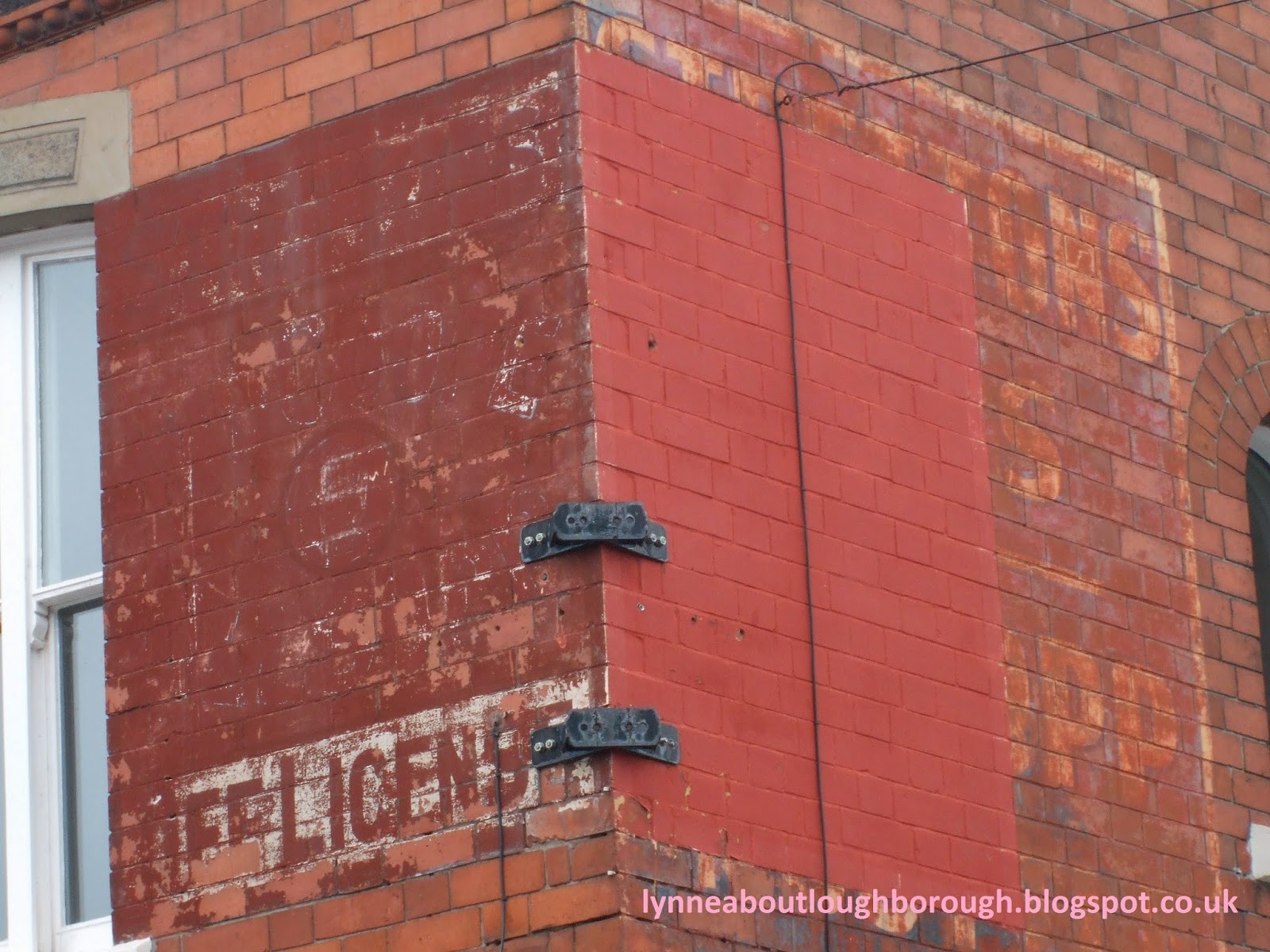
Ghost signs are painted signs, usually advertising signs, on the side of buildings, that are not maintained, or not representative of the business that now takes place in the building. As such, some of the pictures below are not actually classed as ghost signs, but are either carved into the buildings or are reliefs, that represent the building's previous - or in the case of the Town Hall and the library the current - use. The Putts sign is, of course, not a ghost sign, because it is maintained and the business operated from the premises is still Putts the Decorators, as is the sign on the side of the Three Nuns pub, and that on the Royal Oak. The first two ghost signs below are not from Loughborough, but are very good examples of the art of ghost signs that I have seen very recently.

Someone suggested that there might be some remnants of a sign for the pub in George Yard, but I could find no evidence of this.

Ghost sign on a building in Swadlincote

Ghost sign on a restaurant in Stratford-upon-Avon


Putts on Nottingham Road
The Three Nuns on the right of the picture

The Royal Oak on Leicester Road


Corner of George Street and Storer Road


Stag and Pheasant Nottingham Road from the other side!

Former shop on Wharncliffe Road


Houses on the end of Gregory Street with ghost sign top right


Close up of the Gregory Street painted street sign


Not really ghost signs, but evidence of Cottons!! 


More evidence of Cottons!


Above the first floor window is the ghost of the Leicester Mercury!


The Black Lion, lately the Hobgoblin


The Old Pack Horse, now the Organ Grinder

The Blacksmith's Arms

The former offices of the Loughborough Echo on Swan Street

The Town Hall, formerly the Corn Exchange

Great Central Station Hotel, now flats and a day nursery


Messrs Garton The Mart! Originally the Temperance Hall

Close up of Messrs Garton The Mart!


William Corah's on Aumbry Gap etched in the green stone, left of the hardboard!


The L and the I of William Corah's on Aumbry Gap

The Carnegie Library


Sunday, 16 March 2014

Ghost signs of Loughborough


Someone recently posted a question on facebook about ghost signs in Loughborough, so here are a couple of pictures I've taken over the last couple of years. If you know of any more, do let me know, and I'll do a follow-up to today's post. If you don't want to register to leave comments below, you can email me by converting the following to text with punctuation: lynnedotdyeratgooglemaildotcom

There are also a couple of websites associated with ghost signs generally, that you might like to read, including this article from November 2013, the History of Advertising website, a flickr group, and one specifically on Leicestershire ghost signs.


Aumbry Gap

Cottons (I think) on Baxter gate

Butchers on Moor Lane

Collin Bros on Baxter Gate

Nottingham Road

Olde Packe Horse

Ratcliffe Road

Nottingham Road

Corner of Storer Road

Corner of Storer Road

Corner of Storer Road and George Street

Corner of Storer Road and George Street

Corner of Storer Road and Station Street

The Empire Cinema


Towles Nottingham Road
William Street

Nottingham Road