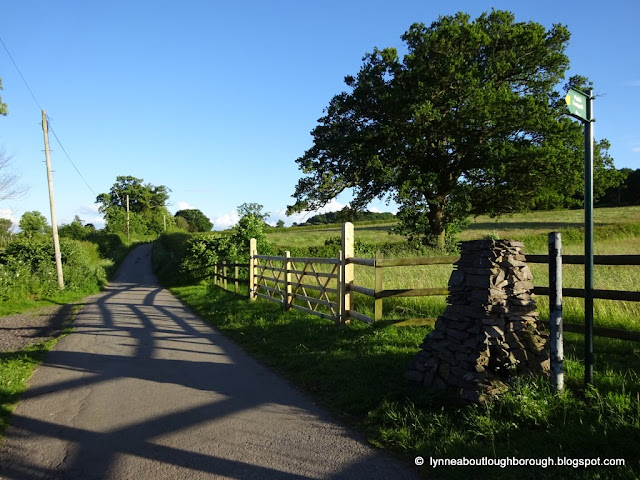
Showing posts with label pub. Show all posts

Sunday, 6 April 2025

Christie Connections – Paul Pry

Introduction – Christie Connections with Loughborough

As you know from last a recent post, I recently finished the challenge of reading all the Agatha Christie novels, and had been surprised at how many references there were within her books to Loughborough-related things, or, at least, things that connected in some way with Loughborough.      

“Hickory Dickory Dock”

Today’s post is prompted by something I read in Hickory Dickory Dock, on p300.


Written in 1955, unlike Sleeping Murder which featured Miss Marple, HDD is a Poirot affair, a synopsis of which can be found elsewhere. In short, a number of items go missing from a student hostel, then come the murders …

One of the characters in the novel, Mrs Christina Nicoletis, is the eccentric and volatile owner of the student accommodation, and in the reference we’re interested in, she is in conversation with Mrs Hubbard, who is the warden of the accommodation, and incidentally just happens to be the sister of Poirot’s secretary, Miss Lemon. Here’s what’s said, when Mrs Nicoletis flew into one of her tempers:

“Ah, you do not think I have cause for anxiety? You know best as usual! You know everything! You are so wonderful: you cater, you manage, you spend money like water on food so that the students are fond of you, and now you want to manage my affairs! But that, no! I keep my affairs to myself and nobody shall pry into them, do you hear? No, Mrs What-do-you-call-it Paul Pry.”

The Loughborough Connection

Back in March 2022 I posted an article entitled ‘So Who Was Paul Pry?

This post gave a detailed description of the character of ‘Paul Pry’ – a do-gooding, nosey busybody – as he appeared in a play written in 1825 by the writer John Poole (1786-1872). And it is this character that is referenced in Hickory Dickory Dock, in which, essentially, Mrs Nicoletis is telling Mrs Hubbard to mind her own business!

Apparently, according to a report in the Leicestershire Mercury of October 1839, we had a Paul Pry in Church Gate, one John Hollingsworth, who knocked over William Smith, who he accused of catching him “playing the part of Paul Pry, by listening under [someone's] window, a practice of which he was frequently guilty.”  

However, in my earlier post about Paul Pry, I focussed on the name as the name of a local beer-off premises, that according to a newspaper report (Leicester Evening Mail of 5th March 1930), was on Leicester Road, and was once the home of the Clemerson family, when it was known as the White House, and later was Maher’s Off-Licence. Since then, research has revealed that the George Moore referred to in that article, who was of the Paul Pry and who had been in court in 1832 for not looking after his apprentice, was listed in a trade directory of 1835 as a beer retailer on Wood Gate. Later, in 1841, a report of a gun being shot up the chimney of the Paul Pry gives no indication of who was running the business, nor where it was situated, although we are told that the perpetrator lives close to the Roman Catholic Chapel – presumably on Ashby Road.

A similar situation arises in 1846 when two shoemakers – Mr Rozzell and Mr Barker – have a bit of an argument. They were drinking in the Paul Pry – but where, is not stated!

Could the Paul Pry have been in Ward’s End?

By 1851 we find that there is a publican listed in Ward’s End, called Matthew Ward. On the 1841 census return he was in Ward’s End but listed as either a farrier or a farmer. I suspect the latter, as he also appears in a polling book as owning property in Ward’s End. In 1858, Matthew Ward of the Paul Pry beerhouse (no address given) was convicted of keeping his house open on Sunday 17 th January, for the sale of beer, and was fined £1 and costs. Matthew Ward died in 1859, aged 75, and is buried in Emmanuel churchyard.

In October 1923, a letter which appeared in the Leicester Daily Mercury mentioned that a farmer stopped off at “the tavern known as the Paul Pry, in Bedford Square”, I don’t know about you, but I can never quite work out where Bedford Square ends, and Ward’s End begins, but this could well be the same premises as mention in 1851.

In 1952, the Loughborough Echo published a piece quoting extracts from an account book that was about 100 years old. This account book belonged to Mr John Cooper, a maltster from Hathern and in it is recorded the sales he made, many of which were to Loughborough folk. The first entry in the book is for 1843, but the one of more interest here is an entry for 1852, which named the Paul Pry on Ward’s End as one of the customers.

So, was there a Paul Pry on Leicester Road, and on Ward’s End / Bedford Square? I can honestly say I really have no idea!!

But, just one more thing before I leave you in peace, in September 1891, the Loughborough cyclers indulged in a lantern parade, and the participants were decked out in gorgeous array, representing historical characters like "Ally Soper", "Paul Pry", and others!

____________________________________

Posted by lynneaboutloughborough

With apologies for typos which are all mine!

_______________________________________________

Thank you for reading this blog.

Copyright:

The copyright © of all content on this blog rests with me, however, you are welcome to quote passages from any of my posts, with appropriate credit. The correct citation for this looks as follows:

Dyer, Lynne (2025). Christie Connections – Paul Pry. Available from: https://lynneaboutloughborough.blogspot.com/2025/03/christie-connections-paul-pry.html  [Accessed 6 April 2025]

Take down policy:

I post no pictures that are not my own, unless I have express permission so to do. All text is my own, and not copied from any other information sources, printed or electronic, unless identified and credited as such. If you find I have posted something in contravention of these statements, or if there are photographs of you which you would prefer not to be here, please contact me at the address listed on the About Me page, and I will remove these.

External Links:

By including links to external sources I am not endorsing the websites, the authors, nor the information contained therein, and will not check back to update out-of-date links. Using these links to access external information is entirely the responsibility of the reader of the blog.

Blog archive and tags:

If you are viewing this blog in mobile format, you will not be able to easily access the blog archive, or the clickable links to various topics. These can be accessed if you scroll to the bottom of the page, and click 'View Web Version'. Alternatively, there is also a complete list of posts, which when clicked will take you to the page you are interested in.

Searching the blog:

You can search the blog using the dedicated search box that appears near the top of the blog when viewed in the web version. Alternatively, you can search using your usual search engine (e.g. Bing, Google, DuckDuckGo etc.) by following this example:

site: https://lynneaboutloughborough.blogspot.com/ “Radmoor House”

NOTE – the words you’re actually looking for must be in “” and the first of these must be preceded by a space

Thank you for reading this blog.

Lynne

Monday, 28 August 2023

Walking From Loughborough to The Outwoods and Back

So, most of the walks that I’ve previously shared with you are based around the town centre, and focus on heritage or history, like the Sculpture, Art and Architecture Trail, or the Zeppelin Trail, so I am pleased to be able to introduce you to a guest blogger who has either walked or run many of the footpaths, and towpaths around our wonderful town, and out into the countryside. I’m very lucky as he’s often taken me with him, well, not running, but certainly walking, so I’m familiar with the routes too! I’ve known Jon quite a long time, and I’m really pleased he’s agreed to write something for the blog, instead of listening to me talking about it all the time!

Over to Mr Lynneaboutloughborough (his words, not mine!)

View across fields into a town
View across Loughborough

Loughborough to The Outwoods and Back!

Loughborough is a beautiful town, often very underrated by those who don’t spend time in it, and even often by those who live, work, or visit there.  It is situated in a fairly wide river valley that gently runs down from Leicester and meets the River Trent at Trent Lock after about 25 miles, with Loughborough just over halfway along this route. 

On the Western side of the valley is a series of reasonably high areas, including Bradgate Park, Mountsorrel Castle and Quarry, Beacon Hill, the Outwoods, Garendon Park, and the Whatton Ridge. All of these areas are crisscrossed with public footpaths and bridleways, and having walked and run this extensively, I know there are paths running most of this distance almost without using public roads, and many paths down to Loughborough itself, the only major restriction is the crossing past the Great Central Railway. 

On the Eastern side of the valley are the Wolds, but there are more limited crossings for the River Soar and the Midland Mainline, however once you are on the other side there are similar footpaths and bridleways, with many beautiful walks. 

My favourite walks are along the River Soar/Grand Union Canal in either direction, walking from Cotes to Prestwold or Stanford Hall, Beacon Hill and from Loughborough to the Outwoods, which is the walk covered here.

One of the most notable things about walking around Loughborough is that you can see The Towers clearly from every direction when on the ridges surrounding Loughborough, and both the Carillon and the Parish Church are noticeable.

We're going to follow the red route on the map shown below, on which, as well as our route, you'll also see letters of the alphabet (A-R) showing choices of path, and notable features, etc.. There are also 4 blue routes that show more directions you might choose to follow. 

Map showing route


Walking to the Outwoods and back

This walk is around 7 miles long, and takes around 2 ½ Hours at a gentle pace.  It does involve walking uphill, with 1 section of 400m which is fairly steep.  The walk starts at the junction of Forest Road and Epinal Way near Mountfields School and ends at the Beacon Pub on Beacon Road.  Almost all of the walk is on Public Footpaths, about a mile is walking on pavements, with only a short stretch on a very quiet access road without any pavement.

You can shorten the walk to around 4 ½ miles by parking in the Nanpantan Sports Ground car park, which is on Watermead Lane.

I picked this walk as it is a regular walk for me, provides some exercise when walked briskly and has fantastic views over Loughborough.

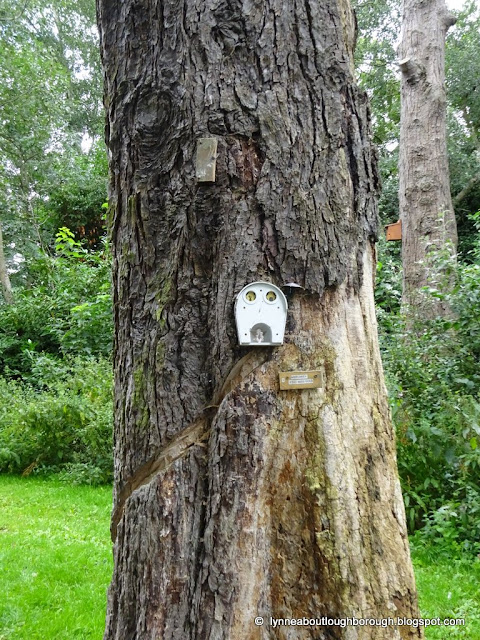
Starting at the junction of Forest Road and Epinal Way, walk along the path called the Forest Green Belt, which runs between the cottages and Mountfields School. This is a quiet haven compared to the busy road, and is quite cool in the shade in the hotter, sunnier periods.  Note the flowers that bloom outside the cottage (Mountfields Lodge Cottage) which are immaculately maintained by Pat Cook, in memory of her husband, Harry Cook, and there are lots of fairy doors along the footpath.  

House surrounded by flowers
Mountfields Lodge Cottage beside the path in the Forest Green Belt

Wooden noticeboard with posters
Noticeboard at the start of the Forest Green Belt


Fairy door placed in tree trunk
Fairy house


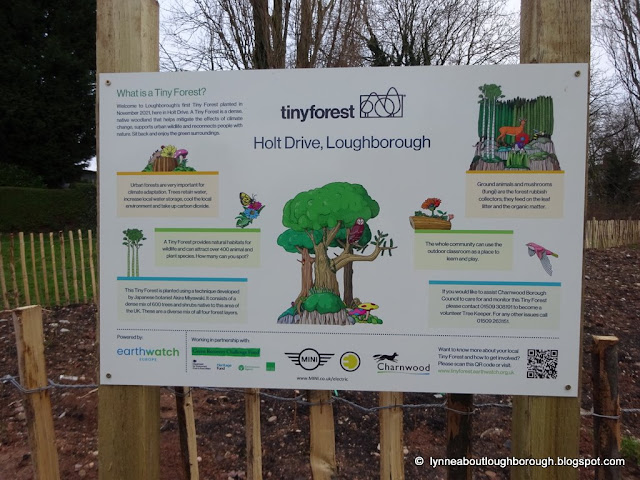
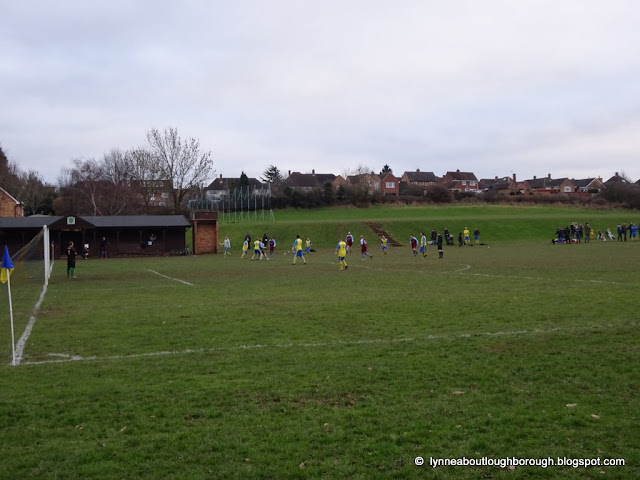
You will be following the Wood Brook for the first mile or so, passing the small, relatively new Urban Forest near the Forest Gate Pub, crossing over Holt Drive, you’ll pass the play park to your right, and crossing over Outwoods Road you’ll then pass the Lodge Farm Playing Fields to your left.  

Pub building through trees and bushes
Toby Carvery

Notice explaining what the Tiny Forest is
The Tiny Forest

A small new planting of trees
The Tiny Forest

A small planting of new trees
The Tiny Forest

A sign for the Forest Green Belt
Looking back across the Forest Green Belt

Two people crossing a road
Crossing Holt Drive

A residential street
Crossing Outwoods Drive

People playing football on grass
People playing football at Lodge Farm

Note the allotments on the other side of the Brook, another Urban Haven (I have my own allotment on Beacon Road, and I can attest to the delights of quietly working on this to remove the stresses of modern life).  At the end of the path (A), turn right, past the new flats on the site of the old post office and small parade of shops and cross Valley Road to take the small footpath opposite.  

Block of flats
Exiting from Lodge Farm with postbox far right

Note the junction between the Wood Brook running towards the One Stop Stores and the smaller tributary Beck that runs alongside the path.  The Wood Brook runs up past the Nanpantan Reservoir, through the Outwoods towards its source in the fields on the other side of Beacon Hill.  We will see the Wood Brook later on.
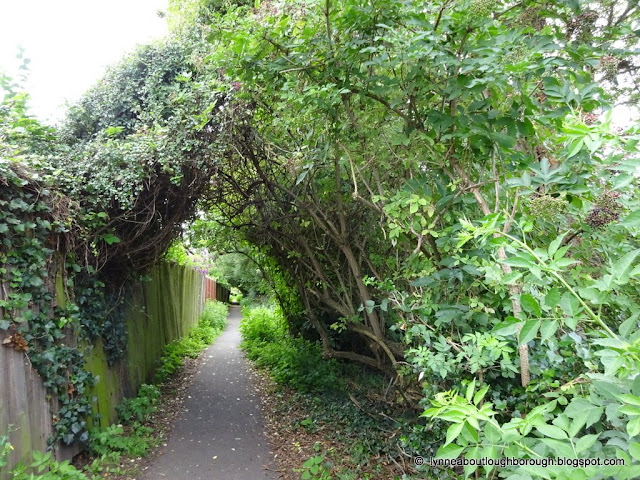

Footpath through trees
Crossing Valley Road to follow the footpath

Residential street
Crossing Priory Road


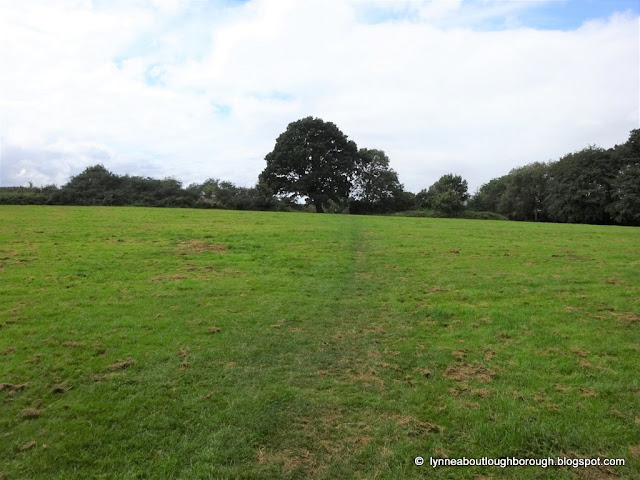
The path is another cool place in the sun, following the brook over a road, behind more houses and coming out in Moat Road, continue a little bit further and you’ll see a small Bridge (B) over the brook towards a green patch, the big Oak Tree straight ahead is one of my favourite trees, partially because I once sheltered under the sloping trunk during a major rainstorm.  


Footpath through trees
Path off Moat Road towards The Outwoods


Oak tree in the distance across a field
Oaktree

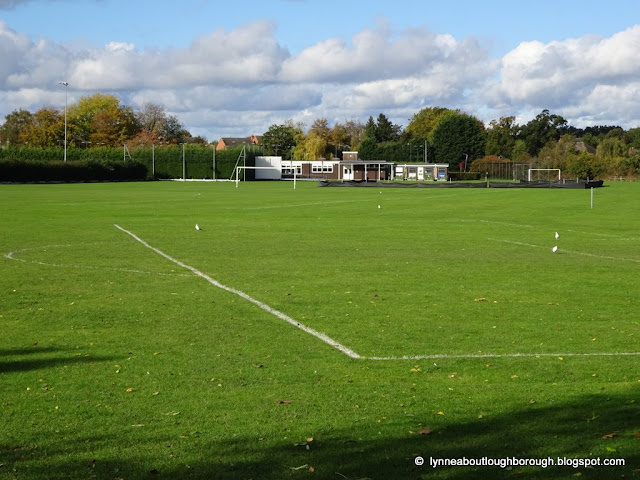
To the left of the path is Pignut Spinney Marsh. Take a right after the oak tree and follow the path along the edge of the fields, initially beside the houses and then alongside the Nanpantan Sports Fields (where we follow the Wood Brook again).   This year the fields have Oats growing, but I have seen them with Wheat, Sweetcorn, Cabbage and Hay over the years.  You’ll pass the new soakaway at the new cemetery and then you turn left (C) up the farm track, where there will be a public footpath sign to the right (D) through the hedge and along side the fields [the path you’ve turned off is a private drive leading to Outwoods Farm].  Walk up the hill along the edge of 3 fields and you’ll get to the old-style kissing gate into the Outwoods (E). At this point, if you turn around, you get stunning views across Loughborough, including the Bright Red Woodbrook Vale School, the Towers hall of residence on the university campus, the former Astra Zeneca plant and to the Bluebell (AKA Burleigh) Woods.  Take a breather and you can also see Stanford Hall, the Parish Church, and across the valley.
Sports grounds
Nanpantan sports ground

Field of oats
Oats


New cemetery
New cemetery

Grassy path leading to a gate
Approaching the kissing gate

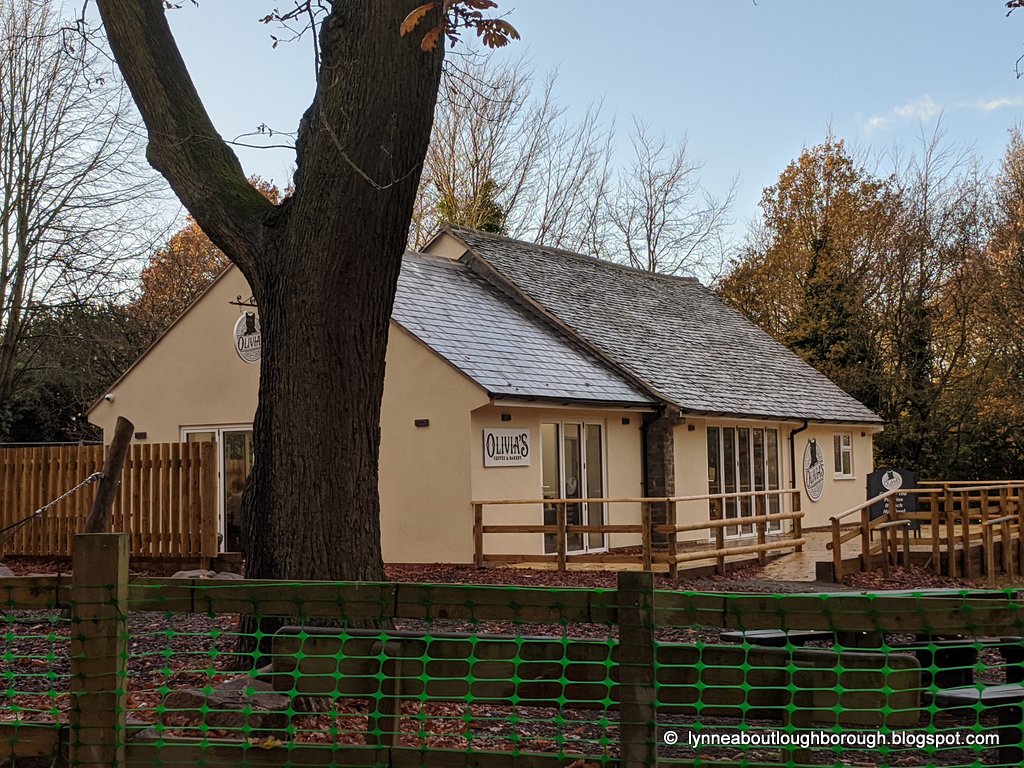
Carry on along the left-hand path along the Outwoods, past the tall cliff of rock with the stunning strata showing.  You can cross the Outwoods on the Blue Line marked 1, which brings you out opposite a footpath that you can take to climb up Buck Hill, which is even higher and has great views of Nanpantan Hall and Home Farm, but that’s for another day. Continue along the path, noting the badger/fox gates in the fences on your left, and in May, the fields of bluebells under the trees on the right, until you reach the charcoal burner in a clearing in the woods (F), I’ve seen ground-nesting bees entering their hives in this clearing.  The Outwoods has many wooden carvings and benches and it’s worth reading the memorials, some of which are on the benches, to the many people who have similarly loved the Outwoods.  The last section is a little steeper but takes you up to the car park (G) where you can access toilets and Olivia’s café if you need to.  You are at the highest point of this walk now, so it’s mostly downhill from here, but the trees stop you having a view.  Most of the trees in the woods are now of native species as many non-native trees have been felled over the past 5 years.


Rocks in the landscape
Rocks


Charcoal burner behind a wooden fence
Charcoal burner
Real trees and willow crafted trees
Trees and willow sculptures at the Outwoods

Carved animal sculpture
Carved sculpture

Building
Cafe 

At the car park take the path that runs parallel to Woodhouse Lane and down to the Gate at H.  If you are minded to go up Beacon Hill, you can go through the gate, and follow the new pavement which takes you into the bottom corner of Beacon Hill Country Park (blue path marked 2), where there are many wooden sculptures, and beautiful Alpacas, Highland Cattle and Sheep.  It would be around 2 ½ miles to walk this, but Beacon Hill has fantastic views over the Trent Valley to the Peak District, and across Charnwood Forest.

However, for this walk we’ll continue to follow the path in the Outwoods to the left and down the hill, over the little wooden planking (this section gets very wet in the wet seasons, so I’m always thankful for the causeway).
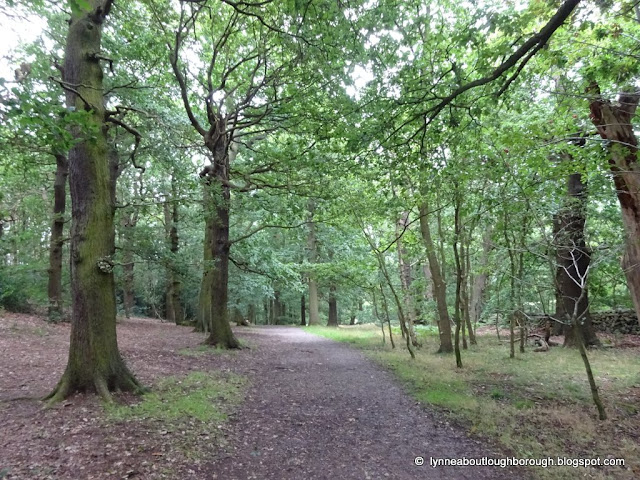
Trees
Trees

Two people walking through trees
Trees

A wooden boardwalk through the trees
The boardwalk


Then follow the path up and down until you reach a junction (I). Here, turn right along the path and you’ll come to a field, where you can turn left which will bring you down Beacon Lane after around a mile to the junction of Beacon Road and Valley Road/Belvoir Drive.  This path/lane is called Beacon Lane and is an ancient right of way up to Beacon Hill. But, we’re going to go straight across though and walk on the path down the field and turn right at the farm track/bridgeway (J) in the middle of the field, walking past the old School House and alongside another brook.  The bridleway becomes the access drive to the Schoolhouse, keep walking until you get to the T junction (K).  The forest golf course is on the other side of the trees straight ahead, but we’re going to turn left, as though we were going to Pocket Gate Farm, but we’ll immediately turn right towards the gate up the slope, another bridleway.  Whilst walking along this path, looking left gives you more views of Loughborough and across the valley.  Just before the trees end, Hanging Rock is behind the trees on your right.

Keep following the bridleway, you may meet horse riders along this path, and the path becomes and a single-track tarmac access road for the houses.  Occasionally you may meet cars coming along here, but there is space to step onto the verges.  You can see the golf course across the fields to the right-hand side, and occasionally golfers can be seen through the hedgerow.

Opposite the stone pillar (right-hand side of the road, L), there is a footpath sign, go through the kissing gates towards the trees.  You get a good view of the back of the former Defence Sixth Form College across the fields, and I’ve seen birds of prey in the trees here.  You can carry on instead of taking the footpath (blue path 3) and this brings you out in Woodhouse Eaves next to the Bulls Head.

Building at the end of a footpath
Approaching the Old School House

Field of sweetcorn with view of a town in the distance
View down to Loughborough

Buildings in a field
Pocket Gate Farm


Footpath sign
Footpath to the left


Go through the woods, which can be very wet and muddy in the winter, but blissfully cool in the hot sun, you cross several bridges and go through very dense trees until you reach the fields which you keep crossing.   At the edge of the first field, you will see some blue Gimson railings and posts, there are several sets of these along the edges of the fields in this area.  Some of the fields currently have 6’ sweetcorn growing so the views are limited, but exciting for children. You will pass “Halfway House”, a farm halfway between Loughborough and Woodhouse Eaves along this ancient Right of Way, and across the last field towards the woods (M).  At the edge of these woods, you can turn tight along Blue path 4, which brings you out by Rainbows Hospice and allows you to pick up the path that skirts Grange Park from which you can pick the path to Beaumanor Hall or to Woodthorpe (another favourite walk of mine).
Muddy footpath through trees
Muddy path

Blue ironwork in a green field
Blue Gimson ironwork

Person hiding in tall sweetcorn
Hiding in the sweetcorn

Old farm buildings
Halfway House

We’re going to cross diagonally across these little woods though, which brings you out at the footpath that skirts the back and side of Woodbrook Vale School (N).  I once met a gentleman along this path whose family used to keep horses where the newer houses to the left of the path are located, and who had placed one of the branches that’s still there as a part of the “fence” to keep the horses in.

Tarmac footpath
Path alongside Woodbrook Vale School

At the gates of Woodbrook Vale, turn left and follow the road until you reach Belvoir Drive, then cross and turn right and left down Pytchley Drive (O).  Many of the roads in this area are named after prominent fox hunts.  At Farndale Drive, turn right (P) and walk all the way down to the bottom, where you can see a small jitty joining up with Cross Hill Lane (Q).  There are good views over the field here and across Loughborough, and you can sometimes see rabbits, foxes, badgers or birds of prey.  I’ve seen many of these in Loughborough, even in the residential areas, and even Green Woodpeckers in the cemetery. 

Houses with path between
Path to Cross Hill Lane between the bungalows

Turning left along Cross Hill Lane leads you to Beacon Road (R), close to the post box (which I think is an EIIR), where turning right here brings you past the William Davis depot, and the beautifully improved Beacon Pub with its Pétanque pitch, and ending at the Epinal Way Roundabout. 

Footpath leaading onto residential street
Cross Hill Lane leads to Beacon Road

A pub building
Estate pub called the Beacon Inn

One of these days, I will write a book of Loughborough Walks, but I hope you enjoy this one.

____________________________________

Posted by lynneaboutloughborough

With apologies for typos which are all mine!

_______________________________________________

Thank you for reading this blog.

Copyright:

The copyright © of all content on this blog rests with me, or in the case of guest blogposts, with the named Guest Blogger. However, you are welcome to quote passages from any of my posts, with appropriate credit. The correct citation for this looks as follows:

Hill, Jonathan (2023). Walking from Loughborough to The Outwoods and back. Available from: https://lynneaboutloughborough.blogspot.com/2023/08/walking-from-loughborough-to-outwoods.html [Accessed 28 August 2023]

Take down policy:

I post no pictures that are not my own, unless I have express permission so to do. All text is my own, and not copied from any other information sources, printed or electronic, unless identified and credited as such. If you find I have posted something in contravention of these statements, or if there are photographs of you which you would prefer not to be here, please contact me at the address listed on the About Me page, and I will remove these.

Blog archive and tags:

If you are viewing this blog in mobile format, you will not be able to easily access the blog archive, or the clickable links to various topics. These can be accessed if you scroll to the bottom of the page, and click 'View Web Version'. Alternatively, there is also a complete list of posts, which when clicked will take you to the page you are interested in.

Searching the blog:

You can search the blog using the dedicated search box that appears near the top of the blog when viewed in the web version. Alternatively, you can search using your usual search engine (e.g. Bing, Google, DuckDuckGo etc.) by following this example:

site: https://lynneaboutloughborough.blogspot.com/ “Radmoor House”

NOTE – the words you’re actually looking for must be in “” and the first of these must be preceded by a space

Thank you for reading this blog.

Lynne


Sunday, 7 March 2021

Spotlight on the King's Head Part 3

The King's Head Hotel: a pub?

So, in Part 1 we looked at the very recent history of the King's Head Hotel which has more recently been known as the Ramada by Wyndham, and this was prompted by an article on the Leicestershire Live website about the possible future of the hotel.

Last week we looked at the various types of pub-related establishments that have existed over the years, and concluded that the King's Head was, or had been both a coaching inn and a posting house. 

Extract from the Sun (London) 19 August 1830

This week we shall look at the King's Head in relation to pubs and their offering in the nineteenth century.

This is part of the description of the function of a public house:

"The public house was the place to go for discussion and argument, and often, those who were unable to read would go to the pub to listen to the latest news being read aloud from the newspaper. Also, property sales were often held in public houses, as were shows, like the Nottingham annual Auricula and Polyanthus Show, which were often followed by a dinner. Back rooms of pubs often became home to working-class organisations, like friendly societies and later trade union branches."

Sales

While I have found nothing as yet to support the first of those statements in relation to the King's Head, there is, however, plenty of evidence relating to property sales, meetings of various groups, and events related to specific local societies, taking place at the King's Head. 

Property - in the loosest sense of the word - sales often took place at the King's Head. The earliest reference to this I have found is in 1806 when oak timber that had been felled from The Outwoods was being auctioned at the King's Head Inn (1), the house of Mr Fowler. Interestingly, the sale, which began at 2pm, was preceded by a dinner:

From the Derby Mercury of 13 February 1806, pg 2

An early recorded sale of actual property was advertised in the Leicester Journal of 19 April 1811 the property 
in this case being seven freehold dwelling houses in the yard of the Wheat Sheaf on Wards End. The auction would be held by Mr Boott, at the King's Head Inn, and particulars could be obtained prior to the sale from Mr Fowler at the aforementioned establishment.

The King's Head was also the venue for the sale of other licensed establishments and in April 1874, an old and well established public house, with a brewhouse, extensive stabling, malt offices, yard, outbuildings and saddlers shop, all set in about 800 square yards, known as the Golden Fleece, was offered for auction there. 

Properties sold at the King's Head weren't just in Loughborough: in March 1814 a valuable freehold estate was auctioned at the King's Head Inn, where Mr Fowler was the proprietor. This estate at Burton-on-the-Wolds, approximately 5.5 miles from Loughborough, was extensive, and including a house, barn and other outbuildings, as well as land:

Extract from Leicester Journal 25 February 1814, pg 4


Perhaps one of the most important nearby local estates to be auctioned at the King's Head was Quorndon Hall, in 1832. Quorn Hall was billed as a highly celebrated sporting residence in the heart of the Leicestershire countryside. Sporting, of course, means horse-related, and there was also available as part of the sale, a magnificent range of stabling for about 50 horses. The whole of the estate which comprised about 117 acres, was freehold. The most recent occupant was Lord Southampton.

Extract from the Nottingham Review and General Advertiser for the Midland Counties
23 November 1832, pg 2


In 1824, although the auction of the freehold manors and estate of Dowsby Hall in Lincolnshire was taking place at the Greyhound Inn in Falkingham, particulars relating to the sale were available from the King's Head Inn, in Loughborough.

Auctions of property continued well into the 20th century. In April 1919, auctioneers W. and F. Armstrong auctioned lots of freehold property, including nos. 43 and 45 Hastings Street (a shop and a dwelling house); nos. 56, 41 and 52 Paget Street; nos. 5,6,7 and 8 Conery Terrace and Conery Passage; no. 196 Freehold Street, a shop and dwelling house at the corner of Freehold Street and Queen’s Road; Fairview Cottage on Queen’s Road; no. 45 Queen’s Road; 2 villas and stables also on Queen’s Road; nos. 9 and 10 School Street; nos. 10 and 12 Burleigh Road; nos. 11, 13 and 15 Chapman Street. Note: not all of these were actually purchased on the day.

In addition to properties, numerous effects were also auctioned off, and the King's Head was regularly the place to go to obtain a copy of the sales catalogue. In 1831, all the useful household furniture and other effects, that belonged to the Rev. Charles Allsopp, now deceased, and which included a four-poster bed, bedding, tables, chairs, wardrobes, chests, kitchen utensils, brewing and dairy utensils, carriage and animals, as well as several acres of cultivated land, was auctioned at the vicarage in Shepshed: catalogues could be obtained from the King's Head Inn.

In a similar vein, catalogues for the 5-day auction of the extensive library of books, and other household furniture and effects (days 4 and 5), belonging to the Rev. William Casson, now deceased, were also available from the King's Head, Loughborough, the sale taking place during September 1829. And what self-respecting local historian wouldn't have popped into the King's Head in January 1831 to pick up a catalogue for the sale of the effects of Saville John Hyde, Esq., latterly of Quorn, which included not only a pianoforte and a library of books, but more specifically, a "fine copy of Nichol's History of Leicestershire, in eight volumes, and many other rare and valuable works." 

Catalogues for sales of animals were also available from the King's Head in Loughborough, for example, in 1825 when Mr Brearey was selling by auction an entire stud of valuable hunters, young horses, broodmares, and the celebrated stallion, Ranzleman, as well as riding equipment upon the death of George Redmond Hulbert, Esq., of Aston Lodge in Derby, catalogues were available from a variety of establishments including the Loughborough King's Head.

And, animals were not the only biological thing on sale at the King's Head. In October 1832 Mr Slater was selling his "new genuine winter tares for seed" both from his corn, hop, seed and cheese warehouse in Castle Donnington, and from the King's Head Inn in Loughborough, the latter every market day, from 1pm to 4pm.

Similarly, in 1861 there was a sale of cattle on Thursday 27 June, and on the next day, Friday 28, this was followed by the annual meeting of the Loughborough Association for the Prosecution of Felons at the King's Head. 

Society meetings and dinners

As mentioned above, many societies met, and many special dinners have taken place in the lovely setting of the King's Head Hotel. Here are some examples from across the ages. 

In December 1834, it was announced in the Nottingham review and General Advertiser for the Midland Counties that the Grand Lodge of Freemasons had agreed to the appointing of a new lodge, the Rancliffe Lodge, which would hold its meetings on the second Tuesday of each month, at the house of John and George Fowler, which was the King's Head Hotel, Loughborough. 

In May 1852, the Trustees of the Burton Charity held their meeting at the King's Head Hotel. At this particular meeting, the trustees were presented with a petition from Loughborough inhabitants, requesting a reduction in the proposed tuition fees.

Until about 1901, the Howe and Charnwood Lodge of the Freemasons held their meetings from April to November in the King's Head, but then moved to the Town Hall.

In April 1928, the annual meeting of the Loughborough Boat Club, which was presided over by Mr F.W.P. Simpson, was held at the King's Head Hotel. The society had had a good year, and the regatta had been particularly successful, and a new boathouse had been built at Zouch. 

The Loughborough Building Society was founded in 1867, and 100 years later, in 1967 a celebratory dinner was held at the King's Head Hotel, with honoured guests including the then mayor of Loughborough, Councillor J.E. Hammond. 

In early 1999, the Leicestershire Chamber of Commerce hosted a luncheon at what was at the time known as the Jarvis King's Head Hotel. The event was for the directors of the National Forest with whom the Chamber wished to forge a close working relationship, in support of the programme of transformation of around 200 square miles of land partly in Leicestershire, Derbyshire and Staffordshire, where already about two million trees had been planted and were now thriving.   

Financial affairs

Meetings and sales related to finances often took place in the King's Head Hotel. Here's an interesting event from 1828:

At the King's Head, the house of Mr Fowler, an auction was held by B. Payne, on Thursday 7th February at 3pm, at which "One Share in the Loughborough or Soar Navigation" was to be sold.

Meetings related to bankruptcy were relatively frequent:

The occasion in 1826 concerned the case of S. Peters, a grocer at Shepshed; in 1831, the case of William Bissil, a bowl manufacturer of Quorndon was heard, and the bankruptcy case relating to T. Crane, a grocer, took place in 1837.

The building itself

In January 1832 the Leicester Journal reported that a new dining room had opened at the King's Head in Loughborough, and more than 100 gentlemen celebrated with a dinner, accompanied by excellent wine, and Mr Barker, who sang 'in the best style'.


As we already know from last week's post, the Bull's Head coaching inn was demolished during a period of road widening in the late 1920s-early 1930s, and replaced with the building we see today. This was also the case for the King's Head so the old building was pulled down and the new building, with its Neo-Georgian frontage onto the widened High Street is the building we see today.

In 1953 some alterations to the relatively new King's Head building were made. I have an inkling that these alterations may have been completed by the Loughborough building firm of Corah, but, because archives are currently closed I have not been able to access the plans.

Conclusion

I think we can conclude from the evidence above that the King's Head, a posting house, until the demise of the mail coach, in favour of transporting mail by train (around 1830), became solely an inn, rather than a public house as I might have suggested last time. 

Next week we'll look into the origins of the hotel's name.

(1) The inn 

The inn was often built along the main public highway, or around a market, and served passing trade, as well as the more wealthy inhabitants of a place, like merchants, guild members, aldermen, justices and the richer pilgrims. See more at Spotlight on the King's Head Part 2.


Posted by lynneaboutloughborough 7 March 2021

You are welcome to quote passages from any of my posts, with appropriate credit. The correct citation for this looks as follow:

Dyer, Lynne (2021). Spotlight on the King's Head Part 3. Available fromhttps://lynneaboutloughborough.blogspot.com/2021/03/spotlight-on-kings-head-part-3.html [Accessed 7 March 2021]

Take down policy:
I post no pictures that are not my own, unless I have express permission so to do. All text is my own, and not copied from any other information sources, printed or electronic, unless identified and credited as such. If you find I have posted something in contravention of these statements, or if there are photographs of you which you would prefer not to be here, please contact me at the address listed on the About Me page, and I will remove these.

You can leave comments below, but do check back as my reply will appear here, below your comment.

Thank you for reading this blog.

Lynne