Showing posts with label Shelthorpe. Show all posts

Sunday, 24 November 2024

Loughborough Pub Licence Transfers

Over the past couple of weeks I’ve been so busy on the blog, sharing the story of the Barkers the Builders, and Remembrance 2024, that I had forgotten that the first anniversary of the publication of my book ‘Loughborough Pubs’ – inspired by and dedicated to my friend Bill Wells, who was one of a few people who encouraged me in the early days of my local history journey – was mid-November 2024!

Around this time last year, I shared some relevant legislation around pubs, and the use of pubs as meeting spacesThis time, let’s have a look at a few selected licence transfers …

Half Moon to Hunters Moon 1959 / 1961

Half Moon (previously the Half Moon Inn) on Pinfold Street, closed in 1959 and the licence was transferred to the Hunter’s Moon which opened on Monday 11th September 1961, on the junction of Walnut Road and Poplar Road in Shelthorpe. It was opened as an Ind Coope house, and that brewery had just joined a group of other brewers – Ansells (Birmingham) and Tetley (Leeds) – to become Allied Breweries. Hunter’s Moon closed and was re-opened first as a Nisa then as a Spar mid-2015, but the pub name remains on the side of the building.


Bull’s Head to Bull’s Head 1927 / 1928

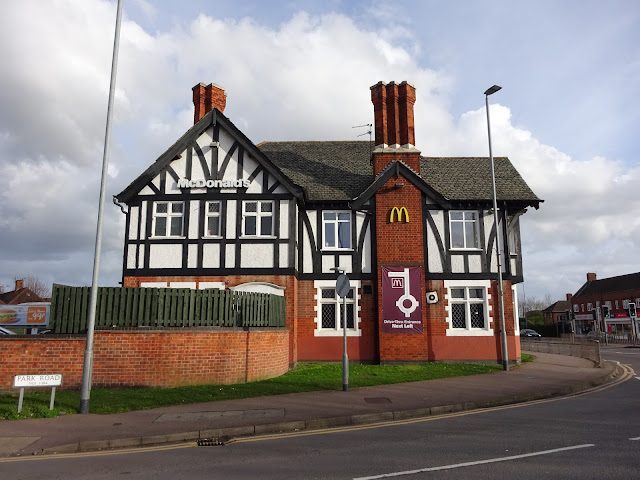
The Bull’s Head on High Street had originally been a coaching inn. It closed in 1927, and the licence was transferred to the new Bull’s Head in Shelthorpe in 1928. The Shelthorpe pub itself closed in X and is now a fast-food burger restaurant.


Nelson to Maxwells 1986 / 1987

The Nelson closed in 1986, and since that time has been home to various retail shops, and is currently a mobile phone shop. The licence was transferred in 1987 to Maxwells on Maxwell Drive, which was built to serve the residents of the new housing estate in that area.


Stag and Pheasant to The Beacon 1962 / 1963

As reported in the 'Loughborough Echo' of 6th December 1963, when the Stag and Pheasant on Nottingham Road closed in 1962, the licence was transferred in 1963 to The Beacon on Beacon Road, which served the growing population of that area. In recent years, The Beacon has had a major refurbishment, a side extension, and marquees erected in the grounds. However, both The Beacon and the Stag and Pheasant are listed in the 4th edition of a CAMRA listing - 'Real Ale in Leicestershire and Rutland' - which was published in November 1981 by the Leicester and Loughborough branch of CAMRA. Was the Stag and Pheasant still operating beyond 1962? Was a licence transferred from another pub to keep the S&P going for a while? Conversations with friends leads us to believe the licence really was transferred from the one to the other, and they were not open at the same time!


Nag's Head, Swan Street to the Ring O' Bells, Derby Road 1956 / 1956

Along with the Half Moon, the Nag’s Head is the only other pub mentioned here which no longer stands. It was situated where the former Wilkinsons building is now. Of course, the Wilkinsons building was only built around 2000, and replaced a Co-operative food store which had only been built around 1960, after the demolition of the Nag’s Head. The licence was transferred to the Ring O’ Bells on Derby Road when the Nag’s Head closed in 1956.


____________________________________

Loughborough Pubs’ is available from W H Smith in Loughborough, through various online retailers, and - for Loughborough residents - from the author upon request. 

____________________________________

Posted by lynneaboutloughborough

With apologies for typos which are all mine!

_______________________________________________

Thank you for reading this blog.

Copyright:

The copyright © of all content on this blog rests with me, however, you are welcome to quote passages from any of my posts, with appropriate credit. The correct citation for this looks as follows:

Dyer, Lynne (2024). Loughborough Pub Licence Transfers. Available from: https://lynneaboutloughborough.blogspot.com/2024/11/loughborough-pub-licence-transfers.html [Accessed 24 November 2024]

Take down policy:

I post no pictures that are not my own, unless I have express permission so to do. All text is my own, and not copied from any other information sources, printed or electronic, unless identified and credited as such. If you find I have posted something in contravention of these statements, or if there are photographs of you which you would prefer not to be here, please contact me at the address listed on the About Me page, and I will remove these.

External Links:

By including links to external sources I am not endorsing the websites, the authors, nor the information contained therein, and will not check back to update out-of-date links. Using these links to access external information is entirely the responsibility of the reader of the blog.

Blog archive and tags:

If you are viewing this blog in mobile format, you will not be able to easily access the blog archive, or the clickable links to various topics. These can be accessed if you scroll to the bottom of the page, and click 'View Web Version'. Alternatively, there is also a complete list of posts, which when clicked will take you to the page you are interested in.

Searching the blog:

You can search the blog using the dedicated search box that appears near the top of the blog when viewed in the web version. Alternatively, you can search using your usual search engine (e.g. Bing, Google, DuckDuckGo etc.) by following this example:

site: https://lynneaboutloughborough.blogspot.com/ “Radmoor House”

NOTE – the words you’re actually looking for must be in “” and the first of these must be preceded by a space

Thank you for reading this blog.

Lynne

Sunday, 13 March 2022

Rising cost of food, 1940s

This week a topic of conversation has been the rising cost of food – what’s affordable, what’s not, and how to make sure we eat a balanced diet. Which reminded me of last week’s post about Gertrude Mary Hutton, who worked at Unity House, and later uses of that building.

I seem to remember from one of the episodes of “A House Through Time” that during the Second World War, the Ministry of Food set up what it initially called communal or community ‘feeding stations’. These establishments were variously referred to as community meal centres, community kitchens, or civic or municipal restaurants, but became better known as “British Restaurants”, allegedly at the suggestion of Churchill.   

The Minister of Food at the time was Lord Woolton, and he was concerned enough about British health during the War, especially considering rationing and the lack of availability of foodstuffs, that he was instrumental in the setting up of the British Restaurant in 1940, where the aim was to improve the health and strength of Britons during a period of war. These restaurants ran from 1940 to about 1949, although there are cases where some lasted much longer.  

If a place didn’t have a suitable venue, like a working men’s club, or a church hall, a town hall, or even a school, or if any venue wasn’t able to be easily and cheaply converted, then a prefabricated building, made from mostly concrete, and called a Naschcrete, could be erected.  Some villages where no suitable building or space for one was available, were served by a British Restaurant on wheels, as were places that had been bombed.

If a building had a suitable kitchen, or if it could be equipped with cooking utensils provided by the Ministry of Food, meals would be prepared on-site, and cooked and served by volunteers, but some places received ready-prepared meals provided by either the local authority, or the Ministry of Food itself.  

Many of the restaurants were self-service, rather than waitress service, so more like a canteen than a restaurant, and at some, you could buy food to take away and eat at home. Some were staffed by volunteers, like those from the WVS (as it was then known), or had staff who were paid a minimum wage. The interiors of the restaurants were often quite different from each other, depending upon the space and furniture available, but they weren’t depressing places, and were often decorated with brightly painted furniture, bunting, tablecloths and posies of flowers, and in some cases, suitable paintings decorated the walls. Payment for meals was made by buying a special British Restaurant token, a different colour depending on how much one could afford to spend, so didn’t use coupons out of the ration book.

The restaurant generally served starters, main courses, and puddings, and some areas grew their own vegetables, although whether this happened before the coming of Woolton Pie or not, I don’t know!! However, one of the staple foods during the shortages brought on by the Second World War was the Woolton Pie, which was usually made of cooked, diced vegetables – a mixture of cauliflower, swede, carrots, and potatoes – along with spring onions if available, and vegetable extract and oatmeal. All these vegetables would be placed in a pie dish, and then baked, covered with either potatoes or pastry. Gravy was a welcome addition, to serve over the top, and one of the companies that made this – trademarked as Vita-Gravy - was William Symington’s of Market Harborough, not to be confused with the company founded by his brother James Symington!

But what has all this to do with Loughborough?? Well, Loughborough actually had two of these British restaurants, one in the Medical Aid Centre on Fennel Street, and one in the dance hall of the Bull’s Head in Shelthorpe.

Bull's Head, Shelthorpe, from Ling Road

The ‘Leicester Evening Mail’ of 4th July 1941 carried an advert from the Town Clerk, A. Gwynne Davies, as the British Restaurants were looking for 2 capable chefs, at £5 per week, and 3 women helpers, at 37/6d per week, plus a free midday meal. The closing date for applications was 15th July 1941, so it looks as though these will be open in the summer of 1941.

In a report in the ‘Leicester Chronicle’ of Saturday 12th July, it seems Loughborough’s ‘communal feeding centres’ were the talk of the county!!! Plans for the two centres were complete, and they were expected to be officially opened in September, and would provide one, three-course midday meal at a cost of 10d per head. It was planned that they would be open six days a week, and were primarily intended for use by factory workers, and their families. However, plans were already in place “to set up separate feeding centres for Loughborough school children.” The same newspaper confirmed in a later edition (26th July) that the Education Board of Loughborough were endeavouring to secure the Emmanuel Parochial Hall for the feeding and accommodation of children.

I don’t know when the Medical Aid Centre opened as a British Restaurant, but the 42nd one to open in the North Midlands area, was opened in Shelthorpe at the beginning of September, 1941. The Mayoress, Mrs George Hill, whose husband, George was the Mayor, attended the opening ceremony, as did the Deputy Regional Commissioner, Professor Wortley, and Alderman George Bowler. The adult dinner cost 11d, while the children ate soup, meat and vegetables, sweets and a cup of tea or coffee, at a cost of 7d..

Mayor George Hill, although he had been quite ill during his mayoral year, accepted the invitation of the Town Council to remain as mayor into a second year, and the mayor-making ceremony took place in November 1941, after which lunch was taken a the British Restaurant in Shelthorpe.

Bull's Head, Shelthorpe, from Park Road

In December 1941, a group of people from Kettering visited the British Restaurants at Loughborough and Leicester. The Ministry of Food had suggested to Kettering Town Council that meals for their proposed British Restaurant should be cooked at one of the cooking depots in a nearby town, and delivered to the Kettering premises, but the Town Council really wanted to have the cooking done in their actual restaurant, so they came to Leicestershire to see how this could work. They reported that apparently, the meals cost 7d. for an adult portion of meat and vegetables, while children under 14 could pay 4d., pudding was 2d., soup, 1d., and tea also 1d.. The chef was paid £5 weekly, women helpers £1 17s. 6., and the ticket office attendant £1 5s.. The outcome of their visit is not known.

In May 1942, the Loughborough MP, the Conservative, Major Lawrence Kimball, dined at a British Restaurant in Loughborough, and is reported to have said he had a better and bigger lunch for one shilling here than he could usually get in the House of Commons for four shillings!!

Finally, the ‘Leicester Evening Mail’ of 18th February 1943 reported that Loughborough’s total war savings, in the two and a half years to date, amounted to £1,725,063, which was about 8s. 6d. per head of population. The British Restaurant in Fennel Street served more than 37,000 meals, and brought in a surplus of £202, but there was a loss at the Shelthorpe venue of £144. By 1943, there were about 2,160 British Restaurants in the country, and about 600,000 meals were served each day, at a cost of around 9d.. Although the scheme was designed not to be profit-making, Fennel Street was not alone in making a profit – venues in about 546 local authorities also did; equally, around 203 made losses.

Medical Aid Centre on Fennel Street

British Restaurants largely ceased operation a few years after the end of the war. 

_______________

You are welcome to quote passages from any of my posts, with appropriate credit. The correct citation for this looks as follows:

Dyer, Lynne (2022). Rising cost of food, 1940s. Available from: https://lynneaboutloughborough.blogspot.com/2022/03/rising-cost-of-food-1940s.html     [Accessed 13 March 2022]

Take down policy:
I post no pictures that are not my own, unless I have express permission so to do. All text is my own, and not copied from any other information sources, printed or electronic, unless identified and credited as such. If you find I have posted something in contravention of these statements, or if there are photographs of you which you would prefer not to be here, please contact me at the address listed on the About Me page, and I will remove these.
Thank you for reading this blog. 

Lynne         

Sunday, 26 January 2020

William Morris and Ladybird Books connections


Last week on the blog I focussed on hurricanes, inspired by my visit to the ThinkTank in Birmingham, and I promised I'd share my other discoveries from the Mint Cemetery and Winterbourne House. The latter has become even more relevant over the last week, but I can't for the life of me work out what connections I found between Loughborough and the Mint Cemetery! Well, here's a few pictures anyway:


The Mint Cemetery (aka Warstone)

A familiar name, but no relation to Loughborough's family

The catacombs

War grave


When we'd finished at the cemetery, we walked back through the jewellery quarter, and along the route saw a few 1920s and Art Deco buildings. If you're interested in Art Deco - and Loughborough has plenty of it! - don't miss the exhibition in the public library at the moment, which focusses on Loughborough's Art Deco buildings.


The Art Deco Electric Cinema from New Street station

An Art Deco building with familiar tiling

A 1920s building. Crittall windows, perhaps?


The walk to Winterbourne house also took us along the canal - which of course reminded me of Loughborough - which ran within feet of the railway line. 


Winterbourne House is a most exciting Arts and Crafts house, built around 1903, to the ideals of the Arts and Crafts movement that was started by William Morris. The owner of Winterbourne, John Sutton Nettlefold, was instrumental in improving housing for the people of Birmingham and described as a pioneer of town planning. He was appalled by the Birmingham 'courts', where lots of dwellings were clustered around a central yard, with no access to any kind of garden, but with plenty of open sewers. There were quite a number of similar areas in Loughborough, although many have now been demolished or replaced.


One of Loughborough's extant Courts

Nettlefold (1) was also a believer in the idea of the 'garden city', and providing open spaces amongst new housing developments: Shelthorpe is our local example (more about this in 'Secret Loughborough'). 


Gateway to Shelthorpe!

As well as housing, Nettlefold was also involved in a company called Kynoch who made gun cartridges, for hunting, and apparently Annie Oakley, when touring England with Buffalo Bill, paid tribute to Kynoch's production of ammunition! You would be right in thinking that Buffalo Bill and his group came to Loughborough, in 1903, although I don't think Annie was on that particular trip (a little more in 'Secret Loughborough'). 


As well as the footprint and architectural design of Winterbourne House, much of the interior decoration also reflected the fashions of the time, with period furniture, little Arts and Crafts features and walls covered with patterns of the time. The garden of Winterbourne House was designed by Nettlefold's wife following the ideas presented by Gertrude Jekyll. 


It wasn't until last week that I made another exciting discovery, which links Loughborough to the likes of Winterbourne House, when I watched a television programme about renovating an Edwardian property (3). This was hosted by George Clarke (an architect hero of my youngest child), who actually came to Loughborough to visit the former Ladybird factory on Beeches Road - lovingly named Ladybird House - which is now home to what is known as Anstey Wallpaper Company. Now, I was aware that the company had taken over many other wallpaper designers/manufacturers, but hadn't realised that they actually had an archive (2) of block prints used in the printing of paper, going back to the 1860s and the time of William Morris! From the shots shown in the programme, the archive looked immense - and exciting! I now feel inspired to go back to the Leicester Print Workshop and take some classes in block printing - not that I could ever produce anything as stunning as William Morris, and other proponents of the Arts and Crafts movement! 


Grand Designs Show, 2009

Of course, one of the most striking Arts and Crafts houses in our area is Stoneywell Cottage, designed by Ernest Gimson, now owned by the National Trust. I feel another visit coming on ...


Stoneywell Cottage


(1) Please note that although this website is an interesting history, it does suggest that John Nettlefold's wife, Margaret, was the daughter of Arthur Chamberlain, whereas the information presented in Winterbourne House says that she was the daughter of Joseph Chamberlain. Whilst I am keen to share the work of other local history groups, I am concerned about this information, but deem the rest of the information on the site to be of interest. If I had time, I would check these claims out for myself, but sadly I don't, and they are only vaguely related to the focus of my blog. Feel free to do a bit of digging for yourself - and let me know the outcome!!

(2) There is a separate page for the archive, although it appears not to have a different url. In order to access it click 'Design' from the lefthand menu, which will open up 3 sub-options from which click 'Archive'.

(3) Hurry!! Only 16 days left to watch!! Series 6, Episode 2.

You are welcome to quote passages from any of my posts, with appropriate credit. The correct citation for this looks as follow:

Dyer, Lynne (2020). William Morris and the Ladybird Books connection. Available fromhttps://lynneaboutloughborough.blogspot.com/2020/01/wiliam-morris-and-ladybird-books.html  [Accessed 26 January 2020]

Take down policy:
I post no pictures that are not my own, unless I have express permission so to do. All text is my own, and not copied from any other information sources, printed or electronic, unless identified and credited as such. If you find I have posted something in contravention of these statements, or if there are photographs of you which you would prefer not to be here, please contact me at the address listed on the About Me page, and I will remove these.
Thank you for reading this blog. 

Lynne  
Monday, 4 April 2016

Tuckers

A few weeks ago I was leafing through the local paper (The Loughborough Echo, Wednesday 23 March, 2016, p31) and my attention was caught by a headline in the Looking Back section, From The Archives, 50 years ago ... Beacon Rd brickworks ...


Apparently, the brickworks on Beacon Road, belonging to Tuckers, was scheduled to close after Easter. That would have been around April 1966, which was only a couple of years since Tuckers had been taken over by Butterley Bricks. 

I think my interest in the brick-making firm of Tuckers started when I looked into the development of Middleton Place, and discovered that one member of the brick-making family was living at number 81. I've also seen a number of adverts for Tuckers Bricks in some of my books, including in "Loughborough 1951":


The Gilbert Tuckers

The story of this brick-making family goes back many years. Gilbert Tucker (born Smisby, 1806) was married to a lady called Hannah Orgill, who was born in 1811. In 1841 Gilbert was a publican and maltster, running what was then called the Malt Shovel (which I believe is now called the Tap House and is on the corner of Annwell Lane and Ashby Road, and was previously known as the Annwell Inn, and Mother Hubbard's). Also in 1841 Gilbert and Hannah had at least 3 children: Gilbert (jnr) born Clay Cross, 1838; William, born 1833; Emma, born 1839; and Nathan, born 1841. 

By the time of the 1851 census, Gilbert snr was now a brick maker and, and Gilbert jnr was a brick maker's assistant, and they were living on Far Park Lane, Loughborough. When the next census took place, in 1861, Gilbert snr was living with his wife Hannah and their son Nathan in Brickyard Cottage, in Loughborough Parks (in between the listings for Pocket Gate and Sydney Terrace). Gilbert snr was a brick maker/master employing 2 men and 6 boys, and Nathan was also a brick maker. They were also living with James something-or-other, who seems to have been a partner in the brick making business.

Meanwhile, by 1861, Gilbert jnr had branched out and moved away from his parents, having married Eliza. They, with their 8 month old son, William Trueman, were living on Bedford Street (the next census entry is for Albert Street), and Gilbert was a brick maker/master, and a Primitive Methodist local preacher. 

By 1871, Gilbert and Eliza were living at number 2 Park Street, with 6 of their children (William Trueman, Annie, Lucy Emma, John Edward, Ellen and Arthur. Gilbert was by now a brick maker/master employing 11 men and 6 boys. Father Gilbert, brick maker, and his wife Hannah were at this time living on Park Lane, with their invalid son, Nathan, formerly a brick maker, and Nathan's wife, Eliza.

In 1876, Gilbert snr died, and in 1881 his widow, Hannah can be found living in Park Lane with Kate, aged 7, listed as Hannah's daughter (???). At the same time, Gilbert jnr was living with his wife, Eliza, the same 6 children as in 1871, but were joined by 2 further children, Florence Louisa, and Alfred Gilbert. Gilbert was a master brick maker and farmer, John Edward was an assistant brick maker, and William Trueman was a book keeper. They were all living on Forest Road, at number 12, which I believe is the house on the corner of Park Road and Forest Road, opposite the side of the Trinity Methodist Church.

In 1886 Eliza Tucker died, and in 1887 Gilbert jnr married Annie Jane Evans Boden (daughter of Charles Boden of Walsall), from Chesterfield, and in 1889 their son, Charles Henry Boden Tucker was born. At the time of the 1891 census, Gilbert is living with his new wife Annie, his children from his first marriage - Annie, Ellen, Florence, Kate, and Alfred - and their son Charles. Gilbert is listed as a brick manufacturer, Alfred is a joiner's apprentice and they are still living at number 12 Forest Road.

Hannah Tucker died in 1893. In 1901 son Gilbert, his wife Annie, their son, Charles, and Annie's father Charles, were living at Brick Yard, which I believe is number 1 Granville Street. Gilbert was listed as a brick and terra cotta manufacturer. His father-in-law Charles was a retired Primitive Methodist Minister.

1911 and Gilbert, his wife and their son Charles were living at Burleigh Cottage on William Street, which appears to be next to number 14. Gilbert was listed as a brick and tile manufacturer (employer) and Charles listed as a tile maker (worker). Gilbert died in February 1920 and left the sum of £2,596 5s. 6d. Probate was granted to his widow Annie, and his son Arthur, a brick manufacturer.

Arthur Tucker

Gilbert jnr's son Arthur, born in 1869, was living with his parents on the night of the 1871 and 1881 census, but I can't find a listing for him in 1891. By 1901 he was listed as a brick makers manager, and on the night of the census was at the house of his sister, Annie, and her husband, Wallis Adcock, at 134 Herrick Road. It was in the summer of 1901 that Arthur married Mary Ellen Hand, in Shardlow, and their daughter Ida Mary was born in 1903, and their son Arthur Leslie born in 1907. In 1911 the family were living at 81 Middleton Place, and Arthur was listed as a brick and tile manufacturer. 

At the time of his death, on 29 May 1936, Arthur was living at "Gyseburne" on Ashby Road. Probate was granted to Mary Ellen, his widow, and Arthur Leslie, his son, a brick manufacturer. He left the sum of £44,579 6s. 6d.

William Trueman Tucker

William Trueman Tucker, the eldest son of Gilbert jnr and his wife Eliza, was born in 1861 and was living with his parents and siblings at the time on the 1871 and the 1881 census, and in the latter he was listed as a book keeper. In 1883 he married Martha Philips Jones, the daughter of John Jones, the iron founder of Britannia House, and their son, William Jones was born in 1885. In 1891 William and his wife Martha were living at 12 Charnwood Road (although I'm not sure the house numbering is still the same today - see later census returns) with their children, William Jones, Charles Gilbert, born 1886, and Elsie Mary, born 1890. William Trueman was listed as a brick manufacturer.

by 1901 the family had been joined by another child, Dorothy Martha, born 1893, and were living at "Parkside" on Charnwood Road (which today is a nursery school, and is numbered 25). William Trueman is listed as a brick manufacturer (employer) but there was no occupation listed for the two sons who were now 16 and 14; nor were they listed as scholars.

Still living at "Parkside" in 1911, William Trueman and Martha now lived William Jones and Dorothy Martha, and Violet Ruth who was born in 1902. William Trueman was listed as the Managing Director of a Brick and Tile Works, whilst William Jones was now a brick maker.

William Trueman Tucker died on 17 November 1925. The family were still living at "Parkside" and probate was granted to Martha Phillips, William Jones Tucker, Manager, and Charles Gilbert Tucker, squadron leader, RAF. He left £11,985 19s. 7d.     

Charles Gilbert Tucker

Charles died in an unfortunate flying boat accident in 1931 in Plymouth. The Blackburn Iris No N238 was a British three-engined biplane (unlike the Sunderlands which were British flying boat patrol bombers).  

William Jones Tucker

William married Hannah Marion Stephenson in January 1912, and I believe they went to live in Canada, but returned to England in about 1918. Their son, Robert, was born in Vernon, British Columbia in 1913, but sadly died in 1918 in Loughborough. William died on 7 September 1946. He had been living at "Stapenhill" (number 156) Leicester Road, in Loughborough. Probate was granted to Hannah, his widow, and David William, an architectural student at the time, who was their son and he left £6,054 14s. 6d.. 

David William Tucker 

There may well have been other children, but David William was born in 1925, and after his studies he went on to design golf courses, like Lingdale, Beedles Lake, amongst others. His daughter, Lindsay Jelley (wife of the MD of Jelsons) has been going through the papers he left when he died in 2006, and there is an interesting discussion of this in Golf Course Architecture: the global journal of golf design and development (2014).
          
Bricks today

The identification and collecting of bricks is a particularly popular hobby today, and there are a number of useful and interesting websites where you can see pictures of the actual bricks that were used.  

Houses on the local Shelthorpe estate, which were built around 1926-1928, were made of bricks and tiles made locally by Tuckers.

When the Nottingham Patent Brick Company couldn't supply enough bricks to finish building St Pancras railway station, Tuckers provided more (along with a number of other brick makers, including Wains of Heather, and the Butterley Brick Company.

I don't know why, but I have a feeling Tuckers bricks were used in the construction of the former central control tower at Heathrow airport. 

Of course, there were many local buildings in Loughborough that used Tuckers bricks, not least the Carillon, which, as well as using mostly these local bricks, used steel made by Herbert Morris's, bells that were cast and hung by Taylors, and the tower being built by Moss the builders.     

If you happened to want to own some Tuckers bricks or roof tiles, they are, apparently, available to buy!

I believe the clay pits that were used by Tuckers have now been reused, one being part of the site occupied by Tesco's Park Road store and William Davis Construction, the other having been filled with water and which has become Charnwood Water, formerly known as Tucker's Pond.

So, I'd better stop now! As ever, this research could go on for so much longer ...