Showing posts with label Loughborough Grammar School. Show all posts

Sunday, 22 September 2024

Loughborough's Heritage Open Days Success

I'm sure you're all aware that the past couple of weeks have been Heritage Open Days, a time that sees many heritage buildings that aren't usually open, allowing the public access. Or, sites that normally make a charge. throwing open their buildings for free, or putting on something special for the Open Days.

This year, some Loughborough venues got together to offer a greater contribution to Heritage Open Days than has happened in previous years. Loughborough's Heritage Open Weekend took place last weekend, and many buildings, groups, and organisations took part, offering free art sessions, free roadshows, free guided walks, free demonstrations, or free access to archive material.

On Saturday morning, I was lucky enough to be able to do a quick tour of some of the town centre offerings, and it was lovely to see lots of pink bunting around! Sorry I didn't get as far as the GCR, the Bellfoundry, or the Grammar School

On Saturday afternoon I went on a guided walk related to Zeppelins, and on Sunday, I spent a very sunny morning walking a group of people around some of Loughborough's Art Deco heritage, and a very wet afternoon showcasing some of our heritage sites!

Thank you so much to everyone who was involved in providing such a variety of places to visit!

Here's some very quickly-taken photos from the weekend.


____________________________________

Posted by lynneaboutloughborough

With apologies for typos which are all mine!

_______________________________________________

Thank you for reading this blog.

Copyright:

The copyright © of all content on this blog rests with me, however, you are welcome to quote passages from any of my posts, with appropriate credit. The correct citation for this looks as follows:

Dyer, Lynne (2024). Loughborough's Heritage Open Days Success. Available from: https://lynneaboutloughborough.blogspot.com/2024/09/loughboroughs-heritage-open-days-success.html [Accessed 22 September 2024]

Take down policy:

I post no pictures that are not my own, unless I have express permission so to do. All text is my own, and not copied from any other information sources, printed or electronic, unless identified and credited as such. If you find I have posted something in contravention of these statements, or if there are photographs of you which you would prefer not to be here, please contact me at the address listed on the About Me page, and I will remove these.

External Links:

By including links to external sources I am not endorsing the websites, the authors, nor the information contained therein, and will not check back to update out-of-date links. Using these links to access external information is entirely the responsibility of the reader of the blog.

Blog archive and tags:

If you are viewing this blog in mobile format, you will not be able to easily access the blog archive, or the clickable links to various topics. These can be accessed if you scroll to the bottom of the page, and click 'View Web Version'. Alternatively, there is also a complete list of posts, which when clicked will take you to the page you are interested in.

Searching the blog:

You can search the blog using the dedicated search box that appears near the top of the blog when viewed in the web version. Alternatively, you can search using your usual search engine (e.g. Bing, Google, DuckDuckGo etc.) by following this example:

site: https://lynneaboutloughborough.blogspot.com/ “Radmoor House”

NOTE – the words you’re actually looking for must be in “” and the first of these must be preceded by a space

Thank you for reading this blog.

Lynne

Sunday, 1 September 2024

About the Loughborough Heritage Open Weekend 2024

In my guest blog post this week, Jill Vincent, co-ordinator of the Loughborough Heritage Open Weekend, explains what this weekend in September is all about and how it came to be!

The Loughborough Heritage Open Weekend,

14th & 15th September 2024 

Jill Vincent, co-ordinator

Loughborough has a long and well-documented history: for example, we are mentioned in the Domesday Book; royal permission was granted to our Thursday Market and Fair in 1221; the Bell Foundry originated in the C14, and the Taylor family took over in 1784; the Industrial Revolution in textiles and engineering brought a rapid increase in population along with necessary education and training.


Loughborough’s built environment evidences our fascinating history and heritage. Vigorous local voluntary and community bodies support this heritage and meet in a Forum (organised by two members of the Loughborough Library Local Studies Volunteer Group (LLLSVG)) twice a year to update and exchange information, offer mutual support and cooperate.

Members of the Forum realised that many, individually, held Open Days as part of the national programme of Heritage Open Days (HOD) organised by the National Trust every September.  HODs give free entry to buildings that might not normally be open to public view.  Members who already held Open Days thought that if they collaborated and enlisted others to join them, the Loughborough offer would be so much greater - and indeed it is!

So, we have organised: 

Loughborough Heritage Open Weekend, 14th & 15th September 2024.

Twelve sites are taking part. They are:

  • All Saints with Holy Trinity Parish Church
  • Fearon Hall
  • Carillon Museum, Military Memorabilia Roadshow
  • Charnwood Museum
  • Garendon Park
  • The Generator Loughborough
  • Loughborough Central Station (Great Central Railway)
  • Loughborough Grammar School
  • Loughborough Library Local Studies Volunteer Group (guided walks)
  • Old Rectory Museum
  • Taylor’s Bellfoundry 
  • Unity House


Visitors will be able to explore places that give an insight and experience of Loughborough’s history and heritage. Local enthusiasts will guide and inform and we believe that people will make exciting discoveries – not least because they may come to visit a familiar place and at the same time find somewhere new and unknown to them. We will be highly visible, with HOD bunting and banners. 

To find out more, visit the Heritage Open Days website and search for Loughborough Heritage Open Weekend, or click here for LHOW results. There are also a couple of other events that come up if you search the HODs site for Charnwood!

And please note that some of the sites do need to be pre-booked. All details are on the website. Do be sure to check.

We look forward to seeing you over the LHOW - remember - 14th and 15th September 2024!!

____________________________________

About Jill Vincent

Jill’s career has combined her interest in the arts with work teaching and researching social policy, and active engagement in politics and the voluntary and community sector.

Jill studied fine art at St Martins, then had a break for children and family. She returned to study at Loughborough Uni (Sociology and Political Science) and gained her PhD from Nottingham Uni.

She worked for the Open University and as a researcher at the Centre for Research in Social Policy (CRSP) at Loughborough Uni. Jill’s employment and commitment to social issues complemented each other nicely. She was a Borough Councillor for 16 years, spending the final year as Mayor; she has been a Trustee at John Storer Charnwood and Equality Action (where she is still actively involved) and a Governor at Loughborough College (where she is now a co-opted member).

Jill’s interest in the arts is a thread running through her life. She worked in Arts in Prisons research and provision, and with Kevin Ryan at Charnwood Arts. She was a member of ACE East Midlands Arts Board, and was awarded an Honorary Degree by Loughborough University in 2012.

All of Jill’s experience, but that particularly in arts and heritage, has led her to take on the role of local co-ordinator for Loughborough’s heritage offering during the national Heritage Open Days event 2024. Jill will be around in person at The Generator, on the Loughborough Heritage Open Weekend (LHOW) 14th – 15th September, so do drop by and visit (pre-booking essential), and if not, she hopes you will enjoy the other LHOW offerings.

____________________________________

Please note, the views expressed in this Guest Blog Post are the views of the author, and do not necessarily reflect the views of the blog owner, lynneaboutloughborough.

Please use this blog's search facility to find related posts, e.g. Unity House, the Old Rectory, Loughborough Grammar School, etc..

____________________________________

Posted by lynneaboutloughborough

With apologies for typos which are all mine!

_______________________________________________

Thank you for reading this blog.

Copyright:

The copyright © of all content on this blog rests with me, or in the case of guest blogposts, with the named Guest Blogger. However, you are welcome to quote passages from any of my posts, with appropriate credit. The correct citation for this looks as follows:

Vincent, Jill (2024). About the Loughborough Heritage Open Weekend! Available from: https://lynneaboutloughborough.blogspot.com/2024/09/about-loughborough-heritage-open.html [Accessed 1 September 2024]

Take down policy:

I post no pictures that are not my own, unless I have express permission so to do. All text is my own, and not copied from any other information sources, printed or electronic, unless identified and credited as such. If you find I have posted something in contravention of these statements, or if there are photographs of you which you would prefer not to be here, please contact me at the address listed on the About Me page, and I will remove these.

Blog archive and tags:

If you are viewing this blog in mobile format, you will not be able to easily access the blog archive, or the clickable links to various topics. These can be accessed if you scroll to the bottom of the page, and click 'View Web Version'. Alternatively, there is also a complete list of posts, which when clicked will take you to the page you are interested in.

Searching the blog:

You can search the blog using the dedicated search box that appears near the top of the blog when viewed in the web version. Alternatively, you can search using your usual search engine (e.g. Bing, Google, DuckDuckGo etc.) by following this example:

site: https://lynneaboutloughborough.blogspot.com/ “Radmoor House”

NOTE – the words you’re actually looking for must be in “” and the first of these must be preceded by a space

Thank you for reading this blog.

Lynne

Sunday, 18 February 2024

Loughborough's Carillon

Every year, when I ponder what to write about the Zeppelin raid on Loughborough on 31st January 1916, or when I wander through the Queen's Park, or when I think about what I can do to promote Loughborough to visitors, and when I do promote the town when I lead guided walks, one of the features that always comes up is the Carillon. And, would you believe, in the recent Art Deco talk I gave to a local history society, the Carillon even made an appearance in there!!!

The Carillon Tower and War Memorial Museum is unique in the country. True, there are other carillons, for example, that at Bournville, and there's even one down at our own bellfoundry, but the uniqueness is attributed to the one in Queen's Park being a war memorial. The carillon itself is a musical instrument that has been regularly played by the Borough Carillonneur, who was Eric Jordan at the time of the opening, and is currently Caroline Sharpe, or by visiting carillonneurs, or student carillonneurs, since the day the Carillon was opened in 1923. Regular recitals were also broadcast from the Carillon by the BBC!

Of course, such a magnificent monument, the building of which was a truly local affair - bricks by Tuckers, steelwork by Morris, bells by Taylors, and actually built by Moss - but came at a cost, some of which money was raised by the creation of a bedspread, which was awarded as a prize to the person who guessed the correct weight - or at least, came closest - of the Carillon tower! 

It was when I was doing my tour guide training, way back in 2012, that I first learned about Songster, the war horse who returned from the First World War and lived to an old age. Then, when I was a volunteer museum assistant at the Carillon for a couple of seasons, back in 2014, I encountered the life-sized Songster - well, it may not have been full size, but it seemed very large to me! - whose reins were being held by a mannequin dressed in full Leicestershire Yeomanry uniform. I have to say, both were rather scary! I also learned about trench art, which wasn't something I'd come across before. Since then, an attractive wire model of Songster has graced the flowerbed close to the Carillon!

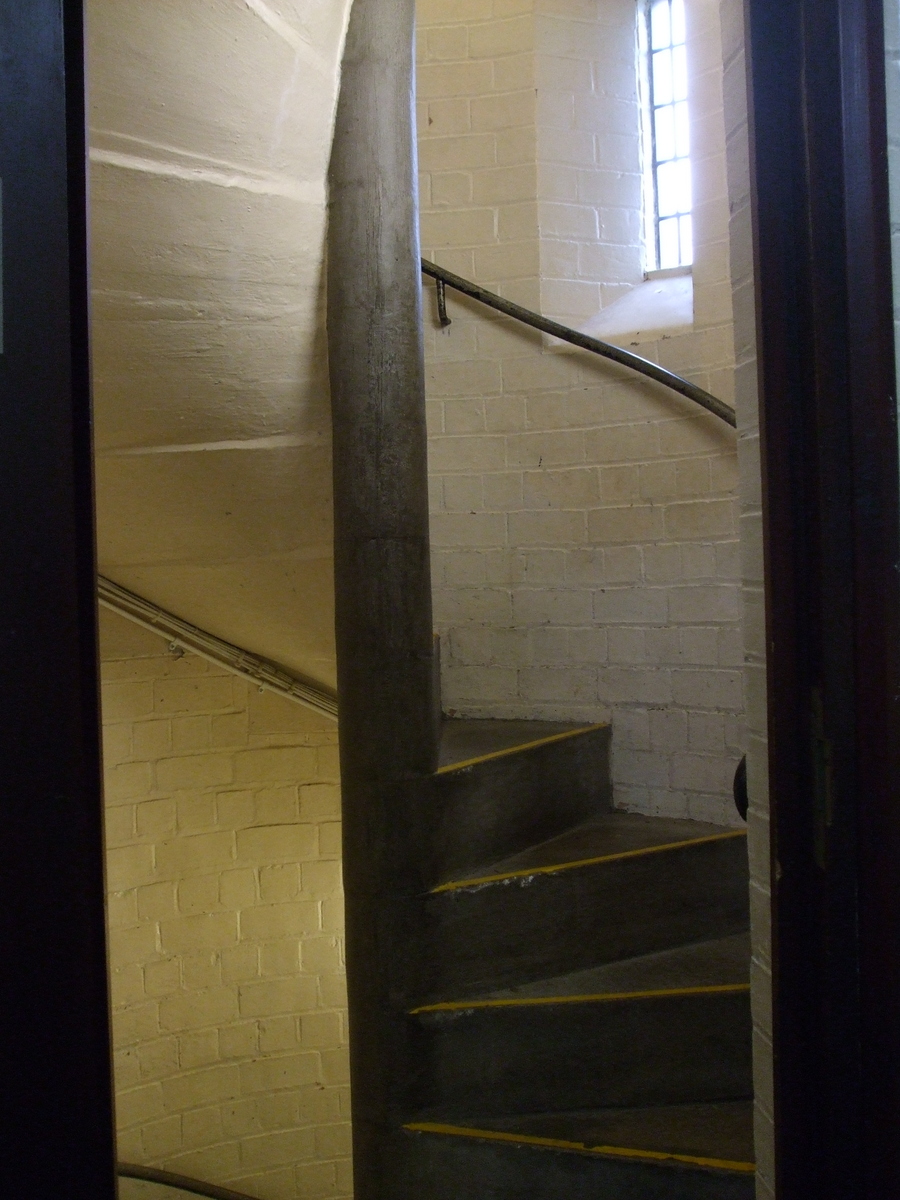
The first year I volunteered I staffed the top museum floor; the second year, I was on the first floor museum - see the end of this article for a selection of photographs of some of the artefacts that were on those floors. Access to both floors - and to the clavier room, and the actual bell chamber - is via a wonderful, spiral staircase! Who doesn't love these?! I have to put my claustrophobia to one side, and concentrate fully on putting one foot in front of the other! It's really not unlike climbing to the top of a castle turret - and who doesn't love those, too?! Or climbing the church tower, either to get to the bell chamber, or out onto the roof to see the surrounding countryside!! Or even the tower of the Loughborough Grammar School which is often open during Heritage Open Days in September. When the Carillon tower is open, it is possible to climb to the top and survey the countryside around our wonderful town, and see the actual bells in the bell chamber.

Carillon stairs

Descending the spiral stairs in the parish church

One of the bells in the bell chamber at the parish church

The spiral stairs in the Loughborough Grammar School Tower

In May 1952, the Leicester Evening Mail informed its readers that there was a "small museum inside where war relics are kept". 


In January 1964, the Illustrated Leicester Chronicle included a long description of the "unique building", saying:

 "Anyone may enter the tower to view the bells, at certain times of the day, for a small admission fee, however, one must be warned that there are 138 steps to the top of the tower! Half-way up there is a war-museum, relics brought back from the war by local men who served there." 

A comprehensive description of the contents of the museum then followed, and included both artefacts and documents.


It wasn't until Monday 5th November 1984 that the Carillon was added to the Register of Listed Buildings, and granted Grade II status. 

During the opening season, which I believe is usually Easter to October (but do please check the official website!), the Carillon receives all kinds of visitors, many of whom come from overseas on special visits. Locals and students alike climb the tower, listen to the carillon recitals, and learn from the museum exhibits, and from talking to the volunteer guides, and members of the Carillon team even go out into schools, sharing the story of the wonderful building, and taking along objects that the students can handle and learn more about.   

Last summer we celebrated the 100th anniversary of the completion of the Carillon in July 1923. I believe the weather on the occasion of the opening ceremony was quite reasonable and seasonable, however on 23 July 2023 it rained heavily and constantly! Nevertheless, enthusiasts did turn out for what was a momentous occasion. More recently, the Carillon was the destination for the replica of the Great Paul Bell, which was made from willow, and journeyed from the parish church to Queen's Park via the town centre!

Of course, every November, the Carillon is the focal point for the poignant Service of Remembrance, which is fitting, given its role as the town's war memorial, commemorating not only those who died during the First and Second World Wars, but also in subsequent, and more recent conflict.


____________________________________

Posted by lynneaboutloughborough

With apologies for typos which are all mine!

_______________________________________________

Thank you for reading this blog.

Copyright:

The copyright © of all content on this blog rests with me, however, you are welcome to quote passages from any of my posts, with appropriate credit. The correct citation for this looks as follows:

Dyer, Lynne (2023). Loughborough's Carillon. Available from: https://lynneaboutloughborough.blogspot.com/2024/02/loughboroughs-carillon.html [Accessed 18 February 2024]

Take down policy:

I post no pictures that are not my own, unless I have express permission so to do. All text is my own, and not copied from any other information sources, printed or electronic, unless identified and credited as such. If you find I have posted something in contravention of these statements, or if there are photographs of you which you would prefer not to be here, please contact me at the address listed on the About Me page, and I will remove these.

External Links:

By including links to external sources I am not endorsing the websites, the authors, nor the information contained therein, and will not check back to update out-of-date links. Using these links to access external information is entirely the responsibility of the reader of the blog.

Blog archive and tags:

If you are viewing this blog in mobile format, you will not be able to easily access the blog archive, or the clickable links to various topics. These can be accessed if you scroll to the bottom of the page, and click 'View Web Version'. Alternatively, there is also a complete list of posts, which when clicked will take you to the page you are interested in.

Searching the blog:

You can search the blog using the dedicated search box that appears near the top of the blog when viewed in the web version. Alternatively, you can search using your usual search engine (e.g. Bing, Google, DuckDuckGo etc.) by following this example:

site: https://lynneaboutloughborough.blogspot.com/ “Radmoor House”

NOTE – the words you’re actually looking for must be in “” and the first of these must be preceded by a space

Thank you for reading this blog.

Lynne

Thursday, 27 July 2023

Ernest Edwin Coltman and Ernest Huram Marsh

What follows is the tying up of another loose end I promised in relation to Ernest Edwin Coltman, and it is indeed a relation we are considering! Ernest Edwin Coltman had a nephew, well, actually he had more than one nephew, and nieces too, but it is one specific nephew who is the subject of this post.

Possibly named after his uncle, and very likely to have been named after his grandfather, Ernest Huram Marsh was born on 18 July 1892 at Tempé House in Swepstone. Swepstone was a small parish in North-West Leicestershire, which had been in existence since before the Domesday Book of 1086. Ernest’s parents, who had married in 1882, were John William Marsh, a farmer who had been born at Woodthorpe around 1855, and Eliza Ann, Ernest Edwin Coltman’s older sister.

Woodthorpe in July 2023


Ernest Huram’s older sister Frances Ethel Marsh had been born in 1885, and Mabel Eliza Marsh in 1888. In 1891 the family were living at a farm in Swepstone, and had a nursery governess, Lucy Hill, a general domestic servant, Julia Cooper, and Edward Basford was the farm hand. In 1901 When Ernest Huram Marsh was aged 8, the family were still in Swepstone, but now only had one servant, Emily Wood. In 1902, another son was born – John Bernard Sidney Marsh, however, by 1911 the family had moved to Forest Road, Loughborough, next door to a house called Forest Hey. Father John was now a corncake merchant, living with his wife, Eliza, two daughters Frances and Mabel, and son John.

Forest Hey looking away from town


Forest Hey looking towards town

Ernest Huram attended the Loughborough Intermediate School, before going on to the Loughborough Grammar School, where he seemed to excel at sport, gaining the Kaye Cup for athletics in both 1908 and 1909. He was also Captain of the First XI football, a member of the First XI Cricket, and of the Tennis VI. Oh, and he also had the nickname of 'Emma', whilst at LGS, a name which he still rejoiced in, throughout his life.

Loughborough Grammar School in 2021

Ernest Huram, in 1911, was now nearly 17, and had been engaged in an apprenticeship for two years, since 1909. This apprenticeship had followed a period of general education at the Loughborough Intermediate School, which he attended from 1901-1906, before moving on to the Loughborough Grammar School from 1906-1909, where he had passed the Senior Oxford Examination. His younger brother, John Bernard Sidney Marsh (known I believe as Bernard) would also attend the LGS.

Ernest Huram undertook his technical education at the Grantham Technical Institute from 1909-1910, where he studied second stage Practical Maths; gained a second class in Machine Drawing, and in first stage Applied Mechanics. In each of his first stage Applied Mechanics, Construction, and Heat Engines studies he gained a first class. 

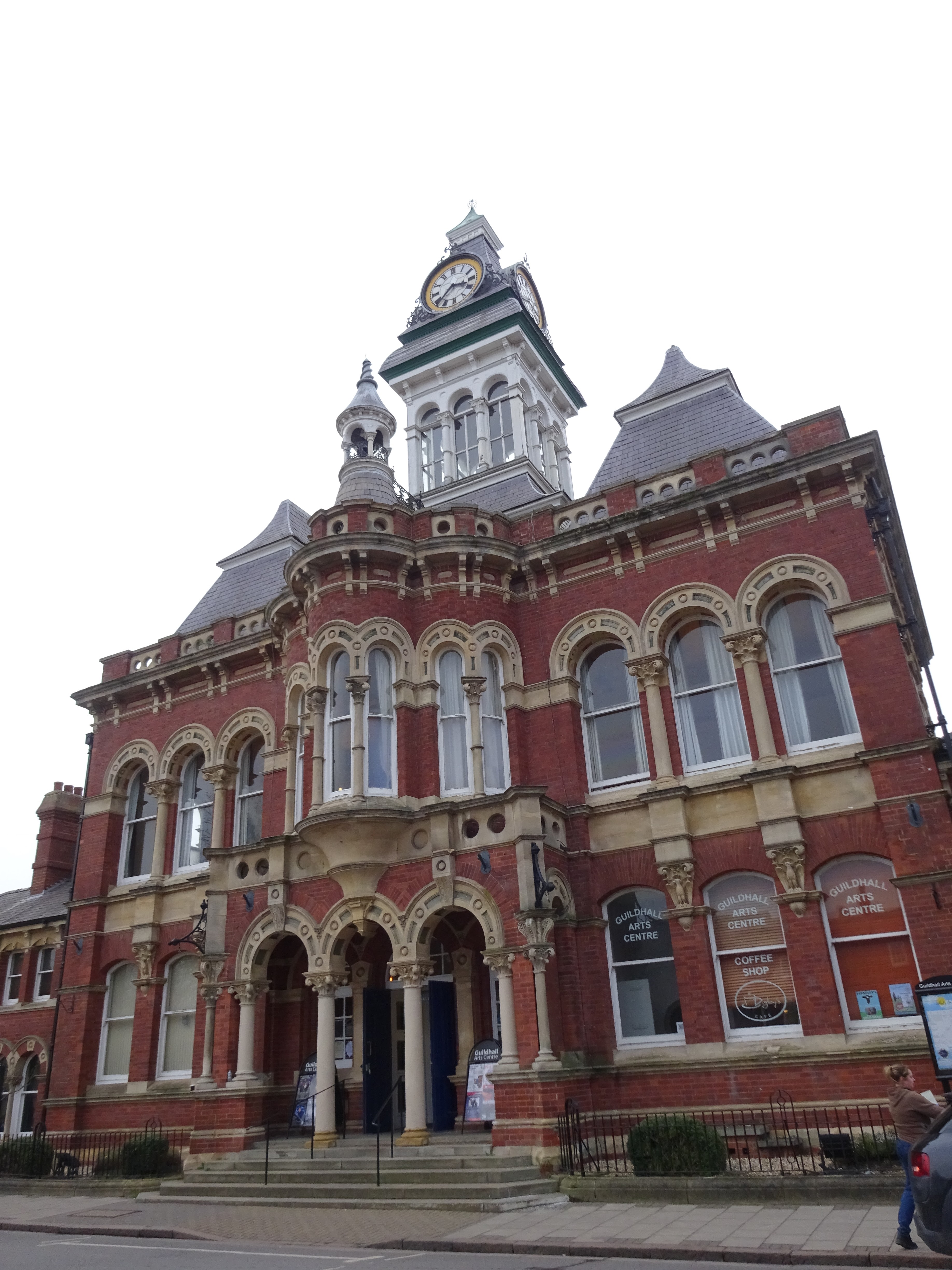
In 1897 the Grantham Technical Institute moved into this building, the former guildhall and jail. Whether or not it was still the Institute when Ernest arrived, I'm not sure.

At the age of 16 ½, Ernest Huram began an apprenticeship with Hornsby’s, in the gas-engine fitting and erecting workshops. In December 1910, at the age of 18, Ernest Huram March applied for membership of the Institute of Mechanical Engineers. He was an engineering pupil, working for Messrs. Richard Hornsby and Sons, Ltd, at Spittlegate Iron Works in Grantham, where he was an apprentice. The iron works were adjacent to the LNER as it passed through Grantham.

Richard Hornsby, snr., had taken over the well-established firm (makers of ploughs and seed drills) in 1828, and the company had thrived, winning a council medal at the Great Exhibition in 1851 at Crystal Palace for their products – a corn and seed drill, drop drill, two-row turnip drill on the ridge, oil-cake bruiser and steam engine – reminds me of Robert Bakewell! By 1861, the firm were employing 378 men, and when Richard Hornsby snr. died in 1864, the firm was carried on by his son, Richard, who led the company to more prize-winning products. After its becoming a limited company in 1879, more prizes followed, so by the time Ernest Huram joined, the firm it was thriving.

His application to the Institute of Mechanical Engineers was proposed by Charles H. Gadsby, a member of the Institution, who was based in London and was his uncle by marriage, having wed Florence Mary Coltman in 1886. The proposal was supported by another member of the Institution, this time, John Charles Coltman, another uncle, based in Loughborough. Further supporters of the proposal were members David Roberts, and Charles James. I believe the proposal was accepted and Ernest Huram Marsh joined the Institute as an associate.

So, while his family is living on Forest Road, in 1911, Ernest Huram is boarding with the Bowler family at 20 St Annes Street, Grantham, and his occupation is confirmed as a pupil engineer. Whatever Ernest had planned next was not to be as 1914 saw the outbreak of the First World War, and Ernest signed up with the Sherwood Foresters (Notts and Derby Regiment), by December 1914 being a temporary second lieutenant.


Is it possible that during this time, in July 1915, Ernest applied for a patent as the inventor of machine-gun mountings, as reported in the ‘Belfast News-Letter’?


As far as I know, the Royal Air Force was created on 1 April 1918, and by the time of his marriage, Ernest Huram had become a captain with the RAF. On 25 April 1918, Ernest married Margaret Althea Cook at the Wood Gate Baptist Chapel. Miss Cook was attended by her two sisters, Barbara Cook and Irene Cook, and Ernest’s sister Frances. At this time, Frances was serving with the VADs at Loughborough General Hospital, so was able to attend the wedding, unlike sister Mabel who was also in the VADs but who was stationed in Cairo, so would have been unable to attend. Their cousin, Phyllis Coltman, also served as a VAD, between 1916 and 1919.  

In 1921, Ernest, now aged 28, and his wife Margaret aged 24, were living with son David who had been born in 1920, at High Crest, Whaley Bridge, Derbyshire. Ernest was a Mechanical Engineer Representative with the firm, W. H. Allen, Sons and Co Ltd. Bedford.  

W. H. Allen, Sons and Co. Ltd. had been formed in 1880, originally in London, but had moved to Bedford. The business was involved in many things, including mechanical, hydraulic and electrical machinery, but specialised in the early 1900s in high-speed steam engines, centrifugal pumps and pumping engines for irrigation, and more. So, in many ways, very similar to the trade carried on by Ernest’s Coltman relatives in Loughborough.

In 1927, Ernest’s father, John William of Brooklands, Forest Road, Loughborough, died, and probate was granted to Ernest, a commercial traveller, and his brother John Bernard Sidney, a chartered accountant. Effects were £2,742 16s. 5d..

Ernest Huram Marsh applied for full membership of the Institution of Mechanical Engineers on 2 January 1939. On his application for membership, Ernest cited his occupation as “Representative Engineer in Yorkshire for Messrs. W. H. Allen, Sons & Co. Ltd.” Whoever it was who proposed his application had known Ernest for 20 years, and the seconder had known him for 16. The references that Ernest suggested were Lieutenant Colonel E. Kitson Clark MA, who was a past president of the Institution; F. C. Lea, Esq., OBE, DSC, a member of the council, and A. Roebuck, who was also a member of the council. Ernest states that although: “I have not passed the examination [the Associate Membership Examination], but was a Graduate of the Institution from about 1912 onwards.” Nonetheless, his application appears to have been successful.

By September 1939, Ernest, his wife Margaret, and their two boys, David J. (aged 19, and at college), Keith E. (aged 16 at school) and daughter Margaret R. aged 17, a social science student, were living at 4 West Park Place, Roundhay, Leeds. Ernest was still working for W. H. Allen Sons and Co. as a chartered mechanical engineer and representative.

On 30 December 1939, Ernest Huram Marsh’s mother, Eliza Ann, died, while living at Brooklands, Forest Road, Loughborough. Probate was granted on 20 April 1940 to Frances Ethel (who had married Arthur Thomas Walsh), Mabel Eliza Marsh, Ernest Huram Marsh, a commercial traveller, and John Bernard Sidney Marsh, chartered accountant. Effects were £7,427 18s. 

Of course, the 1939 register was taken at the outbreak of World War Two, and Ernest’s mother died shortly after this. By 1940 we find Ernest is a pilot officer with the RAF Volunteer Reserve (85181).

Ernest survived the war, and by 1958, we find him and wife Margaret living at Fosscote, Weeton Lane, near Barkston Ash, West Yorkshire. It might be that this is where Ernest and his wife retired to, since in November 1958, Ernest retired from W. H. Allen, a company he had been with for nearly 40 years. The trail here runs a bit dry. After 5 years of retirement, during which time Ernest had probably continued to play tennis and golf, there follows the death of Margaret Althea Marsh, Ernest’s wife, of Foscote, Weeton Lane near Leeds, on 23 August 1963. Probate was granted to Ernest on 16 September 1963. The effects were £1,945 11s. 4d..

Ernest Huram Marsh continued to live at Fosscote, on Weeton Lane, until his own death on 11 May 1971. Probate was granted on 13 August 1971, and effects were £13,072. 

It is interesting to note that Ernest Huram Marsh did not follow in the footsteps of his father John William Marsh, who early in life was a farmer, before becoming a cornfactor – a dealer in corn – nor of his grandfather, Joseph Marsh, who in 1861 was farming 230 acres in Woodthorpe, and employing 5 men. Rather, Ernest Huram Marsh followed in the trade of his namesakes, and maternal relatives – Ernest, his uncle, the boilermaker and engineer, and Huram, his grandfather, an enginesmith, boilermaker, and engineer.                

___________________________________

posted by lynneaboutloughborough

With apologies for typos which are all mine!

_______________________________________________

Thank you for reading this blog.

Copyright:

The copyright © of all content on this blog rests with me, however, you are welcome to quote passages from any of my posts, with appropriate credit. The correct citation for this looks as follows:

Dyer, Lynne (2023). Ernest Edwin Coltman and Ernest Huram Marsh. Available from: https://lynneaboutloughborough.blogspot.com/2023/06/ernest-edwin-coltman-and-ernest-huram.html [Accessed 16 July 2023]

Take down policy:

I post no pictures that are not my own, unless I have express permission so to do. All text is my own, and not copied from any other information sources, printed or electronic, unless identified and credited as such. If you find I have posted something in contravention of these statements, or if there are photographs of you which you would prefer not to be here, please contact me at the address listed on the About Me page, and I will remove these.

Blog archive and tags:

If you are viewing this blog in mobile format, you will not be able to easily access the blog archive, or the clickable links to various topics. These can be accessed if you scroll to the bottom of the page, and click 'View Web Version'. Alternatively, there is also a complete list of posts, which when clicked will take you to the page you are interested in.

Searching the blog:

You can search the blog using the dedicated search box that appears near the top of the blog when viewed in the web version. Alternatively, you can search using your usual search engine (e.g. Bing, Google, DuckDuckGo etc.) by following this example:

site: https://lynneaboutloughborough.blogspot.com/ “Radmoor House”

NOTE – the words you’re actually looking for must be in “” and the first of these must be preceded by a space

Thank you for reading this blog.

Lynne

Sunday, 7 November 2021

So who was Robert Algernon Persse?

First a word of apology: I have spelled words as found on the original documents I’ve consulted, and have not tried to make these consistent. Hopefully, the story will still make sense! I should also apologise for referring almost entirely throughout to the Hon. Mrs Algernon Persse simply as Mrs Persse. I must also apologise for the dense text and lack of photographs.


Sunday, 24 October 2021

John George Gordon and the departure from the Grammar School

So, last week we learned a bit about the reverend John George Gordon, the first headteacher of the Loughborough Grammar School, when it moved to its current location. Since then, the school archivist has been in touch and provided a few more details about the final days of the career of the Rev'd Gordon at the school.


In the spring of 1860, Rev'd Gordon had expelled a young student by the name of Algernon Perse (1) who was from Scotland and who was a boarded at the Grammar School. Upon learning of the expulsion, Algernon's father, Dudley, wrote to the school, as a result of which, Rev'd Gordon was interviewed by the school's trustees, its deputy headteacher, and Gordon's housekeeper, about the reason's behind the boy's expulsion.

Here's what the archivist said:

"During the spring of 1860 he [Gordon] had expelled Algernon Perse, a boarder from Scotland, but it the manner of their final confrontation that was to have repercussions. 

Mr Dudley Perse [father of Algernon] wrote to the trustees expressing dissatisfaction with the conclusion which they had reached with regard to his son. He stated that Dr Gordon had exclaimed to him [Algernon] 'None of your lies, Sir' and had then kicked him.

On 1st June 1860 the trustees interviewed Dr Gordon, his deputy (2), and his housekeeper about the quarrel and the struggle."  

Following this interview, the trustees took the unusual step of interviewing three boys  - William Bolton, James Sweetenham, and William Farmer - who had been witness to the 'quarrel and struggle':

"Clearly unhappy at what they heard, they decided to interview on 13th June, three boys who were eye-witnesses to the incident. William Bolton, a 14-year-old boarder from Dublin, had seen Gordon strike Perse once with the 'whacking cane'. Perse seized the cane after which the headmaster kicked him twice. During the struggle, James Sweetenham, aged 13 from Cumberland entered the room. He heard Perse urge Gordon to 'keep himself cool', but Gordon was 'much excited' and kicked him twice."

Clearly the trustees were shocked by Gordon's behaviour, and as, according to the archivist, they "had been looking for some time to get rid of Gordon - in fact since 1853" (3) and were ready to dismiss him from post, but before they managed to do this, Gordon resigned. Apparently:

"The trustees were unimpressed by the [resignation] letter which was self-pitying and self-serving, blaming his aberrant behaviour on the stress of running a new school in conditions which he had never previously experienced."

So unimpressed were the trsutees that they refused to grant Gordon's request for a pension.

And so, the search for a new headteacher began ...

(1) Algernon Perse, surname variously spelled Perse, Persse, Perces, Pierce, Piersse etc..

(2) The deputy headteacher at the time was Rev'd J. Kitchen

(3) Astonishing since Gordon had only been headteacher since the school opened in its new location in 1852

Posted by lynneaboutloughborough 24 October 2021

You are welcome to quote passages from any of my posts, with appropriate credit. The correct citation for this looks as follow:

Dyer, Lynne (2021). John George Gordon and the departure from the Grammar School. Available fromhttps://lynneaboutloughborough.blogspot.com/2021/10/john-george-gordon-and-departure-from.html  [Accessed 24 October 2021]

Take down policy:
I post no pictures that are not my own, unless I have express permission so to do. All text is my own, and not copied from any other information sources, printed or electronic, unless identified and credited as such. If you find I have posted something in contravention of these statements, or if there are photographs of you which you would prefer not to be here, please contact me at the address listed on the About Me page, and I will remove these.

You can leave comments below, but do check back as my reply will appear here, below your comment.

Thank you for reading this blog. 

Lynne                  

Sunday, 17 October 2021

So who was the reverend John George Gordon


Loughborough Grammar School has had a presence in Loughborough since around 1495, being founded as part of a bequest made by the estate of Thomas Burton, a wealthy local wool merchant. The school was originally placed in the porch of the Church of St Peter and St Paul, now known as All Saints with Holy Trinity. As numbers of pupils increased, the teaching moved into the body of the church, before moving into a separate building in the churchyard. In 1825 the teaching moved to a new building on nearby Church Gate, before re-locating to the present site, off Leicester Road, in 1852.

The first headteacher at the new site was Rev'd John George Gordon, who held the position from 1852 until 1860. Gordon was born in Ireland, around 1813, to merchant father, John. 

Gordon attended the School of St John the Baptist at Cork, and graduated from Trinity College, Dublin, before passing an MA at Sydney College, Cambridge. During his educational journey, Gordon had been a high achiever, being a gold medallist at Trinity College Dublin. He moved to Cheltenham and on 6 March 1844, at his initiation into the Foundation Lodge of the Cheltenham United Grand Lodge of Freemasons, was listed as a ‘clerk’. In reality, Gordon was the assistant master at Cheltenham College from 1841-1847. In December of 1844 he was ordained a deacon, and the following year, a priest.

The Dorset County Chronicle of December 1847 announced the appointment of Gordon to the position of second master of the Bristol Free Grammar School, saying: “His testimonials of classical and mathematical attainments were high, … his credentials were also of a very high character.”

Perhaps it was the move to Bristol which prompted his marriage at St Mary’s church, Cheltenham, to Sarah Carr, the daughter of lawyer, George Charles Carr. Gordon, who was listed as a clerk residing at Clifton, and Sarah, who had been born in Chester, married on 26 April 1948.

The 1851 census lists Gordon and Sarah living at 6 Grosvenor Place, Clifton, with house servant, Harriet Jones. An advert appeared in the Bristol Times and Mirror, in July 1851, to attract new pupils. We learn that the school employs nine masters, and “The object of the school … is to furnish an Education at once liberal and useful, without the necessity of removing Boys from the care and control of their Friends.” Instruction was offered in English, Latin. Greek, French and German language, alongside, writing, arithmetic, book-keeping, geography, history, mathematics, and natural philosophy.

Although Slater’s directory of Bristol and its suburbs and vicinity, lists Gordon as living at 6 Grosvenor Place, in mid-1852, the Trustees of the Burton Charity had elected Gordon as headmaster of the new Loughborough Grammar School. The Coventry Herald, in October of 1852, carried an interesting article about the “Reform of the Free Grammar School of Loughborough”, suggesting that after a period of decline, this new school, of a superior architectural character, had been erected under a decree of Chancery. Rev’d Gordon, it said, had a salary of £200 a year, with a share of the money paid by day pupils and the boarders. The second master, who was paid £120, and a share of money paid by day pupils, was Thomas White. Other masters were C.E. Warner, and A. Selss (?).

In 1857, Gordon performed the marriage ceremony of his niece, Louisa Courtenay, to Rev’d Elwin John Everard Evered, at the Abbey Church in Bath. School matters were also high on the agenda, and Gordon attended the 1858 National Conference of Upper and Middle-Class Schoolmasters in the Guildhall in London, a conference presided over by the Lord Mayor of London, and contributed to by several members of parliament and other distinguished men. Gordon also represented the school at other events, like the annual dinner of the Loughborough Agricultural Association.

Something happened that saw Gordon move away from Loughborough (possibly something to do with Great Southern Railway Company, but I really cannot be sure on that), and in October 1860, Loughborough Grammar School was advertising for a new headmaster, offering a salary of £200 and residence.

In his next position, Gordon was the Principal of the Collegiate Institution at 23 Notting-Hill Terrace, in the parish of St Mary Abbott, Kensington, London, as post he held until his tragic death on 26 December 1862. Gordon was killed in an accident on the London, Brighton and South Coast Railway, at the Gipsy Hill station in Norwood, on the London side of Crystal Palace. He had tried to board a train which had just begun to move off from the station, and a porter had signalled to him not to. The porter knew not only was it unsafe to try and board a moving train, it also wasn’t the train Gordon actually wanted. The well-meaning porter tried to help Gordon down from the train, but as he did so, they both fell, the porter landing on the platform, and Gordon onto the tracks. Gordon was conveyed to Guy’s Hospital, but died of his injuries.

The news of this accident was widely reported in the press at the time, including in the local Loughborough Monitor. Probate was granted to Gordon’s widow, Sarah Gordon: effects were under £4,000. Gordon was buried on 1 January 1863 in Old Brompton cemetery.

Posted by lynneaboutloughborough 17 October 2021

You are welcome to quote passages from any of my posts, with appropriate credit. The correct citation for this looks as follow:

Dyer, Lynne (2021). So who was the reverend John George Gordon? Available fromhttps://lynneaboutloughborough.blogspot.com/2021/10/so-who-was-reverend-john-george-gordon.html  [Accessed 17 October 2021]

Take down policy:
I post no pictures that are not my own, unless I have express permission so to do. All text is my own, and not copied from any other information sources, printed or electronic, unless identified and credited as such. If you find I have posted something in contravention of these statements, or if there are photographs of you which you would prefer not to be here, please contact me at the address listed on the About Me page, and I will remove these.

You can leave comments below, but do check back as my reply will appear here, below your comment.

Thank you for reading this blog. 

Lynne