Showing posts with label motifs. Show all posts

Monday, 28 April 2025

X is for eXercise Book!

Ok, so Letter X was always going to be challenging, and so I am resorting to the common practice of making an entry under the Letter E, as the Letter X actually sounds like it starts with a Letter E – if you see what I mean!!

So, an eXercise book!

Miss Winifred Ellen Sarson was born on 28th December 1900, to William and his wife Lizzie. Her birth was registered in Leicester in January 1901, and the family were living on Kirby Road, Leicester, probably at number 24. Winifred had an older sister, Gladys born in 1892, and an older brother, Kenneth born in 1899. Winifred’s father, William was a commercial traveller in the boot and shoe industry. The family continued to live at 24 Kirby Road until at least 1921, when William was working for Barsley Tomlinson Watkins in Cosby.

In 1939, Winifred and her sister Gladys were living together at 79 Westcotes Drive, a place where Winifred lived after the death of her sister Gladys on 24th July 1975, until her own death on 20th December 1986, aged 85.

So why Winifred, and why an eXercise book?
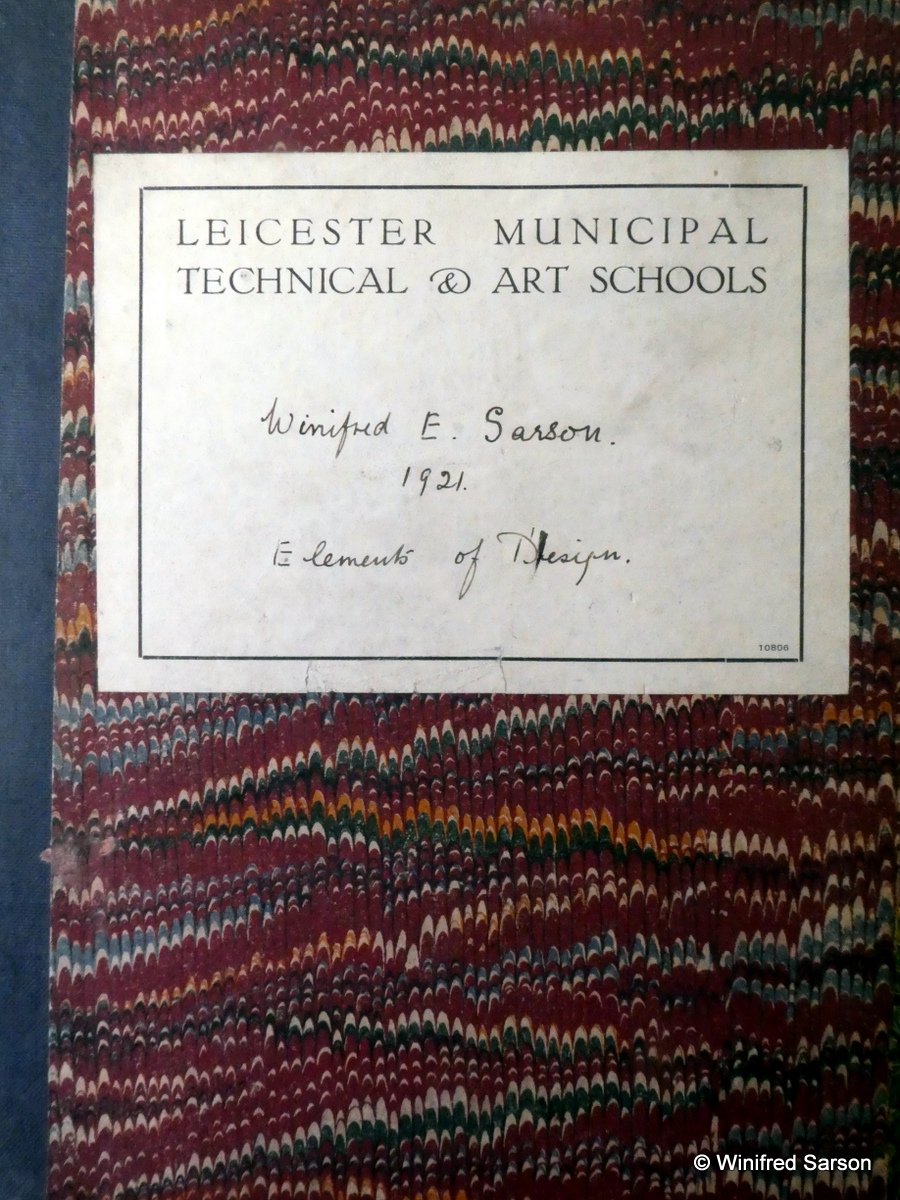


The book is a notebook issued by the Leicester Municipal Technical & Art Schools, and it was used by Winifred to record notes, designs, and progress in the area of the Elements of Design, when she was a student at the College around the beginning of the burgeoning of the Art Deco movement. In the eXercise book she describes the meaning behind designs – like an ornament being an enrichment of an object or of a service, or repeating geometric patterns. Many of the drawings she made are of classic designs, and she talks of Roman patterns, Greek patterns, Byzantine patterns, and Renaissance patterns. She also draws a number of Egyptian inspired patterns which chime perfectly well with the Art Deco movement that was about to take off.


In her notes on geometric ornaments, she describes a geometric pattern as being the most conventional of all patterns, which might consist entirely of straight lines, entirely of curved lines, or a combination of both! Triangles, squares, lozenges, diamonds, hexagons, octagons, and polygons being the main geometrical forms for patterns in ornament.

One of the final sections in the eXercise book looks at the idea of plant forms in ornamentation. After a very short introduction, Winifred writes extensively about the Egyptian lotus, papyrus, and palms.


“The Lotus & Papyrus are plants of ancient oriental civilisation; & plays an important part in the social life of the Egyptians and Assyrians. The died stalks of these water plants were used as fuel, or made into mats and other plaited articles; their roots served as food; the pith as wicks for lamps. The paper of the ancients was made of Papyrus. This explains its appearance in the ornamental art of these nations, & its special [?] in Egyptian style.”


As we have already seen in Letter E, and Letter N, these Egyptian motifs have a presence in Loughborough’s Art Deco buildings.

Winifred became an art teacher, and taught at Leicester’s Collegiate Girls’ School for 37 years, before retiring. Her sister, Gladys was also a teacher. Neither sister ever married.

____________________________________ 

I'm taking part in the A-Z April Blogging Challenge!!


____________________________________

Posted by lynneaboutloughborough

With apologies for typos which are all mine!

_______________________________________________

Thank you for reading this blog.

Copyright:

The copyright © of all content on this blog rests with me, however, you are welcome to quote passages from any of my posts, with appropriate credit. The correct citation for this looks as follows:

Dyer, Lynne (2025). X is for eXercise Book]. Available from: https://lynneaboutloughborough.blogspot.com/2025/04/x-is-for-exercise-book.html  [Accessed 28 April 2025]

Take down policy:

I post no pictures that are not my own, unless I have express permission so to do. All text is my own, and not copied from any other information sources, printed or electronic, unless identified and credited as such. If you find I have posted something in contravention of these statements, or if there are photographs of you which you would prefer not to be here, please contact me at the address listed on the About Me page, and I will remove these.

External Links:

By including links to external sources I am not endorsing the websites, the authors, nor the information contained therein, and will not check back to update out-of-date links. Using these links to access external information is entirely the responsibility of the reader of the blog.

Blog archive and tags:

If you are viewing this blog in mobile format, you will not be able to easily access the blog archive, or the clickable links to various topics. These can be accessed if you scroll to the bottom of the page, and click 'View Web Version'. Alternatively, there is also a complete list of posts, which when clicked will take you to the page you are interested in.

Searching the blog:

You can search the blog using the dedicated search box that appears near the top of the blog when viewed in the web version. Alternatively, you can search using your usual search engine (e.g. Bing, Google, DuckDuckGo etc.) by following this example:

site: https://lynneaboutloughborough.blogspot.com/ “Radmoor House”

NOTE – the words you’re actually looking for must be in “” and the first of these must be preceded by a space

Thank you for reading this blog.

Lynne

Saturday, 26 April 2025

W is for Waves Wheatsheaves and Weedon the Architects

I simply can’t decide between these choices for the Letter W, so let's cover them all!

So, Harry Weedon’s architectural practice was the one favoured by Oscar Deutsch to design his Odeon cinemas. Arthur J. Price was one of the architects in the practice, and it was he who designed Loughborough’s original Odeon on Baxter Gate, most recently a Beacon Bingo, and now in the process of being renovated.

The Art Deco style was rather influenced by the designs of things of travel and speed – like the Mallard train built in 1938, which broke the speed record for steam locos in the summer of that year; like Babs the racing car which broke the speed record on Pendine Sands in 1926 with J.G. Parry Thomas in the driving seat; and like the popularity of the cruise ships. Hence the building designs that almost mimicked the shape and style of the cruise liner, or included waves, or wave-like patterns in their ornamentation. Perhaps you might stand where Market Place joins High Street and look at the amusement arcade, which if you get the right angle, looks like the front of an ocean liner. Plus, its ornamentation is decidedly wavey - and the central panel almost looks like the letter W!


A similar ocean liner feel comes from the row of shops on Market Street, and they too have waves. These are above the windows at first floor level of the blocks either side of Party Pieces, although these almost look like eyelashes!


There are also some waves above the windows on the first floor of the row of buildings on the right-hand side of the former Ramada Hotel (previously the King's Head), although they do look rather more like window pelmets!


And my final choice for W is wheatsheaves! No, not the Jam Garden, but the architectural motifs that we can see on the former Burton Tailoring store. They are keeping well out of the way of the lions, and can be found on the outside pillars of the building, at first-floor level.


____________________________________ 

I'm taking part in the A-Z April Blogging Challenge!!


___________________________________

Posted by lynneaboutloughborough

With apologies for typos which are all mine!

_______________________________________________

Thank you for reading this blog.

Copyright:

The copyright © of all content on this blog rests with me, however, you are welcome to quote passages from any of my posts, with appropriate credit. The correct citation for this looks as follows:

Dyer, Lynne (2025). W is for Waves, Wheatsheaves, and Weedon the Architects. Available from: https://lynneaboutloughborough.blogspot.com/2025/04/w-is-for-waves-wheatsheaves-and-weedon.html  [Accessed 26 April 2025]

Take down policy:

I post no pictures that are not my own, unless I have express permission so to do. All text is my own, and not copied from any other information sources, printed or electronic, unless identified and credited as such. If you find I have posted something in contravention of these statements, or if there are photographs of you which you would prefer not to be here, please contact me at the address listed on the About Me page, and I will remove these.

External Links:

By including links to external sources I am not endorsing the websites, the authors, nor the information contained therein, and will not check back to update out-of-date links. Using these links to access external information is entirely the responsibility of the reader of the blog.

Blog archive and tags:

If you are viewing this blog in mobile format, you will not be able to easily access the blog archive, or the clickable links to various topics. These can be accessed if you scroll to the bottom of the page, and click 'View Web Version'. Alternatively, there is also a complete list of posts, which when clicked will take you to the page you are interested in.

Searching the blog:

You can search the blog using the dedicated search box that appears near the top of the blog when viewed in the web version. Alternatively, you can search using your usual search engine (e.g. Bing, Google, DuckDuckGo etc.) by following this example:

site: https://lynneaboutloughborough.blogspot.com/ “Radmoor House”

NOTE – the words you’re actually looking for must be in “” and the first of these must be preceded by a space

Thank you for reading this blog.

Lynne

Wednesday, 23 April 2025

T is for Tutankhamun and Torches

We’ve already talked a bit about Tutankhamun, and the finding and opening of his tomb in 1922, under E is for Egyptomania, and N is for Nymphaea Lotus, and Nymphaea Caerulea, so instead, let’s have a look at another popular Art Deco motif – torches!

The Art Deco style was keen on its motifs, and things like sunbursts and bright colours were used widely. I guess torches could fall into this theme, unless, in 1931, people were looking forward to the spectacle that would be the 1932 Olympics, which was bigger and better than any that had come before! Or maybe it was just to do with the name of the building, and the trade of previous landlords!

I say 1931, because the best example of torches as ornamentation on an Art Deco building in Loughborough appear on a building constructed in 1931! We’ve actually seen this building before under Keystones, and I’m pretty sure we’ll see it again, but just look at these wonderful impressions of torches, which adorn the end pillars of the building, on both the top and the bottom of the frontage onto Wards End and that facing Brown’s Lane!! There are 8 in total! Firstly, a photograph of the frontage onto Wards End, and a close up of the top right hand torch. Then the corner of the building where Wards End meets Browns Lane, with a close up of that corner pillar. Finally, a close up of the torch furthest along Browns Lane, towards Royland Road.


____________________________________ 

I'm taking part in the A-Z April Blogging Challenge!!


____________________________________

Posted by lynneaboutloughborough

With apologies for typos which are all mine!

_______________________________________________

Thank you for reading this blog.

Copyright:

The copyright © of all content on this blog rests with me, however, you are welcome to quote passages from any of my posts, with appropriate credit. The correct citation for this looks as follows:

Dyer, Lynne (2025). T is for Tutankhamun and Torches. Available from: https://lynneaboutloughborough.blogspot.com/2025/04/t-is-for-tutankhamun-and-torches.html [Accessed 23 April 2025]

Take down policy:

I post no pictures that are not my own, unless I have express permission so to do. All text is my own, and not copied from any other information sources, printed or electronic, unless identified and credited as such. If you find I have posted something in contravention of these statements, or if there are photographs of you which you would prefer not to be here, please contact me at the address listed on the About Me page, and I will remove these.

External Links:

By including links to external sources I am not endorsing the websites, the authors, nor the information contained therein, and will not check back to update out-of-date links. Using these links to access external information is entirely the responsibility of the reader of the blog.

Blog archive and tags:

If you are viewing this blog in mobile format, you will not be able to easily access the blog archive, or the clickable links to various topics. These can be accessed if you scroll to the bottom of the page, and click 'View Web Version'. Alternatively, there is also a complete list of posts, which when clicked will take you to the page you are interested in.

Searching the blog:

You can search the blog using the dedicated search box that appears near the top of the blog when viewed in the web version. Alternatively, you can search using your usual search engine (e.g. Bing, Google, DuckDuckGo etc.) by following this example:

site: https://lynneaboutloughborough.blogspot.com/ “Radmoor House”

NOTE – the words you’re actually looking for must be in “” and the first of these must be preceded by a space

Thank you for reading this blog.

Lynne

Tuesday, 15 April 2025

M is for Motifs

There have been a couple of alphabetical entries in this Art Deco A-Z that I have found difficult to find something to write about, and the Letter M was one of these. Initially I thought I might write about mosaics, which were quite popular during the Art Deco period, but the only one I know about is the one on the building occupied by Francis and Gaye, the jewellers on the corner of High Street and Baxter Gate. But, as it was built in 1907, this building is in the Arts and Crafts style, so not Art Deco.

So, instead, let’s talk about motifs! In architectural terms, a motif is simply an ornament, or decoration on the surface of a building, which forms a recurring pattern or theme. This could be several designs on just one building, displayed like a frieze, or similar ornamentation across a range of buildings. Often the motif is slightly raised from the surface of the building, but equally, it could stand proud, like the lion heads on the former Burton Tailoring store.

In architecture of the Art Deco period, there were many recurring motifs, and those we find in Loughborough include chevrons, roses, fans, feathers, shells, horns, lions, waves, torches, and many more.

Here are a few examples from Loughborough town centre buildings - a couple of friezes and a couple of motifs


____________________________________ 

I'm taking part in the A-Z April Blogging Challenge!!


____________________________________

Posted by lynneaboutloughborough

With apologies for typos which are all mine!

_______________________________________________

Thank you for reading this blog.

Copyright:

The copyright © of all content on this blog rests with me, however, you are welcome to quote passages from any of my posts, with appropriate credit. The correct citation for this looks as follows:

Dyer, Lynne (2025). Mis for motifs. Available from: https://lynneaboutloughborough.blogspot.com/2025/04/m-is-for-motifs.html  [Accessed 15 April 2025]

Take down policy:

I post no pictures that are not my own, unless I have express permission so to do. All text is my own, and not copied from any other information sources, printed or electronic, unless identified and credited as such. If you find I have posted something in contravention of these statements, or if there are photographs of you which you would prefer not to be here, please contact me at the address listed on the About Me page, and I will remove these.

External Links:

By including links to external sources I am not endorsing the websites, the authors, nor the information contained therein, and will not check back to update out-of-date links. Using these links to access external information is entirely the responsibility of the reader of the blog.

Blog archive and tags:

If you are viewing this blog in mobile format, you will not be able to easily access the blog archive, or the clickable links to various topics. These can be accessed if you scroll to the bottom of the page, and click 'View Web Version'. Alternatively, there is also a complete list of posts, which when clicked will take you to the page you are interested in.

Searching the blog:

You can search the blog using the dedicated search box that appears near the top of the blog when viewed in the web version. Alternatively, you can search using your usual search engine (e.g. Bing, Google, DuckDuckGo etc.) by following this example:

site: https://lynneaboutloughborough.blogspot.com/ “Radmoor House”

NOTE – the words you’re actually looking for must be in “” and the first of these must be preceded by a space

Thank you for reading this blog.

Lynne

Monday, 14 April 2025

L is for Lions

Art Deco art, ceramics, and architecture took a lot of inspiration from nature – like animals and flowers – as well as from mythical creatures, like sphinxes, which had the body of a lion and the head of a human. Unlike the ethereal nature depicted in the Art Nouveau style, along with the use of fantasy creatures, the Art Deco style favoured domestic animals, like dogs, particularly greyhounds, and any number of different big cats. These graceful animals, with their sleek forms, symbolised power, and elegance.

Jaguars, of course, became the logo and name of British motor manufacturers (now Jaguar Land Rover), which saw its origins in the company of the Swallow Side-Car company back in 1922, but it wasn’t until 1935 that the first Jaguar car was produced.  

Taking the lions as a motif in Art Deco architecture, these were depicted in a static way, often sitting like royalty, and often they were placed at the entrance to a grand building. You can walk around Loughborough today, and see various pairs of lions adorning the gateway to a number of domestic buildings, for example, on Westfield Drive. Back in 1962, however, you’d not have seen the pair of terracotta lions that sat outside a property on Leicester Road, but the following year you might have spotted them on the entry to Quorn Court, on Loughborough Road in Quorn.

But let’s go a bit further back in time, to the 1920s and 1930s! I haven’t been able to find much evidence of lions on our Art Deco architecture, apart from those on the former Burton Tailoring store. And what a treat that is! There are no less than 9 lion heads adorning the string course above the first-floor windows, and just below the parapet.


There are also these on the former Echo Press offices, which are located on the string course between the upper two floors of windows, and are surrounded by an angular motif. There are only 8 of these, but again, they're pretty stunning, but look a bit more vicious than the ones on the former Burtons!  


____________________________________ 

I'm taking part in the A-Z April Blogging Challenge!!


____________________________________

Posted by lynneaboutloughborough

With apologies for typos which are all mine!

_______________________________________________

Thank you for reading this blog.

Copyright:

The copyright © of all content on this blog rests with me, however, you are welcome to quote passages from any of my posts, with appropriate credit. The correct citation for this looks as follows:

Dyer, Lynne (2025). L is for Lions. Available from: https://lynneaboutloughborough.blogspot.com/2025/04/l-is-for-lions.html  [Accessed 14 April 2025]

Take down policy:

I post no pictures that are not my own, unless I have express permission so to do. All text is my own, and not copied from any other information sources, printed or electronic, unless identified and credited as such. If you find I have posted something in contravention of these statements, or if there are photographs of you which you would prefer not to be here, please contact me at the address listed on the About Me page, and I will remove these.

External Links:

By including links to external sources I am not endorsing the websites, the authors, nor the information contained therein, and will not check back to update out-of-date links. Using these links to access external information is entirely the responsibility of the reader of the blog.

Blog archive and tags:

If you are viewing this blog in mobile format, you will not be able to easily access the blog archive, or the clickable links to various topics. These can be accessed if you scroll to the bottom of the page, and click 'View Web Version'. Alternatively, there is also a complete list of posts, which when clicked will take you to the page you are interested in.

Searching the blog:

You can search the blog using the dedicated search box that appears near the top of the blog when viewed in the web version. Alternatively, you can search using your usual search engine (e.g. Bing, Google, DuckDuckGo etc.) by following this example:

site: https://lynneaboutloughborough.blogspot.com/ “Radmoor House”

NOTE – the words you’re actually looking for must be in “” and the first of these must be preceded by a space

Thank you for reading this blog.

Lynne

Monday, 7 April 2025

F is for Fascines, Fans, and Feathers

Art Deco buildings often show off elaborate embellishments, or motifs, and there are plenty of these to be found on Loughborough’s Art Deco buildings! Let’s look at some fascines (bundles of wood), fans, and feathers, and where we might find these …

Fascines

Probably the best example of fascines can be seen on the old No.1 Branch Co-op building on Derby Road, a building which has featured numerous times on this blog! [1] It’s a beautiful building which has a lovely balustrade, almost forming a faux balcony in front of the gabled roof, and bunches of foliage dropping down along columns of the second floor. The fascines are in the middle of the three bays, leading up either side to the metal lettering, indicating that this is a Co-op building. I’m calling these fascines, but it’s probably open to individual interpretation, and you might see long-handled torches, or tied bamboo stems! Here’s a couple of photographs of the building and the detail.


Fans

Again, my interpretation of a fan motif might be slightly different from yours, but after a long time spent looking up at the detail on some of Loughborough’s buildings, it gets a bit tricky to tell exactly what the motifs are! The detail on the first floor of the building that used to be PoundStretcher on High Street, both on the middle gable and on the surrounding two bays, could loosely be described as fans. Alternatively, you might see wall lights, or candelabras, or maybe feathers or shells!! But, I’m sure we can all agree that the detailing is beautifully on what was opened as one of Russell Smith’s drapery stores. We might, however, consider the building is in a domestic revival style, not Art Deco!!


Feathers

And finally, we take a look at feathers!! Art Deco feather features often depict peacock feathers. Again, in my opinion it’s a bit of a subjective thing, so some feathers might be shells, and vice versa! The motif on what is now Caffe Nero, just above the first floor window, with its faux balcony, looks like peacock feathers in the centre, with decoration leading out to some proud miniature columns, with possibly a round flower motif to complete the design.


____________________________________


[1] See the following examples:

https://lynneaboutloughborough.blogspot.com/2022/12/no1-co-op.html

https://lynneaboutloughborough.blogspot.com/2024/01/changes-in-loughborough-2023.html 

____________________________________ 

I'm taking part in the A-Z April Blogging Challenge!!

____________________________________

Posted by lynneaboutloughborough

With apologies for typos which are all mine!

_______________________________________________

Thank you for reading this blog.

Copyright:

The copyright © of all content on this blog rests with me, however, you are welcome to quote passages from any of my posts, with appropriate credit. The correct citation for this looks as follows:

Dyer, Lynne (2025). F is for Fascines, Fans, and Feathers. Available from: https://lynneaboutloughborough.blogspot.com/2025/04/f-is-for-fascines-fans-and-feathers.html [Accessed 7 April 2025]

Take down policy:

I post no pictures that are not my own, unless I have express permission so to do. All text is my own, and not copied from any other information sources, printed or electronic, unless identified and credited as such. If you find I have posted something in contravention of these statements, or if there are photographs of you which you would prefer not to be here, please contact me at the address listed on the About Me page, and I will remove these.

External Links:

By including links to external sources I am not endorsing the websites, the authors, nor the information contained therein, and will not check back to update out-of-date links. Using these links to access external information is entirely the responsibility of the reader of the blog.

Blog archive and tags:

If you are viewing this blog in mobile format, you will not be able to easily access the blog archive, or the clickable links to various topics. These can be accessed if you scroll to the bottom of the page, and click 'View Web Version'. Alternatively, there is also a complete list of posts, which when clicked will take you to the page you are interested in.

Searching the blog:

You can search the blog using the dedicated search box that appears near the top of the blog when viewed in the web version. Alternatively, you can search using your usual search engine (e.g. Bing, Google, DuckDuckGo etc.) by following this example:

site: https://lynneaboutloughborough.blogspot.com/ “Radmoor House”

NOTE – the words you’re actually looking for must be in “” and the first of these must be preceded by a space

Thank you for reading this blog.

Lynne