Showing posts with label Charles Jennens. Show all posts

Sunday, 7 June 2020

Death and funeral of Reverend Henry Fearon


Reverend Henry Fearon: on the 135th anniversary of his death and funeral


On Friday 12 June, 1885 (1), at the age of 82 (2), and only 8 days off his 83rd birthday, the Reverend Henry Fearon, Rector of Loughborough, and Archdeacon of Leicester, passed away. Fearon had retired from the archdeaconry in early April, 1884, due to failing health, but had been granted permission by the Bishop of Peterborough to retain the title of archdeacon. Reverend Fearon had been in declining health for some time, and had refrained from taking part in the services of the church for several months. The final two months of his life were spent confined to his bed, under the care of Dr Eddowes (3) right up until the time of his death.


The living at Loughborough, which became vacant upon the death of Fearon, was variously described as being valued at anything from £800, through £988 to over £1,000 per year, a substantial amount, and probably one of the highest in the country at the time. It was not until the beginning of August 1885, that a successor to Fearon was appointed, when Reverend Thomas Pitts, MA and Fellow of Emmanuel College, Cambridge, accepted the living of Loughborough. Reverend Pitts had previously been a master of the Haileybury School, an independent school in Hertfordshire. By contrast, the Bishop of Peterborough was quick to confer the 8th Honorary Canonry on Reverend John Martyn Collyns, MA, and Rector of Daventry, and Reverend Collyns was installed at a service on the afternoon of Saturday 27 June 1885. Reverend Canon Assheton Pownell, MA, and graduate of Brasenose College Oxford, and Rector of South Kilworth, had been appointed to the archdeaconry of Leicester immediately upon Fearon’s resignation in April 1884.

Fearon’s death was reported widely in the press of the day (4). He was variously described as a most learned and courteous divine, and a moderate Liberal. Some newspapers reported on the admirable and kindly manner in which he performed his important duties, and how he gained the respect and esteem of the community of Loughborough. It was also said that one couldn’t over-estimate the value of his dedication to the cause of education, and his unfailing interest in the welfare of the working classes. During his time as rector, the church of All Saints had been improved, the ecclesiastical affairs of the parish had been developed, and all in a quiet and unostentatious manner. Fearon was reported to be earnest, making practical efforts to improve the condition of those around him, and a striking feature of his life was the charitable way in which he treated those of differing religious beliefs to his own.


Reverend Fearon’s funeral took place on Friday 19 June, the service being held at All Saints church, and the burial at the town cemetery on Leicester Road. The ceremony itself was simple, and the whole day was declared a day of mourning. Most of the shops in the town centre closed just before the time of the funeral, and even the blinds of private houses were drawn. All the town factories were closed for several hours so that the workers could pay their last respects to Reverend Fearon: as such thousands of townsfolk were able to attend the funeral or line the route of the funeral procession. The bells of All Saints, Holy Trinity church and Emmanuel church were tolled, and the flag on the tower of the Grammar School was mounted at half-mast.


The funeral procession was extensive, comprising both relatives and friends of Fearon; both clergy from the archdeaconry and non-conformist ministers from Loughborough; representatives from different public bodies and tenants of the reverend. In fact, so extensive was the procession that entry to the church service at All Saints was by ticket only. The cortege arrived at the church just before 2.30 on the afternoon of Friday 19 June, where, on entering through the west door, it was met by the sounds of a combined choir of over 80 voices from All Saints, Holy Trinity church and Emmanuel church, singing ‘When our heads are bowed with woe’.


Members of the congregation who were not part of the procession had been seated for over an hour before the procession entered the church. Once everyone was seated, the, which was taken by the Reverend James Mountain, the curate of All Saints, began. The lesson was read by Reverend L.L. Cooper of St John’s church in Leicester, and Dr Briggs, the organist at All Saints, brought the service to a close with a rendition of ‘Dead march’ from Handel’s Oratorio, ‘Saul’ (5).  


The funeral procession then made its way to the cemetery on Leicester Road, led by the sexton, Mr T. Grundy. Leaving the church at about 3pm, the procession went down Church Gate, passed the edge of Market Place, then along High Street and up Leicester Road to the cemetery, passing hundreds of mourners along its way. The whole journey of just under a mile-and-a half took about an hour to reach its destination. The massed choir sang ‘Jesus lives no longer now’ as the procession entered the cemetery gates, and did so also at the graveside. The service at the graveside was read first by the Reverend J. B. N. Woodroffe, followed by the Reverend Mountain, and the benediction was pronounced by the Venerable Archdeacon Lightfoot. The grave was layered with dark leaves, a cross of white flowers, and circles of daisies, and on the ledges were white blossoms fringed with ferns. The locally made oak coffin, with brass fittings and an inscribed brass plate, was covered in wreaths and crosses.

On the Sunday following Reverend Fearon’s funeral, a funeral service was held at All Saints, the sermon being preached by Reverend Lewis Clayton of St Margaret’s church in Leicester, assisted by Reverend Mountain and the Reverend R. H. Parsons. The chosen text read from the bible, was from the 9th verse of the 4th chapter of Phillippians, which was chosen for its appropriateness to the situation in Loughborough, and for its obvious application to the Reverend Fearon, a man who most certainly practised what he preached, and a man who was always ready to forgive. Later that same evening, the Reverend Martin preached to another large congregation, whilst the Reverend E. Bell held a special service at Holy Trinity church, and reference was made to the funeral of the Reverend Fearon at Emmanuel and other churches across the town.


Post-Script Further details of the life of the Reverend Henry Fearon can be found elsewhere on this blog, as can memories of happy times for the Reverend Fearon. 

Footnotes

(1) Newspaper reports of the time vary widely in their statements about the date of Reverend Fearon’s death: some quoted 7.50 on the evening of Thursday 11 June, others Friday 12 June and yet others Saturday 13 June. Friday 12 June is the date recorded in the probate record.

(2) Again, newspaper reports of the time claim the Reverend Fearon was 82, 83, 85 or even 89 at the time of his death. His birth is recorded as 20 June 1802, and he was baptised on 8 September 1802.

(3) I am unclear which Dr Eddowes was attending Reverend Fearon: this could have been John Henry (jun.) or his brother, Arthur Benjamin Jackson Eddowes. 

(4) The report of the funeral and burial of Fearon which appeared in the ‘Nottinghamshire Guardian’ of 26 June 1885, was ironically immediately followed by an article describing the opening of a new reservoir at Park Row, Nottingham, which cost around £12,000, the reservoir being capable of holding 2.25 gallons. In 1870 Fearon had been instrumental in providing Loughborough with a clean supply of fresh water from Nanpantan Reservoir, and presented the town with the Fearon Fountain, which, along with the more recent ‘Sockman’ is an iconic feature of Loughborough’s Market Place.

(5) The librettist who wrote 'Saul' was Charles Jennens, from Gopsall Hall, in Leicestershire, with whom Handel had a close friendship, and whom he visited often. 

You are welcome to quote passages from any of my posts, with appropriate credit. The correct citation for this looks as follow:

Dyer, Lynne (2020). Death and funeral of Reverend Henry Fearon. Available from:https://lynneaboutloughborough.blogspot.com/2020/06/death-and-funeral-of-reverend-henry.html  [Accessed: 7 June 2020]

Take down policy:
I post no pictures that are not my own, unless I have express permission so to do. All text is my own, and not copied from any other information sources, printed or electronic, unless identified and credited as such. If you find I have posted something in contravention of these statements, or if there are photographs of you which you would prefer not to be here, please contact me at the address listed on the About Me page, and I will remove these.

If you wish to leave a comment, please do so in the comments box that appears below this blogpost. Alternatively, you can contact me via lynneaboutloughborough[at]gmail[dot]com.

Thank you for reading this blog. 

Lynne     

Monday, 28 April 2014

Handel's Messiah, Snibston Discovery Museum, Jennens and an international supermarket - part 2!

Last week I mentioned to you that I'd been singing Handel at Snibston, and that I'd visited the wonderful exhibition connected with Handel's librettist, Jennens. This week I want to connect you with something in Loughborough you may have just dismissed as a rather scruffy old building ...

Information board in the Music & Performance display cabinet.


When I visited the Jennens exhibition, I'd expected to see nothing other than a history of his life, and maybe a bit about his connection with Handel, so imagine my surprise and excitement when there was a cabinet devoted to music and performance! So what, I hear you say! Well, there were a couple of things here that really "floated my boat" which I'll tell you about.


There's an international supermarket that I frequent on Sparrow Hill. It's a bit scruffy on the outside, but they sell a good range of pasta, dried beans, herbs and paklava! Before becoming a supermarket, it was an outdoor supplies shop, called "Up the Mountain" where I bought some ski kit for my eldest child when he was going on a Garendon High School skiing trip, quite a few years ago. When I first came to Loughborough I think it was Cunningham's the carpet shop, although I never went in there. Before that I think it was a cycle shop. If we go even further back, it was home to Adkinson and Freckletons auction mart (I don't know what happened to Adkinson, but Freckletons is now on the corner of Leicester Road and Woodgate).

18 months ago, when I was doing my guide training, this building was one that I investigated for my exam, so it holds a special place in my affection, as it helped me pass said exam! I also have memories of excitedly talking about this building on one of my guided walks, whilst it was pouring down with rain, and we were all getting awfully wet, but despite the rain, the group managed to show huge enthusiasm!

On 2nd June, 1823 Loughborough's earliest purpose-built theatre was opened in Sparrow Hill. The owner/manager was one Mr Bennett, who also had theatres in Ashby, Worcester, Coventry, and Wolverhampton. Local subscribers paid £700 for the building and the first plays to be performed were "Speed the plough", a comedy in 5 acts by Thomas Morton (1764-1838), written in 1800 and first performed 8th February 1800, and "The Warlock of the Glen", a melodrama in two acts by C[harles]. E. Walker, probably written around 1800, and certainly performed at the Theatre Royal Covent Garden on Tuesday April 3rd, 1821 and at the Edinburgh Theatre Royal* in April 1825. At the Sparrow Hill theatre, these plays played for about six weeks.

However, the theatre wasn't terribly successful, in its early years. There was somewhat of a revival in the 1830s, and Master B Grossmith**, aged about seven, performed all the characters in three short plays one evening. This was part of a mini revival and led to the installation of gas lighting in the theatre in 1845. However, the success was short-lived, and the theatre closed in about 1848, opening again seven years later, having been converted into a free church, before being remodelled again into a dance hall and music salon.

Only a year later, in 1856, the building changed hands and was managed by The Loyal Sovereign Lodge of Oddfellows. This branch of the Oddfellows was established in 1831, and according to the current District Secretary, they met at the "Odd Fellows Hall" in Sparrow Hill, presumably from those early days. During the next 90 years, the theatre building was used for the odd theatrical performance, to show some of the earliest films, and for dances and dancing lessons, before being sold to Adkinson and Freckleton in 1945.

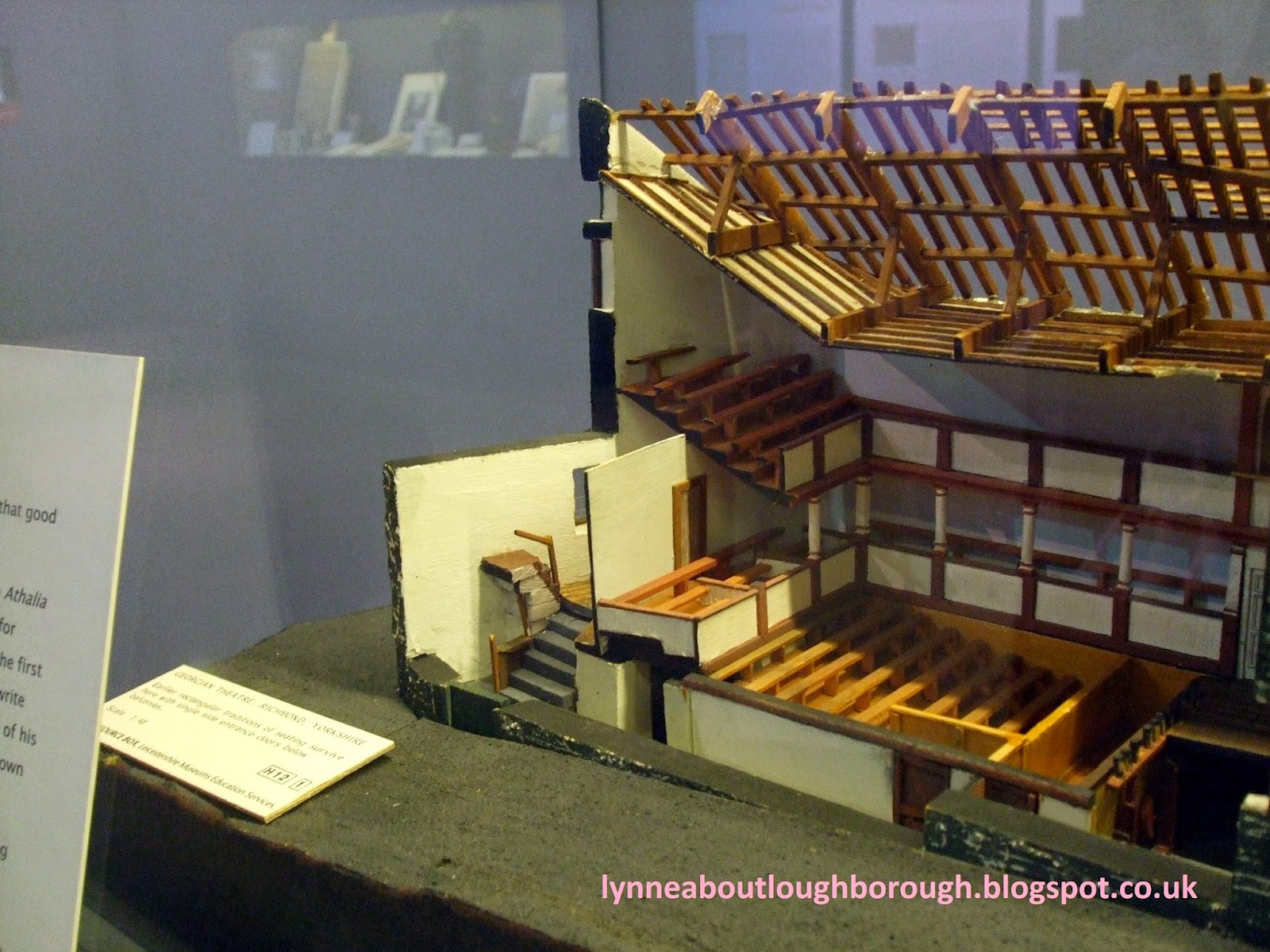
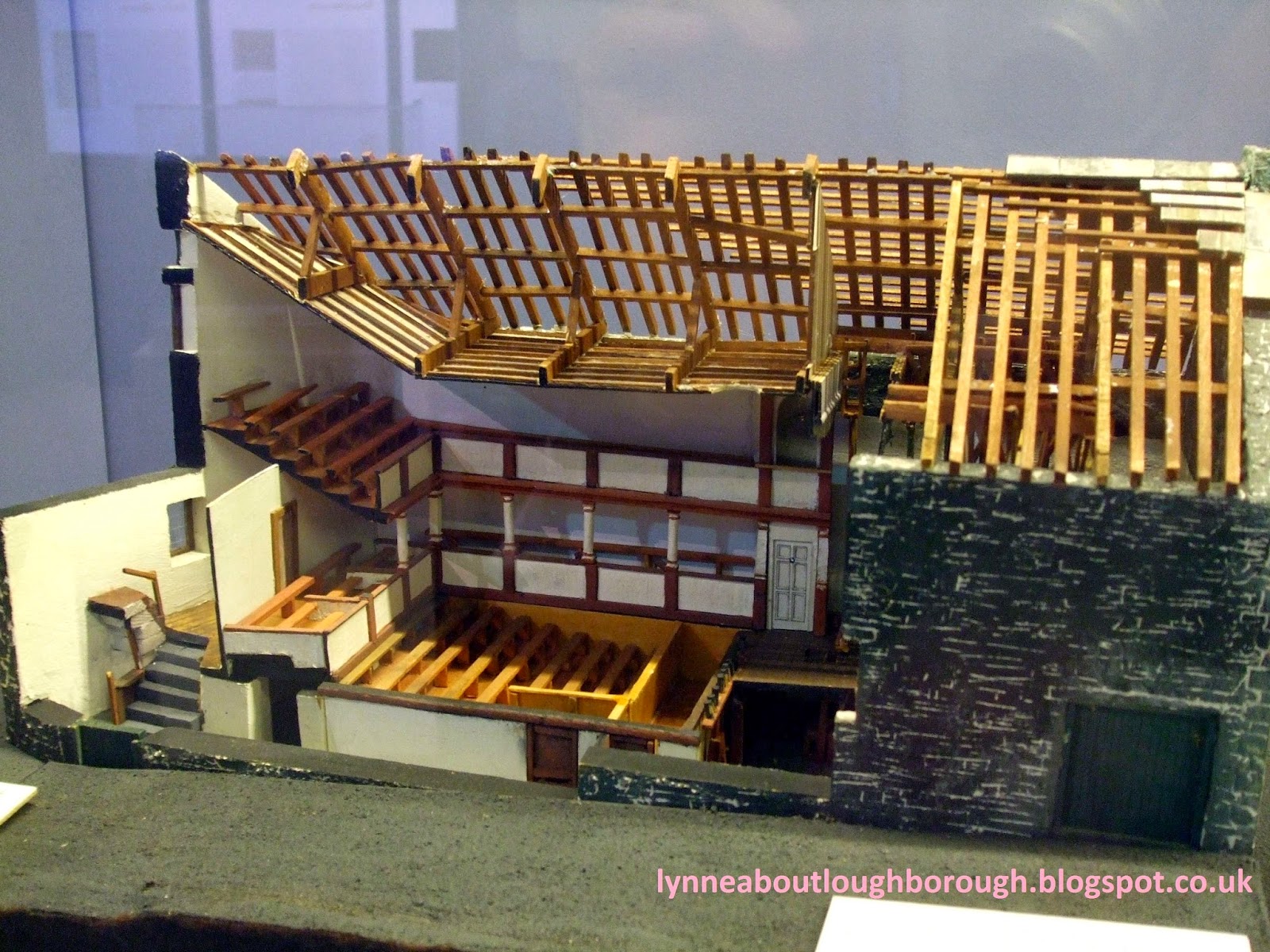
One of the things that excited me about the Jennens display was that there was a model of the Georgian Theatre in Richmond in the Music and Performance cabinet. This was fascinating because not only had the model been made by students of Leicester Polytechnic (now De Montfort University, where I have worked for the past 27 years), but they'd done this with the help of Richard Leacroft, who has written a number of books on the subject of theatre and cinema nationally, in Leicestershire, and in Loughborough, some joint authored with Helen Leacroft.


So, I expect you've guessed by now that this all has something to do with that international supermarket? And you'd be right! There exists in our little market town, a theatre based on the model of the Georgian Theatre in Richmond, which is hiding under a coat of crumbling white paint, a society's crest and posters of appealing groceries! I have to admit, the new inner relief road has also revealed an interesting view of our former theatre. Although the ground floor was added a very long time ago, and its use, as outlined above, has changed dramatically over the years, there is still apparently, evidence of the theatre in the basement. Now that the relief road has been built the rear of the theatre is quite evident and it looks juts so like the theatre in Richmond that there really is no doubt of its original purpose.

The former Sparrow Hill Theatre, now an international supermarket.

Close-up of the Oddfellows crest and first floor window lintels.

The rear gable of the Sparrow Hill Theatre seen in front of the Post Office exchange
Over the years there have been a number of theatres in Loughborough, but now only the Town Hall (formerly the Corn Exchange) still stands and is used as a theatre.

*A review of the performance appeared in the Edinburgh Review, No. CXXIII, Volume III of Wednesday, April 13, 1825. "Gladly would we give this piece, excellent as it is, the go-be, to relieve ourselves of labour; but as the benefits are approaching, we cannot withhold praise from those to whom it is eminently due; - therefore, we are bound to observe that Pritchard's Warlock, the Andrew Mucklestane of Mackay, and the Sandy of Denham were most meritorious. Lee's Donald and McGregor's Murdoch were both good, and Rae's Ruthven far from amiss."


**Master B Grossmith was actually Benjamin Grossmith (1825-1849?), the younger brother of William Robert Grossmith (1816-1899), and both were uncles to George and Weedon Grossmith, the brothers who wrote the popular "Diary of a nobody", which was published in book form in 1892. Both young Grossmith actors were billed as the "Young Roscius": Quintus Roscius Gallus (died BC 62) was a very successful Roman actor, and the epithet has become a term used for a successful actor. One of the most famous Young Roscius to appear in the late 18th and early 19th century was William Henry West Betty (1791-1874), popularly known as Master Betty. A young actor who followed in the footsteps of the Grossmith brothers was Master Henry Herbert (born 1822), who was particularly influenced by them as his father opened a boarding school in Reading, and since this was where the Grossmiths were born and lived, young Master Herbert was able to see them acting on stage. More recently, Daniel Radcliffe, aka Harry Potter, has also been described as a Young Rosicus.


Sunday, 20 April 2014

Handel's Messiah, Snibston Discovery Museum, Jennens and an international supermarket!

A couple of weeks ago I had the good fortune to be able to join in a mass sing through of some of the choruses from Handel's Messiah. And what a good sing this was! And what a wonderful venue!
My music score


The organisation, Music For Everyone (formerly Nottingham Choral Trust) offered the chance to local people for them to get together with a handful of proficient musicians and sing selected movements from The Messiah. There were literally hundreds of singers and we were separated into two groups, those with experience of singing, and those new to singing, each group being conducted by a very experienced conductor!


This is one you'll all know!

The enrolment fee was modest, the rehearsals were relatively short and the lunch superb! After about 4 hours of rehearsals, a public performance was given for friends and relatives who'd turned up to listen. This was also a treat for other people to, because the event took place in the wonderful Snibston Discovery Museum in Coalville, so visitors who'd come to the museum got an extra delight for their entrance fee!!


Of course, this meant that singers also had a reduced price entrance fee to the museum, and this was particularly relevant, as tucked away in a corner of the museum was a special exhibition about the life and times of Charles Jennens. Jennens, was a Leicestershire man, being brought up in Gopsall Hall, which I believe he had extended during his lifetime. Gopsall Hall was demolished in about 1952, and replaced by Gospall Leisure Park. But, Charles Jennens' memory lives on ... for he was a great friend of Handel, and wrote the words for that great Handel oratorio, The Messiah!

Today, there are a few small remnants of Gopsall Hall to be seen, which include the temple which was believed to have been where Handel wrote the Messiah. However, it seems to have been proved that actually the temple was built after the Messiah had been completed in 1741, and that although Handel frequently visited Jennens, there is little evidence that he actually stayed at Gopsall Hall. The temple, which was built as a homage to Jennens' friend Edward Holdsworth, a Latin poet and classical scholar, was the subject of a restoration in about 2003, and can still be visited today. 

The exhibition at Snibston was fantastic, being a commentary on Georgian life, a depiction of what Georgian entertainment was like, and a summary of the life of Charles Jennens. The relationship between Jennens and Handel also formed a large part of the exhibition.


One of the information boards.

I'm not sure how long this exhibition is on for, but it's well worth a visit. But then, so is Snibston worth a visit, before the museum in its present format is closed for good ... Here's the facebook page for the friends of the museum.

Did I say international supermarket?? Run out of time ... see next week's post for an exciting revelation in Loughborough!