Showing posts with label churches. Show all posts

Sunday, 25 May 2025

Robert Bakewell commemorative service

The previous post on this blog was a birthday blog for the 300th anniversary of the birth of Robert Bakewell, agriculturalist of Dishley. When I wrote the blog, I hadn’t had the pleasure of attending any celebratory events (apart from a very informative and interesting talk a few weeks earlier).

To mark the anniversary, there was a lovely service held at Dishley church, led by the Reverend Tim Day, vicar of Thorpe Acre church, Thorpe Acre church being the church which was built to replace the one at Dishley, around 1845, and designed by architect, William Railton. 


Amongst the people who congregated for the service were many local people, and children from the Robert Bakewell School. It was a gloriously sunny day – perhaps a bit too sunny, so a few of us sought out the shade!

A buffet lunch was held at Thorpe Acre church, where there were some superb information boards relating to Robert Bakewell, produced and exhibited by the New Dishley Society, and a celebratory cake!!


It's been quite a few years since I've been to Dishley church, so it was lovely to visit again. Here are some photos from the celebratory service.


At teatime, Leicestershire bellringers rang a quarter peal at Hathern church in honour of Robert Bakewell’s anniversary.

Extract from Ringing World, with thanks (1)

____________________________________

Notes

(1) https://bb.ringingworld.co.uk/view.php?id=1855332

____________________________________

Posted by lynneaboutloughborough

With apologies for typos which are all mine!

_______________________________________________

Thank you for reading this blog.

Copyright:

The copyright © of all content on this blog rests with me, however, you are welcome to quote passages from any of my posts, with appropriate credit. The correct citation for this looks as follows:

Dyer, Lynne (2025). Robert Bakewell commemorative service. Available from: https://lynneaboutloughborough.blogspot.com/2025/05/robert-bakewell-commemorative-service.html [Accessed 25 May 2025]

Take down policy:

I post no pictures that are not my own, unless I have express permission so to do. All text is my own, and not copied from any other information sources, printed or electronic, unless identified and credited as such. If you find I have posted something in contravention of these statements, or if there are photographs of you which you would prefer not to be here, please contact me at the address listed on the About Me page, and I will remove these.

External Links:

By including links to external sources I am not endorsing the websites, the authors, nor the information contained therein, and will not check back to update out-of-date links. Using these links to access external information is entirely the responsibility of the reader of the blog.

Blog archive and tags:

If you are viewing this blog in mobile format, you will not be able to easily access the blog archive, or the clickable links to various topics. These can be accessed if you scroll to the bottom of the page, and click 'View Web Version'. Alternatively, there is also a complete list of posts, which when clicked will take you to the page you are interested in.

Searching the blog:

You can search the blog using the dedicated search box that appears near the top of the blog when viewed in the web version. Alternatively, you can search using your usual search engine (e.g. Bing, Google, DuckDuckGo etc.) by following this example:

site: https://lynneaboutloughborough.blogspot.com/ “Radmoor House”

NOTE – the words you’re actually looking for must be in “” and the first of these must be preceded by a space

Thank you for reading this blog.

Lynne

Sunday, 11 June 2023

Building Stone

Sadly, I missed a recent talk hosted by the Friends of Charnwood Museum, about stone, so, I had a look back over the blog to see what I’d already written. I must admit, I thought I’d done a piece on Coade stone, an artificial stone, but find I haven’t so I’ve only mentioned it in passing in some posts, like [quote blog posts]. So, let’s have a quick look at some real local stone, and where it’s been used.

Old Rectory, Rectory Place

The 13th-century building was once the home to the rectors of Loughborough, having been passed to the church around 1228 by the Cortlinstoke family. By the time it fell out of use, around 1959, it had been extended enormously, and would have been a substantial family home, however, once unoccupied the building fell into disrepair and was partially demolished, revealing its earlier core, which has been retained.

The building you now see is said to be made of Bromsgrove Sandstone; North Charnwood Diorite; Charnian (volcaniclastic breccia); Charnian (volcaniclastic sandstone); Swithland slate; and Charnian (banded tuff).


All Saints with Holy Trinity, Steeple Row

This church is a 14th century building, probably built on the site of an earlier church, and it is here that the rectors of Loughborough would have done most of their work. over the years the church has been subject to many alterations, most notably that by architect Sir George Gilbert Scott in the mid-19th century. 20th and 21st century renovations have included those to the pinnacles on the belltower, and various new stones in the fabric of the building. I've written more extensively on a very early blogpost.

Stone that has been used in the construction of the church includes Millstone Grit; Triassic Red Sandstone; North Charnwood Diorite; Upper Lincolnshire Limestone; Charnian (metasediments0; Swithland slate, and Mountsorrel Granodiorite.


Holy Trinity Church, Moor Lane 

This church is no longer a religious building, but was once a busy church serving the Leicester Road area of Loughborough, opened in 1878, to a design by William Arthur Blomfield. You can find out a bit more about its history on an earlier blogpost.

The range of natural stone used in the construction of the church is much less varied than the Old Rectory and Loughborough’s All Saints church, comprising only of Mountsorrel Granodiorite and Upper Lincolnshire Limestone.


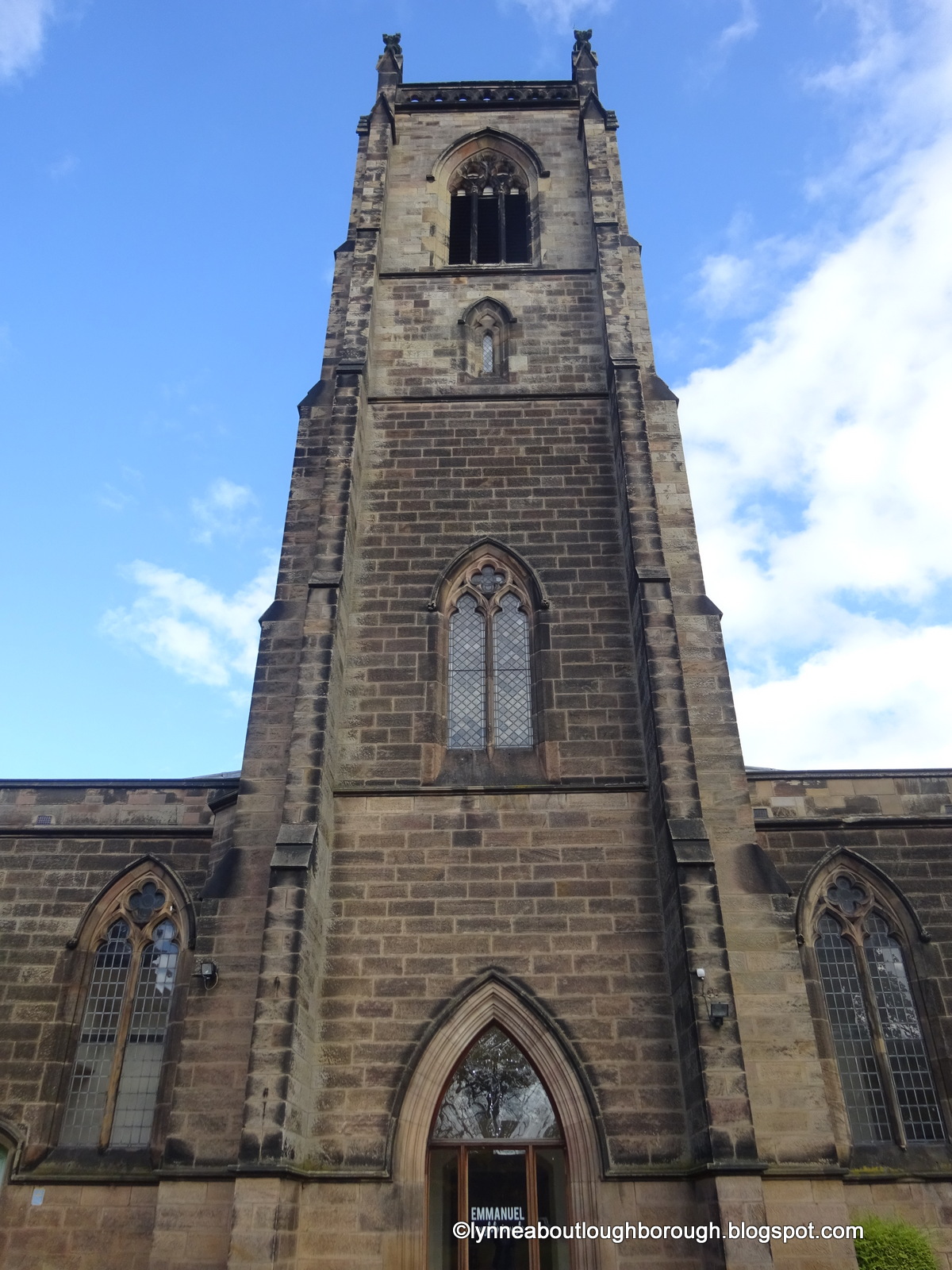
Emmanuel Church, Forest Road

The church was created around 1838, and its first rector was William Holme, who was also Rector of All Saints. The first Rector dedicated solely to Emmanuel was Reverend Bunch, who lived at the Emmanuel Rectory, on Forest Road, close to Mountfields House.  

I’ve not written much about Emmanuel church, but have done a couple of posts about the associated rectory. Part 1 and Part 2 

It appears that Emmanuel Church is constructed solely of Millstone Grit, but has a much later extension using other stone.


St Mary’s Nanpantan

St Mary’s church in Nanpantan started life as a Mission Hall, created by the Warner family of Nanpantan Hall, in 1888. Since 2015, St Mary’s has been a parish in its own right, so no longer connected to Emmanuel.

Using Charnian (volcaniclastic sandstone), St Mary’s is another church which is constructed only from one stone, that is until the 1960s when a granite Chapter House, with a flat-roofed vestry was built.


All Saints Thorpe Acre

This particular church is more usually known as Thorpe Acre church, and was built in 1845 to a design by William Railton, who was the architect responsible for the design of Nelson’s Column in London, and a number of other local Leicestershire churches. I've written extensively about Railton - here's one example post. The church, which replaced All Saints at Dishley (see below), is proud to have an east window, created in 1892 by Charles Eamer Kempe, and in the 1980s, the church was extended and joined to the school house.

All Saints, Thorpe Acre, was constructed using only Millstone Grit, until the extension was built.


All Saints Dishley

Dishley church is now a ruin, having been deconsecrated when All Saints Thorpe Acre was created in 1845. The ruins, which contain plaques to the agriculturalist, Robert Bakewell, are close to Dishley Grange Farm, which was part of the Garendon Estate.

The stone used in the construction of All Saints at Dishley includes Charnian (volcaniclastic sandstone); Diseworth Sandstone; Charnian (igneous); Triassic Red Sandstone; Cobbles (Bunter), and Bromsgrove Sandstone.  


_______________________________________________

posted by lynneaboutloughborough

With apologies for typos which are all mine!

_______________________________________________

Thank you for reading this blog.

Copyright:

The copyright © of all content on this blog rests with me, however, you are welcome to quote passages from any of my posts, with appropriate credit. The correct citation for this looks as follows:

Dyer, Lynne (2023). Building Stone. Available from: https://lynneaboutloughborough.blogspot.com/2023/06/building-stone.html [Accessed 11 June 2023]

Take down policy:

I post no pictures that are not my own, unless I have express permission so to do. All text is my own, and not copied from any other information sources, printed or electronic, unless identified and credited as such. If you find I have posted something in contravention of these statements, or if there are photographs of you which you would prefer not to be here, please contact me at the address listed on the About Me page, and I will remove these.

Blog archive and tags:

If you are viewing this blog in mobile format, you will not be able to easily access the blog archive, or the clickable links to various topics. These can be accessed if you scroll to the bottom of the page, and click 'View Web Version'. Alternatively, there is also a complete list of posts, which when clicked will take you to the page you are interested in.

Searching the blog:

You can search the blog using the dedicated search box that appears near the top of the blog when viewed in the web version. Alternatively, you can search using your usual search engine (e.g. Bing, Google, DuckDuckGo etc.) by following this example:

site: https://lynneaboutloughborough.blogspot.com/ “Radmoor House”

NOTE – the words you’re actually looking for must be in “” and the first of these must be preceded by a space

Thank you for reading this blog.

Lynne


Saturday, 25 July 2020

So who was Jane Lester of Loughborough?

After two weeks of being on holiday, last week saw me back at work - well, working from home at least. Having taken loads of photos on a daily basis during my watery holiday in Loughborough, I spent a bit of time this week looking back at these, and was reminded of some Loughborough-related things I happened upon while I was discovering watery areas close to Loughborough.

One of our holiday days saw us parking in Shardlow, and walking along the canal and river to Trent Lock. On the way back, we took a slightly different route which meant walking through the field next to the towpath. The cows were gorgeous, and the view of the church as we approached Sawley was very attractive. 

Church of All Saints, Sawley, in the distance

Sawley church and cows rushing to the drinking trough


Reaching the end of the field, and coming out onto the road we headed off towards the church of All Saints. The approach to the church, through an avenue of trees and passing the Old Rectory, which is a Grade II listed building, constructed in 1823 with later 19th century additions, was stunning, and reminded me a little of the approach to Kirkby Mallory church, the burial place of Ada Lovelace, daughter of Lord Byron.

Tree-lined approach to the church at Sawley

The Old Rectory at Sawley


Anyway, given the current situation, we weren't expecting the church to be open, and although the door was ajar, we didn't venture inside. The churchyard is now closed to new burials, and maintenance of the grounds now rests with the Borough Council. The churchyard was, of course, open to visitors, so we had a look around. How lovely it was to see a few examples of Swithland slate gravestones, as well as those made of Welsh slate and local stone.

Siwthland slate headstones in the foreground, Welsh slate in the distance

Detail from a Swithland slate headstone in Sawley churchyard


Doing the circuit of the churchyard, right at the end of the route I stumbled across a headstone of Welsh slate that particularly grabbed my attention: 

The gravestone of Jane Lester and Harriet Roe


Interesting that Jane Lester was 'late of Loughborough', so why was she buried in Sawley? And who was Harriet Roe? An investigation into Jane Lester has revealed many snippets of information, but some remains elusive. Here's what I have discovered so far. Sadly, it's only the information pertaining to her family and where they lived, as in order for more information to be available, one would need to have been a member of the nobility or aristocracy, or in the public eye (like a publican) or perhaps a criminal, and, as you will see, neither Jane nor Harriet were none of these.  

Jane was born in around 1819, in Shepshed. Her husband-to-be, Stephen Lester, was born around 1816 in Long Whatton. Stephen's father, William, was a baptist, whose own birth was recorded in the baptist registers. I am wondering if this might be why I can't find Stephen and Jane's marriage anywhere. Information in later census returns points me in the direction of Jane's surname being either Oram or Mills, but further investigation has proved neither conclusively.

STOP PRESS! Thanks to a very kindly friend, Stephen and Jane's marriage record has now been found, and it confirms that Jane was born Jane Mills, in 1818, and she was baptised on 25 August that year. Her parents were William Mills, a carpenter, who was also born in Shepshed in 1793, and Hannah Chester, who married William on 31 October 1815.   

Anyway, by 1841, Stephen and Jane were living in the same house on Brook Street, in Shepshed, and Stephen is a framework knitter. The nine-year old girl, Milicent (spelled Melicent on the census return) listed as being at the same property the night the census is taken, is actually Stephen's sister, who later marries a man from Loughborough, where they make their home.

By 1851 Stephen, listed specifically as a framework knitter in cotton on the census return, and Jane are lodging with someone called Mary Oram and Mary's nephew, James Mills, a potato dealer, in Brook Street, Shepshed. Stephen and Jane have five children: Isaac; William; James; Elizabeth and John, ranging from age 9 (Isaac) to a baby (John).

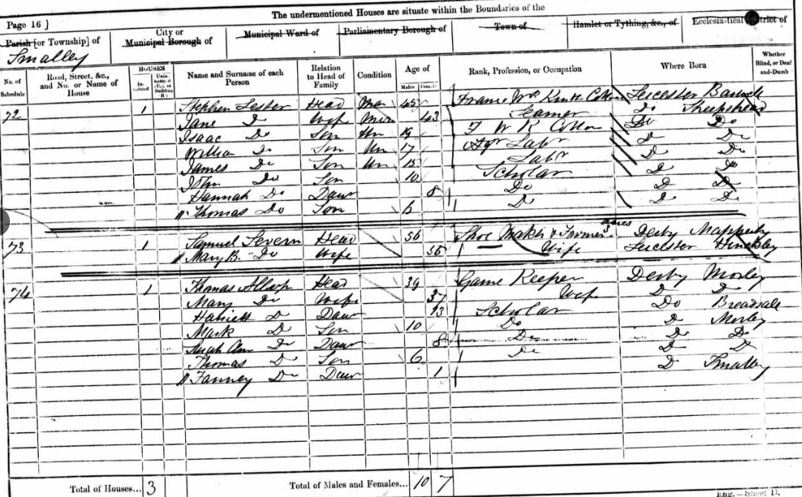
On the 1861 census return, Stephen and Jane, and their children - Isaac (a framework knitter), William (an agricultural labourer), James (a labourer), and John, Hannah and Thomas who were all school-aged. They are no longer living in Shepshed, but have moved to Smalley in Derbyshire, which is a small village on the main A608 Heanor to Derby Road, being situated just over 2 miles to Heanor itself. Maybe Stephen was working for the firm of I&R Morley who had recently opened a factory in Heanor in 1860, but this is purely speculation on my part. 

1861 census return
 

In 1871 Jane and Stephen are living at 8 Regent Street in Loughborough, along with four of their children, Isaac and John, and Hannah who is now a dressmaker, and Thomas, who is a painter. Stephen's father, a retired framework knitter, is also listed at the property on the night of the census. Stephen's father died in 1878, and in 1881, Stephen and Jane are living alone at the property on Regent Street. The 1891 census shows them as living at 10 Regent Street, but whether they have moved, or whether the house numbering has changed is unclear.

In 1898 Stephen dies, and his death is registered in Loughborough, in the April, May, June quarter. As we already know, Jane died shortly after her husband, on March 28 1899, at Sawley.

So, what is the connection between Jane and Harriet Row with whom she shares a grave in Sawley?

Investigation shows that it is Stephen and Jane's son, James, who links the two families, through his marriage to Rosetta Roe. This event happened on 30 May 1868 in Shardlow, and the couple move to Normanton, near Derby, which is about 10 miles from Sawley and 13 from Shardlow. Rosetta's father is listed on the marriage document as Joseph Roe.

James and Rosetta's marriage, 1868


Joseph Roe was born in 1816 in Smalley to parents Joseph and Millicent. By 1841 he has married, and he and his wife are living in Scropton, Derbyshire (about 20 miles from Smalley) where Joseph is working on a farm. They have a six-year-old son, William. The 1851 census has the family living in Normanton (near Derby), and includes children William, Thomas, Ann, Rosetta and baby Joseph.

The whereabouts of the family in 1861 is a little less clear, but they might still be living in Normanton, with older children William, Ann and Joseph, and three younger children, Mary, Charles and James. 

There is a more positive listing of the family in 1871 when Joseph and his wife are living with two of their sons, Charles (15) and James (11). Other people listed at the property on the night of the 1871 census are James Lester, son of Stephen and Jane, his wife, Rosetta, daughter of Joseph, and their baby daughter, Emma.

James and Rosetta on the night of the 1871 census
 

In 1881, Joseph and his wife are living in Barley Row, Normanton, with their son, Charles, and next door to Charles Roe and his wife Elizabeth, Charles maybe being Joseph's younger brother. By the time of the next census, taken in 1891, Joseph and his wife are living with their son Charles in Normanton. 

I haven't definitely established Joseph's date of death, but it is likely his death was registered in Shardlow in 1893. He left behind, his wife, Harriet Roe, Joseph and Harriet being the parents of Rosetta Roe who married James Lester, son of Stephen and Jane. 

Given the message on the gravestone, and the entry in the local newspaper, I can only assume that Harriet, who lived at Normanton, was visiting Jane in Sawley, or perhaps staying with her for a while, and both died in March 1899, although the dates vary slightly.

Long Eaton Advertiser, 15 April 1899


Funny the things you discover on holiday!!!

You are welcome to quote passages from any of my posts, with appropriate credit. The correct citation for this looks as follow:

Dyer, Lynne (2020). So who was Jane Lester of Loughborough? Available from: https://lynneaboutloughborough.blogspot.com/2020/07/so-who-was-jane-lester-of-loughborough.html [Accessed: 26 July 2020]

Take down policy:
I post no pictures that are not my own, unless I have express permission so to do. All text is my own, and not copied from any other information sources, printed or electronic, unless identified and credited as such. If you find I have posted something in contravention of these statements, or if there are photographs of you which you would prefer not to be here, please contact me at the address listed on the About Me page, and I will remove these.

If you wish to leave a comment, please do so in the comments box that appears below this blogpost. Alternatively, you can contact me via lynneaboutloughborough[at]gmail[dot]com.

Thank you for reading this blog. 

Lynne     
 

Sunday, 5 November 2017

Churchyards

The last couple of weeks have been really busy, and I've been out and about a bit, but not so much in Loughborough. Churchyards have been on the itinerary, looking especially for Swithland slate gravestones. 

Here's some photos from Woodhouse Eaves churchyard:

Gravestones

Gravestones

Gravestones

Gravestones

Gravestones

Gravestones

Gravestones

Gravestones

Gravestones

Here are some from Woodhouse churchyard:
Gravestones

Gravestones

Gravestones

Gravestones

Gravestones

Gravestones

Gravestones

These are from Rothley:

Gravestones

Gravestones

Gravestones

Gravestones

Gravestones

Gravestones

Gravestones

Gravestones

Church


You are welcome to quote passages from any of my posts, with appropriate credit. The correct citation for this looks as follow:

Dyer, Lynne (2017). Churchyards. Available from: https://lynneaboutloughborough.blogspot.com/2017/11/churchyards.html [Accessed 5 November 2017]
Take down policy:
I post no pictures that are not my own, unless I have express permission so to do. All text is my own, and not copied from any other information sources, printed or electronic, unless identified and credited as such. If you find I have posted something in contravention of these statements, or if there are photographs of you which you would prefer not to be here, please contact me at the address listed on the About Me page, and I will remove these.
Thank you for reading this blog. 

Lynne