Showing posts with label John Heathcoat. Show all posts

Sunday, 25 February 2024

Loughborough's K6 telephone kiosk

Brief history of the telephone kiosk

There were several versions of the telephone kiosk created, ranging from the K1 released in 1912, through to the K8 created in 1968, to the KX100, the last to be designed in the 1980s.

The Grade II listed telephone kiosk at Loughborough railway station is of the K6 variety, and was made by the Carron Company of Stirlingshire, who were also responsible for many of the letter boxes that can still be found around the country [1].

Initially, telephone kiosks weren’t standardised, and early ones were sometimes made of wood, and looked like garden sheds! A company called the National Telephone Company (NTC) began the process of trying to standardise the kiosk design, and they created three models: the Birmingham, the Norwich, and the Wilson. Then, around 1912 the General Post Office (GPO) took over from the NTC and successfully standardised the kiosks, and began the numbering of the designs, starting with the K1, which started to appear around 1920. However, this K1 design, which had three concrete panels and a wooden door, a pyramid roof, sometimes thatched, is probably very unlike the ubiquitous red telephone kiosks like ours at Loughborough railway station.

For some reason, the K1 design wasn’t very popular and so in 1924, the GPO held a competition for a new design. The competition was won by Giles Gilbert Scott, grandson of Sir George Gilbert Scott who was responsible for Victorian renovations to many churches. The competition winner was knighted that same year after the consecration service at the new Liverpool Cathedral which he had designed, but which wasn’t completed until 1980. The new K2 kiosk was made of cast iron with a wooden door, had a domed roof and was painted red! However, the kiosk was large and expensive, and really only took off in London, so Giles Gilbert Scott then designed the K3, introduced in 1929.

The K3 was smaller than the K2 and was made from concrete. It was painted in cream, with the metal frames of the glass panels – of which there were 6 rows of three equal sized ones in each of the three glazed sides – highlighted in red. However, the K3 design only lasted for about six years, until about 1935, as the box tended to be rather brittle.

The K4 telephone kiosk, was designed by the Engineering Department of the General Post Office, and its production overlapped with that of the K3. Essentially, the kiosk followed the design of Gilbert Scott’s K2, but was constructed from cast iron, and had a stamp dispensing machine as its rear ‘wall’, so it was very large, and had to be placed so access could be gained from all four sides. The kiosk was painted entirely red, and had six rows of three panes of equal sized glass panes. However, the K4 was not hugely successful, partly due to the noise of the stamp machine which interfered with telephone conversations, the stamp machine not being waterproof, and the kiosk generally being overly large – and nicknamed the ‘Vermillion Giant’ – and only about 50 were ever produced.

The K5 can hardly be said to have been any more successful than the K4, and in fact, it never actually reached full-scale production. Had it gone into full production, the kiosk would probably be made from concrete, however, the design only ever reached the metal-faced plywood stage. In a design change from the earlier kiosks, the K5 was not fully glazed on the three normally glass sides, but had a window of two rows by two columns, rather like a house window.

Our K6 telephone kiosk

And so we come to the K6 kiosk, which is the design outside the Midland Mainline station at Loughborough. Although it looks perfectly normal, it does strike me as being a little odd because I would have expected the door to be on the front so when opened the dail and handset etc. are straight in front of you, but strangely, the door is actually on one of the sides, so you have to sidle up to the wall to get in! (see pic below). And I've just discovered why this is! In 1939, the K6 design was modified, resulting in a Mark 2 with several new versions:

Mk2 - K6A - the door is fitted opposite the back panel and is hinged, and therefore opens, to the left

Mk2 - K6B - the door is fitted opposite the back panel and is hinged, and therefore opens, to the right

Mk2 - K6C - the door is fitted as the lefthand side panel and is hinged, and therefore opens, to the left

Mk2 - K6D - the door is fitted as the righthand side panel and is hinged, and therefore opens, to the right

Interestingly, this kiosk is still in use as a telephone, but its original rotary handset and coin buttons (A for money in, B for returned coins) have been replaced. You can just about see the number punchpad through the glass on the first picture below:


What the inside would have originally looked like

There were originally detailed instructions on how to use the telephone, as well as a list of all the dialling codes, mounted inside the kiosk.

Instructions for use!

The K6 is really the one which came to be the iconic ‘red telephone box’ that we know today. It was designed in 1935, in celebration of the silver jubilee of King George V, who had come to the throne in 1911. The K6 was another box designed by Giles Gilbert Scott, who had designed the earlier boxes. The K6 was commissioned by the General Post Office, and 8,000 jubilee boxes came to our streets in jubilee year, 1936, sited in the towns and villages that actually had a Post Office.

These K6 boxes were mounted on a concrete base, and were rectangular in shape, being made of cast-iron sections (except for the door which is actually made from teak) that are bolted together. Each piece of the kiosk is numbered, perhaps to ensure that each piece was attached during construction to the right piece!


Three of the four sides of the box are glazed, with 8 rows of glass on each side, and each side having a larger glass panel sandwiched between two small panels. The box has a domed roof and a teak door, which has a metal cup-shaped handle.

A foundry plate, showing the name of the company that made the box – in our case, the Carron Company of Stirlingshire - can be found on the back of the box, towards the bottom.


The front pediment, above the door, bears a moulded St Edward’s crown. Since the K6 was produced until 1968, and as Queen Elizabeth favoured the use of the St Edward’s Crown over the Tudor Crown, kiosks produced since 1953 bear the St Edward’s Crown. This helps us to date the railway station K6 kiosk as having been produced between 1953 and 1968.


1937 was the 300th anniversary of the Post Office, and in celebration of this another 1,000 K6 boxes were installed over a period of 12 years, provided that the local authority paid a subscription of £4 over a 5-year period. Sadly, the original K6 was prone to being damaged, so a Mark II was developed and introduced in 1939, a design which was slightly more damage resistant.

Having said that the red K6 is iconic and familiar, in 1949, some rural boxes were painted in different colours, and some later ones in green and battleship grey. Over time, the K6 began to look dated, and production stopped, by which time - 1968 - around 60,000 boxes of the K6 design had been installed.

The moulded crown on the domed roof of the kiosk was originally painted in red, but since the early 1990s, in recognition of the heritage value of the iconic red telephone kiosk, British Telecom have highlighted the crown in gold paint. Ours is still red, however (see pic above).

In the late 1950s, the General Post Office began to consider a new design for the telephone kiosk, and initially chose a design for the new K7 by Nevill Conder, which was a square affair, intended to be constructed from aluminium and glass. However, the K7 never entered full-production, and only about a dozen prototypes were produced. This was mostly because aluminium became discoloured and stained in the British climate, making the K7 quite unsuitable.  Enter the K8 …

The K8 was designed by Bruce Martin, but rather than using aluminium as he suggested, the K8 was constructed of cast-iron sections which were bolted together, and mounted on a concrete base that was slightly narrower than the kiosk itself. The kiosk was three-quarter glazed on three sides, is rectangular in shape, and is painted red. In all, around 11,000 K8 kiosks were installed across the country.

When British Telecom took over the public telephone network from the General Post Office in 1985, a new kiosk, the KX100, was introduced. Its frame was made from aluminium, which was clad with stainless steel panels, the back panel which reached the ground, being made from stainless steel, and the other three sides, which didn’t quite reach the ground, and provided ventilation, were made of glass, and included a ‘modesty panel’.  Further variations of the KX100 – the KX100+ - having a domed roof, appeared between around 1996, which offered the customer the option of either paying for their call using cash or card, and also offering access to the internet. By 1999, there were just under 150,000 KX100 and its variants in existence.

Today, as people move to using mobile telephones, thus reducing the need to have a public telephone kiosk on every street, many of these public telephone kiosks have been, and are being converted. Popular conversions include use as a housing for defibrillator equipment, small libraries or book exchanges, tourist information kiosks, museums, or even small coffee vending machines!

A K6 in use as a tiny library near Carn Brea, Cornwall [2]

A K6 with a gold crown, in use as a defibrillator in Melton

News of a Leicester hero being celebrated in a tiny K6 museum in Hereford!

And here are some KX100s in Loughborough - the one on Cattle Market and those outside the Sparrow Hill post office.


More about the architect

Giles Gilbert Scott (1880-1960) grew up on a farm in Sussex, and attended a Jesuit school in Windsor.  Giles was the son of architect George Gilbert Scott (jnr.), and grandson of Sir George Gilbert Scott the Victorian architect mostly remembered for his renovation of churches. The latter was involved in the re-ordering and renovation of our own parish church, and along with W. Bonython Moffatt, also designed Loughborough’s Union Workhouse on Regent Street.

Giles’ mother was keen that he also followed the family tradition and encouraged him into the world of architecture. He was articled to the architectural firm of Temple Moore, and at the age of only 22 he won the competition to design the new cathedral at Liverpool. As Giles was a Roman Catholic, the competition committee assigned a joint architect, G. F. Bodley, but Bodley died 4 years into the build, and Giles was able to modify the original design. Liverpool Cathedral was not completed until 1980, so Giles didn’t get to see the completion of is design.

Giles was knighted in 1924, and was President of the Royal Institution of British Architecture (RIBA) for a time. Some of his other designs include religious buildings, like the Catholic Cathedral in Oban; the chapel at Charterhouse School in Godalming, Surrey, and the church for Ampleforth College. While his secular buildings include Chester House in Clarendon Place, London; Waterloo Bridge; the library for Clare College, Cambridge; the Bodleian Library at Oxford, and Battersea Power Station, which, rather like the red telephone box, is an iconic structure!

It is interesting to note that the website maintained by the Gilbert Scott family has as its logo, a red telephone box!

____________________________________

Notes

[1] I wrote a series of posts about those iconic letter boxes in October and November 2022. Here's the list:

Part 1

Part 2

Part 3

Part 4

Part 5

The case of the Burton Street box

Unusual and unreal letter boxes!

[2] Another connection with Loughborough is that the manufacturer, John Heathcoat, who took his lacemaking business to Tiverton in Devon after the Luddite riots, opened another factory in 1934, this time in Carn Brea - see picture below.

____________________________________

Posted by lynneaboutloughborough

With apologies for typos which are all mine!

_______________________________________________

Thank you for reading this blog.

Copyright:

The copyright © of all content on this blog rests with me, however, you are welcome to quote passages from any of my posts, with appropriate credit. The correct citation for this looks as follows:

Dyer, Lynne (2024). Loughborough's K6 telephone kiosk. Available from: https://lynneaboutloughborough.blogspot.com/2024/02/loughboroughs-k6-telephone-kiosk.html [Accessed 18 February 2024]

Take down policy:

I post no pictures that are not my own, unless I have express permission so to do. All text is my own, and not copied from any other information sources, printed or electronic, unless identified and credited as such. If you find I have posted something in contravention of these statements, or if there are photographs of you which you would prefer not to be here, please contact me at the address listed on the About Me page, and I will remove these.

External Links:

By including links to external sources I am not endorsing the websites, the authors, nor the information contained therein, and will not check back to update out-of-date links. Using these links to access external information is entirely the responsibility of the reader of the blog.

Blog archive and tags:

If you are viewing this blog in mobile format, you will not be able to easily access the blog archive, or the clickable links to various topics. These can be accessed if you scroll to the bottom of the page, and click 'View Web Version'. Alternatively, there is also a complete list of posts, which when clicked will take you to the page you are interested in.

Searching the blog:

You can search the blog using the dedicated search box that appears near the top of the blog when viewed in the web version. Alternatively, you can search using your usual search engine (e.g. Bing, Google, DuckDuckGo etc.) by following this example:

site: https://lynneaboutloughborough.blogspot.com/ “Radmoor House”

NOTE – the words you’re actually looking for must be in “” and the first of these must be preceded by a space

Thank you for reading this blog.

Lynne

Sunday, 4 October 2020

So who was Bernard Nixon Wale?

... obviously a man with Loughborough connections!!

Bernard Nixon Wale was born in Willoughby-on-the-Wolds in 1872, to a farming family. He studied at a variety of institutions, and worked in a wide variety of places across the country in a number of different roles, before returning to Loughborough in the early 1930s. There are many connections to Loughborough, some of which are outlined below.  

Focussing on just one of his positions: in 1909 Bernard Nixon Wale was appointed to the post of Principal at the Seale-Hayne AgriculturalCollege in Newton Abbot, a college which was to be created from an endowment of Mr Seale Hayne, and which had seen much delay in its creation. When the news of his appointment was announced, Bernard Wale was described in the press very favourably:

“He is a young man for the hight post, only 37 in fact, but he has a good London degree in science, and has shown great ability successively at London University, the Midland College, and the Wye College (Kent and Surrey). He also holds the Cambridge diploma for agricultural science.” – ‘London Evening Standard’ 27 December 1909, pg 3

“In making this choice [Bernard Wale, BSc. of the South Eastern Agricultural College at Wye, Kent] the governors have no doubt selected a gentleman particularly qualified for the post. He has had a brilliant career, and has come through numerous examinations with flying colours, and, what is very important, he has a thorough practical knowledge of agriculture. Naturally, as the son of a farmer, he had every opportunity to become intimately acquainted with this work, and four years he spent exclusively on a farm of some 200 acres, where all kinds of agricultural work were carried out, including the breeding and rearing of farm stock, sheep feeding, corn and root-growing, and dairying. For eight years he had the management of the land in connection with the Brewood Grammar School, Staffs., and during that time he purchased the stock, seeds and manures which were needed. Mr Wale has, further, had extensive experience in experimental work, including the manuring of grass, roots, and cereals, pig feeding, milk production and research work on cheese discolouration by bacteria. Nor is the new Principal unknown as a writer, for in the agricultural press have frequently appeared articles from his pen touching, amongst other things, catch cropping, the financial aspect of sheep washing, and the variation in the quantity and quality of milk.” – ‘Western Times’ 26 November 1909, pg 7

But it is the report a week earlier in the same newspaper – ‘Western Times’ 20 November 1909, pg 2 – that clearly links Bernard Nixon Wale with Loughborough:

“The new Principal, who is 38 years of age, has had a distinguished career, and was highly recommended. Educated at the Grammar School, Loughborough, Leicestershire, he was for three years, 1892-1895, at Cambridge University as a student of the Cambridge and Counties Agricultural Scheme.”

According to this report he was also a student at the Midland Agricultural and Dairy College in Kingston, Derby, and at the University College, Nottingham. The article goes on to mention every possible educational attainment and accolade that Bernard Wale had ever achieved, as well as information about his practical knowledge, which it said was:

“ … extensive. As a farmer’s son he has always had a very intimate practical acquaintance with farm work and farm management of every description. Four years were exclusively spent on a farm of 200 acres … For two years (1896-1898) he was in close touch with the method of farming adopted on the Midland Agricultural and Dairy College Farm; and for eight years (1898-1907) he was managing the land in connection with the agricultural side of Brewood Grammar School, Staffs., including the purchasing of stock, seeds and manure necessary for the same. Since 1908 he has had the joint management of Wye College Farms of 460 acres.”

In addition to his lecturing work, he has been engaged in experimental work:

“In regard to his experimental work and organization he has been engaged at the Midland Agricultural and Dairy College in carrying out experiments on manuring for hay, pig feeding, and milk production; research work on cheese discolouration by bacteria; and the tabulating of results and drawing up reports on the same. Organising experimental work on the agricultural side at Brewood included – the manuring of grass, cereals and roots, a comparison of yields from different varieties of farm crops, and sheep feeding experiments. He has also been engaged in the planning of pupils’ garden and field plots, bee-keeping and poultry; in field days and demonstrations to farmers on the experimental plots, and charlock spraying on selected farms; in arranging of local classes in dairying and hedge layering (including a course of lecture to elementary school teachers on ‘Insect pests’.). Being the first agricultural instructor appointed to Brewood he had the sole organisation of classes and subjects to be taught, with the general arrangement of timetables, the drawing up of prospectuses and reports of experimental work. At Wye College he was engaged in the organisation of the agricultural teaching in the lecture room and on the farm for four assistants, the latter including the arranging of classes in ploughing,  mowing, sheep shearing, hedge layering, land draining, milking and butter making. …”

The report goes on to say that Bernard Wale also did advisory work with farmers and others, and has:

“…written a good deal for the agricultural press, his contributions including: reports on experimental work; variation in the quantity and quality of milk, catch cropping etc.; autumn cultivation as affecting the water supply of the soil; mendelism in plant and animal breeding; plants in enclosed spaces etc.; and the financial aspect of sheep washing … Mr Wale … has had a thorough theoretical and practical training … he is an enthusiastic teacher. ‘There are’ Professor Turner [says] ‘few men to whom I could more willingly commit a son of my own, as I should feel certain that his education would be well attended to, and that the moral effect of Mr Wale’s teaching would be excellent. I may add that Mrs Wale is a lady of educational experience and refinement, and that her interest in connection with the college would be of the very best.’”

The article finishes with a list of the testimonials received from many, many influential people, in support of Bernard Wales, including from Professor G D Living, MA, FRS, who was Professor of Chemistry at Cambridge University.

Reading about Bernard Wale’s experimental work and advisory work, particularly into plant and animal breeding reminds me so much of the work that Robert Bakewell of Dishley did into the breeding of sheep, cattle and heavy horses, and his work with turnips! More about Robert Bakewell is in an earlier blogpost.  

Robert Bakewell in mosaics

Back to Bernard! Although Bernard Wale was appointed to be its Principal in 1909, Seale-Hayne college was not actually built until 1919, its construction timescale being disrupted by the First World War. Thus, Bernard Wale found himself undertaking a variety of duties which included lecturing in various places, like Linfield, and Torquay Museum, and to groups like the Mutual Improvement Association of Ashburton. He also judged agricultural and horticultural shows, like that at Islington. Bernard Wale presided over the annual event of the Newton Abbott Men’s Own Brotherhood, chaired the YMCA meetings, and was part of the Royal Sanitary Institute 28th annual congress executive committee, which event took place in Exeter.

In his capacity as joint livestock officer for Devon and Cornwall he visited Helston where he explained about the government’s Development Fund to the Helston Farmers’ Union. Bernard Wale was a member of the Primrose League and attended the annual meeting in Sheffield. He also attended and presented at farming conferences, e.g. at Newton Abbott.

During the First World War, Bernard Wale wrote a letter to the “Western Morning News” of 22 February 1916 expressing astonishment that the council allowed the lights of Newton Abbott to shine out: far from being as glaring as ever, he suggested they were even more glaring than a year ago. He questioned the use of lighting in specific locations, including Wolborough and Knowles hills, which, in his opinion, would:

“… invite the attention of the enemy. This was not the time to consider the dividends of the lighting companies.”

Bernard Wale was not alone in his concerns, which were shared by various inhabitants, like Mr W Eggington suggesting that “it was indiscreet to have the place all lighted up again, just when the raids had commenced”

Unlike Loughborough, which was hit by Zeppelins bombs on the night of 31st January 1916, Newton Abbot was not targeted by Zeppelins. 

Zeppelin raid on Loughborough, commemorative plaque unveiled January 2016


As Loughborough trained women to become munitions workers, so Bernard Wale offered the opportunity to women to be trained to work the land. In a letter printed in the “Exeter and Plymouth Gazette” of  8 May 1916, pg 3, Bernard Wale makes an offer from his college:

“… it becomes increasingly important to safeguard our home-grown food supply, and if the men must go [to the Front] … women must take their place. Already there are many women who have volunteered for farm work, or have shown their readiness to learn, but many more will be required … The women of our Allies, and also of our enemies, are working on the land and thus setting free their relatives for the fighting lines, and I believe that our women will do the same …”

However, Bernard identified a problem:

“ … there is one thing lacking amongst our farmers – a more sympathetic attitude towards women’s employment on the land.”

He did however acknowledge that:

“ … Many [farmers] see quite clearly the necessity of utilising women on their own farms … some women … can do really efficient work on the land after a short training, combined with patience and sympathy on the part of the farmer.”

Bernard was keen to make an offer:

“ … with the approval of the Board of Agriculture and the County Councils of Devon and Cornwall, and also as a war emergency measure, the Governors of Seale-Hayne College are providing a month’s course of practical instruction for women in farm work on the College farm. There is to be a succession of courses, each of four weeks’ duration, and after their training it is stipulated that these students shall work on farms for a period of at least three months, provided a suitable offer of employment is made at a reasonable rate of wages”

The instruction on offer was pretty extensive and included:

“… milking, dairying, calf, pig and poultry feeding, grooming, feeding and  harnessing of horses, harrowing, rolling, hoeing and harvesting according to season, and other lighter branches of farm work.”

Following the publication of this letter in the newspaper, at meeting at Kingsteignton, both Bernard Wale and his wife Edith talked about training women to work on the land:

“… Mrs Wale … urged the women to augment the food supply by working on the land, whole or part-time, by cultivating their gardens, by keeping poultry or pigs, and by helping in the harvesting, and always do what they could to prevent waste.” – ‘Exeter and Plymouth Gazette’ 2 June 1916, pg 12

According to the ‘Military Times’ of 30th November 2018, the First World War was arguably the first ‘total war’. John Heathcoat’s factory in Tiverton, which had moved to the town in 1816, following the Luddite attacks, was Tiverton’s largest employer in 1914, and it switched from the production of the lace for which it was well-known, to the production of munitions, and with many men away from home, fighting abroad, it was women who were working the machines.

Re-enacting the Luddite attacks on Heathcoat's factory in Loughborough, Chorus Theatre

Throughout the period 1909-1914, work on the actual Seale-Hayne college buildings was either proposed or taking place. In 1911 between 60 and 70 applications were received for the college building design. Prizes of £100, £50 and £30 were offered by the college governors for the best sets of plans. The cost of the proposed building was not to exceed £20,000, although future extensions, at a cost of £10,000 were an integral part of the submissions.

In 1912 the college was inviting tenders for the laying of about 2,800 yards of 3-inch cast-iron pipes! The plans were available to view at the public library, and the exact specifications were available from Bernard Wale.  

In the event, the Seale-Hayne college buildings were completed between 1912 and 1914, but the first students did not attend until 1919.

Although we have seen some connections with Loughborough – Bernard Wale’s attendance at the Grammar School, Zeppelin bombing during 1916, and Heathcoat’s lace-making factory in Tiverton, and similarities with Robert Bakewell, come by next week to learn more about Bernard Wale’s family, his connections to many different Loughborough families and about his residence in Loughborough.

In relation to Zeppelins, Heathcoat and Robert Bakewell, you can follow the virtual plaque walk which will take you to the commemorative plaques related to these people and events, and there is a virtual walk specifically related to the Zepplin raid, and to the Luddite attacks.  

You are welcome to quote passages from any of my posts, with appropriate credit. The correct citation for this looks as follow:


Dyer, Lynne (2020). Who was Bernard Nixon Wale? Available fromhttps://lynneaboutloughborough.blogspot.com/2020/10/so-who-was-bernard-nixon-wale.html [Accessed 4 October 2020]

Take down policy:

I post no pictures that are not my own, unless I have express permission so to do. All text is my own, and not copied from any other information sources, printed or electronic, unless identified and credited as such. If you find I have posted something in contravention of these statements, or if there are photographs of you which you would prefer not to be here, please contact me at the address listed on the About Me page, and I will remove these.

You can leave comments below, but do check back as my reply will appear here, below your comment.

Thank you for reading this blog. 

Lynne             

Sunday, 21 July 2019

Everywhere reminds me of Loughborough

So glad to be back in sunny Loughborough after a couple of weeks away in Cornwall! As ever, things I've spotted in the many places I've visited during the holiday have been constant reminders of our lovely market town. Indeed, there have been so many interesting connections, I could use up a whole year's worth of blog posts sharing my findings with you ... but I won't!!

So, a quick look at the similarities between Launceston - which was where we broke our long journey - and Loughborough. Both were small market towns, both played a part in the Civil War. 


Costume in Launceston Museum

Launceston Museum
Costumed mannequin at one time in the Old Rectory Museum

The War Memorial in Launceston rises up in the centre of the town, unlike ours which is in the beautiful setting of Queen's Park, and is now accompanied by a memorial to Loughborough's war horse, Songster. 


The town hall clock in Loughborough is pretty special: the clock I spotted in Launceston was attached to a bank building, and was rather ornate:


Both towns had a workhouse. Loughborough's first was on the site now occupied by the Royal Mail sorting office. The Union workhouse was situated on what is now Regent Street. I've posted before about Loughborough's Workhouse, so here's some information about Launceston's:


Now, of course, almost everywhere I go I am tuned in to spot bells! Sadly, they're not always the Taylors variety, but I love to have a quiet poke around, just in case! There were two in Launceston Museum, the first of these was used to summon estate workers to meals, and the second one from a local iron foundry:


The cast of the Great Paul Bell in Queen's Park Loughborough


Another formerly Loughborough-based company is always evident, wherever I go, because I spend a lot of time in bookshops, and whether they're selling new or second-hand books, you can guarantee they've got some Ladybird Books!!! At Launceston Museum, they had a ladybird, but no Ladybird Books:


Boundary stones, milestones and fingerposts? Don't get me started on that one - something I've blogged about before!!!! Here's a boundary stone from the Bude Canal:


And ours from the boundary between Loughborough and Woodthorpe, although experts suggest that this one is not in its original location:


Pubs everywhere are of interest!!! Like Loughborough, Launceston has a White Hart pub: I don't know what the Launceston one was like inside, but it differed on the outside from Loughborough's as it actually had a 3D white hart sitting on the front of the building.


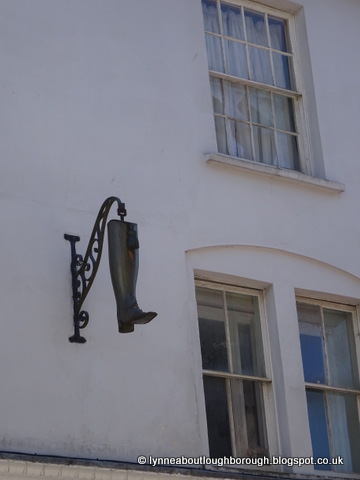
Then I thought I'd spotted another local connection, when I saw an old boot hanging from the front of a building. Did Launceston, like Loughborough, used to have an Old Boot pub?


Excitement continued to grow, until I came to the doorway of the shop, and looked at the tiled floor ... 


Ah well, Leicester's quite close!!!

Another area of employment in Loughborough was lacemaking. Local inventor John Heathcoat had a lacemaking factory on Mill Lane (now Market Street) which was attacked in 1816. The building that replaced it has recently been honoured with a Leicestershire Green Plaque. Lacemaking on display in Launceston Museum was of the Bedfordshire pillow lace type.


Another interest of mine is fire insurance plaques. I don't think there are many in Loughborough: I've only found one, on a house in Park Street. Launceston Museum had a few on display:


And finally, when I was training to be a tour guide we were encouraged to look up, in order to learn more about a town's history from its buildings. I've been used to doing this for many years, but I would also encourage you to look down, as there is a huge amount of history hidden in our streets, which we simply walk over and take for granted! Here's an example from Launceston:


And a couple from Loughborough:


Many of the things I've written about also appear in 'Secret Loughborough'.


You are welcome to quote passages from any of my posts, with appropriate credit. The correct citation for this looks as follow:

Dyer, Lynne (2019). Everywhere reminds me of Loughborough. Available from: https://lynneaboutloughborough.blogspot.com/2019/07/everywhere-reminds-me-of-loughborough.html [Accessed 21 July 2019]
Take down policy:
I post no pictures that are not my own, unless I have express permission so to do. All text is my own, and not copied from any other information sources, printed or electronic, unless identified and credited as such. If you find I have posted something in contravention of these statements, or if there are photographs of you which you would prefer not to be here, please contact me at the address listed on the About Me page, and I will remove these.
Thank you for reading this blog. 

Lynne