Showing posts with label Civil War. Show all posts
Showing posts with label Civil War. Show all posts
Sunday, 22 September 2019
Iron foundries Battle of Cotes and Freemasonry
Yet again, another week of astonishing moments and visits. So many, in fact that this week I am not going to wax lyrical about iron foundries I've visited, the Civil War Walk focussing on the Battle of Cotes that I went on, nor on the visit to the meeting house of the local freemasons. Instead, I've written up last week's walk - a circular walk from the Carillon to the bellfoundry and back, via some interesting history and heritage. Here's a link to The Three Towers Trail over on the blog pages. Enjoy!

Sunday, 21 July 2019
Everywhere reminds me of Loughborough
So glad to be back in sunny Loughborough after a couple of weeks away in Cornwall! As ever, things I've spotted in the many places I've visited during the holiday have been constant reminders of our lovely market town. Indeed, there have been so many interesting connections, I could use up a whole year's worth of blog posts sharing my findings with you ... but I won't!!
So, a quick look at the similarities between Launceston - which was where we broke our long journey - and Loughborough. Both were small market towns, both played a part in the Civil War.
The War Memorial in Launceston rises up in the centre of the town, unlike ours which is in the beautiful setting of Queen's Park, and is now accompanied by a memorial to Loughborough's war horse, Songster.


The town hall clock in Loughborough is pretty special: the clock I spotted in Launceston was attached to a bank building, and was rather ornate:


Both towns had a workhouse. Loughborough's first was on the site now occupied by the Royal Mail sorting office. The Union workhouse was situated on what is now Regent Street. I've posted before about Loughborough's Workhouse, so here's some information about Launceston's:


Now, of course, almost everywhere I go I am tuned in to spot bells! Sadly, they're not always the Taylors variety, but I love to have a quiet poke around, just in case! There were two in Launceston Museum, the first of these was used to summon estate workers to meals, and the second one from a local iron foundry:


Another formerly Loughborough-based company is always evident, wherever I go, because I spend a lot of time in bookshops, and whether they're selling new or second-hand books, you can guarantee they've got some Ladybird Books!!! At Launceston Museum, they had a ladybird, but no Ladybird Books:


Boundary stones, milestones and fingerposts? Don't get me started on that one - something I've blogged about before!!!! Here's a boundary stone from the Bude Canal:

And ours from the boundary between Loughborough and Woodthorpe, although experts suggest that this one is not in its original location:

Pubs everywhere are of interest!!! Like Loughborough, Launceston has a White Hart pub: I don't know what the Launceston one was like inside, but it differed on the outside from Loughborough's as it actually had a 3D white hart sitting on the front of the building.


Then I thought I'd spotted another local connection, when I saw an old boot hanging from the front of a building. Did Launceston, like Loughborough, used to have an Old Boot pub?


Excitement continued to grow, until I came to the doorway of the shop, and looked at the tiled floor ...
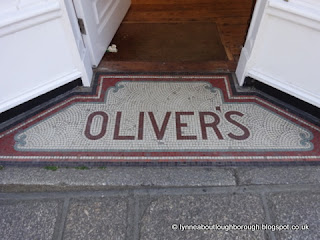
Ah well, Leicester's quite close!!!
Another area of employment in Loughborough was lacemaking. Local inventor John Heathcoat had a lacemaking factory on Mill Lane (now Market Street) which was attacked in 1816. The building that replaced it has recently been honoured with a Leicestershire Green Plaque. Lacemaking on display in Launceston Museum was of the Bedfordshire pillow lace type.


Another interest of mine is fire insurance plaques. I don't think there are many in Loughborough: I've only found one, on a house in Park Street. Launceston Museum had a few on display:

And finally, when I was training to be a tour guide we were encouraged to look up, in order to learn more about a town's history from its buildings. I've been used to doing this for many years, but I would also encourage you to look down, as there is a huge amount of history hidden in our streets, which we simply walk over and take for granted! Here's an example from Launceston:

And a couple from Loughborough:


Many of the things I've written about also appear in 'Secret Loughborough'.
So, a quick look at the similarities between Launceston - which was where we broke our long journey - and Loughborough. Both were small market towns, both played a part in the Civil War.
 |
| Costume in Launceston Museum |
 |
| Launceston Museum |
 |
| Costumed mannequin at one time in the Old Rectory Museum |
The War Memorial in Launceston rises up in the centre of the town, unlike ours which is in the beautiful setting of Queen's Park, and is now accompanied by a memorial to Loughborough's war horse, Songster.


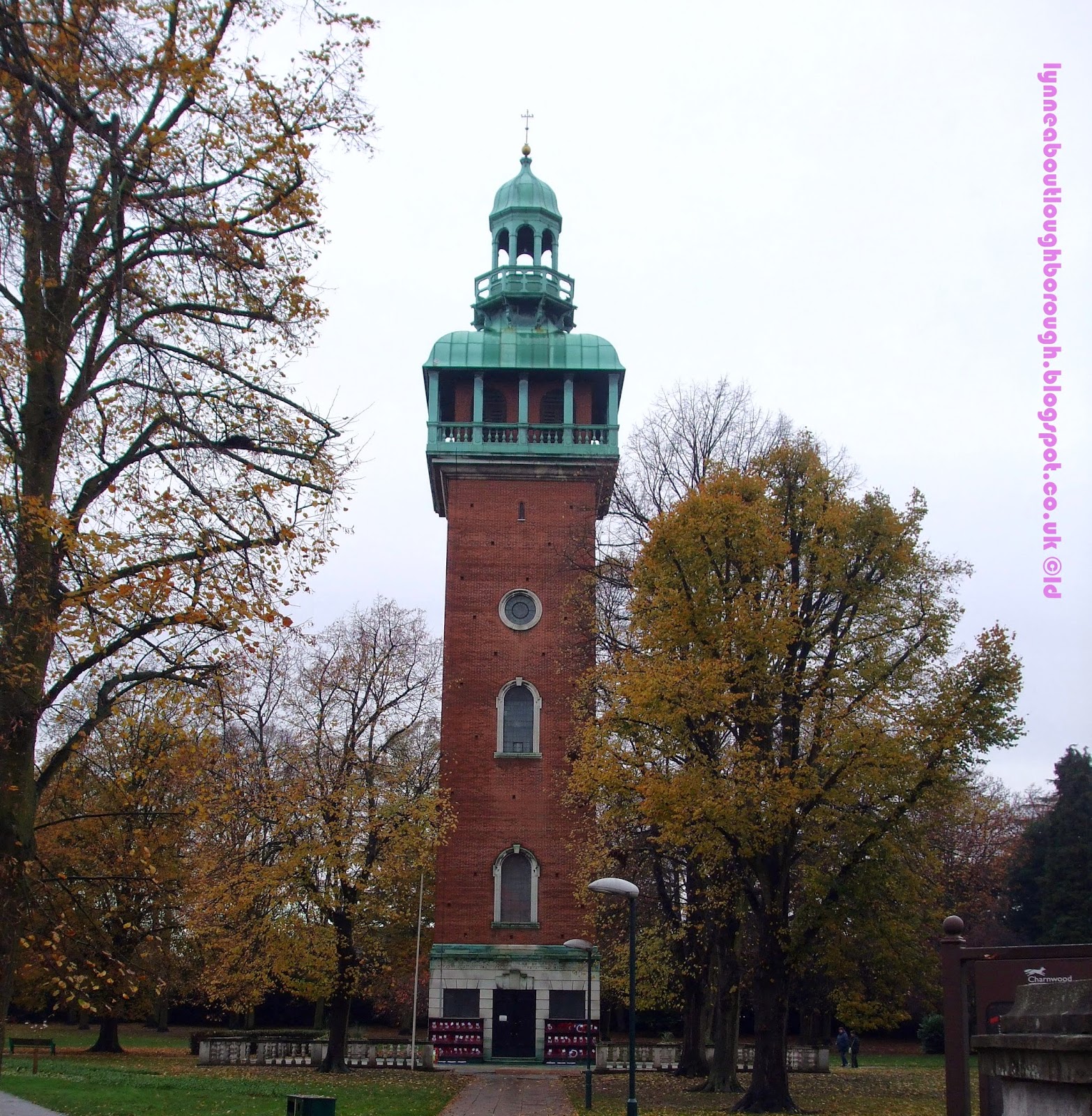


The town hall clock in Loughborough is pretty special: the clock I spotted in Launceston was attached to a bank building, and was rather ornate:


Both towns had a workhouse. Loughborough's first was on the site now occupied by the Royal Mail sorting office. The Union workhouse was situated on what is now Regent Street. I've posted before about Loughborough's Workhouse, so here's some information about Launceston's:


Now, of course, almost everywhere I go I am tuned in to spot bells! Sadly, they're not always the Taylors variety, but I love to have a quiet poke around, just in case! There were two in Launceston Museum, the first of these was used to summon estate workers to meals, and the second one from a local iron foundry:


 |
| The cast of the Great Paul Bell in Queen's Park Loughborough |
Another formerly Loughborough-based company is always evident, wherever I go, because I spend a lot of time in bookshops, and whether they're selling new or second-hand books, you can guarantee they've got some Ladybird Books!!! At Launceston Museum, they had a ladybird, but no Ladybird Books:


Boundary stones, milestones and fingerposts? Don't get me started on that one - something I've blogged about before!!!! Here's a boundary stone from the Bude Canal:

And ours from the boundary between Loughborough and Woodthorpe, although experts suggest that this one is not in its original location:

Pubs everywhere are of interest!!! Like Loughborough, Launceston has a White Hart pub: I don't know what the Launceston one was like inside, but it differed on the outside from Loughborough's as it actually had a 3D white hart sitting on the front of the building.


Then I thought I'd spotted another local connection, when I saw an old boot hanging from the front of a building. Did Launceston, like Loughborough, used to have an Old Boot pub?

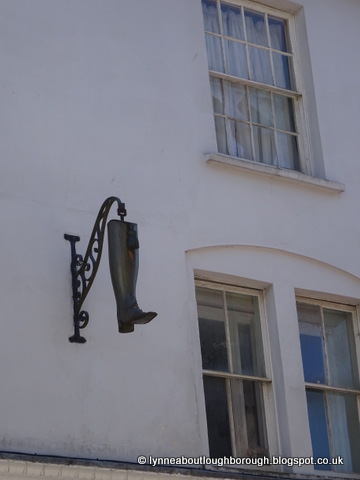
Excitement continued to grow, until I came to the doorway of the shop, and looked at the tiled floor ...

Ah well, Leicester's quite close!!!
Another area of employment in Loughborough was lacemaking. Local inventor John Heathcoat had a lacemaking factory on Mill Lane (now Market Street) which was attacked in 1816. The building that replaced it has recently been honoured with a Leicestershire Green Plaque. Lacemaking on display in Launceston Museum was of the Bedfordshire pillow lace type.


Another interest of mine is fire insurance plaques. I don't think there are many in Loughborough: I've only found one, on a house in Park Street. Launceston Museum had a few on display:

And finally, when I was training to be a tour guide we were encouraged to look up, in order to learn more about a town's history from its buildings. I've been used to doing this for many years, but I would also encourage you to look down, as there is a huge amount of history hidden in our streets, which we simply walk over and take for granted! Here's an example from Launceston:

And a couple from Loughborough:


Many of the things I've written about also appear in 'Secret Loughborough'.
You are welcome to quote passages from any of my posts, with appropriate credit. The correct citation for this looks as follow:
Dyer, Lynne (2019). Everywhere reminds me of Loughborough. Available from: https://lynneaboutloughborough.blogspot.com/2019/07/everywhere-reminds-me-of-loughborough.html [Accessed 21 July 2019]
Take down policy:
I post no pictures that are not my own, unless I have express permission so to do. All text is my own, and not copied from any other information sources, printed or electronic, unless identified and credited as such. If you find I have posted something in contravention of these statements, or if there are photographs of you which you would prefer not to be here, please contact me at the address listed on the About Me page, and I will remove these.
Thank you for reading this blog.
Lynne
Sunday, 17 June 2018
Popular surnames
Sadly I missed the Loughborough Car Show 2018, taking place in the Market Place today, but I hope you can forgive me as I took time out to visit the motorbike show and post loads of pics a couple of weeks ago.
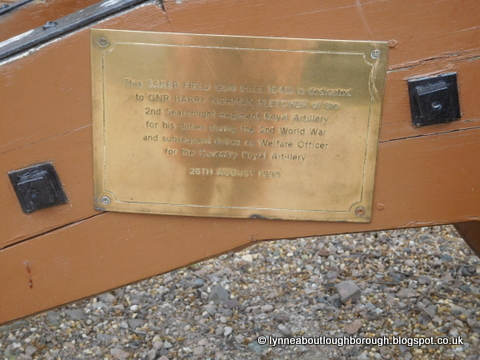
This week I found myself on the outskirts of Coventry, an interesting experience as we were near a place called Cannons Park (complete with a canon from the 1600s) and Canley, having driven along Gibbet Hill Road, and walked along Lynchgate and De Montfort Way. The area around Canley has an interesting history (more here) and I was right to be interested because there was a lot of Civil War action here, just as there was at Cotes near Loughborough. But what caught my eye most was the information board at the entrance to the Prior Deram Park, which talked of the land being inhabited from Anglo-Saxon times, and once owned by Henrys I and VIII. Land around the area was known as Fletchamstead, after the trade of arrow-making which was prevalent in the area.
Here's a few pictures before we get onto the main content of this post:


This got me thinking about surnames, and what they mean, and what our popular local Loughborough ones might mean, or where they originated. So, Fletcher comes from the trade of arrow-making, but what about others?
Not quite knowing where to start, I had a think about some popular surnames of which I was aware, and tried to identify where families bearing these names were mostly living. Varying degrees of success with this, so, for example, there were not enough Lemyngtons and Burnabys to produce any conclusive evidence, but other names were easier to locate. Note of caution: this work is in its infancy and I've only checked in a few sources, not comprehensively - yet!!
Adcock
Adkin
Alcock
Amatt
Barrowcliff
Beaumont
Birkin
Bumpus
Burder
Burton
Cartwright
Corah
Corcoran
Cotton
Craddock
De Lisle
Dean
Eddowes
Fearon
Garton
Grey
Griggs
Grudgings
Hames
Hastings
Heathcoat
Hepworth
Hodson
Lowe
Messenger
Middleton
Moss
Onions
Paget
Paltridge
Peberdy
Storer
Toon
Tucker
Vavasour
Wakerley
Warner
Wills
Woolley
Ok, so now it's the witching hour and I should be away! I'll update further next week!
This week I found myself on the outskirts of Coventry, an interesting experience as we were near a place called Cannons Park (complete with a canon from the 1600s) and Canley, having driven along Gibbet Hill Road, and walked along Lynchgate and De Montfort Way. The area around Canley has an interesting history (more here) and I was right to be interested because there was a lot of Civil War action here, just as there was at Cotes near Loughborough. But what caught my eye most was the information board at the entrance to the Prior Deram Park, which talked of the land being inhabited from Anglo-Saxon times, and once owned by Henrys I and VIII. Land around the area was known as Fletchamstead, after the trade of arrow-making which was prevalent in the area.
Here's a few pictures before we get onto the main content of this post:
 |
| A beautiful car I saw on Saturday |


 |
| The 1600s canon |
 |
| The dedication plaque |
 |
| Information about Prior Deram Park |
This got me thinking about surnames, and what they mean, and what our popular local Loughborough ones might mean, or where they originated. So, Fletcher comes from the trade of arrow-making, but what about others?
Not quite knowing where to start, I had a think about some popular surnames of which I was aware, and tried to identify where families bearing these names were mostly living. Varying degrees of success with this, so, for example, there were not enough Lemyngtons and Burnabys to produce any conclusive evidence, but other names were easier to locate. Note of caution: this work is in its infancy and I've only checked in a few sources, not comprehensively - yet!!
Adcock
- centred around Grantham and radiating outwards
Adkin
- most popular slightly north of Nottingham, and predominantly between Nottingham & Loughborough. Also around Lanarkshire
Alcock
- Stoke-on-Trent and radiating outwards
Amatt
- Reading, Nottingham, Dorset and Wolverhampton
Barrowcliff
- mostly Dorset, and ranging from Nottingham to Kingston-Upon-Hull
Beaumont
- predominantly Leeds
Birkin
- Nottingham and radiating outwards
Bumpus
- only found in Norwich
Burder
- around Ipswich, slightly in Hastings, Luton, Oxford and Leicestershire
Burton
- Northampton to Stoke-on-Tret to Lincoln to Kingston-on-Hull, and Dundee
Cartwright
- Wolverhampton and radiating outwards
Corah
- Leicestershire & Nottinghamshire
Corcoran
- Manchester, Stoke-on-Trent, Swansea, Northern Ireland and Kirkcudbright
Cotton
- Stoke-on-Trent and Lincoln
Craddock
- Stoke-on-Trent
De Lisle
- Leicestershire
Dean
- Stoke-on-Trent and York
Eddowes
- predominantly Telford/Birmingham, with bits in Northamptonshire and Holyhead
Fearon
- South of Belfast, and Carlisle
Garton
- Grantham and Peterborough
Grey
- North of Newcastle and between Gloucester and Bristol
Griggs
- predominantly Suffolk, heading towards Peterborough
Grudgings
- slightly west of Andover, mostly Northern Ireland, south of Londonderry, near Enniskillen
Hames
- Nottinghamshire and radiating outwards, and Telford
Hastings
- Dumfries
Heathcoat
- Worcester, Swindon and Wilton
Hepworth
- Leeds and radiating outwards
Hodson
- east of Leicestershire and predominantly Peterborough
Lowe
- band across the middle of the country Birmingham up to Manchester, through Leicestershire and Nottinghamshire to Lincoln
Messenger
- Carlisle
Middleton
- slightly west of Kendal and radiating outwards
Moss
- between Stoke-on-Trent/Manchester, and south of Londonderry
Onions
- slightly east of Wolverhampton and radiating outwards
Paget
- predominantly west of Aberdeen and a few near Bristol
Paltridge
- Carmarthen and radiating outwards and Exeter
Peberdy
- Glasgow and a few in Nottingham
Storer
- Leicestershire and radiating outwards
Toon
- Leicesterhire and radiating outwards
Tucker
- Devon
Vavasour
- predominantly Wye in Kent then Leicestershire
Wakerley
- Melton Mowbray and radiating outwards
Warner
- Gloucester and radiating outwards, and Ipswich
Wills
- Bodmin and radiating outwards
Woolley
- Stoke-on-Trent
Ok, so now it's the witching hour and I should be away! I'll update further next week!
You are welcome to quote passages from any of my posts, with appropriate credit. The correct citation for this looks as follow:
Dyer, Lynne (2018). Popular surnames. Available from: https://lynneaboutloughborough.blogspot.com/2018/06/popular-surnames.html [Accessed 17 June 2018]
Take down policy:
I post no pictures that are not my own, unless I have express permission so to do. All text is my own, and not copied from any other information sources, printed or electronic, unless identified and credited as such. If you find I have posted something in contravention of these statements, or if there are photographs of you which you would prefer not to be here, please contact me at the address listed on the About Me page, and I will remove these.
Thank you for reading this blog.
Lynne
Sunday, 11 June 2017
Picnic in the Park
So sorry for not posting last week: I'm in the midst of completing a final assignment for my course, and it's taking a lot longer than I anticipated! Still, when it's all finished I'll be able to blog more authoritatively about trade in Loughborough during the 19th century!


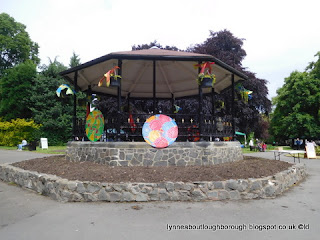


In the meantime, this week I've been out and about in Queen's Park. I say this week, but of course I don't mean all week, only Saturday! The event taking place was Picnic in the Park, an annual event that's been going for 36 years, making this the 37th event. The focus is on music, dance, street theatre, art, and stalls featuring arts and crafts and local groups.
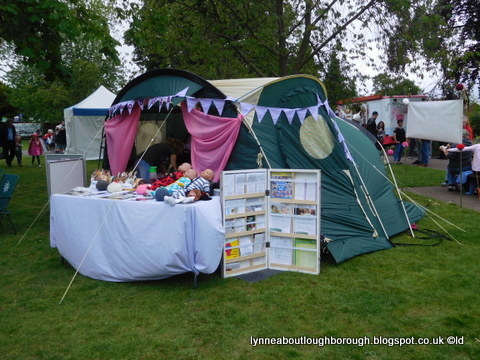
As part of the festivities, last year the Loughborough Library Local Studies Volunteers set up an information camp - the Ludd Hub - in commemoration of the Luddite attacks on John Heathcoat and John Boden's lace making factory on Market Street in 1816. Alongside the stall, they also had a reading - in full costume - of Lord Byron's maiden speech to the House of Lords. Visitors were invited from Tiverton Museum - Tiverton being the place that Heathcoat moved to after the attacks - and the long, nearly 200 mile journey from Loughborough to Tiverton that Heathcoat's Loughborough workers made in 1816, was re-enacted by the "Tivertonioians", accompanied by one of the LLLSVs. I believe it took them two weeks to reach their destination!
So, this year the LLLSVs information camp focused on Lord Hastings and the Civil War - hte Hastings Hub - in and around Loughborough. Looking back at my blog posts this time last year, I see there is a Civil War connection between Loughborough and Tiverton:
"Both towns were affected by the Civil War of 1642-1651. Royalist Tiverton Castle was under siege from Parliamentarians in 1645, and in December of that year Oliver Cromwell paid it a brief visit. On 17 March 1644 there was a minor battle at Cotes Bridge, just outside Loughborough, when Parliamentarians occupied the bridge. "
Anyway, this year's LLLSV stall told the story of the Civil War in and around Loughborough, and a brief history of the Hastings family, the Lords of the Manor.


They also had a visiting 17th century family, complete with dining table, woollen fleeces awaiting spinning, and two strapping sons, one with a pike, the other with a musket. They had some very interesting information to impart to me on the subject of dyers, and pinfolds!

During the early part of the afternoon, I was lucky enough to be able to attend a debate between parliamentarians and royalists, and with the levellers, diggers and ranters (for a better explanation of what these groups were about pop over to the Oxford Scholarship Online webpage) presenting a completely different view. The case for the beheading of Charles I was ably put by local MP, Nicky Morgan, whilst that for the case against the beheading was engagingly presented by Dr Robert Knight of Loughborough University. The case for the levellers was put by Professor Martin Bennett of Nottingham Trent University. Following the debate, questions from the floor and the rebuttals, a vote was taken, and sadly, it was agreed that Charles I would lose his head.

This was a truly exciting day, made even better as the rain held off, and the sun tried to shine a little! Of course, as well as the buzz of the picnic and stalls, it was business as usual for Loughborough Queen's Park Bowlers:

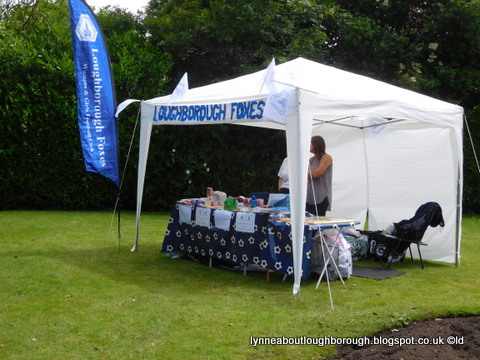
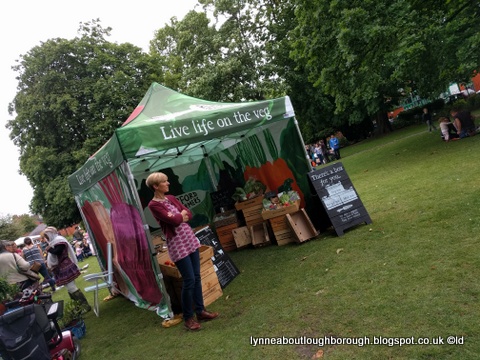
Here are some pics of the day:






You are welcome to quote passages from any of my posts, with appropriate credit. The correct citation for this looks as follow:
Dyer, Lynne (2017). Picnic in the Park. Available from: http://lynneaboutloughborough.blogspot.com/2017/06/picnic-in-park.html [Accessed 28 May 2017]
Take down policy:
I post no pictures that are not my own, unless I have express permission so to do. All text is my own, and not copied from any other information sources, printed or electronic, unless identified and credited as such. If you find I have posted something in contravention of these statements, or if there are photographs of you which you would prefer not to be here, please contact me at the address listed on the About Me page, and I will remove these.
Thank you for reading this blog.
Lynne
Subscribe to:
Posts (Atom)