Showing posts with label Knightthorpe. Show all posts

Sunday, 4 December 2022

No.1 Co-op

Back in June 2021 (gosh, I thought I'd written that post only a couple of months ago, but it turns out to be nearly 18 months since it was done!) I wrote about the former No.1 Co-op store down on Derby Road, close to the new supermarket, the chip shop, and Belton Road. Before the Co-op was built, the land was close to the Charnwood Forest Railway, and adjacent to the Wood Brook. 

Pictured in 2020

Detail from 2020

I think it was sometime the year before, so, in 2020, that the former Co-op, which was then an Oriental restaurant, had been sold, and was being converted to flats: the June 2021 post was a record of progress with that conversion, but also a brief history of the Co-op stores, the movement having definitely been active in Loughborough from around 1866. The Derby Road Co-op, despite being called 'No.1' was not the first Co-op in Loughborough, that honour going to the store on Wood Gate, coincidentally, now an Oriental restaurant.

Detail of the Wood Gate store

At the time, it was a puzzle as to why the Derby Road Co-op was called the No.1 Co-op, having been built in 1926. 

Several theories had emerged:

*Was it the first Co-op in Knightthorpe? It could not have been the first Co-op store in Loughborough, as the store on Wood Gate opened in the 1860s

*Had the Loughborough Co-operative Society merged with another local society, and this was the first building to be built and occupied by the merged Society?

*Was it a road number? Perhaps intended to be the start of Alan Moss Road?

*Was it the first of Loughborough's buildings to be clad in Hathernware faience tiles?

*Was it the first to be built along the Charnwood Forest railway line, with others planned along the route?

*Was it the first self-service Co-op in the area?

A recent chance conversation on Facebook, about the No.1 Co-op in Farnborough, has led me to what I believe might be the answer. I might not quite have got the dates right, but I think it does all have to do with parish boundaries.


At one time Loughborough was surrounded by a number of different parishes, including Woodthorpe to the south, Knightthorpe, and Thorpe Acre cum, or with,  Dishley, the latter two being northwest of Loughborough. 

In 1871, Knight Thorpe is described in Wilson's 'Imperial Gazetteer of England and Wales', as "a township in Loughborough parish, Leicester; near Loughborough. Real property, £1,533. Population, 58. Houses, 12."

The same source describes Dishley-Cum-Thorpe Acre, as "a parish in the Loughborough district, Leicester; adjacent to the river Soar and the Midland railway, 1.5 miles NW of Loughborough. Post town, Loughborough. Acres, 890. Real property, £1,742. Population, 194. Houses, 54. Bakewell, the distinguished agricultural improver, lived and laboured here; and has bequeathed to the place marked benefits of his skill. The living is in the diocese of Peterborough. Value, £150. Patron, the Bishop of Peterborough. The church was built in 1845 [designed by William Railton]. A school has £11 from endowment, and other charities £11."

By 1925 this had all changed, as shown by the following extract from Kelly's 1925 directory. This explains that by an Order of the County Council, confirmed by Local Government Board Order, which came into operation on 25th March 1892, parts of the parishes of Knight Thorpe, and Dishley with Thorpe Acre were constituted the new parish of Knight Thorpe, and parts of the parishes of Garendon and Dishley with Thorpe Acre constituted the present parish of Dishley with Thorpe Acre, and parts of the parishes of Garendon, Knight Thorpe and Dishley with Thorpe Acre formed into the new parish of Garendon.

So, looking at a map of the municpal boundary, i.e. post-1888 when the borough became incorporated, it appears that the Knightthorpe boundary runs alongside the Wood Brook, down to part of what is now the university campus, and up past the site of the No.1 Co-op (X marks the spot), along what is now Belton Road.


As the No.1 Co-op built in 1926 on Derby Road, is on the Derby side of the Wood Brook, it might therefore follow that the store, being outside the boundary of Loughborough, was the first one to be built in Knightthorpe parish. But I could be wrong!

Anyway, over the years there have been, and indeed still are, various Co-op stores across town including, on Loughborough High Street and Swan Street, on Lansdowne Drive, on the site of the Maltings pub off Epinal Way, on Nottingham Road, on Derwent Drive and on Ashby Road.

And so the renovation continues ...
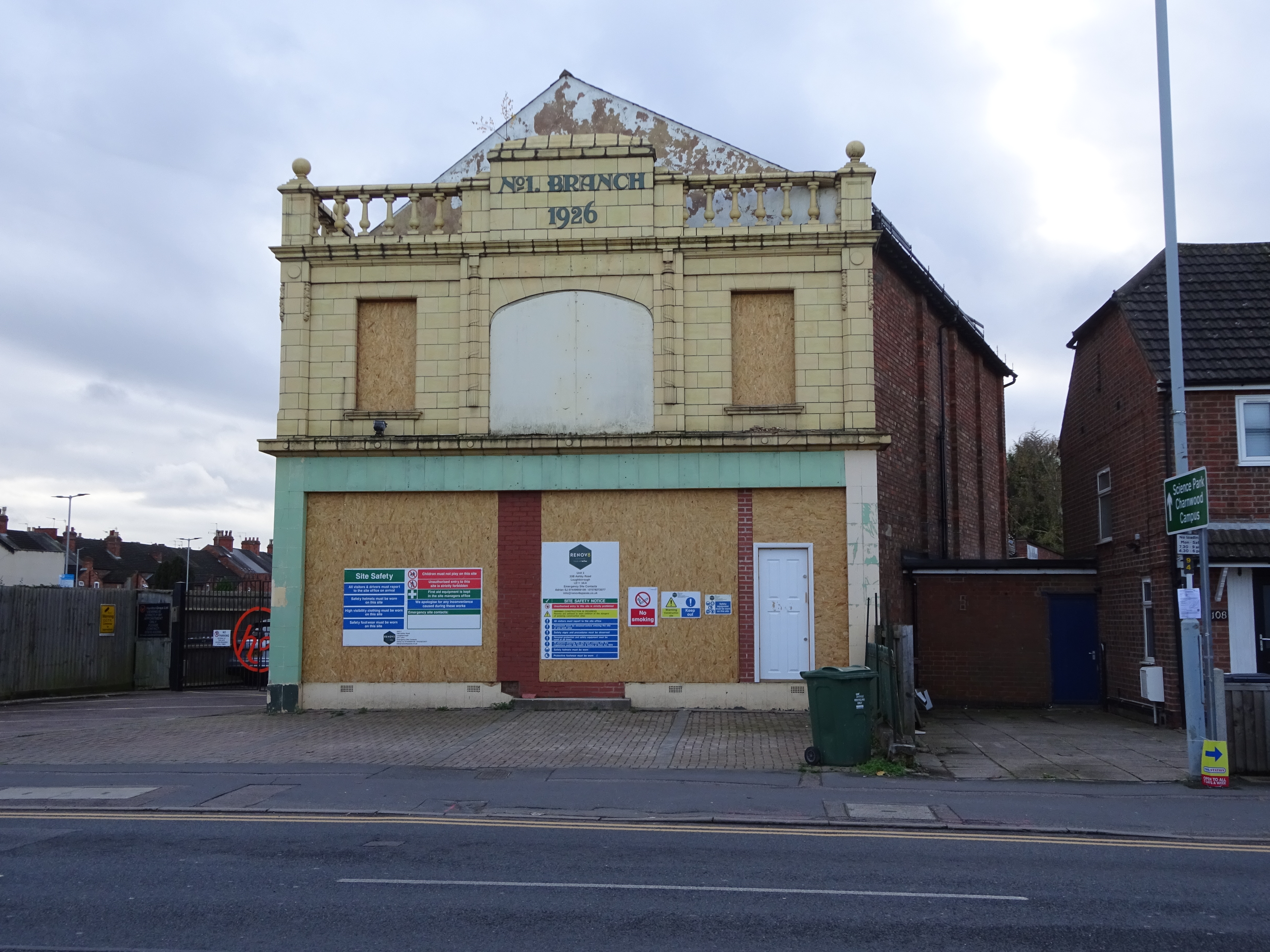
Photographed November 2022

____________________________________

posted by lynneaboutloughborough

With apologies for typos which are all mine!

_______________________________________________

Thank you for reading this blog. You are welcome to quote passages from any of my posts, with appropriate credit. The correct citation for this looks as follows:

Dyer, Lynne (2022). No.1 Co-op. Available from: https://lynneaboutloughborough.blogspot.com/2022/12/no1-co-op.html [Accessed 4 December 2022]

Take down policy:
I post no pictures that are not my own, unless I have express permission so to do. All text is my own, and not copied from any other information sources, printed or electronic, unless identified and credited as such. If you find I have posted something in contravention of these statements, or if there are photographs of you which you would prefer not to be here, please contact me at the address listed on the About Me page, and I will remove these.

Blog archive and tags:
If you are viewing this blog in mobile format, you will not be able to easily access the blog archive, or the clickable links to various topics. These can be accessed if you scroll to the bottom of the page, and click 'View Web Version'. Alternatively, there is also a complete list of posts, which when clicked will take you to the page you are interested in.  
 
Thank you for reading this blog. 

Lynne

Sunday, 17 January 2021

Loughborough cemetery Part 2

More memorials to World War Two PoWs


It appears there were over 1,000 Prisoner of War camps in Britain, and quite a few of these were in Leicestershire. Many are listed in this article and associated databank (2020) which includes the following:


o    Barkby Camp, Barkby Lane, Leicester, No.616 (previously a heavy anti-aircraft battery)

o   Farndon Road Camp, (Harrington Camp), Farndon Fields Farm, Market Harborough, No.49, (German working camp, standard type/caravan site)

o   Garendon Park, Loughborough, No.28

o   Gaulby Road, Billesdon, No.94 (German working camp, standard type)

o   Hathern Camp, Pear Tree Lane, Hathern, No. 590 (farmland)

o   Knightthorpe Camp, Loughborough, No.28 (German working camp)

o   Old Dalby Camp, Old Dalby Lane, Melton Mowbray, No.613 (large RAF depot with huts converted to accommodation)

o   Old Liberal Club, Charnwood Road, Shepshed, N0.152 (German working camp)

o   Quorn Camp, Wood Lane, Quorn, No.9/183 (Base camp, standard type)

o   Scraptoft, Thurnby, Leicester, No.4 (Base camp)

o   Shady Lane, Stoughton, Leicester, No.167 (Base camp)

There is, however, some debate as to whether or not Knightthorpe and Garendon were actually the same place: Garendon Hall was originally used as the headquarters for local munitions, but both seem to be known as Camp 28, with the main camp being towards the south of the estate lands. 

Last week we looked at some of the PoW camps close to Loughborough, and one in Stoughton which had a Loughborough connection. Let’s stay with the Leicester area, and a camp in Billesdon for a moment as there are more Loughborough connections, before moving closer to Loughborough.

A report in the Leicester Evening Mail of 6 October 1947 carried a report of the death of Peter Leugner. He was born on 17 September 1902 in the Ukraine, and died on 4 October 1947. Leugner was found hanging in a room at the Scraptoft PoW camp. The article says:

“It is understood that he was due for repatriation.”

Leugner has a memorial stone in Loughborough cemetery.


Earlier in 1947, an inquest took place in Market Harborough on the death of Corporal Konrad Schubert. Schubert was born on 30 July 1906 in Paszowice, Poland, and died on 19 January 1947 in the camp at Billesdon. According to a report in the Leicester Evening Mail of 23 April 1947, Schubert was depressed following the death of his mother and sister, and worried about his two children who were living in the Russian part of Germany. His own ill-health had meant that he had been unable to work on the farm, and this made him more unhappy, although his fellow PoWs had not ever heard him talk about taking his own life.  

Mr Tempest Bouskell, the coroner for South Leicestershire, pronounced that Schubert had committed suicide whilst the balance of his mind had been temporarily disturbed, and passed on his sympathy to Corporal Schubert’s fellow prisoners.

Schubert has a memorial stone in Loughborough cemetery.


We shall now leave these distant Leicestershire camps, and return closer to home, where we find a camp at Quorn which was used as such until about 1948. In the Nottingham Evening Post 12 August 1947, the following report appeared:

“A German prisoner-of-war, Baumann Hubert, died suddenly at the Quorn Camp yesterday. The body was removed to the Loughborough mortuary and the facts reported to the Coroner for North Leicestershire.”

Listed as Hubert Baumann on his memorial stone, Corporal Baumann was born 27 October 1924, died 11 August 1947, and has a memorial stone in Loughborough cemetery.


A report of a sad event appeared in the Daily Mirror of 18 September 1945:

COMEDIAN HANGED HIMSELF BECAUSE HE WAS LAUGHED AT.

A German giving evidence at a Loughborough, Leicestershire, inquest yesterday on a fellow prisoner of war who hanged himself at a camp said that the dead man had complained that other men in his working party made too much fun of his acting on the camp stage. He was a comedian.

Other prisoners said that the dead man, Sargeant Herbert Bruhn, 29, of Hamburg, had been unhappy for the last two weeks – they didn’t know why.

A police witness said he found no suggestion of either foul play or bullying. Recording a verdict that Bruhn hanged himself while his mind was disturbed, the coroner said it was difficult to understand the mind of a German, particularly a prisoner.”

Sergeant Herbert Bruhn, was born 28 January 1916 in Hamburg, died 16 September 1945, and has a memorial stone in Loughborough cemetery, but I have no idea which camp he was held in, nor in which camp he died.

The following report appeared in the Sunday Post 1 April 1945:

Allies sentence German boy to death. Karl Punzeler, of Monschau, 16-year-old boy, former leader of the local Hitler Youth, has been found guilty of espionage. Sentenced to death. This is an extract from ‘Die Mitteilungen’, the Allied newspaper, which is being distributed free in occupied Germany. It’s one of a list of sentences passed by Allied Military Government on civilians, and reported in the paper.”

The report continues with a list of misdemeanours, perpetrators, and punishments, in which we find the following:

“Franz Franke and Helmut Engel – for refusing to work as directed with a labour gang – 60 days.”

I believe Private Helmut Engel was born 30 April 1926 in Berlin-Neukolln, and died in Ankle Hill camp at Old Dalby, in Melton Mowbray, on 22 August 1947. The camp, which as well as housing over 3,000 soldiers, housed around 300 PoWs, during WW2. Quite why Helmut Engel has a memorial headstone in Loughborough cemetery, I’m not sure.  


I have been unable to trace much information pertaining to Dr Karl Theodor Reuter, other than that which appears on his memorial headstone in Loughborough cemetery. 

Dr Karl Theodor Reuter, was born 24 March 1914 in Herdecke, Ennepe-Ruhr-Kreis, Nordrhein-Westfalen, Germany, and died 11 December 1946 in Leicestershire, in the Thurnby Camp at Scraptoft.


Corporal Leonhard Rademacher was born on 24 May 1910 in Monchengladbach, died on 17 September 1946 in Garendon Park/Knightthorpe Camp, No.28, in Loughborough. He has a memorial headstone in Loughborough cemetery.


It will be noted from the death dates found on the memorial headstones that the majority of these eight people died in Britain after the end of the Second World War. There are likely to many and varied reasons why they still found themselves in Britain, rather than returned to their homeland: according to this article, published on the occasion of VE Day in May 2020, some stayed and integrated themselves into the British way of life because they had made good friends, or had fallen in love. Other reasons may have been that conditions in Germany were very difficult, and there was a delay in repatriation, but also perhaps because the British government resisted sending them home as the country was short of workers. Indeed, the final German PoW returned home as late as 1948.

The bridge at Shepshed watermill built by PoWs from Garendon Hall


The bridge at Shepshed watermill from a distance


Pear Tree Lane, approach from Derby Road


Site of the Pear Tree Lane PoW camp

Site of the Pear Tree Lane PoW camp

Site of the Pear Tree Lane camp


Posted by lynneaboutloughborough 17 January 2021

You are welcome to quote passages from any of my posts, with appropriate credit. The correct citation for this looks as follow:

Dyer, Lynne (2021). Loughborough cemetery part 2. Available fromhttps://lynneaboutloughborough.blogspot.com/2021/01/loughborough-cemetery-part-2.html [Accessed 17 January 2021]

Take down policy:
I post no pictures that are not my own, unless I have express permission so to do. All text is my own, and not copied from any other information sources, printed or electronic, unless identified and credited as such. If you find I have posted something in contravention of these statements, or if there are photographs of you which you would prefer not to be here, please contact me at the address listed on the About Me page, and I will remove these.

You can leave comments below, but do check back as my reply will appear here, below your comment.

Thank you for reading this blog. 

Lynne