Showing posts with label Thorpe Acre. Show all posts

Sunday, 25 May 2025

Robert Bakewell commemorative service

The previous post on this blog was a birthday blog for the 300th anniversary of the birth of Robert Bakewell, agriculturalist of Dishley. When I wrote the blog, I hadn’t had the pleasure of attending any celebratory events (apart from a very informative and interesting talk a few weeks earlier).

To mark the anniversary, there was a lovely service held at Dishley church, led by the Reverend Tim Day, vicar of Thorpe Acre church, Thorpe Acre church being the church which was built to replace the one at Dishley, around 1845, and designed by architect, William Railton


Amongst the people who congregated for the service were many local people, and children from the Robert Bakewell School. It was a gloriously sunny day – perhaps a bit too sunny, so a few of us sought out the shade!

A buffet lunch was held at Thorpe Acre church, where there were some superb information boards relating to Robert Bakewell, produced and exhibited by the New Dishley Society, and a celebratory cake!!


It's been quite a few years since I've been to Dishley church, so it was lovely to visit again. Here are some photos from the celebratory service.


At teatime, Leicestershire bellringers rang a quarter peal at Hathern church in honour of Robert Bakewell’s anniversary.

Extract from Ringing World, with thanks (1)

____________________________________

Notes

(1) https://bb.ringingworld.co.uk/view.php?id=1855332

____________________________________

Posted by lynneaboutloughborough

With apologies for typos which are all mine!

_______________________________________________

Thank you for reading this blog.

Copyright:

The copyright © of all content on this blog rests with me, however, you are welcome to quote passages from any of my posts, with appropriate credit. The correct citation for this looks as follows:

Dyer, Lynne (2025). Robert Bakewell commemorative service. Available from: https://lynneaboutloughborough.blogspot.com/2025/05/robert-bakewell-commemorative-service.html [Accessed 25 May 2025]

Take down policy:

I post no pictures that are not my own, unless I have express permission so to do. All text is my own, and not copied from any other information sources, printed or electronic, unless identified and credited as such. If you find I have posted something in contravention of these statements, or if there are photographs of you which you would prefer not to be here, please contact me at the address listed on the About Me page, and I will remove these.

External Links:

By including links to external sources I am not endorsing the websites, the authors, nor the information contained therein, and will not check back to update out-of-date links. Using these links to access external information is entirely the responsibility of the reader of the blog.

Blog archive and tags:

If you are viewing this blog in mobile format, you will not be able to easily access the blog archive, or the clickable links to various topics. These can be accessed if you scroll to the bottom of the page, and click 'View Web Version'. Alternatively, there is also a complete list of posts, which when clicked will take you to the page you are interested in.

Searching the blog:

You can search the blog using the dedicated search box that appears near the top of the blog when viewed in the web version. Alternatively, you can search using your usual search engine (e.g. Bing, Google, DuckDuckGo etc.) by following this example:

site: https://lynneaboutloughborough.blogspot.com/ “Radmoor House”

NOTE – the words you’re actually looking for must be in “” and the first of these must be preceded by a space

Thank you for reading this blog.

Lynne

Sunday, 11 June 2023

Building Stone

Sadly, I missed a recent talk hosted by the Friends of Charnwood Museum, about stone, so, I had a look back over the blog to see what I’d already written. I must admit, I thought I’d done a piece on Coade stone, an artificial stone, but find I haven’t so I’ve only mentioned it in passing in some posts, like [quote blog posts]. So, let’s have a quick look at some real local stone, and where it’s been used.

Old Rectory, Rectory Place

The 13th-century building was once the home to the rectors of Loughborough, having been passed to the church around 1228 by the Cortlinstoke family. By the time it fell out of use, around 1959, it had been extended enormously, and would have been a substantial family home, however, once unoccupied the building fell into disrepair and was partially demolished, revealing its earlier core, which has been retained.

The building you now see is said to be made of Bromsgrove Sandstone; North Charnwood Diorite; Charnian (volcaniclastic breccia); Charnian (volcaniclastic sandstone); Swithland slate; and Charnian (banded tuff).


All Saints with Holy Trinity, Steeple Row

This church is a 14th century building, probably built on the site of an earlier church, and it is here that the rectors of Loughborough would have done most of their work. over the years the church has been subject to many alterations, most notably that by architect Sir George Gilbert Scott in the mid-19th century. 20th and 21st century renovations have included those to the pinnacles on the belltower, and various new stones in the fabric of the building. I've written more extensively on a very early blogpost.

Stone that has been used in the construction of the church includes Millstone Grit; Triassic Red Sandstone; North Charnwood Diorite; Upper Lincolnshire Limestone; Charnian (metasediments0; Swithland slate, and Mountsorrel Granodiorite.


Holy Trinity Church, Moor Lane 

This church is no longer a religious building, but was once a busy church serving the Leicester Road area of Loughborough, opened in 1878, to a design by William Arthur Blomfield. You can find out a bit more about its history on an earlier blogpost.

The range of natural stone used in the construction of the church is much less varied than the Old Rectory and Loughborough’s All Saints church, comprising only of Mountsorrel Granodiorite and Upper Lincolnshire Limestone.


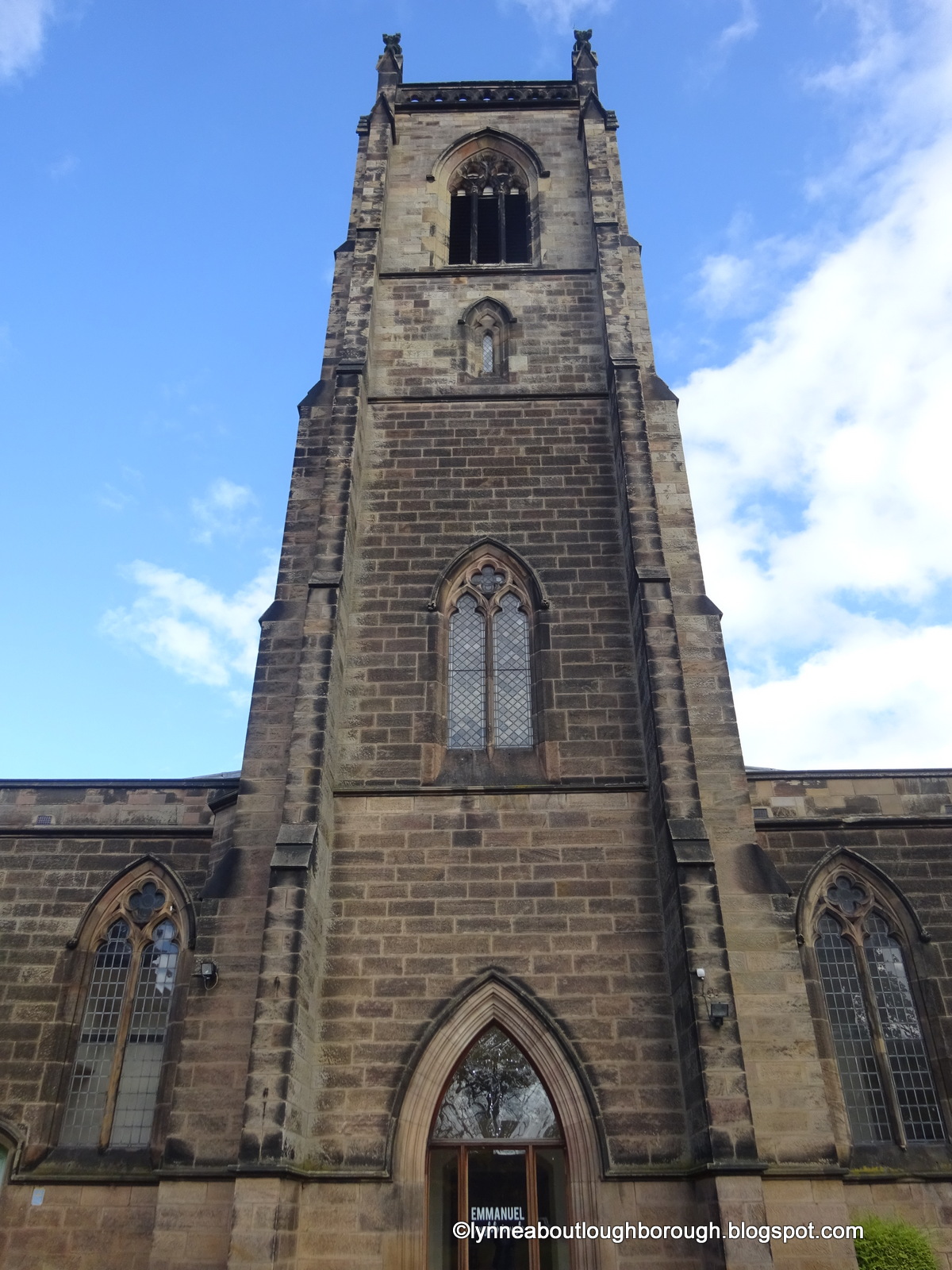
Emmanuel Church, Forest Road

The church was created around 1838, and its first rector was William Holme, who was also Rector of All Saints. The first Rector dedicated solely to Emmanuel was Reverend Bunch, who lived at the Emmanuel Rectory, on Forest Road, close to Mountfields House.  

I’ve not written much about Emmanuel church, but have done a couple of posts about the associated rectory. Part 1 and Part 2 

It appears that Emmanuel Church is constructed solely of Millstone Grit, but has a much later extension using other stone.


St Mary’s Nanpantan

St Mary’s church in Nanpantan started life as a Mission Hall, created by the Warner family of Nanpantan Hall, in 1888. Since 2015, St Mary’s has been a parish in its own right, so no longer connected to Emmanuel.

Using Charnian (volcaniclastic sandstone), St Mary’s is another church which is constructed only from one stone, that is until the 1960s when a granite Chapter House, with a flat-roofed vestry was built.


All Saints Thorpe Acre

This particular church is more usually known as Thorpe Acre church, and was built in 1845 to a design by William Railton, who was the architect responsible for the design of Nelson’s Column in London, and a number of other local Leicestershire churches. I've written extensively about Railton - here's one example post. The church, which replaced All Saints at Dishley (see below), is proud to have an east window, created in 1892 by Charles Eamer Kempe, and in the 1980s, the church was extended and joined to the school house.

All Saints, Thorpe Acre, was constructed using only Millstone Grit, until the extension was built.


All Saints Dishley

Dishley church is now a ruin, having been deconsecrated when All Saints Thorpe Acre was created in 1845. The ruins, which contain plaques to the agriculturalist, Robert Bakewell, are close to Dishley Grange Farm, which was part of the Garendon Estate.

The stone used in the construction of All Saints at Dishley includes Charnian (volcaniclastic sandstone); Diseworth Sandstone; Charnian (igneous); Triassic Red Sandstone; Cobbles (Bunter), and Bromsgrove Sandstone.  


_______________________________________________

posted by lynneaboutloughborough

With apologies for typos which are all mine!

_______________________________________________

Thank you for reading this blog.

Copyright:

The copyright © of all content on this blog rests with me, however, you are welcome to quote passages from any of my posts, with appropriate credit. The correct citation for this looks as follows:

Dyer, Lynne (2023). Building Stone. Available from: https://lynneaboutloughborough.blogspot.com/2023/06/building-stone.html [Accessed 11 June 2023]

Take down policy:

I post no pictures that are not my own, unless I have express permission so to do. All text is my own, and not copied from any other information sources, printed or electronic, unless identified and credited as such. If you find I have posted something in contravention of these statements, or if there are photographs of you which you would prefer not to be here, please contact me at the address listed on the About Me page, and I will remove these.

Blog archive and tags:

If you are viewing this blog in mobile format, you will not be able to easily access the blog archive, or the clickable links to various topics. These can be accessed if you scroll to the bottom of the page, and click 'View Web Version'. Alternatively, there is also a complete list of posts, which when clicked will take you to the page you are interested in.

Searching the blog:

You can search the blog using the dedicated search box that appears near the top of the blog when viewed in the web version. Alternatively, you can search using your usual search engine (e.g. Bing, Google, DuckDuckGo etc.) by following this example:

site: https://lynneaboutloughborough.blogspot.com/ “Radmoor House”

NOTE – the words you’re actually looking for must be in “” and the first of these must be preceded by a space

Thank you for reading this blog.

Lynne


Sunday, 4 December 2022

No.1 Co-op

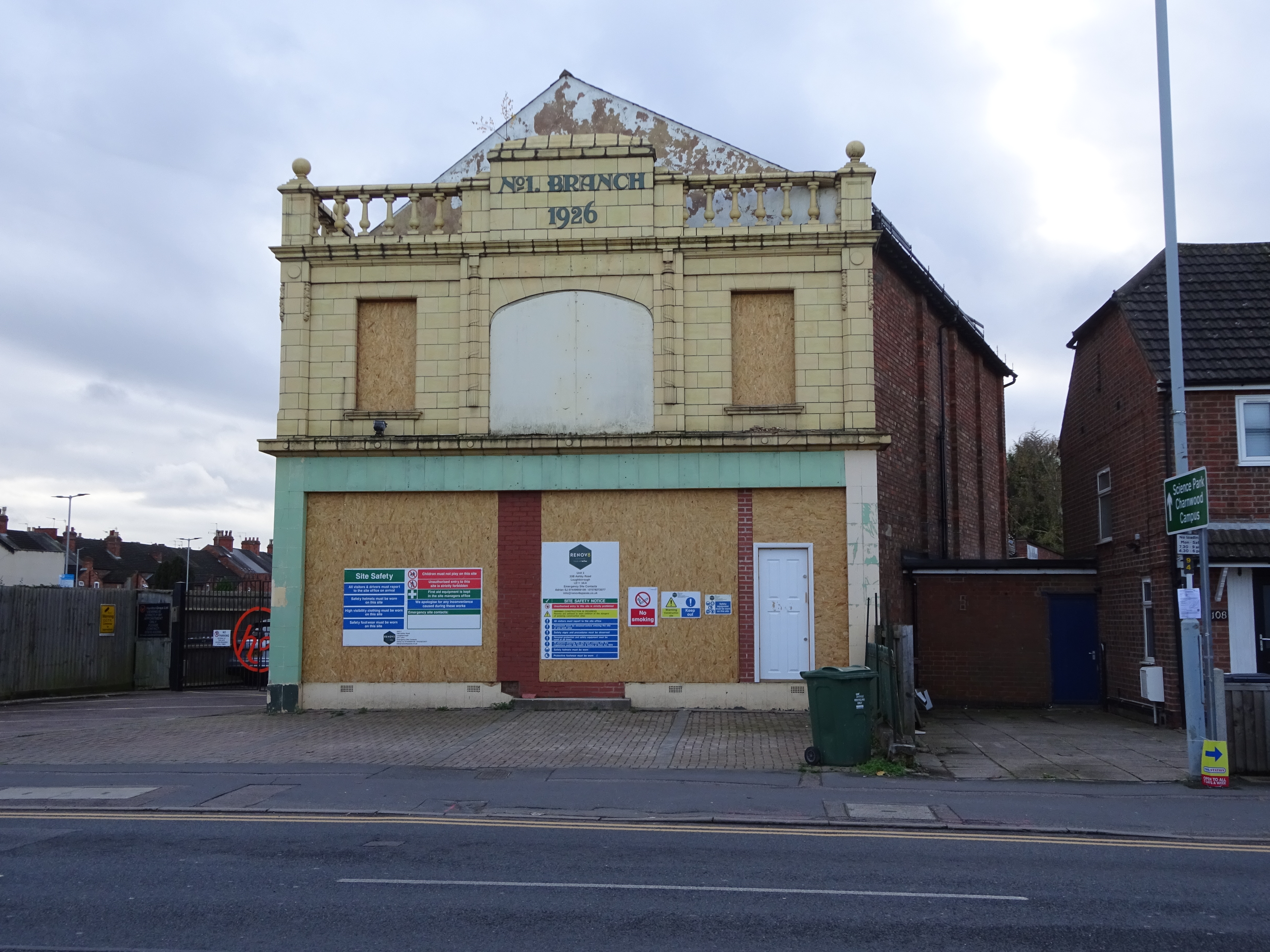
Back in June 2021 (gosh, I thought I'd written that post only a couple of months ago, but it turns out to be nearly 18 months since it was done!) I wrote about the former No.1 Co-op store down on Derby Road, close to the new supermarket, the chip shop, and Belton Road. Before the Co-op was built, the land was close to the Charnwood Forest Railway, and adjacent to the Wood Brook. 

Pictured in 2020

Detail from 2020

I think it was sometime the year before, so, in 2020, that the former Co-op, which was then an Oriental restaurant, had been sold, and was being converted to flats: the June 2021 post was a record of progress with that conversion, but also a brief history of the Co-op stores, the movement having definitely been active in Loughborough from around 1866. The Derby Road Co-op, despite being called 'No.1' was not the first Co-op in Loughborough, that honour going to the store on Wood Gate, coincidentally, now an Oriental restaurant.

Detail of the Wood Gate store

At the time, it was a puzzle as to why the Derby Road Co-op was called the No.1 Co-op, having been built in 1926. 

Several theories had emerged:

*Was it the first Co-op in Knightthorpe? It could not have been the first Co-op store in Loughborough, as the store on Wood Gate opened in the 1860s

*Had the Loughborough Co-operative Society merged with another local society, and this was the first building to be built and occupied by the merged Society?

*Was it a road number? Perhaps intended to be the start of Alan Moss Road?

*Was it the first of Loughborough's buildings to be clad in Hathernware faience tiles?

*Was it the first to be built along the Charnwood Forest railway line, with others planned along the route?

*Was it the first self-service Co-op in the area?

A recent chance conversation on Facebook, about the No.1 Co-op in Farnborough, has led me to what I believe might be the answer. I might not quite have got the dates right, but I think it does all have to do with parish boundaries.


At one time Loughborough was surrounded by a number of different parishes, including Woodthorpe to the south, Knightthorpe, and Thorpe Acre cum, or with,  Dishley, the latter two being northwest of Loughborough. 

In 1871, Knight Thorpe is described in Wilson's 'Imperial Gazetteer of England and Wales', as "a township in Loughborough parish, Leicester; near Loughborough. Real property, £1,533. Population, 58. Houses, 12."

The same source describes Dishley-Cum-Thorpe Acre, as "a parish in the Loughborough district, Leicester; adjacent to the river Soar and the Midland railway, 1.5 miles NW of Loughborough. Post town, Loughborough. Acres, 890. Real property, £1,742. Population, 194. Houses, 54. Bakewell, the distinguished agricultural improver, lived and laboured here; and has bequeathed to the place marked benefits of his skill. The living is in the diocese of Peterborough. Value, £150. Patron, the Bishop of Peterborough. The church was built in 1845 [designed by William Railton]. A school has £11 from endowment, and other charities £11."

By 1925 this had all changed, as shown by the following extract from Kelly's 1925 directory. This explains that by an Order of the County Council, confirmed by Local Government Board Order, which came into operation on 25th March 1892, parts of the parishes of Knight Thorpe, and Dishley with Thorpe Acre were constituted the new parish of Knight Thorpe, and parts of the parishes of Garendon and Dishley with Thorpe Acre constituted the present parish of Dishley with Thorpe Acre, and parts of the parishes of Garendon, Knight Thorpe and Dishley with Thorpe Acre formed into the new parish of Garendon.

So, looking at a map of the municpal boundary, i.e. post-1888 when the borough became incorporated, it appears that the Knightthorpe boundary runs alongside the Wood Brook, down to part of what is now the university campus, and up past the site of the No.1 Co-op (X marks the spot), along what is now Belton Road.


As the No.1 Co-op built in 1926 on Derby Road, is on the Derby side of the Wood Brook, it might therefore follow that the store, being outside the boundary of Loughborough, was the first one to be built in Knightthorpe parish. But I could be wrong!

Anyway, over the years there have been, and indeed still are, various Co-op stores across town including, on Loughborough High Street and Swan Street, on Lansdowne Drive, on the site of the Maltings pub off Epinal Way, on Nottingham Road, on Derwent Drive and on Ashby Road.

And so the renovation continues ...

Photographed November 2022

____________________________________

posted by lynneaboutloughborough

With apologies for typos which are all mine!

_______________________________________________

Thank you for reading this blog. You are welcome to quote passages from any of my posts, with appropriate credit. The correct citation for this looks as follows:

Dyer, Lynne (2022). No.1 Co-op. Available from: https://lynneaboutloughborough.blogspot.com/2022/12/no1-co-op.html [Accessed 4 December 2022]

Take down policy:
I post no pictures that are not my own, unless I have express permission so to do. All text is my own, and not copied from any other information sources, printed or electronic, unless identified and credited as such. If you find I have posted something in contravention of these statements, or if there are photographs of you which you would prefer not to be here, please contact me at the address listed on the About Me page, and I will remove these.

Blog archive and tags:
If you are viewing this blog in mobile format, you will not be able to easily access the blog archive, or the clickable links to various topics. These can be accessed if you scroll to the bottom of the page, and click 'View Web Version'. Alternatively, there is also a complete list of posts, which when clicked will take you to the page you are interested in.  
 
Thank you for reading this blog. 

Lynne

Sunday, 25 May 2014

Dishley Grange in photographs

Briefly, Dishley Grange is a private farm between Loughborough and Hathern. In the 18th century it was farmed by Robert Bakewell, a pioneering agriculturalist who selectively bred farm animals, to provide more feed for the growing population. The farm was originally part of the Garendon Abbey estate, and in later years was the site of Dishley Anglican Church, records of which go back to 1681. This church was superseded by the church at Thorpe Acre, known as Thorpe Acre with Dishley, and opened about 1845. I recently went on a walk around Dishley Grange, led by Ernie Miller: I posted about Robert Bakewell last week, so today I am posting some of the photographs I took of a farm that is not normally open to the public.


 The view which greeted us when we entered the farmstead was the abandoned Dishley Church:


Looking towards the altar

Looking through to the dovecote

The outer wall

Windows?

Evidence of another floor?

View of the trees

Roof and dovecote

Inside the church were Swithland slate memorials to the Bakewell family. This would not have been their original position: If I remember rightly, these were "table-top" gravestones, ones that were not designed to stand upright, rather they were tombs.

Gravestones of eight of the Bakewell family


This is the gravestone commemorating Robert Bakewell, father of the agriculturalist


A memorial plaque mounted on the wall of the church 

Outside the church there were a number of gravestones to be seen. these would not originally have been laid flat, but would have been standing. The double line in the middle of the stone directly below marks how much of the memorial would have been buried, and how much visible above ground level.


Gravestone lying flat, but originally intended to be standing.

Another horizontal memorial

Commemoration of Robert Bakewell, 1725-1795


A gravestone lying flat

Just beyond the church, in the direction of the farmhouse stands a mausoleum. There is no way in. It is believed that the mausoleum was opened up around the turn-of-the-century, and was closed up again, it being deemed there was no-one of importance within. Who knows?
The mausoleum and church
Looking towards the farmhouse:

The farmhouse itself, peeping through the trees

We were not the only visitors that day!

Getting closer - through the willows

The farmhouse has had an extension to the front, but the back has some original features:


The front view of the farmhouse

The rear of the farmhouse with an original window on the far right (kitchen)
A useful outdoor tap!
 The barns formed a courtyard:
Archway on the right leading to the courtyard

Inside the courtyard

Horses within, doves to the right!


The dovecote was an integral part of the farm.
View of the dovecote from the back (i.e. from the church)


Inside the dovecote looking up to the glover

The walls showing the angled bricks that provided nesting areas for the doves/pigeons

Another view up the wall!

Old and new working together

Farming moves with the times!