This post was prompted by a recent article in the local newspaper concerning the closure of the Rosebery St Peter's community centre.
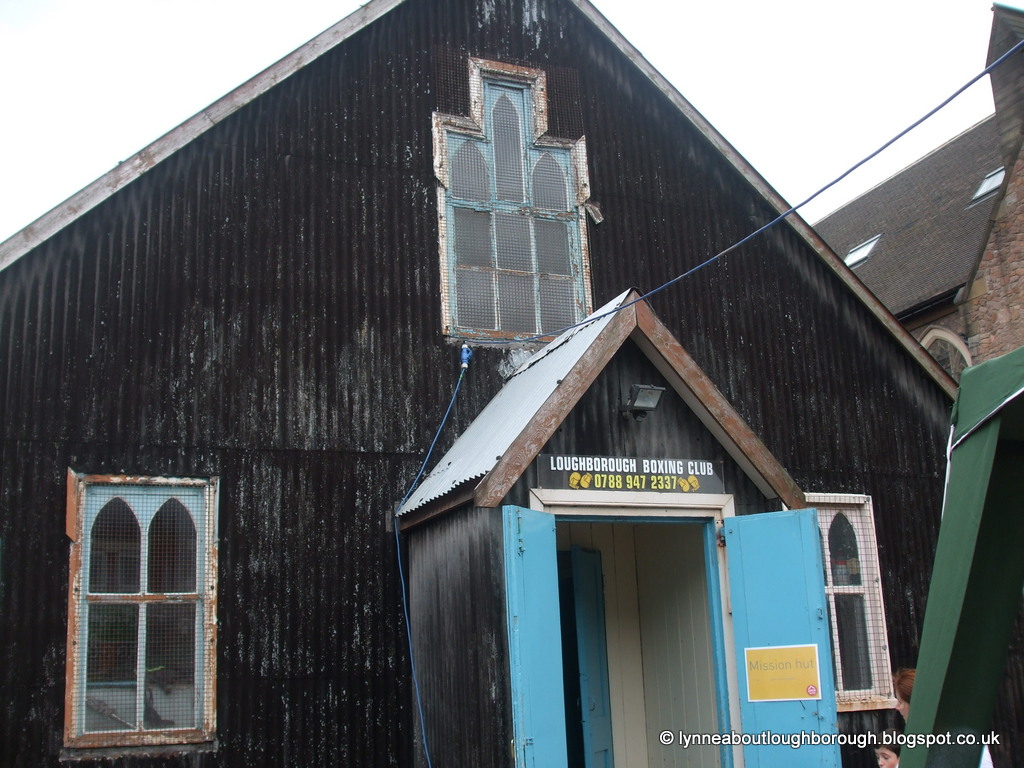
April 1889 – the iron mission church was built,
and a Sunday School established. The iron mission church (1), which is on the Paget
Estate, was dedicated by the Bishop of Leicester. It was expected to be
temporary and was built to serve the rapidly expanding local community. The
site on which it stood was big enough for additional, permanent buildings to
house the church, a Sunday School, and a vicarage. The iron church itself was
built by Mr Lee of Manchester. Gas fittings within were provided by Mr C
Fisher, seating by Messrs Watson and Lovett, brickwork by Messrs A and S Main,
and Mr Walter Chapman Burder presented a prayer book and bible.
 |
| The iron mission church |
 |
| The iron mission church adjacent to St Peter's church |
1892 – Reverend W Irwin became curate at Loughborough parish church, and curate-in-charge in respect of the mission church at St Peter’s.
March 1892 – the iron mission church was enlarged
to double its original size. At the same time it was dedicated. The new part was
at right angles to the original: a chancel of 25ft by 17ft 6in, a classroom
25ft square on the left, which also had a gallery for infants, and on the right
were two rooms, each 15ft by 12 ft 4in., one of which acting as a vestry. The exterior
of the church was corrugated iron, whilst the inside was of stained and varnished
wood. Foundations for the extensions were laid by W Ludlam, the interior
woodwork by W F Harding, and the heating system by Messengers. George Hodson
was the superintendent of the building works, the cost of which was £300, all raised
by donation. Gifts for the interior included an oak communion table, altar
linen and altar vases, and a brass cross.
 |
| The iron mission church from the rear |
 |
| Inside the iron mission church |
 |
| Inside the iron mission church |
1895 – at a public meeting at Fearon Hall it
was agreed to appeal for funds to build a permanent church and school rooms.
28
December 1895 – Tenders
were received for the building of the new St Peter’s school rooms. These were submitted
by W Corah, W F Harding, T Barker & Son, W Moss & Son, and the contract
was awarded to A Faulks, a master builder of Sparrow Hill, at a cost of £2,330.
George H Barrowcliff was the architect.
February 12
1896 – the foundation
stone for the Sunday School building, comprising a Sunday school and church hall,
to accommodate 800 scholars was laid by Mayoress of Loughborough, Mrs Walter
Chapman Burder. The central hall measured 61ft by 30ft, the infant room 54ft by
19ft, and the six classrooms were 13ft by 12ft each. There was also a committee
room, cloakrooms and a general out-office.
 |
| The foundation stone of the Sunday School building |
 |
| The Sunday School building from Storer Road |
 |
| The Sunday School building from the rear |
July 1898 – after an illness lasting several months,
Reverend Irwin died.
1900 – a committee, charged with arranging
for the erection of a permanent church building, met with the ecclesiastical architect,
Mr William Samuel Weatherley, to discuss plans. The proposed design was large
and handsome, but the committee decided now was not the right time to build it,
so decided to build a nave only, with the chancel, vestries and tower to be
added later. The estimated cost of the complete new church were £8,000.
February 1907 – plans to build around the current nucleus
of the church were developing and local people were pledging money towards the
cost.
June 1907 – the need for a permanent church,
and the creation of a separate parish was now urgent, and it was proposed that an
application be sent to the Ecclesiastical Commissioners.
1909-1913 – the plans for the new church were
drawn up by the joint architects, Mr William Samuel Weatherley, of London, who
during 1867-72 had been a pupil of Sir George Gilbert Scott, and George H,
Barrowcliff of Loughborough, who had already designed the Memorial Baths in
Queen’s Park, the Carnegie library on Granby Street and had just designed the
United Reformed church building on Frederick Street.
 |
| A drawing of St Peter's church |
November 1910 - the foundation stone is laid
April 1912 - the new church is consecrated by the Bishop of Peterborough.
March 1913 – St Peter’s becomes a fully
instituted parish, both in legal and ecclesiastical terms.
Skip forward in time to:
1962 - the lady chapel was added to the church.
1966 – the Sunday School was converted to
become a community centre. As the heart of the community, over the years it was
used by groups as varied as the Chrysanthemum Club, the Mother’s Union, folk
clubs, keep fit clubs, bridge clubs, drama groups, for weddings and religious celebrations
for members of the local Asian community, offering help to Vietnamese refugees,
morris dancing clubs, boxing and judo clubs. This is not meant to be an exhaustive list - just a selection to give a flavour of how the community centre was used.
 |
| The Sunday School building from the front |
1989 – a time capsule was buried at the edge of the centre’s car park, under a sculpture by Rosebery Arts.
 |
| The time capsule buried underneath a sculpture in 1989 |
2004 – the church of St Peter’s officially became redundant and in 2005 churches were invited to propose future use of the building.
2007 – the joint use proposal submitted by
Elim Pentecostal Church and Open Heaven was successful, and detailed plans were
submitted to the planning department, with permission being granted in 2009,
and renovations taking place between 2012 and 2013.
2009 - the St Peter's Community Centre, formerly the Sunday school building, became the Rosebery St Peter's Centre.
 |
| The Sunday School building from the side |
2013 – following extensive renovation and
redesign an open event, opened by the Mayor, to celebrate this and the start of
a new chapter in the history of St Peter’s church, was held in August 2013. The
community festival event included an historical display at which was shown the 102-year-old
time capsule that had been found during the renovations.
 |
| Record of the laying of the foundation stone of the church |
 |
| Time capsules inspired by the one found |
 |
| The uncovered time capsule from 1911 |
2016 – St Peter’s community centre celebrated
its 50th anniversary.
September 2019 –Becca Byrers from BBC Radio
Leicester, and I walked around Loughborough looking for its hidden past. This
included a trip to the former St Peter’s church where we were treated to a
viewing of the time capsule and a number of relevant documents. We also went along to Beaumanor Hall, and the whole event is available as a podcast, called Multi-Story.
June 2020 – it is announced that the Rosebery Community Centre will close permanently. The community centre hired out its space for a variety of events, including art exhibitions, but income during the coronavirus pandemic ceased as community groups have not been able to meet: As such, the community centre could no longer continue due to lack of finance.


