Showing posts with label Carillon Museum. Show all posts

Sunday, 12 July 2015

Red about Loughborough Part 1!


These last few weeks have been hectic, so all I've managed to do is go out and about taking a few snaps about town, of all things red! Enjoy! And for more pics of red about Loughborough, check out Part 2!

Pillings Lock

On the water

On the water, 2

At the GCR

Inside Towles, now SOFA

The Charnwood Forest Line

Beside the water!

So RIII did visit Lowes, like Henry, after all!

A day at the museum!

Traditionally known as red brick, but are they Tucker's?

At the GCR station

In the GCR worksheds 1

In the GCR worksheds 2

Around the GCR 1

Around the GCR 2

The signals


On the GCR platform 1

On the GCR platform 2

At the Carillon Tower and War Memorial Museum

On the GCR line

At the GCR museum

On the GCR platform 3

On the GCR platform 4

Celebrating a 21st birthday at The Plough, Normanton!

Cattle Market 1

Cattle Market 2

At the Midland Mainline station

At the new Baxter Gate cinema/restaurant complex

Sunday, 17 May 2015

What have Hathern Band, LMVC, the BCM, the carillon, ceramics and John Nichols got in common?


This week I am spoilt for choice, and having a difficult time deciding what to share with you!


Since my last post I’ve been lucky enough to listen to the Hathern Band, not once, but twice!! Last week, Hathern Band played in the bandstand in Queen’s Park, directly after the Carillon recital, in commemoration of the 70th anniversary of VE day. This was a lovely performance, with glorious sunshine and a large, appreciative audience.


Last evening, I was lucky enough to find a seat in the Trinity Methodist Church for a joint concert of Hathern Band with the Loughborough Male Voice Choir. Hathern were on top form – especially the trombones, but I am a bit biased!! I particularly loved the rendition of “76 trombones”! The choir did themselves proud too, and their numbers have swelled recently since they had a pseudo recruitment drive earlier this year. I think they’re still on the lookout for new members, so if you’re looking for something to do, check out their webpage.

Yesterday we took a trip to the Black Country Museum in Dudley. Hadn’t been before, but had heard good reports about it, and it didn’t disappoint. Lots of exciting things to see and do, including a ride on a 1948 bus, and a Midland Red double-decker, a tram (but this was closed for maintenance), reconstructed terraced houses, dressed accordingly, and with volunteers making soup over the open fires. And gardeners tending their little plots, and producing beautiful pink sticks of rhubarb which the children dip in sugar. Then there’s the authentically 1940s shops, including a chemist, a greengrocers, ironmongers, confectioners, bakers etc., some of them actually selling things, like the little fish and chip shop. The cafĂ© was in the Worker’s Institute, and had a wonderful selection of food, and we enjoyed a steak and Stilton pastie with mushy peas and new potatoes coated in yummy salt and pepper.

Lots of remnants of the days when Dudley had iron founders (I think there was a saying about the area, black by day, red by night, which related to the smoke and grime in the daytime and the glow of the iron works in the night). This reminded me of John Jones the iron founder in Loughborough, who owned the Britannia Foundry. I think he lived in that very large house at the junction of Meadow lane and Clarence Street, which now appears to be a health spa (sounds like the beginnings of a future blog post … !). The mine at the Black Country Museum was open, but I’m afraid I couldn’t go down there: The last time I went, or rather tried to go, down a mine, it was a tin mine in Cornwall, but I had to turn back pretty sharpish, when even I had to watch my head! Trips on the canal boats were also available, although they seemed to be doing quite a lot of work on the canal, so we thought we’d leave that till our next visit!! When will I ever find time?!

I’ve also giving up a bit of my spare time in helping out at the Carillon Tower and Museum again this year. This is such good fun, as I get to meet so many interesting people from all over the world, and who all have such interesting tales to tell! I also finally got to learn what the copper boots in the Airborne room were all about, and I get to hear the carillon being played (guessed what day I’m there, yet?). If you fancy helping, the museum is always on the lookout for volunteers so they can keep all floors of the tower open to visitors.

Talking of the carillon, today, I also heard the carillon play as I walked into town to take a peek at the ceramics market. It’s an annual event and I blogged about it last year, so I shan’t say anything about today’s market other than to say there was a lovely variety of pottery, and it’s difficult to go and not spend any money: Well, that’s a few birthday and Christmas presents sorted!!

Now, what have I forgotten? Oh, yes, the banquet in celebration of the bi-centenary of John Nichols’ History and Antiquities of the County of Leicester, an 8-volume work, written by Nichols in 1815. What a glorious event that was, but, I’ve run out of time to tell you about it tonight, so I will save this one for next time!


Saturday, 4 April 2015

Museums

Museums in Loughborough

Well, back in Loughborough, after a long week in Leicester, I see Spring has sprung, Easter is upon us and we all know what that means - Yes! The museums in town are now open for their summer season hours!


The Carillon Tower and War Memorial includes three rooms of artefacts, the clavier chamber, the carillon bells themselves, as well as a roll of honour to those who gave their lives in WW1 (and later conflicts). Entry to the ground floor exhibits are free, whilst the upper floors are accessible on payment of a small charge (£1). The carillon is played twice a week, at 1pm on a Thursday and Sunday (I think). The opening hours for the museum are: 1-4.30pm everyday, apart from Monday when it is closed all day. You can find the Carillon in Queen's Park Loughborough, close to the bandstand, the aviaries and the ...


... Charnwood Museum. Charnwood Museum tells the fascinating story of Loughborough and its environs, covering early history - think Walking ON dinosaurs, rather than Walking WITH dinosaurs - the geology of the area - "small areas of Precambrian and lower Cambrian rocks in Charnwood Forest and the unconformable overlying Carboniferous cover." - through framework knitting to rubbish tips, to Ladybird Books, and Edward Elgar music scripts. As well as the permanent displays, there are two exhibition areas which are used for temporary events - displays of local work, of national events, and exhibitions mostly relevant to the local area. The museum is FREE to visit, and the opening hours for the summer are: Tuesday - Saturday 10.00-4.30, Sunday 2-5pm. Beside the museum, with an entrance from the museum and from Queen's Park itself, is the CafĂ© in the Park.

Both the above museums are on facebook:

The Carillon

Charnwood Museum

Situated in the Heritage Quarter of Loughborough, next to the Parish Church (aka the Church of All Saints with Holy Trinity), is the former rectory, known as the Old Rectory, which was the home of the former vicars of the adjacent church. The building that is still standing is a 13th century stone-built manor house, which although extended many times over the years, is all that is left of the former prestigious house. Inside there is an exhibition area which houses a different display each year, whilst upstairs there are display cases which show the history of the building, the area, and even some local firms. Last year, I visited the museum and wrote about my experience. The Old Rectory Museum is FREE to enter (I think), and can be found on Rectory Place, very close to the Parish Church, and is open every Saturday, April - October, 11.00-3pm.

The final museum I would like to mention is Taylor's Bellfoundry museum. This museum is spread over two floors, and includes things like bells from different era made by different founders, artefacts pertaining to bell founding, and also has a shop which sells many bell-related items. You can take yourself around the museum, but to get the very best experience, guided tours are also offered (these must be pre-booked). The museum is a little way from the town centre, on Freehold Street, and is generally open Tuesday, Wednesday and Thursday 10.00 - 12 noon, and 2.00 - 4pm, although it is advisable to check before making the journey. There is a small charge of approx. £4 for entry.

For an account of my visit to the Great Central Railway Museum, which is open during times the station is open, please follow this link.
     

Friday, 30 January 2015

99 years since the Zeppelin raids on Loughborough

A little more about the Zeppelin raids on Loughborough

Some time ago I posted about a guided walk led by a friend of mine, which covered the spots hit by the Zeppelin raid on Loughborough of 31st January 1916. Next year will be the 100th anniversary of this dreadful attack, so I thought it would be appropriate to share a few links with you.

The BBC World War One at Home website has an interviewer talking to an expert about the event.

In this video, ITV take a lady back to the area of the attack.

The Charnwood Great War Centenary Project is planning a community commemoration event.

The Loughborough Roll of Honour website has an extensive account and list of those killed and injured in the attack.

The Leicester Mercury of 26 February 2014 has an account of the attack, and contains a selection of photographs.

Leicestershire Revealed, 100 Museum Objects puts exhibits from the Zeppelin raid, on show in the Carillon Museum in its top 100 items.

Last year an academic from Loughborough University gave a talk to the Friends of Charnwood Museum on the journey from the start of the war to the Zeppelin raid on Loughborough.

The borough council have produced a self-guided walk, which encompasses The Rushes, site of one of the bombings.

Information on the Leicestershire War Memorials Project.

In 2000 this artefact was put up for auction: "Loughborough, Leicestershire, 42mm, in silver, die struck medallion, obverse with profile of Herbert Morris and inscription ‘Carry on’, reverse inscribed ‘Herbert Morris Limited, Empress Works Loughborough, in appreciation of services rendered Aug. 4th 1914 - Nov. 11th 1918’, edge inscribed ‘Walter Williams’, contained in its original hinged fitted case of issue, extremely fine £40-50". I believe it actually went for £130.

There's a tiny bit on the raids under the heading "1916" on Wikipedia, but not mention specifically of Loughborough.

The new artwork by Silent Hobo installed in Devonshire Square, above the shops, has a Zeppelin as one of its images.

An interesting initiative on Twitter, although not directly related to the Zeppelin raids on Loughborough, helps inform people today by sharing the war diary of William Grudgings, a former schoolteacher from Cobden Street School who signed up in 1916.

The recently re-discovered war diaries of Alfred Angrave, from the Leicestershire Regiment, have just started to be shared on Twitter.

In two of the locations where the bombs fell, there are granite crosses still to be seen, and one brass plaque on Empress Road, and another housed in the Carillon Museum.

Empress Road

Empress Road

The Rushes
The Carillon, a memorial to those who fell during the First World War, and later conflicts.

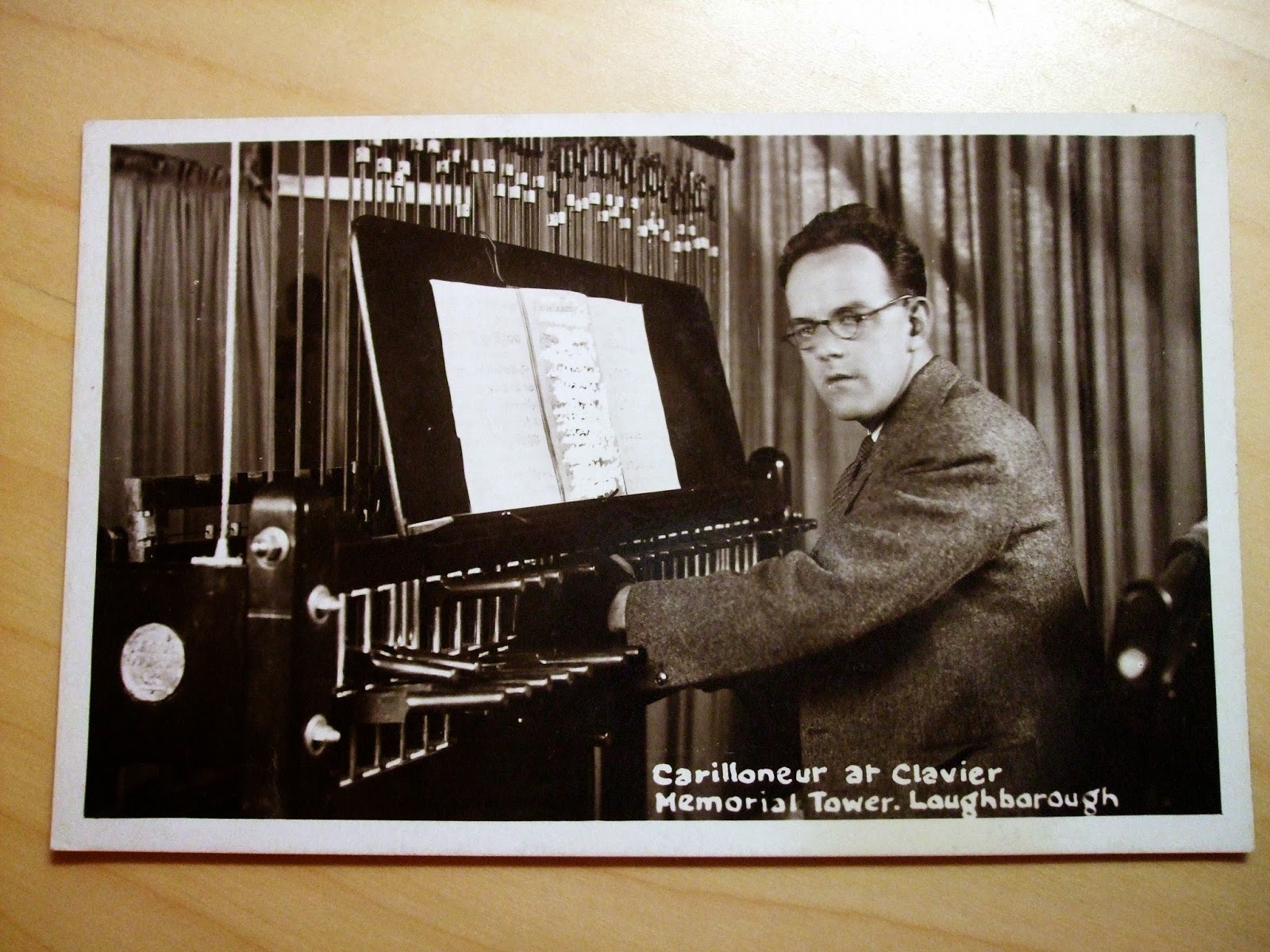
A selection of postcards of the Carillon

A postcard of the Carillon

Borough Carilloneur

The Carillon bells in Taylor's bellfoundry

A postcard relating to the Carillon and its bells


Sunday, 11 January 2015

Needlemaking and other Loughborough connections

This week the Loughborough Archaeological and Historical Society held their members event which sees members of the society give presentations on things they've been researching that would be of interest to others. This year, I decided to give it a go, and presented a short talk on archaeology - my kind, not the trench-digging, field-walking kind - with examples of artefacts I've found on my travels that have informed my research.

If you would like to see the presentation, I've uploaded the slides , and I've included the transcript below.

Archaeology and the fundamental interconnectedness of all things (with thanks to DA)

In late 2012, when I responded to an advert for members of the public who were interested in the history of Loughborough to enrol on a 6-month course in Leicester on learning how to lead a guided walk, little did I know what was actually in store for me!

At the first session of the course I felt like a complete interloper! Almost everyone else there was attached to a museum  - The Old Rectory, The Abbey Pumping Station, The Space Centre, The GCR, Newarke Houses etc. – so I attached myself to the unattached chap next to me and we got on like a house on fire, which was great as he was a retired fire officer!

As a daughter of the grim industrial areas of South Wales, what exactly did I think I had to offer to people who might be interested in the history of our little market town – and probably knew more about it than I did anyway!

Well, to cut a very long story short, I may have known very little about Loughborough at the start of the course, but many years of researching significant (that’s significant to me) areas of Wales, and endless hours of pouring over census returns and bmd records in a quest to complete the family tree, all held me in good stead. And maybe, just maybe, being a librarian by day was also a bit of help!

So, I passed the tour guiding course, and have shared some of my knowledge on guided walks. But when I read on Twitter about 18 months ago that some people viewed Loughborough as a rubbish town, I decided to try and do something to raise the profile of the town. Thus, the blog, lynneaboutloughborough was born. Each Sunday evening I write a piece about, or related to, our wonderful town, and share this on the internet for anyone to read.

Articles are prompted by my own interests, by things people have said to me, by events happening in and around the town, and by chance finds.

I know the Loughborough Archaeological and Historical Society started life as the Loughborough and District Archaeological Society, and although I was daunted at the prospect of joining such a prestigious group, I paid my subs and showed up at meetings. Now, I know nothing about archaeology except what I’ve seen on television programmes like Time Team, and in truth, I have a bit of an aversion to getting dirty, but I bit the bullet and went on a fieldwalking event, and thoroughly enjoyed walking through a recently ploughed field looking for bits of debris that might be a flint arrowhead, or some kind of pottery. Problem was though, having been brought up in South Wales I could easily recognise slate, and had there been any granite I would have recognised that too, from regular holidays in Cornwall. But, I didn’t find anything significant, and was really rather more interested in the 19th century horseshoe I spotted!

So, if digging trenches and walking ploughed fields isn’t quite my kind of archaeology then what is?

Well, antique and junk shops are! Charity shops are! 2nd hand bookshops are! The internet is!

So, I dig around all of these, looking for clues, usually about something specific, but equally often just picking up things that might be of interest. Everything I see of buy helps me to build up a picture of what I’ve been researching into and helps me to understand more about social history.  

Take this postcard. A picture of Leicester, sent to someone in Loughborough and bought over 100 years later from Lichfield. To me, this is all hugely significant: My journey from home to town takes me along Albert Street, and I’ve always been fascinated by the engineering factory on the corner. Research revealed that it had once been a needlemaking factory, one of the ones run by the Grudgings family, at least one of whom died during WW1, and at least one other who survived (and whose WW1 diary is tweeted via the Carillon Museum). And here I am holding a postcard sent to Flo Grudgings, an elementary school teacher and a member of that needlemaking family. The card was posted in 1903.

And then, of course, there’s the Lichfield connection. Wasn’t Lichfield Cathedral once the cathedral associated with our town? And at least some of the current bells were cast by Taylor’s Bell Founders in 1947. It was Taylor’s, of course, who cast the bells for our beautiful war memorial, which can still be heard on Sundays when the carillon is played.

I did a spot of volunteering at the Carillon Museum this year, just before my grandmother died. How strange then to learn at her funeral that a long lost uncle who emigrated to the States in the ‘60s, regularly plays the carillon in his home town of Morristown, New Jersey.

But, back to archaeology! Earlier, I said I could recognise slate and granite, but perhaps I should also add alabaster to that list. I first met Ray State in the local studies library about a week after I’d written an article on spar ornament makers of Loughborough, so it was a real pleasure to come along and hear him talk, just before Christmas. Curiously, also a couple of weeks before Christmas, we had a sale of unwanted goods at work: We’re trying to raise money to train a guide dog, and for the huge sum of 50p I bought this alabaster egg. I got the feeling people thought I was a bit mad, but I’m now so glad I did buy it! Needless to say, I have been scouring the shops for other alabaster ornaments, but I don’t think I’ll ever find any! But, who knows, I might yet be surprised …

… as I was on another recent shopping trip looking for suitable Christmas presents!

Imagine my total astonishment and excitement when I stumbled across this trunk! Ok, so it’s a steamer trunk, but not just any old steamer trunk! Fortuitously, the last luggage label had been left on: This trunk belonged to Charles Knight Deeming, he, latterly of One Ash House, the former owner of the current Odeon (aka The Empire, The New Empire, The Curzon, The Reel), and the now demolished Victory Cinema, which stood in Biggin Street on the site now occupied by a card shop, Games Workshop and Bonkers.  

Ironically, I’m a little bit interested in cinema and theatre and had been researching the family tree of Charles Deeming. Unfortunately, at £165 the trunk was too expensive for me to buy – so no prop to show you!

Finally, it was a visit to a 2nd hand bookshop in Warwickshire that led me to this publication,  Needlemaking, and the list of places to visit in the back. This included Forge Mill Needlemaking Museum in Redditch. This, of course, takes us back to the Grudgings family where we started, unless we want to explore these connections further, for Bordesley Abbey was on the same site as the needlemaking museum and there is a strong connection to Garendon Abbey and has been the subject of a community dig.

So, our archaeologies are fundamentally interconnected, but I must stop here, otherwise I could carry on connecting for a very long time!

Thanks for listening!

Sunday, 10 August 2014

World War One - We Remember

Wonderful event in Queen's Park

Yesterday I spent a very special afternoon in Queen's Park, with some very special people, to commemorate the start of World War One. Somehow or other I got invited to the reception held at John Storer House, and was privileged to join the procession from there to the carillon, where we took part in a remembrance service, which included the recitation of the names of Loughborough servicemen who died before Christmas 1914.

It was lovely to hear Mike and Dru from Hathern Band play the Last Post and the Reveille, and to sing along to Hathern playing "Land of Hope and Glory" (even if the singing was about 2 bars ahead of the band!).

After the service we dispersed, and I spent a very happy couple of hours listening to some fantastic music, meeting up with loads of friends, talking to many people, drinking tea, and generally soaking up the atmosphere. I must say, I thought this was a fantastic event, and the setting of Queen's Park was perfect.

I don't have any pictures of the actual service, but here are some pictures I took as I wandered around.


And to close the event, Caroline played a short recital: I was too slow off the mark, but here's a couple of seconds worth of her wonderful playing (with apologies for the upside down picture).