Showing posts with label Long Whatton. Show all posts

Monday, 4 July 2022

Loughborough Carillon and Carilloneurs Part 2

Last time on the blog we looked at the views of Queen's Park, Loughborough, and beyond from the top of the Carillon Tower and War Memorial Museum - to give it its full title!

This time, we'll have a look at some of the bells, and learn about the wonderful carilloneurs (1) who have regularly played the carillon instrument down the years. The bells really speak for themselves!


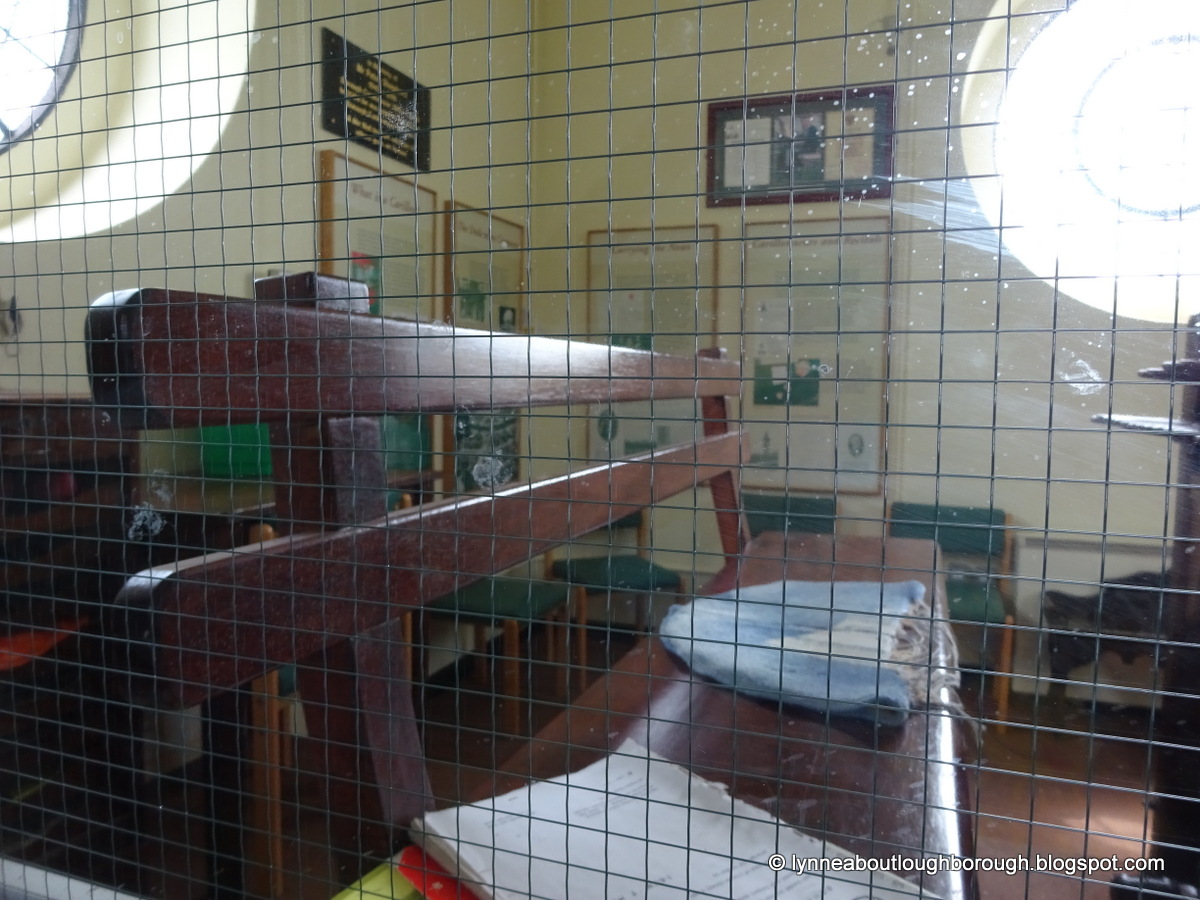
A poor quality view of the clavier room, and the carillon instrument

View of the carilloneur's seat!

The above seat has been the playing position of quite a number of carilloneurs, as well as visiting players. The first-ever recital was performed at the opening of the Carillon on 22nd July 1923, when the playing of the "Last Post" and a minute of silence had happened, 'Chevalier' (2) Jef Denyn, from Belgium played Elgar's "Land of Hope and Glory". This was followed by a rendition of the more sombre "Marche Funebre" by Chopin, then a Flemish piece, and ended with a performance of "Carillon Chimes", a piece specially written by Elgar for the occasion, before the national anthem was played. According to a report in the 'South Nottinghamshire Echo' there was a crowd of around 30,000 people in Queen's Park, and amongst the dignitaries attending, were the principals of the town colleges, headteachers from the town schools, the local clergy, members of the War Memorial committee, members of the Corporation, the mayor, mayoress (Mr and Mrs Wilfred Moss) and guests, which included Dame Nellie Melba, who had come to visit as she was hoping that a carillon could be built in Melbourne, Australia.

A year before the opening of Loughborough's Carillon, Jef Denyn had founded the Royal Carillon School "Jef Denyn" in Mechelen (3), Belgium, which was also known informally as the Mechelen Carillon School. It was the world's first and largest carillon school, and was a mecca for would-be carilloneurs.     

Following the installation of the Carillon in 1923, the borough appointed Eric Jordan as the borough carilloneur, and Sidney Potter, as the deputy borough carilloneur. Both studied at the Royal Carillon School "Jef Denyn" in Mechelen, Belgium, under the great man himself. By 1952, Eric was tutoring two local people in the art of playing the carillon, but was very keen to find more pupils!

A very short account of Eric Jordan

A couple of weeks ago I was lucky enough to meet some descendants of Loughborough's carilloneur, Eric Jordan, when they visited Loughborough and the Carillon.

Eric was born in 1901 in Loughborough to parents William Joseph Jordan and Hannah Wightman, who were married in 1884. At the time of the 1901 census, the family were living in Thorpe Acre, having previously been recorded in 1891 as living at 25 Hastings Street in Loughborough, when William Joseph was a drayman. In 1901 Eric's father was listed as a woodworking machinist, Eric's sister, Edith was aged 14, and a school teacher, his brother Charles was a school student, and sister Alice, aged 10, was at the General Hospital on Baxter Gate. Eric did not appear on the 1901 census as this was taken in April, and he was not born until September.

The 1911 census return sees Eric listed for the first time, living in Thorpe Acre with his parents, Joseph and Hannah, where his father is now a horticultural builder (a woodworking machinist), as is his brother Charles. In 1926, Eric Jordan married Edith Agnes Swift, who was born in 1900, and brought up on the main road in Hathern, where her father, Henry, was a dairyman. Henry had married Hannah Elizabeth Wightman, daughter of a joiner, Charles, and his wife, Elizabeth Street, in 1884.

I believe Eric and Edith had two sons, one born in 1929, the other in 1934, and the family lived on Lime Street. Eric's main occupation was that of insurance agent. Both Eric and his wife lived into their 90s, Edith dying in 1993 at the age of 93 in 1993, and Eric at the age of 92 in 1994. Both are buried in the church of All Saints in Long Whatton.

 
All Saints church at Long Whatton


Sadly, as usual, I have run out of time, and I have done little other than mention the basics of Eric Jordan's life, and not done him justice. There is a vast body of information to sift through, so please be assured that this is not the last I will write about Loughborough's first Borough Carilloneur, and his successors. Do pop over to this post on the Zeppelin raid of 1916 to see a likeness of Eric Jordan. 

Notes

(1) Oh dear, different reputable sources have used different spelling for this word, and now that I've looked it up in a reputable dictionary, I find I have used the incorrect spelling. However, since I have done this consistently I shall continue with using 'carilloneur' rather than the correct spelling, of 'carillonneur'.

(2) The use of the word 'Chevalier' preceding his name indicates that Jef Denyn had been granted the title "Chevalier of the Order of Leopold" by the King of Belgium.

(3) I have to apologise here for my confusion over whether to refer to the Belgium city in its Dutch form, Mechelen, or in its French name, Malines. Apparently, Belgium's linguistic diversity is potentially a hot political potato, and I wouldn't want to offend anyone, by using a non-preferred version of the name, without at least some small explanation.     

You are welcome to quote passages from any of my posts, with appropriate credit. The correct citation for this looks as follows:

Dyer, Lynne (2022). Loughborough Carillon and Carilloneurs: Part 2. Available from: https://lynneaboutloughborough.blogspot.com/2022/06/Loughborough-Carillon-and-Carilloneurs-Part-2.html [Accessed 4 July 2022]

Take down policy:
I post no pictures that are not my own, unless I have express permission so to do. All text is my own, and not copied from any other information sources, printed or electronic, unless identified and credited as such. If you find I have posted something in contravention of these statements, or if there are photographs of you which you would prefer not to be here, please contact me at the address listed on the About Me page, and I will remove these.
Thank you for reading this blog. 

Lynne

Sunday, 4 April 2021

Tuckers Bricks Part 3

Over the past two weeks, we’ve been looking at buildings built using products from Tuckers, the brickmakers from Loughborough - Part 1, Part 2. This week we continue looking into some of the buildings constructed post-1934.

Advert from 1957


According to an article in the Nottingham Journal in 1935, the new St Cyprian’s church in Nottingham had many remarkable features, one of which was the use of a tasteful variety of bricks, rather than stone. The Portland cement, produced at Barnstone in the Vale of Belvoir, was used to complement the many thousands of handmade bricks, especially made to the architect’s particular design. The company who produced these bricks was G. Tucker and Son of Loughborough, who made their ‘tudorstyl’ facing bricks in a variety of colours, and these were used exclusively on both the exterior and interior. 

As well as the facing bricks, Tuckers also supplied the ‘Loughborough’ handmade sand-faced roofing tile. This new church building, costing around £8,500 to build, was designed by local architect C. E. Howitt of the firm of John Howitt and Sons, and was in a modern gothic design, able to seat around 400 people. The new church complemented an earlier building of 1913 which had become too small for the burgeoning population of the Sneinton area of Nottingham, the latter now being used as the church hall.  There is a small bell hung in an external bell frame on the north wall of the church, which is used for swing chiming. Coming in at 20 inches, the bell is dated 1913, and originally hung in the old church, being moved in 1935. It was created by Taylors bellfoundry.

St Cyprian's Church, Sneinton

The following year, all the facing bricks used in the construction of St Margaret’s church in Aspley were supplied by Tuckers. According to the Nottingham Journal  “ ‘Multiruf’ facing bricks were a registered speciality of Messrs. Tuckers.” St Margaret’s church has an entry in the 1979 edition of Pevsner’s ‘Buildings of England: Nottinghamshire’, which reads: “St Margaret, Aspley Lane, Aspley. 1934-6 by E. H. Heazell, Brick, typical reduced Gothic of the period.”

St Margaret's church, Aspley


In 1937, following much controversy over the need for another cinema to join the three existing cinemas in the town, the Odeon in Rhyl was built, using Tuckers products. Even in its construction, the building was problematic, not least because it was built in an area that was subject to tidal flooding!

According to the Story of Leicester, in the 1930s there were over 25 cinemas in Leicester: the Odeon opened in 1938, and was, apparently, the grandest. Like Loughborough’s Odeon on Baxter Gate, Leicester’s was designed by architects from the Harry Weedon partnership, Leicester’s probably by Harry Weedon, and Loughborough’s by Arthur J. Price. The cinema is situated in the area now known as the Leicester Cultural Quarter, close to The Curve theatre, and what is now the Serbian Orthodox Church of St George (incidentally, chancel added by Blomfield in 1879), although it was converted to a catering venue around 2005 after the building closed as a cinema in 1997.  The opening in July 1938, which was attended by Harry Weedon himself, was reported in the Leicester Evening Mail: “the whole of the facing bricks for the new Odeon cinema are two-inch hand-made ‘tudorstyl’ facings, manufactured by G. Tucker & Son, Ltd., Loughborough.”


Former Odeon in Leicester

Up to and including 1939, Tuckers appear to have been extremely busy providing roofing tiles and facing bricks, the latter particularly in lighter colours, but also in a great increase in the range of colours available, across the country. This included materials for many housing estates; the swimming baths at Hitchen and Willesden; cinemas at Lutterworth, and Birkenhead; various hospitals; a number of libraries; a selection of police stations, and some hotels, including the Test Match Hotel in West Bridgford and the Cocked Hat Hotel in Aspley. Like the Bull’s Head in Shelthorpe, the Cocked Hat was built to serve the new housing that had grown up in the area, and apparently in the late 1950s it was run by landlord Bill Frame, who was an ex-Leicester City football player. Unlike our Bull’s Head, which is now a McDonalds, the Cocked Hat at Aspley was demolished in 2004 and replaced with new housing. Other buildings of this time include offices for Evans Lifts, on Abbey Lane in Leicester.

Evans Lifts, Abbey Lane, Leicester

Over in Peterborough, head offices were built at The Lawns Eye, for Derek Crouch, contractors involved in mining. The offices replaced a large house called The Lawns, and were “faced externally on the east and west elevations in Tuckers Tudorstyl facing bricks”. This office building looks very similar to John Storer House, in Loughborough.

Some of the many houses built with Tucker’s products include the following:

An ‘architect-designed’ house in Woodhouse Eaves, built in 1957 using Tuckers bricks was for sale in 1959.

A 4-bedroomed property in Breaston, construction date not known, was ‘built to a high standard with Tucker hand-made facing bricks … and matching brick and tile double garage’

The appeal of easy access to travel was espoused when in 1965 properties in Long Whatton were for sale – “Two detached bungalows with easy access to M1 and East Midlands Airport, built in Tuckers bricks …”. While, over in Draycot, Derbyshire, in 1966, an ultra-modern 4-year old dwelling in 7 acres of land was for sale, and described as being “Built in local cut stone and Tickers facing bricks.”

But, Tucker’s bricks weren’t just used for the exterior of properties. In 1967 a house came up for sale in Sawley, which had a “Through lounge/dining area, feature chimney breast in Tuckers facing bricks.”

Over on Deans Drive, in Borrowash, no.59 was up for sale in 1974 and was described as being constructed with “Tucker’s hand-made bricks” although the year of construction is not known. In 1977 a house on Briargate, Long Eaton was available for purchase, and according to the Long Eaton Advertiser, it was “built in 1954 to a high standard with Tucker’s facing bricks to all elevations”.

There are still more buildings to look at that use material from Tuckers. Hopefully, next time there’ll be more of a focus on local buildings.

Posted by lynneaboutloughborough 4 April 2021

You are welcome to quote passages from any of my posts, with appropriate credit. The correct citation for this looks as follow:

Dyer, Lynne (2021). Tuckers Bricks Part 3. Available fromhttps://lynneaboutloughborough.blogspot.com/2021/04/tuckers-bricks-part-3.html [Accessed 4 April 2021]

Take down policy:
I post no pictures that are not my own, unless I have express permission so to do. All text is my own, and not copied from any other information sources, printed or electronic, unless identified and credited as such. If you find I have posted something in contravention of these statements, or if there are photographs of you which you would prefer not to be here, please contact me at the address listed on the About Me page, and I will remove these.

You can leave comments below, but do check back as my reply will appear here, below your comment.

Thank you for reading this blog. 

Lynne