Back in January of 2019, I was really pleased to be involved in helping to research a couple of people whose name was embroidered on the Alexandra Bedspread. Geroge Cattan, a student at Loughborough College, and his motorcycle accident in 1923 will stay with me for a very long time! And this is how I first came to meet Deborah! Our paths have crossed many times since, either at Friends of Charnwood Museum talks, or in the Town Hall! Many thanks to Deborah for her fascinating account of the origin of our unique bedspread!
The
Alexandra Bedspread
By
Deborah Moxom
What is the Alexandra Bedspread?
 |
| The Alexandra Bedspread |
The Alexandra Bedspread is a wonderful patchwork textile we
have here in Loughborough. It was created between 1920 and 1923 as part of the
fundraising effort required to pay for the building of our town’s war
memorial, the Carillon Tower.
The Bedspread measures 8ft 7ins by 7ft 5ins (2616mm X 890mm)
and is made up of cream cotton squares, 510 of which have a signature of a
donor embroidered on it. People paid a shilling to sign their name which was
then embroidered in navy cotton by local girls. The central panel of the
bedspread depicts the Carillon Tower embroidered in various stitches. This was
done by students at the Technical College.
The Story of the Bedspread
In 1919 a committee was formed to oversee the fundraising
and building of Loughborough’s war memorial. It had been decided that this
would take the form of a Carillon tower with 47 bells.
The General Committee, as it was known, was split into
smaller committees including finance and the Ladies committee. It was estimated
that between £16,000 and £18,000 would be needed to complete the project.
Money came in via personal donations, workplace
subscriptions and many other fundraising ideas but it was in 1920 that mention
of holding a Grand Bazaar was noted in the committee meetings.
The Grand Bazaar was held over 3 days in Queen’s Park and
the Corinthians football fields (now the Leisure Centre on Brown’s Lane) and it
was here that the Alexandra Bedspread made its first public appearance. It
appeared on the Malines stall run by Mrs Frances Bond and the public were
invited to guess the weight of the Carillon Tower to win the bedspread.
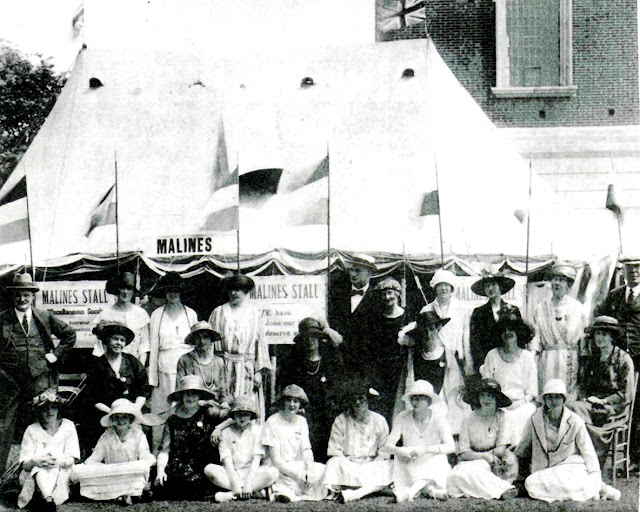 |
| Mr and Mrs Bond, centre of photo, outside their stall at the Grand Bazaar. Reproduced with permission |
The Bedspread was made at 94 Leicester Road, the home of Mr
William and Mrs Frances Bond.
The Bonds originally came from Yorkshire but work brought
them to Loughborough around 1904. Mr Bond worked for the Prudential Assurance
Company and became the local superintendent here in Loughborough.
Their extended family lived in Ireland and Canada some of whom themselves came to Loughborough to study engineering and the family married
into the local community.
Mrs Frances Bond was a member of the Carillon General
Committee and a postcard has been found of Frances proudly displaying the
completed bedspread in her garden (Postcard image courtesy of Christine
Harris).
 |
| Mrs Bond and the bedspread. Reproduced with thanks, courtesy of Christine Harris. |
We believe Frances had this postcard made to be sent out to
donors who lived further afield to show them what they had contributed to.
The bedspread was won by Mr James Ernest Collins, the
landlord of the Volunteer Inn, Devonshire Square, Loughborough. Mr Collins was
extremely proud of the bedspread and after winning it the Collin’s family added
their names and Mr Collins added the word Owner below his signature.
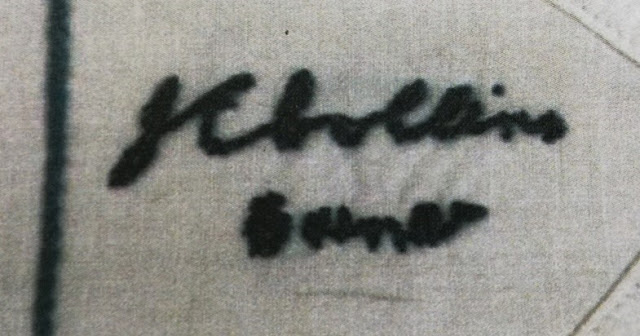 |
| An example signature |
He named the bedspread in his will, where he left it to his
daughter Ivy in 1937. |
| The Volunteer Inn, Ward's End pictured in 1900. Reproduced with permission. |
Ivy kept it until 1950 when she gave the bedspread to
Charnwood Borough Council in whose care it remains today. Unfortunately the
bedspread is unable to be permanently on public display at the moment but ideas
are being considered on other ways to tell its story.
The
Story of the Signatures
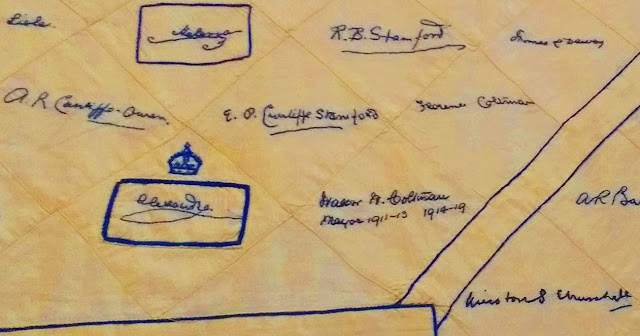 |
| Signatures of Queen Alexandra, Princess Helena, Winston Churchill and Emma Cunliffe-Stamford |
Interesting SignaturesThe bedspread is named after Queen Alexandra now, but was
actually known as the War Memorial Bedspread in 1923.
Queen Alexandra’s signature was obtained as late as May 1923
and it was through her connection to a local family that it appears on the
bedspread.
At the time she signed, the Queen was a widow and her son
King George V was on the throne. Queen Alexandra was godmother to Alexander Robert
Cunliffe- Owen who had come to live in Loughborough after his Mother, Emma had
married a local doctor.
Emma Cunliffe-Stamford had been born in London and her
father Sir Francis Cunliffe-Owen had been the first director of the South
Kensington Museum, which became the V&A and Science museums. The family
moved in royal circles and also knew Lord Kitchener. Emma married Dr Robert
Basil Stamford in 1919 after her first husband died and settled here in
Loughborough living on Burton Walks, at the Red House, until her death in 1950.
During WW1 Emma and her first husband Edward decided to
recruit their own battalion of men to fight. They called them The Sportsmen’s
Battalion, later to join with the Royal Fusiliers.
Overall, Emma and Edward managed to recruit a total of 5,000
men and personally supervised their training, as well as ensuring they had the
correct clothing and equipment. For 11 months, Emma administered the battalions
under the supervision of the War Office, working from 8.30am until 11pm every
day.
The Cunliffe-Owen’s presented each man they recruited with a
silver medallion.
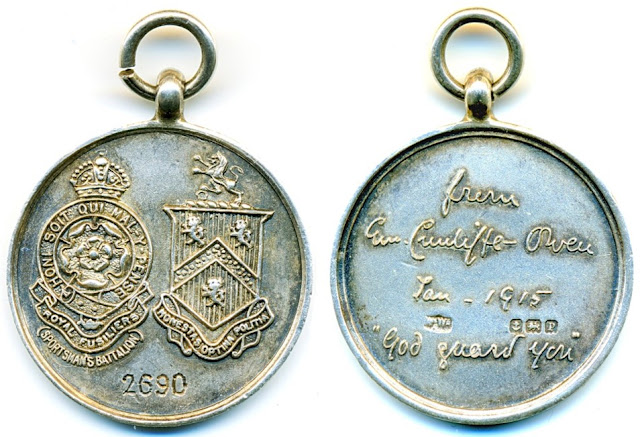 |
| An example of the silver medallions |
Emma was awarded an OBE in 1920 for her contribution to the
war effort.
Princess Helena’s signature was also obtained by Emma
Cunliffe-Stamford. Princess Helena was the youngest daughter of Queen Victoria
and sister-in-law to Alexandra. It seems that Helena’s signature may have been
obtained before Alexandra’s as Helena was gravely ill by May 1923 and in fact, had died before the bedspread was won.
Winston Churchill was not a serving M.P. when he signed the
bedspread but was a close friend of Edward Louis Spears who was M.P. for
Loughborough in 1922. Edward and his wife Mary also signed the bedspread.
Edward and Winston had met on the French front line in WW1
and became firm friends for the rest of their lives. In the 1921 census Winston
and his wife are staying with Edward and Mary Spears in Sevenoaks, Kent.
Edward Louis Spears had been a career soldier. Born in
France he was a fluent French speaker and was deployed to the front line in
1914 as a translator between the British and French Generals. During his time
there he met a nurse named Mary Borden.
Mary was an American, daughter of a silver tycoon and she
had inherited a fortune. At the outbreak of WW1 Mary was living in London with
her husband and had just given birth to their third daughter. Having no
experience of nursing and unable to speak French Mary nevertheless joined the
French Red Cross and travelled to France to work in a hospital in Dunkirk. What
she witnessed appalled her, and she approached the chief of the French Forces,
General Joffe and offered to finance and staff her own mobile hospital. Her
offer was accepted and for the rest of the war Mary headed up a hospital that
moved with the fighting, at times being within shelling distance of the front.
Her idea of a mobile hospital was revolutionary and resulted in her having a
survival rate of 4 out of every 5 casualties, a number unthinkable before.
When Mary and Edward met, they began an affair and in 1918,
after the dissolution of her first marriage they married in Paris.
Mary won many awards for her outstanding war work and she
also wrote poetry and novels about her experiences. One of her poems, Beyond
the Deepening Shadow, was used as a soundscape to the flaming torches installation at the Tower of London in 2018.
A Local
Signature
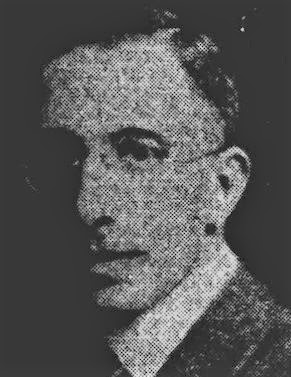 |
| Frank Stockall 1937 |
Frank Stockall was 28 in 1922 and was living at 55 Park
Road, Loughborough. [1]Frank had attended Loughborough Grammar School from
1908-1912 and on leaving school went to Chemnitz in Germany where he was
studying at a German bank. He had also intended to spend time at a French bank
before returning to London where he hoped his experiences aboard would prove
useful to him in a future career.
His father William was managing director of the Nottingham Manufacturing Company, a hosiery company here in Loughborough. They had a
factory in Chemnitz which is why Frank chose to go there.
At the outbreak of WW1 Frank remained in Chemnitz and in
1915 was interned as a British Civil Prisoner of War in Engländerlager of
Ruhleben-Spandan, west of Berlin. At Christmas 1915 he sent a message back to
his school sending greetings and wishes for a brighter New Year and saying that
a printing press had been set up in the internment camp.
In 1922 Frank gave a talk at Loughborough Grammar entitled
“Experiences in a German Prison Camp”. There was a record attendance where he
told them of his arrest, internment and inhumane treatment. He had become
seriously ill whilst in Ruhleben and had been sent home in an exchange of
prisoners before the Armistice which ended WW1.
Frank made a visit to Malines (now named Mechelen in
Flemish) in Belgium to visit their Carillon Tower and the School of Carillon
Music in 1922 and on his return gave another talk at his old school which demonstrated the
passion he felt about Loughborough erecting their own Carillon Tower.
“Can we picture the German troops dancing on the floor of our Parish
Church as they danced in the cathedral of Malines in 1914? Can we imagine the
houses round our Parish Church utterly destroyed by bombardment as the houses
for many yards round the Malines tower were destroyed? Can we imagine returning
to homes in ruins, our rooms covered in debris and dirt, as some of the Malines
men found theirs, when they returned after four years? To the town the Memorial
can therefore never be great enough, great as it will be.”
Frank worked as a hosiery salesman for the Nottingham
Manufacturing Company so never realised his ambition to work in a bank. On the
5th June 1924 he married Gertrude Margery Amatt and remained in
Loughborough until he died in 1969.
There are so many stories to tell behind the signatures on
the bedspread. I have been researching since October 2018 and still the
research continues. The bedspread is a wonderful depository of social history
and tells the story of 1920s, post-WW1 Loughborough. Through the signatures a
story is told of manufacturers, educators, shopkeepers, hoteliers, doctors and
nurses, and everyone else needed to make up a thriving market town. I hope to share
more of the stories I have found through local talks and perhaps a publication.
Deborah Moxom
____________________________________
About Deborah
Hi, I am
Deborah Moxom and I moved to Loughborough in 1995 when my husband came to study
engineering at the University. I have worked locally as a nurse and gardener
but in 2007 I joined the team at the Town Hall working as an usher in the
theatre and latterly on the box office and helping in the SOCK Gallery, our art
space. Having researched my own family history for over 20 years I was very
excited to be asked to look at the Alexandra Bedspread in 2018 when it was to
go up on display in the gallery. I was immediately hooked and have spent the
last, nearly 5 years researching the creation of the bedspread and all 510
signatures on it. It was absolutely wonderful to share my research through the
recent exhibition at the Town Hall and also through talks I give to local
groups and clubs. In the future I hope to produce a publication of my discoveries so that as many people as
possible can discover what a wonderful treasure we have here in Loughborough.
____________________________________
NOTES and Further resources
[1] No.55 Park Road was once the home of the widowed Laura Clarke, whose family had been involved in the dyeing industry.
There are a number of posts in this blog which talk about the Alexandra Bedspread, particularly in relation to signed artefacts, and in comparison with other signed textiles. A short entry also appears in 'A-Z of Loughborough' although since publication it has since been confirmed that there are more than 500 signatures, and that the bedspread was not allowed to be raffled, hence the 'guess the weight' competition.
____________________________________
Posted by
lynneaboutloughborough
With apologies for
typos which are all mine!
_______________________________________________
Thank you for
reading this blog.
Copyright:
The copyright
© of all content on this blog rests with me, or in the case of guest
blogposts, with the named Guest Blogger. However, you are welcome to quote
passages from any of my posts, with appropriate credit. The correct citation
for this looks as follows:
Moxom, Deborah (2023). The Alexandra bedspread. Available from: https://lynneaboutloughborough.blogspot.com/2023/08/the-alexandra-bedspread.html [Accessed 13 August 2023]
Take down
policy:
I post no
pictures that are not my own, unless I have express permission so to do. All
text is my own, and not copied from any other information sources, printed or
electronic, unless identified and credited as such. If you find I have posted
something in contravention of these statements, or if there are photographs of
you which you would prefer not to be here, please contact me at the address
listed on the About Me page, and I will remove these.
Blog
archive and tags:
If you are
viewing this blog in mobile format, you will not be able to easily access the
blog archive, or the clickable links to various topics. These can be accessed
if you scroll to the bottom of the page, and click 'View Web Version'.
Alternatively, there is also a complete list of posts, which when clicked will
take you to the page you are interested in.
Searching
the blog:
You can
search the blog using the dedicated search box that appears near the top of the
blog when viewed in the web version. Alternatively, you can search using your
usual search engine (e.g. Bing, Google, DuckDuckGo etc.) by following this
example:
site: https://lynneaboutloughborough.blogspot.com/ “Radmoor
House”
NOTE – the words you’re actually looking
for must be in “” and the first of these must be preceded by a space
Thank you for
reading this blog.
Lynne


