Showing posts with label Tucker's Bricks. Show all posts

Sunday, 28 January 2024

Tuckers clay pits

Over the years I seem to have written quite a few blogposts about Tuckers, the brickmakers of Loughborough (see below), and included the company in some of my presentations and books. It seems timely to re-visit …

Evidence of Tucker’s brickworks can still be seen around Loughborough. Charnwood Water, formerly a Tucker’s claypit, is now filled with water and is a haven for birds, a great place for anglers, a perfect place for model boats (though not so often nowadays), is ideal for walking, and once was the location for raft and dragon boat races.

I make quite regular visits to Charnwood Water, which was once known as Tuckers Pond, and every time I visit, I see something different! I guess this is partly because of the changing seasons, which means that the plants are different throughout the year, and the views are different when the trees are in leave and during the winter. It’s also partly because of the migratory birds that grace the pond, so Sometimes there’s loads of Canada Geese, or black and white ducks, while other times there’ll be loads of cygnets. Bizarrely, I’ll see something different, or differently depending on which way round I choose to walk the perimeter! And I see and hear different things depending on whether I’m focussing on looking around, or more on listening – or not focussing on anything other than putting one foot in front of the other, a different experience in the muddy winter, and the sunny spring!


Of course, although I believe this was the main brickworks Tuckers also had a works off what is now Epinal Way, on William Street. There are two ponds in the vicinity, and the little one is now also haven for wildlife, and if I remember rightly, I have also seen people fishing there. It’s a bit hidden, and I don’t think it’s possible to walk all the way around, and some of the banks are a bit slopey, but it’s an interesting place, nestled as it is between allotments and a new housing estate. I’m not sure that the larger pond is publicly accessible.


The other Tuckers works was called the Park Road Brick and Tile Works, and was off Park Road, with kilns and other buildings closer to what is now Beacon Road. The main site is now occupied by a supermarket – the building, the car park and the petrol station covering almost exactly the footprint of the brickworks, and the area closer to Beacon Road is now a storage area for a building firm. However, before this, the area was used as the town landfill site, before moving to its present position on Railway Terrace, off Nottingham Road.

Previous posts about Tuckers

A selection of Tuckers buildings post-1934 

A few Tuckers brick buildings from 1928-1933 

Some of Tuckers early buildings up to 1927 

A selection of buildings in Loughborough made from Tuckers bricks 

A bit of family history

Previous posts about Charnwood Water

A winter walk around Charnwood Water 

Charnwood Water in the snow 

____________________________________

Posted by lynneaboutloughborough

With apologies for typos which are all mine!

_______________________________________________

Thank you for reading this blog.

Copyright:

The copyright © of all content on this blog rests with me, however, you are welcome to quote passages from any of my posts, with appropriate credit. The correct citation for this looks as follows:

Dyer, Lynne (2023). Tuckers clay pits. Available from: https://www.blogger.com/blog/post/edit/8260542616882131850/7888115552364711966#:~:text=https%3A//lynneaboutloughborough.blogspot.com/2024/01/tuckers%2Dclay%2Dpits.html [Accessed 28 January 2024]

Take down policy:

I post no pictures that are not my own, unless I have express permission so to do. All text is my own, and not copied from any other information sources, printed or electronic, unless identified and credited as such. If you find I have posted something in contravention of these statements, or if there are photographs of you which you would prefer not to be here, please contact me at the address listed on the About Me page, and I will remove these.

External Links:

By including links to external sources I am not endorsing the websites, the authors, nor the information contained therein, and will not check back to update out-of-date links. Using these links to access external information is entirely the responsibility of the reader of the blog.

Blog archive and tags:

If you are viewing this blog in mobile format, you will not be able to easily access the blog archive, or the clickable links to various topics. These can be accessed if you scroll to the bottom of the page, and click 'View Web Version'. Alternatively, there is also a complete list of posts, which when clicked will take you to the page you are interested in.

Searching the blog:

You can search the blog using the dedicated search box that appears near the top of the blog when viewed in the web version. Alternatively, you can search using your usual search engine (e.g. Bing, Google, DuckDuckGo etc.) by following this example:

site: https://lynneaboutloughborough.blogspot.com/ “Radmoor House”

NOTE – the words you’re actually looking for must be in “” and the first of these must be preceded by a space

Thank you for reading this blog.

Lynne

Sunday, 11 April 2021

Tucker's buildings in Loughborough

Tucker’s buildings in Loughborough

The former Prudential Assurance building, Market Place, Loughborough


I’ve come to the conclusion that blogposts about the use of Tucker’s bricks could go on forever, so I have had to draw a line somewhere! So, before we begin looking at just a selection of the buildings in Loughborough that have been constructed using bricks from Tuckers, here’s a few more non-local buildings with that local connection:

According to the Nottingham Journal of 1st January 1931, in 1930 Tuckers had secured the contract “for the new village of Morris Cowley, built near Coventry by the famous firm from which it derives its name”. I have been unable to locate this …the only Cowley I know is near Oxford …

Extract about Morris Cowley


On 27th May 1954 the Leicester Evening Mail carried the following report on London airport: “At the rate of five bricks a minute, 1,000,000 Loughborough-made bricks are being turned out for use in the construction of London Airport’s new terminal buildings. This order was secured by G. Tucker and Son, Ltd., of Beeches Road, Loughborough. The bricks, which have a rough finish and an appealing antique appearance, are being used in part of the £26,000,000 development scheme planned for the airport … The bricks were chosen because of their exceptionally good colour – a warm reddish brown – and rustic finish … All the bricks are hand-made.” These bricks were used for the control tower, and adjacent offices, the passenger handling building and the Eastern Apex, and further would be used on a public building for spectators.

The Quorn Village Design Statement of 2008 is keen that properties are restored and renovated sympathetically. It is noted that “traditional Quorn is unified by the use of a small palette of local building materials”: this includes the traditional mellow red brick fired from local clays by Tuckers.

In 1893 the foundation stone was laid for the Charnwood Forest Convalescent Home, which was to be built on Woodhouse Lane. The building would be built in forest stone, and faced with red sand-faced bricks to the doors and windows, and with brick lining to all sides: the facing bricks were to be supplied by Tuckers.

Charnwood Forest Convalescent Home

Charnwood Forest Convalescent Home, 2016

Charnwood Forest Convalescent Home showing detail of stone and brick construction

And so to Loughborough …

Grammar School 1852

It is believed that the Loughborough Grammar School buildings of 1852 were constructed of Tucker’s bricks, as were some of the later additions. The Tucker family had close connections with the school as many of the family were educated there.

Detail of a Loughborough Grammar School building


Memorial Baths 1898

What is now the Charnwood Museum in Queen’s Park, was originally constructed in celebration of Queen Victoria’s Diamond Jubilee as the Memorial Baths, offering the people of Loughborough the opportunity to bathe indoors. The building is built of ‘local red pressed bricks, which I presume to be provided by Tuckers. The dressings were from Ruabon – so probably from J. C. Edwards, who were based in Ruabon, Denbighshire, and were certainly very active between 1903-1956.

The memorial baths, now Charnwood Museum


Temperance Café 1899

The foundation stones of the building that we now know as the betting shop on the corner of Granby Street and Cattle Market, which carries a sandstone plaque bearing the words ‘Messrs Garton the Mart’ were laid at the end of August 1899, as the beginning of the Temperance café. Although the terracotta was not made by the Hathern Station Brick and Terra Cotta company, but rather by J. C. Edwards, the bricks used in the construction of the building were indeed local, being produced by Tuckers.

The former Temperance Cafe


Public Library 1905

The public library on Granby Street was completed in 1905. “A competition to design a new library resulted in an Edwardian Baroque-style public library building. This replaced the 1886 library on the corner of Green Close Lane which was considered no longer adequate. The Scottish-Anglo industrialist and philanthropist, Andrew Carnegie, had pledged £5,000 towards its building, as had local man, Griggs, and it was prominent and prolific local architects Barrowcliff and Allcock, who won the design competition. 

One of the assessors of the competition entries was George Hodson. As founder of the Hathern Station Brick and Terra Cotta Company, it comes as no surprise that the resulting library building has much terracotta detailing! The bricks were made by the local firm of Tuckers, and the builders were the local firm of Moss, both of whom would later be involved with the construction of the Carillon. The heating system was installed by the local firm, Messengers.” (1)


The public library

Prudential Assurance 1914

On 18th March 1914, the Prudential Assurance company opened their offices in what was described as one of the best sites in the town, on Market Place. The stunning  building, described by the mayor as ‘an admirable building for others to imitate’ (2) comprised two storeys above-ground and a basement, with a frontage composed of sand stocks from the brickyards of Tuckers. At the opening ceremony, Mr Martin, the assistant manager of the offices, addressed the assembled party, saying he believed the building would stand for many years, and would be a lasting monument of hard and conscientious work by the architect and the builder. He was pleased with the “special specimens of terra cotta from the Hathern Station Brick and Terra Cotta Works” and went on to comment about Tuckers and the bricks: “Messrs. Tucker & Sons …had a reputation all over the country for their material. They [Prudential] had been fortunate indeed in having so much excellent material ready to hand, and such earnest workers to carry out the designs.” The mayor, commenting upon Loughborough itself, said Loughborough had great facilities, and many prosperous businesses, so much so that business premises could be erected and furnished throughout by local firms: as well as the companies already mentioned in the building of the Prudential offices, they were actually built by Loughborough company Corah, and had heating by Messengers.

Mr Martin was correct in his prophecy that the building would stand for many years, and today the building in Market Place now houses Max Speilmann, The Berber shop and Subway at ground floor level, and the upper storeys are being converted.

Carillon 1923

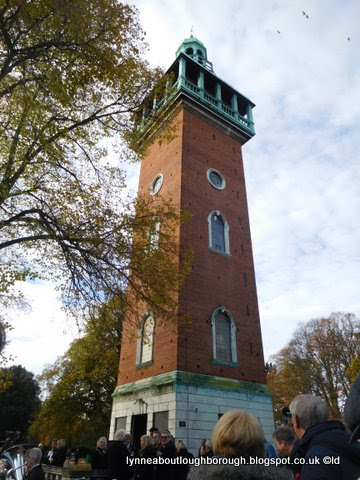
Following a public consultation, Loughborough’s memorial to those who died in the First World War was built in 1923 and took the form of a 151-foot tower with a carillon. “The construction of the tower was a most local affair: built by Moss, of bricks by Tuckers; steelwork by Herbert Morris, and the bells of the carillon made by Taylors Bellfounders.” (3)

The carillon


Shelthorpe Estate 1925-1931

The Shelthorpe housing, built between 1925 and 1931 was built with Tucker’s bricks. During excavations at the site, workmen from Tuckers unearthed half a bronze seal. In 1926 the brickmaking firm offered Loughborough Corporation the sum of £1,000 towards the cost of a road linking Park Road and Leicester Road, known as Shelthorpe Road today.

Extract from the Nottingham Evening Post, 13 January 1935 


Extract from the Leicester Daily Mercury 15 March 1926 


Rutland Hall 1933

Rutland Hall on the university campus was originally built as a hall of residence, but is now offices, and the name transferred to halls in the student village. Much of the emphasis on the descriptions of the original hall focus on the interiors, which were designed in the Arts and Crafts style, influenced by the Cotswold tradition of Ernest Gimson. These interiors were created by Peter Waals, who had worked with Gimson, and Edward Barnsley, whose relatives had also worked with Gimson, and their students. However, the Nottingham Journal of 3 January 1933 quotes a number of buildings across the country that were constructed with bricks from Tuckers, and this includes ‘Rutland Hall, the new Loughborough College Hostel’, which was opened by the Duke of Rutland on 12th October 1932.

It has been suggested that some of the 1930s houses on Beeches Road are constructed with Tucker’s bricks. 

It has also been suggested that houses on Alan Moss Road have facing bricks from Tuckers, but the commons (the ones not on the kerbside) are by the London Brick Company – a company who have been producing bricks since 1877 which have been used in the building of in excess of five million houses across the country.

It has also been suggested that houses on Parklands Drive are made of Tucker’s bricks, as are the houses on Beacon Drive, which were constructed around the late 1940s.

Beacon Drive

And finally, here's a pair of houses, which, according to the estate agent's particulars when one of them was for sale in 2017, were built for Tuckers, and indeed, William Trueman Tucker certainly lived in the one on the left at one time. One must assume that the company provided the brick!
Parkside and Southernhay


References 

(1) Dyer, Lynne (2018) Loughborough in 50 buildings. Stroud: Amberley

(2) Loughborough Echo 20 March 1914, pg 3

(3) Dyer, Lynne (2018) Loughborough in 50 buildings. Stroud: Amberley

Posted by lynneaboutloughborough 11 April 2021

You are welcome to quote passages from any of my posts, with appropriate credit. The correct citation for this looks as follow:

Dyer, Lynne (2021). Tucker's buildings in Loughborough. Available fromhttps://lynneaboutloughborough.blogspot.com/2021/04/tuckers-buildings-in-loughborough.html  [Accessed 11 April 2021]

Take down policy:
I post no pictures that are not my own, unless I have express permission so to do. All text is my own, and not copied from any other information sources, printed or electronic, unless identified and credited as such. If you find I have posted something in contravention of these statements, or if there are photographs of you which you would prefer not to be here, please contact me at the address listed on the About Me page, and I will remove these.

You can leave comments below, but do check back as my reply will appear here, below your comment.

Thank you for reading this blog. 

Lynne                     

Saturday, 27 March 2021

Tuckers Bricks Part 2

Last week we looked at some of the early buildings across the country, up to 1927, that were constructed with bricks made by Tuckers of Loughborough. This week, we'll have a look at a few more such buildings.

In 1928 the Skegness Convalescent Home for Derbyshire miners was built in a neo-Georgian style. The 'Sheffield Daily Telegraph' described the home as:

"faced with Loughborough bricks of pleasing colour and roofed with tiles to harmonise, from the same neighbourhood." 

and continued:

"The builder’s skill was not hampered by lack of good material, and ‘Tucker’s silver-grey and stock bricks’ were specified. These bricks are individual monuments to craftsmen – they are made entirely by hand by G. Tucker and Son, Ltd., Loughborough."

Convalescent home for Derbyshire miners in Skegness

Convalescent home for Derbyshire miners in Skegness, showing rooms to the right with sea views


Nearer to home, in Derby, three small villas were being constructed on Balfour Road, in 1929. Each house had 7 rooms, as well as a coal-house and outside toilet, and were constructed of Tucker’s multiruf facing bricks and with white spar on the front. Balfour Road is cut in half by Portland Street, but it has been impossible to identify the houses in question, partly because those from the right era which are situated on the street today are generally semi-detached properties. Since the 'Derby Telegraph' explicitly says the houses are: "exceptionally well-built: nothing jerry or shoddy" then one cannot but expect that these houses are still standing!

Continuing with the theme of houses, Tuckers multiruf facing bricks were also used exclusively for the housing development on Nottingham Road in Derby. Apparently, Messrs Browning Bros, builders, used only these facings on their schemes in Leicester, Rugby and Oxford, and by 1931 these developments amounted to over 400 houses.

Meanwhile, over in Staffordshire, Tuckers provided facing bricks for the new Burton-on-Trent Picturedrome, which was built in 1931, and replaced the earlier Picturedrome that was housed in a converted roller skating rink! Butterley provided the 'common' bricks, while reconstructed stone was provided by the Croft Granite, Brick and Concrete Co.. The building was described by the Burton Observer and Chronicle as having an imposing frontage, with "the facade to Curzon Street [being] built in deep red bricks, the tone of which is emphasised by white mortar joints."

The upper floors of the Burton Picturedrome


Still in 1931, but this time moving to the capital, the 'Nottingham Journal' reported that: "a million 'multiruf' facing bricks have been supplied by Messrs. G. Tucker and Sons, the Loughborough brick and tile manufacturers, for Messrs. Gamages new London store." This new store was at Marble Arch was designed by architects C.S. and Ernest Martin Joseph, alongside Edwin Lutyens, the latter's work being evident in much of the external design, including embellishments like the columns. This store was built only a year after the store's founder had died. Today the store is a Primark.


The same bricks, this time half a million of them, were supplied by Tuckers for the building of the John Player factory in Nottingham. Well, one of the John Player buildings: some sources seem to suggest this was the building known as No.2 on the Radford site - which seems the most plausible to me - but pictures that I have seen (since the building has been demolished) seem to confuse buildings No.2 and No.3. I believe the photo at the bottom of this webpage is the building we are interested in. There's a bit about the history of the company, and another picture of our building on an associated page.

Multirufs were also used in the building of numerous blocks flats, and in London for Warwick Mansions, the Queen's Club in Kensington, and the Liberal Jewish Synagogue, the latter built in 1925 to the design of Ernest Martin Joseph who had been a founder member of the Synagogue in 1911. 

Warwick Mansions, Cromwell Crescent, London


By 1933, Tuckers multiruf facing bricks were increasing in popularity, partly because they could be produced in large quantities quickly. As such they were used in the construction of the Civic Offices in Nuneaton, for churches, public buildings and offices. However, not only were the facing bricks proving popular ... 

The 'Chelsmford Chronicle' in 1932 reported upon the tudor style, half-timbered Army and Navy Hotel, the architect of which was Thorold Bennett of Gravesend, as follows:

"Loughborough tiles were selected for the roof coverings, and they were supplied by Messrs. G. Tucker and Son, Ltd., of Loughborough, who are also specialists in high-class facing bricks, which are produced in a large range of colours. This old-established firm supply tiles to almost every part of the British Isles as well as for export to the continent and elsewhere, and have a great reputation as manufacturers of hand-made, sand-faced tiles."  

A multiruf brick, photographed in situ - it really was upside down!


Well, where are we going to find ourselves next time, when we look at more use of Tuckers bricks?!

Posted by lynneaboutloughborough 28 March 2021

You are welcome to quote passages from any of my posts, with appropriate credit. The correct citation for this looks as follow:

Dyer, Lynne (2021). Tuckers Bricks Part 2. Available fromhttps://lynneaboutloughborough.blogspot.com/2021/03/tuckers-bricks-part-2.html  [Accessed 28 March 2021]

Take down policy:
I post no pictures that are not my own, unless I have express permission so to do. All text is my own, and not copied from any other information sources, printed or electronic, unless identified and credited as such. If you find I have posted something in contravention of these statements, or if there are photographs of you which you would prefer not to be here, please contact me at the address listed on the About Me page, and I will remove these.

You can leave comments below, but do check back as my reply will appear here, below your comment.

Thank you for reading this blog. 

Lynne                   

Saturday, 20 March 2021

Tuckers Bricks Part 1

It's been a long time since I blogged about the Tucker family - 2016 - who were involved in brickmaking in Loughborough. Recent blog posts have been a bit wordy, so this week let's have a look at some pictures of the buildings that have used Tucker's bricks in their construction. This week we'll concentrate on buildings across the country, before looking at the more local buildings next time.

One of the earliest, and one of the most well-known buildings that made use of bricks made by Tuckers of Loughborough is St Pancras station and hotel. 

"In 1868 a new London railway station opened, showcasing the best of construction materials from the Midlands. Engineered by William Henry Barlow and Roland Marsh Ordish, St Pancras station was built by the Midland Railway Company to connect London to many major English cities. The Victorian Gothic design for the hotel and station accommodation was by the renowned Sir George Gilbert Scott.  The ironwork was made by the Derbyshire firm Butterley Iron Company, the majority of the 60 million bricks used in the building were manufactured by Nottingham firm, Edward Gripper, and the mortar was also produced in the Midlands. Such was the demand for brick that Edward Gripper’s firm were unable to keep up, and while disappointing for the Nottingham company, this proved to be the perfect opportunity for the Loughborough firm of Tucker who were able to provide the additional bricks. Butterley Iron Company also made bricks, and it was they who acquired Tucker of Loughborough in 1964, keeping the firm open until 1967, but liquidating it in 1979." (1)

St Pancras, summer 2018

The first school to be opened in Leicester by the Leicester School Board, in January 1874, was the Syston Street Board School, and Tuckers supplied the bricks. The following year, they supplied the bricks for the Everard's Brewery building on Southgates Leicester. I don't have any photos of either the school or the brewery, but the Everards webpage has a timeline that includes a photo of the latter.

Red-brick churches seem quite unusual, as I'm used to stone-built ones, but Tuckers supplied the red bricks for St Saviour's church in Leicester, which was built 1875-6.

St Saviour's church, Leicester

The barracks at Glen Parva, which is very close to South Wigston, was constructed in 1881 and used bricks from Tuckers. There are numerous photos on the web, as well as a history of the barracks.

Apparently, the town hall at Aberavon was also constructed with Tucker's bricks, but the 'old town hall' was built sometime between 1826 and 1840, which is possibly a bit early for the Loughborough firm, and since the reference is in a volume published in 1891 (2), then the re-building of the Aberavon town hall in 1915 is most certainly not the one referred to. However, Gilbert Tucker (snr. born 1803) was listed as a brickmaker on the entry in the birth register for his son, Gilbert (jnr.) in 1838, so perhaps Gilbert snr. was involved with the building of Aberavon's old town hall.  

In the same volume, mention of the Bull's Head in Leicester is also proving difficult to locate, but was on Market Place, Leicester. 

An article in the 'Newcastle Daily Chronicle' of 1900 states that Messrs G Tucker and Sons would provide the chimney pots for the whole of the convalescent homes and homes of rest for discharged soldiers, but doesn't actually say where they are. The newspaper is most definitely based in Newcastle-Upon-Tyne, nor Newcastle-Under-Lyme, so perhaps these homes were in Newcastle-Upon-Tyne?

The Central Board School was erected by the Chesterfield School Board in 1901. Again, this/these has/have been difficult to locate, but could be the schools on Durrant Road and Hipper Street. Interestingly, Loughborough firms had quite a lot of input to the construction of these schools: the masonry work was done by Moss and Co. of Loughborough. ‘The schools are faced with Ellistown red-dressed bricks with buff terra cotta dressings (manufactured by Messrs G Tucker & son, of Loughborough).’ ‘The schools are provided with a loud-toned bell cast by Messrs John Taylor of Loughborough’ (3) Much later, in 1927, Tuckers would also be involved in the building of Chesterfield Technical College. 

Chesterfield Technical College, now just Chesterfield College


And finally for today, in 1906, ‘Messrs. G. Tucker and Sons, provided pressed sewer and wire cut bricks’ (4) for the Brent sewage works. Again, a location that I'm not 100% convinced about, but could possibly be the sewage works in Brent Cross (which isn't just a shopping centre, and convenient car park for people driving to the outskirts of London from the Midlands, to catch a train to the centre!!)

Did Tuckers contribute to this construction work?


So, that covers some of the contributions Tuckers made to buildings across the country - up to 1906!!! Pop back later for more Tuckers building works: some of the best are yet to come!!

References

(1) Dyer, Lynne (2019) 'Secret Loughborough'. Stroud: Amberley

(2) 'Loughborough: History, manufactures, trade. London: Robinson, Son & Pike, 1892.

(3) 'Derbyshire Courier', 1 June 1901, pg 5. The reason for the involvement of Tuckers in Chesterfield buildings would be that Gilbert Tucker (jnr.) was born in Holmgate in the parish of North Wingfield, which is about 5.5 miles from Chesterfield, and his second wife, Annie Jane Evan Boden, was born in Chesterfield. 

(4) 'Kilburn Times' 16 February 1906, pg 8

Posted by lynneaboutloughborough 21 March 2021

You are welcome to quote passages from any of my posts, with appropriate credit. The correct citation for this looks as follow:

Dyer, Lynne (2021). Tuckers Bricks Part 1. Available fromhttps://lynneaboutloughborough.blogspot.com/2021/03/tuckers-bricks-part-1.html [Accessed 21 March 2021]

Take down policy:
I post no pictures that are not my own, unless I have express permission so to do. All text is my own, and not copied from any other information sources, printed or electronic, unless identified and credited as such. If you find I have posted something in contravention of these statements, or if there are photographs of you which you would prefer not to be here, please contact me at the address listed on the About Me page, and I will remove these.

You can leave comments below, but do check back as my reply will appear here, below your comment.

Thank you for reading this blog. 

Lynne                   


Monday, 4 April 2016

Tuckers

A few weeks ago I was leafing through the local paper (The Loughborough Echo, Wednesday 23 March, 2016, p31) and my attention was caught by a headline in the Looking Back section, From The Archives, 50 years ago ... Beacon Rd brickworks ...


Apparently, the brickworks on Beacon Road, belonging to Tuckers, was scheduled to close after Easter. That would have been around April 1966, which was only a couple of years since Tuckers had been taken over by Butterley Bricks. 

I think my interest in the brick-making firm of Tuckers started when I looked into the development of Middleton Place, and discovered that one member of the brick-making family was living at number 81. I've also seen a number of adverts for Tuckers Bricks in some of my books, including in "Loughborough 1951":


The Gilbert Tuckers

The story of this brick-making family goes back many years. Gilbert Tucker (born Smisby, 1806) was married to a lady called Hannah Orgill, who was born in 1811. In 1841 Gilbert was a publican and maltster, running what was then called the Malt Shovel (which I believe is now called the Tap House and is on the corner of Annwell Lane and Ashby Road, and was previously known as the Annwell Inn, and Mother Hubbard's). Also in 1841 Gilbert and Hannah had at least 3 children: Gilbert (jnr) born Clay Cross, 1838; William, born 1833; Emma, born 1839; and Nathan, born 1841. 

By the time of the 1851 census, Gilbert snr was now a brick maker and, and Gilbert jnr was a brick maker's assistant, and they were living on Far Park Lane, Loughborough. When the next census took place, in 1861, Gilbert snr was living with his wife Hannah and their son Nathan in Brickyard Cottage, in Loughborough Parks (in between the listings for Pocket Gate and Sydney Terrace). Gilbert snr was a brick maker/master employing 2 men and 6 boys, and Nathan was also a brick maker. They were also living with James something-or-other, who seems to have been a partner in the brick making business.

Meanwhile, by 1861, Gilbert jnr had branched out and moved away from his parents, having married Eliza. They, with their 8 month old son, William Trueman, were living on Bedford Street (the next census entry is for Albert Street), and Gilbert was a brick maker/master, and a Primitive Methodist local preacher. 

By 1871, Gilbert and Eliza were living at number 2 Park Street, with 6 of their children (William Trueman, Annie, Lucy Emma, John Edward, Ellen and Arthur. Gilbert was by now a brick maker/master employing 11 men and 6 boys. Father Gilbert, brick maker, and his wife Hannah were at this time living on Park Lane, with their invalid son, Nathan, formerly a brick maker, and Nathan's wife, Eliza.

In 1876, Gilbert snr died, and in 1881 his widow, Hannah can be found living in Park Lane with Kate, aged 7, listed as Hannah's daughter (???). At the same time, Gilbert jnr was living with his wife, Eliza, the same 6 children as in 1871, but were joined by 2 further children, Florence Louisa, and Alfred Gilbert. Gilbert was a master brick maker and farmer, John Edward was an assistant brick maker, and William Trueman was a book keeper. They were all living on Forest Road, at number 12, which I believe is the house on the corner of Park Road and Forest Road, opposite the side of the Trinity Methodist Church.

In 1886 Eliza Tucker died, and in 1887 Gilbert jnr married Annie Jane Evans Boden (daughter of Charles Boden of Walsall), from Chesterfield, and in 1889 their son, Charles Henry Boden Tucker was born. At the time of the 1891 census, Gilbert is living with his new wife Annie, his children from his first marriage - Annie, Ellen, Florence, Kate, and Alfred - and their son Charles. Gilbert is listed as a brick manufacturer, Alfred is a joiner's apprentice and they are still living at number 12 Forest Road.

Hannah Tucker died in 1893. In 1901 son Gilbert, his wife Annie, their son, Charles, and Annie's father Charles, were living at Brick Yard, which I believe is number 1 Granville Street. Gilbert was listed as a brick and terra cotta manufacturer. His father-in-law Charles was a retired Primitive Methodist Minister.

1911 and Gilbert, his wife and their son Charles were living at Burleigh Cottage on William Street, which appears to be next to number 14. Gilbert was listed as a brick and tile manufacturer (employer) and Charles listed as a tile maker (worker). Gilbert died in February 1920 and left the sum of £2,596 5s. 6d. Probate was granted to his widow Annie, and his son Arthur, a brick manufacturer.

Arthur Tucker

Gilbert jnr's son Arthur, born in 1869, was living with his parents on the night of the 1871 and 1881 census, but I can't find a listing for him in 1891. By 1901 he was listed as a brick makers manager, and on the night of the census was at the house of his sister, Annie, and her husband, Wallis Adcock, at 134 Herrick Road. It was in the summer of 1901 that Arthur married Mary Ellen Hand, in Shardlow, and their daughter Ida Mary was born in 1903, and their son Arthur Leslie born in 1907. In 1911 the family were living at 81 Middleton Place, and Arthur was listed as a brick and tile manufacturer. 

At the time of his death, on 29 May 1936, Arthur was living at "Gyseburne" on Ashby Road. Probate was granted to Mary Ellen, his widow, and Arthur Leslie, his son, a brick manufacturer. He left the sum of £44,579 6s. 6d.

William Trueman Tucker

William Trueman Tucker, the eldest son of Gilbert jnr and his wife Eliza, was born in 1861 and was living with his parents and siblings at the time on the 1871 and the 1881 census, and in the latter he was listed as a book keeper. In 1883 he married Martha Philips Jones, the daughter of John Jones, the iron founder of Britannia House, and their son, William Jones was born in 1885. In 1891 William and his wife Martha were living at 12 Charnwood Road (although I'm not sure the house numbering is still the same today - see later census returns) with their children, William Jones, Charles Gilbert, born 1886, and Elsie Mary, born 1890. William Trueman was listed as a brick manufacturer.

by 1901 the family had been joined by another child, Dorothy Martha, born 1893, and were living at "Parkside" on Charnwood Road (which today is a nursery school, and is numbered 25). William Trueman is listed as a brick manufacturer (employer) but there was no occupation listed for the two sons who were now 16 and 14; nor were they listed as scholars.

Still living at "Parkside" in 1911, William Trueman and Martha now lived William Jones and Dorothy Martha, and Violet Ruth who was born in 1902. William Trueman was listed as the Managing Director of a Brick and Tile Works, whilst William Jones was now a brick maker.

William Trueman Tucker died on 17 November 1925. The family were still living at "Parkside" and probate was granted to Martha Phillips, William Jones Tucker, Manager, and Charles Gilbert Tucker, squadron leader, RAF. He left £11,985 19s. 7d.     

Charles Gilbert Tucker

Charles died in an unfortunate flying boat accident in 1931 in Plymouth. The Blackburn Iris No N238 was a British three-engined biplane (unlike the Sunderlands which were British flying boat patrol bombers).  

William Jones Tucker

William married Hannah Marion Stephenson in January 1912, and I believe they went to live in Canada, but returned to England in about 1918. Their son, Robert, was born in Vernon, British Columbia in 1913, but sadly died in 1918 in Loughborough. William died on 7 September 1946. He had been living at "Stapenhill" (number 156) Leicester Road, in Loughborough. Probate was granted to Hannah, his widow, and David William, an architectural student at the time, who was their son and he left £6,054 14s. 6d.. 

David William Tucker 

There may well have been other children, but David William was born in 1925, and after his studies he went on to design golf courses, like Lingdale, Beedles Lake, amongst others. His daughter, Lindsay Jelley (wife of the MD of Jelsons) has been going through the papers he left when he died in 2006, and there is an interesting discussion of this in Golf Course Architecture: the global journal of golf design and development (2014).
          
Bricks today

The identification and collecting of bricks is a particularly popular hobby today, and there are a number of useful and interesting websites where you can see pictures of the actual bricks that were used.  

Houses on the local Shelthorpe estate, which were built around 1926-1928, were made of bricks and tiles made locally by Tuckers.

When the Nottingham Patent Brick Company couldn't supply enough bricks to finish building St Pancras railway station, Tuckers provided more (along with a number of other brick makers, including Wains of Heather, and the Butterley Brick Company.

I don't know why, but I have a feeling Tuckers bricks were used in the construction of the former central control tower at Heathrow airport. 

Of course, there were many local buildings in Loughborough that used Tuckers bricks, not least the Carillon, which, as well as using mostly these local bricks, used steel made by Herbert Morris's, bells that were cast and hung by Taylors, and the tower being built by Moss the builders.     

If you happened to want to own some Tuckers bricks or roof tiles, they are, apparently, available to buy!

I believe the clay pits that were used by Tuckers have now been reused, one being part of the site occupied by Tesco's Park Road store and William Davis Construction, the other having been filled with water and which has become Charnwood Water, formerly known as Tucker's Pond.

So, I'd better stop now! As ever, this research could go on for so much longer ...