Showing posts with label canals. Show all posts

Friday, 26 April 2024

W is for Walking

Back in 2015 I was on a mission to walk more, and I certainly managed to achieve that!! In the process, I discovered just how beautiful our area was and still is, and how lucky we are to have such a variety of countryside surrounding us. Also, of course, as an accredited Leicestershire Tour Guide, I lead groups on guided walks, so walking is fairly central to my life!


Wherever I walk to I usually have my trusty camera to hand, and often stop briefly to take a photo of something interesting – and often the same thing on more than one occasion as the seasons can have a dramatic effect on nature, and on the view! I now find that my pc file directory is full of folders called things like ‘Walk to Beaumanor and back’, or ‘Walk via Woodthorpe to GCR Quorn and back’. Of course, that doesn’t mean I can find the photo I want at the time I want it though!!


While I love walking in the countryside – to the Outwoods, or Beacon Hill – I also love walking along the canal – to Barrow, or to Hathern – and I also love walking the streets of Loughborough, seeing the changes to buildings happening, seeing interesting things I might not have noticed before. Oh, and I love bumping into friends and people when I’m out on a walk.

As for my guided walks, I have put a few of these on this blog – the Luddites and Lace Trail, the Zeppelin Trail, the Three Towers Trail, the Sculpture, Art, and Architecture Trail, and the Walking the Plaques Trail, although I admit at least one of these does need to be updated.

Some of my real life walks include a general walk around Loughborough town centre, an Art Deco walk, and a pubs walk, as well as bespoke walks covering something specific. In September for the Heritage Open Days I shall be leading an Art Deco walk, and a general walk for the Loughborough Library local Studies Volunteers, and two others from the group will be leading a Suffragette walk and a Zeppelin walk. Keep an eye on the HODs website for more details of these walks!

 ____________________________________

This post is one in a series of posts for the 'April A-Z Blogging Challenge'


____________________________________

Posted by lynneaboutloughborough

With apologies for typos which are all mine!

_______________________________________________

Thank you for reading this blog.

Copyright:

The copyright © of all content on this blog rests with me, however, you are welcome to quote passages from any of my posts, with appropriate credit. The correct citation for this looks as follows:

Dyer, Lynne (2024). W is for Walking. Available from: https://lynneaboutloughborough.blogspot.com/2024/04/back-in-2015-i-was-on-mission-to-walk.html [Accessed 26 April 2024]

Take down policy:

I post no pictures that are not my own, unless I have express permission so to do. All text is my own, and not copied from any other information sources, printed or electronic, unless identified and credited as such. If you find I have posted something in contravention of these statements, or if there are photographs of you which you would prefer not to be here, please contact me at the address listed on the About Me page, and I will remove these.

External Links:

By including links to external sources I am not endorsing the websites, the authors, nor the information contained therein, and will not check back to update out-of-date links. Using these links to access external information is entirely the responsibility of the reader of the blog.

Blog archive and tags:

If you are viewing this blog in mobile format, you will not be able to easily access the blog archive, or the clickable links to various topics. These can be accessed if you scroll to the bottom of the page, and click 'View Web Version'. Alternatively, there is also a complete list of posts, which when clicked will take you to the page you are interested in.

Searching the blog:

You can search the blog using the dedicated search box that appears near the top of the blog when viewed in the web version. Alternatively, you can search using your usual search engine (e.g. Bing, Google, DuckDuckGo etc.) by following this example:

site: https://lynneaboutloughborough.blogspot.com/ “Radmoor House”

NOTE – the words you’re actually looking for must be in “” and the first of these must be preceded by a space

Thank you for reading this blog.

Lynne

Saturday, 25 July 2020

So who was Jane Lester of Loughborough?

After two weeks of being on holiday, last week saw me back at work - well, working from home at least. Having taken loads of photos on a daily basis during my watery holiday in Loughborough, I spent a bit of time this week looking back at these, and was reminded of some Loughborough-related things I happened upon while I was discovering watery areas close to Loughborough.

One of our holiday days saw us parking in Shardlow, and walking along the canal and river to Trent Lock. On the way back, we took a slightly different route which meant walking through the field next to the towpath. The cows were gorgeous, and the view of the church as we approached Sawley was very attractive. 

Church of All Saints, Sawley, in the distance

Sawley church and cows rushing to the drinking trough


Reaching the end of the field, and coming out onto the road we headed off towards the church of All Saints. The approach to the church, through an avenue of trees and passing the Old Rectory, which is a Grade II listed building, constructed in 1823 with later 19th century additions, was stunning, and reminded me a little of the approach to Kirkby Mallory church, the burial place of Ada Lovelace, daughter of Lord Byron.

Tree-lined approach to the church at Sawley

The Old Rectory at Sawley


Anyway, given the current situation, we weren't expecting the church to be open, and although the door was ajar, we didn't venture inside. The churchyard is now closed to new burials, and maintenance of the grounds now rests with the Borough Council. The churchyard was, of course, open to visitors, so we had a look around. How lovely it was to see a few examples of Swithland slate gravestones, as well as those made of Welsh slate and local stone.

Siwthland slate headstones in the foreground, Welsh slate in the distance

Detail from a Swithland slate headstone in Sawley churchyard


Doing the circuit of the churchyard, right at the end of the route I stumbled across a headstone of Welsh slate that particularly grabbed my attention: 

The gravestone of Jane Lester and Harriet Roe


Interesting that Jane Lester was 'late of Loughborough', so why was she buried in Sawley? And who was Harriet Roe? An investigation into Jane Lester has revealed many snippets of information, but some remains elusive. Here's what I have discovered so far. Sadly, it's only the information pertaining to her family and where they lived, as in order for more information to be available, one would need to have been a member of the nobility or aristocracy, or in the public eye (like a publican) or perhaps a criminal, and, as you will see, neither Jane nor Harriet were none of these.  

Jane was born in around 1819, in Shepshed. Her husband-to-be, Stephen Lester, was born around 1816 in Long Whatton. Stephen's father, William, was a baptist, whose own birth was recorded in the baptist registers. I am wondering if this might be why I can't find Stephen and Jane's marriage anywhere. Information in later census returns points me in the direction of Jane's surname being either Oram or Mills, but further investigation has proved neither conclusively.

STOP PRESS! Thanks to a very kindly friend, Stephen and Jane's marriage record has now been found, and it confirms that Jane was born Jane Mills, in 1818, and she was baptised on 25 August that year. Her parents were William Mills, a carpenter, who was also born in Shepshed in 1793, and Hannah Chester, who married William on 31 October 1815.   

Anyway, by 1841, Stephen and Jane were living in the same house on Brook Street, in Shepshed, and Stephen is a framework knitter. The nine-year old girl, Milicent (spelled Melicent on the census return) listed as being at the same property the night the census is taken, is actually Stephen's sister, who later marries a man from Loughborough, where they make their home.

By 1851 Stephen, listed specifically as a framework knitter in cotton on the census return, and Jane are lodging with someone called Mary Oram and Mary's nephew, James Mills, a potato dealer, in Brook Street, Shepshed. Stephen and Jane have five children: Isaac; William; James; Elizabeth and John, ranging from age 9 (Isaac) to a baby (John).

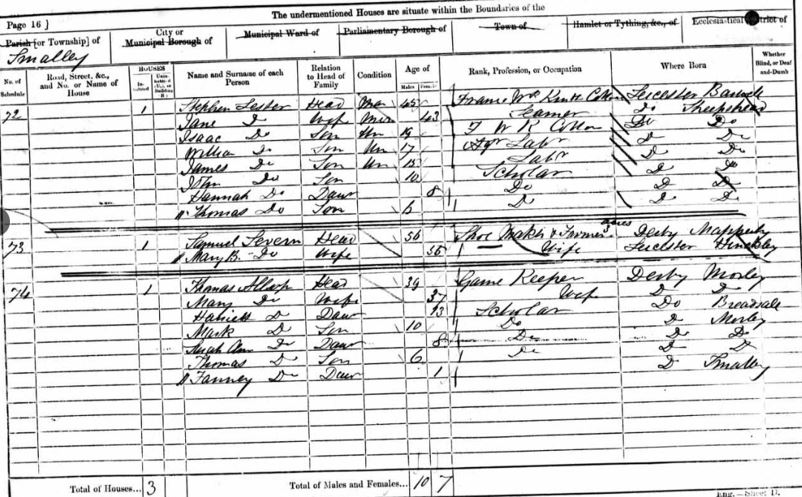
On the 1861 census return, Stephen and Jane, and their children - Isaac (a framework knitter), William (an agricultural labourer), James (a labourer), and John, Hannah and Thomas who were all school-aged. They are no longer living in Shepshed, but have moved to Smalley in Derbyshire, which is a small village on the main A608 Heanor to Derby Road, being situated just over 2 miles to Heanor itself. Maybe Stephen was working for the firm of I&R Morley who had recently opened a factory in Heanor in 1860, but this is purely speculation on my part. 

1861 census return
 

In 1871 Jane and Stephen are living at 8 Regent Street in Loughborough, along with four of their children, Isaac and John, and Hannah who is now a dressmaker, and Thomas, who is a painter. Stephen's father, a retired framework knitter, is also listed at the property on the night of the census. Stephen's father died in 1878, and in 1881, Stephen and Jane are living alone at the property on Regent Street. The 1891 census shows them as living at 10 Regent Street, but whether they have moved, or whether the house numbering has changed is unclear.

In 1898 Stephen dies, and his death is registered in Loughborough, in the April, May, June quarter. As we already know, Jane died shortly after her husband, on March 28 1899, at Sawley.

So, what is the connection between Jane and Harriet Row with whom she shares a grave in Sawley?

Investigation shows that it is Stephen and Jane's son, James, who links the two families, through his marriage to Rosetta Roe. This event happened on 30 May 1868 in Shardlow, and the couple move to Normanton, near Derby, which is about 10 miles from Sawley and 13 from Shardlow. Rosetta's father is listed on the marriage document as Joseph Roe.

James and Rosetta's marriage, 1868


Joseph Roe was born in 1816 in Smalley to parents Joseph and Millicent. By 1841 he has married, and he and his wife are living in Scropton, Derbyshire (about 20 miles from Smalley) where Joseph is working on a farm. They have a six-year-old son, William. The 1851 census has the family living in Normanton (near Derby), and includes children William, Thomas, Ann, Rosetta and baby Joseph.

The whereabouts of the family in 1861 is a little less clear, but they might still be living in Normanton, with older children William, Ann and Joseph, and three younger children, Mary, Charles and James. 

There is a more positive listing of the family in 1871 when Joseph and his wife are living with two of their sons, Charles (15) and James (11). Other people listed at the property on the night of the 1871 census are James Lester, son of Stephen and Jane, his wife, Rosetta, daughter of Joseph, and their baby daughter, Emma.

James and Rosetta on the night of the 1871 census
 

In 1881, Joseph and his wife are living in Barley Row, Normanton, with their son, Charles, and next door to Charles Roe and his wife Elizabeth, Charles maybe being Joseph's younger brother. By the time of the next census, taken in 1891, Joseph and his wife are living with their son Charles in Normanton. 

I haven't definitely established Joseph's date of death, but it is likely his death was registered in Shardlow in 1893. He left behind, his wife, Harriet Roe, Joseph and Harriet being the parents of Rosetta Roe who married James Lester, son of Stephen and Jane. 

Given the message on the gravestone, and the entry in the local newspaper, I can only assume that Harriet, who lived at Normanton, was visiting Jane in Sawley, or perhaps staying with her for a while, and both died in March 1899, although the dates vary slightly.

Long Eaton Advertiser, 15 April 1899


Funny the things you discover on holiday!!!

You are welcome to quote passages from any of my posts, with appropriate credit. The correct citation for this looks as follow:

Dyer, Lynne (2020). So who was Jane Lester of Loughborough? Available from: https://lynneaboutloughborough.blogspot.com/2020/07/so-who-was-jane-lester-of-loughborough.html [Accessed: 26 July 2020]

Take down policy:
I post no pictures that are not my own, unless I have express permission so to do. All text is my own, and not copied from any other information sources, printed or electronic, unless identified and credited as such. If you find I have posted something in contravention of these statements, or if there are photographs of you which you would prefer not to be here, please contact me at the address listed on the About Me page, and I will remove these.

If you wish to leave a comment, please do so in the comments box that appears below this blogpost. Alternatively, you can contact me via lynneaboutloughborough[at]gmail[dot]com.

Thank you for reading this blog. 

Lynne     
 

Sunday, 31 March 2019

Loughborough and Shugborough

Another exciting week goes by and this time I'm out at the Shugborough Estate, a National Trust property that was once home of the Anson family, and one of their most notable descendants, photographer Patrick Lichfield.

I've never been to Shugborough before, so I was quite looking forward to the trip, and on the journey there I realised how similar were the names Shugborough and Loughborough! Apparently, I'm not the only person who has thought about this, as back in 2011 after her visit to Shugborough, a lady called Katy considered the sometimes bizarre pronunciation associated with English place-names, and quoted Loughborough and Shugborough as examples.  

Idly wandering around the grounds of this magnificent estate, I did actually wonder if I was going to find any connections at all with Loughborough ... but I did, and almost as soon as I entered the grounds, for there were a couple of beautiful long-horned cows, reminding me of the work of Robert Bakewell on the Dishley estate between Loughborough and Hathern. The sheep, however, were most definitely not the Leicester Longwool descendants! Just a quick reminder at this point that Loughborough public library has a Bakewell display on until the end of April!


The house itself was rather splendid, and the servants quarters reminded me of visits I'd made a while ago to Belton House in Lincolnshire, Belvoir Castle and also to the Workhouse at Southwell.


A further connection between Loughborough and Shugborough, which I found after I returned home, in a book called "Follies of Leicestershire & Rutland" are the follies on the Garendon Estate and those at Shugborough. Sir Ambrose Phillipps owned the Garendon Estate, between Loughborough and Shepshed, from 1829-1837. As a direct result of his 'grand tour' of Italy he became a member of the Society of Dilettanti. The author, Gwyn Headley, compares the monuments at Shugborough, created by James "Athenian" Stuart, a fellow member of the Society who was sponsored by the Society to study the remains of classical Greek civilisation in Athens, with those by Phillipps. Shugborough has a shepherd's monument with columns by Stuart, a Doric temple made of coade stone, also by Stuart, a triumphal arch and a structure called the Tower of the Winds, both by Stuart, and a Lanthorn of Demosthenes. As we know, Garendon has the Temple of Venus, modeled on the Temple of Sybil in Tivoli and the triumphal arch emulating the Roman arch of Titus. 


Interestingly, in another book, one called "Divergent paths: family histories of Irish emigrants in Britain, 1820-1920" there is an interesting story of the Giltrap family. Henry Giltrap, born in 1827, came to England in about 1846-7, where he and his brother John joined the Staffordshire police and Henry became a railway policeman. He lived about 3/4s mile from the Shugborough Estate, until moving to work at a signal box the other end of the Shugborough Tunnel in Milford, where he stayed for about 12 years. Here he operated the signal box and the level crossing on what was a busy stretch of railway. One of Henry and his wife Ann's sons, also called Henry (born 1850) worked his way up the railway from being a goods clerk to station master, which involved a move first to Llanberis, than to Abergele, but later left the railways to work for the Singer Sewing Machine Company in London. One of the other sons, William, born in 1851, became a footman at Shugborough Hall, where he married a nursery maid and was promoted to butler. After his death, his wife became a dresser to Queen Alexandra at the Sandringham Estate. 

Back to Henry the elder. By 1880 the signal work was getting a bit too much for Henry, so the LNWR moved him to a quieter location, where on 16 April 1883 Henry signalled the first trains into the new Charnwood Forest Railway, Loughborough. After his wife died in 1888, Henry moved to 145 Paget Street where he lodged with the family of a fellow railway worker, clerk Charles Atkinson. Retiring in 1895, Henry moved to live with another of his sons, Thomas in Lancashire, where he died in 1902.

And, back in Shugborough, at the far end of the grounds was a stunning stone bridge which led to another bridge, the latter which went over the canal. Just beyond this was the railway line, which, unlike Loughborough's, was electrified.


What I also hadn't realised until I actually went into the apartments was that Patrick Lichfield had lived here. And what a set of apartments they were too! Dressed in 1950s-1970s style and with his photographs adorning the walls, his personality was plain to see. Now, I've always known this photographer as Patrick Lichfield, but on this visit to Shugborough I discovered that he was actually Thomas Patrick John Anson, 5th Earl of Lichfield, and was a descendant of the Anson family of Shugborough. A distant relative was George Anson, 1st Baron Anson, a former First Lord of the Admiralty. Apparently, there have been 7 ships named after Anson, and Horatio Nelson wrote the following letter to William Marsden of the Admiralty:
"Victory in Gibraltar Bay, July 21st 1805 Sir, I herewith transmit you, for the information of the Lords Commissioners of the Admiralty, a copy of an Acting-Order, which I have given to Mr. John Chrystie, Midshipman of the Victory. to act as Lieutenant of his Majesty's Ship Guerrier, in the room of Lieutenant William Tiller, invalided. Mr. Chrystie is an Admiralty recommendation, and received a severe wound in his left cheek in an action between Anson [the ship] and La Loire [a ship], by having a musket-ball shot thorugh it. He is also a very deserving young man. I am, Sir, &c. Nelson and Bronte"
I think the connection here is that the memorial to Nelson in Trafalgar Square was created by WIlliam Railton who was also responsible for some of the lodges to the Garendon Estates, as well as for Beaumanor Hall. 

Further connections to Loughborough include the jewellery maker, Jane Moore, who studied at Loughborough College of Art and Design and has exhibited her work at Shugborough. A couple of artists from Staffordshire, or who have displayed in Staffordshire, who studied at Loughborough also include Sally Matthews and Jonathan Mulvaney.

Older connections include some entries in The Monthly Magazine on 1st August 1817 (Vol.44, No.301) all appearing on page 90, where it is reported that "At Loughborough, Lieut. Land, late of the Devonshire-militia married Miss Susannah Harley; Mrs Spittlehouse of Loughborough, aged 39, died; and Mr Kent of Shugborough married Mrs Allen of Radford-bridge, Berkswich."

If I think of any more connections, I'll be sure to let you know!!!

You are welcome to quote passages from any of my posts, with appropriate credit. The correct citation for this looks as follow:

Dyer, Lynne (2019). Loughborough and Shugborough. Available from: https://lynneaboutloughborough.blogspot.com/2019/03/loughborough-and-shugborough.html
[Accessed 31 March 2019]

Take down policy:
I post no pictures that are not my own, unless I have express permission so to do. All text is my own, and not copied from any other information sources, printed or electronic, unless identified and credited as such. If you find I have posted something in contravention of these statements, or if there are photographs of you which you would prefer not to be here, please contact me at the address listed on the About Me page, and I will remove these.
Thank you for reading this blog. 

Lynne

Sunday, 17 March 2019

Victorian factories

If you're a regular reader of this blog, you'll probably have picked up that I'm a bit of a fan of our smaller towns and villages, rather than our big cities. Hence, I find Loughborough to be the perfect size, and only tend to visit cities on holiday - apart from Leicester, which I travel to regularly for work. Years ago I used to visit Nottingham, but rarely go these days.

Anyway, my point is that I have avoided trips to the capital as far as possible, and have also avoided trips to England's second biggest city, apart from around Christmas 2003 when I took the oldest child to see one of his schoolfriends dance in The Nutcracker ballet at the Hippodrome, and a couple of evening trips 2014/15 to see the youngest child perform with the Birmingham Junior Conservatoire Band. 

However, I've recently had the occasion to visit Birmingham for work, and specifically to visit the museums. I was quite surprised by what I found, and couldn't help but make some connections with Loughborough.

Ok, so we haven't got anything equivalent to Symphony Hall in Loughborough, unless you consider the interior, which looks very Art Deco to me and reminded me of our Beacon Bingo, which opened as an Odeon Cinema in 1936.


The auditorium at Symphony Hall

One of the doors into the auditorium at Symphony Hall
Beacon Bingo, once The Odeon, Loughborough

The Museum of the Jewellery Quarter involved a guided tour around the factory of Smith and Pepper. The business opened in 1899 and closed in 1981, but the factory was never cleared out and instead has been preserved, like a time capsule, affording a fascinating insight into what it would have been like to work in a Victorian factory. The similarity with framework knitting was obvious really, if I'd stopped to think about it, and then also with the Herbert Morris factory. The buildings had long narrow rooms with very large windows along the long side and having the opposite interior wall painted white - all to bring in and reflect as much light as possible so the workers could see the intricate work they were doing. When the original building was extended, another long, narrow building was erected with windows sloping up to the roof (not a good description, but you'll see what I mean when you see the photos). The walls of the building opposite were then clad in white tiles - were these possibly Hatherware? Buildings that were used by framework knitters in Loughborough would have had windows very close to the roof and there were likely to have been glass globes filled with water hanging in them, which would have spread the light on the work being done. The Morris factory had those sloping windows I mentioned above - maybe they are called skylights (of a sort), and it is believed that these lights attracted the attention of a passing Zeppelin on the night of 31st January 1916. 


White tiled wall and glass roof at the Jewellery Quarter Museum

White tiled wall and ground floor windows at the Jewellery Quarter Museum

Large side windows, roof windows and white tiled walls at the Jewellery Quarter Museum

Machinery at the Jewellery Quarter Museum

I think the slope of the roofs would originally have been glass at Herbert Morris


I also visited the Coffin Works, which was another Victorian factory, frozen in time, started in 1882 and closed in 1997. The guided tour was of the Newman Brothers factory, where they made handles and decorations for coffins, as well as satin interiors, and shrouds (but not the coffins themselves). What this factory had in common with Smith and Pepper factory was that they were both working with metal, and the smell of grease, the sound of the presses was also common to both. In both factories, the guides did some demonstrations of some of the work that the employees would have done. I couldn't help but think of our bellfoundry. It's a working Victorian factory: it's hot; it's noisy; it's smelly and it's blummin dangerous! 


The Coffin works 
Metalworking at Taylors 2017


My final museum visit (can't really count a cuppa in the Edwardian tearooms in the main museum and art gallery in Town Hall Square!) was to the Pen Museum. Well, that was fascinating! So many pen nibs!!! What did they say - 90% of the world's words at one time were written using a nib from Birmingham! Staggering! It was also in this museum that I read a little about the gun factories in Birmingham, which is interesting because Natahaniel Corah, who started Corah's in Leicester, in the mid-1800s, but not before he'd spent his early years as a framework knitter, then at 27 going to work in a gun factory in Birmingham! And, he used to do business in The Globe pub in Leicester, which is so-called in honour of those framework knitters! Two questions arise here, for further investigation sometime, the first of which is was Nathaniel Corah any relation to the builders, and printers of the same name in Loughborough?


Information about the Birmingham gun quarter


The other question concerns one of the Birmingham pen-making firms which was named after the owner - Joseph Gillott: is there any connection with the Gillott's of Loughborough who had the garage of that name?


Gillott's factory

Nibs at the Pen Museum

Joseph Gillott

Gillott's nibs

Picture of the interior of Gillett's factory


A couple of other incidental connections were that at the Coffin Works they had a machine produced by SamcoStrong in Leicester, which the other half used to work for, and all the museums I visited had typewriters, but it wasn't until I got to the last one (the Pen Museum) that I found an Imperial typewriter from Leicester. 


A SamcoStrong hydraulic cutting press

An Imperial typewriter from Leicester

Other connections to Loughborough - like the canal and terracotta buildings - will have to wait for another blogpost now, as I've run out of time.


Canal, lock and bridge in Birmingham

Terracotta building in the centre of Birmingham


You are welcome to quote passages from any of my posts, with appropriate credit. The correct citation for this looks as follow:

Dyer, Lynne (2019). Plaques. Available from: https://lynneaboutloughborough.blogspot.com/2019/03/victorian-factories.html  [Accessed 17 March 2019]

Take down policy:
I post no pictures that are not my own, unless I have express permission so to do. All text is my own, and not copied from any other information sources, printed or electronic, unless identified and credited as such. If you find I have posted something in contravention of these statements, or if there are photographs of you which you would prefer not to be here, please contact me at the address listed on the About Me page, and I will remove these.
Thank you for reading this blog. 

Lynne