After two weeks of being on holiday, last week saw me back at work - well, working from home at least. Having taken loads of photos on a daily basis during my watery holiday in Loughborough, I spent a bit of time this week looking back at these, and was reminded of some Loughborough-related things I happened upon while I was discovering watery areas close to Loughborough.
One of our holiday days saw us parking in Shardlow, and walking along the canal and river to Trent Lock. On the way back, we took a slightly different route which meant walking through the field next to the towpath. The cows were gorgeous, and the view of the church as we approached Sawley was very attractive.
 |
| Church of All Saints, Sawley, in the distance |
 |
| Sawley church and cows rushing to the drinking trough |
Reaching the end of the field, and coming out onto the road we headed off towards the church of All Saints. The approach to the church, through an avenue of trees and passing the Old Rectory, which is a Grade II listed building, constructed in 1823 with later 19th century additions, was stunning, and reminded me a little of the approach to Kirkby Mallory church, the burial place of Ada Lovelace, daughter of Lord Byron.
 |
| Tree-lined approach to the church at Sawley |
 |
| The Old Rectory at Sawley |
Anyway, given the current situation, we weren't expecting the church to be open, and although the door was ajar, we didn't venture inside. The churchyard is now closed to new burials, and maintenance of the grounds now rests with the Borough Council. The churchyard was, of course, open to visitors, so we had a look around. How lovely it was to see a few examples of Swithland slate gravestones, as well as those made of Welsh slate and local stone.
 |
| Siwthland slate headstones in the foreground, Welsh slate in the distance |
 |
| Detail from a Swithland slate headstone in Sawley churchyard |
Doing the circuit of the churchyard, right at the end of the route I stumbled across a headstone of Welsh slate that particularly grabbed my attention:
 |
| The gravestone of Jane Lester and Harriet Roe |
Interesting that Jane Lester was 'late of Loughborough', so why was she buried in Sawley? And who was Harriet Roe? An investigation into Jane Lester has revealed many snippets of information, but some remains elusive. Here's what I have discovered so far. Sadly, it's only the information pertaining to her family and where they lived, as in order for more information to be available, one would need to have been a member of the nobility or aristocracy, or in the public eye (like a publican) or perhaps a criminal, and, as you will see, neither Jane nor Harriet were none of these.
Jane was born in around 1819, in Shepshed. Her husband-to-be, Stephen Lester, was born around 1816 in Long Whatton. Stephen's father, William, was a baptist, whose own birth was recorded in the baptist registers. I am wondering if this might be why I can't find Stephen and Jane's marriage anywhere. Information in later census returns points me in the direction of Jane's surname being either Oram or Mills, but further investigation has proved neither conclusively.
STOP PRESS! Thanks to a very kindly friend, Stephen and Jane's marriage record has now been found, and it confirms that Jane was born Jane Mills, in 1818, and she was baptised on 25 August that year. Her parents were William Mills, a carpenter, who was also born in Shepshed in 1793, and Hannah Chester, who married William on 31 October 1815.
Anyway, by 1841, Stephen and Jane were living in the same house on Brook Street, in Shepshed, and Stephen is a framework knitter. The nine-year old girl, Milicent (spelled Melicent on the census return) listed as being at the same property the night the census is taken, is actually Stephen's sister, who later marries a man from Loughborough, where they make their home.
By 1851 Stephen, listed specifically as a framework knitter in cotton on the census return, and Jane are lodging with someone called Mary Oram and Mary's nephew, James Mills, a potato dealer, in Brook Street, Shepshed. Stephen and Jane have five children: Isaac; William; James; Elizabeth and John, ranging from age 9 (Isaac) to a baby (John).
On the 1861 census return, Stephen and Jane, and their children - Isaac (a framework knitter), William (an agricultural labourer), James (a labourer), and John, Hannah and Thomas who were all school-aged. They are no longer living in Shepshed, but have moved to Smalley in Derbyshire, which is a small village on the main A608 Heanor to Derby Road, being situated just over 2 miles to Heanor itself. Maybe Stephen was working for the firm of I&R Morley who had recently opened a factory in Heanor in 1860, but this is purely speculation on my part.
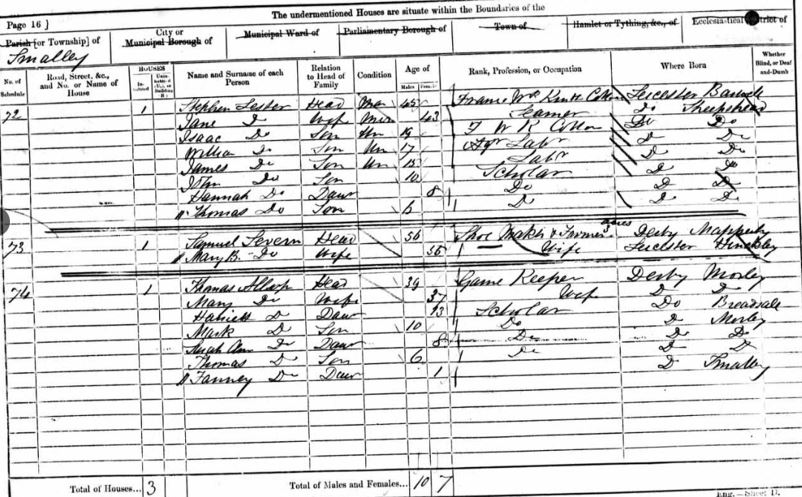 |
| 1861 census return |
In 1871 Jane and Stephen are living at 8 Regent Street in Loughborough, along with four of their children, Isaac and John, and Hannah who is now a dressmaker, and Thomas, who is a painter. Stephen's father, a retired framework knitter, is also listed at the property on the night of the census. Stephen's father died in 1878, and in 1881, Stephen and Jane are living alone at the property on Regent Street. The 1891 census shows them as living at 10 Regent Street, but whether they have moved, or whether the house numbering has changed is unclear.
In 1898 Stephen dies, and his death is registered in Loughborough, in the April, May, June quarter. As we already know, Jane died shortly after her husband, on March 28 1899, at Sawley.
So, what is the connection between Jane and Harriet Row with whom she shares a grave in Sawley?
Investigation shows that it is Stephen and Jane's son, James, who links the two families, through his marriage to Rosetta Roe. This event happened on 30 May 1868 in Shardlow, and the couple move to Normanton, near Derby, which is about 10 miles from Sawley and 13 from Shardlow. Rosetta's father is listed on the marriage document as Joseph Roe.
 |
| James and Rosetta's marriage, 1868 |
Joseph Roe was born in 1816 in Smalley to parents Joseph and Millicent. By 1841 he has married, and he and his wife are living in Scropton, Derbyshire (about 20 miles from Smalley) where Joseph is working on a farm. They have a six-year-old son, William. The 1851 census has the family living in Normanton (near Derby), and includes children William, Thomas, Ann, Rosetta and baby Joseph.
The whereabouts of the family in 1861 is a little less clear, but they might still be living in Normanton, with older children William, Ann and Joseph, and three younger children, Mary, Charles and James.
There is a more positive listing of the family in 1871 when Joseph and his wife are living with two of their sons, Charles (15) and James (11). Other people listed at the property on the night of the 1871 census are James Lester, son of Stephen and Jane, his wife, Rosetta, daughter of Joseph, and their baby daughter, Emma.
 |
| James and Rosetta on the night of the 1871 census |
In 1881, Joseph and his wife are living in Barley Row, Normanton, with their son, Charles, and next door to Charles Roe and his wife Elizabeth, Charles maybe being Joseph's younger brother. By the time of the next census, taken in 1891, Joseph and his wife are living with their son Charles in Normanton.
I haven't definitely established Joseph's date of death, but it is likely his death was registered in Shardlow in 1893. He left behind, his wife, Harriet Roe, Joseph and Harriet being the parents of Rosetta Roe who married James Lester, son of Stephen and Jane.
Given the message on the gravestone, and the entry in the local newspaper, I can only assume that Harriet, who lived at Normanton, was visiting Jane in Sawley, or perhaps staying with her for a while, and both died in March 1899, although the dates vary slightly.
 |
| Long Eaton Advertiser, 15 April 1899 |
Funny the things you discover on holiday!!!
You are welcome to quote passages from any of my posts, with appropriate credit. The correct citation for this looks as follow:
Dyer, Lynne (2020). So who was Jane Lester of Loughborough? Available from: https://lynneaboutloughborough.blogspot.com/2020/07/so-who-was-jane-lester-of-loughborough.html [Accessed: 26 July 2020]
Take down policy:
I post no pictures that are not my own, unless I have express permission so to do. All text is my own, and not copied from any other information sources, printed or electronic, unless identified and credited as such. If you find I have posted something in contravention of these statements, or if there are photographs of you which you would prefer not to be here, please contact me at the address listed on the About Me page, and I will remove these.
If you wish to leave a comment, please do so in the comments box that appears below this blogpost. Alternatively, you can contact me via lynneaboutloughborough[at]gmail[dot]com.
Thank you for reading this blog.


