Introduction
Normally in
this November blog post, I would share something with you about either the
wonderful fair, this year celebrating its 802nd year, or something about
Remembrance, often from our beautiful Queen’s Park (although last year,
from Falmouth). However, this year, I wanted to share with you a guest
blog post which shines a spotlight on the work of the Loughborough Library Local
Studies Volunteer Group (LLLSVG), particularly in relation to Loughborough’s
markets and fair, and the collective memory.
The post has
been guest written by Daniel Mutibwa, whom I met only recently, in fact less
than a year ago, but we immediately discovered a mutual love for heritage, and for
sharing our work in collaboration with others.
In this
wonderful guest blog post for me, Daniel really does shine a spotlight on the
heritage work that the Loughborough Library Local Studies Volunteer Group
(LLLSVG) does. The Group reaches all corners of the world through its varied research,
which one day could be research into family histories, another day into local
firms, and much, much more – as you will see if you read on!
The Group is
the founding member of the Loughborough Heritage Forum, an opportunity for
heritage workers to get together to share knowledge and work together to
promote heritage across Loughborough, into Charnwood and beyond. The Group also
has a sub-group focussed on Loughborough’s built heritage.
Although
based in the depths of the public library on Granby Street in the Local and
Family History Centre, and therefore perhaps a little hard to find, you are most welcome to come and visit them,
especially if you have a local history query. Group members can often be seen
out and about supporting heritage events (like the Carillon100 day)
2023 was a
very good year for the volunteers, and they are looking forward to learning and
sharing more about Loughborough’s history and heritage in the coming years. Enough
from me … enjoy the spotlight below!
Community Engagement in Heritage Work:
Spotlighting the Loughborough Library
Local Studies Volunteer Group
Daniel H. Mutibwa (Nottingham University)
In
his widely acclaimed book titled How Societies Remember published in
1989, the late British social anthropologist — Paul Connerton — made a very
interesting four-fold observation about how we interact with our past and
present. First, we experience our present world in ways causally connected with
past events and objects. Second, we experience our present differently in
accordance with the different pasts to which we are able to connect that
present. Third, it is difficult to disentangle our past from our present
because present factors tend to influence (but also distort) our recollections
of the past. Conversely — and fourth, past factors tend to influence (but
equally distort) our experience of the present. To Connerton, this interaction
reaches into the most minute and everyday details of our lives (1989: 2). In
putting forward this observation, Paul Connerton was discussing what he thought
was the most helpful way of understanding memory in general, and social memory
in particular. This discussion also engaged with the different forms and modes
that individual and collective commemorative acts take.
Six
years later in 1995, the late British sociologist — John Urry — picked up and
built upon Paul Connerton’s observation in an article published in a very
prominent academic journal called The Sociological Review. In that
article titled ‘How Societies Remember the Past’, John Urry explicitly
connected memory with heritage and showed particular interest in the role
played by what he termed ‘non-hegemonic collective enthusiasms’ in facilitating
collective remembering (1995: 51). Urry was very critical of the ways in which
memory institutions typically essentialise grand narratives that reinforce
conservative, elitist and selective views of past events while deflecting
attention from the possibilities of incorporating a multiplicity of accounts,
perspectives and actors — including the lived experiences of ordinary people.
He was very concerned about how this produces a monolithic heritage that
underrepresents numerous communities, groups and publics in society. One way to
redress this imbalance, Urry noted, was the ‘proliferation of social groups who
have sought through their enthusiasm to preserve aspects of “their” history’
(1995: 58) as part of a much broader two-pronged strategy to (1) democratise
engagement with heritage work— and to do so taking a bottom-up, inclusive
approach, and (2) conserve and animate heritage sustainably in ways that are
relatable to the life experiences of generations of local communities.
 |
| Loughborough's Carnegie Public Libary, pictured in 2013 |
Fast
forward to the late 2000s — about a decade following the publication of John
Urry’s journal article cited above. The Loughborough Library Local Studies
Volunteer Group (LLLSVG) — hereafter interchangeably referred to as LLLSVG and
the Group — entered the picture to do precisely what John Urry outlines above
and to facilitate the interaction between the past and the present that Paul
Connerton observes earlier. In an interview conversation held in early May 2023
with LLLSVG’s Chairperson (Kathy Phillips) and Treasurer (Sharon Gray)
respectively, I learnt that the Group constituted itself to preserve and
enhance the local studies collection based in the Local and Family History
Centre at Loughborough Library for the people of Charnwood. This was a year after
austerity-induced measures compelled local authorities to cut library staff
jobs. Local authorities at the time were committed to supporting and delivering
cultural provision in its many different facets — including library services.
That commitment has not wavered to this day, but the persistent austere
conditions within which local authorities have operated mean provision cannot
be sustained. To avert the spectre of the local history collection being locked
up and possibly transferred to the Records Office located south of the county
town, at South Wigston, LLLSVG stepped in and took stewardship of the
collection on behalf of Leicestershire County Council (LCC). Ever since, the
Group has operated under the auspices of the Libraries and Heritage Services
within LCC and is a formally approved library service provider. This, as we are
going to see below, is a considerable feat.
Within
this arrangement, the Group provides extensive and varied expertise in, and
rich experience and rigorously researched authoritative accounts of, local
history and heritage to a range of stakeholders including Loughborough Library
staff and users, members of the public, students and teachers, researchers,
architects and planners, writers and artists, cyclists and walkers, local
businesses, heritage agencies of different kinds and local history aficionados
beyond Loughborough. To put this in perspective, the local studies collection
was originally created, staffed and used primarily by local and family
historians — including academic staff at Loughborough University. Like those
original local and family historians, LLLSVG members run the collection and
local heritage work on a volunteering basis. In addition to staffing the
collection section during the week, LLLSVG members bring their distinctive and
varied expertise in wide-ranging subject areas of local history and heritage to
bear when fielding often complex queries. Many regular library staff do not
possess that expertise that spans subject areas ranging from genealogy to
photography to archiving to publishing to storytelling to church history among
many others. The Group’s rich and extensive expertise has been conveyed,
exchanged and shared with numerous stakeholders at various events — including
via publications of different kinds, local heritage-themed exhibitions and
talks. Here, LLLSVG’s ‘local historians, genealogists, librarian and information
specialists with backgrounds in industry, education and academia’ (LLLSVG,
2022: 2) have provided a critical library service that would otherwise not
exist. Naturally, the Group has become a key LCC flagship partner.
 |
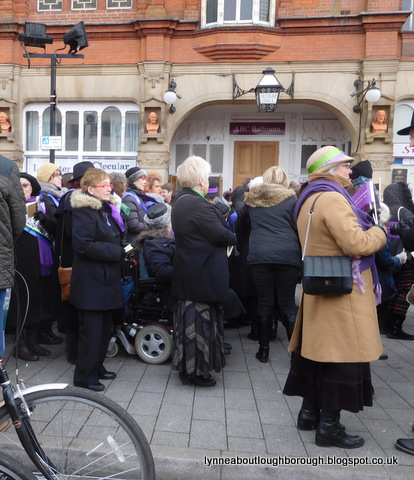
| Some of the LLLSVG members at Picnic in the Park 2018, commemorating the work of the Suffragettes and the Votes for Women campaign |
But
the Group’s heritage work extends much farther. Over the years, LLLSVG has
built up a portfolio of impactful work both within and beyond the library that
has earned the Group an excellent reputation and validation. For example, in
2020, LCC commissioned the Group to carry out research on the comprehensive
history and heritage of the markets and fair for which Loughborough is
nationally and internationally renowned. This commissioned work marked the 800th anniversary of the Royal Charters which permitted the markets and fair to be
held. In addition to their significant contribution to an exhibition (July to
Dec 2021) celebrating the anniversary in Loughborough’s Charnwood Museum, there
resulted a fine book titled 800th Anniversary: Loughborough
Markets and Fair 1221 – 2021 that was published in January 2022 and makes
for an impressive and informative read. It is worth adding that Charnwood
Borough Council (CBC), which operates the markets and fair, commissioned LLLSVG
to write a chapter for the book — drawing, in part, on some of the relevant
objects, specimens, records, images and exhibitions at heritage venues that CBC
manages on a daily basis. As a reader, I could see the vast expertise,
invaluable experience and rigorous research practice demonstrated by the
contributing members of the Group shining through. I was also reminded of some
of the research I have conducted that has captured the interplay between
history, memory and identity across various communities and regions in the UK
(Mutibwa, 2016). Connecting that research to one of the overarching narratives
of LLLSVG’s book, I could discern how the Group skilfully reconstructs and
brings to life Loughborough’s markets and fair as a cornerstone of the town’s
unique past identity. That past identity comes alive through acts of
commemoration at the heart of which are two key aspects: (1) remembering what
the town was, and (2) setting that past in relation to the present (Mutibwa,
2016: 9).
 |
800th Anniversary: Loughborough Markets and Fair 1221-2021 ,
and other publications from the LLLSVG |
This
brings us back to the point made earlier in this blog post about the different
formats of individual and collective commemorative acts that Paul Connerton
suggested. LLLSVG’s book identifies several such ways of remembering the
heritage surrounding the town’s markets and fair over a period spanning eight
centuries: (1) re-enactment; (2) light installations; (3) exhibitions; (4)
banners; (5) a plaque; (6) a celebratory and commemorative cake; and (7)
commemorative mugs (LLLSVG, 2022: 96–103).
 |
The
celebratory cake, the mug, and the unveiling of the plaque at the
800th anniversary of Loughborough markets and fair in 2021 |
Unsurprisingly,
800th Anniversary: Loughborough Markets and Fair 1221 – 2021
won the Group an important Leicestershire and Rutland Heritage Forum Award in the
category of Archives and Research in early October 2023. This
accomplishment is clear testament to LLLSVG’s impactful heritage work in
Loughborough and beyond. Even before this major feat, the Group had undertaken
local heritage projects that involved profiling some of Loughborough’s oldest
established local businesses that are still trading to this day — with a
particular focus on their trajectories and continuing impact on the town. That
profiling exercise took the form of public displays that were exhibited at
Loughborough Library. One might argue that both the research that informed
those public displays and the displays themselves generated meaningful
engagement with, and (re)presentation of, local business histories and
associated local community experiences very likely unavailable elsewhere to
access. 
 |
Photographs from a display about Loughborough Building Society,
held at the public library in 2017 |
The
Group was represented on the Loughborough Town Deal’s Community Consultation and Engagement Group committee that advised Charnwood Borough Council with respect to the town’s
investment plan, which resulted in securing £16.9 million from the Government’s
Towns Fund. One of the 11 projects funded, the Bedford Square Gateway Project, was one for which consideration was called for on how best to incorporate
local heritage into this, a major regeneration venture. In particular, much of
the heritage content (e.g., names of prominent local personalities, place
names) inscribed on the decorative paving stones in the new pedestrianised
areas as a means to celebrate and memorialise Loughborough’s past were
contributed by LLLSVG.
The Group’s important contribution here cannot be
understated considering that the Bedford Square Gateway Project was a major
collaborative venture funded by CBC, the Loughborough Town Deal and the Leicester and Leicestershire Enterprise Partnership (LLEP) — all of whom are key players
in the creative, cultural and heritage economies across the county of
Leicestershire and beyond. Besides LLLSVG’s growing visibility and influence on
the local heritage scene in Loughborough and farther afield, the Group has
gradually and very deservedly become the ‘go-to source’ for expert knowledge on
the local history of Loughborough. This is unmistakeably underlined by the fact
that CBC, on its bespoke website that promotes the town’s local tourism economy, advises the public to consult
LLLSVG on its ‘wealth of knowledge about [the town’s] local history’ (Discover Charnwood, 2023: n.p).
 |
Some of the
Devonshire Square heritage floor tiles,
installed as part of the Bedford Square Gateway
Project |
Where
John Urry would see the Group’s heritage work as mere ‘collective enthusiasms’,
I see that same work very, very differently. I see that critical work as a
distinctive product of powerful local heritage movers and shakers who take an
inclusive and bottom-up approach to engagement with, and preservation of,
Loughborough’s history. I am in complete agreement with Paul Connerton about
how the Group’s heritage work commemorates the town’s past in numerous and
effective ways — thanks to the varied and distinctive expertise, complementary
competencies and diverse lived experiences that LLLSVG members bring along to
what they do enthusiastically. Those members view and treat their heritage work
as part of a wider strategy to conserve and memorialise the past in ways that
people in Loughborough and beyond can relate with. At times, this takes the
form of animating past lived realities — individual and collective alike and
how those historical realities shape the present. For example, I think about
how the markets and fair in the town over time, by adding ‘colour, vibrancy and
atmosphere […] bring in thousands of people each week to Loughborough which is
very important to [the town’s] local economy’ (LLLSVG, 2022: 107). At other
times, the Group’s work provides a space to reflect on, and document, how
individual and collective past aspirations, dreams and hopes have materialised
and how they have been remembered. That space also allows opportunities to
reflect on, and record, why those aspirations, dreams and hopes may not have
materialised and whether or not they are remembered or consciously forgotten.
For
instance, I think about the accounts captured in public displays created by
LLLSVG of the oldest, established local businesses in Loughborough that are
still trading. I cannot help but wonder what those accounts reveal about
scenarios that could have been — had different business and/or organisational
decisions been made. The same can be said of opportunities that local
businesses feel have been missed for a range of different reasons. Of utmost
interest and relevance is learning about the impact these events may have had
both on the businesses themselves, the town as a whole and the wider East
Midlands region and possibly beyond. Equally important is finding out the ways
in which these events may have had a direct or indirect impact on what the
local business landscape and climate have shaped up to become over time.
Ultimately, the Group’s proven ability to bring formal written local discourses
and (hi)stories into critical and productive dialogue with the perspectives of
local communities is contributing to a multivocal and rich interpretation and
(re)presentation of Loughborough’s history and heritage. This effectively
counters the production of the monolithic heritage that John Urry and others
have raised serious concerns about.


 |
| Selection of photographs of the George Hill exhibition, held in the Carnegie Library in 2015 |
Bringing
together formal historical accounts and the words, lived experiences, artefacts
and memories of the people involved is quite empowering because it allows
people to shape what is meaningful and of enduring value to them. It gives
people the opportunity to shape the collective memories of their pasts and to
control the means through which the associated stories are told, retold,
understood and (re)interpreted in their rightful and/or fitting contexts. This
reflects what I understand to be community engagement in heritage work. The
work by LLLSVG described in this blog post could not capture exceptional
community engagement in heritage work any better. At a time when LCC is
preparing the groundwork for aligning culture- and heritage-based provision across
Leicestershire more effectively and strategically via a Cultural Strategy, the Group’s portfolio of work, growing status and outstanding contributions
are going to feature prominently in pointing the way to developing democratic
partnerships between local authorities and local community groups around
community engagement in creative, cultural and heritage work — both within
Leicestershire and beyond. ____________________________________
NOTES
You can
see more of the LLLSVG and some of their work on the Culture Leicestershire website, where they are featured for one of their recent exhibitions, and for
some extensive family history work they undertook, and also at the Volunteering Day held at County Hall in March 2023.
If you would
like to follow the work of the LLLSVG you can find them on X: @Loughlibvol and on Instagram: @lllsvgroup
Contact
details for the Local Studies collection at Loughborough Library (follow the
sign to the Local and Family History Centre), including opening hours, can be
found on the county council’s website.
____________________________________
References
Connerton,
P. (1989). How Societies Remember. Cambridge: Cambridge University
Press.
Discover Charnwood (2023). History of
Loughborough. Charnwood Borough Council (CBC). Available online at: https://www.discovercharnwood.co.uk/history-of-loughborough
(Accessed 14.10.2023).
Loughborough Library Local Studies
Volunteer Group (LLLSVG) (2022). 800th Anniversary: Loughborough
Markets and Fair 1221 – 2021. Loughborough Library Local Studies Volunteer
Group.
Mutibwa, D. H. (2016). Memory,
Storytelling and the Digital Archive: Revitalising Community and Regional
Identities in the Virtual age. International Journal of Media and Cultural
Politics, 12(1): 7–26. Pre-print also available online at: https://eprints.whiterose.ac.uk/97003/1/Memory,%20Storytelling%20&%20the%20Digital%20Archive-Revitalising%20Community%20&%20Regional%20Identities%20in%20the%20Virtual%20Age-Daniel%20H.%20Mutibwa-MCP%202016.pdf
(Accessed 3.11.2023)
Urry,
J. (1995). How Societies Remember the Past. The Sociological Review, 43(1):
45–65.
____________________________________
About the author
Although
currently on sabbatical, Daniel Mutibwa is Associate Professor of Creative
Industries and Digital Culture in the Department of Cultural, Media and Visual
Studies (CMVS) at Nottingham University. Daniel joined the University of
Nottingham in 2016 from the University of Leeds where he received his PhD
qualification. Daniel holds a Postgraduate Certificate in the Political Economy
of Information and Communication Technologies from Aarlborg University
(Denmark), an MPhil from Saarland University (Germany) and a BA (Hons) from
Makerere University (Uganda).
One of
Daniel’s current research projects involves collaborating with Leicestershire
County Council (LCC), a range of regional and national policy partners,
statutory and non-statutory bodies, and diverse local communities in order to
develop a cultural strategy for LCC. The project is called ‘Visioning a
Creative and Cultural County (VCCC).
____________________________________
Posted by
lynneaboutloughborough
With apologies for
typos which are all mine!
_______________________________________________
Thank you for
reading this blog.
Copyright:
The copyright
© of all content on this blog rests with me, or in the case of guest
blogposts, with the named Guest Blogger. However, you are welcome to quote
passages from any of my posts, with appropriate credit. The correct citation
for this looks as follows:
Mutibwa, Daniel (2023). Community Engagement in Heritage Work: Spotlighting the Loughborough Library Local Studies Volunteers Group. Available from: https://lynneaboutloughborough.blogspot.com/2023/11/community-engagement-in-heritage-work.html [Accessed 12 November 2023]
Take down
policy:
I post no
pictures that are not my own, unless I have express permission so to do. All
text is my own, and not copied from any other information sources, printed or
electronic, unless identified and credited as such. If you find I have posted
something in contravention of these statements, or if there are photographs of
you which you would prefer not to be here, please contact me at the address
listed on the About Me page, and I will remove these.
Blog
archive and tags:
If you are
viewing this blog in mobile format, you will not be able to easily access the
blog archive, or the clickable links to various topics. These can be accessed
if you scroll to the bottom of the page, and click 'View Web Version'.
Alternatively, there is also a complete list of posts, which when clicked will
take you to the page you are interested in.
Searching
the blog:
You can
search the blog using the dedicated search box that appears near the top of the
blog when viewed in the web version. Alternatively, you can search using your
usual search engine (e.g. Bing, Google, DuckDuckGo etc.) by following this
example:
site: https://lynneaboutloughborough.blogspot.com/ “Radmoor
House”
NOTE – the words you’re actually looking
for must be in “” and the first of these must be preceded by a space
Thank you for
reading this blog.
Lynne