Coltman Engineers and Boiler Makers
Huram Coltman was the creator of the company H. Coltman and Sons, engineers, and boiler makers. Huram was born in Broughton Astley, or Wigston, in 1832, to Charles Coltman, a framesmith, and his wife, Hannah, (sometimes recorded as Ann or Anna). By the time he was 19, Huram, still living at home with his parents and siblings, was, like his father and younger brother, Zina, a framesmith. It’s possible, that after his marriage in 1854, Huram and wife Eliza lived in Loughborough, as their first son, John Charles was born in Loughborough. Certainly, by the time of the 1861 census, the family, which now included a daughter, Eliza Ann, was living on Derby Road, and Huram was an engine smith.
A further son, Huram, was born in 1861, but sadly died, shortly after the birth of daughter Henrietta, in 1863, when Huram was a foreman for Henry Hughes, at the Falcon Works. Three more children were born to Huram and Eliza: Florence Mary (1865), Ernest Edwin (1867) and Walter William (1869). In 1867 the family was living on Regent Street, but by 1871 had moved to Falcon House on Nottingham Road, and Huram is recorded on the census return as a master railway builder, and in 1873, daughter Clara was born here.
At some point, Huram had gone into partnership with Henry Hughes, and in 1875, a patent for 6 months was granted to Henry Hughes (Leicester) and Huram Coltman for an invention relating to improvements for trams. However, the partnership was dissolved in 1877, and was reported in the 'London Gazette' on 3 August:
“… the Partnership in the trade of business of Locomotive Builders and Mechanical Engineers, heretofore carried on by the undersigned, Henry Hughes and Huram Coltman at Loughborough, in the county of Leicester, under the style of Henry Hughes and Co., was dissolved…”
Trade directories for the next couple of years variously list Huram as working from Cambridge Street and Charles Street in Loughborough. By 1881, the family is living at Island House on Granby Street, and Huram is a mechanical engineer employing 13 men and one boy. His eldest son, John Charles is an assistant engineer, and is probably the ‘& Son’ in the company name, ‘H. Coltman & Son’. Between 1885 and 1890, Huram’s son, Walter William served a five-year apprenticeship with the company, now also known as the Midland Ironworks, and became a partner from 1890-1899, joining (I think), brothers John Charles and Ernest Edwin.
By 1882, the company had had new, large premises built next to the Midland railway station on Meadow Lane. The works were fitted out with modern tools, and the workers had experience of making and repairing locomotive tank engines, stationary and portable steam engines, vertical, portable and flue boilers, etc. etc..


In the 1880s the company put out adverts for their products in newspapers across the country. The photo below is of a boiler mounted horizontally on the wall in the servant’s area of Brodsworth House, near Doncaster. I don’t think it’s a Coltman boiler (it was mounted too high to be able to see any identifying marks) as a Coltman boiler would have been mounted vertically, but the overall object might have been similar in some respects.

Here’s an advert that the firm placed in the ‘Runcorn Examiner’ in 1883, advertising vertical and Cornish boilers and vertical, horizontal, and portable engines, and one in the ‘Widnes Advertiser’ of 1886, advertising vertical boilers of between 1 and 14 horsepower:


By 1891, the firm is known for being an engineering company, making steam boilers, as well as being an iron foundry. An 1892 publication [1] contains, amongst many other things, a description of Messrs. Coltman and Sons, Engineers and Boiler Makers of Meadow Lane Loughborough at that time:
“The engineering and boiler-making works of Messrs. Coltman and Sons have long held a foremost position amongst the industrial features of Loughborough …
The premises are situated on the northern outskirts of Loughborough and close to the main line of the Midland Railway Company, with which they are connected by sidings. They consist of five main shops or sheds, solidly built and well equipped for the purposes of the heavy iron trade. Considerable extensions have been made to the rear of these shops, with the result that the establishment may be fairly regarded as one of the largest boiler works in the Midlands.
The firm’s great speciality is the manufacture of the larger classes of vertical boilers for stationary engines. They also build locomotives, vertical engines and boilers combined, and flue boilers. The space, appliances, and machinery which Messrs. Coltman have at command enable them to conduct these departments most efficiently.
All the work is carried out on the premises and under the immediate supervision of the partners, who are practical engineers of great experience. It is to this fact, no doubt, that the continued progress and prosperity of the business may be traced. We believe we are correct in saying that it was commenced in a comparatively small way, but, ‘great oaks from little acorns grow’, and at present Messrs. Coltman’s foundry is one of the industrial mainstays of the district in which it is situated. It already finds employment for about 150 hands, and it will no doubt continue to keep pace with the commercial growth of Loughborough and neighbourhood.
In conclusion we may mention that the senior partner of the firm is serving on the Aldermanic bench of his native town, and has always been to the fore in endeavouring to promote the interests and advancement of his fellow-townsmen”.
The partnership of the firm, which was known as H. Coltman and Sons, was dissolved in 1894, when Huram retired, leaving his sons John Charles, Ernest Edwin, and Walter William at the helm.
In 1895, the company applied for a patent for a refuse destructor and steam generator combined, an invention which was attributed to Ernest. The machinery was first used in connection with the Loughborough sewerage works, which was built in late 1895.
In March 1899, a patent was sealed for improvements to vertical boilers, which was submitted by Huram, John Charles, and Ernest Coltman, shortly before the partnership of the company changed. Later in 1899, Walter William Coltman left the partnership of John Charles and Ernest E. Coltman, trading as H. Coltman and Sons, to become a manufacturing engineer on his own account, taking on the role of the proprietor of the company Central Boiler and Engineering Works, often referred to as Walter W. Coltman and Co., based on Great Central Road.
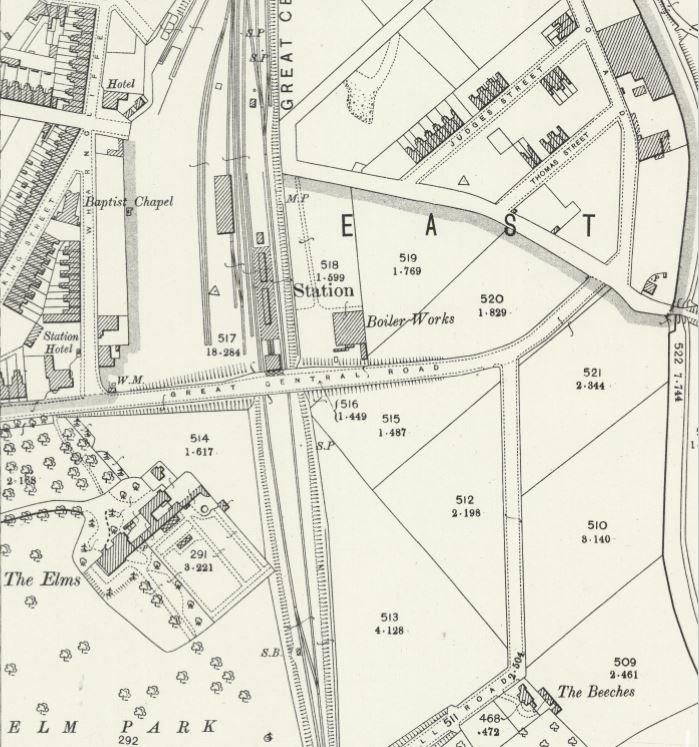
The company H. Coltman and Sons, as well as advertising as repairers to all kinds of engines and boilers, and having a large stock of circular and straight firebars, boiler mountings and fittings at the lowest prices, then went on to diversify somewhat. Between 1907 and 1920 we find the company producing 20hp cars, albeit in small numbers. In February 1920, a note appeared in the ‘London and China Express’ that the Loughborough firm of Herbert Morris Ltd. had acquired the business of H. Coltman and Sons, Midland Ironworks.

Meanwhile, the Central Boiler Works of Walter William Coltman continued to trade, and adverts for staff often appeared in the press, whether that were for a smith (angle-iron), skilled rivetters, electric welders, or young people to learn the trade. In the 1930s, a member of the local Onions family was the secretary and director of the Central Boiler Works.

Walter William Coltman, who created the Central Boiler Works died in 1958, but the company kept trading until the early 1980s, when in 1982 they were taken over by Loughborough-based Trentside Investments Ltd., and finally closing down in June 1982, there being many employees who had been with the 80-year-old company for over 20 years. The closure was put down to the decline in demand for coal-fired boilers, which had in part been caused by the lower price of oil.
____________________________________
Notes
[1] ‘Loughborough: its history, manufactures, trade'. Brighton: London: Robinson, Son & Pike, 1892
[2] Huram Coltman went on to serve two terms as mayor of
Loughborough, firstly in 1896-97, following Walter Chapman Burder, and then in
1898-9, following William Tidd. He was succeeded in the role by Thomas
Mayo.
____________________________________
posted by lynneaboutloughborough
With apologies for
typos which are all mine!
_______________________________________________
Thank you for reading this blog.
Copyright:
The copyright © of all content on this blog rests with me, however, you are welcome to quote passages from any of my posts, with appropriate credit. The correct citation for this looks as follows:
Dyer, Lynne (2023). Coltman family, boiler makers and engineers. Available from: https://lynneaboutloughborough.blogspot.com/2023/06/coltman-family-boiler-makers-and.html [Accessed 2 July 2023]
Take down
policy:
I post no pictures that are not my own, unless I have express permission so to do. All text is my own, and not copied from any other information sources, printed or electronic, unless identified and credited as such. If you find I have posted something in contravention of these statements, or if there are photographs of you which you would prefer not to be here, please contact me at the address listed on the About Me page, and I will remove these.
Blog
archive and tags:
If you are viewing this blog in mobile format, you will not be able to easily access the blog archive, or the clickable links to various topics. These can be accessed if you scroll to the bottom of the page, and click 'View Web Version'. Alternatively, there is also a complete list of posts, which when clicked will take you to the page you are interested in.
Searching
the blog:
You can search the blog using the dedicated search box that appears near the top of the blog when viewed in the web version. Alternatively, you can search using your usual search engine (e.g. Bing, Google, DuckDuckGo etc.) by following this example:
site: https://lynneaboutloughborough.blogspot.com/ “Radmoor House”
NOTE – the words you’re actually looking for must be in “” and the first of these must be preceded by a space
Thank you for reading this blog.
Lynne
