Showing posts with label Representation of the People. Show all posts

Sunday, 11 February 2018

More on suffrage and the carillon

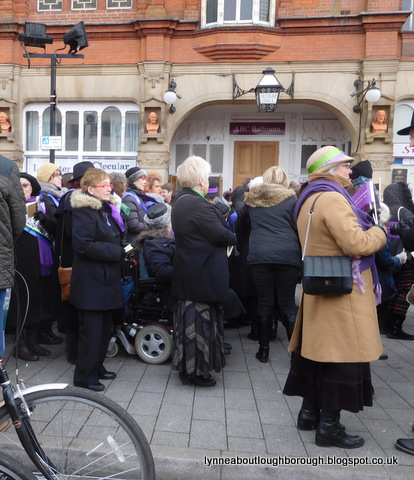
Following on from last week's mention of the unveiling of the statue of Alice Hawkins, suffragette from Leicester, this week I found myself at another unveiling, this time of the suffragette exhibition in the public library. 

This display was researched and arranged by the newly-formed Leicestershire Labour History Society, and the unveiling timed specifically to coincide with the passing of the Representation of the People Act, 1918. This Act decreed that all men over the age of 21 would be granted the vote, as would women over 30, provided they held property to the value of at least £5, or were married to a man who did. 

There were, of course, many things that lead up to the passing of this Act, including the First World War, during which whilst men were fighting in the trenches, women were working in munitions factories, as well as on the trains, trams and buses, and in other industries which were previously regarding as men's roles. Also, as part of the women's suffrage movement, women were campaigning to be allowed to vote. 

The exhibition in the public library starts with the early days suffrage, possibly around 1875, and follows the progress of the movement, form early meetings in the Town Hall, to later involvement of some Loughborough women. 

The opening of the exhibition began in the Charnwood Museum, in front of the model suffragette, and moved on to the public library. Many members of the Leicestershire Labour History Society were present, along with other interested people, and the exhibition was declared open by Lord Willy Bach, Police and Crime Commissioner for Leicester, Leicestershire and Rutland.

I've put a few photos from the event below, but do pop along to the exhibition if you can - it's well worth a read.

Last week I attended a fascinating talk given by Caroline Sharpe (King) about the Loughborough Carillon. After the initial discussions over the pronunciation of the word "carillon" Caroline told the meeting all about her tour of the carillons in the UK, which she undertook when she became our carilloneur in 2008. Apparently, there are 15 carillons in the UK, and Caroline, along with some of her relatives, visited and played quite number of these. 

She also explained how the instrument works, and how to interpret the music that is written for it. Unlike playing a piano or an organ, playing the carillon requires a good deal of strength and is a great workout!

There are regular carillon recitals during the year, given by Caroline, and special performances during the week surrounding 22 July, the anniversary of the opening of the Carillon, and on Remembrance Day. The sound of the bells rings out around the town, and can be heard from quite some way away.




Alice Hawkins the day after unveiling


You are welcome to quote passages from any of my posts, with appropriate credit. The correct citation for this looks as follow:

Dyer, Lynne (2018). More on suffrage and the carillon. Available fromhttps://lynneaboutloughborough.blogspot.com/2018/02/more-on-suffrage-and-carillon.html [Accessed 11 February 2018]

Take down policy:
I post no pictures that are not my own, unless I have express permission so to do. All text is my own, and not copied from any other information sources, printed or electronic, unless identified and credited as such. If you find I have posted something in contravention of these statements, or if there are photographs of you which you would prefer not to be here, please contact me at the address listed on the About Me page, and I will remove these.
Thank you for reading this blog. 


Lynne  


Sunday, 4 February 2018

What is Loughborough's story?

So, over the last couple of weeks, apart from sharing anniversaries with you, I've been out and about and doing  a lot of thinking about things I've encountered on the way.

In particular I've been trying to work out the story of Loughborough, but in all honesty, I'm having a bit of bother with this!

Imagine you go to a work meeting where there's lots of discussion about a variety of topics. After the meeting you chat with someone else who was there and they say something like "Gosh, that was a controversial meeting", and you think to yourself "Was it? What was controversial about it?". 

Or, imagine you go to a party, and have the time of your life! Afterwards, you talk to a friend who was a the same party, who says to you "Wasn't that such a boring party last night?" 

Or imagine you go into town on a Monday, while your 21st cousin 300 times removed goes in on a Saturday. You meet up one evening in the local pub, and you say to them "Loughborough is so quiet and boring, with lots of empty shops, lots of charity/betting/telephone/coffee shops". They look at you in amazement and share their thoughts "Good grief! Yes, there's some empty shops and quite a lot of charity/betting/telephone/coffee shops, but it's a really, really busy and buzzing little place."

So, you may be left wondering if you went to the same meeting/party/town centre?

But, of course, all these views are valid, none are right, none are wrong, and there are plenty of other views to be had as well! 

And so it is with history. Events are interpreted in different ways by different people. Events are recorded in different ways by different people. Some things are recorded to the nth degree, other things more sparsely, other things not at all. 

An additional problem with trying to piece together history is trying to find what's been recorded and where it is now kept. And then once you've found it, trying to read it, both from a handwriting point of view and from an etymological point of view. Then it's helpful to know where the person who recorded the information is coming from - so, why did they record this information? for their own use? for official use? and why did they only record this but not something else?  

So, it's helpful to know what has been recorded, and by whom, and where it can be accessed. Of course, other issues affecting historical records are geographic coverage, which can vary widely across the country, hence some areas have a rich story, others virtually none. And, whilst many events and happenings have been diligently recorded, some have since been lost, for example, the 1931 UK census was taken, but later destroyed during a fire in WWII.   

On top of all the above, add your own 21st century perspective, and you've got a story that represents one view of what might or might not have happened, which may be extremely far-removed from the general contemporaneous consensus, or the view of other people today.

2018 sees the centenary of the Representation of the People Act, which gave the right to vote to those men who didn't already have the right, and to a certain selection of women. The Suffragettes were instrumental in campaigning for votes for women, so it is not surprising that the women's suffrage movement is getting a bit of publicity. For me this has started with the unveiling of the statue of Alice Hawkins, the Leicester Suffragette, and will continue with the opening of an exhibition in the public library. 

The story of the Suffragettes is one which has been told many times, but it is also one of those where the whole story may not be available. If you're interested to learn more about this, and the story of Kitty Marion, pop over to this blog. And pop back to my blog next week and see what's been happening over the coming week. 

New Market Square Leicester Alice Hawkins, Suffragette, covered
Alice Hawkins under wraps

New Market Square Leicester Alice Hawkins, Suffragette, covered
Alice Hawkins under wraps

New Market Square Leicester Alice Hawkins, Suffragette, uncovered
Alice Hawkins unveiled

You are welcome to quote passages from any of my posts, with appropriate credit. The correct citation for this looks as follow:

Dyer, Lynne (2018). What is Loughborough's story? Available fromhttps://lynneaboutloughborough.blogspot.com/2018/02/what-is-loughboroughs-story.html [Accessed 4 February 2018]

Take down policy:
I post no pictures that are not my own, unless I have express permission so to do. All text is my own, and not copied from any other information sources, printed or electronic, unless identified and credited as such. If you find I have posted something in contravention of these statements, or if there are photographs of you which you would prefer not to be here, please contact me at the address listed on the About Me page, and I will remove these.
Thank you for reading this blog. 

Lynne  


Sunday, 17 December 2017

Suffragettes

Perhaps 17th December is a little too soon to be blogging about what 2018 might bring, but I thought it might be an idea to give some advance warning that 2018 is going to be looking back 100 years, to the Representation of the People Act (6th February), which led to an increase from 8 million folk being allowed to vote, to about 21 million. 

Over on the UK Parliament website, they explain that only 58% of adult men had the vote prior to 1918, this being restricted to property and landowners, and excluded many members of the armed forces who might not have been resident in Britain for the full 12 months before an election.

The Representation of the People Act gave the vote to all men over the age of 21, all male armed forces personnel over the age of 19, and women of property, over the age of 30 were also given the vote. Nevertheless, there was still inequality which was finally sorted with the Equal Franchise Act of 1928 (2nd July), when all women over the age of 21 were enabled to vote. 

A couple of pages from the 1918 Act are available here.

Leicester have been fortunate enough to have been awarded some money to use for celebratory and commemorative events in the coming year, along with 6 other cities - Manchester, Leeds, Bolton, Bristol, London and Nottingham. A prominent Leicester Suffragette was Alice Hawkins, who died in 1946, and in whose honour a new statue is being sculpted and will probably be erected in Leicester's new Market Square in February 2018. There's some more information about the sculptor here, and a bit more about the location here

There's plenty of information out there about Alice, like this comprehensive website, and a book about the lady in question: Whitmore, Richard (2007). Alice Hawkins and the Suffragette movement in Edwardian Leicester. Breedon Books. There's also an interesting website in the making on which we'll be able to search for local events during 2018.

Talking of local - well, this is a Loughborough-focussed blog, after all - we had our own Suffragettes in Loughborough, Nora and Kathleen Corcoran, daughters of Dr Corcoran. There's a bit more information on them by Mike Shuker in East Midlands History and Heritage, Issue 3, July 2016, pp. 17-19, and an article in the Loughborough Echo of March 2016. I believe there is some connection between the sisters and a fire at the Red House on Burton Walks - oops, better not mention the Red House, about which I was going to blog, ummm, over a year ago (sorry).

Anyway, next year will see many events taking place in Loughborough in commemoration of the Suffragettes and their protests, including exhibitions, talks and other special moments. 

You are welcome to quote passages from any of my posts, with appropriate credit. The correct citation for this looks as follow:

Dyer, Lynne (2017). Snowy Loughborough. Available fromhttps://lynneaboutloughborough.blogspot.com/2017/12/suffragettes.html [Accessed 17 December 2017]

Take down policy:
I post no pictures that are not my own, unless I have express permission so to do. All text is my own, and not copied from any other information sources, printed or electronic, unless identified and credited as such. If you find I have posted something in contravention of these statements, or if there are photographs of you which you would prefer not to be here, please contact me at the address listed on the About Me page, and I will remove these.
Thank you for reading this blog. 

Lynne