Tucker’s
buildings in Loughborough
 |
| The former Prudential Assurance building, Market Place, Loughborough |
I’ve come to
the conclusion that blogposts about the use of Tucker’s bricks could go on
forever, so I have had to draw a line somewhere! So, before we begin looking at
just a selection of the buildings in Loughborough that have been constructed
using bricks from Tuckers, here’s a few more non-local buildings with that
local connection:
According to the
Nottingham Journal of 1st January 1931, in 1930 Tuckers had secured the
contract “for the new village of Morris Cowley, built near Coventry by the famous
firm from which it derives its name”. I have been unable to locate this …the
only Cowley I know is near Oxford …
 |
| Extract about Morris Cowley |
On 27th May 1954
the Leicester Evening Mail carried the following report on London
airport: “At the rate of five bricks a minute, 1,000,000 Loughborough-made
bricks are being turned out for use in the construction of London Airport’s new
terminal buildings. This order was secured by G. Tucker and Son, Ltd., of
Beeches Road, Loughborough. The bricks, which have a rough finish and an
appealing antique appearance, are being used in part of the £26,000,000
development scheme planned for the airport … The bricks were chosen because of
their exceptionally good colour – a warm reddish brown – and rustic finish …
All the bricks are hand-made.” These bricks were used for the control tower,
and adjacent offices, the passenger handling building and the Eastern Apex, and
further would be used on a public building for spectators.
The Quorn
Village Design Statement of 2008 is keen that properties are restored and
renovated sympathetically. It is noted that “traditional Quorn is unified by
the use of a small palette of local building materials”: this includes the
traditional mellow red brick fired from local clays by Tuckers.
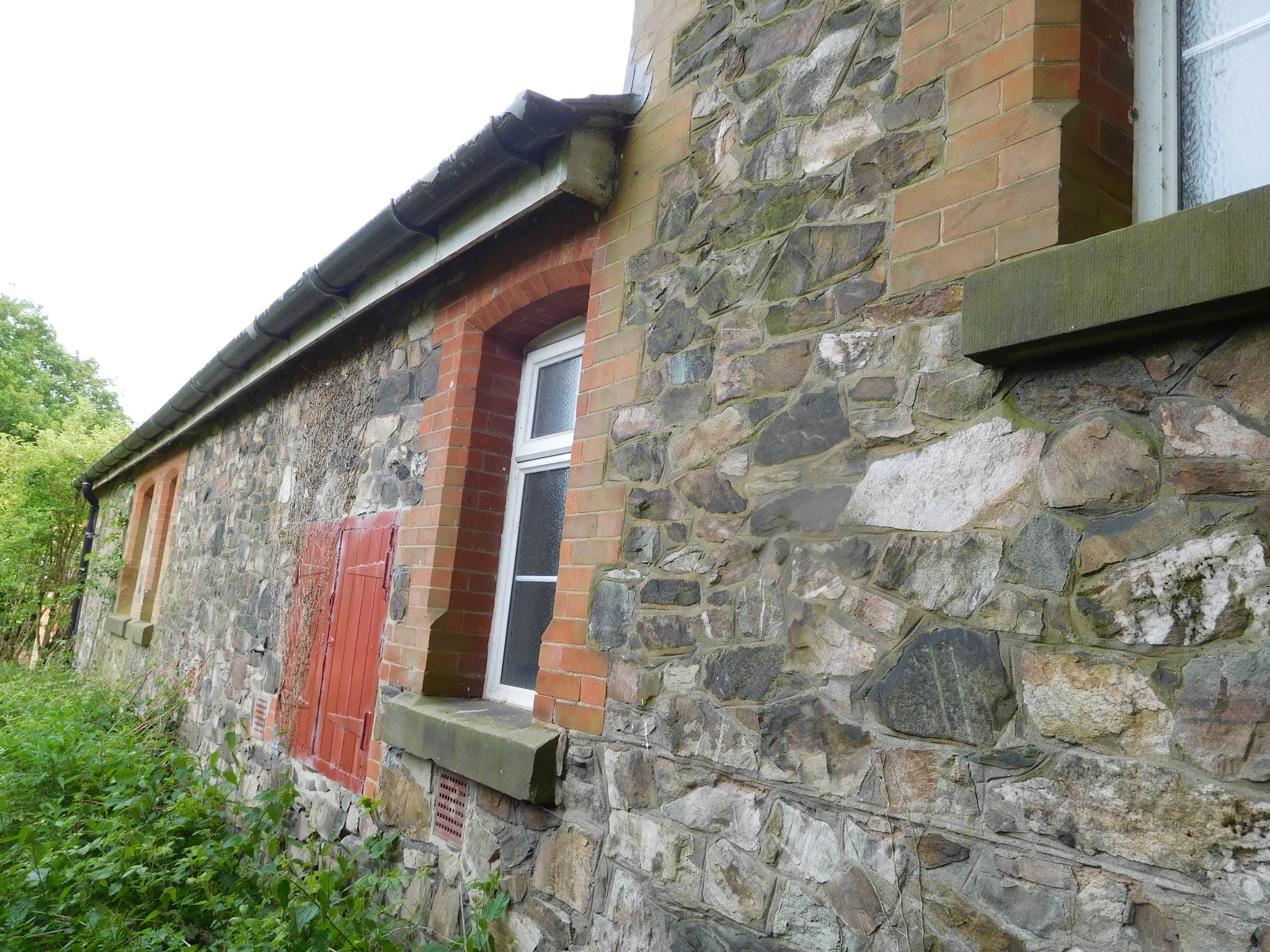
In 1893 the foundation stone was laid for the Charnwood Forest Convalescent Home, which was
to be built on Woodhouse Lane. The building would be built in forest stone, and
faced with red sand-faced bricks to the doors and windows, and with brick
lining to all sides: the facing bricks were to be supplied by Tuckers.
 |
| Charnwood Forest Convalescent Home |
 |
| Charnwood Forest Convalescent Home, 2016 |
 |
| Charnwood Forest Convalescent Home showing detail of stone and brick construction |
And so to
Loughborough …
Grammar School
1852
It is believed
that the Loughborough
Grammar School buildings of 1852 were constructed of Tucker’s bricks, as
were some of the later additions. The Tucker family had close connections with
the school as many of the family were educated there.
 |
| Detail of a Loughborough Grammar School building |
Memorial
Baths 1898
What is now
the Charnwood Museum in Queen’s Park, was originally constructed in celebration
of Queen Victoria’s Diamond Jubilee as the Memorial Baths, offering the people
of Loughborough the opportunity to bathe indoors. The building is built of ‘local
red pressed bricks, which I presume to be provided by Tuckers. The dressings
were from Ruabon – so probably from J. C. Edwards, who were based in Ruabon,
Denbighshire, and were certainly very active between 1903-1956.
 |
| The memorial baths, now Charnwood Museum |
Temperance
Café 1899
The foundation
stones of the building that we now know as the betting shop on the corner of
Granby Street and Cattle Market, which carries a sandstone plaque bearing the
words ‘Messrs Garton the Mart’ were laid at the end of August 1899, as the beginning
of the Temperance
café. Although the terracotta was not made by the Hathern Station Brick and
Terra Cotta company, but rather by J. C. Edwards, the bricks used in the
construction of the building were indeed local, being produced by Tuckers.
 |
| The former Temperance Cafe |
Public
Library 1905
The public
library on Granby Street was completed in 1905. “A competition to design a new
library resulted in an Edwardian Baroque-style public library building. This
replaced the 1886 library on the corner of Green Close Lane which was
considered no longer adequate. The Scottish-Anglo industrialist and
philanthropist, Andrew Carnegie, had pledged £5,000 towards its building, as
had local man, Griggs, and it was prominent and prolific local architects
Barrowcliff and Allcock, who won the design competition.
One of the
assessors of the competition entries was George Hodson. As founder of the
Hathern Station Brick and Terra Cotta Company, it comes as no surprise that the
resulting library building has much terracotta detailing! The bricks were made
by the local firm of Tuckers, and the builders were the local firm of Moss,
both of whom would later be involved with the construction of the Carillon. The
heating system was installed by the local firm, Messengers.” (1)
 |
| The public library |
Prudential
Assurance 1914
On 18th March
1914, the Prudential Assurance company opened their offices in what was
described as one of the best sites in the town, on Market Place. The stunning building, described by the mayor as ‘an
admirable building for others to imitate’ (2) comprised two storeys
above-ground and a basement, with a frontage composed of sand stocks from the
brickyards of Tuckers. At the opening ceremony, Mr Martin, the assistant
manager of the offices, addressed the assembled party, saying he believed the
building would stand for many years, and would be a lasting monument of hard
and conscientious work by the architect and the builder. He was pleased with
the “special specimens of terra cotta from the Hathern Station Brick and Terra
Cotta Works” and went on to comment about Tuckers and the bricks: “Messrs.
Tucker & Sons …had a reputation all over the country for their material.
They [Prudential] had been fortunate indeed in having so much excellent
material ready to hand, and such earnest workers to carry out the designs.” The
mayor, commenting upon Loughborough itself, said Loughborough had great facilities,
and many prosperous businesses, so much so that business premises could be
erected and furnished throughout by local firms: as well as the companies
already mentioned in the building of the Prudential offices, they were actually
built by Loughborough company Corah, and had heating by Messengers.
Mr Martin was
correct in his prophecy that the building would stand for many years, and today
the building in Market Place now houses Max Speilmann, The Berber shop and
Subway at ground floor level, and the upper storeys are being converted.
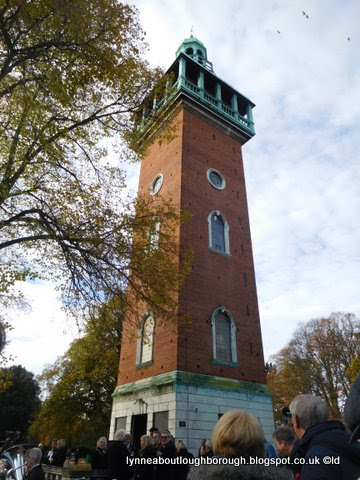
Carillon
1923
Following a
public consultation, Loughborough’s memorial to those who died in the First
World War was built in 1923 and took the form of a 151-foot tower with a carillon.
“The construction of the tower was a most local affair: built by Moss, of
bricks by Tuckers; steelwork by Herbert Morris, and the bells of the carillon
made by Taylors Bellfounders.” (3)
 |
| The carillon |
Shelthorpe
Estate 1925-1931
The Shelthorpe
housing, built between 1925 and 1931 was built with Tucker’s bricks. During excavations
at the site, workmen from Tuckers unearthed half a bronze seal. In 1926 the
brickmaking firm offered Loughborough Corporation the sum of £1,000 towards the
cost of a road linking Park Road and Leicester Road, known as Shelthorpe Road
today.
 |
| Extract from the Nottingham Evening Post, 13 January 1935 |
 |
| Extract from the Leicester Daily Mercury 15 March 1926 |
Rutland Hall
1933
Rutland Hall
on the university campus was originally built as a hall of residence, but is
now offices, and the name transferred to halls in the student village. Much of the
emphasis on the descriptions of the original hall focus on the interiors, which
were designed in the Arts and Crafts style, influenced by the Cotswold tradition
of Ernest Gimson. These interiors were created by Peter Waals, who had worked
with Gimson, and Edward Barnsley, whose relatives had also worked with Gimson,
and their students. However, the Nottingham Journal of 3 January 1933 quotes a
number of buildings across the country that were constructed with bricks from
Tuckers, and this includes ‘Rutland Hall, the new Loughborough College Hostel’,
which was opened by the Duke of Rutland on 12th October 1932.
It has been
suggested that some of the 1930s houses on Beeches Road are constructed
with Tucker’s bricks.
It has also
been suggested that houses on Alan Moss Road have facing bricks from
Tuckers, but the commons (the ones not on the kerbside) are by the London Brick Company
– a company who have been producing bricks since 1877 which have been used in
the building of in excess of five million houses across the country.
It has also
been suggested that houses on Parklands Drive are made of Tucker’s
bricks, as are the houses on Beacon Drive, which were constructed around
the late 1940s.
 |
| Beacon Drive |
And finally, here's a pair of houses, which, according to the estate agent's particulars when one of them was for sale in 2017, were built for Tuckers, and indeed, William Trueman Tucker certainly lived in the one on the left at one time. One must assume that the company provided the brick! |
| Parkside and Southernhay |
References
(1) Dyer,
Lynne (2018) Loughborough in 50 buildings. Stroud: Amberley
(2) Loughborough
Echo 20 March 1914, pg 3
(3) Dyer,
Lynne (2018) Loughborough in 50 buildings. Stroud: Amberley
Posted by lynneaboutloughborough 11 April 2021
You are welcome to quote passages from any of my posts, with appropriate credit. The correct citation for this looks as follow:
Take down policy:
I post no pictures that are not my own, unless I have express permission so to do. All text is my own, and not copied from any other information sources, printed or electronic, unless identified and credited as such. If you find I have posted something in contravention of these statements, or if there are photographs of you which you would prefer not to be here, please contact me at the address listed on the About Me page, and I will remove these.
You can leave comments below, but do check back as my reply will appear here, below your comment.
Thank you for reading this blog.
Lynne