Showing posts with label Olde Packe Horse. Show all posts

Sunday, 15 May 2016

Night of the Zeppelin

Over the years there have been many moments when I have been moved to tears. One such was when I read the Alexander Cordell trilogy (Rape of the Fair Country, Hosts of Rebecca and Song of the Earth) set in the iron foundry of South Wales - Clydach, near Gilwern, to be precise. As a child I'd played on the disused foundry buildings: as an adult I'd romanticised these relics of our industrial heritage, that is, until I read the trilogy. My outlook changed completely, when I came to fully understand the life my ancestors had had, the hardships they had endured, and the emotional and physical scars they carried with them as a result of working in the iron foundry.
The Iron Works at Clydach (2008)
And so it is with the story of the Zeppelin bomb attack on Loughborough, that took place on Monday evening, 31st January 1916. I know the events that took place, I know the theories behind the big question of "why Loughborough?", I know some of the personal information about the Loughborough folk who either died in the attacks, or who were injured, but it wasn't until today that I fully appreciated what this actually meant to the people involved and the people of Loughborough.

This weekend saw an ambitious community event take place in various locations across the town, a collaboration between Charnwood Arts, Loughborough College, Chorus Theatre and Excavate Community Theatre, funded by the Heritage Lottery Fund, and Arts Council England, and represented the culmination of months of planning, preparation and rehearsal.

Events were repeated a number of times across Saturday and Sunday, which gave people plenty of opportunity to attend a variety of sessions. For me the day started off with a performance from the Tommy Atkins Band outside a specially erected dome in Queen's Park.
The Tommy Atkins Band
and was followed by an introduction to the whole event.
Setting the scene
Although there were numerous events to choose from, it proved somewhat difficult to decide which order to do them in, so eventually picked to do the following:
  • Introduction at the Dome
  • The Council Meeting in Glebe House
  • The newspaper reporters' meeting at the Organ Grinder (formerly the Old Pack Horse)
  • The Adkins family story and the Adcocks family story at the Swan-in-the-Rushes
  • The Sarah Oram and Martha Shipman story at Peter's Pizza (formerly the Crown and Cushion pub)
  • The Zeppelin play in the Dome
  • Josiah Gilbert's story at the Organ Grinder
  • The story of friends Ethel Higgs and Elizabeth Askew, and the Page family at Fearon Hall
  • The finale at the Church of All Saints and Holy Trinity

Regrettably, I missed the stories of:
  • Beatrice and Ernest
  • Alfred Coleman
  • Arthur Turnill
  • The Coroner's story
So, what exactly was it all about? Well, on the evening of Monday 31st January 1916 a German Zeppelin, apparently on its way to Liverpool, dropped  four bombs on the town of Loughborough. It seems the crew thought they had reached Sheffield, not least because there were lights on in various parts of the town, making it an easy target. This weekend's event told the stories of the 10 people who were killed in the bombings, and of some of those injured in the blasts, through a variety of performances - acting and dancing by groups of young people, a short, almost comedy sketch, in a replica Zeppelin, re-enactments of council meetings, a soliloquy etc.. 

In some cases, the venues chosen were the actual sites of the events of 1916, for example, the story of Sarah Oram and Martha Shipman was told in Peter's Pizza place, which was previously the Crown and Cushion pub, and it was in the back yard of this that one of the bombs landed. 

Peter Pizza, formerly the Crown and Cushion pub
I can't be 100% certain, but I would imagine the council and coroner's meetings would have taken place in the Magistrate's Court on the corner of Town Hall Passage, so placing the re-enactments in Glebe House was probably fitting. 
The former Magistrate's Court

The courtooom inside
For me, the most moving performance took place upstairs in the Swan-in-the-Rushes, the story of Annie and Joseph Adkins being acted out by four young performers who danced and acted with incredible emotion. Annie and Joseph were described in newspaper reports of the time as being newly-weds, making their deaths all the more poignant. Almost equally as emotionally portrayed was the story of the Adcock family, again, young actors in the same location, acting out the death of young mother Annie Adcock.

Throughout all the performances I was lucky enough to go to, there were a number of themes that ran across them all. 

The first theme was the excitement of experiencing the first of the electric lights, in, what was referred to as the Market Square, and along Leicester Road, and the fact that Loughborough town was not observing the blackouts. This also came across in the story of the Empress Road bombing, where the Herbert Morris factory had lights shining out, as they had recently installed bright ones, and even removed the blinds from the ceiling windows as the workers had complained about how hard it was to work in the dim lighting of previous.
The Herbert Morris factory from the canalside
Another theme was that of snow! I heard several times that it had been snowing in the days leading up to the attack.

An interesting theme was that of ice-cream, and the Italian Bartolomucci family were mentioned in several of the events, not least the finale in the church, when a make-shift Bartolomuch handcart was wheeled down the central aisle and choc ices thrown to the audience, which prompted the Tommy Atkins Band and their friends to burst into song, led by that well-known local performer, and now Britain's Got Talent star, Bill Brookman!
Bill Brookman
Several events mentioned the lack of horses in town, as most had been taken to France to take part in the war. 

And the gas works was mentioned a couple of times too, people expressing their relief that the bombs narrowly missed both the gas and electric works.

There was also a lot of mention of the jobs that women were doing during the war while the men were fighting on the front, like, for example, being postwomen, and being trained in the Technical Institute to make engine parts, and using tools like vernier calipers. There was comment in the finale (a sort of re-enactment of the local Mayor's (Walter William Coltman, owner of Walter W. Coltman and Co Ltd., Central Boiler Works) meeting after the events of 31st January) that since women had done many of the men's jobs whilst they'd been away at war, that women should now be accepted in the workplace, and women allowed to vote!

One phrase that will certainly stay in my mind is that attributed to Annie Adcock, who apparently said:

"Wherever you are, wherever life takes you, the best decisions come from the heart."

I do hope you managed to get to the event, and if you didn't, I hope this little blogpost gives you a flavour of the weekend.

Thank-you for reading. If you are interested to visit the locations on which the bombs fell, you can follow my virtual Zeppelin walk. 

Here are some pictures of the day.
The camping in Queen's Park

A short silent movie about the event ...

Approaching the Organ Grinder

The news reporters' office upstairs at the Organ Grinder

At the Swan-in-the-Rushes

Awaiting the show upstairs at the Swan-in-the-Rushes

Three German officers in a replica Zeppelin

Inside Fearon Hall

Music in the church

The finale in the church


Sunday, 23 March 2014

Ghost signs of Loughborough, part 2

Last week's post on ghost signs in Loughborough proved to be a bit popular, but I can't help but think that people might have been looking for ghost stories from the area! Anyway, I've been out and about a bit this week and captured some more ghost signs for you to see.

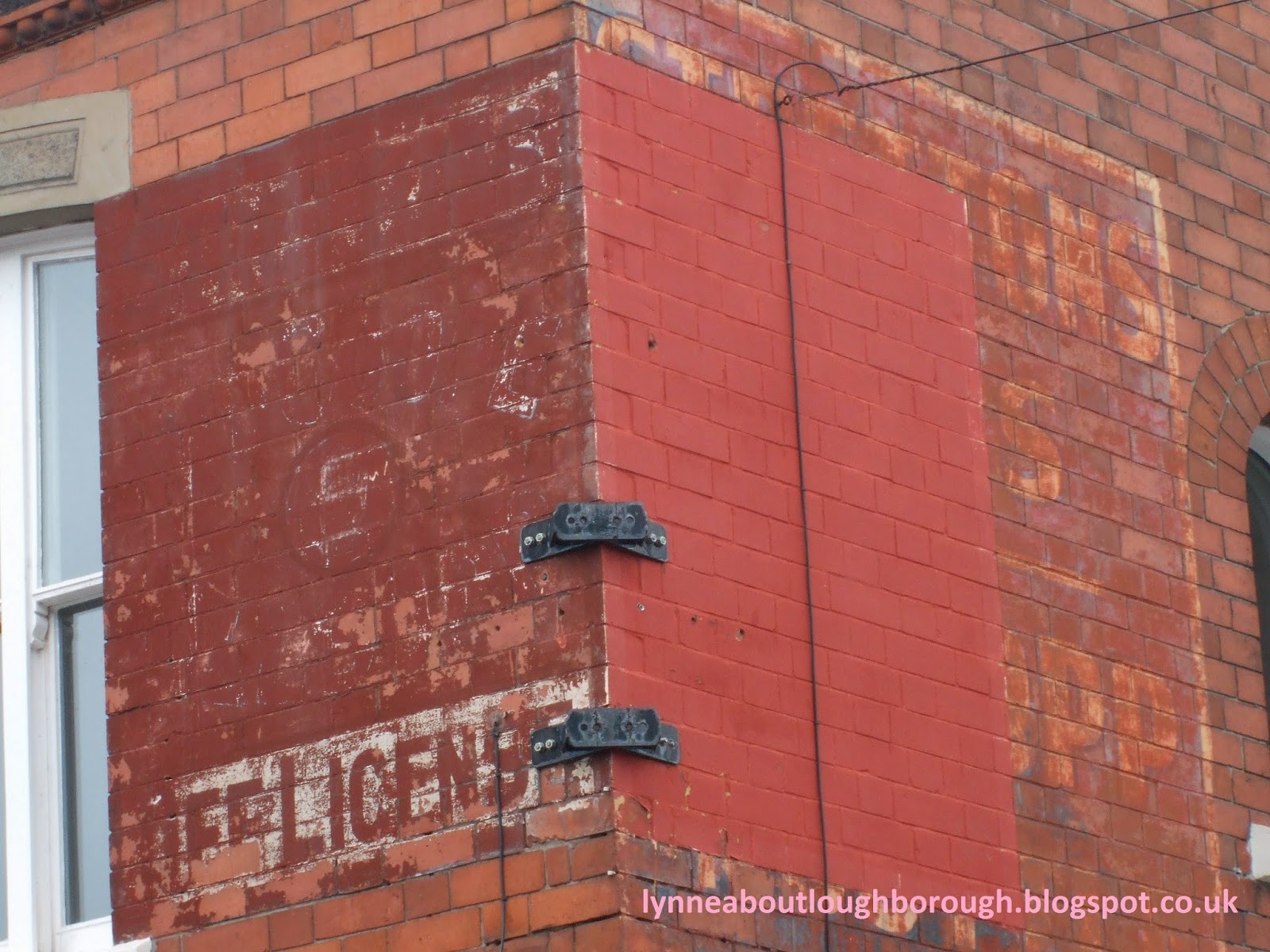
Ghost signs are painted signs, usually advertising signs, on the side of buildings, that are not maintained, or not representative of the business that now takes place in the building. As such, some of the pictures below are not actually classed as ghost signs, but are either carved into the buildings or are reliefs, that represent the building's previous - or in the case of the Town Hall and the library the current - use. The Putts sign is, of course, not a ghost sign, because it is maintained and the business operated from the premises is still Putts the Decorators, as is the sign on the side of the Three Nuns pub, and that on the Royal Oak. The first two ghost signs below are not from Loughborough, but are very good examples of the art of ghost signs that I have seen very recently.

Someone suggested that there might be some remnants of a sign for the pub in George Yard, but I could find no evidence of this.

Ghost sign on a building in Swadlincote

Ghost sign on a restaurant in Stratford-upon-Avon


Putts on Nottingham Road
The Three Nuns on the right of the picture

The Royal Oak on Leicester Road


Corner of George Street and Storer Road


Stag and Pheasant Nottingham Road from the other side!

Former shop on Wharncliffe Road


Houses on the end of Gregory Street with ghost sign top right


Close up of the Gregory Street painted street sign


Not really ghost signs, but evidence of Cottons!! 


More evidence of Cottons!


Above the first floor window is the ghost of the Leicester Mercury!


The Black Lion, lately the Hobgoblin


The Old Pack Horse, now the Organ Grinder

The Blacksmith's Arms

The former offices of the Loughborough Echo on Swan Street

The Town Hall, formerly the Corn Exchange

Great Central Station Hotel, now flats and a day nursery


Messrs Garton The Mart! Originally the Temperance Hall

Close up of Messrs Garton The Mart!


William Corah's on Aumbry Gap etched in the green stone, left of the hardboard!


The L and the I of William Corah's on Aumbry Gap

The Carnegie Library


Sunday, 16 March 2014

Ghost signs of Loughborough


Someone recently posted a question on facebook about ghost signs in Loughborough, so here are a couple of pictures I've taken over the last couple of years. If you know of any more, do let me know, and I'll do a follow-up to today's post. If you don't want to register to leave comments below, you can email me by converting the following to text with punctuation: lynnedotdyeratgooglemaildotcom

There are also a couple of websites associated with ghost signs generally, that you might like to read, including this article from November 2013, the History of Advertising website, a flickr group, and one specifically on Leicestershire ghost signs.


Aumbry Gap

Cottons (I think) on Baxter gate

Butchers on Moor Lane

Collin Bros on Baxter Gate

Nottingham Road

Olde Packe Horse

Ratcliffe Road

Nottingham Road

Corner of Storer Road

Corner of Storer Road

Corner of Storer Road and George Street

Corner of Storer Road and George Street

Corner of Storer Road and Station Street

The Empire Cinema


Towles Nottingham Road
William Street

Nottingham Road