Showing posts with label Manor House. Show all posts

Friday, 22 January 2021

Loughborough market and fair

Loughborough market from above
Loughborough market


In this blog post I was going to write about the history of Loughborough market and fair, but during my research for information, I came across a lovely little book (1), a sort of guide to some of the market towns of England, that I just found so appealing I had to share with you before looking into the history of Loughborough market - and fair.


The book in question is basically an introduction to English market towns, and it’s rather like a guidebook. How wonderful to find our lovely town in a guidebook! The book is a Colourmaster Publication, printed in 1973, but the author does not reveal their identity, either within, or on the cover. However, in the acknowledgements, the author and publisher thank a number of people, which includes the then Market Manager for the Borough of Loughborough, M. W. Green.

Let’s take a look at what appeared in the text.

“Ancient Loughborough is the second largest town in Leicestershire and has been described as the town of bells. It owes this title to John Taylor of Oxford who came to the town to recast the bells of All Saints Church. He was so taken with the town that he stayed, setting up his famous foundry in Cherry Orchard.”

The tower of Loughborough parish church


The writer goes on to comment upon the world-wide reputation of the bells that have been cast in Loughborough, including the Great Paul bell for St Paul’s Cathedral. The church of All Saints is said to be of 14th-century structure, although much restored, with a bell tower that is 500 years old. There was at the time of the writing of the book, a small museum to the memory of Taylor, although it does not specify which Taylor.
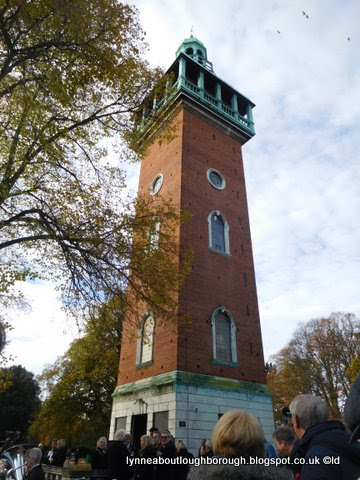


Loughborough's carillon


Of course, no book about ‘what to see’ in Loughborough would be complete without mention of the Carillon, the bells of which were of course made by Taylors:

“The 151 feet high war memorial in Queen’s Park also contains one of the finest carillons in the country. Forty-seven bells hang in there ranging in weight from over four tons to twenty pounds. It rang for the first time in 1923 and it was from here that the first broadcast of bell music was made.”


Without pausing for breath, the writer continues:

“Loughborough was also the home of John Cleveland, the so-called Cavalier Poet. His devotion to the Stuart cause was reflected in his work in which he heaped scorn on the Commonwealth and he was hounded by those he satirised. He died before the Restoration but his works were avidly read for many years although now they are little known, for his wit was topical and not enduring.”

We finally get to a section on Loughborough’s wonderful market and fair:

A fairground ride at Loughborough

“Loughborough is eminent as a market town and much of the history of the town is reflected in the story of its fairs and gatherings. The earliest known document relating to Loughborough fair is dated 1221 although the market has almost certainly existed before that time, probably from the right to hold the Thursday market granted by Hugh Despenser in 1206.

In 1227 the charter was a confirmation that the market was to be held on Thursdays and likewise the fair was to be a two-day event to commence on 31st July each year. The following year the right to hold an additional fair was granted, to be held in November and to this day the annual November pleasure fair is held on the second Thursday of that month.”

Some general history of the town follows:

“So the town, prosperous and growing, continued to expand and in the years 1400 to 1600 was an important centre for the wool trade. The Civil War left it unmarked, although Royalists on one occasion recruited a motley army after a fiery speech from the Market Cross. The town had passed to the Earls of Huntingdon and in 1677 there was granted the right to hold two additional fairs in the town, ‘on the Tuesday preceding Palm Sunday and on the second Tuesday after Easter Sunday’.

In 1742 the original cross was replaced by a new structure, known as the ‘butter and hen’ cross, which instantly evokes the picture of a bustling market place. It was described as having a ‘slated roof supported by eight round brick pillars set up in an octagon form’, and was topped with a sumptuous weather vane. Additional fairs flourished, including two described in contemporary accounts as ‘cheese meetings’. In 1829 the manorial rights in the markets and fairs were sold to the Loughborough Local Board. The Cattle Market continued to function in the Market Place until 1896 when it was moved to a new site. During recent years this has been much modernised and improved. The general market, after some years of uncertainty about its future, has been saved on its traditional site and made a pedestrian precinct with an added bonus of more space for open air trading. Its future as one of England’s oldest markets now seems assured.”

Background to Loughborough markets and fairs

So, here’s a bit of background to Loughborough’s markets and fairs. The charters for the market and fair were granted in the reign of Henry III, who ruled between 1207 and 1272, and who during this reign granted charters to over 1,000 towns and villages, of which Loughborough was one, and Ashby, Belton and Waltham-on-the-Wolds some of the others.

Henry III had become the monarch at the age of nine, thus the country was ruled by two regents, until Henry came of age. However, Henry signed up to the Great Charter of 1225, which was the definitive version of the Magna Carta created by King John in 1215, and which separated out rules pertaining to forests. This charter limited royal powers and protected some of the rights of the manorial barons.

Thus, in a royal letter (2), Henry III granted Hugh Despenser the right to hold a market, from 22nd January 1221 – 800 years ago! The market and fair was to be held at Despenser’s manor in Loughborough, and the permission granted in the royal letter was to be valid until Henry came of age. In 1227, on 12th February, once Henry had come of age, he granted a charter to Hugh Despenser to hold a market on a Thursday, and further confirmation was given in February 1229 and February 1233.

Loughborough’s market is therefore known as a Charter Market, and this status can only be changed by an Act of Parliament. The other type of market is a Statutory Market, one which has not been created as the result of a charter, rather being formed by an Act of Parliament.

The former manor house

Hugh Despenser’s manor house was in the area of Sparrow Hill, now occupied by an Italian restaurant, inside which, beams have been dated to 1477. This area is close to the church, and the churchyard would have been the original location for market stalls – barrows, carts, as well as static furniture. Because of the regularity of the market in such a well-known area, it would have been easy for people to remember when the market was, and for them to meet here to trade their goods. There would also have been plenty of witnesses, should anything go wrong!

It had been known for events to get a bit out of hand during these markets, and occasions when people set up stalls without permission, so in 1285, Edward I passed a law that stopped the holdings of markets and fairs in churchyards.

In August 2020, the inhabitants of Sileby set up a few market-type stalls in the car park at the Free Trade Inn. This sparked a whole debate about charter markets, the area around them that were protected by such a charter (in Loughborough’s case this was a radius of six and two-third miles) and competition, which reached the national news.

This wasn’t the first battle over the rights to hold a market, for in 1239, the town of Leicester claimed that its market trade was being damaged and put under threat by a Tuesday market that had been installed in nearby Narborough. Both markets had been in fact been going for quite some time. Narborough’s market day had changed in 1220 from a Thursday to a Tuesday, so perhaps this change of day was the concern in Leicester, although why this was raised as an issue nineteen years later, I cannot say.

Loughborough fair

Although today we think of fairs as being fun places, full of whizzy rides, bright lights, amusement, and food stalls, all to the cacophony of music, sirens and people screaming, fairs haven’t always been all about fun and games, but were once very important trading places.

Originally, the terms ‘market’ and ‘fair’ were used interchangeably, as charter fairs were essentially markets. The main differences between the market and the fair were that markets were held either daily or weekly, while fairs were usually an annual event associated with the feast day of a specific saint, and while markets traded in fresh produce and necessities, fairs traded in higher value, non-perishable goods, like homewares, pottery, furniture, and farm tools.  

The word fair comes from the Latin word ‘feria’, which means holiday, and as early fairs often began on the feast days of a saint, people would go to church in the morning, and then the fun of the holiday would begin after this. Amusements may have been provided by acrobats, fire-eaters, jugglers, and minstrels. Shops closed, but their proprietors were able to trade at the fairground.

Like markets, fairs could only operate if granted a charter, and there were close to 5,000 such charters granted in the thirteenth and fourteenth centuries. Of these, most villages, towns and cities that were granted permission could hold only one fair per year, which probably lasted for just a few days. Some of the more important fairs were held at Winchester, Stourbridge, Bartholomew in London, and St Ives in Cambridgeshire (although at the origination of the fair, there was no town of St Ives: the town grew up there because of the fair).

Also like markets, fairs could operate if allowed so to do by an Act of Parliament. These fairs were called hiring fairs, statute fairs, or mop fairs, and were conceived from about the mid-1300s, when there was a shortage of workers, probably in part due to the black death. Later, around the mid-1500s, it became the custom for rates of pay for workers to be fixed on a specific day each year, which would hold true for the coming year, and be re-set the next year. So, workers were employed for a year, and then had to seek employment at the end of that year. Because so many people congregated at the annual fair, this became a good opportunity for workers and employers to seek each other out. People looking for work would often carry with them some visual indication of their trade: perhaps a shepherd would carry a crook, a housemaid a mop, hence the term ‘mop’ fair.

So, what of Loughborough fair?   

The background to Loughborough fair is almost identical to that of its market. In a royal letter (3), Henry III granted Hugh Despenser the right to hold a fair, from 22nd January 1221 – 800 years ago! On 12th February 1227, once the king had come of age, he specified that the fair be held on the eve or day before the feast of St Peter. A further letter was sent to Despencer in April 1227, and again confirmed in February 1229 and February 1233.

Today, Loughborough fair has now expanded to cover many of the town centre’s streets – and the Granby Street car park, which used to be the site of the cattle market. 
One of the rides on the Granby Street car park

For many years, the event always began on the second Thursday in November, but a few years ago this was extended, and now begins on the second Wednesday of November. The fair is opened at an official ceremony, when the current mayor reads out the charter, and there are usually many dignitaries in attendance.

Dignitaries at the opening ceremony


When the fair closes for the final time the stalls are quickly dismantled, and the following day, a visit to the town centre reveals barely any remnants of the amazing show. In some years, there is an even greater urgency for the fairground rides and stalls to evacuate, as the annual Remembrance Day parade, which passes through the town into the market place, always takes place on the second Sunday in November (which is closest to Armistice Day, 11th November), which is often the morning following the last night of the fair.

Remembrance parade through town, 2007


The year 1978

In October 1978 I arrived in Loughborough, the place that was to be my home for the next three years, but which has turned out to still be my home 42 years later!! Some friends and I went down to the fair the next month, excited to see what was on offer. 

In truth, I'd grown up with fairs, because the small town in which I had been brought up held a fair each May on the common: my house was beside the common and the dodgems were right in front of my house! Not only that, the town where my parents had been brought up, and where my grandparents lived also had an annual fair in May, although this was on what was now a large car park, but it was somewhere we visited most years.

Although I was excited to visit Loughborough, I have to say this excitement was tempered a bit by an experience I'd had only a couple of months before at the fair on Harrogate Stray, when I'd been persuaded to go on the waltzers. Hanging on for dear life, and practically falling off with dizziness, I realised why I'd never been on them before, and that sealed my relationship with fairground rides: great to look at, but not ever to be ridden on!

Anyway, in November 1978, we trooped into the town centre from the Forest Road direction and ended up at the start of the fair in Bedford Square, where there was a stallholder just standing there, without a stall, offering to guess people's ages. Well, my friends thought it would be a sure-fire bet that he'd never be able to work out my age, and they'd win the wager. I suspect their optimism had something to do with the fact that at the age of 18, I was still under five feet tall, and had something of a young-looking face. Needless to say, their naivety was not rewarded when the chap estimated I was 17!

The year 1979

By November 1979 I had been living in Loughborough for a year, and so this was the second time I visited the fair. Again, I went with friends on the Friday evening, and although we all had a great time, I was nursing a sore throat. By Sunday evening I was decided poorly, and on the Monday I was diagnosed with some dreaded lurgy, more than just the cold I thought I had. It took a couple of weeks to recover, although ever since then I have needed more sleep than I did before!  

The year 2020

During the year 2020, a year in which the country saw itself in various stages of lockdown due to a pandemic, the bustling market of previous years, with its stalls stretching from Devonshire Square down to Swan Street, partly along Market Street, and four layers in the market place, has been severely reduced in size, and now only presents a few stalls on Cattle Market, with two rows in the market place, and the approach to the various stalls is controlled by barriers.

The fair, one of the main highlights of the year, was not able to come to Loughborough in 2020.

A view of the new market layout. The Fearon Fountain celebrated its 150th anniversary in 2020


The year 2021

As mentioned above, permission to hold both a market and the fair was granted in 1221, making the year 2021 the 800th anniversary of both, a milestone that was to be celebrated in many different ways across the town. As at the moment the country is still in a lockdown situation, some of these celebratory events may not be able to take place, but we can rest assured that something will happen at some point!

It is to be hoped that the sentiment expressed in that guidebook quoted above, in relation to the market, still applies to the market, and applies also to the fair such that "Its future as one of England’s oldest markets now seems assured.” It simply wouldn't be Loughborough without its markets and fair.  

(1) Read about English Market Towns. Colourmaster International, 1973.

(2) Such a letter was a letter of instruction and was folded and sealed, securing the contents until opened by the recipient. Hugh Despenser was given permission to hold a market and fair in this way because an under-age monarch was not able to grant charters.

(3) This may have been included in the same letter as that which granted the right to hold the market to Hugh Despenser, or it might have been a separate communication? 

Posted by lynneaboutloughborough 22 January 2021

You are welcome to quote passages from any of my posts, with appropriate credit. The correct citation for this looks as follow:

Dyer, Lynne (2021). Loughborough market and fair. Available from:https://lynneaboutloughborough.blogspot.com/2021/01/loughborough-market-and-fair.html [Accessed 22 January 2021]

Take down policy:
I post no pictures that are not my own, unless I have express permission so to do. All text is my own, and not copied from any other information sources, printed or electronic, unless identified and credited as such. If you find I have posted something in contravention of these statements, or if there are photographs of you which you would prefer not to be here, please contact me at the address listed on the About Me page, and I will remove these.

You can leave comments below, but do check back as my reply will appear here, below your comment.

Thank you for reading this blog. 

Lynne         

Sunday, 28 January 2018

Anniversaries 1068 to 1578

Following on from last week’s blog post, in which we delved into the history of Loughborough in the years ending with an 8, we shall continue with our journey.

We got to 918 when Britain regained control of its country from the Danes. Here's a bit more!

The year is: 1068

William I (aka The Conqueror) was the King responsible for commissioning the Domesday Book, which was the survey that listed all landholdings in England, along with the name of their current holder. Loughborough has an entry in this book – total population at the time 39 households, which in relation to other settlements appearing in the Domesday survey was a very large population.

It was in 1068 (or maybe 1069, depending on which sources you consult) that William I marched northwards from Westminster, through Warwick, Leicestershire, Nottingham and into Yorkshire, building castles along the way. His mission was to put down rebellions and it is said the area surrounding Loughborough suffered greatly during his march.


The year is: 1228


The Old Rectory in Loughborough, tucked away on Rectory Place, next to the new development of houses on Steeple Row, may well have been in existence before 1228, but it is from 1228 that the first written evidence is found, when the Old Rectory was acquired from the Cortlinstoke family by the church. There’s a full history of the Old Rectory over on the Old Rectory and Loughborough Archaeological and Historical Society blog.


The year is: 1238

When Ranulf de Blondeville, 6th Earl of Chester, 1st Earl of Lincoln, and Lord of the Manor of Loughborough died in 1232, the lordship of Loughborough passed to the Despenser family. Sadly, the first title holder, Hugh, who appears to have been popular with his monarch, King Henry III, died, despite being under the care of one of Henry’s physicians. Hugh was succeeded by his son, also called Hugh.


Not entirely sure what happened in the intervening 300 years but –

The year is: 1538

This is the year that sees the beginning of the keeping of the Parish Records – a book in which all births, marriages and deaths are recorded, the book being kept in the Parish Chest.


The year is: 1558

Queen Mary I had made Sir Edward Hastings, 2nd Earl of Huntingdon, a Knight of the Garter, and in 1558 she granted him the title Baron Loughborough, as a reward for his bravery and loyalty. It is believed that Sir Edward was the first of the Lords of the Manor to live in the Manor House.

Later in 1558, Queen Elizabeth 1 acceded to the throne.

Tragically, also in 1558, there was a protracted outbreak of the plague, which lasted intermittently for 100 years, and killed nearly 300 people in the space of 18-months. There's a bit more about the later plagues on my blog.   


The year is: 1578

It was in 1578 that repairs were made to the whipping post, and the stocks. The whipping post was a wooden post to which the person to be punished was tied, in order to be whipped. The stocks were a wooden frame with holes cut out for the person being punished to put their hands and head through, where they stayed for a couple of hours whilst people threw all sorts of things at them.

Where exactly these instruments of punishment were in 1578, I don’t, know, but from 1688 both the whipping post and the stocks were near The Shambles, on the corner of Market Place and Market Street, where the phone shop is now, that was once Potters Toy Shop and Clemerson’s department store. The Shambles was the area beneath the court leet - a meeting place for local government – and was where butchers slaughtered animals.     

More information on medieval punishment can be found at:

  
and
  

You are welcome to quote passages from any of my posts, with appropriate credit. The correct citation for this looks as follow:

Dyer, Lynne (2018). Anniversaries 1068 to 1578. Available fromhttps://lynneaboutloughborough.blogspot.com/2018/01/anniversaries-1068-to-1578.html [Accessed 28 January 2018]

Take down policy:
I post no pictures that are not my own, unless I have express permission so to do. All text is my own, and not copied from any other information sources, printed or electronic, unless identified and credited as such. If you find I have posted something in contravention of these statements, or if there are photographs of you which you would prefer not to be here, please contact me at the address listed on the About Me page, and I will remove these.
Thank you for reading this blog. 

Lynne  


Sunday, 24 January 2016

Changes in Loughborough

Isn't it funny how things can remain the same for years and years, and then suddenly lots of things seem to change all at the same time?

Some of the things that stand out in my mind are the building of the Inner Relief Road, and all the changes that brought, like the partial demolition of Warner Street School and the butchers, amongst other things. The building of the law courts a couple of years previously, then seemed to make a bit more sense, as its position is now on the side of the relief road.

There are too many recent changes for me to document, but here are a few that I have noticed when I've been out and about in Loughborough recently.

Over the last couple of years, I've been watching with dismay and interest as the former nurses' home on Baxter Gate (built as an auction mart for Garton and Amatt), a Grade II listed building, has first deteriorated and then been taken over and renovated by Pizza Express: here's a couple of photos:

After the demolition of the General Hospital

Soon after the start of the renovation in 2015

At the beginning of 2016

At the beginning of 2016

Down by the old Ladybird factory, there's been a bit of derelict land, surrounded by fencing, which is finally taking shape as houses:

In June 2015, from the canal, Ladybird factory in the middle distance

The same view at the beginning of 2016, but with the canal slightly behind me

Fairly close to this, after passing the Herbert Morris works, where, on January 31st, 1916 a Zeppelin bomb landed, a pile of rubble has been transformed into a flat piece of land, presumably on which will be built more homes:
In 2015 there was an interesting pile of rubble, mostly made up of Victorian bricks

In early 2016 the rubble has gone, and the land flattened
  
In March 2015 I had a look around SOFA, a second-hand shop based in the old Towles factory on Nottingham Road. Going up to the top floor gave me a lovely view across parts of Loughborough, including the patch of derelict land which used to be the site of a dye works (if memory serves me correctly). This looks a little different today:
A view from the top floor of the former Towles building in February 2015

A view from the canal, looking towards the former Towles building

The biggest surprise I had on my latest walk was the changes that are happening down on Sparrow Hill, at Sid Powell's old place. The render has been removed, exposing the brick, and the modern tiled roof has been replaced with slate tiles. Ok, so they're not Swithland slate like the Manor House (now Caravelli's) next door, but, I presume, the thinner Welsh Slate:

Sid Powell's shop (formerly the Shakespeare Inn and the Crown and Thistle) in Jan 2014

The same building in Jan 2016. Renovation also taking place on what is thought to be an old butcher's in the yard behind.

Now, I am waiting with trepidation, to see what is going to happen at Parks Millwrights. Planning permission  has been requested to do something to the buildings in the yard. I'm hoping this won't affect the main building.


Sorry if I haven't documented the recent history of your favourite building or piece of land, but I hope you've enjoyed seeing some of the developments that are happening in current day Loughborough.


Sunday, 4 October 2015

Spotlight on Ancient Loughborough, Part 2 The Coneries

A revealing trip to Northamptonshire!

Recently, I was lucky enough to visit Sir Thomas Tresham's triangular lodge, just outside Kettering / Desborough, in the village of Rushton. Tresham, was a devout Roman-Catholic farmer, who was imprisoned for his religious beliefs, as Protestants in the time of Elizabeth I regarded Catholics with great suspicion. He designed the lodge in 1593 when he was released after 12 years in prison, and it was completed by 1596.

The lodge was built on the edge of Rushton Park, Tresham's home, and was placed in rough open ground, surrounded by rabbits, no surprise since the supposed purpose of the lodge was as a place for the warrener (the keeper of the rabbit warren) to live and run his business. However, the lodge was much more than this, being a building with huge symbolic meaning - the shape and the number of things that appeared in threes - representing the Holy Trinity, and proudly announcing Tresham's devotion to Catholicism.


So, what has this to do with Loughborough? Well, thinking about the road from the railway station into town, this starts as Nottingham Road, beyond the station, and beyond the Brush, in fact approximately at the junction with Cotes Mill. If you come into Loughborough from that direction, if you're anything like me, you think Nottingham Road comes up past Towles, now SOFA, on the right, past Queen's Road on the left, past the Greyhound and Putts on the left, past the Tap and Mallet and the Stag and Pheasant [ok, this is only a ghost sign!] on the right -which, indeed it does. I'd always thought it then continued up, turning gently leftwards, past the Koh-I-Noor, the Royal George pub and the Sunnyside Hotel on the left, and the City Heights flats, and Enterprise Cars on the right [ok, I know this has very recently moved to the end of Epinal Way at its junction with Park Road], to the junction with the old Post Office on the corner. Here, the road which carries straight on becomes Baxter Gate.

But no, Nottingham Road actually makes a right turn at the junction with the Royal George pub, into the road with the Post Office sorting office on its end - but, don't drive down there, it's one way, but coming the other way!!! So, if that's Nottingham Road, then what name is given to the stretch from the Royal George pub to the old Post Office? That would be The Coneries.

Thinking back to Tresham's lodge, as well as being called the warrener's lodge, it also appeared in his account books as the "Connegerie Lodge". A "connegerie" was an old word for a rabbit warren, and was so called because "coney" was an old word for rabbit. So, does this explain our road called The  Coneries? Indeed, it does.


If you carry along Nottingham Road as it turns into The Coneries, and turn right into Sparrow Hill which has 12 Degrees West on one corner, and flats on the other (formerly the town's Maserati/Ferrari dealership owned by David Clarke) and continue down until you are standing outside Caravelli's Italian restaurant, then this is the explanation.


To return to Tresham for a moment. In 1598 Tresham was breeding rabbits, and killing them for profit - from the fur, which was used as trimming for clothes, and for their meat. There were various grades of rabbit, the best being the "rich" rabbit, which had black and white fur and which were bigger and plumper than the other, either grey or black ones. They were sold in groups of a hundred, and fetched £10 for the "rich" ones, £5 for the black ones, and £3 for the grey ones.

Loughborough's Manor House (where the Lord of the Manor may, or may not have lived) is the beautiful old building which now houses Caravelli's. Some of the timbers have been tree-ring dated to 1477, and it is known that rabbits were bred in the grounds surrounding it - which would have extended far beyond The Coneries. Naively I imagined that the Lord of the Manor would have used his rabbits as a source of food for himself and his family, but having learned of Tresham's dealings in rabbits for both meat and fur, I am now supposing that Loughborough's Lord of the Manor would have been doing the same thing.

How lovely that this historic activity has been preserved in the naming of the local road.

With many thanks to my friend TJ for reminding me that 34 years after first catching a glimpse of the Triangular Lodge, it really was time to see it for myself, and to my friend EM for sharing his knowledge of the Manor House with me.       


Sunday, 5 July 2015

So who was A T Warbis?

If you pop down to the public library before the end of July you will see the exhibition cabinets near the Local Studies Library full of sketches created by A T Warbis. Alfred Thomas Warbis, or AT as I believe he signed his drawings, was a prolific artist, and created over 1,200 drawings for the Loughborough Echo, which appeared in a column called "From and Artist's Sketchbook".

Here are some pics from the exhibition; they don't do it justice and I'm still trying to get to grips with my new camera, so do try and pop in and have a look for yourself. And, if you're on Twitter and want to follow what's going on in the Local Studies Library, follow the volunteers - LLLSV @Loughlibvol


If you pop over to the internet (preferably using Chrome rather than IE (as the site doesn't work for me on IE)) you'll find some webpages on A T Warbis created by his son, David. This site also includes an obituary that appeared in the Loughborough Echo at the time of A T's death (1976). In his introduction, David makes a great point that his father's sketches were not only works of art, but now also contribute to a recorded social history of Loughborough. So, for example, in the public library exhibition you can see copies of A T Warbis's sketches, next to a photograph of what the same view looks like today: some are little changed, but many are vastly different.

The Loughborough Echo obituary tells you a little more about the artist's life, and it is wonderful to learn that he created about 5,000 sketches, was a pupil of, amongst others, Herbert Railton *, and worked for Brush.

Personally, I love these sketches. There is no substitute for a real drawing, but since I am no drawer myself, and I do like taking photographs, so I have recently been playing with some software that allows me to create pencil sketches from photographs, and I've used these in my walking booklets. Of course, as I said, they are no substitute for the real thing ...

The Manor House

The Odeon

The Sockman

Beacon Bingo

The Parish Church

The Old Hospital Site

The Old Rectory in the snow!
 * I've been looking for a connection between Herbert Railton, artist (who originally trained as an architect) and William Railton, architect, who designed, amongst other things, Nelson's Column, and the Bavarian Lodge at Garendon Park, but as yet have been unsuccessful!