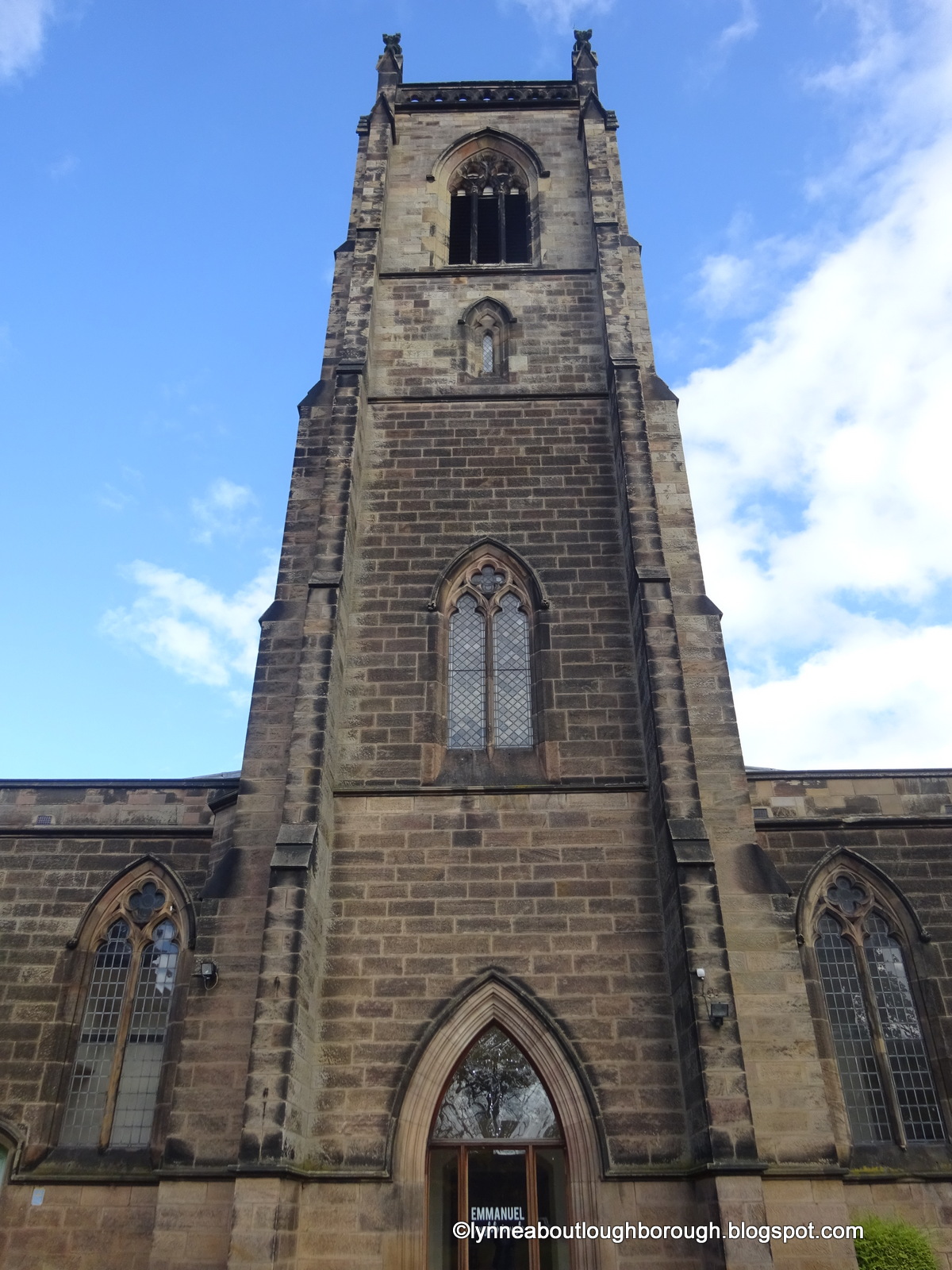
Showing posts with label Emmanuel Church. Show all posts

Thursday, 31 August 2023

Mary Tate

I remember turning out one cold and wet winter evening in 2016 to attend a book launch at Donnington Hall for a Victoria County History Book about Castle Donnington! It was a lovely event, and the authors each gave a short speech. One of those authors was Pam, which was how I came to meet her. Since then, it won't surprise you to know that our paths have frequently crossed at heritage events and talks, and we often find our areas of interest and research overlap! In her guest post, which is the last article in a series specifically celebrating the 10th anniversary of the blog, Pam tells us the story of Mary Tate, a notable inhabitant of Burleigh Hall. Read on to find out why ...

Mary Tate

By Pamela J. Fisher

Writing to the Ecclesiastical Commissioners in 1849 about the new church and benefice of Thorpe Acre, the Bishop of Peterborough wrote of Miss Mary Tate: ‘Her exertions, to use the expression in the neighbourhood, hav[e] been the very “making of the place”’. It was not just Thorpe Acre that benefited from her ‘exertions’: Mary Tate also provided two schools in Loughborough, assisted a third, made a substantial contribution towards the cost of building Emmanuel Church, provided food for the poor of Loughborough and left money in her will to Loughborough Dispensary.

Mary was the life tenant of her family property, Burleigh Hall, a country house in substantial grounds, the site of which now forms part of Loughborough University campus. She was born on 20 December 1775 and was the only child of George Tate and his wife Bridget Moore (née Ford), who had married on 9 March that year in St George’s church, Hanover Square in the city of Westminster. George was of that parish and Bridget was from the parish of St James, Westminster. Mary was baptised at St George’s church, Hanover Square on 14 February 1776.

Members of the Tate family had been at Burleigh since at least 1705. Mary inherited her life interest from her father in 1822, but she was not a direct descendant of ‘Henry Tate of Burleigh’, the owner of the Hall and Park who had died in 1722. A hint of her family’s extensive landholdings is given in the parish register of Mitcham, Surrey when her father was buried there on 25 May 1822, aged 76: ‘George Tate Esq from Southampton, Hants, of Burleigh House near Loughborough’. The mention of Southampton is a reference to another family property, Langdown House in Dibden and Hythe, near Southampton Water, which is believed to have been built for George in 1797. It was demolished in the 1960s, but a painting shows a substantial property standing in large landscaped grounds. 

George also owned at least one property in London and another in Mitcham, and the latter place was clearly dear to the family, as both George and Mary in their wills asked to be buried at Mitcham, where there was a family vault. Mary paid for a wall monument to her father’s memory in St Peter and St Paul church in Mitcham, which had then just been rebuilt, and this joined several other family monuments that had been carefully moved from the old church to the new one.

Burleigh Hall was acquired by Mary’s grandfather Benjamin (George’s father) through his second marriage in 1765 to his cousin, Mary Herbert (née Tate). Mary Herbert had inherited Burleigh as the granddaughter of Anthony Tate, the brother of the Henry who died in 1722. Benjamin was the grandson of Henry and Anthony’s younger brother William.

We don’t know how the Mary Tate we are concerned with here was educated, or how frequently she visited Burleigh. She was 46 and unmarried when her father died in 1822. She had inherited land and property in Mitcham and shares in six canal companies in 1821, on the death of her uncle (George’s younger brother), the Rev. Dr Benjamin Tate. On her father’s death the following year she received a life interest in Burleigh Hall and Park, in other land in Loughborough and Woodthorpe, in properties in Chelsea, Brompton and within Middlesex (including Grosvenor Place) and was left outright ownership of Langdown House, other land and properties in Dibden and Fawley in Hampshire, all of George Tate’s bank stock, his household goods and £30,000 in bank annuities ‘to do with as she pleases’.

As well as erecting the monument mentioned in Mitcham church in memory of her father, Mary also commissioned Sir Richard Westmacott RA to provide a memorial for All Saints’ church in Loughborough, where it can be seen today on the south wall of the chancel. Westmacott was one of the leading sculptors of his age, and had provided two of the wall monuments to other family members in Mitcham church. For this commission he produced a figure of a kneeling angel in classical robes, holding a sickle to cut surrounding sheaves of corn.

Wall-mounted memorial depicting a kneeling angel with outstretched wings, with inscription below
Memorial to members of the Tate family by Sir Richard Westmacott RA in the chancel of All Saints’ church

The inscription remembers ‘with the deepest sense of gratitude and with the tenderest impressions’, her grandfather Benjamin Tate (died 13 January 1790), his wife Martha (died 29 December 1760), their four children who reached adulthood, George (Mary’s father, died 15 May 1822), the Rev. Dr Benjamin (died 22 November 1820), Martha (died 6 December 1793) and Sophia (died 1 April 1780), and also Mary, Benjamin’s second wife, who had inherited Burleigh from her parents (died 24 May 1798).

A series of letters written by ‘our’ Mary Tate survives from 1844–5, when she was dividing her time between three properties, Burleigh Hall, Grosvenor Place in London and Langdown House in Hampshire. Her time in Leicestershire had been sufficient for her to become well acquainted with William Herrick of Beaumanor Hall and his family, and she turned to him for advice in the 1840s. She was then managing a large estate, and appears to have been doing so very capably, but as a woman she probably faced discrimination in some of her dealings, and he may have provided support on business and legal matters.

Mary extended the Burleigh estate a little by purchasing a neighbouring piece of land, and also improved her estate in Fawley, Hampshire by exchanging with Southampton Corporation parcels of land in other parts of Hampshire for land in Fawley. The latter suggests astute land management and confidence in her business dealings.

Mary was a devout Anglican, and spent large sums in charitable works and the establishment of new churches. In Mitcham, she demolished the property she had inherited from her uncle and built almshouses for 12 poor women on the site, which opened in 1829. In Dibden, near her Hampshire home, she gave money to a school for poor children. Her closest affections seem to have been for Loughborough and the neighbourhood of Burleigh, where the majority of her philanthropy was directed, and especially from the 1830s in Emmanuel parish, Loughborough and Thorpe Acre.

She began an infant school In Loughborough in a building in the yard of the Boot Inn, Fishpool Head (later known as Cattle Market) and by 1836 had rented two other buildings from John Paget, also for use as infant schools, which in that year were teaching 180 boys and 100 girls. These would have been a huge boon to the town, helping married women to obtain work, for example in the local hosiery industry. After Loughborough’s rector, the Rev. William Holme, built a boys’ school at Wards End attached to the new church of Emmanuel, Mary Tate built a girls’ school for Emmanuel on Bedford Square (the building survives as part of the retailer Bed City), endowed it with income of £54 annually towards the payment of salaries and other expenses, and gave a further endowment worth £30 annually to Emmanuel boys’ school. 

A bed shop in an old building
The former Emmanuel Girls’ school on Bedford Square

She gave £500 towards the building of Emmanuel church, alongside £1,000 from the Rev. William Holme and £1,000 from Emmanuel College, Cambridge (patron of All Saints’ church and soon-to-be patron of Emmanuel church). These donations were sufficient to leverage £2,143 from the Commissioners for the Building of New Churches and £500 from the Incorporated Society for Promoting the Enlargement, Building and Repairing of Churches and Chapels, which together enabled Thomas Rickman to be commissioned to design the church, and Rickman’s favoured contractor, John Bennett of Birmingham, to be employed in building it. Emmanuel Church opened in 1837. 

A church on a roadside
Emmanuel Church on Forest Road, built 1835–7

The comment that opened this post, by the Bishop of Peterborough in 1849 (Leicestershire was then within Peterborough diocese), relates to the building and endowment of Thorpe Acre church and its ministry. Thorpe Acre was then a small rural village with a population of 298 in 1841 (it is close to 20,000 today). There was no church in the village, but there was a weekly Sunday service in the medieval chapel at Dishley, a much smaller village c.¾ mile away. Dishley chapel was a donative – a church that was owned by an individual. In this case it had originally belonged to Garendon abbey and had passed into lay hands at the dissolution of the monasteries. Donative churches lay outside ecclesiastical jurisdiction: the family of the owner could choose and pay a minster, and refuse entry to anyone. Dishley chapel was the property of Charles March Phillipps of Garendon, and weekly Sunday services there were conducted by his brother, the Rev. Edward Thomas March Phillipps, vicar of Hathern. A copy of a printed circular now held in Lambeth Palace library shows that there were concerns in the early 1840s for the continuation of Anglican worship in Dishley chapel over the long term as Ambrose March Phillipps, the eldest son and heir of its owner, had converted to Roman Catholicism and was ‘full of zeal for the faith’ (he was employing a priest who was trying to convert local people). The ‘solution’ suggested, and supported by the Rev. E.T.M. Phillipps, was to build an Anglican church in Thorpe Acre, with its own minister.

An appeal was launched for funds to buy land, build a church and parsonage house in Thorpe Acre and provide an income for an incumbent. One account says Miss Tate was the principal donor towards the building of the church, but the amount she gave is not recorded. She donated £1,000 to the Ecclesiastical Commissioners towards an endowment to provide a minister’s salary, gave £500 for the parsonage house and established a fund for church repairs. Her £1,000 gift was the statutory sum that would enable Mary and her heirs to nominate the vicar at each vacancy, but she realised that this sum was insufficient to provide a decent clerical living, and that it could be bolstered by funds from the Ecclesiastical Commissioners at no extra cost to herself if she agreed that the incumbents would always be chosen by some ‘public body’. She therefore specified that the advowson (the right to nominate the minister) was to rest with the bishop of the diocese, but at the same time made a private agreement with the Bishop of Peterborough that she could choose the first appointee. It seems that her first, and possibly second, choice declined the appointment, but the Rev. John Bridges Ottley, a Fellow of Oriel College, Oxford accepted the position. Mary had met him 20 years before, when he was a curate at Dibden (Hampshire).

With a minister in place, Mary consulted him on the location of the parsonage, agreed an alternative site when he rejected the land already purchased for this purpose, and arranged for him to brief the church architect, William Railton, on the specification of the house he wanted. Ottley had a wife and daughter, servants and a private pupil who was boarding with the family, and a large house with three reception rooms and seven bedrooms was built. (This house has since been demolished and replaced by a smaller vicarage on a new site.) Mary Tate also told the bishop in confidence that she would ensure Mr Ottley received a stipend of £150 p.a., although she would not provide an endowment to pay that sum until the Ecclesiastical Commissioners (who then had no funds for augmenting livings) had added to the £1,000 she had already provided. To this end she set up a separate trust, endowing it with bank stock that would provide £120 annually above the sum that her endowment to the Ecclesiastical Commissioners would provide.

Thorpe Acre church was consecrated and opened on 30 September 1845. 

A church built in 1845 showing both the original part and the 1986 extension
All Saints’ church, Thorpe Acre. The original nave/chancel to the right of this image was extended to the south (and also to the west and north) in 1986, trebling the number of seats. The tip of the original western bellcote is just visible.

Other less prominent acts of philanthropy, of no less importance to the beneficiaries, included weekly gifts of meat to 200 poor families each winter and setting up ‘an establishment in which young women were taught washing’, helping them to earn money to lift them out of poverty.

Mary Tate died at Burleigh Hall on 15 March 1849, aged 73, the last of this Tate lineage. In accordance with her wishes, her body was taken to Mitcham, where she was buried on 22 March. Her charitable wishes continued to the end, with bequests in her will of £500 to each of four medical establishments, including Loughborough Dispensary and Leicester Infirmary. She also left £200 to the Rev. Ottley, the first incumbent of All Saints’ church, Thorpe Acre. Burleigh House passed under the terms of George Tate’s will to a cousin, Louisa Pinfold, who took the surname Tate, as George had desired. Louisa Pinfold Tate gave stained glass for the east window of Emmanuel church in 1851 in memory of Mary.

Before her death, Mary had settled her properties in Surrey on her half-brother Richard Moore (her mother’s son by Bridget’s first marriage to Blunsden Moore). By her will she left Langdown House to one of Richard’s children, Charlotte Selina Hobart (née Moore) and £30,000 to be divided equally between three other children of Richard, Mary Bridget, Mary Jane and Edmund. She does not appear to have been close to her cousin Louisa, as to raise the cash to settle her many personal bequests she instructed her executors to sell the land she had purchased on the edge of the Burleigh Estate, after giving Louisa the option of buying it before it went on the market.

Mary Tate has largely been forgotten today, yet she was a remarkable woman, especially for her time, and one of Loughborough’s and Thorpe Acre’s major benefactors.

Pamela J Fisher

____________________________________

Sources

Primary Sources

The National Archives, letter of wishes for Benjamin Tate (PROB 11/1190/8); wills for Edward Butler (father of Mary Herbert, PROB/ 11/742/486); the Rev. Dr Benjamin Tate (PROB 11/1637/245); George Tate (PROB 11/1658/44); Henry Tate (PROB 11/588/390); Lucy widow of Henry Tate (PROB 11/591/485); Mary wife of Benjamin Tate (PROB 11/1309/3); Mary Tate (PROB 11/2093/364); and others from this family, of less direct relevance to this article; 1851 census HO 107/2085/373.

Lambeth Palace Library, Emmanuel Church: CBC/7/1/4; ICBS 1701; ICBS MB7.

Lambeth Palace Library, Thorpe Acre Church: CC/OF/NB19/54; ECE/7/1/6676/1; ICBS 3319; ICBS MB12; QAB/7/3/F1442.

The Record Office for Leicestershire, Leicester and Rutland: DE884 (deeds Burleigh); DG9/2249 (Letters re Burleigh and Thorpe Acre); DG9/2556/1–39 (letters re Thorpe Acre church).

Parish registers (through FindMyPast), St George, Hanover Square; Mitcham, and others.

Commissioners for Building New Churches, Annual Reports, 1836, 1837

J.H. Chapman, The Register Book of Marriages belonging to the parish of St George Hanover Square in the County of Middlesex (Harleian Society, London, 1886).


Newspapers (through British Newspaper Archive)

Hampshire Advertiser, 29 Nov. 1834.

Leic. Jnl. 17 Oct. 1845; 16 Jan. 1852.

Leics Merc., 24 Mar. 1849.

Northampton Merc., 4 Oct. 1845.

Nottingham Review, 4 Mar. 1836; 3 Oct. 1845.


Secondary Sources

N. Pevsner (rev. E. Williamson), Buildings of England: Leics and Rutl.

M.H. Port, Six Hundred New Churches: The Church Building Commission, 1818–1856 (Reading, 2006)

VCH Hants. IV, Dibden

VCH Leics. III, Table of population

White, Hist., Gaz. and Dir. of Leics. and Rutl. (Sheffield, 1863)

Websites (all accessed 17 July 2023)

http://research.hgt.org.uk/item/langdown-house/

https://collections.hampshireculture.org.uk/object/painting-watercolour-langdown-house-and-garden-langdown-hythe-and-dibden-hampshire-louise-c;

http://www.speel.me.uk/chlondon/mitchamch.htm

http://www.croydonalmshouses.org.uk/our-history.html

____________________________________

About Pamela Fisher

Dr Pamela Fisher works with Leicestershire Victoria County History Trust and is currently researching a social and cultural history of Loughborough since 1750. This will include a history of the schools, churches and other places of worship in Loughborough (including Thorpe Acre and Nanpantan) and will be published as a paperback book as part of the national Victoria County History series of books. Other topics and periods will follow, to eventually become a full history of Loughborough from the earliest settlement in the town to the 21st century. You can follow progress on Twitter and Facebook (@LeicsVCHT) or make contact through their website https://leicestershirehistory.co.uk/ to be added to their mailing list for Newsletters and updates. 

____________________________________

Posted by lynneaboutloughborough

With apologies for typos which are all mine!

_______________________________________________

Thank you for reading this blog.

Copyright:

The copyright © of all content on this blog rests with me, or in the case of guest blogposts, with the named Guest Blogger. However, you are welcome to quote passages from any of my posts, with appropriate credit. The correct citation for this looks as follows:

Fisher, Pamela J. (2023). Mary Tate. Available from: https://lynneaboutloughborough.blogspot.com/2023/08/mary-tate.html  [Accessed 31 August 2023]

Take down policy:

I post no pictures that are not my own, unless I have express permission so to do. All text is my own, and not copied from any other information sources, printed or electronic, unless identified and credited as such. If you find I have posted something in contravention of these statements, or if there are photographs of you which you would prefer not to be here, please contact me at the address listed on the About Me page, and I will remove these.

Blog archive and tags:

If you are viewing this blog in mobile format, you will not be able to easily access the blog archive, or the clickable links to various topics. These can be accessed if you scroll to the bottom of the page, and click 'View Web Version'. Alternatively, there is also a complete list of posts, which when clicked will take you to the page you are interested in.

Searching the blog:

You can search the blog using the dedicated search box that appears near the top of the blog when viewed in the web version. Alternatively, you can search using your usual search engine (e.g. Bing, Google, DuckDuckGo etc.) by following this example:

site: https://lynneaboutloughborough.blogspot.com/ “Radmoor House”

NOTE – the words you’re actually looking for must be in “” and the first of these must be preceded by a space

Thank you for reading this blog.

Lynne

Sunday, 11 June 2023

Building Stone

Sadly, I missed a recent talk hosted by the Friends of Charnwood Museum, about stone, so, I had a look back over the blog to see what I’d already written. I must admit, I thought I’d done a piece on Coade stone, an artificial stone, but find I haven’t so I’ve only mentioned it in passing in some posts, like [quote blog posts]. So, let’s have a quick look at some real local stone, and where it’s been used.

Old Rectory, Rectory Place

The 13th-century building was once the home to the rectors of Loughborough, having been passed to the church around 1228 by the Cortlinstoke family. By the time it fell out of use, around 1959, it had been extended enormously, and would have been a substantial family home, however, once unoccupied the building fell into disrepair and was partially demolished, revealing its earlier core, which has been retained.

The building you now see is said to be made of Bromsgrove Sandstone; North Charnwood Diorite; Charnian (volcaniclastic breccia); Charnian (volcaniclastic sandstone); Swithland slate; and Charnian (banded tuff).


All Saints with Holy Trinity, Steeple Row

This church is a 14th century building, probably built on the site of an earlier church, and it is here that the rectors of Loughborough would have done most of their work. over the years the church has been subject to many alterations, most notably that by architect Sir George Gilbert Scott in the mid-19th century. 20th and 21st century renovations have included those to the pinnacles on the belltower, and various new stones in the fabric of the building. I've written more extensively on a very early blogpost.

Stone that has been used in the construction of the church includes Millstone Grit; Triassic Red Sandstone; North Charnwood Diorite; Upper Lincolnshire Limestone; Charnian (metasediments0; Swithland slate, and Mountsorrel Granodiorite.


Holy Trinity Church, Moor Lane 

This church is no longer a religious building, but was once a busy church serving the Leicester Road area of Loughborough, opened in 1878, to a design by William Arthur Blomfield. You can find out a bit more about its history on an earlier blogpost.

The range of natural stone used in the construction of the church is much less varied than the Old Rectory and Loughborough’s All Saints church, comprising only of Mountsorrel Granodiorite and Upper Lincolnshire Limestone.


Emmanuel Church, Forest Road

The church was created around 1838, and its first rector was William Holme, who was also Rector of All Saints. The first Rector dedicated solely to Emmanuel was Reverend Bunch, who lived at the Emmanuel Rectory, on Forest Road, close to Mountfields House.  

I’ve not written much about Emmanuel church, but have done a couple of posts about the associated rectory. Part 1 and Part 2 

It appears that Emmanuel Church is constructed solely of Millstone Grit, but has a much later extension using other stone.


St Mary’s Nanpantan

St Mary’s church in Nanpantan started life as a Mission Hall, created by the Warner family of Nanpantan Hall, in 1888. Since 2015, St Mary’s has been a parish in its own right, so no longer connected to Emmanuel.

Using Charnian (volcaniclastic sandstone), St Mary’s is another church which is constructed only from one stone, that is until the 1960s when a granite Chapter House, with a flat-roofed vestry was built.


All Saints Thorpe Acre

This particular church is more usually known as Thorpe Acre church, and was built in 1845 to a design by William Railton, who was the architect responsible for the design of Nelson’s Column in London, and a number of other local Leicestershire churches. I've written extensively about Railton - here's one example post. The church, which replaced All Saints at Dishley (see below), is proud to have an east window, created in 1892 by Charles Eamer Kempe, and in the 1980s, the church was extended and joined to the school house.

All Saints, Thorpe Acre, was constructed using only Millstone Grit, until the extension was built.


All Saints Dishley

Dishley church is now a ruin, having been deconsecrated when All Saints Thorpe Acre was created in 1845. The ruins, which contain plaques to the agriculturalist, Robert Bakewell, are close to Dishley Grange Farm, which was part of the Garendon Estate.

The stone used in the construction of All Saints at Dishley includes Charnian (volcaniclastic sandstone); Diseworth Sandstone; Charnian (igneous); Triassic Red Sandstone; Cobbles (Bunter), and Bromsgrove Sandstone.  


_______________________________________________

posted by lynneaboutloughborough

With apologies for typos which are all mine!

_______________________________________________

Thank you for reading this blog.

Copyright:

The copyright © of all content on this blog rests with me, however, you are welcome to quote passages from any of my posts, with appropriate credit. The correct citation for this looks as follows:

Dyer, Lynne (2023). Building Stone. Available from: https://lynneaboutloughborough.blogspot.com/2023/06/building-stone.html [Accessed 11 June 2023]

Take down policy:

I post no pictures that are not my own, unless I have express permission so to do. All text is my own, and not copied from any other information sources, printed or electronic, unless identified and credited as such. If you find I have posted something in contravention of these statements, or if there are photographs of you which you would prefer not to be here, please contact me at the address listed on the About Me page, and I will remove these.

Blog archive and tags:

If you are viewing this blog in mobile format, you will not be able to easily access the blog archive, or the clickable links to various topics. These can be accessed if you scroll to the bottom of the page, and click 'View Web Version'. Alternatively, there is also a complete list of posts, which when clicked will take you to the page you are interested in.

Searching the blog:

You can search the blog using the dedicated search box that appears near the top of the blog when viewed in the web version. Alternatively, you can search using your usual search engine (e.g. Bing, Google, DuckDuckGo etc.) by following this example:

site: https://lynneaboutloughborough.blogspot.com/ “Radmoor House”

NOTE – the words you’re actually looking for must be in “” and the first of these must be preceded by a space

Thank you for reading this blog.

Lynne


Monday, 27 June 2022

Loughborough Carillon and Carilloneurs Part 1

So, the month of June seems to have been a lot about the Carillon, and related things! Earlier in the month, I took the opportunity to climb the Carillon tower, and look out over Queen's Park, over Loughborough, over to Beacon Hill and the Outwoods, to the Leicestershire Wolds, and even over to East Midlands airport! I've been up the tower many times over the years, and I've taken photos of the views from many of Loughborough's taller places and from the town's rooftops, but here are some photos from my latest tower climb - simply in the order in which I took them!

Looking towards the Leicestershire Wolds, with parish church tower

View of the bandstand looking towards Granby Street

The roof of Charnwood Museum, centre

Looking towards the university, Towers Hall of residence to the rear left, Beacon Hill in distance

Looking along possibly Arthur Street and Curzon Street

Gardens on Arthur Street and Curzon Street, with cars parked along Burleigh Road (or York Road)

Cars probably on Burleigh Road, catholic church on Ashby Road on the left

Emmanuel Church, and the leisure centre rooftop!

Park Road to the right, and convent buildings centre and left

Premiere Inn (white), convent far right

Looking across to Granby Street car park and bowling green (Premiere Inn is the white building)

Rear of mill buildings off Ward's End / Devonshire Square


The cupola atop the public library

The Charnwood Museum in Queen's Park

Ratcliffe-on-Soar power station in the distance

You are welcome to quote passages from any of my posts, with appropriate credit. The correct citation for this looks as follows:

Dyer, Lynne (2022). Loughborough Carillon and Carilloneurs: Part 1. Available from: https://lynneaboutloughborough.blogspot.com/2022/06/httpslynneaboutloughborough.blogspot.com202206loughborough-carillon-and-carilloneurs-part-1.html [Accessed 27 June 2022]

Take down policy:
I post no pictures that are not my own, unless I have express permission so to do. All text is my own, and not copied from any other information sources, printed or electronic, unless identified and credited as such. If you find I have posted something in contravention of these statements, or if there are photographs of you which you would prefer not to be here, please contact me at the address listed on the About Me page, and I will remove these.
Thank you for reading this blog. 

Lynne

Friday, 4 December 2020

Spotlight on Glebe House

Nestled between a primary school, the former home of Loughborough’s first mayor, and close to a university hall of residence, on what is affectionately known as the Forest Green Belt, Glebe House will be a name well known to those who are familiar with Loughborough. For many years the property was home to the Glebe House project, being used by Loughborough MENCAP from about 1982 until 2010. 

Glebe House

But what of the building before this, and what afterwards? And what exactly does this have to do with no.57 Forest Road - now part of a student property, but once part of the Forest Rise Hotel - and an unassuming mid-twentieth century property, no.47 Forest Road?

Rev. William Holme, who was Rector of Loughborough, initiated the dividing of Loughborough from one large parish, served by the church of All Saints, into two parishes. As a result of this, the building of Emmanuel church began in 1835, and was completed by 1837, with the service of dedication being held on 4 September 1837. At this time (and until 1839) Loughborough was in the diocese of Lincoln.

As Rev. Holme was the rector of the whole of Loughborough, he resided at the Rectory in Rectory Road, practically adjacent to the church of All Saints. When the reverend died in 1848, a new rector for Loughborough (i.e. the parish of All Saints) was appointed, as was a rector for the relatively new parish of Emmanuel.

The Old Rectory on Rectory Road, home to the Rector of All Saints


Rev. Robert James Bunch arrived in Loughborough in 1848, and in June of that year Rev. Bunch married Mary Anne Cooper, daughter of the Rev. B. Cooper, Rector of Lewcombe in Dorset, at Christ Church, St Pancras.

On the 1851 census, Rev. Bunch and his wife are listed at The Grove on Ashby Road, the family home of the banking dynasty of Middleton. 

The Grove, Ashby Road

However, also in 1851 the new rectory for the Emmanuel church was completed at a cost of around £2,000 to build. Apparently this new rectory was designed to be similar to the vicarage in Yetminster, Dorset, as both Mrs Bunch’s grandfather and father had been the vicar there. What emerged was a beautiful red-brick Victorian Gothic rectory, which today appears on the register of Locally Listed Buildings.  

During the time that Rev. Bunch and his family were living at the rectory, in October 1869 there were a series of about nine fires, deliberately set alight, all in a straight line and within a quarter of a mile of each other. According to a newspaper report, “On the right, and very near to Emmanuel Rectory, the residence of the Rev. R.J. Bunch, a haystack, the produce of six acres, belonging to Mr Robert Handley, was being consumed.” The perpetrator of the crime had given himself up and confessed to the police.

On 19 June 1870, Rev. Bunch died, and in August 1870 the auction house on Baxter Gate were auctioning valuable furniture and contents from the rectory, including 700-800 volumes of books. Bunch’s position as rector was filled by Rev. Octavius Glover, a bachelor who lived in the rectory with his four servants. Rev. Glover retired from his position as rector of Emmanuel in 1904, and died in Torquay the following year. Oddly, in August of 1904 the auction house of Garton and Amatt on Baxter Gate was again auctioning furniture etc. from the Emmanuel Rectory.

The former offices of auctioneers, Garton and Amatt

It was in September of 1904, following the retirement of Rev. Glover, that the Rev. Richard H. Fuller first appeared to preach at Emmanuel church. He and his family lived at the Rectory, but there were a number of things about the building which worried him: the house wasn’t connected to the local water supply, instead relying on water drawn from a well, and the sewerage system was not up to scratch either, nor did Rev. Fuller appreciate the necessity for employing a large number of servants! In March 1907, Mr Beeby, a 24-year old gardener with 2.5 years’ experience was advertising that he was looking for a position elsewhere: the address given in the advert was the Emmanuel Rectory Loughborough, and it appeared in the Stamford Mercury.  

Rev. Fuller continued to live at the rectory until about 1920. During the period from 1904 – 1920, there were many newsworthy things happening. 

In 1908 there was an extensive report in the newspaper about one of the many fetes and sales of work that were held in the rectory grounds. Apart from giving everyone the chance to have fun, the aim of the fete was to raise funds to improve and extend the church. Although the rain fell, and people got bogged down in the garden, the event went well, and funds were, indeed, raised.

In 1911 Mr Amatt was auctioning, amongst other things, a plot of freehold building land on Forest Road, previously belonging to Mrs S.J. Crosher. The plot was currently occupied by Mr Scott, and was subject to Land Tax and a Tithe Rent of 14s. 6d. payable to the Rector of Emmanuel. The plot had a frontage of 90 feet onto Forest Road, and was of 1,036 square feet.

In March 1914 the ‘Loughborough Echo’ reported that a nest of thrushes were hatched in the Emmanuel Rectory garden. And in September that same year an appeal was put out by H. Sabina Fuller [sic] of Emmanuel Rectory for people to knit socks for soldiers, as the War Office allowance was only three pairs.

A couple of years later, in March 1916 a young person was charged with stealing a cycle lamp used by Miss Fuller, and belonging to Rev R.H.  Fuller of Emmanuel Rectory and worth 6s. 6d.. This was taken in October 1915 from outside Rosebery School, while Miss Fuller was attending a nursing class. 

In August 1917 ‘The Tatler’ carried the announcement of the marriage between Miss Cecil Sabrina Fuller, the only daughter of Rev R.H. Fuller and his wife, with Mr Maurice Woolley.

In 1920, Emmanuel Church bought a smaller property, on Forest Road, as a home for the rector. This house, at no.57, was a semi-detached Victorian red-brick villa, which has more recently been the left-hand half of the Forest Rise Hotel, now student accommodation. At the time of purchase, the house was just over £4,500, and despite being smaller than the original rectory, still had six bedrooms!

These two semi-detached properties, nos.55 (right) & 57 (left), have been merged

Perhaps it was at this time that the 1851 rectory became known as Glebe House, to make it more easily differentiated from the new rectory?

Let’s very quickly look at successive rectors and their homes …

Rev. Fuller moved on in 1923 to become rector of North Luffenham in Rutland, and Rev. Douglas A. Robson took over from him. Rev. Robson came from Par in Cornwall, and when he moved on in 1939, it was to South Kilworth in Leicestershire. Rev. Harold Marley took over in 1939, coming from Sedgley, and moving to be rector of Thorpe Morieux in Suffolk.

Rev. Lancelot Edgell Dashwood became Rector of Emmanuel in 1951, following on from Rev. Marley. His immediately previous position was as vicar of Hugglescote and he retired in 1961 to Hothfield in Kent. It was during Rev. Dashwood’s incumbency, in 1953-54, that the current rectory, no.47 Forest Road was built and became home to future rectors.

No.47 Forest Road

The rector from 1961-1969 was Rev. Alfred Reginald Meakin, who came to Loughborough from the position of Rector of Appleby Magna. ‘Rex’ as he was known, retired to Dorset in 1969, and his shoes were filled in 1970 by Rev. Ian D. Campbell, who, in 1980 moved on to become vicar of All Saints in Leamington Spa. Coming from Thorpe Arnold, near Melton Mowbray, Michael T.H. Banks became Rector of Emmanuel in 1980. Rev. Banks was followed by Rev. David Newman, who left Emmanuel in 2009 to become Warden at Launde Abbey, and he was followed in the role at Emmanuel by Rev. Michael Broadley, who remains as rector today, and resides at no.47.

So, now we’ve seen where the rector resides after 1920, wouldn’t it be interesting to know what happens to ‘Glebe House’ once the rector moves out?

Find out in the next post!!!

You are welcome to quote passages from any of my posts, with appropriate credit. The correct citation for this looks as follow:

Dyer, Lynne (2020). Spotlight on Glebe House. Available fromhttps://lynneaboutloughborough.blogspot.com/2020/11/spotlight-on-glebe-house.html [Accessed 6 December 2020]

Take down policy:
I post no pictures that are not my own, unless I have express permission so to do. All text is my own, and not copied from any other information sources, printed or electronic, unless identified and credited as such. If you find I have posted something in contravention of these statements, or if there are photographs of you which you would prefer not to be here, please contact me at the address listed on the About Me page, and I will remove these.
You can leave comments below, but do check back as my reply will appear here, below your comment.

Thank you for reading this blog. 
Lynne                     

Sunday, 7 June 2020

Death and funeral of Reverend Henry Fearon


Reverend Henry Fearon: on the 135th anniversary of his death and funeral


On Friday 12 June, 1885 (1), at the age of 82 (2), and only 8 days off his 83rd birthday, the Reverend Henry Fearon, Rector of Loughborough, and Archdeacon of Leicester, passed away. Fearon had retired from the archdeaconry in early April, 1884, due to failing health, but had been granted permission by the Bishop of Peterborough to retain the title of archdeacon. Reverend Fearon had been in declining health for some time, and had refrained from taking part in the services of the church for several months. The final two months of his life were spent confined to his bed, under the care of Dr Eddowes (3) right up until the time of his death.


The living at Loughborough, which became vacant upon the death of Fearon, was variously described as being valued at anything from £800, through £988 to over £1,000 per year, a substantial amount, and probably one of the highest in the country at the time. It was not until the beginning of August 1885, that a successor to Fearon was appointed, when Reverend Thomas Pitts, MA and Fellow of Emmanuel College, Cambridge, accepted the living of Loughborough. Reverend Pitts had previously been a master of the Haileybury School, an independent school in Hertfordshire. By contrast, the Bishop of Peterborough was quick to confer the 8th Honorary Canonry on Reverend John Martyn Collyns, MA, and Rector of Daventry, and Reverend Collyns was installed at a service on the afternoon of Saturday 27 June 1885. Reverend Canon Assheton Pownell, MA, and graduate of Brasenose College Oxford, and Rector of South Kilworth, had been appointed to the archdeaconry of Leicester immediately upon Fearon’s resignation in April 1884.

Fearon’s death was reported widely in the press of the day (4). He was variously described as a most learned and courteous divine, and a moderate Liberal. Some newspapers reported on the admirable and kindly manner in which he performed his important duties, and how he gained the respect and esteem of the community of Loughborough. It was also said that one couldn’t over-estimate the value of his dedication to the cause of education, and his unfailing interest in the welfare of the working classes. During his time as rector, the church of All Saints had been improved, the ecclesiastical affairs of the parish had been developed, and all in a quiet and unostentatious manner. Fearon was reported to be earnest, making practical efforts to improve the condition of those around him, and a striking feature of his life was the charitable way in which he treated those of differing religious beliefs to his own.


Reverend Fearon’s funeral took place on Friday 19 June, the service being held at All Saints church, and the burial at the town cemetery on Leicester Road. The ceremony itself was simple, and the whole day was declared a day of mourning. Most of the shops in the town centre closed just before the time of the funeral, and even the blinds of private houses were drawn. All the town factories were closed for several hours so that the workers could pay their last respects to Reverend Fearon: as such thousands of townsfolk were able to attend the funeral or line the route of the funeral procession. The bells of All Saints, Holy Trinity church and Emmanuel church were tolled, and the flag on the tower of the Grammar School was mounted at half-mast.


The funeral procession was extensive, comprising both relatives and friends of Fearon; both clergy from the archdeaconry and non-conformist ministers from Loughborough; representatives from different public bodies and tenants of the reverend. In fact, so extensive was the procession that entry to the church service at All Saints was by ticket only. The cortege arrived at the church just before 2.30 on the afternoon of Friday 19 June, where, on entering through the west door, it was met by the sounds of a combined choir of over 80 voices from All Saints, Holy Trinity church and Emmanuel church, singing ‘When our heads are bowed with woe’.


Members of the congregation who were not part of the procession had been seated for over an hour before the procession entered the church. Once everyone was seated, the, which was taken by the Reverend James Mountain, the curate of All Saints, began. The lesson was read by Reverend L.L. Cooper of St John’s church in Leicester, and Dr Briggs, the organist at All Saints, brought the service to a close with a rendition of ‘Dead march’ from Handel’s Oratorio, ‘Saul’ (5).  


The funeral procession then made its way to the cemetery on Leicester Road, led by the sexton, Mr T. Grundy. Leaving the church at about 3pm, the procession went down Church Gate, passed the edge of Market Place, then along High Street and up Leicester Road to the cemetery, passing hundreds of mourners along its way. The whole journey of just under a mile-and-a half took about an hour to reach its destination. The massed choir sang ‘Jesus lives no longer now’ as the procession entered the cemetery gates, and did so also at the graveside. The service at the graveside was read first by the Reverend J. B. N. Woodroffe, followed by the Reverend Mountain, and the benediction was pronounced by the Venerable Archdeacon Lightfoot. The grave was layered with dark leaves, a cross of white flowers, and circles of daisies, and on the ledges were white blossoms fringed with ferns. The locally made oak coffin, with brass fittings and an inscribed brass plate, was covered in wreaths and crosses.

On the Sunday following Reverend Fearon’s funeral, a funeral service was held at All Saints, the sermon being preached by Reverend Lewis Clayton of St Margaret’s church in Leicester, assisted by Reverend Mountain and the Reverend R. H. Parsons. The chosen text read from the bible, was from the 9th verse of the 4th chapter of Phillippians, which was chosen for its appropriateness to the situation in Loughborough, and for its obvious application to the Reverend Fearon, a man who most certainly practised what he preached, and a man who was always ready to forgive. Later that same evening, the Reverend Martin preached to another large congregation, whilst the Reverend E. Bell held a special service at Holy Trinity church, and reference was made to the funeral of the Reverend Fearon at Emmanuel and other churches across the town.


Post-Script Further details of the life of the Reverend Henry Fearon can be found elsewhere on this blog, as can memories of happy times for the Reverend Fearon. 

Footnotes

(1) Newspaper reports of the time vary widely in their statements about the date of Reverend Fearon’s death: some quoted 7.50 on the evening of Thursday 11 June, others Friday 12 June and yet others Saturday 13 June. Friday 12 June is the date recorded in the probate record.

(2) Again, newspaper reports of the time claim the Reverend Fearon was 82, 83, 85 or even 89 at the time of his death. His birth is recorded as 20 June 1802, and he was baptised on 8 September 1802.

(3) I am unclear which Dr Eddowes was attending Reverend Fearon: this could have been John Henry (jun.) or his brother, Arthur Benjamin Jackson Eddowes. 

(4) The report of the funeral and burial of Fearon which appeared in the ‘Nottinghamshire Guardian’ of 26 June 1885, was ironically immediately followed by an article describing the opening of a new reservoir at Park Row, Nottingham, which cost around £12,000, the reservoir being capable of holding 2.25 gallons. In 1870 Fearon had been instrumental in providing Loughborough with a clean supply of fresh water from Nanpantan Reservoir, and presented the town with the Fearon Fountain, which, along with the more recent ‘Sockman’ is an iconic feature of Loughborough’s Market Place.

(5) The librettist who wrote 'Saul' was Charles Jennens, from Gopsall Hall, in Leicestershire, with whom Handel had a close friendship, and whom he visited often. 

You are welcome to quote passages from any of my posts, with appropriate credit. The correct citation for this looks as follow:

Dyer, Lynne (2020). Death and funeral of Reverend Henry Fearon. Available from:https://lynneaboutloughborough.blogspot.com/2020/06/death-and-funeral-of-reverend-henry.html  [Accessed: 7 June 2020]

Take down policy:
I post no pictures that are not my own, unless I have express permission so to do. All text is my own, and not copied from any other information sources, printed or electronic, unless identified and credited as such. If you find I have posted something in contravention of these statements, or if there are photographs of you which you would prefer not to be here, please contact me at the address listed on the About Me page, and I will remove these.

If you wish to leave a comment, please do so in the comments box that appears below this blogpost. Alternatively, you can contact me via lynneaboutloughborough[at]gmail[dot]com.

Thank you for reading this blog. 

Lynne