Showing posts with label St Peter's Church. Show all posts

Sunday, 12 July 2020

St Peter's church and community centre

Timeline for St Peter’s Mission Church, St Peter’s Sunday School 
(latterly Rosebery Arts Centre) and St Peter’s Church


This post was prompted by a recent article in the local newspaper concerning the closure of the Rosebery St Peter's community centre. 

April 1889 – the iron mission church was built, and a Sunday School established. The iron mission church (1), which is on the Paget Estate, was dedicated by the Bishop of Leicester. It was expected to be temporary and was built to serve the rapidly expanding local community. The site on which it stood was big enough for additional, permanent buildings to house the church, a Sunday School, and a vicarage. The iron church itself was built by Mr Lee of Manchester. Gas fittings within were provided by Mr C Fisher, seating by Messrs Watson and Lovett, brickwork by Messrs A and S Main, and Mr Walter Chapman Burder presented a prayer book and bible.  
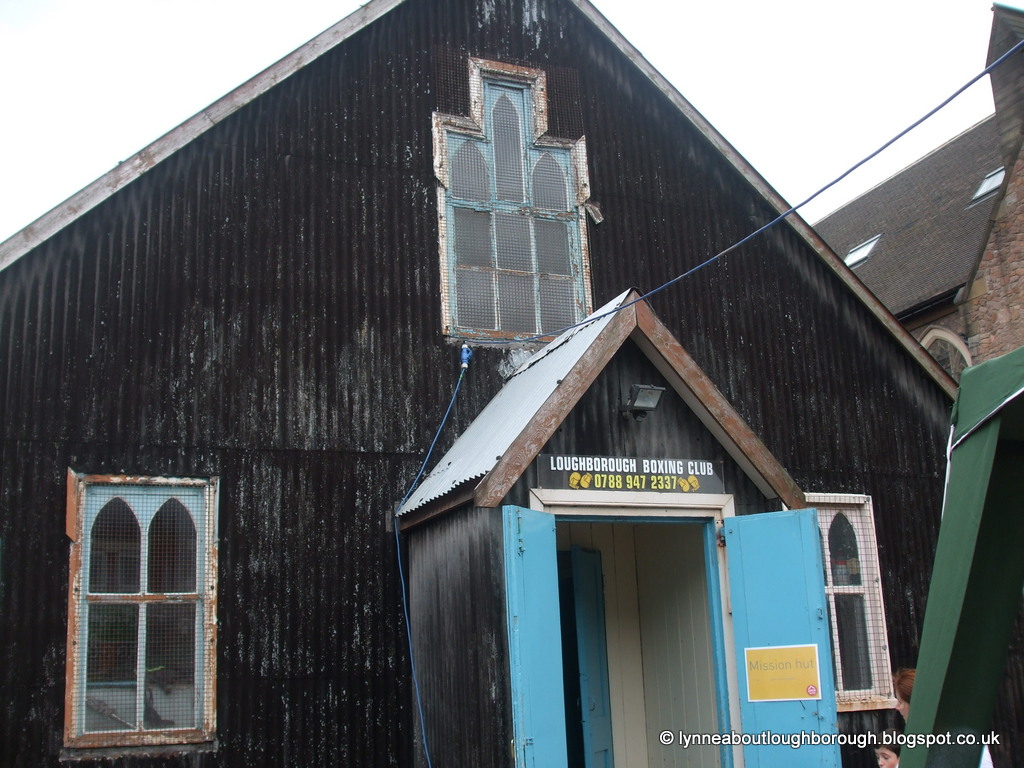


The iron mission church
 

The iron mission church adjacent to St Peter's church

1892 – Reverend W Irwin became curate at Loughborough parish church, and curate-in-charge in respect of the mission church at St Peter’s.


March 1892 – the iron mission church was enlarged to double its original size. At the same time it was dedicated. The new part was at right angles to the original: a chancel of 25ft by 17ft 6in, a classroom 25ft square on the left, which also had a gallery for infants, and on the right were two rooms, each 15ft by 12 ft 4in., one of which acting as a vestry. The exterior of the church was corrugated iron, whilst the inside was of stained and varnished wood. Foundations for the extensions were laid by W Ludlam, the interior woodwork by W F Harding, and the heating system by Messengers. George Hodson was the superintendent of the building works, the cost of which was £300, all raised by donation. Gifts for the interior included an oak communion table, altar linen and altar vases, and a brass cross.

The iron mission church from the rear
 

Inside the iron mission church

Inside the iron mission church

1895 – at a public meeting at Fearon Hall it was agreed to appeal for funds to build a permanent church and school rooms.


28 December 1895 – Tenders were received for the building of the new St Peter’s school rooms. These were submitted by W Corah, W F Harding, T Barker & Son, W Moss & Son, and the contract was awarded to A Faulks, a master builder of Sparrow Hill, at a cost of £2,330. George H Barrowcliff was the architect.


February 12 1896 – the foundation stone for the Sunday School building, comprising a Sunday school and church hall, to accommodate 800 scholars was laid by Mayoress of Loughborough, Mrs Walter Chapman Burder. The central hall measured 61ft by 30ft, the infant room 54ft by 19ft, and the six classrooms were 13ft by 12ft each. There was also a committee room, cloakrooms and a general out-office.

The foundation stone of the Sunday School building
 

The Sunday School building from Storer Road


The Sunday School building from the rear

July 1898 – after an illness lasting several months, Reverend Irwin died.


1900 – a committee, charged with arranging for the erection of a permanent church building, met with the ecclesiastical architect, Mr William Samuel Weatherley, to discuss plans. The proposed design was large and handsome, but the committee decided now was not the right time to build it, so decided to build a nave only, with the chancel, vestries and tower to be added later. The estimated cost of the complete new church were £8,000.


February 1907 – plans to build around the current nucleus of the church were developing and local people were pledging money towards the cost.


June 1907 – the need for a permanent church, and the creation of a separate parish was now urgent, and it was proposed that an application be sent to the Ecclesiastical Commissioners.


1909-1913 – the plans for the new church were drawn up by the joint architects, Mr William Samuel Weatherley, of London, who during 1867-72 had been a pupil of Sir George Gilbert Scott, and George H, Barrowcliff of Loughborough, who had already designed the Memorial Baths in Queen’s Park, the Carnegie library on Granby Street and had just designed the United Reformed church building on Frederick Street.  

A drawing of St Peter's church
 

November 1910 - the foundation stone is laid


April 1912 - the new church is consecrated by the Bishop of Peterborough.


March 1913 – St Peter’s becomes a fully instituted parish, both in legal and ecclesiastical terms.


Skip forward in time to:


1962 - the lady chapel was added to the church.


1966 – the Sunday School was converted to become a community centre. As the heart of the community, over the years it was used by groups as varied as the Chrysanthemum Club, the Mother’s Union, folk clubs, keep fit clubs, bridge clubs, drama groups, for weddings and religious celebrations for members of the local Asian community, offering help to Vietnamese refugees, morris dancing clubs, boxing and judo clubs. This is not meant to be an exhaustive list - just a selection to give a flavour of how the community centre was used.

The Sunday School building from the front
 

1989 – a time capsule was buried at the edge of the centre’s car park, under a sculpture by Rosebery Arts.

The time capsule buried underneath a sculpture in 1989
 

2004 – the church of St Peter’s officially became redundant and in 2005 churches were invited to propose future use of the building.


2007 – the joint use proposal submitted by Elim Pentecostal Church and Open Heaven was successful, and detailed plans were submitted to the planning department, with permission being granted in 2009, and renovations taking place between 2012 and 2013.


2009 - the St Peter's Community Centre, formerly the Sunday school building, became the Rosebery St Peter's Centre.  

The Sunday School building from the side

2013 – following extensive renovation and redesign an open event, opened by the Mayor, to celebrate this and the start of a new chapter in the history of St Peter’s church, was held in August 2013. The community festival event included an historical display at which was shown the 102-year-old time capsule that had been found during the renovations.

Record of the laying of the foundation stone of the church

Time capsules inspired by the one found

The uncovered time capsule from 1911
 

2016 – St Peter’s community centre celebrated its 50th anniversary.


September 2019 –Becca Byrers from BBC Radio Leicester, and I walked around Loughborough looking for its hidden past. This included a trip to the former St Peter’s church where we were treated to a viewing of the time capsule and a number of relevant documents. We also went along to Beaumanor Hall, and the whole event is available as a podcast, called Multi-Story


June 2020 – it is announced that the Rosebery Community Centre will close permanently. The community centre hired out its space for a variety of events, including art exhibitions, but income during the coronavirus pandemic ceased as community groups have not been able to meet: As such, the community centre could no longer continue due to lack of finance.

(1) The mission church does not have the full status of a parish church, but is rather a church supporting an area within the parish of the main church, the latter being the one with the full-time minister, and the mission church supported by a curate from the main church. 
          
You are welcome to quote passages from any of my posts, with appropriate credit. The correct citation for this looks as follow:

Dyer, Lynne (2020). So who were the Woodwards of Loughborough? Available fromhttps://lynneaboutloughborough.blogspot.com/2020/07/st-peters-church-and-community-centre.html    [Accessed: 12 July 2020]

Take down policy:
I post no pictures that are not my own, unless I have express permission so to do. All text is my own, and not copied from any other information sources, printed or electronic, unless identified and credited as such. If you find I have posted something in contravention of these statements, or if there are photographs of you which you would prefer not to be here, please contact me at the address listed on the About Me page, and I will remove these.

If you wish to leave a comment, please do so in the comments box that appears below this blogpost. Alternatively, you can contact me via lynneaboutloughborough[at]gmail[dot]com.

Thank you for reading this blog. 

Lynne     

Sunday, 29 September 2019

Secret of Loughborough's newest streets

You may have caught me on BBC Radio Leicester on Wednesday (listen again, available until 25th October 2019)? This was an extract from a podcast recorded by Becca Bryers for her award-winning podcast, Multi Story, which was released on 25th September 2019 (available forever!). Becca and I chatted about some of Loughborough's secrets, and decided we would visit Queen's Park, the former St Peter's Church and Beaumanor Hall. We had a great walk around Loughborough's town centre, and spoke to some really interesting folk at St Peter's and Beaumanor.


One of the reasons we chose to visit Beaumanor was because we knew of the links with Bletchley Park during the Second World War, when Beaumanor was a "Y" listening station. The other reason was because of the naming of the streets on a new estate on the outskirts of Loughborough, off Epinal Way, and close to Beaumanor. I covered these streets, and the background to their names in my book, 'Secret Loughborough'. Sadly, there wasn't enough room in the book to write everything I wanted to, so below is a slightly extended version.


Alongside thematically named groups of streets, like those after trees, or flowers, or stately homes, there are other thematically named groups of streets in Loughborough that are rather more complex than those named after trees, or birds, and an understanding of these really does point to some interesting history. A relatively recent example of one such theme is that to be found on a newish estate, on the edge of Loughborough, close to the hamlet of Woodthorpe and the estate of Beaumanor, where one can find roads names like Hugh Foss Drive, Leslie Yoxall Drive, Peter Twinn Drive, Peter Laslett Close, John Tiltman Drive, which are clearly named after people, and the less obvious ones like Knox Drive, Boyle Drive, Aitken Way, Watkin Drive, Wilson Drive.

The one that really cracks the code, is Alan Turing Road, as these roads are named for people who were associated with the intelligence operations at Bletchley Park during the Second World War. Beaumanor Hall, in Woodhouse close to Loughborough, was a “Y” listening station during that war, and had regular contact with people working in cryptography or cryptanalysis at Bletchley Park, many of whom went on to have distinguished careers.

Peter Laslett lectured at Cambridge University, reaching the position of Reader in Politics and History of Social Structure before retiring in 1983. He was a founder member of the University of the Third Age (U3A) of which there is a branch in Loughborough. Hugh Foss retired from GCHQ in 1953. Leslie Yoxall joined GCHQ, retiring in 1974. Dilly Knox, a graduate of King’s College Cambridge, had been a codebreaker during the First World War, and died in 1943 whilst working at Bletchley Park as chief cryptographer.

Edward Boyle went on to study at Christ Church Oxford, graduating in 1949. When his father died in 1945, Edward inherited the baronetage, becoming Baron Boyle of Handsworth. He later became an MP, and died in 1981.

Peter Twinn was the first person to read a German military Enigma message just before the secret operations moved from London to Bletchley Park in July 1939. He later became associated with institutions like the Royal Aircraft Establishment and the Natural Environment Research Council. In 1980 he was appointed a CBE and died in 2004.

John Tiltman, an army officer in the First World War, was wounded and received the Military Cross. At Bletchley Park he was considered to be one of the best at his job, and in 1944 he was promoted to Brigadier, a position from which he earned his nickname – The Brig.. He died in 1982.

One or two of the road names on this estate cause a little consternation.

Was Watkin Drive named for Vernon Watkins, a Welsh poet and friend of Dylan Thomas, who attended Repton School in Derbyshire before going on to Cambridge to study for a degree in modern languages, although he left before he completed this. Whilst working at Bletchley Park Watkins met his future wife, and at the time of his death in 1967 he was seriously in the running to become Poet Laureate. Is it possible that the name Watkin Drive was chosen in order to simplify what would otherwise have been a bit of an awkward name to spell – Watkins’ Drive?

For a similar reason, it could be concluded that Wilson Drive is named for Angus Johnstone-Wilson, rather than Harold Bernard Willson, the former being a graduate of Merton College Oxford, who worked as a code-breaker in the Naval section at Bletchley Park. Harold Bernard Willson graduated from Cambridge University with a degree in modern languages, working at Bletchley Park during the Second World War, being the first person to decrypt the Italian Navy Hagelin C-38 code machine. But why not Johnstone-Wilson, or Willson?

Aitken Way could refer to either: James Macrae Aitken, a Scottish chess player, who worked at solving German Enigma machines, from Hut 6 at Bletchley Park, and seems to have spent much of his life playing (and winning) championship chess; or to the New Zealand mathematician, Alexander Craig Aitken, who also worked from Hut 6 during the Second World War, also decrypting the Enigma code.
  
Finally, perhaps the most well-known of the Bletchley staff is Alan Turing, whose story was told in the recent film, ‘The Imitation Game’. He is perhaps best known for being a cryptanalyst and designer of the Bombe (a mechanical device to help decipher Enigma messages) as well as being the head of Hut 8. Turing died a few days before his forty-second birthday.


You are welcome to quote passages from any of my posts, with appropriate credit. The correct citation for this looks as follow:

Dyer, Lynne (2019). Secret of Loughborough's newest streets. Available from: https://lynneaboutloughborough.blogspot.com/2019/09/secret-of-loughboroughs-newest-streets.html  Accessed 26 September 2019]

Take down policy:
I post no pictures that are not my own, unless I have express permission so to do. All text is my own, and not copied from any other information sources, printed or electronic, unless identified and credited as such. If you find I have posted something in contravention of these statements, or if there are photographs of you which you would prefer not to be here, please contact me at the address listed on the About Me page, and I will remove these.
Thank you for reading this blog. 

Lynne     


Sunday, 15 September 2019

Carillon and bellfoundry on Heritage Open Days

I have to offer you many sincere apologies for the radio silence last week. Life has been particularly hectic over the last couple of weeks. Read on to find out more!

On a visit to Oakham last weekend to listen to the Hathern Band performing at Oakham's Party in the Park. As you'd expect, there were several things that reminded me of Loughborough, aside from Party in the Park! The display of bikes in the park reminded me of the bike show in Loughborough Market Place that takes place in June each year. The band, of course, is the main connection, with many of the players being from Loughborough. 

The bandstand in Cutts Park, behind the castle in Oakham was an interesting one, too. So, Loughborough's was created by Hill and Smith of Brierley Hill, West Midlands in 1902, although it was moved from its original position, close to Granby Street, to its present position in about 1914, this because the ground can get (and still does get) rather soggy. The roof and columns have since been replaced, but the balustrade is the original. Other nearby bandstands created by this company include those at Church Gresley, Swadlincote, and Alton Towers. 

The bandstand at Oakham was created by the Lion Foundry in Kirkintilloch and placed in the park in 1948. There are no nearby bandstands created by that company, the nearest probably are in Birmingham. The bandstand was apparently the subject of an expensive makeover in 2012, and this prompted its renaming to the Queen Elizabeth II Diamond Jubilee Bandstand. 


Loughborough's bandstand

Loughborough's bandstand

Oakham's bandstand showing dedication

Oakham's bandstand

Some of the bikes on display in Oakham park

Lord Lieutenant of the county and the High Sherrif of the county


While we're on the topic of bandstands, this weekend I was in Nottingham Arboretum where there was a green festival happening. The bandstand was alive with fabulous music and there were loads of people enjoying the event. The opening ceremony for the bandstand was on Thursday 16th May, 1907, although as yet the maker has not been identified.

Nottingham Arboretum bandstand

My next visit this last week was to St Peter's church as part of a podcast for local radio. I went along to look at the items that had been found hidden behind a wall during the renovation work way back in 2013. This was so fascinating, so much social history hidden in a glass container, and now stored in a box file in an office! I am still fascinated by the bell rope on the stairs, the First World War memorial on the ground floor and the amazing copper font.


The glass container

The bell pull on the stairs

The First World War memorial

The copper font

The visit to St Peter's was followed by a visit to Beaumanor Hall where I was lucky enough to be shown around the attic rooms, the cellars, and some of the huts associated with the work of the women who were involved in transcribing encrypted messages received via morse code during the Second World War when Beaumanor was a Y listening station. I don't have any photos of the inside of Beaumanor, but here's what I do have!


The front entrance to Beaumanor Hall

The Beaumanor tour guides being photographed

The next day saw me lunching in town before wandering over to the public library where there is currently a display of all the libraries in the countries that Andrew Carnegie donated to in the main body of the library, and an exhibition of Victorian Loughborough in the Local and Family History Centre. 

Yesterday saw me leading a walk from the Carillon to Taylor's Bellfoundry via the parish church as part of the 25th-anniversary celebrations of the Heritage Open Day initiative. Both the Carillon and the bellfoundry were open to visitors and both were jam-packed as those visitors took the opportunity to experience the unique war memorial and the workings of a Victorian factory. The route we walked took us through the park, out onto Granby Street, to Frederick Street, along Derby Square where we saw some of the Ladybird Collective artwork, through Clay Pipe Jitty, up Church Gate, across to the parish church, into Sparrow Hill and through the Chapman Street housing estate into the bellfoundry, passing the bellfoundry's own carillon. Here's some pictures inside the bellfoundry works. 


A beautiful mode of transport!

Bells destined for Zennor in Cornwall
In between all this busy-ness, I managed a relaxing trip to Thornton Reservoir, where I chilled, breathed in some fresh air, got up close to a cow, and marvelled at the trees!


And now, I'm off for a bit of a rest!!!


You are welcome to quote passages from any of my posts, with appropriate credit. The correct citation for this looks as follow:

Dyer, Lynne (2019). Carillon and bellfoundry on Heritage Open Days. Available from: https://lynneaboutloughborough.blogspot.com/2019/09/carillon-and-bellfoundry-on-heritage.html   [Accessed 15 September 2019]

Take down policy:
I post no pictures that are not my own, unless I have express permission so to do. All text is my own, and not copied from any other information sources, printed or electronic, unless identified and credited as such. If you find I have posted something in contravention of these statements, or if there are photographs of you which you would prefer not to be here, please contact me at the address listed on the About Me page, and I will remove these.
Thank you for reading this blog. 

Lynne