Showing posts with label Great Paul Bell. Show all posts

Sunday, 1 October 2023

Loughborough Bell Festival 2023

If you are a regular reader of my blog, you might remember that during my 10th birthday month, August 2023, I hosted a number of guest posts from a variety of people who were kind enough to write for me? Well, this month – oh, hang on, it’s the 1st of October today, so I mean last month – I enlisted the help of a young photojournalist to take some photos of an event taking place in Loughborough which I was unable to attend myself, due to a previous appointment. 

On Sunday 10th September, Loughborough held its first-ever bell festival publicised by Charnwood Arts! And what a festival it was!! I’m sure many of you were there to witness the willow bell, made by local artist Nita Rao, who was also responsible for many of the sculptures on the Beacon Hill, and Outwoods trails, whilst it was in the grounds of the parish church (All Saints with Holy Trinity). From here, it made its way through town to Queen’s Park, where there were celebrations all round!

This willow bell was made to represent the Big Paul Bell, which was made by the local bellfoundry, Taylors, for St Paul’s Cathedral in London. While this bell may have been made of willow, the original bell was made of bell metal (a combination of copper and tin) and weighed in at in excess of an impressive 20 imperial tons according to the St Paul’s Cathedral website. It’s apparently the second largest bell to have been cast in the UK – or maybe the biggest in England, depending on what sources you read - and is still the biggest bell cast by our local foundry.

While the journey from the parish church to the park might have only been a short distance, taking only about 30 minutes, Loughborough to St Paul’s in London was a voyage of about 100 miles, and took 11 days! The mode of transport for the two journeys was practically the same though! In both cases, the bell was loaded onto a trailer, and the whole pulled by a steam traction engine!

At the Loughborough Bell Festival – an event that is likely to be repeated in some form a couple more times – the procession from the church to the park, was accompanied by groups like Morris dancers (I spotted Bare Bones and Way of the Wyrd, with loads of members of the public lining the route and even joining in with the procession. Once in the park, there was more entertainment put on, including a concert in the bandstand from the Hathern Band (the subject of many of my previous blogposts, like this one!), and a marquee in which people could have a go at things like handbell ringing!

Here's some photos that give a flavour of the event:

A man in Victorian gentleman's dress, with flag, in churchyard with a 7-foot willow bell sculpture
Mr John Taylor (aka Lez!) with the Great Paul Bell!

Green steam engine
The steam engine

A trailer being prepared for use
The trailer

3 Victorian men and wheels of a steam engine
The experts!

Crowds watching the willow bell being loaded onto the trailer
Loading the bell
 
The rector consulting the engine drivers
Preparing for the blessing

The rector blessing the bell
The Reverend Wendy Dalrymple giving the blessing
 
The bell on its journey through the streets
The journey begins!

People processing
The procession of people!

Procession in the market place
The procession arriving in the Market Place

Bandstand surrounded by flowers in the park
The bandstand in Queen's Park

Morris dancers performing around the bandstand
Morris in the park!

People heading to the marquee
The have-a-go marquee

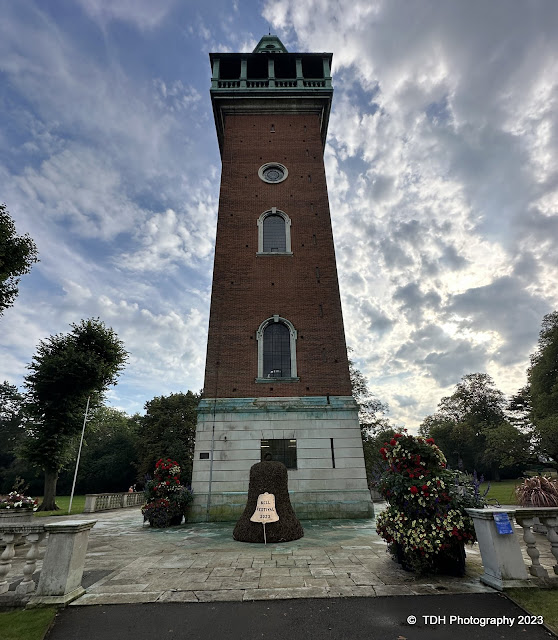
The Carillon after the event with the willow bell in front
The end of the day

_______________________________________________

Posted by lynneaboutloughborough

With apologies for typos which are all mine!

_______________________________________________

Thank you for reading this blog.

Copyright:

The copyright © of all content on this blog rests with me, however, you are welcome to quote passages from any of my posts, with appropriate credit. The correct citation for this looks as follows:

Dyer, Lynne (2023). Loughborough Bell Festival 2023. Available from: https://lynneaboutloughborough.blogspot.com/2023/10/loughborough-bell-festival-2023.html [Accessed 1 October 2023]

Take down policy:

I post no pictures that are not my own, unless I have express permission so to do. All text is my own, and not copied from any other information sources, printed or electronic, unless identified and credited as such. If you find I have posted something in contravention of these statements, or if there are photographs of you which you would prefer not to be here, please contact me at the address listed on the About Me page, and I will remove these.

External Links:

By including links to external sources I am not endorsing the websites, the authors, nor the information contained therein, and will not check back to update out-of-date links. Using these links to access external information is entirely the responsibility of the reader of the blog.

Blog archive and tags:

If you are viewing this blog in mobile format, you will not be able to easily access the blog archive, or the clickable links to various topics. These can be accessed if you scroll to the bottom of the page, and click 'View Web Version'. Alternatively, there is also a complete list of posts, which when clicked will take you to the page you are interested in.

Searching the blog:

You can search the blog using the dedicated search box that appears near the top of the blog when viewed in the web version. Alternatively, you can search using your usual search engine (e.g. Bing, Google, DuckDuckGo etc.) by following this example:

site: https://lynneaboutloughborough.blogspot.com/ “Radmoor House”

NOTE – the words you’re actually looking for must be in “” and the first of these must be preceded by a space

Thank you for reading this blog.

Lynne

Sunday, 19 August 2018

Whitechapel and Taylors bell foundries

So, are you bored of bells yet?? Sorry, but I don't think I could ever be!!

This past week I've been to Woodhouse Eaves church again, and admired the Taylor's bell in the porch! I was actually there to listen to a friend present some of the research done on the architect of the church, and was reminded of my recent visit to London, by mention of the Whitechapel Bellfoundry.

When I went to London for my son's graduation, we popped into the local medical museum, The Royal London Hospital Museum, as we were aware they had some significant material. On entering the crypt of the former church the first display we came across was a bell. According to the information board: 
"Operation bell of the London Hospital. Date: 1791.This bell, together with the bell of 1757 that hangs in the Hospital entrance, was made at the Whitechapel Bell Foundry. Before the introduction of anaesthetics in 1846, it is reputed to have summoned attendants to hold surgical patients still." 


Further into the museum we saw the replica skeleton of Joseph Herrick, otherwise known as the Elephant Man. This was here because the hospital had done much investigation of his condition during his lifetime.


Once we'd been around all the museum, we headed off down the length of Whitechapel Road to get into Central London. 


Along the way we spotted various things of interest, but none of greater interest than the Whitechapel Bell Foundry buildings! Founded in 1570, the Whitechapel Bell Foundry moved to its buildings on Whitechapel Road in 1739, has the honour of being the oldest British manufacturing business. Since 1904 the business has been owned by the Hughes family, but in 2016 they sold the Grade II listed buildings and the foundry finally closed for business in May 2017. 

Some of the most well-known bells that were cast at Whitechapel include the Liberty Bell, cast in 1752, and in 1856 Big Ben, although this had to be re-cast in 1858 because it developed a crack during the testing process. More recently, Whitechapel designed the bell which was used to start the 2012 Olympics, although because it was too big to be cast in their foundry, it was actually cast in The Netherlands. They did, however, cast the bell for the leading barge on the Thames for the Queen's Jubilee Pageant in 2012. From the markings on the photo below, Whitechapel did not just cast bells: this is the base of a lamppost in the vicinity.


When we walked past the foundry buildings - well, ok, we didn't just walk past, we lingered for quite some time - the buildings did not appear to be in use, but nonetheless seemed well-kept. I do wonder what will happen to them. Of course, this does mean that Taylors Bell Foundry, at one time financially vulnerable, and its buildings still in need of a degree of renovation, is now the sole remaining bell foundry in the UK. As we've already read, its bells can be found across the globe, and can its renovation work on bells that may have been cast in different foundries. 

Regarded as a relative newbie, the company has a direct link from the Leicester bell founder, Johannes de Stafford who seems to have been casting bells earlier than 1338, although the Taylor family didn't become involved until 1784, first coming to Loughborough in 1839, moving to the present site in 1859. One of Taylors most notable bells is the Great Paul bell which was cast for St Paul's Cathedral in London. Anyway, long may Taylors continue!


And here I feel I must stop! 

You are welcome to quote passages from any of my posts, with appropriate credit. The correct citation for this looks as follow:

Dyer, Lynne (2018). Whitechapel and Taylors bell foundries. Available fromhttps://lynneaboutloughborough.blogspot.com/2018/08/whitechapel-and-taylors-bell-foundries.html  [Accessed 19 August 2018]

Take down policy:
I post no pictures that are not my own, unless I have express permission so to do. All text is my own, and not copied from any other information sources, printed or electronic, unless identified and credited as such. If you find I have posted something in contravention of these statements, or if there are photographs of you which you would prefer not to be here, please contact me at the address listed on the About Me page, and I will remove these.
Thank you for reading this blog. 


Lynne


Sunday, 18 August 2013

Spotlight on: Queen’s Park

History

The park was opened in 1899 as a result of a suggestion by Joseph Griggs, the first Mayor of the Borough of Loughborough, and a collection of subscriptions from local people and local businesses and had been considered as a commemoration of Queen Victoria’s diamond jubilee. This meant that about 4 acres of land in Granby Street could be bought (actually bought in 3 separate lots) and the area planted up with flowers and plants: A young tree was planted at the opening ceremony. There were also to be recreational areas, and walkways between the plants and shrubs. Today, being a park situated centrally in town, it serves the needs of everyone, from the business, education and local community to the shoppers and the tourists. 

Features

Carillon – the Carillon was erected in 1923 as a memorial to those who died during the First World War. It was designed by Sir Walter Tapper, an independent architect from London, but was constructed by a local building firm, Moss. The carillon is a musical instrument, sounding rather like a peal of bells, but played in a completely different way: The carilloneur, who sits in a room below the actual bells, hits the keys with a fist which in turn moves a clapper to hit the bell. The bells were made by local bellfounding firm, Taylors, who have had a business in Loughborough since about 1839. There are 47 bells, weighing from 14 imperial pounds, to over 82 hundredweight and the tower is 46 metres high! The museum based in each of the rooms on each of the lower floors contains WW1 and memorabilia from later wars.


Charnwood Museum – was officially opened in 1899 to celebrate Queen Victoria’s diamond jubilee. It was gifted to the townspeople by Joseph Griggs, the first Mayor of the Borough of Loughborough. The swimming baths was closed when the new leisure centre opened in the 1970s. The building was then used for Saturday/Sunday craft and antique fairs, and later for the regular Friday morning flea market. In 1995 the building was converted into a very popular museum, charting the history of Loughborough and having regular travelling displays and lots of activities.


Bandstand – the bandstand was erected to commemorate the coronation of Edward VII in 1902. It’s a beautiful addition to the park and is in a central position: Paths radiate out from the bandstand, and it is also in a direct line with the Carillon.


Swan – the swan maze and sculpture was created in 1992 by a local man, David Tarver, to celebrate 100 years since the town became a borough in 1888. The sculpture shows a swan with her three cygnets and a swan.


Olympic rings – 2012 saw Britain host the Olympics, and to celebrate this, there are five hoops planted in the park, the flower and related arrangements representing many of the events. To accompany this planting, there were several pairs of legs arising from the ponds outside the Museum. Theses were created by Loughborough University art students to represent the synchronised swimmers! These have now been removed to make way for the latest sculptures.


Bell and related sculptures – the Great Paul Bell was created by Taylors for St Paul’s cathedral in 1881. In July 2013 the Great Paul Bell casing was given pride of place in Queen’s Park, situated on a plinth next to the pools opposite the museum. It has been surrounded by a collection of musical-themed sculptures – a set of tuning forks, a nest of bells and a half a bell with clapper – as part of the Loughborough in Bloom effort.


Aviary – the aviary has been a part of the park since about 1955, although its position in the park has changed. There is quite a variety of birds to be seen – although the Humboldt penguins and the peacocks are no longer there!         

Events

Remembrance Day parade and service – In November each year a parade through the town leads onto a service in Queen’s Park. Attended by a range of civic dignitaries, members of the scouting and guiding families, the Boys/Girls Brigade, service personnel, and others gather outside the Carillon and remember those who died in the world wars, and alter conflicts. At 11am precisely, two shots are fired and thousands of poppies are released from the top of the Carillon. The procession takes off again, through town, ending at Southfields Park.

Regular recitals – the borough carilloneur, Caroline Sharpe, gives regular recitals, usually on Thursday afternoons and Sundays. Other recitals are given on special occasions.


Bands in the park – during the summer months a variety of bands play in the bandstand. These range from concert bands, through jazz bands to brass bands.


Picnic in the park – has become a regular feature on the calendar of the park. There are food and craft stalls, games, dancing and music, lending a festive atmosphere.


Bowls – during the outdoor bowls season (April to October) bowls matches are regularly held on the green. The home club is known as Granby Bowling Club, and visiting teams come from all over Leicestershire to play here. 


Mela - the Loughborough Mela is an annual event that takes place in August and celebrates Asian entertainment and culture.

Facilities

Playgrounds – there are two distinct children’s play parks within Queens park, one with lots of equipment for younger children, and one for older children.

Café – the café is open from about Easter time to October, and has both an inside seating area and an outside one. The café can be accessed from outside in the park, or from inside via the museum. A range of refreshments is sold, and there are often displays of local artwork that can be purchased.

Toilets – are available inside the museum and outside, near the bowling green.

Address – Queen’s Park, Granby Street, Loughborough, LE11 3DU

Opening hours – from dawn to dusk