Showing posts with label terracotta. Show all posts

Wednesday, 9 April 2025

H is for Hathern Station Brick and Terra Cotta Company, Hathernware, and the Hodson Family

Yesterday we had a look at glazed tiles, which included those on some of Loughborough’s pubs and cinemas. The makers of these tiles were a local company …

Originally called Hathern Station Brick and terra Cotta Company, the firm was started in 1874 by George Hodson (1844-1907), along with his brother, James, at a site between Sutton Bonington and Hathern, close to Hathern Station – which, I guess, is where part of the firm’s name came from. The company also had a brick works near Tamworth, called the Cliff Works, which produced blue engineering bricks.

The speciality of the company was initially in terra cotta, and many local buildings are beautifully decorated with terra cotta embellishments. Examples are the Carnegie Library on Granby Street, and Lloyds Bank on High Street, but not BetFred (previously Gartons estate agents, but originally opened as a Temperance Hall), which has terra cotta from J.C. Edwards of North Wales.


The story of the company and the family behind it is a very long one, and I don’t have space to tell it all here, so let’s move on to the Art Deco period. The Hathern company began making faience tiles towards the end of the nineteenth century, as architects began to use glazed ceramics on building façades. This product was known as Hathernware Faience, and eventually, in 1938 the company changed its name to Hathernware. The tiles were made from glazed terracotta which was moulded rather than carved to imitate marble and granite surfaces.

There are examples of Hathern’s tiles across the country. I believe Hathernware had the contract for cinemas in the Odeon chain, and certainly some Burton’s Menswear stores were also of Hathernware. In the 1970s the company merged with Shaws, and was taken over by Ibstock Brick in 1990. During that period, much of the work was concentrated on renovations, and this included repairs to the Wrigley Building in Chicago. The local site eventually closed in 2004, but the Hathern name is now owned by Michelmersh Brick Holdings, who still produce terracotta and faience ware under the Hathern name.

Locally, we have many examples of buildings clad in Hathernware’s faience, not least the original Odeon on Baxter Gate, and the current Odeon on Cattle Market, on the former Echo Press offices on Swan Street, and many others.   


____________________________________ 

I'm taking part in the A-Z April Blogging Challenge!!

____________________________________

Posted by lynneaboutloughborough

With apologies for typos which are all mine!

_______________________________________________

Thank you for reading this blog.

Copyright:

The copyright © of all content on this blog rests with me, however, you are welcome to quote passages from any of my posts, with appropriate credit. The correct citation for this looks as follows:

Dyer, Lynne (2025). H is for Hathern Station Brick and Terra Cotta Company, Hathernware, and the  Hodson Family. Available from: https://lynneaboutloughborough.blogspot.com/2025/04/h-is-for-hathern-station-brick-and.html  [Accessed 9 April 2025]

Take down policy:

I post no pictures that are not my own, unless I have express permission so to do. All text is my own, and not copied from any other information sources, printed or electronic, unless identified and credited as such. If you find I have posted something in contravention of these statements, or if there are photographs of you which you would prefer not to be here, please contact me at the address listed on the About Me page, and I will remove these.

External Links:

By including links to external sources I am not endorsing the websites, the authors, nor the information contained therein, and will not check back to update out-of-date links. Using these links to access external information is entirely the responsibility of the reader of the blog.

Blog archive and tags:

If you are viewing this blog in mobile format, you will not be able to easily access the blog archive, or the clickable links to various topics. These can be accessed if you scroll to the bottom of the page, and click 'View Web Version'. Alternatively, there is also a complete list of posts, which when clicked will take you to the page you are interested in.

Searching the blog:

You can search the blog using the dedicated search box that appears near the top of the blog when viewed in the web version. Alternatively, you can search using your usual search engine (e.g. Bing, Google, DuckDuckGo etc.) by following this example:

site: https://lynneaboutloughborough.blogspot.com/ “Radmoor House”

NOTE – the words you’re actually looking for must be in “” and the first of these must be preceded by a space

Thank you for reading this blog.

Lynne

Sunday, 17 March 2019

Victorian factories

If you're a regular reader of this blog, you'll probably have picked up that I'm a bit of a fan of our smaller towns and villages, rather than our big cities. Hence, I find Loughborough to be the perfect size, and only tend to visit cities on holiday - apart from Leicester, which I travel to regularly for work. Years ago I used to visit Nottingham, but rarely go these days.

Anyway, my point is that I have avoided trips to the capital as far as possible, and have also avoided trips to England's second biggest city, apart from around Christmas 2003 when I took the oldest child to see one of his schoolfriends dance in The Nutcracker ballet at the Hippodrome, and a couple of evening trips 2014/15 to see the youngest child perform with the Birmingham Junior Conservatoire Band. 

However, I've recently had the occasion to visit Birmingham for work, and specifically to visit the museums. I was quite surprised by what I found, and couldn't help but make some connections with Loughborough.

Ok, so we haven't got anything equivalent to Symphony Hall in Loughborough, unless you consider the interior, which looks very Art Deco to me and reminded me of our Beacon Bingo, which opened as an Odeon Cinema in 1936.


The auditorium at Symphony Hall

One of the doors into the auditorium at Symphony Hall
Beacon Bingo, once The Odeon, Loughborough

The Museum of the Jewellery Quarter involved a guided tour around the factory of Smith and Pepper. The business opened in 1899 and closed in 1981, but the factory was never cleared out and instead has been preserved, like a time capsule, affording a fascinating insight into what it would have been like to work in a Victorian factory. The similarity with framework knitting was obvious really, if I'd stopped to think about it, and then also with the Herbert Morris factory. The buildings had long narrow rooms with very large windows along the long side and having the opposite interior wall painted white - all to bring in and reflect as much light as possible so the workers could see the intricate work they were doing. When the original building was extended, another long, narrow building was erected with windows sloping up to the roof (not a good description, but you'll see what I mean when you see the photos). The walls of the building opposite were then clad in white tiles - were these possibly Hatherware? Buildings that were used by framework knitters in Loughborough would have had windows very close to the roof and there were likely to have been glass globes filled with water hanging in them, which would have spread the light on the work being done. The Morris factory had those sloping windows I mentioned above - maybe they are called skylights (of a sort), and it is believed that these lights attracted the attention of a passing Zeppelin on the night of 31st January 1916. 


White tiled wall and glass roof at the Jewellery Quarter Museum

White tiled wall and ground floor windows at the Jewellery Quarter Museum

Large side windows, roof windows and white tiled walls at the Jewellery Quarter Museum

Machinery at the Jewellery Quarter Museum

I think the slope of the roofs would originally have been glass at Herbert Morris


I also visited the Coffin Works, which was another Victorian factory, frozen in time, started in 1882 and closed in 1997. The guided tour was of the Newman Brothers factory, where they made handles and decorations for coffins, as well as satin interiors, and shrouds (but not the coffins themselves). What this factory had in common with Smith and Pepper factory was that they were both working with metal, and the smell of grease, the sound of the presses was also common to both. In both factories, the guides did some demonstrations of some of the work that the employees would have done. I couldn't help but think of our bellfoundry. It's a working Victorian factory: it's hot; it's noisy; it's smelly and it's blummin dangerous! 


The Coffin works 
Metalworking at Taylors 2017


My final museum visit (can't really count a cuppa in the Edwardian tearooms in the main museum and art gallery in Town Hall Square!) was to the Pen Museum. Well, that was fascinating! So many pen nibs!!! What did they say - 90% of the world's words at one time were written using a nib from Birmingham! Staggering! It was also in this museum that I read a little about the gun factories in Birmingham, which is interesting because Natahaniel Corah, who started Corah's in Leicester, in the mid-1800s, but not before he'd spent his early years as a framework knitter, then at 27 going to work in a gun factory in Birmingham! And, he used to do business in The Globe pub in Leicester, which is so-called in honour of those framework knitters! Two questions arise here, for further investigation sometime, the first of which is was Nathaniel Corah any relation to the builders, and printers of the same name in Loughborough?


Information about the Birmingham gun quarter


The other question concerns one of the Birmingham pen-making firms which was named after the owner - Joseph Gillott: is there any connection with the Gillott's of Loughborough who had the garage of that name?


Gillott's factory

Nibs at the Pen Museum

Joseph Gillott

Gillott's nibs

Picture of the interior of Gillett's factory


A couple of other incidental connections were that at the Coffin Works they had a machine produced by SamcoStrong in Leicester, which the other half used to work for, and all the museums I visited had typewriters, but it wasn't until I got to the last one (the Pen Museum) that I found an Imperial typewriter from Leicester. 


A SamcoStrong hydraulic cutting press

An Imperial typewriter from Leicester

Other connections to Loughborough - like the canal and terracotta buildings - will have to wait for another blogpost now, as I've run out of time.


Canal, lock and bridge in Birmingham

Terracotta building in the centre of Birmingham


You are welcome to quote passages from any of my posts, with appropriate credit. The correct citation for this looks as follow:

Dyer, Lynne (2019). Plaques. Available from: https://lynneaboutloughborough.blogspot.com/2019/03/victorian-factories.html  [Accessed 17 March 2019]

Take down policy:
I post no pictures that are not my own, unless I have express permission so to do. All text is my own, and not copied from any other information sources, printed or electronic, unless identified and credited as such. If you find I have posted something in contravention of these statements, or if there are photographs of you which you would prefer not to be here, please contact me at the address listed on the About Me page, and I will remove these.
Thank you for reading this blog. 

Lynne

Sunday, 7 February 2016

Victorian house plaques

Over on facebook people are talking about plaques that appear on many Victorian houses in the town. I've long been interested in these, but rarely seem to have time to do any investigation and research that I could blog about.

In my post about Middleton Place, I mentioned the house names and the carved stone plaques, for example:

"Others (61, 63, 65 & 67) all had bay windows, were slightly taller than 53-59, with rounded arches over the doors, and with the house name carved into shaped stone above the door (Sunnydene, Lyndene, Rosedale & Avondale)."

and:

"Numbers 77, 79, 81 and 83, have very similar doorways to 61-67 and, like 61-67, the house names – Mystrayla, Jesmond, Danesford, and Cresford - were carved into a stone block above the doorway, but these were a more plain rectangular shape."  

These names do appear in the pictures that are on my Middleton Place page, but they are difficult to see, and I haven't had a chance to take further pictures. Nor have I been able to come up with any plausible solutions as to what the house names mean, nor why they were used. To date, all I've managed to come up with is:

Mystralya - spelled Mistralya seems to be the name of an elder god in a role playing game, Never Winter Nights, specifically from the Known Lands. Now, I may be wrong here, but I think this role playing game is a whole lot more recent than the house on Middleton Place!!

Jesmond - appears to be an area of Newcastle! Is this significant to Middleton Place? I personally don't know. Oh, and there are also places called Jesmond in Australia and Canada. Now, there is a place called Jesmond Dene, an important wildlife corridor that leads into Newcastle city centre: given the house names of numbers 61 and 63, is this significant in any way?

Danesford - is a small village in Shropshire, so why would a Loughborough house be so named?

Cresford - well, there's a Cresford Road in London, and a place called Cresford in Australia and Toronto, but why there is a house with such a name in Loughborough is a mystery to me,

Sunnydene - ok so "dene" could mean a sandy tract near the sea, or a steep-sided wooded valley. Maybe this house is situated in a sunny valley?

Lynedene - this name is found as both a forename and a surname. Or, lyne is a variation on the word line or lind. Or, linden is the name for a lime tree. Looking a bit deeper, lind could be mild or gentle, a lime or linden tree, to grow, or feed, a wellspring, to give birth or to bear, soft or thin, a bird, Spring, supple, vineyard's bud, sprout, plank, etc.. 

Rosedale - appears to be the name of a city in Maryland, and is also a name.

Avondale - appears to be the name of a city in Arizona, and is also a name.

To briefly return to the plaques ...

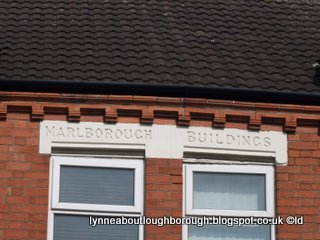
Sometimes plaques are quite ornate, but with minimal information, like a date, or the initials of the architect or builder. Nos 85 and 87 Middleton Place have a plaque bearing a date, whereas on Ashby Road and Chestnut Street, there are plaques with initials and a date, with house names and a date, and a variety of others. 


Next time you are driving along Epinal Way, do take a look at the elaborate carving on the side of Field House - swags and green men!
Well, this started as a blog about house plaques, and has ended mentioning green men - answers to the former on a postcard please, but don't mention green men ...