Showing posts with label Sparrow Hill. Show all posts

Sunday, 19 April 2020

From Clement to Clemersons

Pondering over the guest blog post written by Tony Jarram recently about artists in Loughborough, I was idly looking through some notes, when I spotted someone who classed themselves as a landscape painter, who at one time was living on Sparrow Hill.

Clement Edwards Pike was born in Quorn in 1859 almost the youngest child of James Carey Pike, born in Derby on 26 June 1817, and his wife Maria Balm, born in Quorn, who married in 1851. There were eight children in all. On the 1861 census, James was listed as a Baptist minister, while Maria was listed as a lace manufacturer, employing 31 men, 16 boys and 22 girls, the factory being on Leicester Road Quorn, and the family were living in Quorn. The Quorn company made twisted lace, silk net and cotton-tatting, and was at one time called Balm & Hill. For more information see:


Anyway, back to the Pikes!

This was James Pike’s second marriage. His first had been to Lucy Wherry from Bourne, in 1839, and together they had at least three children, but Lucy died in 1850. James then married Maria and had another five children. When Clement was 12, his elder brother, Joseph was a medical student at St Thomas’s hospital in London, and when Clement was 17, his father died in 1876. On the 1871 census, the family were living in Leicester, but quite what Clement was doing between 1871 and 1881 I don’t know, but on the 1881 census returns, Clement is listed a being art 30 Sparrow Hill, in the home of his brother James, who is a physician and surgeon. Their widowed mother, Maria, their younger sister, Caroline Annie, and their nieces Jane and Florence are also listed here.

For occupation Clement has been recorded as a landscape artist. As yet, I have been unable to trace any paintings Clement may have done, nor have I been able to trace him on the 1891 census returns. UPDATE: Thanks to one of the Loughborough Library Local Studies Volunteers (LLLSVs), Clement has been found on the 1891 census, masquerading as Clement Rike - at least according to the transcriber!!!! He is living with his sister Caroline and servant Kate Chapman, from Loughborough, at N0.10 Bramshill Gardens, Kentish Town. He is listed as a Minister of Religion,  Free Christian Unitarian Church.  

On the 1901 census, Clement is now recorded as being a Unitarian Minister, living on Carisbrooke Road on the Isle of Wight with his sister, Caroline Annie. By 1911 they had moved to Taunton Road, Bridgewater in Somerset, where they continued to live until at least 1919.


Clement died in 1928 at no.88 Leicester Road, Loughborough, although he was living in Mill Brook, Tavistock at the time. No.88, until recently the De Montfort Hotel, was the home of his sister, who had moved to Loughborough on her marriage, so presumably Clement was visiting her. She and her husband lived at the White House (formerly Maher’s the off-licence) on Leicester Road. Caroline had married relatively late in life, in 1923, at the age of 63, and she outlived her new husband, who died 2 years after their marriage, in 1927, by 10 years. Caroline died in 1937, and at the time she was living on Stanley Street.

So, the journey from Clement to Clemersons and the connection is that Clement’s sister, Caroline Annie, had married Henry Clemerson, a member of the Clemerson family who are so fondly remembered by many folk in Loughborough for their department store in the town centre.

You are welcome to quote passages from any of my posts, with appropriate credit. The correct citation for this looks as follow:


Dyer, Lynne (2020). From Clement to Clemersons. Available from:https://lynneaboutloughborough.blogspot.com/2020/04/from-clement-to-clemersons.html [Accessed 19 April 2020]

Take down policy:
I post no pictures that are not my own, unless I have express permission so to do. All text is my own, and not copied from any other information sources, printed or electronic, unless identified and credited as such. If you find I have posted something in contravention of these statements, or if there are photographs of you which you would prefer not to be here, please contact me at the address listed on the About Me page, and I will remove these.
Thank you for reading this blog. 

Lynne 
      

Sunday, 21 September 2014

Spotlight on Ancient Loughborough, part 1 The Windmill Inn

The Windmill Inn
The Windmill Inn, Sparrow Hill, Loughborough

Last week, having showed you some of Canterbury’s impressive old buildings, and mentioned the cruck-frame building in Loughborough on Church Gate where Irish is now, I promised you I’d investigate some of Loughborough’s oldest timer-framed buildings. So, here goes!

The Baker's

Down on Sparrow Hill, next to the right of the Parish Church, and to the left of what used to be Merrin’s the bakers, you’ll see a pub claiming to be “The oldest pub in Loughborough”.
The back of The Three Nuns
I think there’s a battle going on between The Windmill Inn and The Three Nuns, on Church Gate, to lay claim to the title, but I’m really not sure who wins! According to that expert, and dear friend, Bill, the Windmill was opened pre-1600, and the Three Nuns pre-1666, so whatever, it’s a pretty close call!

The front of The Three Nuns


Another friend of mine has been upstairs in The Windmill Inn and has dated the timber used in the cruck-frame to the 15th century, and on these timbers you can still see the carpenter’s marks. The Leicestershire traveller, John Throsby, included in the record of his travels, an engraving of a romanticised view of the Parish Church, viewed from the meadow [presumably the Big or Nether Meadow, now one of the Coronation Meadows], with a windmill [his engraving showed a Midlands Post-mill] in the foreground. This engraving appeared around 1789, although I’m convinced I’ve seen it in one of my books with an earlier date, but, of course, I can’t find it now!
The Windmill from the side


No matter, I think it’s pretty obvious from the date of the timbers, and the view from the side and the back that this building is as old as we think it is. We are pretty sure that there was a farm in this area, many, many years ago, so I shouldn’t be surprised if this pub were not one of the farm buildings themselves, probably not the farmhouse, but possibly one of the outbuildings.


The Windmill from the back
The pub has a wonderful history, and has been a meeting place for a variety of interesting clubs, including the United Order of Druids in 1837 (perhaps the Druid’s Arms down on Pinfold Gate was shut that particular evening!), the Buttonhole Club (who also used the Blackamoor’s Head in Market Place as a meeting place for a while) and the Royal Antediluvian Order ofBuffaloes. It may also he haunted by a lady in grey.


I can tell you who a few of the owners and landlords have been over the years, but not all, and certainly not since 1989:

Pre-1830 – Charles Limb

c. 1830 –  c.1859 John Cleever/Cleaver (may have been the owner of the property rather than the landlord of the pub itself)

c. 1849 – Christopher Cleever

c. 1861 – Matthew Stafford

c. 1866 – Robert Speed

c. 1872 – owned by Mr North

c. 1883 - 1895 Benjamin Sharp & Mrs E. Sharp

c. 1895 – Alfred H. Ellis

c. 1899 – Luke Birkin

c. 1904 – Mr Dowding

Pre-1928- c. 1960 – Everard Hickinbottom, and Mrs M. A. Hickinbottom

1960 -1975 Peter and Doreen Heath

1975 – 1989 Doreen Heath

My own connection with the pub goes back to the late ‘70s, early ‘80s when we used to go down every Wednesday lunchtime for a cheese cob and a game of darts. The landlady at the time was Doreen Heath, and, coincidentally, her barmaid was also called Doreen. And one of those spooky coincidences is that while I was starting to write this article, a picture of Doreen popped up onto my facebook page, as someone was posting pictures of pub landlords/ladies! The local paper, The Loughborough Echo, referred to Doreen as one of Loughborough’s most colourful and respected characters.

I admit, I haven’t been in for many, many years, but the memories remain, and an affection for the place has been re-ignited by researching into its history.
Yours truly outside The Windmill Inn


Monday, 28 April 2014

Handel's Messiah, Snibston Discovery Museum, Jennens and an international supermarket - part 2!

Last week I mentioned to you that I'd been singing Handel at Snibston, and that I'd visited the wonderful exhibition connected with Handel's librettist, Jennens. This week I want to connect you with something in Loughborough you may have just dismissed as a rather scruffy old building ...

Information board in the Music & Performance display cabinet.


When I visited the Jennens exhibition, I'd expected to see nothing other than a history of his life, and maybe a bit about his connection with Handel, so imagine my surprise and excitement when there was a cabinet devoted to music and performance! So what, I hear you say! Well, there were a couple of things here that really "floated my boat" which I'll tell you about.


There's an international supermarket that I frequent on Sparrow Hill. It's a bit scruffy on the outside, but they sell a good range of pasta, dried beans, herbs and paklava! Before becoming a supermarket, it was an outdoor supplies shop, called "Up the Mountain" where I bought some ski kit for my eldest child when he was going on a Garendon High School skiing trip, quite a few years ago. When I first came to Loughborough I think it was Cunningham's the carpet shop, although I never went in there. Before that I think it was a cycle shop. If we go even further back, it was home to Adkinson and Freckletons auction mart (I don't know what happened to Adkinson, but Freckletons is now on the corner of Leicester Road and Woodgate).

18 months ago, when I was doing my guide training, this building was one that I investigated for my exam, so it holds a special place in my affection, as it helped me pass said exam! I also have memories of excitedly talking about this building on one of my guided walks, whilst it was pouring down with rain, and we were all getting awfully wet, but despite the rain, the group managed to show huge enthusiasm!

On 2nd June, 1823 Loughborough's earliest purpose-built theatre was opened in Sparrow Hill. The owner/manager was one Mr Bennett, who also had theatres in Ashby, Worcester, Coventry, and Wolverhampton. Local subscribers paid £700 for the building and the first plays to be performed were "Speed the plough", a comedy in 5 acts by Thomas Morton (1764-1838), written in 1800 and first performed 8th February 1800, and "The Warlock of the Glen", a melodrama in two acts by C[harles]. E. Walker, probably written around 1800, and certainly performed at the Theatre Royal Covent Garden on Tuesday April 3rd, 1821 and at the Edinburgh Theatre Royal* in April 1825. At the Sparrow Hill theatre, these plays played for about six weeks.

However, the theatre wasn't terribly successful, in its early years. There was somewhat of a revival in the 1830s, and Master B Grossmith**, aged about seven, performed all the characters in three short plays one evening. This was part of a mini revival and led to the installation of gas lighting in the theatre in 1845. However, the success was short-lived, and the theatre closed in about 1848, opening again seven years later, having been converted into a free church, before being remodelled again into a dance hall and music salon.

Only a year later, in 1856, the building changed hands and was managed by The Loyal Sovereign Lodge of Oddfellows. This branch of the Oddfellows was established in 1831, and according to the current District Secretary, they met at the "Odd Fellows Hall" in Sparrow Hill, presumably from those early days. During the next 90 years, the theatre building was used for the odd theatrical performance, to show some of the earliest films, and for dances and dancing lessons, before being sold to Adkinson and Freckleton in 1945.

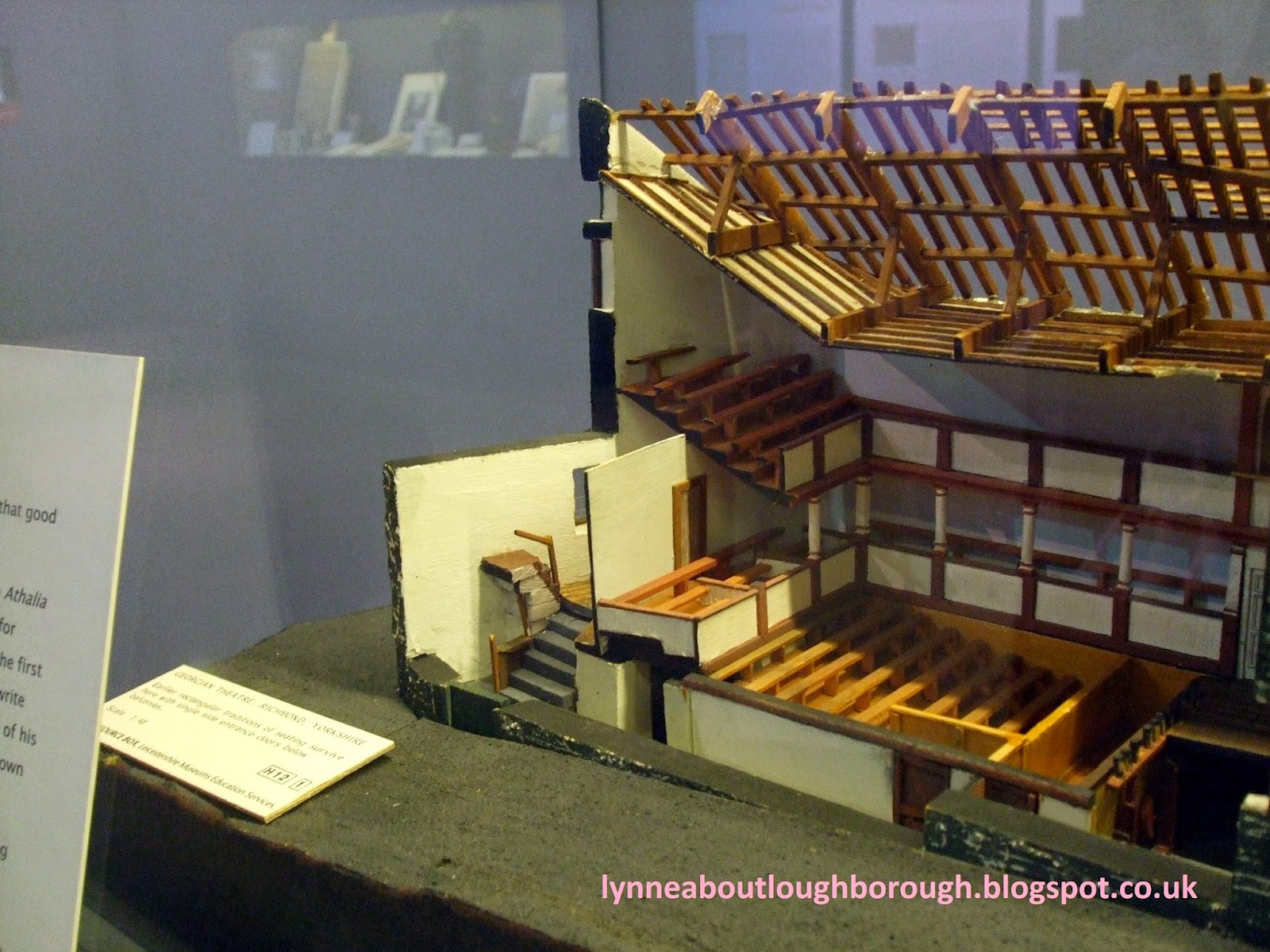
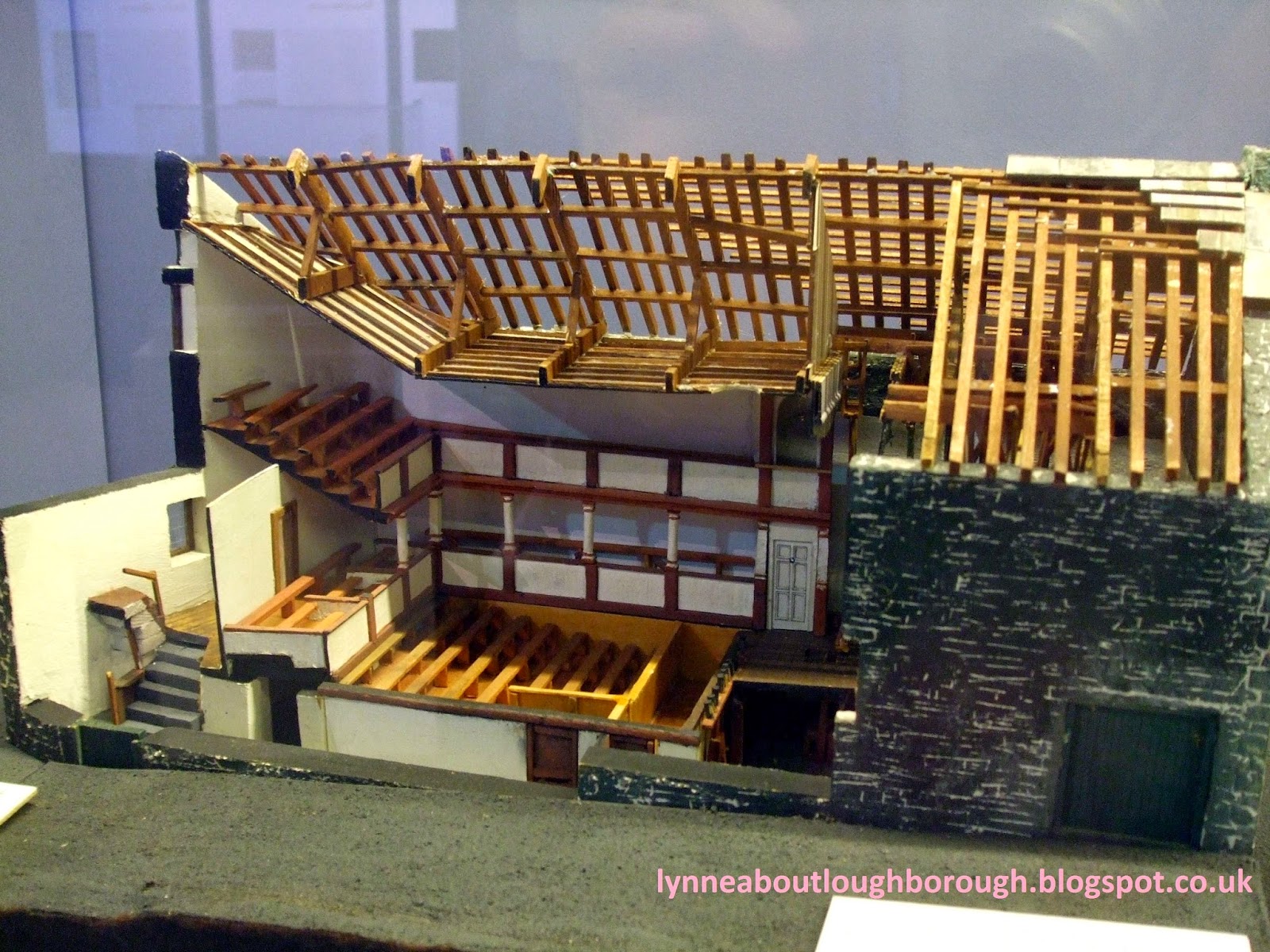
One of the things that excited me about the Jennens display was that there was a model of the Georgian Theatre in Richmond in the Music and Performance cabinet. This was fascinating because not only had the model been made by students of Leicester Polytechnic (now De Montfort University, where I have worked for the past 27 years), but they'd done this with the help of Richard Leacroft, who has written a number of books on the subject of theatre and cinema nationally, in Leicestershire, and in Loughborough, some joint authored with Helen Leacroft.


So, I expect you've guessed by now that this all has something to do with that international supermarket? And you'd be right! There exists in our little market town, a theatre based on the model of the Georgian Theatre in Richmond, which is hiding under a coat of crumbling white paint, a society's crest and posters of appealing groceries! I have to admit, the new inner relief road has also revealed an interesting view of our former theatre. Although the ground floor was added a very long time ago, and its use, as outlined above, has changed dramatically over the years, there is still apparently, evidence of the theatre in the basement. Now that the relief road has been built the rear of the theatre is quite evident and it looks juts so like the theatre in Richmond that there really is no doubt of its original purpose.

The former Sparrow Hill Theatre, now an international supermarket.

Close-up of the Oddfellows crest and first floor window lintels.

The rear gable of the Sparrow Hill Theatre seen in front of the Post Office exchange
Over the years there have been a number of theatres in Loughborough, but now only the Town Hall (formerly the Corn Exchange) still stands and is used as a theatre.

*A review of the performance appeared in the Edinburgh Review, No. CXXIII, Volume III of Wednesday, April 13, 1825. "Gladly would we give this piece, excellent as it is, the go-be, to relieve ourselves of labour; but as the benefits are approaching, we cannot withhold praise from those to whom it is eminently due; - therefore, we are bound to observe that Pritchard's Warlock, the Andrew Mucklestane of Mackay, and the Sandy of Denham were most meritorious. Lee's Donald and McGregor's Murdoch were both good, and Rae's Ruthven far from amiss."


**Master B Grossmith was actually Benjamin Grossmith (1825-1849?), the younger brother of William Robert Grossmith (1816-1899), and both were uncles to George and Weedon Grossmith, the brothers who wrote the popular "Diary of a nobody", which was published in book form in 1892. Both young Grossmith actors were billed as the "Young Roscius": Quintus Roscius Gallus (died BC 62) was a very successful Roman actor, and the epithet has become a term used for a successful actor. One of the most famous Young Roscius to appear in the late 18th and early 19th century was William Henry West Betty (1791-1874), popularly known as Master Betty. A young actor who followed in the footsteps of the Grossmith brothers was Master Henry Herbert (born 1822), who was particularly influenced by them as his father opened a boarding school in Reading, and since this was where the Grossmiths were born and lived, young Master Herbert was able to see them acting on stage. More recently, Daniel Radcliffe, aka Harry Potter, has also been described as a Young Rosicus.