Showing posts with label Queen Victoria. Show all posts

Friday, 26 April 2024

V is for Victorians and what they did for us

So, whatever did the Victorians do for us in Loughborough?

Queen Victoria reigned from 1837 until 1901, a period of 63 years, and a time which saw huge changes in the lives and fortunes of not only the well-to-do, but also the poor, across the country.

New research suggests that the industrial revolution was beginning to happen almost a hundred years earlier than was initially thought, so around 1650, but surely, until the nineteenth century, Loughborough was still essentially a farming and agricultural economy? True, we also had butchers, bakers, and tallow chandler makers, and a wide variety of other trades that were essential to life.

However, factory working began to be introduced, and industry began to come to Loughborough in the mid-late seventeen hundreds particularly. I’m thinking here of framework knitting factories, dyeworks like Atherstones, and other trades allied to the hosiery industry. In the early nineteenth century, we see lacemaking, more dyeworks (like Clarke’s, Calverts, Heafford, Hepworth, Rossell, and Toone), brickmakers like the Tuckers, and George Hodson, and the Taylors bellfounders all finding their way to Loughborough. Later in the century, these were joined by hosiers Morley, and Cartwright and Warner, dyers like Godkin & Sons, Claypoole, Diggle and Hardy, and more. And by now there were no less than eight needle-making factories in town, and Messengers were producing glasshouses and conservatories for places across the country. We also saw the rise of ironmakers like Edwin Cooke, and John Jones, and boiler makers like the Coltman family. Towards the end of Queen Victoria’s reign, we also saw the Falcon Works become The Brush, and Herbert Morris moved their factory to Loughborough, and the last new railway in the UK was opened.


So, the Victorian era gave us a lot of engineering and heavy industry in Loughborough, and many were family firms that grew, and remained in the same family for generations. Owners of the family business needed somewhere to live, as did the workers in those factories. Thus, the Victorian era saw a huge increase in the housing available in Loughborough, ranging from the large impressive, country-house-like properties, like Field House, the Grove and so on, to detached residences like those on Ashby Road, and semi-detached properties, for example on Forest Road. Housing for the Victorian workers came in the form of redbrick, terraced properties, like those on Station Street, Paget Street, Leopold Street, and Oxford Street, and on Ratcliffe Road, Queen’s Road, and so on. Houses for the group of people in between the wealthy owners and the workers are probably like those found on Storer Road, Herrick Road, Middleton Place, and similar areas. Many streets bear names that remind us of this Victorian era, from the obvious Victoria Street, Albert Street, and streets named after Victoria and Albert’s offspring. And many houses, and groups of houses include name stones that indicate a connection to the era.  

The Victorian era also gave us things designed to keep us healthy in both body and spirit. So, Queen’s Park was created, with the swimming baths in the park providing a cleaner environment than the baths on Moor Lane near the canal.

To be honest, there is a huge deal more we could say about what the Victorians did for us, but that’s enough for one blogpost! Besides, a very kind person has just given me a copy of BBC History Today which seems to include some interesting stories from Victorian times, and, as if that weren't enough, an article about Muncaster Castle - (Part 2 of Alan's story is also worth a read!)


____________________________________

This blogpost is one in a series of posts in the ‘April A-Z Blogging Challenge


____________________________________

Posted by lynneaboutloughborough

With apologies for typos which are all mine!

_______________________________________________

Thank you for reading this blog.

Copyright:

The copyright © of all content on this blog rests with me, however, you are welcome to quote passages from any of my posts, with appropriate credit. The correct citation for this looks as follows:

Dyer, Lynne (2024). V is for Victorians and what they did for us. Available from: https://lynneaboutloughborough.blogspot.com/2024/04/v-is-for-victorians-and-what-they-did.html [Accessed 25 April 2024]

Take down policy:

I post no pictures that are not my own, unless I have express permission so to do. All text is my own, and not copied from any other information sources, printed or electronic, unless identified and credited as such. If you find I have posted something in contravention of these statements, or if there are photographs of you which you would prefer not to be here, please contact me at the address listed on the About Me page, and I will remove these.

External Links:

By including links to external sources I am not endorsing the websites, the authors, nor the information contained therein, and will not check back to update out-of-date links. Using these links to access external information is entirely the responsibility of the reader of the blog.

Blog archive and tags:

If you are viewing this blog in mobile format, you will not be able to easily access the blog archive, or the clickable links to various topics. These can be accessed if you scroll to the bottom of the page, and click 'View Web Version'. Alternatively, there is also a complete list of posts, which when clicked will take you to the page you are interested in.

Searching the blog:

You can search the blog using the dedicated search box that appears near the top of the blog when viewed in the web version. Alternatively, you can search using your usual search engine (e.g. Bing, Google, DuckDuckGo etc.) by following this example:

site: https://lynneaboutloughborough.blogspot.com/ “Radmoor House”

NOTE – the words you’re actually looking for must be in “” and the first of these must be preceded by a space

Thank you for reading this blog.

Lynne

Sunday, 25 August 2019

Railton, Taylors and Fearon

It all started way back when: I thought it had come to a natural conclusion last July, but it's all come back to me, again.

On Saturday last week I was unexpectedly swept up in it all over again! Despite being busy, and despite obstacles, like road closures, I nonetheless found myself in St Paul's church in Woodhouse Eaves for the last of the open sessions for this year, at which a good friend of mine was delivering a talk on ... William Railton! 

As I've just said, I've been researching Railton for quite a number of years now, and I've mentioned Railton and his Loughborough connections once or twice before on this blog. The talk re-awakened my thirst for researching and for getting to the bottom of stories, so I found it impossible to not turn on the pc and let my fingers Bing it, Yahoo it, Dogpile it, or even Google it - "it" being Railton. Seven hours later, and many, many exclamations of "Oh my goodness ...!" I finally emerged ...

The problem with "Google it" is, that if you don't delete your browsing history the search engine remembers where you've been before and assumes you want to go there again! Often this is not the case: I'm usually after new information, not stuff I've found before, but this time I didn't mind being reminded of the plans of various churches that Railton had designed, as such architectural drawings are always interesting, and sometimes simply beautiful.

This time though, I searched a little deeper, and from the same information source found an absolutely fascinating description of thousands of churches across the country, along with pictures of most of them, often cuttings taken from newspapers, sometimes postcards. I searched every one of the 30 volumes for mention of Railton's churches and was most dismayed to read the author's opinion of Railton's St Philip and St James church in Groby:


"a pathetic little church",  with "a dolls house tower and runner bean roof" 

Personally, I rather liked Groby church when I visited.


Anyway, back to the mysterious author, who had this to say about Copt Oak church: 

"...stands by itself - of dark granite in flat slabs, and rather forbidding...The church is 1837, plain E[arly].E[nglish]., by Railton."

Copt Oak Church May 2017

Copt Oak Church May 2017

After a lot of scurrying around, I discovered that the author of these wonderful descriptions was Basil Fulford Lowther Clarke, son of ordained minister, William Kemp Lowther Clarke, and was himself an ordained minister, as well as being involved in work for the Council of Churches. His description of Launde Abbey is extensive, although with regard to Railton's restorations, he merely says: "It was restored in 1846..."

Launde Abbey

Apart from this Railton connection, I couldn't help but wonder if William Kemp Lowther Clarke was in any way connected to the family of Charles Eamer Kempe, a designer of stained glass, and some from the firm of C.E. Kempe and Co. (1) grace St Paul's in Woodhouse Eaves. 

Bottom half of a Kempe window in St Paul's 

Well, my tenacity for going back generations of both these families was not holding out, but I did happen upon many other connections.

Charles Eamer Kempe worshipped at All Saints Church in Lindfield (which had previously been dedicated to St John the Baptist), but following a disagreement with folk regarding a memorial for Queen Victoria's Golden Jubilee, Kempe moved to worship at the Holy Trinity Church in Cuckfield, for which he designed the south porch. Further research into Cuckfield revealed that some of the ceiling bosses depict a chained bull, a crowned portcullis, crossed staples and the red rose of Lancaster, all of which were badges of the Neville family. The suggestion is that the ceiling may have been gifted to the church by Edward Neville, Lord Abergavenny. Edward Neville was the grandson of John of Gaunt who had a connection with Cuckfield in the mid-1600s. Lord Neville's name is associated with the hospital in Abergavenny (I haven't done any research on this, but I assume that as the hospital is called Neville Hall, that the hospital was built on the site of the former Neville Hall): this is a connection close to my heart. 

Getting ever closer to Loughborough, we find that John of Gaunt died at Leicester Castle in 1399. But the bells that Cuckfield were ringing in my head were stronger than Leicester, and I eventually reached Loughborough when I remembered that our very own Revd Henry Fearon was born in Cuckfield in 1802, a year after his father, Joseph Francis Fearon, had become vicar of Cuckfield Church! Sadly, Joseph died whilst still vicar of Cuckfield in 1816, and his role was taken up by Canon Henry Plimley. Henry would have only been 14 at the time of his father's death, and would probably have been at school in Winchester. After successfully completing his degree at Emmanuel College Cambridge, Fearon was ordained as deacon, working at Chichester, and then priest. By 1840 he was back with the Cuckfield church, and on the 1841 census he is listed as a clergyman living at The Stable, Cuckfield (2). 

Henry Fearon remained in Cuckfield until 1848 when he came to Loughborough, in the position of Rector. And the rest is history, as they say!!!

Connections with Loughborough don't end there though!!! There is a vague connection in that an architect called John Henry Taylor did some work at Cuckfield church, probably the extensive 1855 interior alterations. No relation to our own Taylors, of bellfoundry fame, but, of course, there is a connection hidden away! The bells at Lindfield church were originally made and repaired at nearby Horsham, and were later repaired and recast by the Whitechapel foundry. In celebration of Queen Victoria's Golden Jubilee (1877), the peal of 5 was increased to 8. 
"The new bells were conveyed from the railway station at Haywards Heath on a timber carriage drawn by four horses, bedecked with ribbons and bells...The bellfounders were Taylor and Co. of Loughborough, Leicestershire."    
Well, didn't you know it!!!   
Anyway, that's enough for one blogpost!


(1) The stained glass company run by Kempe was re-named C.E.Kempe and Co. after his death in 1907. It was run by Kempe's young nephew Walter Ernest Tower, and continued until 1934. Kempe's 'signature' was either a single wheatsheaf, or a trio of wheatsheaves, but once the company was run by Tower, the 'signature' changed to include a wheatsheaf with a black tower on it, and it this that can be seen on the St Paul's window pictured above.

(2) The Stable appears not to be one single dwelling, but many dwellings, but I'm not quite sure where exactly.  


You are welcome to quote passages from any of my posts, with appropriate credit. The correct citation for this looks as follow:

Dyer, Lynne (2019). Railton, Taylors and Fearon. Available from: https://lynneaboutloughborough.blogspot.com/2019/08/railton-taylors-and-fearon.html  [Accessed 25 August 2019]

Take down policy:
I post no pictures that are not my own, unless I have express permission so to do. All text is my own, and not copied from any other information sources, printed or electronic, unless identified and credited as such. If you find I have posted something in contravention of these statements, or if there are photographs of you which you would prefer not to be here, please contact me at the address listed on the About Me page, and I will remove these.
Thank you for reading this blog. 

Lynne  


Sunday, 23 June 2019

Nearby country homes

Another very exciting week learning about local history - in a small pub in Leicester, in Loughborough's Town Hall, and on a walk around the local countryside.

In the Two-Tailed Lion pub, a small, but fantastic building, in the heart of Leicester's Greyfriars area, I heard a very interesting talk by someone who works at Lamport Hall in Northamptonshire. The topic was the impact of the slave trade on the English country house, which seems to be a hot topic at the moment, with people campaigning to eradicate and remove all reminders of Britain's involvement. Anyway, it appears there are many country houses that were built, and architects influenced, by money earned through things like the sugar trade etc.. These now wealthy people - new money - wanted to introduce an air of respectability to their lives and to rub shoulders with the aristocratic land owners. This helps to explain to me why there are so many country houses in our area, of which more later.

The next evening we went along to the Town Hall to see Lucy Worsley sharing her knowledge of, and love for Queen Victoria, on what would have been her 200th birthday. Incidentally, it would also have been Prince Albert's 200th birthday, but he really wasn't the topic of the evening!!! It was fascinating to hear Lucy Worsley's views about the life and times of Queen Victoria, and I was pleased to hear mention of the poor, unfortunate Lady Flora Hastings, as she makes an appearance in my latest book. In the second half of the show, there were some brilliant questions from the floor: no matter what they were, the answers always centred around Queen Victoria!!!

This weekend we popped down to the Old Rectory in Loughborough, to see the wonderful art exhibition that was on, and to meet the artists, who showed us around. It was a beautifully sunny day, the Rectory looked stunning, and the artwork was amazing!

Later that same day I was promised a meal out at The Plough in Normanton, a pretty riverside pub. But, of course, there was a catch! We parked the car on Stanford Lane, not far from the lovely St John the Baptist church which is on Main Street, Stanford. I hadn't really given it any consideration before, but apparently this church is the most southerly in the northern province of York (but I'm guessing it's part of the Diocese of Southwell??). 

So, having parked the car, we then walked along the further of the two footpaths on the left heading towards Cotes, for a bit of a walk! I was promised it was only going to be about an hour, but it took about two, probably mostly my fault for stopping to take photographs of things that are not normally quite so visible! So, we walked a rectangle, from Stanford Lane, along one side, keeping the A60 and Hoton to our right, then down towards the Church of All Saints at Rempstone, then running parallel to the A6006 Melton/Ashby Road, and then finally back to the lower footpath leading out onto Stanford Lane (something like that anyway - I'm not good at orientating myself once I've turned but one corner!). It really was quite a picturesque walk, and only one shortish patch was rather overgrown, the rest was quite easily traversed. Once back at the car we headed off to Normanton, and enjoyed a nice meal by the riverside in the last of the sunshine!

Along the way we were able to see Stanford Hall, now the Defence and National Rehabilitation Centre (DNRC), and Rempstone Hall, both of which can be glimpsed from the A60 when the crops are just planted. They are surprisingly located very close to each other, and not that far from Prestwold Hall, which is nestled in the heart of the Leicestershire Wolds. I've seen Rempstone Hall quoted as being in Leicestershire, in Nottinghamshire and on the Leicestershire/Nottinghamshire border so, take your pick!!! And, I've found a lovely film of coronation scenes at Rempstone Hall in 1937 (George VI and Elizabeth). 

Anyway, I haven't investigated whether the halls were built with new or old money, but here are some pictures from my walk:


Stanford Church at the start of the walk
Stanford Hall in the distance

A bit closer to Stanford Hall

Rempstone Hall in the distance

Stanford Hall in the distance

Closer to Stanford Hall

Even closer!

Closer to Rempstone Hall

Poppies on our walk

Quite close to Stanford Hall

Some of the beautiful views on our walk

Stanford Church at the end of our walk

Hoton church, which is now a family home, in April 2019

Hoton church, which is now a family home, in April 2019


You are welcome to quote passages from any of my posts, with appropriate credit. The correct citation for this looks as follow:


Dyer, Lynne (2019). Nearby country homes. Available fromhttps://lynneaboutloughborough.blogspot.com/2019/06/nearby-country-homes.html  [Accessed 23 June 2019]

Take down policy:
I post no pictures that are not my own, unless I have express permission so to do. All text is my own, and not copied from any other information sources, printed or electronic, unless identified and credited as such. If you find I have posted something in contravention of these statements, or if there are photographs of you which you would prefer not to be here, please contact me at the address listed on the About Me page, and I will remove these.
Thank you for reading this blog. 

Lynne

Sunday, 19 May 2019

A week of local history

I have been very fortunate this week to have spent my spare time engaging in history and heritage-related activities, with quite a number of like-minded people, some of whom I already knew, and some of whom were new to me.

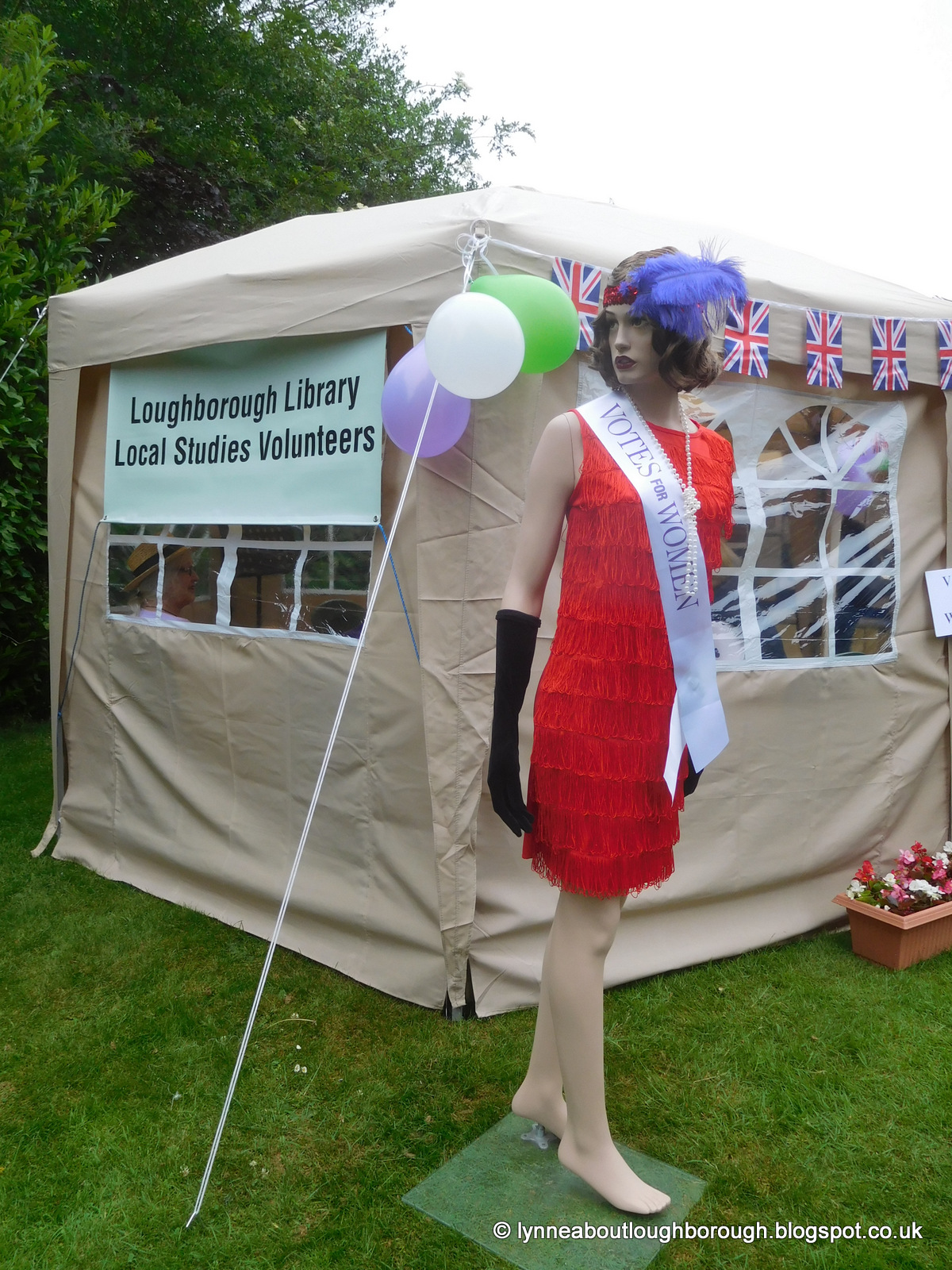
The week started with a meeting with a large group of folk, all engaged with activities and projects related to Loughborough. There seems to be a lot of big anniversaries coming up in the next couple of years and there are some exciting plans afoot. The next upcoming event to look out for is Picnic in the Park on June 8th, arranged by the folk at Charnwood Arts. Staff from the Local and Family History Centre, aka the Loughborough Library Local Studies Volunteers, will be hosting a stall celebrating the 200th birthday of both Queen Victoria and Prince Albert. Victoria and Albert will be in attendance - well, actors will be portraying them!

Picnic in the Park 2018

Talking of the Local and Family History Centre, the current display is a great one - the Midland Main Line then and now - and well worth a visit if you can.


I spent an evening talking with loads of people about what about Loughborough we'd like to see in the Victoria County History volume on the town. This is a national project that's been going since 1899, with the aim of writing a history of every single parish in the country. Progress was initially quite swift, but has since slowed down, and there are still many areas of the country to be written about. We had so many ideas Loughborough's history, it just reinforced to me how fantastic our little town is, and oh so interesting! We thought there was so much to include that we could fill lots of volumes!

I missed a trip to Nottingham with a dear friend due to illness. I was so looking forward to being shown around some of the more interesting parts, especially as I rarely venture off the beaten track that is the Broadmarsh Centre route through to the Victoria Centre, although I did once have a guided tour of the areas associated with D H Lawrence, which was fascinating, I have been to Green's windmill, and I recently had a look at the Alfreton Road area.


Green's windmill


Back in Loughborough, and at the Local and Family History Centre I did a bit of research and met some very interesting people, with whom I seemed to have much in common, not least an interest in milestones!!

After many years of not being available for training, I finally made it to the Old Rectory Museum for some training to be a guide during the open season! Wow! What an exciting opportunity to be able to show people around the building and explain its history, as well as learning something about the artefacts upstairs. There were three of us being trained, which should help towards keeping the ORM open, but there's always a warm welcome for anyone else to be trained up as a guide - just get in touch with the ORM if you're interested!


At the weekend I had a front row seat at a concert in the Trinity Methodist church on Royland Road, given by the Loughborough Male Voice Choir and Hathern Band. Sadly, the youngest wasn't playing due to revision for exams, but it was a great concert, with some lovely singing and some superb playing.

Well, better go now, books don't write themselves!

You are welcome to quote passages from any of my posts, with appropriate credit. The correct citation for this looks as follow:

Dyer, Lynne (2019). Garendon Estate water mill. Available from: https://lynneaboutloughborough.blogspot.com/2019/05/a-week-of-local-history.html [Accessed 19 May 2019]

Take down policy:
I post no pictures that are not my own, unless I have express permission so to do. All text is my own, and not copied from any other information sources, printed or electronic, unless identified and credited as such. If you find I have posted something in contravention of these statements, or if there are photographs of you which you would prefer not to be here, please contact me at the address listed on the About Me page, and I will remove these.
Thank you for reading this blog. 

Lynne 


Sunday, 13 August 2017

Bells, fountains and courtyards

Before I was reminded about my 3rd blogging anniversary I was telling you about some of the connections I made with Loughborough whilst I was on holiday: I know I didn't get very far, and the moment has now passed, but last week we visited Chatsworth House. I admit I was a little disappointed that I saw no more of the artefacts and the building than I did the last time I visited, which was one Christmas when the Alice in Wonderland display was on. 

I hadn't realised that Chatsworth also hosts a regular exhibition for most of the year, and this year it was called House Style. The exhibition covered five centuries of fashion focussed on events and visitors to Chatsworth. It was all quite imaginative, but I found it very dark and hard to see the displays properly, and read the associated information.


That said, we had a great time, and spent about six hours there altogether. There were a number of things that struck me on this visit: 


The last time we came there was a very poignant exhibition about WW1 in a couple of rooms on the side: in those rooms this year, to chime with the fashion exhibition, there was an opportunity for children and adults alike to try on a variety of different hats, and take photos to post on social media under the #hatsworth hook!

As we walked around I couldn't help noticing the courtyard. This reminded me so much of a recent visit I made to the Ramada Loughborough, on High Street, when I discovered the beautiful little courtyard area, which was open to the public for afternoon tea. I was so enchanted at the book launch I went to, that I took the other half there for a chillaxed drink and an attempt at doing the crossword! There was a very helpful guide at Chatsworth who told us about the annual sculpture auctions they have and he pointed out the one in the courtyard which will be leaving soon. It was a bell in a stone fountain with a hare leaping over the top!
The courtyard and fountain at Chatsworth

The courtyard at Chatsworth

The courtyard and fountain at the Ramada Loughborough

The courtyard at the Ramada Loughborough

I also spotted some lace -albeit Venetian - in one of the display cabinets, and this reminded me of Heathcoat and Boden's lace factory on what was Mill Street, and is now Market Street.


Another thing that reminded me of Loughborough was the huge fountain in the huge pond!!! Rather like the ones in Queen's Park, although ours are naturally somewhat smaller! At Chatsworth the sun was shining, and we were lucky enough to spot a rainbow around the fountain. If you see me in Queen's Park one day, just sitting staring at the sky and the fountain, you'll know I'm waiting to see a rainbow!


One of the main features of the exhibition were the costumes worn to the fancy dress ball of the century in 1897 to celebrate Queen Victoria's Diamond Jubilee. Guests included Col. and Mrs Arthur Paget: not our Arthur Paget, engineer, inventor and maker of hosiery, who lived with his wife Rose, their eight children and five servants, in Radmoor House! Of course, the Duchess of Devonshire attended her own ball, and she was dressed in an elaborate costume representing Zenobia, Queen of Palmyra, which reminded me of the Loughborough perfume!


Radmoor House, the home of Loughborough's Arthur Paget and family


Duchess of Devonshire's Zenobia costume

Artefacts at the Old Rectory Museum

Then there was the helmet for the Derbyshire Yeomanry, which reminded me of the Leicestershire Yeomanry museum in the Carillon Tower.


And finally the conservatory, probably built by Messengers, but any large conservatory could have been built by them!

Well, that's all for today! See you next week.
  
You are welcome to quote passages from any of my posts, with appropriate credit. The correct citation for this looks as follow:

Dyer, Lynne (2017). Bells, fountains and courtyards. Available from: https://lynneaboutloughborough.blogspot.com/2017/08/bells-fountains-and-courtyards.html [Accessed 13 August 2017]

Take down policy:
I post no pictures that are not my own, unless I have express permission so to do. All text is my own, and not copied from any other information sources, printed or electronic, unless identified and credited as such. If you find I have posted something in contravention of these statements, or if there are photographs of you which you would prefer not to be here, please contact me at the address listed on the About Me page, and I will remove these.
Thank you for reading this blog. 


Lynne 


Sunday, 16 October 2016

Morley's

Well, over the years I've skim read a lot of local history material, some of which I later look at again in more detail, some things I do a bit more research on, and other things I forget. Or, at least, I think I've forgotten about things, but then something happens and all becomes clear to me!

Something like this happened to me earlier this week. I had spotted an advert for a talk happening in Heanor, being presented by the Heanor & District Local History Society. I don't know why, but I thought it might be interesting to pop along and listen to a talk about a hosiery factory in Heanor, so I might compare it with what I knew about hosiery factories in Loughborough. 

Hubby used to work throughout the whole of Derbyshire, and he had taken me to Heanor twice as there is a lovely antique shop there, but he was away this particular evening, so I filled the car with petrol (I have a phobia of running low on petrol, never mind running out!), braved the sudden cold spell, typed the postcode into the satnav and headed off up the M1. About 40 minutes later I arrived in Heanor, parked the car, and then promptly got lost, and had to go and ask for directions in the local corner shop!

Eventually I found the venue, arriving about 10 minutes later than planned, but approaching I thought, no, this can't be it! In front of the reception desk was a queue, a queue for a local history talk! Looking beyond the queue into the room, I could see it was full! It wasn't a small room, but it was crammed with people who had come to hear the talk. All in all I counted about 150 people! Heanor only has a population of just over 17,000, so this was a brilliant turnout the likes of which I've never seen at a Loughborough heritage talk: maybe I just don't go to the right places in Loughborough?!

Anyway, I eventually found a seat in the crowded room and prepared to listen to a knowledgeable lady talk about the firm of I & R Morley, hosiers. 
Awaiting the talk!
They had a big factory in Heanor, and it seemed that half the population of the town worked for them I think the figure of 1200 was suggested). We were told about the origins of the firm, the working conditions and the life and death of the owners of the firm. 

It was during the middle of the talk that it suddenly dawned on me that I knew Morley's! Now, I don't think Morley's have been in their factory on Nottingham Road since I've been living in Loughborough (since 1978) or at least, not since I've been more aware of buildings etc., so I think I only remember the building being Riker, but you know the one I mean, on the Nottingham Road canal bridge, the L-shaped building with the chimney that is now 3M.

Once I'd realised why I had been attracted to the talk in the first place, I really paid very close attention to the story of the Morley family. Apparently, as well as the Loughborough and the Heanor sites, they also had factories in Nottingham, Leicester (on Bonners Lane, which is very near where I work today!), London, Paris, Daybrook, Sutton-in-Ashfield and Grenoble.

The company was established in 1795 by John Morley and his brother Richard. So the company ought to have been J and R Morley, but actually was known as I and R Morley. This was because since Elizabethan times the letters I and J were interchangeable (apparently there were only 24 letters in the Elizabethan alphabet). 

Perhaps the most prominent member of the Morley family was Samuel, born 1809, died 1886. He was the one who built up the company, such that on his death, he left about the equivalent of £93m in today's money (I think that was the figure the speaker mentioned!). He was, apparently, a good employer, which was evidenced by the fact that he paid employees when they went to war, and in his will he left money to each worker, a sum dependant upon the number of years they had worked for the company.

In common with many men of the era, Samuel Morley was a philanthropist, an abolitionist, and a member of parliament. A further point of interest (for investigation at some later date!) was that he may have worked with someone by the name of Paget. There is a statue of Samuel Morley in Nottingham Arboretum: bizarrely, I visited this park for the first time ever at the beginning of September this year when we went on a guided D H Lawrence walk around Nottingham, and I stopped and looked at this statue, but at the time had no idea who the man was, nor what his significance was! Strangely, I didn't even take a photograph of him. 

When the speaker at the talk was introducing us to Samuel Morley, she spoke of things that were happening at the time he was born: so, in 1809 the first Indian restaurant opened in London, and 1886 was the first year that coca-cola became available.

Other little snippets I picked up were that a lady called Ann Birkin who worked for Morley's, had embroidered stockings for Queen Victoria (and I have a strange feeling that I saw these earlier this year when I paid a visit to Ruddington Framework Knitter's Museum), and that it was Morley's who made the stockings for Queen Elizabeth II on the occasion of her marriage. The talk was quite interactive, and imagine the surprise the speaker had when someone showed her the pair of Morley stockings, still in their box, with a price label of 2/6, that they had brought with them!

So, it was a very interesting evening, and I picked up a lot of information, both about Morley's and Heanor itself. 

Here's a link to some information about a project that's been going on to discover more about Samuel Morley and his factories

Much work has been going on at Morley's Nottingham factory, which is now, partly, a gallery space run by Backlit

There are a couple of videos on youtube - interviews with Heanor people who used to work at Morley's and a film about the inspiration behind the renovation of the Nottingham factory.

Apparently, like Loughborough, Heanor used to have a cinema called the Empire, although ours still exists as The Odeon, and the car park I used was opposite the King of Prussia pub (of which there is also one near Abergavenny in Wales, where I used to live)! The street signs in Heanor were also very, very interesting:
A Heanor street sign
Here's a link to a picture on the inloughborough website of the Morley factory from the canal towpath taken in 1968. And below are some pictures of the 3M Factory today:
Approaching from Leicester along the canal towpath

From the canal towpath

Bridge Number 38, 3M to the right

Looking up from the towpath

Looking along the building from the towpath

The frontage onto Nottingham Road

A view from the opposite side of the towpath

The chimney from the opposite side towpath

From the opposite side towpath
Anyway, that's enough from me for one day!!

See you next week!

You are welcome to quote passages from any of my posts, with appropriate credit. The correct citation for this looks as follow:

Dyer, Lynne (2016). Morley's. [Online] Available from: http://lynneaboutloughborough.blogspot.co.uk/2016/10/morleys.html [Accessed 16 October 2016]