Showing posts with label Robert Bakewell. Show all posts

Sunday, 25 May 2025

Robert Bakewell commemorative service

The previous post on this blog was a birthday blog for the 300th anniversary of the birth of Robert Bakewell, agriculturalist of Dishley. When I wrote the blog, I hadn’t had the pleasure of attending any celebratory events (apart from a very informative and interesting talk a few weeks earlier).

To mark the anniversary, there was a lovely service held at Dishley church, led by the Reverend Tim Day, vicar of Thorpe Acre church, Thorpe Acre church being the church which was built to replace the one at Dishley, around 1845, and designed by architect, William Railton. 


Amongst the people who congregated for the service were many local people, and children from the Robert Bakewell School. It was a gloriously sunny day – perhaps a bit too sunny, so a few of us sought out the shade!

A buffet lunch was held at Thorpe Acre church, where there were some superb information boards relating to Robert Bakewell, produced and exhibited by the New Dishley Society, and a celebratory cake!!


It's been quite a few years since I've been to Dishley church, so it was lovely to visit again. Here are some photos from the celebratory service.


At teatime, Leicestershire bellringers rang a quarter peal at Hathern church in honour of Robert Bakewell’s anniversary.

Extract from Ringing World, with thanks (1)

____________________________________

Notes

(1) https://bb.ringingworld.co.uk/view.php?id=1855332

____________________________________

Posted by lynneaboutloughborough

With apologies for typos which are all mine!

_______________________________________________

Thank you for reading this blog.

Copyright:

The copyright © of all content on this blog rests with me, however, you are welcome to quote passages from any of my posts, with appropriate credit. The correct citation for this looks as follows:

Dyer, Lynne (2025). Robert Bakewell commemorative service. Available from: https://lynneaboutloughborough.blogspot.com/2025/05/robert-bakewell-commemorative-service.html [Accessed 25 May 2025]

Take down policy:

I post no pictures that are not my own, unless I have express permission so to do. All text is my own, and not copied from any other information sources, printed or electronic, unless identified and credited as such. If you find I have posted something in contravention of these statements, or if there are photographs of you which you would prefer not to be here, please contact me at the address listed on the About Me page, and I will remove these.

External Links:

By including links to external sources I am not endorsing the websites, the authors, nor the information contained therein, and will not check back to update out-of-date links. Using these links to access external information is entirely the responsibility of the reader of the blog.

Blog archive and tags:

If you are viewing this blog in mobile format, you will not be able to easily access the blog archive, or the clickable links to various topics. These can be accessed if you scroll to the bottom of the page, and click 'View Web Version'. Alternatively, there is also a complete list of posts, which when clicked will take you to the page you are interested in.

Searching the blog:

You can search the blog using the dedicated search box that appears near the top of the blog when viewed in the web version. Alternatively, you can search using your usual search engine (e.g. Bing, Google, DuckDuckGo etc.) by following this example:

site: https://lynneaboutloughborough.blogspot.com/ “Radmoor House”

NOTE – the words you’re actually looking for must be in “” and the first of these must be preceded by a space

Thank you for reading this blog.

Lynne

Thursday, 22 May 2025

Robert Bakewell, agriculturalist: commemorating 300 years since his birth

I have been reminded that Friday 23 May marks the 300th anniversary of the birth of Robert Bakewell of Dishley. Last week I went to an excellent talk about Bakewell, his work, and his times, and remembered that a long time ago, when this blog was in its infancy, I wrote a couple of posts, after being taken on a walk around the disused church at Dishley, and the estate, one about the estate itself, and one about Robert Bakewell. I’ve also posted previously about the plaque on Warner’s Lane, Loughborough, that mentions him in connection with the Unitarian church of which he was a part.

The mosaic restored in 2023 by Dishley Residents' Association and Artisans at Dishley Grange. Funded by LCC Member's Highway Fund

Dishley Grange, a private farm, and home to some of the artisans mentioned above

So, for the forthcoming anniversary, I thought I’d take a different look at Robert Bakewell … well, a different look at Robert Bakewell the agriculturist, not any other Robert Bakewell! However, I was initially thwarted, when looking through one of the books in my collection [1], I found references in the index to Bakewell, the Derbyshire town, but also to Robert Bakewell – one a piece of text, the other a black and white photograph. Excitedly I leafed through to find the relevant pages, but they turned out to be about that other famous Robert Bakewell, he from Staffordshire, who created fancy ironwork, of which I have seen the gates in Derby cathedral, and the railings and birdcage at Melbourne Hall (which I’ve previously written about.)  


But what of Dishley’s Robert Bakewell? He wasn’t named in the book’s index, but I did manage to find a couple of paragraphs which the author had written about him. The first appeared in the section on The Shires, in chapter 1:

“The Wold country pastures were long famed for the excellent wool they produced; it was known as the best in England and laid the foundations of the county’s woollen industry. In the eighteenth century Robert Bakewell of Loughborough introduced the new Leicester type of sheep, and the county’s reputation for high-grade wool was still further enhanced. Today this breed is found wherever wool is extensively produced.”

The next quotation comes from the section entitled Lowland and Wold, which appears in Chapter 3 [with my paragraph breaks]:

On his virtual tour along the River Soar, Ingram moves south from Bunny, “to Dishley Grange where lived an eighteenth-century worthy who did as much for England as any of the great engineers or explorers. 

Here lived Robert Bakewell whose genius as a breeder of sheep and cattle provided the food for the rapidly expanding populations of the new industrial centres and without which the work of the great inventors and engineers could never have materialised. 

He started the new-fangled idea of irrigation, and surrounded the fields of his model farm with canals, and spent a great portion of his seventy years travelling round the country, examining stock, evolving new breeds out of old nondescript types. 

He established the science of pedigree stock-breeding, becoming the greatest pioneer of agricultural science in the world. The sixteen shillings stud-fee which he charged for hiring out his first rams for the season increased until it rose to 800 and then 1,200 guineas. Now most of the stock in England shows the effects of his years of effort. 

To Dishley Grange came visitors of high and low degree from all over Europe, to learn about his discoveries. Yet his country appreciated him so little that twice he nearly went bankrupt, and had to be helped by his friends.”

These two quoted sections on Robert Bakewell, the agriculturist, together run to nearly 300 words, compared with the text on Robert Bakewell the ironwork maker which runs to just over 50 words. Clearly “… his country appreciated him so little …” that he didn’t even appear in the book’s index! I mustn’t grumble too much – after all, I found the Robert Bakewell I was looking for, and the book did actually have an index!

We learned from the above entry that Robert Bakewell was concerned with the breeding of sheep and cattle, and irrigation. In addition, he also improved the Leicester cart horse, to become the forerunner of the Shire horse, and he also tried his hand at pig-breeding. However, whether or not he was involved with Hugo Meynell of the Quorn Hunt in selectively breeding fox hounds is unclear.

So, the beginning of the paragraph which follows the above extract about Bakewell is a statement which makes me cross!! And reminds me of why I write this blog, write books about Loughborough, lead guided walks around the town, and share my love of Loughborough through presentations. Here it is:

“Loughborough is the second biggest town in the county, but it is not a particularly interesting place …”

I beg to differ!! Ok, so Ingram does continue that sentence with “apart from its bellfoundry.” But this still doesn’t do our wonderful town justice!!

However, to give Ingram his due, while he might have had an intimate knowledge of the hamlets, villages, towns, and cities in the counties of the north Midlands, he would not have been able to share this in much detail in just 116 pages!

Here’s hoping that the expectations of the writer of the book’s flyleaf came to fruition:

“Text and pictures together should win many new friends for a part of England which is less visited or appreciated than its riches, both of landscape and architecture, deserve.”

As part of the commemoration of Bakewell’s birth, 300 years ago, members of the New Dishley Society have written and released a new book, Robert Bakewell Britain’s Foremost Livestock Breeder which will be available from mid-May 2025, for £25, plus £4 post & packing inland UK. The book contains, inter alia, much newly researched material on the Bakewell family, their farming provenance, the distribution of his famous animals and his bankruptcy. It is an illustrated, hardback book running to 341 pages. To obtain a copy of the book please apply to ndssecretaryatgmaildotcom (making the usual substitutions) and include your name, address with postcode, and email address.

____________________________________

Notes

[1] Ingram, J. H. (1947). North Midland Country: a survey of Cheshire, Derbyshire, Leicestershire, Nottinghamshire and Staffordshire. Series: The Face of Britain. London: Batsford, pgs. 13, 15, 26, 29, 93 & 94

____________________________________

Posted by lynneaboutloughborough

With apologies for typos which are all mine!

_______________________________________________

Thank you for reading this blog.

Copyright:

The copyright © of all content on this blog rests with me, however, you are welcome to quote passages from any of my posts, with appropriate credit. The correct citation for this looks as follows:

Dyer, Lynne (2025). Robert Bakewell, agriculturalist: commemorating 300 years since his birth. Available from: https://lynneaboutloughborough.blogspot.com/2025/05/robert-bakewell-agriculturalist.html  [Accessed 22 May 2025]

Take down policy:

I post no pictures that are not my own, unless I have express permission so to do. All text is my own, and not copied from any other information sources, printed or electronic, unless identified and credited as such. If you find I have posted something in contravention of these statements, or if there are photographs of you which you would prefer not to be here, please contact me at the address listed on the About Me page, and I will remove these.

External Links:

By including links to external sources I am not endorsing the websites, the authors, nor the information contained therein, and will not check back to update out-of-date links. Using these links to access external information is entirely the responsibility of the reader of the blog.

Blog archive and tags:

If you are viewing this blog in mobile format, you will not be able to easily access the blog archive, or the clickable links to various topics. These can be accessed if you scroll to the bottom of the page, and click 'View Web Version'. Alternatively, there is also a complete list of posts, which when clicked will take you to the page you are interested in.

Searching the blog:

You can search the blog using the dedicated search box that appears near the top of the blog when viewed in the web version. Alternatively, you can search using your usual search engine (e.g. Bing, Google, DuckDuckGo etc.) by following this example:

site: https://lynneaboutloughborough.blogspot.com/ “Radmoor House”

NOTE – the words you’re actually looking for must be in “” and the first of these must be preceded by a space

Thank you for reading this blog.

Lynne

Sunday, 11 June 2023

Building Stone

Sadly, I missed a recent talk hosted by the Friends of Charnwood Museum, about stone, so, I had a look back over the blog to see what I’d already written. I must admit, I thought I’d done a piece on Coade stone, an artificial stone, but find I haven’t so I’ve only mentioned it in passing in some posts, like [quote blog posts]. So, let’s have a quick look at some real local stone, and where it’s been used.

Old Rectory, Rectory Place

The 13th-century building was once the home to the rectors of Loughborough, having been passed to the church around 1228 by the Cortlinstoke family. By the time it fell out of use, around 1959, it had been extended enormously, and would have been a substantial family home, however, once unoccupied the building fell into disrepair and was partially demolished, revealing its earlier core, which has been retained.

The building you now see is said to be made of Bromsgrove Sandstone; North Charnwood Diorite; Charnian (volcaniclastic breccia); Charnian (volcaniclastic sandstone); Swithland slate; and Charnian (banded tuff).


All Saints with Holy Trinity, Steeple Row

This church is a 14th century building, probably built on the site of an earlier church, and it is here that the rectors of Loughborough would have done most of their work. over the years the church has been subject to many alterations, most notably that by architect Sir George Gilbert Scott in the mid-19th century. 20th and 21st century renovations have included those to the pinnacles on the belltower, and various new stones in the fabric of the building. I've written more extensively on a very early blogpost.

Stone that has been used in the construction of the church includes Millstone Grit; Triassic Red Sandstone; North Charnwood Diorite; Upper Lincolnshire Limestone; Charnian (metasediments0; Swithland slate, and Mountsorrel Granodiorite.


Holy Trinity Church, Moor Lane 

This church is no longer a religious building, but was once a busy church serving the Leicester Road area of Loughborough, opened in 1878, to a design by William Arthur Blomfield. You can find out a bit more about its history on an earlier blogpost.

The range of natural stone used in the construction of the church is much less varied than the Old Rectory and Loughborough’s All Saints church, comprising only of Mountsorrel Granodiorite and Upper Lincolnshire Limestone.


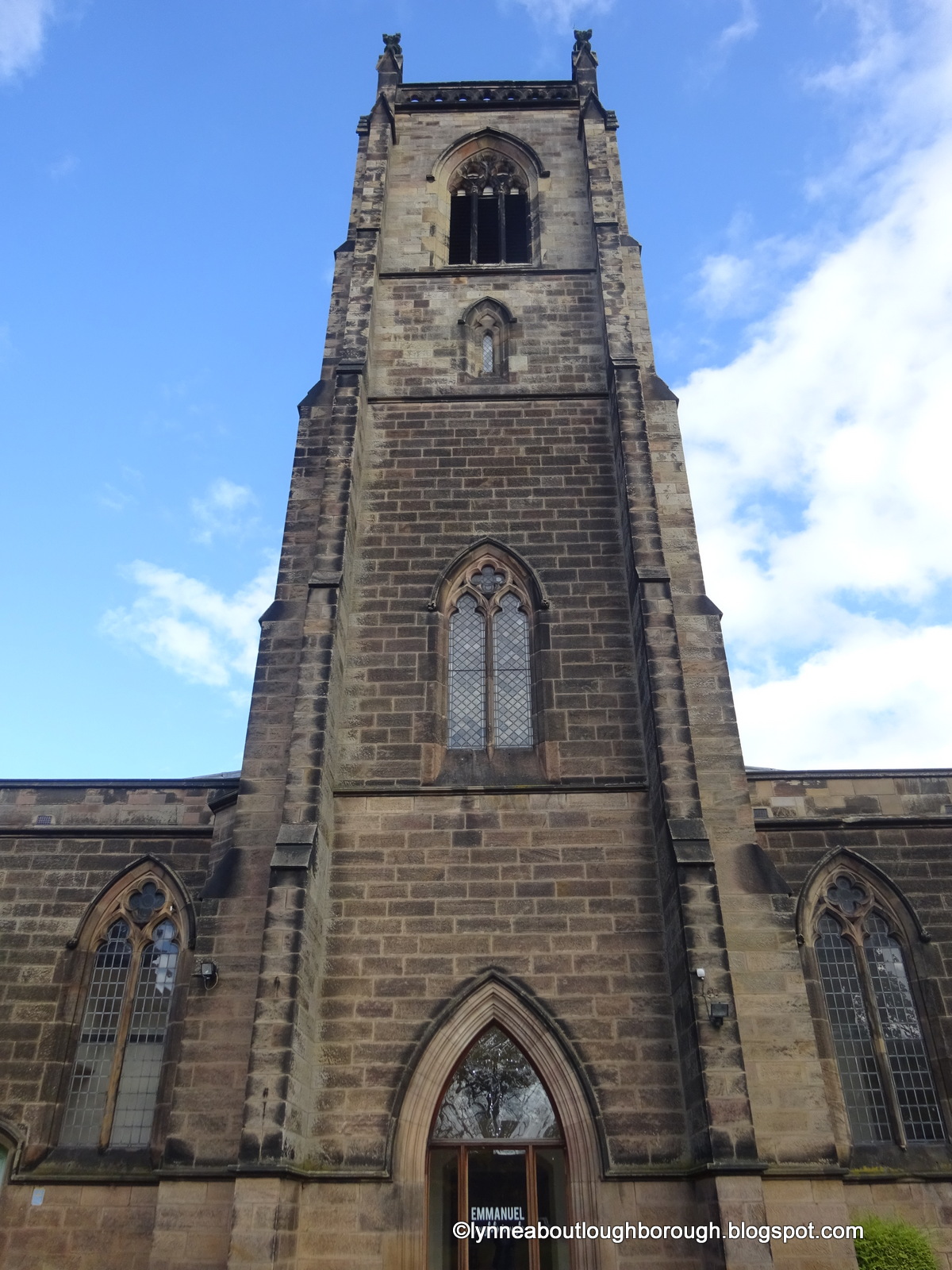
Emmanuel Church, Forest Road

The church was created around 1838, and its first rector was William Holme, who was also Rector of All Saints. The first Rector dedicated solely to Emmanuel was Reverend Bunch, who lived at the Emmanuel Rectory, on Forest Road, close to Mountfields House.  

I’ve not written much about Emmanuel church, but have done a couple of posts about the associated rectory. Part 1 and Part 2 

It appears that Emmanuel Church is constructed solely of Millstone Grit, but has a much later extension using other stone.


St Mary’s Nanpantan

St Mary’s church in Nanpantan started life as a Mission Hall, created by the Warner family of Nanpantan Hall, in 1888. Since 2015, St Mary’s has been a parish in its own right, so no longer connected to Emmanuel.

Using Charnian (volcaniclastic sandstone), St Mary’s is another church which is constructed only from one stone, that is until the 1960s when a granite Chapter House, with a flat-roofed vestry was built.


All Saints Thorpe Acre

This particular church is more usually known as Thorpe Acre church, and was built in 1845 to a design by William Railton, who was the architect responsible for the design of Nelson’s Column in London, and a number of other local Leicestershire churches. I've written extensively about Railton - here's one example post. The church, which replaced All Saints at Dishley (see below), is proud to have an east window, created in 1892 by Charles Eamer Kempe, and in the 1980s, the church was extended and joined to the school house.

All Saints, Thorpe Acre, was constructed using only Millstone Grit, until the extension was built.


All Saints Dishley

Dishley church is now a ruin, having been deconsecrated when All Saints Thorpe Acre was created in 1845. The ruins, which contain plaques to the agriculturalist, Robert Bakewell, are close to Dishley Grange Farm, which was part of the Garendon Estate.

The stone used in the construction of All Saints at Dishley includes Charnian (volcaniclastic sandstone); Diseworth Sandstone; Charnian (igneous); Triassic Red Sandstone; Cobbles (Bunter), and Bromsgrove Sandstone.  


_______________________________________________

posted by lynneaboutloughborough

With apologies for typos which are all mine!

_______________________________________________

Thank you for reading this blog.

Copyright:

The copyright © of all content on this blog rests with me, however, you are welcome to quote passages from any of my posts, with appropriate credit. The correct citation for this looks as follows:

Dyer, Lynne (2023). Building Stone. Available from: https://lynneaboutloughborough.blogspot.com/2023/06/building-stone.html [Accessed 11 June 2023]

Take down policy:

I post no pictures that are not my own, unless I have express permission so to do. All text is my own, and not copied from any other information sources, printed or electronic, unless identified and credited as such. If you find I have posted something in contravention of these statements, or if there are photographs of you which you would prefer not to be here, please contact me at the address listed on the About Me page, and I will remove these.

Blog archive and tags:

If you are viewing this blog in mobile format, you will not be able to easily access the blog archive, or the clickable links to various topics. These can be accessed if you scroll to the bottom of the page, and click 'View Web Version'. Alternatively, there is also a complete list of posts, which when clicked will take you to the page you are interested in.

Searching the blog:

You can search the blog using the dedicated search box that appears near the top of the blog when viewed in the web version. Alternatively, you can search using your usual search engine (e.g. Bing, Google, DuckDuckGo etc.) by following this example:

site: https://lynneaboutloughborough.blogspot.com/ “Radmoor House”

NOTE – the words you’re actually looking for must be in “” and the first of these must be preceded by a space

Thank you for reading this blog.

Lynne


Sunday, 4 October 2020

So who was Bernard Nixon Wale?

... obviously a man with Loughborough connections!!

Bernard Nixon Wale was born in Willoughby-on-the-Wolds in 1872, to a farming family. He studied at a variety of institutions, and worked in a wide variety of places across the country in a number of different roles, before returning to Loughborough in the early 1930s. There are many connections to Loughborough, some of which are outlined below.  

Focussing on just one of his positions: in 1909 Bernard Nixon Wale was appointed to the post of Principal at the Seale-Hayne AgriculturalCollege in Newton Abbot, a college which was to be created from an endowment of Mr Seale Hayne, and which had seen much delay in its creation. When the news of his appointment was announced, Bernard Wale was described in the press very favourably:

“He is a young man for the hight post, only 37 in fact, but he has a good London degree in science, and has shown great ability successively at London University, the Midland College, and the Wye College (Kent and Surrey). He also holds the Cambridge diploma for agricultural science.” – ‘London Evening Standard’ 27 December 1909, pg 3

“In making this choice [Bernard Wale, BSc. of the South Eastern Agricultural College at Wye, Kent] the governors have no doubt selected a gentleman particularly qualified for the post. He has had a brilliant career, and has come through numerous examinations with flying colours, and, what is very important, he has a thorough practical knowledge of agriculture. Naturally, as the son of a farmer, he had every opportunity to become intimately acquainted with this work, and four years he spent exclusively on a farm of some 200 acres, where all kinds of agricultural work were carried out, including the breeding and rearing of farm stock, sheep feeding, corn and root-growing, and dairying. For eight years he had the management of the land in connection with the Brewood Grammar School, Staffs., and during that time he purchased the stock, seeds and manures which were needed. Mr Wale has, further, had extensive experience in experimental work, including the manuring of grass, roots, and cereals, pig feeding, milk production and research work on cheese discolouration by bacteria. Nor is the new Principal unknown as a writer, for in the agricultural press have frequently appeared articles from his pen touching, amongst other things, catch cropping, the financial aspect of sheep washing, and the variation in the quantity and quality of milk.” – ‘Western Times’ 26 November 1909, pg 7

But it is the report a week earlier in the same newspaper – ‘Western Times’ 20 November 1909, pg 2 – that clearly links Bernard Nixon Wale with Loughborough:

“The new Principal, who is 38 years of age, has had a distinguished career, and was highly recommended. Educated at the Grammar School, Loughborough, Leicestershire, he was for three years, 1892-1895, at Cambridge University as a student of the Cambridge and Counties Agricultural Scheme.”

According to this report he was also a student at the Midland Agricultural and Dairy College in Kingston, Derby, and at the University College, Nottingham. The article goes on to mention every possible educational attainment and accolade that Bernard Wale had ever achieved, as well as information about his practical knowledge, which it said was:

“ … extensive. As a farmer’s son he has always had a very intimate practical acquaintance with farm work and farm management of every description. Four years were exclusively spent on a farm of 200 acres … For two years (1896-1898) he was in close touch with the method of farming adopted on the Midland Agricultural and Dairy College Farm; and for eight years (1898-1907) he was managing the land in connection with the agricultural side of Brewood Grammar School, Staffs., including the purchasing of stock, seeds and manure necessary for the same. Since 1908 he has had the joint management of Wye College Farms of 460 acres.”

In addition to his lecturing work, he has been engaged in experimental work:

“In regard to his experimental work and organization he has been engaged at the Midland Agricultural and Dairy College in carrying out experiments on manuring for hay, pig feeding, and milk production; research work on cheese discolouration by bacteria; and the tabulating of results and drawing up reports on the same. Organising experimental work on the agricultural side at Brewood included – the manuring of grass, cereals and roots, a comparison of yields from different varieties of farm crops, and sheep feeding experiments. He has also been engaged in the planning of pupils’ garden and field plots, bee-keeping and poultry; in field days and demonstrations to farmers on the experimental plots, and charlock spraying on selected farms; in arranging of local classes in dairying and hedge layering (including a course of lecture to elementary school teachers on ‘Insect pests’.). Being the first agricultural instructor appointed to Brewood he had the sole organisation of classes and subjects to be taught, with the general arrangement of timetables, the drawing up of prospectuses and reports of experimental work. At Wye College he was engaged in the organisation of the agricultural teaching in the lecture room and on the farm for four assistants, the latter including the arranging of classes in ploughing,  mowing, sheep shearing, hedge layering, land draining, milking and butter making. …”

The report goes on to say that Bernard Wale also did advisory work with farmers and others, and has:

“…written a good deal for the agricultural press, his contributions including: reports on experimental work; variation in the quantity and quality of milk, catch cropping etc.; autumn cultivation as affecting the water supply of the soil; mendelism in plant and animal breeding; plants in enclosed spaces etc.; and the financial aspect of sheep washing … Mr Wale … has had a thorough theoretical and practical training … he is an enthusiastic teacher. ‘There are’ Professor Turner [says] ‘few men to whom I could more willingly commit a son of my own, as I should feel certain that his education would be well attended to, and that the moral effect of Mr Wale’s teaching would be excellent. I may add that Mrs Wale is a lady of educational experience and refinement, and that her interest in connection with the college would be of the very best.’”

The article finishes with a list of the testimonials received from many, many influential people, in support of Bernard Wales, including from Professor G D Living, MA, FRS, who was Professor of Chemistry at Cambridge University.

Reading about Bernard Wale’s experimental work and advisory work, particularly into plant and animal breeding reminds me so much of the work that Robert Bakewell of Dishley did into the breeding of sheep, cattle and heavy horses, and his work with turnips! More about Robert Bakewell is in an earlier blogpost.  

Robert Bakewell in mosaics

Back to Bernard! Although Bernard Wale was appointed to be its Principal in 1909, Seale-Hayne college was not actually built until 1919, its construction timescale being disrupted by the First World War. Thus, Bernard Wale found himself undertaking a variety of duties which included lecturing in various places, like Linfield, and Torquay Museum, and to groups like the Mutual Improvement Association of Ashburton. He also judged agricultural and horticultural shows, like that at Islington. Bernard Wale presided over the annual event of the Newton Abbott Men’s Own Brotherhood, chaired the YMCA meetings, and was part of the Royal Sanitary Institute 28th annual congress executive committee, which event took place in Exeter.

In his capacity as joint livestock officer for Devon and Cornwall he visited Helston where he explained about the government’s Development Fund to the Helston Farmers’ Union. Bernard Wale was a member of the Primrose League and attended the annual meeting in Sheffield. He also attended and presented at farming conferences, e.g. at Newton Abbott.

During the First World War, Bernard Wale wrote a letter to the “Western Morning News” of 22 February 1916 expressing astonishment that the council allowed the lights of Newton Abbott to shine out: far from being as glaring as ever, he suggested they were even more glaring than a year ago. He questioned the use of lighting in specific locations, including Wolborough and Knowles hills, which, in his opinion, would:

“… invite the attention of the enemy. This was not the time to consider the dividends of the lighting companies.”

Bernard Wale was not alone in his concerns, which were shared by various inhabitants, like Mr W Eggington suggesting that “it was indiscreet to have the place all lighted up again, just when the raids had commenced”

Unlike Loughborough, which was hit by Zeppelins bombs on the night of 31st January 1916, Newton Abbot was not targeted by Zeppelins. 

Zeppelin raid on Loughborough, commemorative plaque unveiled January 2016


As Loughborough trained women to become munitions workers, so Bernard Wale offered the opportunity to women to be trained to work the land. In a letter printed in the “Exeter and Plymouth Gazette” of  8 May 1916, pg 3, Bernard Wale makes an offer from his college:

“… it becomes increasingly important to safeguard our home-grown food supply, and if the men must go [to the Front] … women must take their place. Already there are many women who have volunteered for farm work, or have shown their readiness to learn, but many more will be required … The women of our Allies, and also of our enemies, are working on the land and thus setting free their relatives for the fighting lines, and I believe that our women will do the same …”

However, Bernard identified a problem:

“ … there is one thing lacking amongst our farmers – a more sympathetic attitude towards women’s employment on the land.”

He did however acknowledge that:

“ … Many [farmers] see quite clearly the necessity of utilising women on their own farms … some women … can do really efficient work on the land after a short training, combined with patience and sympathy on the part of the farmer.”

Bernard was keen to make an offer:

“ … with the approval of the Board of Agriculture and the County Councils of Devon and Cornwall, and also as a war emergency measure, the Governors of Seale-Hayne College are providing a month’s course of practical instruction for women in farm work on the College farm. There is to be a succession of courses, each of four weeks’ duration, and after their training it is stipulated that these students shall work on farms for a period of at least three months, provided a suitable offer of employment is made at a reasonable rate of wages”

The instruction on offer was pretty extensive and included:

“… milking, dairying, calf, pig and poultry feeding, grooming, feeding and  harnessing of horses, harrowing, rolling, hoeing and harvesting according to season, and other lighter branches of farm work.”

Following the publication of this letter in the newspaper, at meeting at Kingsteignton, both Bernard Wale and his wife Edith talked about training women to work on the land:

“… Mrs Wale … urged the women to augment the food supply by working on the land, whole or part-time, by cultivating their gardens, by keeping poultry or pigs, and by helping in the harvesting, and always do what they could to prevent waste.” – ‘Exeter and Plymouth Gazette’ 2 June 1916, pg 12

According to the ‘Military Times’ of 30th November 2018, the First World War was arguably the first ‘total war’. John Heathcoat’s factory in Tiverton, which had moved to the town in 1816, following the Luddite attacks, was Tiverton’s largest employer in 1914, and it switched from the production of the lace for which it was well-known, to the production of munitions, and with many men away from home, fighting abroad, it was women who were working the machines.

Re-enacting the Luddite attacks on Heathcoat's factory in Loughborough, Chorus Theatre

Throughout the period 1909-1914, work on the actual Seale-Hayne college buildings was either proposed or taking place. In 1911 between 60 and 70 applications were received for the college building design. Prizes of £100, £50 and £30 were offered by the college governors for the best sets of plans. The cost of the proposed building was not to exceed £20,000, although future extensions, at a cost of £10,000 were an integral part of the submissions.

In 1912 the college was inviting tenders for the laying of about 2,800 yards of 3-inch cast-iron pipes! The plans were available to view at the public library, and the exact specifications were available from Bernard Wale.  

In the event, the Seale-Hayne college buildings were completed between 1912 and 1914, but the first students did not attend until 1919.

Although we have seen some connections with Loughborough – Bernard Wale’s attendance at the Grammar School, Zeppelin bombing during 1916, and Heathcoat’s lace-making factory in Tiverton, and similarities with Robert Bakewell, come by next week to learn more about Bernard Wale’s family, his connections to many different Loughborough families and about his residence in Loughborough.

In relation to Zeppelins, Heathcoat and Robert Bakewell, you can follow the virtual plaque walk which will take you to the commemorative plaques related to these people and events, and there is a virtual walk specifically related to the Zepplin raid, and to the Luddite attacks.  

You are welcome to quote passages from any of my posts, with appropriate credit. The correct citation for this looks as follow:


Dyer, Lynne (2020). Who was Bernard Nixon Wale? Available from: https://lynneaboutloughborough.blogspot.com/2020/10/so-who-was-bernard-nixon-wale.html [Accessed 4 October 2020]

Take down policy:

I post no pictures that are not my own, unless I have express permission so to do. All text is my own, and not copied from any other information sources, printed or electronic, unless identified and credited as such. If you find I have posted something in contravention of these statements, or if there are photographs of you which you would prefer not to be here, please contact me at the address listed on the About Me page, and I will remove these.

You can leave comments below, but do check back as my reply will appear here, below your comment.

Thank you for reading this blog. 

Lynne             

Sunday, 16 August 2020

Loughborough Agricultural and Horticultural Show


A chance sighting of the name Crimwell Chief has sent me off on a real treasure hunt this week!!


Who would have thought such a name could have resulted in so much time spent on research!

Loughborough Agricultural Association was set up in 1838, and in 1839 its first anniversary show took place on Mr Warner’s land on the London Road – so probably in the grounds of The Elms. There already were other shows happening in places like Ashby-de-la-Zouch, Market Harborough and Waltham-on-the-Wolds, and the hope was that Loughborough’s would equal any similar show in the Midland Counties.

The show did indeed prove to be successful, and ran for nearly 100 years.


The pictures below were taken at the 1948 show:

Vanners at the 1948 Loughborough Show


A bull at the 1948 Loughborough Show


A cow at the 1949 Loughborough Show


Showing in the ring at the 1949 Loughborough Show


Around 1880 the show moved to Mr W.B. Paget’s land, Southfields – today’s Southfields Park – and continued in the same format until 1930, when financial difficulties forced a change of focus. Although many of the shows were held on Southfields Park, there were a number of occasions when the show took place elsewhere. In 1920 the former cricket ground at Allsopps Lane was the venue; in 1929 the show took place on the Corinthians football ground, and the final show of its type, in 1930, took place in the grounds of Burleigh Hall.

Most of the shows were held in mid-September, and most years were on a Wednesday, but the association did play with the date a bit, so there were times when it was held in early August. During the period of the First World War, no show took place.

Following the stretch of financial difficulties, the show was rebadged as an exhibition, and from 1937 it was held in various locations, including at Cedars Farm, Normanton-on-Soar in 1937; in Wymeswold in 1939, and at Ladygate Farm, Diseworth in 1947. There were no shows during the period of the Second World War.

I’m unsure where the 1948 and 1949 shows were held, but it was these shows that popped up when I was researching Crimwell Stuart.

Our area has long been associated with Robert Bakewell, the eighteenth-century agriculturalist who developed an animal breeding programme which improved the quality of sheep (the Leicester Longwools) and cattle (the Longhorns). Bakewell, who lived and farmed at Dishley Grange also improved the process of irrigation. The other improvement that he made was to the heavy horse, which was the forerunner of the Shire horse, a type of draught horse, being tall, strong and hardworking and often used in farm work like ploughing. Shire horses, often known as draught horses, were often used to pull carts, perhaps carrying beer.    

So, like Songster – Loughborough’s war horse - and Sunloch – a Loughborough winner of the Grand National in 1914 – Crimwell Stuart turned out to be a horse! On 31st July 1948, Crimwell Stuart, a bay gelding, took part in the Loughborough Show, where he came first in his class, and was the runner-up of the challenge cup for the best horse in the draught horse section. Crimwell Staurt was owned by Offilers Brewery, of Derby: they also entered another of their horses, Samson, into the show, and it was he who won the challenge cup.

As well as owning Ambrose and Birkwood Surprise, Offilers also owned quite a number of horses whose names began with ‘Crimwell’, including Crimwell Quality; Crimwell Chief, and Crimwell Prince.  Other Crimwell horses included Crimwell Mimic; Crimwell Goldlust, and Crimwell Modern Boy, although I am not sure who owned them.

These horses were all around in the late 1930s-late 1940s, and appear to have been bred by William Brock at his stud farm called Crimwell Pool in Lower Whitley, Cheshire. Legend has it that the farm was actually named after Oliver Cromwell, as it is thought Cromwell watered his horses here in 1645 – which reminds me that Cromwell is reputed to have rested his horses and his men in our parish church during the Civil War, and, of course, it also reminds me of the story of the Bloody Pool in the grounds of Garendon Hall, so named because legend says that during the Civil War, the pool turned red on four consecutive days, which was believed to represent the 4 years of the Civil War.

However, the name of Cromwell Pool, was changed to Crimwell when the farm became registered to breed pedigree Shire horses. In 1841, at 175 acres, the farm was one of the largest farms in Lower Whitley. 143 of those 175 acres were sold to William Brock around 1941, where as well as breeding Shire horses, he also bred British Friesian cattle, and large white, and Saddleback pigs. His Queen Mary line of pigs trace their lineage back to Derby in 1881, and the prefix ‘Crimwell’ was first used for the large white pigs in 1922. Foot and mouth disease in 1967 meant that the farm had to be re-stocked. Descendants of William Brock continue to farm at Crimwell Pool.  

Offilers, of course, was a brewery formed in Derby in 1876. Although taken over by Charrington in 1965, and closed in 1966, there is still evidence of Offilers in Loughborough, in the windows of the Peacock on Factory Street, and in off-licence ghost signs advertising their ‘nut brown ale’, like the one on the corner of William Street and Curzon Street.

As for the Loughborough Agricultural and Horticultural Show, well this was rather like today's Leicestershire County Show, which did for a few years take place on the land next to Dishley Grange, but which now takes place at the showground in Market Harborough, or like the Sutton Bonington Show - some pictures towards the end of this post. Here's hoping these will return next year. 


You are welcome to quote passages from any of my posts, with appropriate credit. The correct citation for this looks as follow:


Dyer, Lynne (2020). Loughborough Agricultural and Horticultural Show. Available from: https://lynneaboutloughborough.blogspot.com/2020/08/loughborough-agricultural-and.html     [Accessed 16 August 2020]

Take down policy:
I post no pictures that are not my own, unless I have express permission so to do. All text is my own, and not copied from any other information sources, printed or electronic, unless identified and credited as such. If you find I have posted something in contravention of these statements, or if there are photographs of you which you would prefer not to be here, please contact me at the address listed on the About Me page, and I will remove these.
Thank you for reading this blog. 

Lynne