Showing posts with label Nottingham. Show all posts

Sunday, 8 June 2025

So Who Was William Thomas Cartwright

My research into the history of Loughborough takes me in all sorts of directions, down all manner of rabbit holes, and just occasionally I find I have taken a completely wrong turn! This was the case with one piece of research I did, which saw me investigating the life and times of William Cartwright. Of course, I was fully aware from the outset that there were Loughborough families with the name of Cartwright, and even several people called William Cartwright, but on this occasion, I set off in the wrong direction, based on an erroneous assumption! This is most unlike me! I rarely make assumptions, so this all took me a bit by surprise!

Well, rather than let all that research into William Cartwright go to waste, and languish in my research files, I thought I’d share it here on the blog, after all, this particular William Cartwright was born and brought up in Loughborough, so is totally relevant to this blog!

So, let’s go!


William Cartwright’s grandfather was James, a farmer, originally from Derbyshire. William’s father was William Ambrose Cartwright who was born in Loughborough and who married Ann Haywood (née Bailey) on 15 October 1849 in All Saints church in Loughborough, when they were both aged 20. At the time, William Ambrose was a hosiery assistant in Angola wool, presumably at the factory of Richard Cartwright on Queen Street, who had begun the company in 1794, and soon joined forces with Edward Warner. The company employed around 2,000 workers in 1892, and is probably still well-remembered today. 

Back to William Ambrose and Ann ... The couple’s first child was William Thomas, whose birth was registered in the 3rd quarter of 1850, and who was baptised on 21 March 1851 at Emmanuel Church, by the Reverend Bunch. At the time, the family were living on Leicester Road, and lodging with them were 65-year-old William Vickers, a landed proprietor, and 66-year-old Elizabeth Vickers, an annuitant. The household had one servant, local girl, Emma Rossell.

A second son was born to William Ambrose and Ann in 1852, and he was named Thomas Bailey Cartwright, after Ann’s family. Another son, James, was born and was baptised on 18th March 1857 at All Saints church. In 1859, a daughter, Carrie, was born, and the family were living on Leicester Road in 1861, William Ambrose being a 32-year-old hosier’s warehouseman.

Sadly, Ann, wife of William Ambrose and mother to William Thomas, died in December 1862. In March of 1864, William Ambrose married Betsey Amatt at All Saints church, and in 1865 a child, Henry, a half-brother to William Thomas was born. In 1866 we find William Thomas, now aged 16 studying magnetism and electricity with the Loughborough Institute (possibly the Mechanics Institute), for which he obtained a second-class prize.

William Thomas’s half-brother, Albert Edward Harley was born in August 1867 but sadly he did not survive into childhood, and died on 18th February 1868. Another half-brother to William Thomas, named George, was born in 1870, at a time when William Ambrose had risen from the ranks of hosier’s warehouseman to a hosiery manufacturer, and when he was initiated into the Howe and Charnwood Lodge of the Freemasons.  

William Ambrose and wife, Betsy, were living on Stanford Lane, which on the census return for 1871 was listed just after Meadow Lane. Also living there were Thomas Bailey, James, Carrie, Henry aged 6, George E. aged 1, and two servants. Meanwhile, William Thomas was aged 20, and boarding with a family in Nottingham – Melbourne Street (Sherwood?), where he was a solicitor’s articled clerk. The family he was lodging with were the Bramelds – widow Anne aged 60, her daughter Mary, a governess aged 25, her sons Herbert 24, and Godfrey 22, both banker’s clerks – and one servant.

On 15 October 1874, William Thomas Cartwright married Mary Isabel Brameld (the governess listed in the 1871 census return), at St Stephen’s church in Sneinton, Nottingham. The home address was given as Belvoir Terrace. William was noted as a solicitor, his father William Ambrose was quoted as a merchant, and Isabel’s father was John Thomas Brameld a clerk in holy orders – a bit of a change from the time of Mary’s birth on 2 October 1845, and baptism on 13 November that year at St James, Westminster, when he was a china dealer.

A few years later, the 1881 census records William Thomas and Mary as living at 6 Park Terrace, Standard Hill, within the limits of Nottingham Castle, with daughters Edith 5, and Annie 4, and sons Thomas W. 2, and George A. aged 1. They also have three servants. Today, Park Terrace is a private road which runs parallel to the Ropewalk in Nottingham.

Another son, Vincent Henry, was born on 8 September 1882, and baptised 19 October 1882 at St Mary’s in Nottingham, while the family were living at Newcastle Drive Park. Vincent would later attend Rugby School, and matriculate for Oxford University in 1901. He played rugby, and later became a solicitor. In 1884, William was appointed as joint clerk to the magistrates of Nottingham, along with his business partner, Mr F. G. Rawson. Mr Rawson died in 1886, and William Thomas was appointed to the position solely, but later shared the duties with his sons, Thomas William, and Vincent Henry.

In 1891, William Thomas, now aged 40, was still a solicitor; wife Mary was aged 45, daughters Annie 14, and Margaret 5, and son Cecil Bailey aged 3, were living with four servants at 1 Newcastle Drive, Standard Hill, Nottingham. Meanwhile, the couple’s other four sons, all born in Nottingham - Thomas William (12), George Ambrose (11) Arthur James (9) and Vincent Henry (8) - were at school in Brighton, possibly at Chisham Place. A couple of years later, Betsy, William Thomas’s step-mother in Loughborough, died in 1893.

The family continued to live at 7 Newcastle Drive, and in 1901, William Thomas was aged 51, and a solicitor, his wife Mary Isabel was aged 55, and the children living at home were Edith aged 25, Annie aged 24, (neither of whom were working), Thomas William, a solicitor aged 22, and George A. a mechanical engineer aged 21. The family were supported by four live-in servants.

Later, in December 1901, Cecil Bailey Cartwright, a student at Rugby College, died at the school, at the age of only 14. An obituary in the Rugby Advertiser of 21 December states that Cecil was a bright, intelligent boy, who had been taken ill, and died a few weeks later. His funeral was in Nottingham, and there was a simultaneous service held at the Chapel in Rugby School. As a consequence of Cecil’s death, his brother, Vincent Henry, who was the football forward for Oxford University’s team, and who had been due to play sot the South against the North of England, dropped out of the team.

A few months later, in April 1902, William Thomas’s father, William Ambrose of Loughborough, died, and less than a year later, in March 1903, William’s wife, Mary died. 1903 brought happier news, when William’s half-brother, Henry Ernest, married Ann Elizabeth Pidd, daughter of Charles Pidd, a tailor. The address given was 13 Burton Street, presumably, Nottingham as the couple were married in Holy Trinity church, Nottingham, but could have been Loughborough.

In 1910, William Thomas was listed in Wright’s trade directory of Nottingham as a solicitor with Freeth, Rawson, & Cartwright & city magistrates’ clerk, at 13 Low Pavement, but living at 7 Newcastle Drive Park, Nottingham. Son, Thomas William was also listed with the same solicitors, and living at 1 Wellington Square, Nottingham, which was very close to Newcastle Drive. The following year, the census returns listed William Thomas as a 60-year-old solicitor, still living at 7 Newcastle Drive Nottingham, which had 16 rooms. His two daughters (not working) – Edith Mary aged 35, and Margaret Helen aged 25 – were also living there, as was son Vincent Henry now aged 28, who was a solicitor. The family still had four servants. The electoral rolls between 1911 and 1914 show that William Thomas was still living at 7 Newcastle Drive, Nottingham, and owned property at Long Clawson. In 1915, William Thomas suffered a seizure, and as a consequence reduced the amount of public work he did.

The 1921 census return was taken on 19 June that year, and William was still listed as a solicitor, but was possibly still poorly as he had a male attendant, a domestic nurse, as well as three servants, and was being visited by family members from Australia – son Arthur James, his wife, Marjorie, and their children Arthur William Alexander, Isabel Mary Ruth, and Ian Hebburn Scott. William’s two daughters lived with him – Edith Mary aged 45 on house duties, and Margaret Helen aged 35, a private secretary working on Oxford Street, Nottingham.

On 22 December 1921 William Thomas Cartwright of 7 Newcastle Drive, The Park, Nottingham, died. Probate was granted 20 January 1922 to his son, the solicitor Thomas William Cartwright. Effects were £1,103. The funeral took place on 24 December, at Nottingham church cemetery, and amongst the mourners attending was James Cartwright, William’s younger brother, who had made a name for himself in Loughborough – but his story is for another day, as is the story of the William Cartwright I had meant to research!!


____________________________________

Posted by lynneaboutloughborough

With apologies for typos which are all mine!

_______________________________________________

Thank you for reading this blog.

Copyright:

The copyright © of all content on this blog rests with me, however, you are welcome to quote passages from any of my posts, with appropriate credit. The correct citation for this looks as follows:

Dyer, Lynne (2025). So Who Was William Thomas Cartwright. Available from: https://lynneaboutloughborough.blogspot.com/2025/06/so-who-was-william-thomas-cartwright.html [Accessed 8 June 2025]

Take down policy:

I post no pictures that are not my own, unless I have express permission so to do. All text is my own, and not copied from any other information sources, printed or electronic, unless identified and credited as such. If you find I have posted something in contravention of these statements, or if there are photographs of you which you would prefer not to be here, please contact me at the address listed on the About Me page, and I will remove these.

External Links:

By including links to external sources I am not endorsing the websites, the authors, nor the information contained therein, and will not check back to update out-of-date links. Using these links to access external information is entirely the responsibility of the reader of the blog.

Blog archive and tags:

If you are viewing this blog in mobile format, you will not be able to easily access the blog archive, or the clickable links to various topics. These can be accessed if you scroll to the bottom of the page, and click 'View Web Version'. Alternatively, there is also a complete list of posts, which when clicked will take you to the page you are interested in.

Searching the blog:

You can search the blog using the dedicated search box that appears near the top of the blog when viewed in the web version. Alternatively, you can search using your usual search engine (e.g. Bing, Google, DuckDuckGo etc.) by following this example:

site: https://lynneaboutloughborough.blogspot.com/ “Radmoor House”

NOTE – the words you’re actually looking for must be in “” and the first of these must be preceded by a space

Thank you for reading this blog.

Lynne

Monday, 29 April 2024

Y is for Yates

According to the ‘Oxford Dictionary of Family Names in Britain and Ireland’, the surname Yates (or Yate, Yeates, Yeats, and Yetts) is:

“... a locative name, occupational name for someone who lived by a gate … in some cases because they acted as the gatekeeper or porter to a hall, monastery, or some other important building.”

The gates to Burleigh Hall, off Ashby Road

In 1881 there were just under 21,000 people bearing the surname in England, many of whom were resident in Lancashire, the West riding of Yorkshire, and the West Midlands, with some in Kent and Surrey. Not a name to be found very regularly in Loughborough then, but, of course, we weren’t without some members of a Yates family.

In ‘A-Z of Loughborough’ I introduced readers to William Yates (1792-1845), who was the son of a local shoemaker. William was educated at the Loughborough Grammar School, and became a Baptist missionary. He gives his name to one of the competitive houses of the grammar school.

I also shared the story of Samuel Yates (1766-1831), a local insurance agent for Hope Insurance. For a wager, Samuel walked to Nottingham and back every day for six days, from the Bull’s Head (now Esquires coffee shop) on High Street, to the Black’s Head, probably in Carlton, Nottingham, a roundtrip of about 30.5 miles. Despite having broken his leg 18 months before, and walking with a stick, Samuel won the bet. He walked 183 miles in a period of 66 hours and 9 minutes – restricted to the hours of 8am and 8pm - although by the time he returned to Loughborough for the final time, he was using two walking sticks.

Of course, there were many other people in Loughborough with the surname of Yates, down the ages. We have Samuel Yates, a baker in 1892. Then there’s John Yates, a boot and shoemaker on High Street in 1822. In 1828 we find a plasterer on Ashby Road, called Samuel Yates, and a builder named Joseph Yates, also on Ashby Road.  

In 1846 a William Yates is the licensed victualler at the Black Horse public house on Wood Gate, who by 1854 had moved to the Pack Horse, also on Wood Gate, where he – or possibly his descendants, also named William - remained until at least 1876. John Yates was a cowkeeper living at 10 Cobden Street in 1892, and John Joseph Yates was a clerk, living at 113 Park Road also in 1892, where he remained until at least 1908. The final Yates to mention, is J.H., who in 1928 was a fried fish dealer at 28 King Street, a building probably now replaced by the Crown apartments.

The former Pack Horse, now the Organ Grinder


Unlike William Yates’ walk, this has been a whistle-stop tour of some of the Yates people found in Loughborough – taken from street and trade directories, so by no means all of the families!   

____________________________________

This post is one in a series of posts for the ‘April A-Z Blogging Challenge


____________________________________

Posted by lynneaboutloughborough

With apologies for typos which are all mine!

_______________________________________________

Thank you for reading this blog.

Copyright:

The copyright © of all content on this blog rests with me, however, you are welcome to quote passages from any of my posts, with appropriate credit. The correct citation for this looks as follows:

Dyer, Lynne (2024). Y is for Yates. Available from: https://lynneaboutloughborough.blogspot.com/2024/04/y-is-for-yates.html [Accessed 29 April 2024]

Take down policy:

I post no pictures that are not my own, unless I have express permission so to do. All text is my own, and not copied from any other information sources, printed or electronic, unless identified and credited as such. If you find I have posted something in contravention of these statements, or if there are photographs of you which you would prefer not to be here, please contact me at the address listed on the About Me page, and I will remove these.

External Links:

By including links to external sources I am not endorsing the websites, the authors, nor the information contained therein, and will not check back to update out-of-date links. Using these links to access external information is entirely the responsibility of the reader of the blog.

Blog archive and tags:

If you are viewing this blog in mobile format, you will not be able to easily access the blog archive, or the clickable links to various topics. These can be accessed if you scroll to the bottom of the page, and click 'View Web Version'. Alternatively, there is also a complete list of posts, which when clicked will take you to the page you are interested in.

Searching the blog:

You can search the blog using the dedicated search box that appears near the top of the blog when viewed in the web version. Alternatively, you can search using your usual search engine (e.g. Bing, Google, DuckDuckGo etc.) by following this example:

site: https://lynneaboutloughborough.blogspot.com/ “Radmoor House”

NOTE – the words you’re actually looking for must be in “” and the first of these must be preceded by a space

Thank you for reading this blog.

Lynne

Sunday, 27 November 2022

New railway bridge

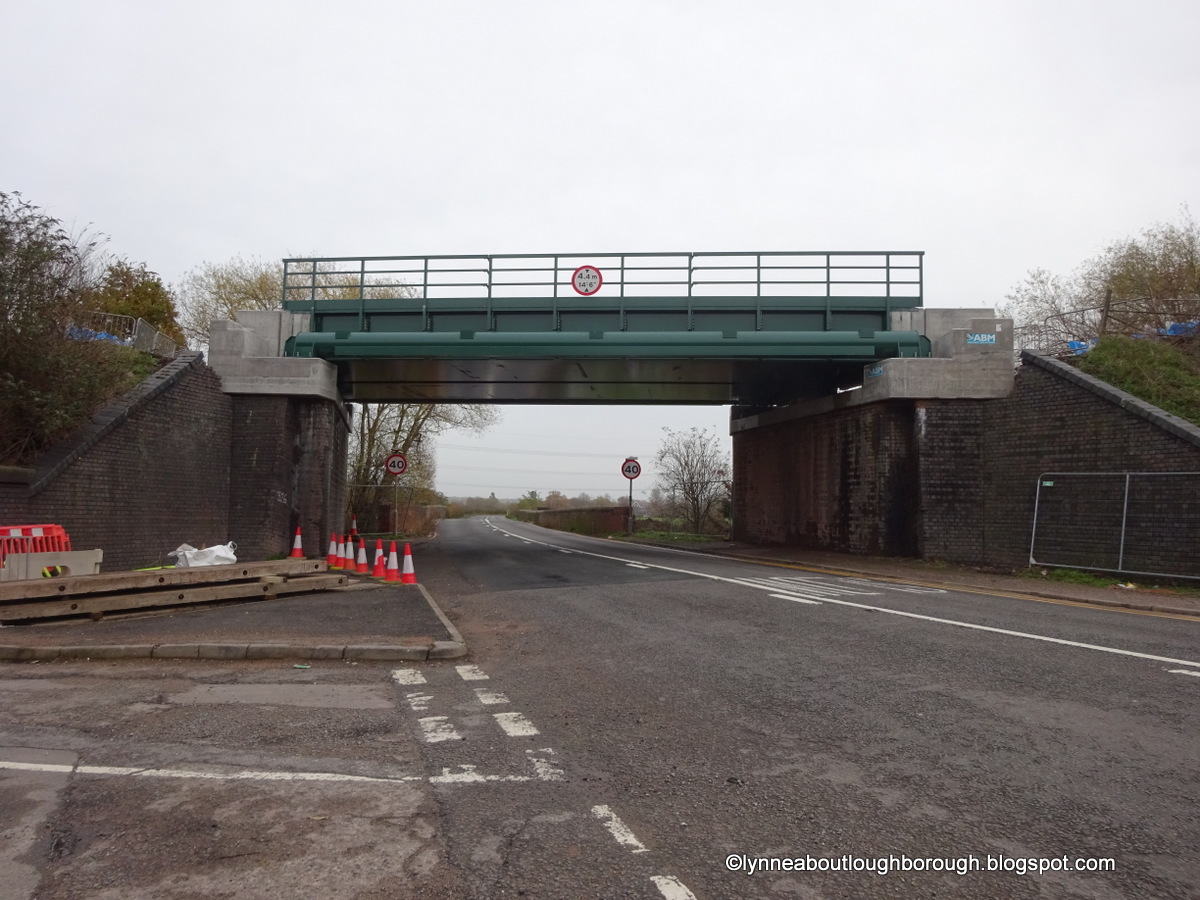
Work on the railway bridge over the A60, close to The Brush.

The work that has recently taken place to demolish and rebuild the A60 bridge, and make it higher, is part of the Reunification of the Great Central Line, which would see the Leicester to Loughborough steam train travel all the way to Ruddington. The project is covered on the GCR's own webpages, but below are some of my photos from the recent work to replace the A60 bridge. I knew it was being demolished and replaced with a higher bridge, but what I hadn't realised was that the increase in height was only to be 3 inches!! 

Photos from 1st October 2022 on the first weekend of the works. By the time I got there, the bridge was already demolished!!!! And, it wasn't possible to get particularly close to the action, as both the road and the footpath were closed, and even the footpath by the side of Brush was out of bounds.

Here's the bridge in situ, in 2019, heading towards Nottingham

Here's the bridge in 2020, heading into Loughborough


Looking towards Loughborough

Road closed from Nottingham into Loughborough

Digger in action

Digger in action

Digger in the distance!

Road closed going out of Loughborough 


A couple of weeks later, on 15th October, I went down to see how the work was progressing, and at least this time I could actually get closer!

Looking from Loughborough towards the bridge

The former bridge adjacent to the footpath to the Meadows (going towards Nottingham)

Remains of the bridge opposite the footpath to the Meadows, heading towards Nottingham

As above

Close-up of the remains next to the footpath

Looking towards Loughborough


During the works, the road was either closed, or there were temporary traffic lights in action. The work was a little delayed, so I popped down again on 21st November to see what was happening - lots!

Looking towards Nottingham

In the direction of Nottingham

Looking towards Loughborough

Next to the Hermitage Brook

Looking along the track towards the GCR station


My final visit was on 27th November, and I was pleased to see that essentially, the work has been completed.

Looking from close to the Brush

Looking towards Nottingham

Under the bridge


Looking towards Loughborough

Under the bridge coming towards Loughborough

Looking towards Nottingham

Looking towards Nottingham

Looking towards Loughborough

Looking towards Nottingham


Interestingly, this bridge is very, very similar to the one that was replaced in late 2017, which is close to the civic amenity site.

The bridge near the civic amenity tip 

____________________________________

posted by lynneaboutloughborough

With apologies for typos which are all mine!

_______________________________________________

Thank you for reading this blog. You are welcome to quote passages from any of my posts, with appropriate credit. The correct citation for this looks as follows:

Dyer, Lynne (2022). New railway bridge. Available from: https://lynneaboutloughborough.blogspot.com/2022/11/new-railway-bridge.html [Accessed 27 November 2022]

Take down policy:
I post no pictures that are not my own, unless I have express permission so to do. All text is my own, and not copied from any other information sources, printed or electronic, unless identified and credited as such. If you find I have posted something in contravention of these statements, or if there are photographs of you which you would prefer not to be here, please contact me at the address listed on the About Me page, and I will remove these.

Blog archive and tags:
If you are viewing this blog in mobile format, you will not be able to easily access the blog archive, or the clickable links to various topics. These can be accessed if you scroll to the bottom of the page, and click 'View Web Version'. Alternatively, there is also a complete list of posts, which when clicked will take you to the page you are interested in.  
 
Thank you for reading this blog. 

Lynne  

Sunday, 24 April 2022

Wax work at the Cross Keys

Probably the best known wax museum in the UK is Madame Tussauds. It was in 1802 that Madame Tussaud first brought her travelling exhibition to the UK, and in 1835 set up a more permanent display at ‘The Baker Street Bazaar’. Eventually, in 1884, thirty-four years after her death, the waxworks museum we know today was set up. 

Wax museums and exhibitions, as well as animal menageries became popular, and various of these toured the country. One such was Hyltons. In 1851, Mr Edward Hylton was advertising his travelling show as a ‘Grand Imperial Museum of Magnificent Moving Figures, as large and as natural as life’ and brilliantly illuminated with gas, ahead of his visit to Newbury in May that year. 

In June 1851, the show visited Marlborough, and we learn that the residents were pleased with their view of what was described as ‘Hylton’s Panorama’, considering it instructive and amusing, particularly to young people, presenting nothing to offend, and everything to awaken and instruct. Hylton also had a brass band, and this was loaned out to the members of the Marlborough Branch of the Wiltshire Friendly Society, to accompany their annual festival.

October 1851 was a busy month for Hyltons, and they could be visited at the Nottingham Goose fair; the Hylton brass band played at Barnstaple, and the ‘Museum of Wax figures’ comprising, amongst other things, models of interesting objects, and a panorama of the Crystal Palace, was on show in Queen Street, Exeter, and was, apparently, skilfully executed.  

1852 was no less quiet! During the period between Christmas and New Year 1852, Hylton’s ‘wild beast’ show delighted audiences at North Shields, and in May, ‘Hylton’s Exhibition of Wax Figures’ was on view for several days at Shepton Mallett, having narrowly escaped complete destruction when a fire took hold, after a naptha lamp was overfilled. 

In September, Hyltons were at the Ashby-de-la-Zouch statutes fair for about four days, and had lots of visitors, and the Hylton brass band attracted large crowds. In October, Hyltons attended the Goose Fair in Nottingham with the wax work collection, alongside Howie’s ‘museum of wax figures’, Batty’s menagerie, and Winroe’s mechanical exhibition. 

Later in October 1852, Hylton’s attended the Mansfield pleasure fair that was part of the cheese fair. The amusements consisted of wax figures, four views of Crystal Palace, a chamber of horrors, and three young cubs. Moving swiftly north, Hylton’s ‘National Menagerie’ was busy with visitors when it exhibited at the Saturday market in Beverley, Yorkshire. However, its outing to Brigg in Lincolnshire seemed somewhat less popular, staying for only one day, and being less busy than hoped for, despite the band giving a good performance of several of the most popular pieces of the day.

In the coming years, Hyltons unique collection of wax figures visited Dundee, where the ingenious mechanisms employed seemed to make the figures move. These figures represented people like the Duke of Wellington, the Emperor of Russia, the Sultan of Turkey, and others. By the time the 1854 exhibition reached Nottingham in December of that year, it was advertised as ‘Hylton’s Animated Wax Work’. In December 1857, Hylton’s wax work exhibition made an appearance in The Square at Chepstow, as part of the Chepstow Farmers’ Club Annual Cattle, Poultry, and Crop Show, and Hylton’s brass band enlivened the proceedings by playing some popular pieces.

At the end of December 1857, the moving wax work figures travelled to Cheltenham, where it was sited in the ground behind the market. Some of the models represented Queen Victoria, the Duchess of Kent, the Duke of Wellington, the Maid of Saragossa, and Don Carlos. All was accompanied by the brass band.  The admission prices were:

One shilling for ladies and gentlemen; 

6d for tradespeople; 

3d each for the working classes and their children. 

Children from the workhouse were admitted free of charge, and those belonging to charity schools were half-price, while children from other schools were admitted on ‘reasonable terms’. 

The events were open daily from 2-5pm, and 6 to 10pm. During the hours of 2-4pm, private viewings of the exhibition cost 1s each.

In July 1858, Hylton’s Wax Exhibition is advertised for sale by public auction in Moore Street, Birmingham. In all, there were five lots.

Lot 1 was a caravan containing Androcles and the lion; King of Delhi and two Sons; six views with glasses.

Lot 2 was a stage carriage with complete decorations; two figures front inside; Nana Sahib; Captain Rogers; Group of Duke of Wellington and Attendants.

Lot 3 was a caravan containing 24 figures, representing the death of General Zumelncarraguay, a Spanish Chieftan.

Lot 4 was a caravan containing 19 figures, representing the Maid of Saragossa Defeating Napoleon’s Army; also views with eight glasses

Lot 5 was a caravan containing 21 figures, representing the Council Chamber of Constantinople, including the Sultan of Turkey.

All the carriages were in good condition. The figures were all worked by machinery. Four of the caravans were 20 feet long, and 8 feet wide, while the stage carriage was 16 feet long by 8 feet wide.

The reason for this sale was because Edward Hylton had died the previous year, in fact on 21 August 1857. Probate, which stated that he was formerly a cooper of the City of Lincoln, but most recently was a travelling exhibitor and proprietor of model wax figures, was granted on 21 June 1858 to his wife, Maria.

But, what has all this to do with Loughborough?

Towards the end of September 1852, after visiting Ashby, and before visiting Nottingham, Hylton brought his wax models to Loughborough, and exhibited them at was then the Cross Keys Inn, now the Phantom, on High Street. This must have been a difficult and sad time for Edward and Maria, as their 17-year-old daughter, Sarah took ill, and they left her at the Cross Keys to recover, the landlord of which was Mr Dougherty, while they proceeded on to Nottingham Goose Fair. Sadly, despite receiving medical attention from a nurse and an attendant, Sarah died.

The Phantom pub, formerly the Cross Keys Inn, High Street

The funeral took place a couple of days later, and the coffin was borne to the grave by six residents of the town, while six females town residents, supported the pall. Amongst the mourners were Edward, Maria, and their son, Joseph. Their grief was indescribable, and of the several thousand spectators who were there, many were moved to tears. The Hylton brass band returned from Nottingham and, wearing mourning dress, hatbands and black gloves, they led the procession from the Cross Keys to Emmanuel Church, playing the Old Hundredth psalm. Reverend Bunch conducted the moving burial service and this was followed by the band performing the music to Pope’s Ode to the Soul. What a sad experience: perhaps Edward never fully recovered from the loss of his daughter.

Emmanuel Church

Curiously, on census returns and other documents, the surname of the family is sometimes spelled Hylton, and sometimes Hilton, but daughter Sarah is always recorded as Susan.

You are welcome to quote passages from any of my posts, with appropriate credit. The correct citation for this looks as follows:

Dyer, Lynne (2022). Wax work at the Cross Keys. Available from:https://lynneaboutloughborough.blogspot.com/2022/04/wax-work-at-cross-keys.html   [Accessed 24 April 2022]

Take down policy:
I post no pictures that are not my own, unless I have express permission so to do. All text is my own, and not copied from any other information sources, printed or electronic, unless identified and credited as such. If you find I have posted something in contravention of these statements, or if there are photographs of you which you would prefer not to be here, please contact me at the address listed on the About Me page, and I will remove these.
Thank you for reading this blog. 

Lynne                    

Sunday, 20 March 2022

The race of the stagecoaches

Last week I was considering the increasing cost of food: this week I have been thinking about the cost of petrol these days, I happened upon an account of a stagecoach journey from the early 1800s. Sir Garrard Tyrwhitt-Drake, writing in the Journal of the Royal Society of Arts in 1952, in an article entitled 'Carriages and their history', just happened to mention Loughborough in relation to a stagecoach race, which I found quite interesting, so I'm sharing this with you, below. 

"For those who could not afford their own travelling chariots, and, at the same time, had occasion to travel, there was only one other way of doing so, if they neither rode nor walked, and that was by one of the public coaches that traversed the roads of this country; and I think it is only right and proper that I should deal rather fully with the stage coach, which was so important a vehicle before the days of steam (i).

The four-horse coach has been depicted so often by the artists of its day that it may come as a surprise that prior to 1784 the team used was three horses driven unicorn fashion, one in front and two behind. Stage coaches were running regularly before the days of MacAdam (ii) and made good time over atrocious roads.

Unicorn formation

 
Coach and four

One, in 1807, ran from London to Stamford, a distance of 90 miles, in just over nine hours. Races between rival coaches was not infrequent. In 1808 the coach The Patriot started against The Defiance from Leicester to Nottingham. Both changed horses at Loughborough (iii), and after a severe contest The Patriot won by only two minutes, having covered 26 miles in 2 hours 10 minutes with a full load of twelve passengers. This was coaching at its best in good weather; in the winter it was a very different story.

It is recorded, for example, that the Eslafette coach from Manchester one Sunday morning did not reach London until Tuesday night, having been dug out of the snow twelve times. Again, the Hope coach out of Sheffield on a Sunday arrived in London the following Saturday afternoon; heavy snow, nine feet deep blocked the roads: on one stage either horses were used and on another ten. Under such conditions the coaches themselves had to be stout, strong vehicles, and were driven by coachmen of strong physique and endurance; the horses they drove, wanted a lot of driving: Nimrod, writing on mail coaching in 1835, describes one of the wheelers in a tea “as fine a thoroughbred stallion led towards the coach with a twitch fastened tightly to its nose”. 

This particular journey from Leicester to Nottingham was reported in the newspapers of the day, from London to Gloucester, to Salisbury, to Ipswich, etc.. Interestingly, these contemporary newspaper reports do say that the carriages were drawn by 4 horses, and give an exciting account! This is how the Saint James' Chronicle (London) of 18th August described it:

"COACH RACE

On Sunday the 7th (August) a coach called the Patriot, belonging to Mr. Hart, of the Bell (iv), Leicester, drawn by four blood horses, started against Messrs. Pettifore and Co.'s celebrated coach call the Defiance, from Leicester to Nottingham, a distance of 26 miles, both coaches changing horses at Loughborough.

Thousands of people from all parts assembled to witness the event, and bets to a considerable amount were depending. Both coaches started exactly at eight o'clock; and after the severest contest ever remembered, the Patriot arrived at Nottingham first by two minutes only, performing the distance of 26 miles in two hours and ten minutes, carrying twelve passengers,

Whatever praise may be due to the proprietors of these coaches, for the goodness of their cattle, and the soundness of their vehicles, we cannot compliment them on their humanity."

____________________

(i) The Midland railway opened in Loughborough in 1840

(ii) John Loudon MacAdam developed road construction around the 1820s, which involved putting large stones at the bottom of the route, covering these with crushed small stones and gravel, which were layered up to make the surface convex. This camber meant that rainwater would drain off into the ditches rather than hang about on the road surface. See Story of Streets Part 1 for more info.

(iii) I do not actually know where the horses may have been changed at Loughborough, but suspect this may have been at the Bull's Head on High Street.

(iv) Today, the Bell Hotel can be accessed off New Walk, Leicester, and bears a blue plaque commemorating it as once the home of the Gimson family of engineers, one of whom was Ernest Gimson, famous for his arts and crafts designs, including houses, like Stoneywell.

_________________

You are welcome to quote passages from any of my posts, with appropriate credit. The correct citation for this looks as follows:

Dyer, Lynne (2022). The race of the stagecoaches. Available from: https://lynneaboutloughborough.blogspot.com/2022/03/the-race-of-stage-coaches.html     [Accessed 20 March 2022]

Take down policy:
I post no pictures that are not my own, unless I have express permission so to do. All text is my own, and not copied from any other information sources, printed or electronic, unless identified and credited as such. If you find I have posted something in contravention of these statements, or if there are photographs of you which you would prefer not to be here, please contact me at the address listed on the About Me page, and I will remove these.
Thank you for reading this blog. 

Lynne        

Sunday, 4 April 2021

Tuckers Bricks Part 3

Over the past two weeks, we’ve been looking at buildings built using products from Tuckers, the brickmakers from Loughborough - Part 1, Part 2. This week we continue looking into some of the buildings constructed post-1934.

Advert from 1957


According to an article in the Nottingham Journal in 1935, the new St Cyprian’s church in Nottingham had many remarkable features, one of which was the use of a tasteful variety of bricks, rather than stone. The Portland cement, produced at Barnstone in the Vale of Belvoir, was used to complement the many thousands of handmade bricks, especially made to the architect’s particular design. The company who produced these bricks was G. Tucker and Son of Loughborough, who made their ‘tudorstyl’ facing bricks in a variety of colours, and these were used exclusively on both the exterior and interior. 

As well as the facing bricks, Tuckers also supplied the ‘Loughborough’ handmade sand-faced roofing tile. This new church building, costing around £8,500 to build, was designed by local architect C. E. Howitt of the firm of John Howitt and Sons, and was in a modern gothic design, able to seat around 400 people. The new church complemented an earlier building of 1913 which had become too small for the burgeoning population of the Sneinton area of Nottingham, the latter now being used as the church hall.  There is a small bell hung in an external bell frame on the north wall of the church, which is used for swing chiming. Coming in at 20 inches, the bell is dated 1913, and originally hung in the old church, being moved in 1935. It was created by Taylors bellfoundry.

St Cyprian's Church, Sneinton

The following year, all the facing bricks used in the construction of St Margaret’s church in Aspley were supplied by Tuckers. According to the Nottingham Journal  “ ‘Multiruf’ facing bricks were a registered speciality of Messrs. Tuckers.” St Margaret’s church has an entry in the 1979 edition of Pevsner’s ‘Buildings of England: Nottinghamshire’, which reads: “St Margaret, Aspley Lane, Aspley. 1934-6 by E. H. Heazell, Brick, typical reduced Gothic of the period.”

St Margaret's church, Aspley


In 1937, following much controversy over the need for another cinema to join the three existing cinemas in the town, the Odeon in Rhyl was built, using Tuckers products. Even in its construction, the building was problematic, not least because it was built in an area that was subject to tidal flooding!

According to the Story of Leicester, in the 1930s there were over 25 cinemas in Leicester: the Odeon opened in 1938, and was, apparently, the grandest. Like Loughborough’s Odeon on Baxter Gate, Leicester’s was designed by architects from the Harry Weedon partnership, Leicester’s probably by Harry Weedon, and Loughborough’s by Arthur J. Price. The cinema is situated in the area now known as the Leicester Cultural Quarter, close to The Curve theatre, and what is now the Serbian Orthodox Church of St George (incidentally, chancel added by Blomfield in 1879), although it was converted to a catering venue around 2005 after the building closed as a cinema in 1997.  The opening in July 1938, which was attended by Harry Weedon himself, was reported in the Leicester Evening Mail: “the whole of the facing bricks for the new Odeon cinema are two-inch hand-made ‘tudorstyl’ facings, manufactured by G. Tucker & Son, Ltd., Loughborough.”


Former Odeon in Leicester

Up to and including 1939, Tuckers appear to have been extremely busy providing roofing tiles and facing bricks, the latter particularly in lighter colours, but also in a great increase in the range of colours available, across the country. This included materials for many housing estates; the swimming baths at Hitchen and Willesden; cinemas at Lutterworth, and Birkenhead; various hospitals; a number of libraries; a selection of police stations, and some hotels, including the Test Match Hotel in West Bridgford and the Cocked Hat Hotel in Aspley. Like the Bull’s Head in Shelthorpe, the Cocked Hat was built to serve the new housing that had grown up in the area, and apparently in the late 1950s it was run by landlord Bill Frame, who was an ex-Leicester City football player. Unlike our Bull’s Head, which is now a McDonalds, the Cocked Hat at Aspley was demolished in 2004 and replaced with new housing. Other buildings of this time include offices for Evans Lifts, on Abbey Lane in Leicester.

Evans Lifts, Abbey Lane, Leicester

Over in Peterborough, head offices were built at The Lawns Eye, for Derek Crouch, contractors involved in mining. The offices replaced a large house called The Lawns, and were “faced externally on the east and west elevations in Tuckers Tudorstyl facing bricks”. This office building looks very similar to John Storer House, in Loughborough.

Some of the many houses built with Tucker’s products include the following:

An ‘architect-designed’ house in Woodhouse Eaves, built in 1957 using Tuckers bricks was for sale in 1959.

A 4-bedroomed property in Breaston, construction date not known, was ‘built to a high standard with Tucker hand-made facing bricks … and matching brick and tile double garage’

The appeal of easy access to travel was espoused when in 1965 properties in Long Whatton were for sale – “Two detached bungalows with easy access to M1 and East Midlands Airport, built in Tuckers bricks …”. While, over in Draycot, Derbyshire, in 1966, an ultra-modern 4-year old dwelling in 7 acres of land was for sale, and described as being “Built in local cut stone and Tickers facing bricks.”

But, Tucker’s bricks weren’t just used for the exterior of properties. In 1967 a house came up for sale in Sawley, which had a “Through lounge/dining area, feature chimney breast in Tuckers facing bricks.”

Over on Deans Drive, in Borrowash, no.59 was up for sale in 1974 and was described as being constructed with “Tucker’s hand-made bricks” although the year of construction is not known. In 1977 a house on Briargate, Long Eaton was available for purchase, and according to the Long Eaton Advertiser, it was “built in 1954 to a high standard with Tucker’s facing bricks to all elevations”.

There are still more buildings to look at that use material from Tuckers. Hopefully, next time there’ll be more of a focus on local buildings.

Posted by lynneaboutloughborough 4 April 2021

You are welcome to quote passages from any of my posts, with appropriate credit. The correct citation for this looks as follow:

Dyer, Lynne (2021). Tuckers Bricks Part 3. Available fromhttps://lynneaboutloughborough.blogspot.com/2021/04/tuckers-bricks-part-3.html [Accessed 4 April 2021]

Take down policy:
I post no pictures that are not my own, unless I have express permission so to do. All text is my own, and not copied from any other information sources, printed or electronic, unless identified and credited as such. If you find I have posted something in contravention of these statements, or if there are photographs of you which you would prefer not to be here, please contact me at the address listed on the About Me page, and I will remove these.

You can leave comments below, but do check back as my reply will appear here, below your comment.

Thank you for reading this blog. 

Lynne