Showing posts with label Market Place. Show all posts

Sunday, 17 March 2024

The Day The Clock Stopped

If you walk into Loughborough town centre today, and you look up to the town hall clock, you will be confused: is it really 10 minutes past 5 o’clock? Well, no, and here’s the reason why …


On Wednesday 15th March 2023, at around 3-3.30pm, the HSBC branch in Loughborough Market Place, caught fire, and a substantial portion of the building collapsed. The fire spread to the Town Hall which is next door to the bank, and damage was done to certain areas. I’m assuming that this was when the Town Hall clock stopped - a couple of hours after the fire started. But, of course, this wasn’t the first time the beautiful timepiece had stopped …

Although the Town Hall had been built as the Corn Exchange in 1855, it was later extended, and became the Town Hall. The clock was commissioned in 1879 following a bequest from Basil Edward Farnham of Quorn, for which he left £200, the clock being for the use of the inhabitants, farmers and others, in recognition of the kindness shown to him for the many years he represented them as member of parliament for the northern division of the county of Leicester.

The clock was to be illuminated, but there was much discussion about the ownership of the clock, and who would pay to light it up! The clock was owned by the Town Hall Company, but it was the Loughborough Local Board who had been requested to pay for the gas to light up the clock.

The clock was made by George and Francis Cope who started a clockmaking business near Canning Circus in Nottingham in 1845. They – and the later generations of the family - made many types of clocks, some of which can still be seen today, like the tower clocks, a courtoom clock for the Galleries of justice, a large grandfather clock which is possibly still in Yate’s Wine Lodge in Nottingham, a wall-mounted clock in an auctioneers in Radford, the clock on the Nottingham University’s Trent Building, one on West Bridgford Grammar School building, as well as the one on the impressive council buildings in the centre of Nottingham, which was constructed in 1928. Incidentally, the bells for the latter were cast at none other than Taylors, Loughborough’s own bellfoundry. Nowadays, the firm of clockmakers is trading as a jewellers.

So, in the week leading up to 28th February 1880, Loughborough’s Town Hall clock was installed and set to work. The clock is described thus, in the ‘Hinckley News’ of 28th February 1880:

“The main wheel is 14 inches in diameter, and all the others correspond. It is fitted with Sir E. Beckett’s new double three-legged gravity escapement, and has a compensated pendulum and maintaining power to keep it going while it is being wound up. The pendulum weighs over a hundredweight, and the distinctive features of the escapement is that the pendulum does part of the work itself, and is not embraced as other escapements are by a crutch or a fork, but hangs independently, and the power to propel it is obtained by the falling to the centre of the gravity arms. Each arm after it has been discharged by the pendulum, falls with the pendulum to the centre, and after it has lifted the other arm, the train then lifts it ready to be discharged by the pendulum, which is a second and a quarter one.

The whole of the wheels are made of the best brass. The striking part has a main wheel, 14 inches in diameter, and the barrels for the cord to be wound on are made of iron. The hammer weighs 28lbs, and is lifted six inches high from cams. Wire ropes and iron pulleys are used and all the clock works are mounted in strong cast iron frames, which are cast solid, and are so arranged that any wheel may be taken out and dismantled without disturbing the rest. The dials are over 5ft 6in in diameter, and are fitted at an angle, one side facing to the Market Place, and the other to Ward’s End.

The outer circle is filled in with white opal glass, and the centre is of half-inch plate glass ground on one side. The hands are made of copper and gilt. Provision has also been made for illuminating the clock with gas, and a mechanical arrangement for lighting the same has been added.”

The article goes on to describe the bell:

“The bell, which is hung in a small turret above the clock has been cast by our eminent local firm of bell founders, Messrs. John Taylor and Co., and possess a very clear and mellow tone, the note struck by it being C. It is 2ft 8in in diameter and weighs 6cwt. 3aqrs. 3lbs. Besides the name of the founder, and the year in which it was cast, the bell bears the following inscription: ‘This bell and clock the gift of the late E. B. Farnham, of Quorndon House, M.P. for North Leicestershire, 1837 to 1859.’ The bell has been struck several times during the past few days, and its sound can be heard at a considerable distance.”

Interestingly, in later years, Miss Ada Annie Stubbs, daughter of Frederick Stubbs, jeweller and watch and clockmaker of Loughborough, regularly winds the Town Hall clock, and checks its accuracy every morning at 7am when she listens to the news broadcast. In the summer of 1956, the clock was overhauled by a Nottingham Company (I do not know if it was the same company as had made the clock originally), but on 26th January 1957, Miss Stubbs was worried that the clock had fallen silent, so she rushed to the Town Hall from her home on Leicester Road, to set if going again. Apparently, the clock had stopped just before 11pm the night before, but Miss Stubbs was only able to get it working again for about 30 minutes. The Nottingham company was called out again to sort it out. Miss Stubbs died in 1968, and more recently the clock’s mechanism was replaced so it no longer needs to be wound up to work.

Since that time, the clock has undergone further refurbishment, for example in 1980, and again in 2012 it stopped working. This time, it was out of action for six years, finally ringing out again in 2018, which it had continued to do until that fateful day last March. Here’s hoping it will once again be repaired and ring out across the town centre.        

____________________________________

Posted by lynneaboutloughborough

With apologies for typos which are all mine!

_______________________________________________

Thank you for reading this blog.

Copyright:

The copyright © of all content on this blog rests with me, however, you are welcome to quote passages from any of my posts, with appropriate credit. The correct citation for this looks as follows:

Dyer, Lynne (2024). The Day the Clock Stopped. Available from: https://lynneaboutloughborough.blogspot.com/2024/03/the-day-clock-stopped.html  [Accessed 17 March 2023]

Take down policy:

I post no pictures that are not my own, unless I have express permission so to do. All text is my own, and not copied from any other information sources, printed or electronic, unless identified and credited as such. If you find I have posted something in contravention of these statements, or if there are photographs of you which you would prefer not to be here, please contact me at the address listed on the About Me page, and I will remove these.

External Links:

By including links to external sources I am not endorsing the websites, the authors, nor the information contained therein, and will not check back to update out-of-date links. Using these links to access external information is entirely the responsibility of the reader of the blog.

Blog archive and tags:

If you are viewing this blog in mobile format, you will not be able to easily access the blog archive, or the clickable links to various topics. These can be accessed if you scroll to the bottom of the page, and click 'View Web Version'. Alternatively, there is also a complete list of posts, which when clicked will take you to the page you are interested in.

Searching the blog:

You can search the blog using the dedicated search box that appears near the top of the blog when viewed in the web version. Alternatively, you can search using your usual search engine (e.g. Bing, Google, DuckDuckGo etc.) by following this example:

site: https://lynneaboutloughborough.blogspot.com/ “Radmoor House”

NOTE – the words you’re actually looking for must be in “” and the first of these must be preceded by a space

Thank you for reading this blog.

Lynne

Sunday, 19 November 2023

Remember the fair and the Remembrance service 2023

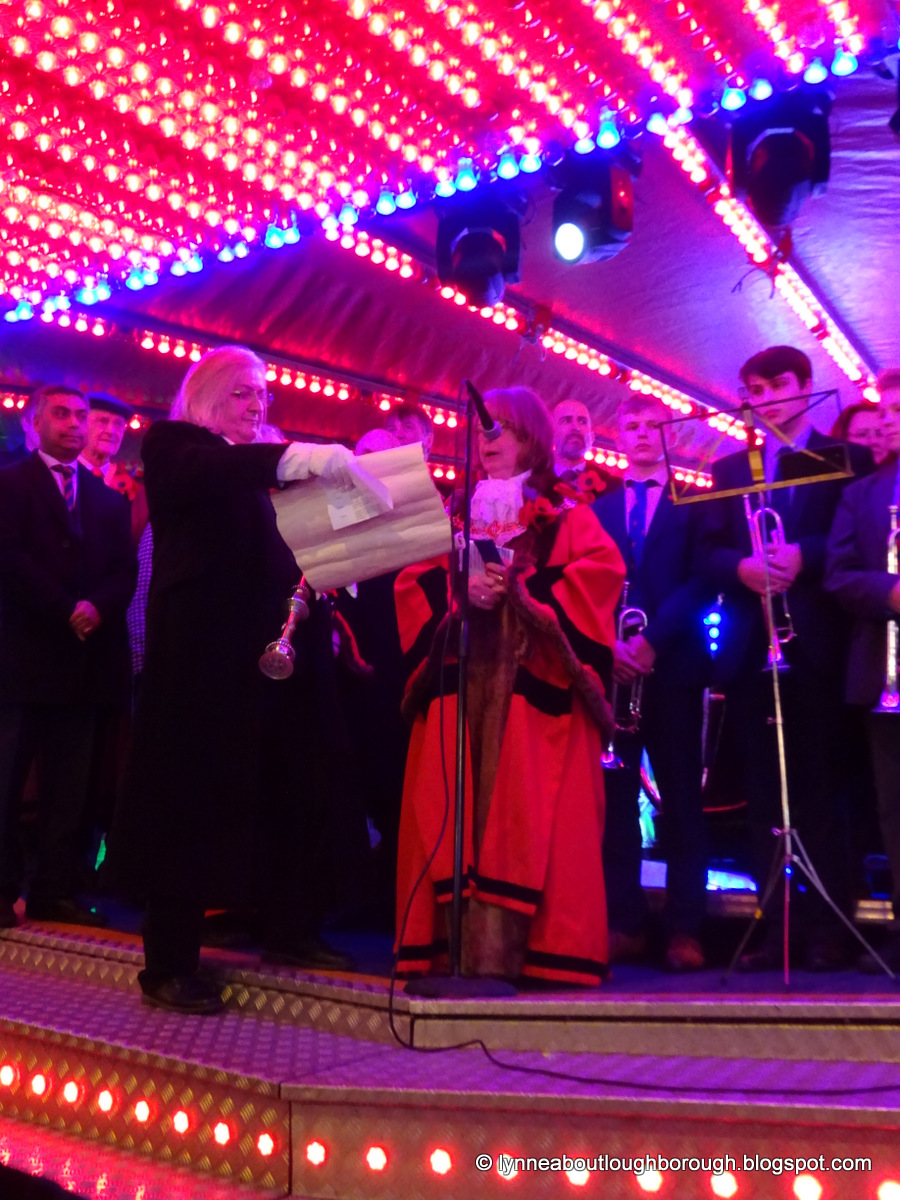
So, I'm running behind a bit at the moment with the blog, so all I have to offer you is my view of the 802nd Loughborough fair, and the 2023 Remembrance Day service. This only happened 10 days, and one week ago, but it already seems like longer ago than that.

I managed to get along to the actual opening of the fair on the Wednesday (this, of course, is an extra day that was granted a few years ago, and prior to that the fair started on the Thursday). It still astounds me how the fair leaves overnight and the market place and surrounding area is prepared for the Remembrance Service the following morning.

I've written quite extensively about the fair and the Remembrance Service in previous blog posts: you can find a complete list of blog posts, including these, here. Meanwhile, here's some photos from the 2023 events.


The Chaplain to the Royal British Legion for the past 8 years has now moved to Canterbury: her place was taken by the acting Chaplain Rev. York (right)


____________________________________

Posted by lynneaboutloughborough

With apologies for typos which are all mine!

_______________________________________________

Thank you for reading this blog.

Copyright:

The copyright © of all content on this blog rests with me, however, you are welcome to quote passages from any of my posts, with appropriate credit. The correct citation for this looks as follows:

Dyer, Lynne (2023). Remember the fair and the Remembrance Service 2023. Available from: https://lynneaboutloughborough.blogspot.com/2023/11/remember-fair-and-remembrance-service.html [Accessed 19 November 2023]

Take down policy:

I post no pictures that are not my own, unless I have express permission so to do. All text is my own, and not copied from any other information sources, printed or electronic, unless identified and credited as such. If you find I have posted something in contravention of these statements, or if there are photographs of you which you would prefer not to be here, please contact me at the address listed on the About Me page, and I will remove these.

External Links:

By including links to external sources I am not endorsing the websites, the authors, nor the information contained therein, and will not check back to update out-of-date links. Using these links to access external information is entirely the responsibility of the reader of the blog.

Blog archive and tags:

If you are viewing this blog in mobile format, you will not be able to easily access the blog archive, or the clickable links to various topics. These can be accessed if you scroll to the bottom of the page, and click 'View Web Version'. Alternatively, there is also a complete list of posts, which when clicked will take you to the page you are interested in.

Searching the blog:

You can search the blog using the dedicated search box that appears near the top of the blog when viewed in the web version. Alternatively, you can search using your usual search engine (e.g. Bing, Google, DuckDuckGo etc.) by following this example:

site: https://lynneaboutloughborough.blogspot.com/ “Radmoor House”

NOTE – the words you’re actually looking for must be in “” and the first of these must be preceded by a space

Thank you for reading this blog.

Lynne                                            

Sunday, 16 April 2023

So Who Was Frederic Stubbs?

On a recent amble around town, I happened to enter a building and spotted a very interesting clock on the wall, the hands frozen at 29-and-a-half minutes past five o’clock, but on what day, I had no idea. It was a very simple but smart wooden-surrounded wall clock, with Roman numerals for hours, and was rather like those you might see gracing a doctor’s waiting room, or maybe a solicitor’s waiting room. Just below the centre of the clockface was a recess into which the key would be placed, to wind the mechanism that made the clock work. The analogue clock had an hour hand which was a plain, ruler-straight pointer, while the shorter minute hand ended in a bulbous point. There was no second hand. 

Anyway, as there was a name and location on the clock face, I decided to investigate further …

A wall clock from Loughborough by Stubbs - with thanks to AJ for the photo

Location – Loughborough! Well, no need to delve too deeply into that one as that’s what this whole blog is about!! But what of the name? F. Stubbs – Frederic Stubbs, jeweller, watch and clock maker and repairer …

It’s possible that Joseph Stubbs, married Sarah Wale on 10 October 1814, when both were aged 17. The couple had many children, including, but not exclusively, Samuel, who was born on 27 December 1820; Mary; Joseph; William, and Ann, most of whom were born in Normanton on Soar.  Meanwhile, in 1815, over in Manchester (I think), one Janet Tate (or possibly Tait) came into the world, and one Robert Alcorn was born in Scotland in 1820. While, over in Norton in Derbyshire, around 1825, one Mary Ann Allen was born, to parents as yet unidentified.


In 1838, John Alcorn married Janet Tate, and had several children, including Mary, Robert, Janet, Agnes, and Elizabeth Margaret Ann, Elizabeth being born in 1851, the family living at Cheadle. Samuel Stubbs didn’t marry Mary Ann Allen until 1846, and their children included William, John, Annie, Frank, and Frederic, the latter being born in 1852 in Normanton on Soar.

Both families – the Alcorns and the Stubbs – continued to live in Cheadle and Normanton respectively, until in 1871, we find the Alcorns living in Rectory Cottage on Toothill Road, Loughborough, and the Stubbs living at 31 Swan Street, Loughborough. John Alcorn is a Baptist minister at the Wood Gate Baptist chapel, and Samuel Stubbs is tailor and woollen making employing three men. Frederic Stubbs, son of Samuel, is an apprentice watchmaker, and by 1876, Frederic Stubbs begins to be listed in the trade directories.

Presumably the Stubbs family were Baptist chapel goers? In 1878 Frederic Stubbs marries Elizabeth Margaret Ann Alcorn, the service taking place at the Wood Gate Baptist chapel, where her father was minister. The jewellery and clock and watch making business begins to flourish, and in 1880 we find Frederic offering a 5s reward for the return of a gold-coloured brooch, with a buckle pattern, which had been lost between the Congregational Chapel (on Orchard Street) and Fennel Street. By 1881, Frederic is now a retail watchmaker, employing two men, two boys, and one woman. The family, which as well as Frederic and Elizabeth themselves, now includes two daughters, Margaret Ethel (aged 1) and Ada Annie (aged 4 months) are living at 19 Market Place. Also on the 1881 census return, Frederic’s parents, and two of his siblings are living at 83 Coben Street, and sister Ellen is listed as a shop assistant: no particular shop type is quoted, but perhaps she was the ‘one woman’ assisting Frederic? Meanwhile, Elizabeth’s parents, John and Janet, have moved away from Loughborough, to Basford.

Frederic begins to advertise his business far and wide! In a Melton Mowbray newspaper, Mr Stubbs advises customers that he’s selling fashionable silver jewellery – brooches, earrings, silver band bracelets and bangles, and watches.

Sadly, in June 1883 Frederic’s sister, Sarah died, aged 24, and this was followed in August by the death of their father, Samuel. Frederic’s brother William, a draper on High Street Tutbury, and John, a cornfactor in Derby, were the executors of their father’s will, and this was proved in September, the effects being £507 7s. 2d.. Frederic had the task of selling the family properties in Brook Street, Wymeswold, which consisted of three dwelling houses, with workshops and outbuildings, and large gardens, which altogether amounted to about 2,000 square yards. The auctioneer involved was Mr William Armstrong, based at 33 Cattle Market.

More newspaper adverts began to appear: a Melton newspaper reports that Mr Stubbs has new stock in hallmarked 9-carat gold, and is selling keepers at 5/9, 6/6, 7/6, and 8/6 each, and according to the Hinckley Times, Frederic Stubbs is now selling keyless watches for boys, which come in a nickel silver case, at a cost of 10/6..

At some point, the Alcorns had moved to Lytham St Annes, and it is here in 1886 that Janet, mother of Elizabeth Stubbs, nee Alcorn, dies. Her death is followed in 1891 by that of her husband, John Alcorn.

Back with Frederic, and in 1890 one of his assistants is Thomas Weston, who lives in Hastings Street. Thomas works at the jewellery business, but also goes out to customers in their homes to mend their clocks and watches, carrying his watchmaking tools around in his Gladstone bag.

Examples of factory-made pocket watches at the Herbert Museum and Art Gallery, Coventry

The Stubbs family is burgeoning along with the business, and another four children have joined Margaret and Ada as seen in the 1891 census return. John Lewis is aged 9, Frederick Horace E. is aged 4, and Winifred Nora A. is aged 3. Frederic’s 66-year-old mother is living at 17 Ashby Road, with her daughter, Ellen, who is a jeweller’s assistant, undoubtedly in Frederic’s shop.

Newspaper adverts are now bigger and advertise more of Frederic’s products. a Melton Mowbray newspaper carries an advert for Frederic Stubbs’ goods, as he has new stock, with modern patterns, and novelties in silver and electro-plate which include fruit spoons, bread forks, muffiners, mustard pots, salts in cases, butter dishes and knives, marmalade dishes, breakfast cruets and more! Any of these would make suitable Christmas presents!

In June 1897, Frederic Stubbs had made the chains for Loughborough’s mayoress, and he displayed these in his shop window, at 19 Market Street, for the public to see. A similar situation had occurred in 1889 at the Incorporation of the Borough, when the mayor’s chains had been made by Ernest Baldwin, which he had displayed in his shop window.

As well as selling sterling silverware that was suitable for wedding or birthday gifts, Frederic Stubbs also provided the enamel and gilt drawing-room clock which was presented to Miss Edith Chester, a stalwart of the Weslyan Chapel on Leicester Road, upon her marriage to the Rev T.H. Barratt.

Frederic Stubbs also began to be called as an ‘expert witness’ in cases where people had tried to pass counterfeit coins. In one particular case in 1900, a jeweller and silversmith, Frederic Stubbs, examined about 12 coins and after testing them declared they were counterfeit shillings, being made of base metal, with a very thin coating of silver.

On 15th November 1900, Mary Ann Stubbs, mother of Frederic, of 17 Ashby Road, Loughborough, died at Tutbury. Probate was granted on 5 February 1901 to William Stubbs, Frederic’s brother, the draper (in Tutbury), and Frederic Stubbs himself, the jeweller. Effects were £218 8s. 5d..

In September 1906, the following headline appeared: 

“LOUGHBOROUGH WATERWORKS. INAUGURATION OF THE BLACKBROOK SCHEME. INTERESTING PROCEEDINGS.”   

The ‘Leicester Daily Post’ were reporting upon the completion of the Blackbrook reservoir. One might have to try hard to imagine what exactly this might have to do with a local jeweller …

The ceremony on this occasion was the laying of the final stone – a block of grey Aberdeen granite, which at six feet long formed a capping stone of the centre pier of the parapet wall on the down-stream side. The inscribed stone was placed in position by Joseph Griggs, who had been the first mayor of Loughborough, and in order to ensure the stone was level, he used a silver spirit level which had been created by Stubbs. The spirit level was a representation of the dam and bridge, with the outflow tunnel shown below, the slopes of the dam on each side being accurately given. The banks on each side were also represented, and on the front slope were two coats of arms, one being of Mr Griggs’ arms, the other the Corporation armorial bearings, executed in coloured enamel. The level was inscribed: ‘Presented to Joseph Griggs, Esq., J.P., D.L., on the occasion of the opening by him of the Blackbrook Reservoir, 12th September 1906.’ The whole was mounted on a plinth made from ebony, and had its own special carrying case. The stone itself was also incised with a similar inscription. Councillor James Cartwright was also presented with gifts made by Frederic Stubbs – a pair of sterling silver candelabra, and a silver rose bowl. All these presentation gifts were displayed after the event, in the window of Frederic Stubbs’ shop for a few days for all to see.

In a similar vein, Frederic Stubbs also made a silver vase and a diamond brooch pendant for the Squire of Garendon, Mr Everard de Lisle, and his wife, in celebration of their return to Garendon Hall in 1907, after a prolonged absence. Later that same year, Frederic Stubbs made a ceremonial key of silver gilt, in a renaissance style, with bold carvings on one side, and on the other the arms of the Girls High School in coloured enamel, with the school motto on the sides. The key was presented on the occasion of the opening of the extension to the school, and it carried a suitable commemorative inscription on the head, and was kept safely in its own special case.

An example of a ceremonial key, at the Herbert Museum and Art Gallery, Coventry

In 1911, at the time the census was taken, Frederic Stubbs was visiting a cousin – Truman Joseph Cook, in Rydal Mount, Hereford, while his sister and sales assistant, Ellen is with Frederic’s wife, Elizabeth, and their children – Margaret aged 31, Ada Annie aged 30, and also a jeweller’s assistant, John Lewis a bank cashier, aged 29, Frederick Horace, a jewellery and clock repairer aged 24, and Winifred aged 23.

We jump now to 1924, 12th June to be precise, which is when Elizabeth Margaret Ann, wife of Frederic Stubbs, died. I have been unable to trace the death of Frederic himself, but can only assume that he had died by May 1925. This is because this was around the time that the Corporation of Loughborough, as it was at the time, looking to widen some of the streets in the town centre. This included what I assume to be the compulsory purchase of 19 Market Place, the former jewellery shop belonging to Frederic Stubbs. On 27th May, the ‘Leicester Evening Mail’ carried the following report:

“ARBITER’S AWARD.

Loughborough Scheme for Street Improvement.

The arbiter’s award in connection with market place, Loughborough, shop of the late Mr. F. Stubbs, jeweller, is notified to the Corporation as £2,600. The shop is required for street improvements, and the Corporation offered £2,250, whereas Stubbs’ trustees under assignment, claimed £4,550. Under the award, the Corporation are to pay costs and £35 towards the claimant’s costs.”

This was the first arbitration under the street improvement scheme, and possibly the end of an era for a number of businesses. In 1939, Frederic and Elizabeth’s son, Frederick Horace E. (known as Horace), is listed in the register as a bellfounder’s assistant and bell tuner. Perhaps he took to this profession when the jewellery shop in which he worked was demolished in the street improvement scheme?

Bells tuned by chipping away at the bellmetal

Modern-day tuning by shaving the bell inner

The resulting swarf from modern-day bell tuning


______________________________________________

posted by lynneaboutloughborough

With apologies for typos which are all mine!

_______________________________________________

Thank you for reading this blog.

Copyright:

The copyright © of all content on this blog rests with me, however, you are welcome to quote passages from any of my posts, with appropriate credit. The correct citation for this looks as follows:

Dyer, Lynne (2023). So Who Was Frederic Stubbs? Available from: https://lynneaboutloughborough.blogspot.com/2023/04/so-who-was-frederic-stubbs.html Accessed: 16 April 2023

Take down policy:

I post no pictures that are not my own, unless I have express permission so to do. All text is my own, and not copied from any other information sources, printed or electronic, unless identified and credited as such. If you find I have posted something in contravention of these statements, or if there are photographs of you which you would prefer not to be here, please contact me at the address listed on the About Me page, and I will remove these.

Blog archive and tags:

If you are viewing this blog in mobile format, you will not be able to easily access the blog archive, or the clickable links to various topics. These can be accessed if you scroll to the bottom of the page, and click 'View Web Version'. Alternatively, there is also a complete list of posts, which when clicked will take you to the page you are interested in.

Searching the blog:

You can search the blog using the dedicated search box that appears near the top of the blog when viewed in the web version. Alternatively, you can search using your usual search engine (e.g. Bing, Google, DuckDuckGo etc.) by following this example:

site: https://lynneaboutloughborough.blogspot.com/ “Radmoor House”

NOTE – the words you’re actually looking for must be in “” and the first of these must be preceded by a space

Thank you for reading this blog.

Lynne               

Sunday, 23 May 2021

Ceramics, pots and markets

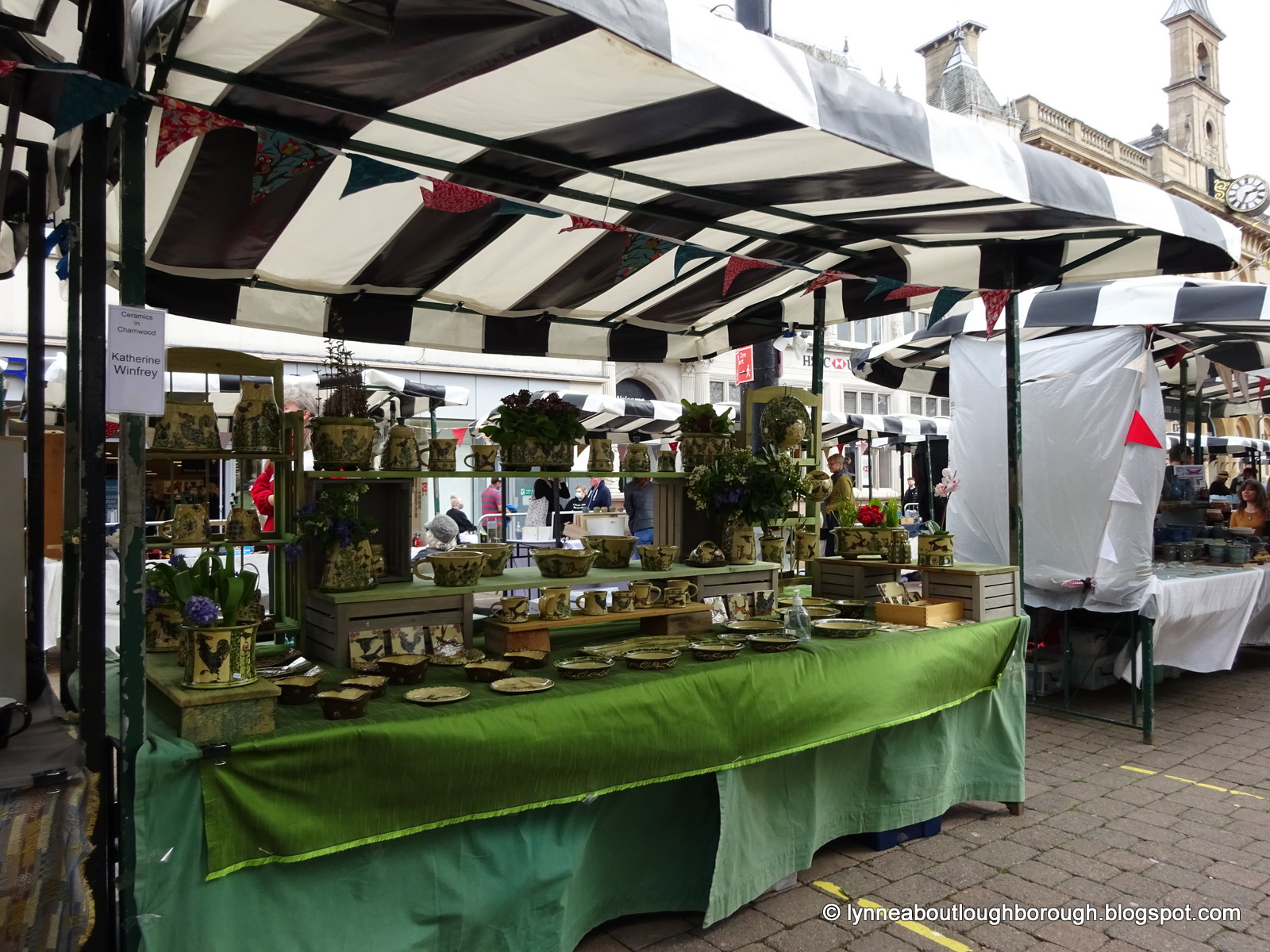
Loughborough Ceramics Market 2021

A couple of weeks ago I was lucky enough to be able to go into town and visit the annual ceramics market. I say annual, but of course there wasn't one held in 2020. So this one in May 2021 was a special one for many reasons. The market was held in the market place, where the traditional Thursday and Saturday market, and the Friday vintage market, and the monthly Wednesday farmers' market takes place. The markets and fairs are celebrating their 800th anniversary this year.

Talking of the Thursday market, back in September 1853, there was a report in the Nottinghamshire Guardian of an event that happened on August 25th. The headline was:

Battle of the Pots

And the report was as follows:

"The Loughborough market place last Thursday was truly the theatre of war and bloodshed. The rival pot-sellers, Johnson and Taylor, have for some time carried their opposition to a great height, but last Thursday, it appeared, that words were insufficient for the auctioneers to express contempt, they had for each other, and consequently recourse was had to the 'exchange' of merchandize - plates, cups, and saucers, and various other articles, were flying about in all directions to the amusement of some and the terror of others, till the blood began to trickle down the faces of the combatants profusely. The war one would think was hot enough at this period, but Taylor's establishment, no doubt thinking an advantage might be gained by coming to close quarters, made a charge upon their opponent's swords (or pots) in hand, and erected their standard on the works of the enemy, causing their chief to fly for medical aid. As the belligerent parties cannot agree as to the terms of peace we hear the magistrates will have to propose an 'ultimatum for their adoption on the day (Thursday)."

The following week, the same newspaper reported on the Petty Sessions which were held at Loughborough before C.W.Packe, Esq., MP, and E.Dawson, Esq., and at which the battle between John Taylor and John Stinson was judged.

"John Taylor, of Loughborough, was charged with assaulting John Stinson, on the 25th August. Mr Ingelsant appeared with defendant. For several weeks past complainant and defendant have attended Loughborough market as rival pot sellers; both sell their wares by auction, and articles for which they cannot gain a bidder, they not unfrequently throw amongst the bystanders. On the day in question, Taylor threw away some saucers, some of which fell amongst Stinson's wares and broke them. Complainant and his assistants retaliated, and a 'shower of pots' was the result, to the amusement of the spectators. After the charge had been maintained on both sides for some time, Taylor jumped from his rostrum, and making his way to Stinson, struck him with half a dozen he had in his hands. Stinson immediately closed with his antagonist, and in the scuffle both fell bleeding upon the ground. The bystanders then separated them, and while Stinson went to a surgery to have his wounds dressed, Taylor remounted his rostrum and commenced 'knocking down' his ware to persons whom the affray had attracted to the spot.

Mr Ingelsant addressed the magistrates in defence, stating that the saucers of Taylor's which first fell amongst Stinson's ware, were not thrown with an intention to fall there, but as presents to the persons standing around to induce them to bid more spiritedly, and that Stinson and his assistants were the first to throw with a malicious intention. It was one of those unfortunate cases which verified the adage 'two of a trade cannot agree' and if the magistrates should think it necessary to convict, he (Mr I.) would suggest the propriety of binding both over to keep the peace. 

Taylor was convicted and fined 10s. and costs, or 14 days' imprisonment. Taylor was further charged with assaulting a lad of Stinson's, named John West, who said when Taylor had struck Stinson, he turned round and struck him also. As the lad's evidence was not confirmed by any of the numerous witnesses, the case was dismissed."

Blimey!!! So, I'm sure you'll be pleased to know that the 2021 ceramics market went off peacefully, and no pots were thrown - at least not while I was visiting!!! There were all manner of ceramics available to purchase, both practical things and ornamental things. You can see photos off the 2018 event in an earlier blogpost, and below are a few photos from the 2021event:


Posted by lynneaboutloughborough 23 May 2021

You are welcome to quote passages from any of my posts, with appropriate credit. The correct citation for this looks as follow:

Dyer, Lynne (2021). Ceramics, pots and markets. Available fromhttps://lynneaboutloughborough.blogspot.com/2021/05/ceramics-pots-and-markets.html  [Accessed 23 May 2021]

Take down policy:
I post no pictures that are not my own, unless I have express permission so to do. All text is my own, and not copied from any other information sources, printed or electronic, unless identified and credited as such. If you find I have posted something in contravention of these statements, or if there are photographs of you which you would prefer not to be here, please contact me at the address listed on the About Me page, and I will remove these.

You can leave comments below, but do check back as my reply will appear here, below your comment.

Thank you for reading this blog. 

Lynne            
Sunday, 26 April 2020

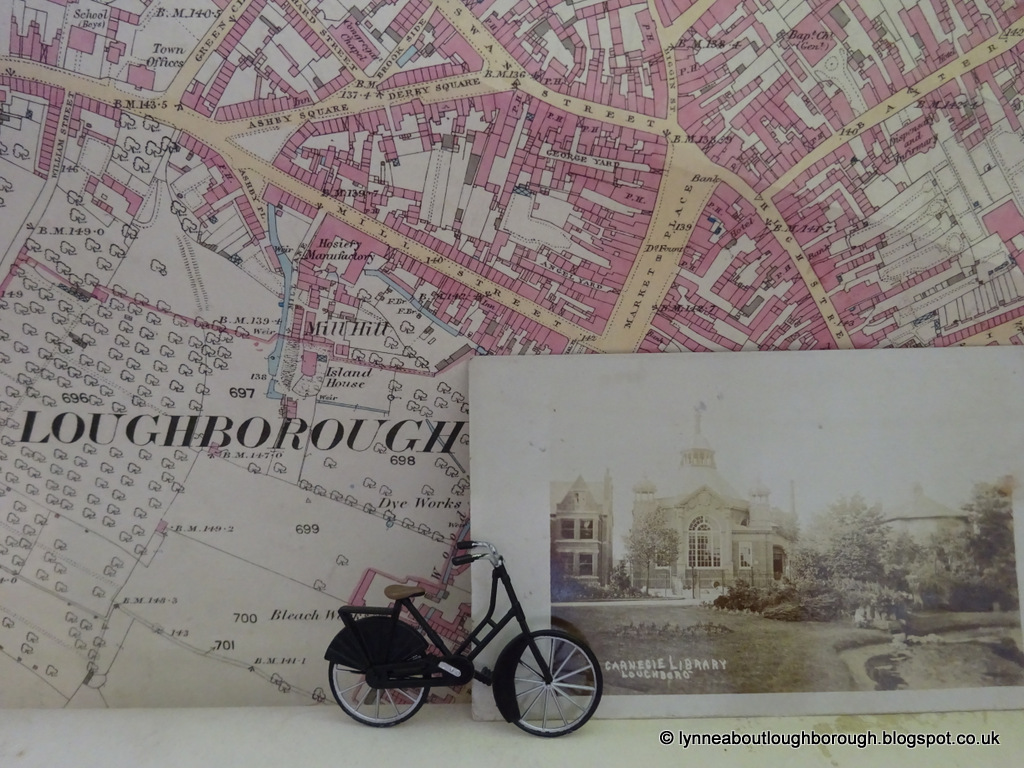
Bikes about Loughborough past

So here we are, it's nearly the end of April 2020, and we've been stuck indoors for almost 5 weeks now. Admittedly, I've managed to go out and get some exercise by walking, but sadly, my bike needs a bit of attention, so I haven't been able to use it recently. 

Instead, I've looked back over bike trips around Loughborough through the ages! Enjoy!


You are welcome to quote passages from any of my posts, with appropriate credit. The correct citation for this looks as follow:

Dyer, Lynne (2020). Bikes about Loughborough past. Available fromhttps://lynneaboutloughborough.blogspot.com/2020/04/bikes-about-loughborough-past.html  [Accessed 26 April 2020]

Take down policy:
I post no pictures that are not my own, unless I have express permission so to do. All text is my own, and not copied from any other information sources, printed or electronic, unless identified and credited as such. If you find I have posted something in contravention of these statements, or if there are photographs of you which you would prefer not to be here, please contact me at the address listed on the About Me page, and I will remove these.
Thank you for reading this blog. 

Lynne