Showing posts with label Generator Building. Show all posts

Sunday, 23 August 2026

Alexandra Bedspread and Heritage Open Days - get voting!

As in some previous years, during August I am hosting some guest blogs, in celebration of my blog’s birthday – this year, its 13th! Today, however, I am not sharing a new guest blog, but referring you to one from 2023. You may be wondering why? Let me explain …

The national scheme called Heritage Open Days, will be upon us next month, and there are plenty of offerings from Loughborough venues which either aren’t normally open to the public, or are events that are hosted specially for the second weekend of the open days (see list at the end of this post). The reason I’m mentioning this is because the beautifully embroidered Alexandra Bedspread will be on display in the magnificently renovated Generator Building! And, as if that weren’t enough …

The lady who has worked on finding out about every person whose name is embroidered on the Alexandra Bedspread (with some help from the Loughborough Library Local Studies Volunteer Group and its Honorary Members) is one of twenty-four people who have been shortlisted for a national award! 

Let’s all us Loughborough - and beyond - folk get behind this!!!

You can vote on devices like your pc, your laptop, your tablet, your iPad, your phone etc.! 

Coincidentally, voting opened on 4th August, which was the exact day of the blog's birthday!!

As of today, there are only SEVEN days left to vote! Here's how ...

You can either click this link and go straight to the voting page, or you can read a bit more about Deborah Moxom and the bedspread below, first!

And here you can hear Deborah talking about the bedspread and the work she's done on it!

_______________________________________________

So, Deborah has been researching the people behind the names on the bedspread since about 2018, and back in January of 2019, I was really pleased to be involved in helping to research a couple of those 510 names! George Cattan, a student at Loughborough College, and his motorcycle accident in 1923 will stay with me for a very long time! And this is how I first came to meet Deborah! Our paths have crossed many times since, either at Friends of Charnwood Museum talks, or in the Town Hall, or in the library! The bedspread was on display in the Town Hall back in 2018, and also in 2023, so its hanging in the Generator building for Heritage Open Days will be a rare chance to have a close look at it.

In August 2023, Deborah wrote a lovely article about the bedspread for my blog, some of which I quote below.

Measuring 8ft 7ins by 7ft 5ins, the Alexandra Bedspread 

“is a wonderful patchwork textile … made up of cream cotton squares … [and each square has] a signature of a donor embroidered on it.” 

As this was one of the fundraisers for the Carillon Tower, each donor 

“paid a shilling [5p] to sign their name which was then embroidered in navy cotton by local girls.”

At the centre of the bedspread is a likeness of the Carillon Tower, and this is surrounded by signatures like that of Queen Alexandra, who at the time was the Queen Mother, her husband, King Edward VII having died in 1910.

As well as raising money by people paying to have their signature included on the bedspread, once completed, the bedspread was shown at a fundraising bazaar, at which people paid a small sum to guess the weight of the bedspread. The person who guessed the closest weight won the bedspread!!

You can read the whole of Deborah’s article on this blog post. 


On display in the Town Hall

The central detail

If you have enjoyed reading about the Aleandra Bedspread, you might also enjoy an earlier blogpost about embroidered linen, and one about signed artefacts! 

Finally, please remember to vote for this wonderful work that's been done on revealing some of Loughborough's early-twentieth century history!!

Here's the link again, in case you missed it above!! 

Thank you!

_______________________________________________

List of places in Loughborough which are taking part in the Heritage Open Days event

More details about how to book can be found on the Heritage Open Days website

In the run-up to the weekend

Architects of Loughborough guided walks led by Lynne Dyer

Queen’s Park Perambulations guided walks led by Lynne Dyer

On the weekend itself

Alexandra Bedspread on display in the Generator Building

All Saints with Holy Trinity church

Anstey Wallpapers (in the former Ladybird Factory on Beeches Road) factory tour

Apple pressing at Fearon Hall

Art Deco walks led by Lynne Dyer on behalf of the Loughborough Library Local Studies Volunteer Group

Carillon Tower ‘The Human Cost’ exhibition

Garendon Park guided walks (led and self-led) with visit to St Botolph’s Church, Shepshed

Generator Building (hosting the Alexandra Bedspread)

Great Central Railway station tours

John Taylor & Co bellfoundry tours of the casting hall with the Master Bellfounder

Loughborough Grammar School – tower tours and exhibition

Old Rectory Museum

Rectory Wildlife Garden

Unity House historical overview

____________________________________

Posted by lynneaboutloughborough

With apologies for typos which are all mine!

_______________________________________________

Thank you for reading this blog.

Copyright:

The copyright © of all content on this blog rests with me, however, you are welcome to quote passages from any of my posts, with appropriate credit. The correct citation for this looks as follows: Alexandra Bedspread and Heritage Open Days - get voting! Available from: https://lynneaboutloughborough.blogspot.com/2026/08/alexandra-bedspread-and-heritage-open.html [Accessed 23 August 2026]

I post no pictures that are not my own, unless I have express permission so to do. All text is my own, and not copied from any other information sources, printed or electronic, unless identified and credited as such. If you find I have posted something in contravention of these statements, or if there are photographs of you which you would prefer not to be here, please contact me at the address listed on the About Me page, and I will remove these.

External Links:

By including links to external sources I am not endorsing the websites, the authors, nor the information contained therein, and will not check back to update out-of-date links. Using these links to access external information is entirely the responsibility of the reader of the blog.

Blog archive and tags:

If you are viewing this blog in mobile format, you will not be able to easily access the blog archive, or the clickable links to various topics. These can be accessed if you scroll to the bottom of the page, and click 'View Web Version'. Alternatively, there is also a complete list of posts, which when clicked will take you to the page you are interested in.

Searching the blog:

You can search the blog using the dedicated search box that appears near the top of the blog when viewed in the web version. Alternatively, you can search using your usual search engine (e.g. Bing, Google, DuckDuckGo etc.) by following this example:

site: https://lynneaboutloughborough.blogspot.com/ “Radmoor House”

NOTE – the words you’re actually looking for must be in “” and the first of these must be preceded by a space

Thank you for reading this blog.

Lynne

Thursday, 24 April 2025

U is for Utilitarian

In this series of posts featuring some of Loughborough’s Art Deco heritage, we’ve already had a look at some stunning buildings, many with some highly decorative and ornamental architectural features – I think one of my favourites has to be the torches on the Blacksmiths, and the lotus columns peeking out from the top of the columns outside the former Echo Press offices on Swan Street.

So, for today’s entry in the A-Z Blogging Challenge, we’re looking into the letter U. I’ve decided to go with Utilitarian. It’s not specifically an Art Deco term, and the dictionary defines the term as something that is designed to be practical and useful rather than something designed to be attractive, so those buildings I’ve just mentioned certainly don’t fall into that category.

Some of our Art Deco town centre buildings really are more utilitarian than some of the others, but in my personal opinion this doesn’t detract from their beauty and elegance. I’m thinking particularly about a couple of our pubs (nothing new there then!), like Fat Sam’s (at one time called the Mundy Arms, and you can find an explanation of why in ‘Loughborough Pubs’), the Generous Briton, which featured in a recent blogpost, and the former Moon and Bell. As I said, the design of the buildings in no way affects how important they are in our town’s history and streetscape.


I guess, you could call the side of Beacon Bingo utilitarian. Absolutely by necessity – the huge auditorium nestled inside the building means that the outside has to stretch a long way, and really it would have been too expensive and unnecessary to clad the whole length in Hathernware! However, do note the most unusual brick poster frame on the side which flows along Lemyngton Street.


There are plenty of other Art Deco buildings which one might suggest are utilitarian in style, and while the fronts of the shops along Market Street all have some lovely features on them – balconies, Crittall windows, beaten metal, and a variety of motifs – a sneaky peek around the back of the buildings, either looking along from the Market Street entrance to the Carillon shopping centre, or from the entrance to the Carillon car park on Derby Square reveals the familiar cube-like rooms at the back of the shops.


I suppose in this respect, the Generator Building might also fall into this category: construction began in 1934, and officially opened in 1937, it certainly is rectangular in shape, and well-suited to the activities that originally took place within its walls. They say imitation is the sincerest form of flattery, and the new building on Frederick Street, close to Caldwell Street certainly echoes the style of The Generator to good effect.

And here we must leave these beautiful buildings and search for the next entry in this challenge! 

____________________________________ 

I'm taking part in the A-Z April Blogging Challenge!!


____________________________________

Posted by lynneaboutloughborough

With apologies for typos which are all mine!

_______________________________________________

Thank you for reading this blog.

Copyright:

The copyright © of all content on this blog rests with me, however, you are welcome to quote passages from any of my posts, with appropriate credit. The correct citation for this looks as follows:

Dyer, Lynne (2025). U is for Utilitatian. Available from: https://lynneaboutloughborough.blogspot.com/2025/04/u-is-for-utilitarian.html  [Accessed 24 April 2025]

Take down policy:

I post no pictures that are not my own, unless I have express permission so to do. All text is my own, and not copied from any other information sources, printed or electronic, unless identified and credited as such. If you find I have posted something in contravention of these statements, or if there are photographs of you which you would prefer not to be here, please contact me at the address listed on the About Me page, and I will remove these.

External Links:

By including links to external sources I am not endorsing the websites, the authors, nor the information contained therein, and will not check back to update out-of-date links. Using these links to access external information is entirely the responsibility of the reader of the blog.

Blog archive and tags:

If you are viewing this blog in mobile format, you will not be able to easily access the blog archive, or the clickable links to various topics. These can be accessed if you scroll to the bottom of the page, and click 'View Web Version'. Alternatively, there is also a complete list of posts, which when clicked will take you to the page you are interested in.

Searching the blog:

You can search the blog using the dedicated search box that appears near the top of the blog when viewed in the web version. Alternatively, you can search using your usual search engine (e.g. Bing, Google, DuckDuckGo etc.) by following this example:

site: https://lynneaboutloughborough.blogspot.com/ “Radmoor House”

NOTE – the words you’re actually looking for must be in “” and the first of these must be preceded by a space

Thank you for reading this blog.

Lynne

Monday, 7 August 2023

The Old Art College and The Generator Loughborough

Dr Jill Vincent will be a familiar figure to many of you. Although I have known of her for many years, it is only quite recently, since I have become rather more vocal about Loughborough's history, that our paths have crossed more frequently. Jill is a supporter of many local initiatives, but it is in her capacity as one of the Directors of The Generator that she writes the following piece, full of history, heritage, and hope, for which I thank her very much. 

Four-storey red brick educational building from the Art Deco period, on the corner of two town streets, with similar lower level buidling to the right.
Old Art College (left) Generator Building (right)

The Old Art College and The Generator Loughborough

This article has been written by Dr Jill Vincent, one of the Directors of The Generator, the other directors being David Pagett-Wright (Chair), Andy Harper, and Roger Perrett, with Jonathan Hale (Company Secretary).  

Introduction

This story must begin with the transformation of a Leicestershire market town by the industrial revolution, and continue with the development of Loughborough College under Herbert Schofield. 

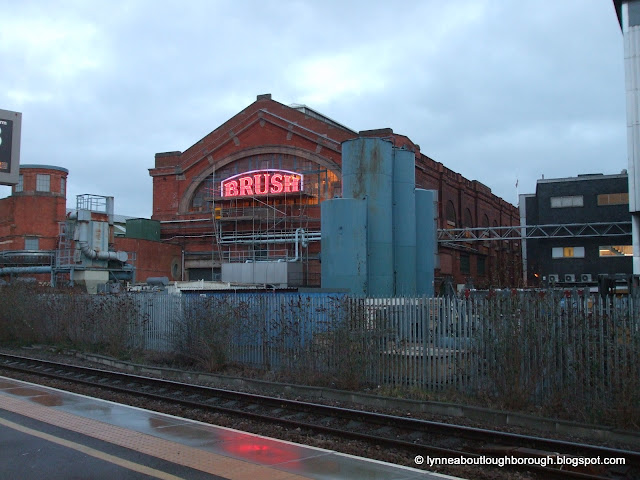
In the mid to late C19 major engineering industries were established in Loughborough: factory-based knitwear and textiles (e.g. Wm Cotton, Towles Ltd), John Taylor & Co Bell Foundry, and heavy industry such as Brush Electrical Engineering Co and Herbert Morris Ltd, cranes and lifting tackle.  At the same time, people came to work in the newly established industries.  In 1871 Loughborough’s population was 11,588; thirty years later in 1901 it had nearly doubled to 21,508.
https://lynneaboutloughborough.blogspot.com/2021/04/loughborough-variety.html
The Brush, Loughborough, adjacent to a railway line

Part of an early twentieth century factory building, with ghost sign and modern door shutters.
Part of the Herbert Morris factory on Empress Road

Victorian factory where bells are still made
Part of the John Taylor & Co bellfoundry works

The application and development of the many scientific discoveries of the C19 that gave rise to the industries meant that industrial workers needed knowledge that could only be supplied through technical education.  The County Education Committee and its Director (W.A. Brockington) [1] acknowledged and supported this.

The Technical Institute (on the corner of Green Close Lane and Ashby Road, now the site of a Sainsbury supermarket) was set up as an administration and educational centre in 1909.  It co-ordinated the evening classes held in the town and district.

Dr Herbert Schofield, an inspirational educationalist, was appointed Principal in 1915.  Under his guidance, education and training were revolutionised.  He believed that education and training should be as near to real life industrial conditions as possible, with modern equipment.  He set about creating a college to ‘reflect his own idiosyncratic views on higher education and his genius for improvising and capitalising on opportunities … a high-level academic institution devoted to the study of science and technology, it must reject the traditional university approach to these subjects and be firmly based on ‘Training on Production’.’  (Len Cantor)

These principles guided developments throughout.

During the 1914/18 war, the Technical Institute responded to the needs of the war effort with practical training for men and women.  Indeed, its development was accelerated, with substantial enlargement of engineering workshops and new machinery, expanding into training for tool setters, fitters, and gauge-makers. 

In 1918, Schofield renamed the institution Loughborough College.

Following the war, the range of high-level courses widened to include Mechanical Engineering, Electric and Automotive Engineering, Chemical Technology, Civil Engineering & Commerce, Law & Economics.  They were influential in establishing an active cultural and social life among the students.  The Instructional Factory also trained workers in carpentry, welding, and gauge-making. 

College departments were set up in various locations in the town centre, including Ashby Road, Green Close Lane, William Street, Frederick Street, and Orchard Street.  They were later described as ‘scattered and frequently makeshift premises’. 

We come now to the developments that gave rise to the buildings currently known as the Old Art College and The Generator Loughborough. 

First, is the construction of the generators.

The ‘U-Boats Episode’

(This account follows that given by the students in their almanac.  It exemplifies Schofield’s genius for improvising and capitalising on opportunities and for ‘Training on Production’)

‘In which J.F.B. Driver, a member of staff, and 25 students went to HM Dockyard at Portsmouth and Devonport, where they were invited to take such gear as they could from four German U-Boats that had been captured in the war.  They removed apparatus that included engines, dynamos, motors, compressors, fans, switchgear, and batteries.

The engines were rebuilt at the College without the aid of drawings or instructions of any kind.  They adapted, rebuilt, and converted parts.  The first engine was started up in 1924 in an old wooden hut on Packe Street.

The switchboard was also designed and built with switches, circuit breakers, instruments, and regulating resistances that had been liberated from the submarines.’ [S1]

The generators built by the students provided electricity to all the scattered College buildings, without interruption, until they were replaced in 1949.  The story goes that on one occasion, Loughborough’s electricity supply failed, and the town was in darkness, but the College buildings were still lit.

The generators were housed in a wooden building that was originally intended for car washing at the back of the automobile repair shop, itself in temporary buildings on Frederick Street.  The batteries were in a divided off portion of the College Instructional Garage.

The Old Art College and The Generator Loughborough

In 1934 the new Garage Block on Frederick Street was begun.  It is a substantial, art deco, four-storey brick building.  We now know it as the Old Art College.

In true Schofield fashion, training was provided by practical instruction.

The Automobile repair and reconditioning shop was on the ground floor.

The first floor was devoted to practical instruction in hosiery, in a Finishing and Making Up Laboratory, and in a Machine Laboratory.  Machinery was supplied by local manufacturers and machine builders such as Blackburn and Sons, PA Bentley, Wm Cotton, and Towles Ltd.

The second floor housed a Textile Testing House and Dyeing Laboratory.  It provided practical instruction for students and also a commercial service for local hosiery manufacturers and dyers.  Much of the plant and machinery was financed by Cllr W. Bastard (who also donated the Bastard Gate on the site of the current University campus). [2]

The top floor held the Handicraft Workshop, Department for the Training of Teachers.  Students supplied their own tools and toolboxes and made the furniture for their college accommodation.  Training in woodwork and metalwork was done in the general workshops of the College, with design, drawing, and construction carried out in the workshop.  The course was led by two of the foremost proponents of the Cotswold School, Peter Waals and Edward Barnsley.
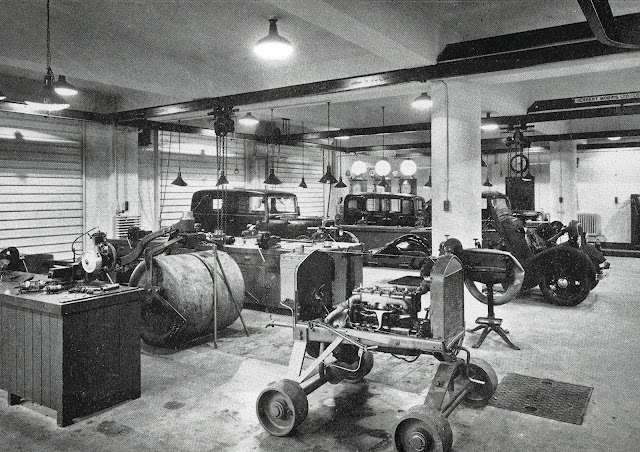
Vehicle repair shop from the early to mid twentieth century
The ground floor automobile repair shop, now a cafe, reproduced with kind permission of LU Archives and Directors of The Generator

Students at work in the Handicraft Workshop, reproduced with kind permission of LU Archives and Directors of The Generator

Building the Generating Station presented serious difficulties as the new building was erected around the existing wooden structure, which was dismantled bit by bit. The electricity supply was maintained, uninterrupted, day and night.

The new Generating Station and Garage Block were officially opened in 1937 by Charles Day MSc, MIMechEng, Past President of the Institution of Mechanical Engineers.  The electricity that was generated provided power (Direct Current) for Loughborough College; the surplus was sold to the National Grid (converted to Alternating Current).

The Generator building, showing black and white tiled floor, reproduced with kind permission of LU Archives and Directors of The Generator

Dusty and dirty floor tiled with black and white tiles
The same black and white floor tiles photographed in March 2023

The 1944 Education Act put a brake on entrepreneurial/maverick developments, bringing Further Education provision under the control of the County Council and the Ministry of Education.  Proper planning and rationalisation had to be undertaken.  The move from central town sites to the ‘playing field’ (current) site began in earnest.

The College was reorganised into separate institutions, namely Lboro College of Technology, Lboro Training College, Lboro College of Further Education and Lboro College of Art & Design.   Further Education and Art & Design remained in the town centre.  Over time, the College institutions moved onto the campus, becoming a College of Advanced Technology, a University of Technology, and finally Loughborough University, the world-class University we know today. 

Art & Design was different: it mostly moved to purpose-built accommodation on the campus in the late 1960s, but remained independent until 1998 when it was reconstituted as Loughborough University School of Art and Design (LUSAD).  The Foundation programme, later replaced by Graphic Communication & Illustration, moved into the Garage Block, referred to as the Foundation building and the Generator Gallery.  The name ‘Loughborough College Generator Gallery’ is etched into the stonework on the Packe Street elevation.   Degree shows, exhibitions by ArtSpace group of local artists and events run by Charnwood Arts opened The Generator to a wider audience.

No courses were run in the building after 2011.  It was used as storage by the Library for a while, and was then declared surplus to need by the University. 

In 2014 a group led by Kevin Ryan, CEO of Charnwood Arts, was formed with a vision to take over the whole building to provide an arts and culture hub serving all Loughborough’s communities.  It would provide a home for Charnwood Arts, incubator space and support for creative enterprises, rehearsal and performance space, meeting rooms and workshops … and so on.  The group comprised committed representatives from Charnwood Arts, Love Loughborough BID, Creative Leicestershire, the Studio at Loughborough University, and Charnwood Borough Council.  It was constituted as a Community Interest Company (CIC) in 2015.  We tried for some years to gain adequate public sector funding to attain our vision; our project was greeted enthusiastically but the funding did not follow.

The University waited patiently while we struggled but eventually gave us a deadline of a year, after which they would put it on the market.  So, in 2019 we went out to tender, seeking a partner who would share our vision and would take over the Old Art College building while we kept The Generator.   We found Our Neighbourhood and bought the building from the University, who contributed to the vision by agreeing a discount on the sale price in view of the proposed use.  Our Neighbourhood is a private sector concern so they could act fast to create the Old Art College, with Public, the thriving coffee shop with plants and bread making on the ground floor, and creative sector tenants on the upper floors.

We have The Generator.  Our vision stands.  We will be the arts and culture hub that Loughborough needs and we are very nearly there, with funding from the Town Deal and a range of sources.  Tenders for the building works knocked us back a bit, as of course inflation has hit the building trades hard, but we are at RIBA stage 4, and are applying for (public sector) funds to bridge the final gap.  Once the builders are in, it will take a year for the works to be completed, so fingers crossed we will open early 2025.

Ceiling of an industrial building showing roof lights and lifting gear
Inside The Generator building March 2023

Low level brick buidling
The Generator building photographed in March 2023

____________________________________

Notes

[1] William Alport Brockington was honoured with an OBE in 1917, and a CBE in 1928. He was knighted in 1946.

[2] William Bastard was chair of the College Governors and donated the Bastard Gates on Ashby Road to the college. You can read more about those gates in 'Loughborough in 50 Buildings'. Bastard is not to be confused with Frank Bastert, a German-born, naturalised British citizen who with Herbert Morris formed the company Herbert Morris & Bastert in 1884 in Sheffield, the company later moving to Empress Road Loughborough, after the pair had split.  

____________________________________

About Jill

During her career, Jill has combined her interest in the arts with work teaching and researching social policy, and active engagement in politics and the voluntary and community sector.

She studied fine art at St Martins, then had a break for children and family, before returning to study at Loughborough Uni (Sociology and Political Science), and then gaining a PhD from Nottingham Uni.

Jill worked for the Open University and as a researcher at the Centre for Research in Social Policy (CRSP) at Loughborough Uni. Her employment and commitment to social issues complemented each other nicely. She was a Borough Councillor for 16 years, spending the final year as Mayor; Jill has been a Trustee at John Storer Charnwood and Equality Action (where she is still actively involved) and a Governor at Loughborough College (where she is now a co-opted member).

Jill's interest in the arts is a thread running through her life. She worked in Arts in Prisons research and provision, and with Kevin Ryan at Charnwood Arts. She was a member of ACE East Midlands Arts Board. She was awarded an Honorary Degree by Loughborough University in 2012.

____________________________________

Sources

S1:

Cantor L. M. and Matthews G. F. (1997) Loughborough: from College to University, A History of Higher Education at Loughborough 1909 – 1966. Loughborough University of Technology

S2:

Loughborough College Past Students’ Association (1957) The History of Loughborough College 1915 – 1952, Past Students’ Association of Loughborough College

Thanks are extended to Jenny Clark, University Archivist, now retired, for information from the university archive, and for permission to reproduce the photographs.

____________________________________

Posted by lynneaboutloughborough

With apologies for typos which are all mine!

_______________________________________________

Thank you for reading this blog.

Copyright:

The copyright © of all content on this blog rests with me, or in the case of guest blogposts, with the named Guest Blogger. However, you are welcome to quote passages from any of my posts, with appropriate credit. The correct citation for this looks as follows:

Vincent, Jill (2023). The Old Art College and The Generator Loughborough. Available from: https://lynneaboutloughborough.blogspot.com/2023/08/the-old-art-college-and-generator.html [Accessed 7 August 2023]

Take down policy:

I post no pictures that are not my own, unless I have express permission so to do. All text is my own, and not copied from any other information sources, printed or electronic, unless identified and credited as such. If you find I have posted something in contravention of these statements, or if there are photographs of you which you would prefer not to be here, please contact me at the address listed on the About Me page, and I will remove these.

Blog archive and tags:

If you are viewing this blog in mobile format, you will not be able to easily access the blog archive, or the clickable links to various topics. These can be accessed if you scroll to the bottom of the page, and click 'View Web Version'. Alternatively, there is also a complete list of posts, which when clicked will take you to the page you are interested in.

Searching the blog:

You can search the blog using the dedicated search box that appears near the top of the blog when viewed in the web version. Alternatively, you can search using your usual search engine (e.g. Bing, Google, DuckDuckGo etc.) by following this example:

site: https://lynneaboutloughborough.blogspot.com/ “Radmoor House”

NOTE – the words you’re actually looking for must be in “” and the first of these must be preceded by a space

Thank you for reading this blog.

Lynne 

Sunday, 23 April 2023

Generating cranes

Last month I was lucky enough to visit a local building called The Generator, which was built in 1936, and used to be a college building. It’s currently being renovated, with a view to offering a space for arts people, arts organisations, and the hosting of events and performances.

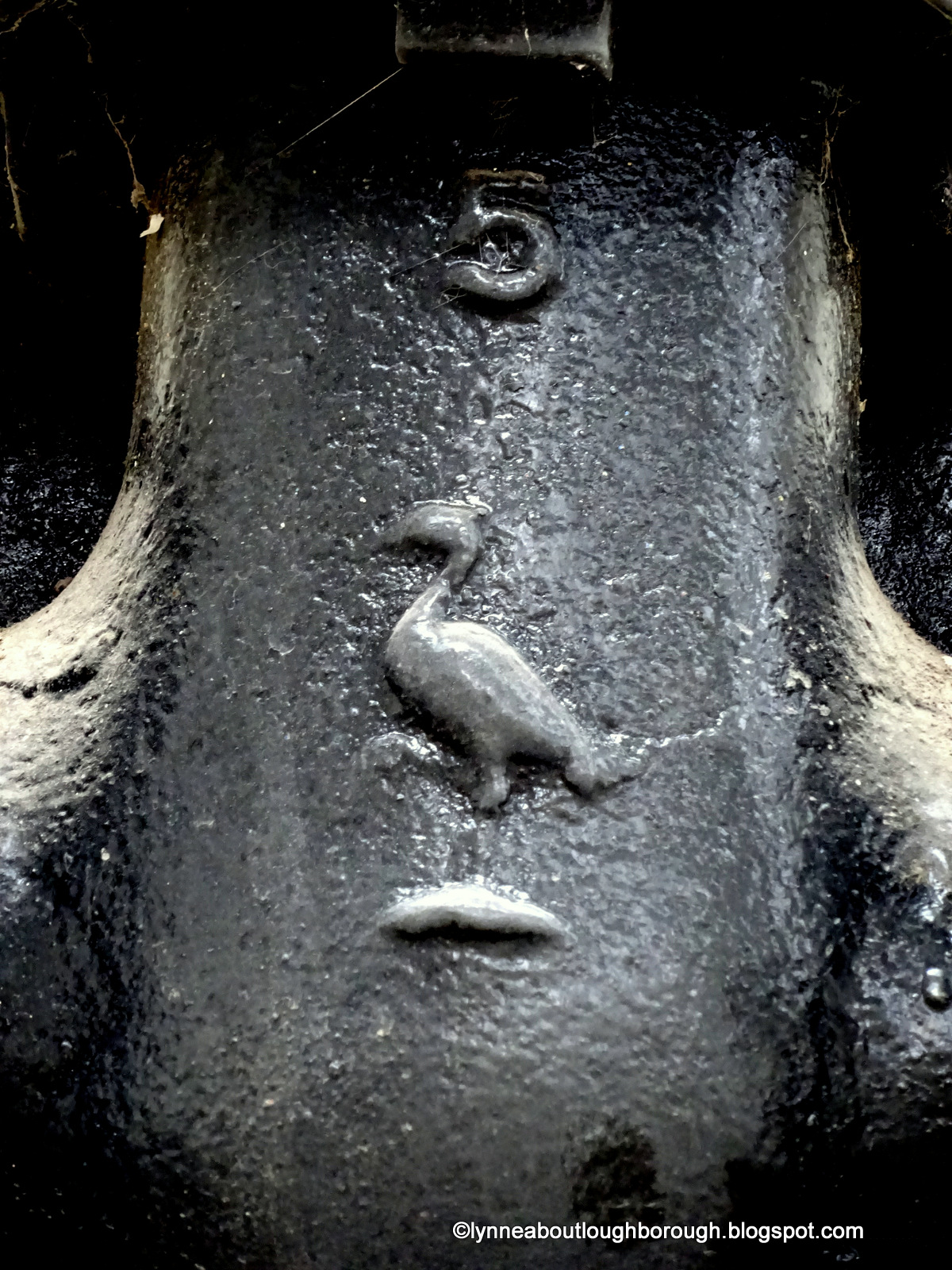
It’s a fabulously stunning building on Packe Street, and when I went inside, was pretty much stripped back to bare walls. There were, however, a couple of interesting features still in situ. One of these was a couple of lovely looking valves, one beautifully painted in black, the other showing its age somewhat, being a bit rusty, but both bore an embossed bird, with the number 5 above it.


As the building was constructed in 1936, and because at that time Loughborough was full to bursting with engineering, manufacturing, and related industry, I thought the item in question might have been made locally, however, I wasn’t aware of any Loughborough company which used a crane as its logo. In truth, I only knew it was a crane because I asked around amongst friends and family – so a huge thank you to them for helping me out!

My next port of call, after my internet searching didn’t really bring up anything that immediately seemed right, was to try Facebook! There are so many groups on the social media platform, that I knew of one that could tap into experts, and potentially provide me with the answer I was looking for. And it did …

Putting together all the information I have gleaned, I think the valves are colloquially known as Crane valves, produced by … well … it’s a long story … let’s start in 1897 …

In the late 19th century, Richard Edwin Hattersley, from Halifax, owned a small toolmaking business. Hattersley went on to establish a company called the United Brassfounders and Engineers in 1910, which he formed from a merger of four companies – Newman, Hender and Co, who were based in Woodchester, Glos.; Isaac Storey and Sons of Manchester; Martinau, Beames, and Madeley from Birmingham, and Gaukroger, Sykes and Roberts who were from Halifax.

Hattersley had moved to live in Ormskirk in the early 1900s, and the head office of UB&E was moved from Manchester to Ormskirk in 1923, and Hattersley actually bought much of the company, except for Newman, Hender and Co, which was bought by Charles Percy Newman, and which then became independent from UB&E. The Newman, Hender & Co, manufactured a complete line of valves, stopcocks, and general steam and water fittings.

Around 1936, both companies – Newman Hender, and Hattersley – sold products across the world, and during the second world war, both made products for armaments, munitions factories, and for military purposes.

In 1953, Hattersley took a majority interest in a company called Beck and Co who made meters, and by 1961, the company was manufacturing valves, stopcocks, and related fittings in gun metal, cast iron, and cast steel. These were used to control steam in heating etc.. This is where I get a bit confused, but in 1969, the Newman Hender Group was acquired by Pegler-Hattersley, which had been formed by a merger in 1968 of Peglers with Hattersley Holdings.

Fast forward to 2004, and the valve business of Hattersleys Newman Hender Limited, were bought by Crane Limited, a subsidiary of Tomkins plc.

At first, I thought ooooh, isn’t that amazing that a stop valve that features a crane as its logo was produced by a company that is now owned by Crane. Well, yes, I suppose it is a bit of a coincidence. So, looking at the stop valve in The Generator building, my assumption was that it was produced at the time the building was constructed, but, my research suggests this might not be the case … The only adverts I can find for Hatterlsey are from the 1960s, and there is one particular advert from 1969 that leads me to believe that Hattersleys were the company that provided the stop valve, but whether that was in the 1930s, or the 1960s, I’m not sure. The reason for my believing that Hattersleys were the company I was seeking can be clearly seen below:

You can see this advert on Hattersley's website

If any of you readers know anything more about the fitting out of The Generator, or more about stop vales, or more about the companies that produce them, I’d be pleased to hear from you!


______________________________________________

posted by lynneaboutloughborough

With apologies for typos which are all mine!

_______________________________________________

Thank you for reading this blog.

Copyright:

The copyright © of all content on this blog rests with me, however, you are welcome to quote passages from any of my posts, with appropriate credit. The correct citation for this looks as follows:

Dyer, Lynne (2023). Generating cranes. Available from: https://lynneaboutloughborough.blogspot.com/2023/04/generating-cranes.html [Accessed 23 April 2023]

Take down policy:

I post no pictures that are not my own, unless I have express permission so to do. All text is my own, and not copied from any other information sources, printed or electronic, unless identified and credited as such. If you find I have posted something in contravention of these statements, or if there are photographs of you which you would prefer not to be here, please contact me at the address listed on the About Me page, and I will remove these.

Blog archive and tags:

If you are viewing this blog in mobile format, you will not be able to easily access the blog archive, or the clickable links to various topics. These can be accessed if you scroll to the bottom of the page, and click 'View Web Version'. Alternatively, there is also a complete list of posts, which when clicked will take you to the page you are interested in.

Searching the blog:

You can search the blog using the dedicated search box that appears near the top of the blog when viewed in the web version. Alternatively, you can search using your usual search engine (e.g. Bing, Google, DuckDuckGo etc.) by following this example:

site: https://lynneaboutloughborough.blogspot.com/ “Radmoor House”

NOTE – the words you’re actually looking for must be in “” and the first of these must be preceded by a space

Thank you for reading this blog.

Lynne                                          

Wednesday, 29 March 2023

Saving the Generator

On an impromptu visit to the town centre, I happened to walk along Packe Street and noticed that the Generator building was open. Sticking my head around the door, I was welcomed into the open event, and joined a group who were having a bit of a guided tour of the space. And, goodness me, what a space it is!

The history of the actual building goes back to the 1930s, when it was once part of the predecessor institution to the University and to the Art College, but let’s have a quick look at the background, and the educational story.

So, the Loughborough University we know today grew from the Loughborough Technical Institute, which had been created in 1909 by Herbert Schofield. The Institute was a centre for further education, with science, technical subjects, and arts being on the syllabus, the Institute having absorbed the College of Art and Design that had been established in 1891. The first Technical Institute building was on the corner of Ashby Road and Green Close Lane, which was demolished in the early 1980s and is now a Sainsbury supermarket.

In 1952, Loughborough College was created, and this comprised: Loughborough Training College; Loughborough College of Art; Loughborough College of Further Education, and Loughborough College of Technology. The latter became the College of Advanced Technology in 1957, and was granted its royal charter, becoming the Loughborough University of Technology in 1966. The Loughborough College of Further Education became part of the university in 1977, and the Loughborough College of Art and Design joined in 1998. Loughborough University of Technology became Loughborough University in 1996.

So, back to the Generator building which is along Packe Street and is joined to the building that spans the corner of Frederick Street and Packe Street, the latter now housing a café downstairs. The Generator was built in 1937, the official opening being in January 1937, when the institution was known as the Loughborough College. When the building was constructed, it was built around a wooden hut that actually housed an electricity generator, and it was intended that the new building would continue to provide electricity for the college buildings. The building it was joined to were, the Garage Workshops, and the 4-storey building comprised: Ground level, car repair bays; 1st floor, housed a hosiery laboratory; 2nd floor had a dyeing lab, conditioning house, and drawing office, and the top floor was a handicraft shop. The adjoining lower building which we now call the Generator, was the generating station itself. At some point, the generating station building was converted for use by the School of Art, as a gallery space (at the very least).

Work has been going on at the Generator building for many years, and certainly since 2016. The last time I properly set foot in the building was back in late 2016, when public consultations were underway in an attempt to save the building and secure its future. 

Things have moved on since then, and funds have become available to do at least some work on the building, but more is needed, hence the owners of the building have now started a Crowdfund appeal. This appeal is running until the end of March, and all monies donated will be doubled until 31st March. You can find more information about this here, and if you’re quick, you still have a few days in which to contribute to saving this amazing space.

Here are some photos of my recent visit, which might give you an idea of the size and condition of the building.


______________________________________________

posted by lynneaboutloughborough

With apologies for typos which are all mine!

_______________________________________________

Thank you so much for reading this blog. 

Copyright:

The copyright © of all content on this blog rests with me, however, you are welcome to quote passages from any of my posts, with appropriate credit. The correct citation for this looks as follows:

Dyer, Lynne (2023). Saving the Generator. Available from: https://lynneaboutloughborough.blogspot.com/2023/03/saving-generator.html [Accessed 29 March 2023]

Take down policy:

I post no pictures that are not my own, unless I have express permission so to do. All text is my own, and not copied from any other information sources, printed or electronic, unless identified and credited as such. If you find I have posted something in contravention of these statements, or if there are photographs of you which you would prefer not to be here, please contact me at the address listed on the About Me page, and I will remove these.

Blog archive and tags:

If you are viewing this blog in mobile format, you will not be able to easily access the blog archive, or the clickable links to various topics. These can be accessed if you scroll to the bottom of the page, and click 'View Web Version'. Alternatively, there is also a complete list of posts, which when clicked will take you to the page you are interested in.

Searching the blog:

You can search the blog using the dedicated search box that appears near the top of the blog when viewed in the web version. Alternatively, you can search using your usual search engine (e.g. Bing, Google, DuckDuckGo etc.) by following this example:

site: https://lynneaboutloughborough.blogspot.com/ “Radmoor House”

NOTE – the words you’re actually looking for must be in “” and the first of these must be preceded by a space

Thank you for reading this blog.

Lynne