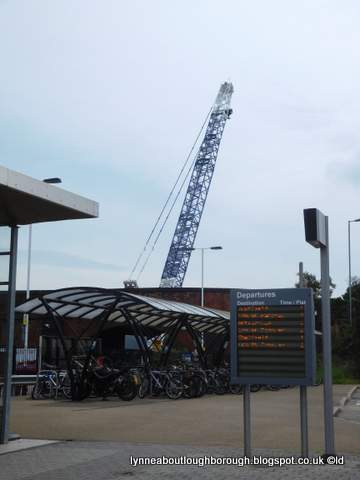
Here's another fascinating guest post for the blog's 10th anniversary!
I've known Nick for a while now - we often seem to be at the same heritage event, or in the same heritage meeting - but I have no idea of actually how long we've known each other! Anyway, I am pleased to be able to share with you Nick's guest post on my blog, in which we hear about his memories of visiting Loughborough's Great Central Railway with his father, and especially their encounter with 34039, aka 'Boscastle'! What a lot of work goes on behind the scenes at the GCR, so visitors can enjoy a great day out!
The Great Central Railway through
Loughborough:
some personal thoughts and connections
Nick Shaw
There’s much
talk at the moment about the billions being spent on HS2 to improve rail links
between London, the Midlands and the ‘Northern Powerhouse’. A high-speed rail
link is apparently needed to bring Britain’s largest economic regions (London,
the Midlands and North-West) together.
Yet turn the
clocks back 130-or-so years and exactly that was proposed by Edward Watkin, an
ambitious industrialist and chairman of the Manchester, Sheffield and
Lincolnshire Railway [1]. Having already achieved a network of railways to connect
the North West with the coalfields of Nottinghamshire, Watkin had a grand plan
to extend his railway not only to London, but also to continental Europe via a
Channel Tunnel.
Construction
of his ‘London Extension’ started in 1894 and in 1899 the Great Central Railway
opened with Marylebone as its magnificent London terminus. To fulfill the aim of
being a high-speed link the line was built to a continental loading gauge
(ready to accommodate trains to and from Europe), no sharp curves, no steep
gradients, and no level crossings. It was the original HS2 - albeit 130 years
early.
The Great
Central was subsequently amalgamated into the LNER and, post-nationalisation,
into the Eastern Region of British Railways. The 1950s saw the growth of
vehicle movements by road and the GCR was run-down as services were transferred
to the Midland line.
In 1963 the
smaller country stations such as Rothley and Quorn & Woodhouse were closed,
but the Beeching Report of the same year saw the death knell of the line. On
3rd May 1969, the last train departed from Loughborough Central and the line
closed.
In some ways
it was an opportunity missed, as the line had other features which contributed
to it being a fast and safe railway. For example, take a visit to the current
Loughborough (Midland) Station and you’ll see that the platforms are built each
side of the tracks, necessitating buildings such as waiting rooms having to be
built on both sides, as well as attendant dangers of having to cross the
running lines.
The Great
Central had a different plan. Rather than building the platforms around the
tracks, at the smaller stations they built the tracks around the platform,
meaning only one set of buildings was required and there were no issues in
crossing the tracks. Our local stations at Loughborough Central, Quorn, Rothley
and the now-demolished Belgrave and Birstall were all built to this genius
pattern. No wonder the motto of the GCR was ‘Forward’.
On that final
day in 1969, my father climbed a few steps up the water tower at the end of the
platform at Loughborough Central to photograph the last train departure, with a
young 8-year-old in shorts looking on [2]. That 8-year-old was me – and thus
started a now 54-year interest in the fortunes of the resurgent Great Central
Railway.
 |
| The last train leaving Loughborough Central before closure May 1969, Nick in shorts looking on! |
As that last
train pulled out of Loughborough, a group of enthusiasts were forming the Main Line Preservation Group with the aim of restoring and
preserving the Leicester to Nottingham section, with Loughborough Central as
its base.
The group set
about the early stages of restoring the station and then in January 1973 staged
its first operating day with one industrial steam locomotive giving
demonstrations. My father and I were there to record that day too, and this
year the GCR is proudly celebrating 50 years of operations, still looking
‘Forward’ to what they hope to achieve in the future.
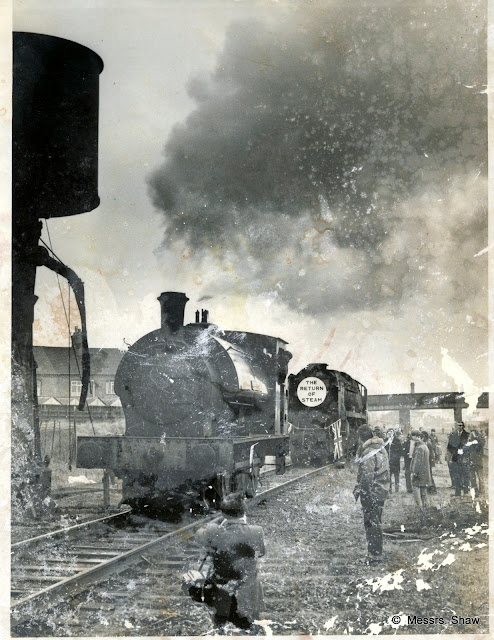 |
| January 1973, opening weekend at the GCR |
The first
mainline locomotive to arrive at Loughborough was West Country Pacific 34039 ‘Boscastle’, in a totally unrestored state from Barry scrapyard. On display on
that opening day in 1973, my father photographed the loco with yours truly
inspecting the front buffers of the rusting hulk.
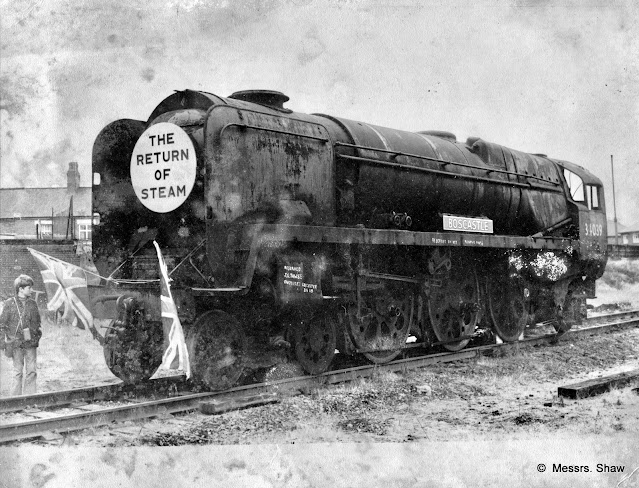 |
| The unrestored Boscastle at the GCR opening weekend, January 1973, with a young Nick at the buffers |
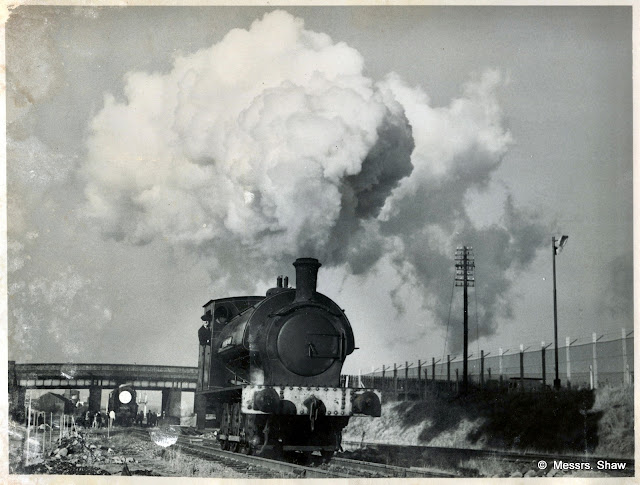 |
| Robert Nelson No.4 at the GCR in January 1973 |
The herculean
task facing the groups and volunteers trying to restore these magnificent
engines is that it takes hundreds of thousands of working hours to strip them
down, clean and repair every part and then slowly put it all back together
again. This process can take years, dependent on the resources and finances
available.
Steam locomotives are very high maintenance. After all, they are basically a huge
kettle where the boiler holds heated water to a pressure of 250psi, with all
the attendant risks that brings. Following years of restoration, the locos are
granted a 10-year certificate, at the end of which they have to be stripped
down to the last nut and bolt for the whole process to start again.
The current
GCR fleet of steam locos at Loughborough comprises 15 engines, of which at any
one time around 5 or 6 are operational with the remainder going through that
cycle of repair and restoration. You have to take your hat off to the committed
volunteers in the loco shed who give so much time to keep the engines running.
In
Boscastle’s case, it took nearly 30 years of painful hard work until the loco
was launched into service in early 1992, yet just eight years later it had to
be withdrawn pending another full overhaul.
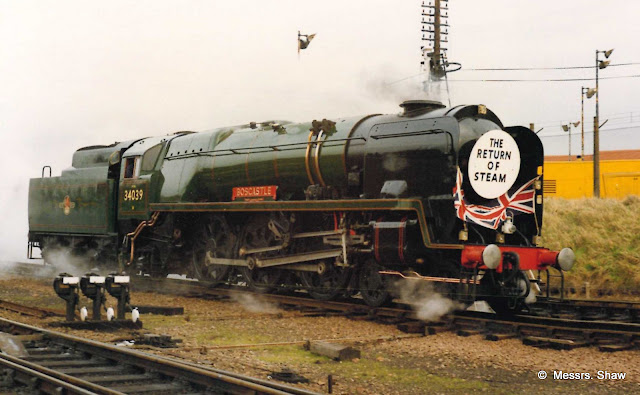 |
| Boscastle finally in steam at the GCR in January 1992 |
 |
| The Flying Scotsman leaving Loughborough's GCR late 1992 |
It’s sobering
that in its 50-year sojourn at Loughborough, Boscastle has spent 42 years under
restoration or repair. As part of the GCR’s 50-year anniversary, the partially
restored Boscastle was wheeled out in June and I took the opportunity to
recreate the photograph of me standing by the front buffers – with a little
less hair these days.
 |
| A restored Boscastle pictured in June 2023, with Nick again at the buffers! |
Throughout
the last 50 years the modern-day GCR has adopted the ‘Forward’ motif and pushed
through with some big infrastructure projects, making it the only double-track
heritage main line railway in the UK. Apart from casual visitors and
enthusiasts, this also makes it a valuable testing centre for new locomotives
and vehicles as the modern-day national railway continues to evolve. Special
dispensation allows steam locos to run at up to 60mph and diesels to 75mph
under strict conditions, but this can also be a valuable source of income for
the line.
What it lacks
at the moment is a rail connection to the national network, but the current
project to re-unite the Loughborough to Leicester section with the Loughborough
to Ruddington northern section [3] will see the creation of an 18-mile railway,
including that all-important connection to the national network to bring in
locomotives, charters and other vehicles without the need to transport them on
a low loader.
This
‘Bridging the Gap’ project is well-advanced with a bridge already in place over
the midland main line and the rusting A60 bridge next to the Brush works having
been replaced last year [4].
When will it
all be completed? Who knows, but it could well be within the next three or four
years. In which case, which loco will pull the first train over the gap to
reunite the two sections? I guess it could be any from the fleet, but I know
that a good few people who have followed the GCR’s fortunes over the years will
be hoping it’s 34039 Boscastle. And I hope to be there to witness it – and it
will be before HS2 is finished.
____________________________________
Notes
[1] There is a society dedicated to Sir Edward William Watkin, called the WatSoc, where you can find lots of information about Sir Edward and the family. An entry for him also appears in 'A-Z of Loughborough', and there are numerous books written about him, for example, that by Canon John Neville Greaves, called 'Sir Edward Watkin 1819-1901: the last of the railway kings'
[2] The Platform
Water Tank and both the South and the North Water Tanks were added to the
Register of Listed Buildings, and assigned Grade II status in 2005.
[3] 'Bridging the Gap', i.e. the actual railway bridge that was installed in November 2017 is the final entry in 'Loughborough in 50 Buildings'. The whole project to link with Ruddington is now branded under the title 'Reunification', which has its own website.
[4] 'Bridging the Gap', i.e. the actual railway bridge that was installed in November 2017 is the final entry in 'Loughborough in 50 Buildings', and lynneaboutloughborough posted some photographs of the replacement of the bridge near Brush.
____________________________________
About Nick
Although Nick now lives in Wymeswold, he works in the centre of Loughborough, and can often be seen around the town, and in Charnwood on official business, sporting the yellow high-vis jacket we so often see these days!
Nick seems to think he is a bad cricket player, a bad football player, and average cyclicst: of course, I can't possibly comment, but I would imagine he puts his all into whatever he does!
____________________________________
Posted by
lynneaboutloughborough
With apologies for
typos which are all mine!
_______________________________________________
Thank you for
reading this blog.
Copyright:
The copyright
© of all content on this blog rests with me, or in the case of guest
blogposts, with the named Guest Blogger. However, you are welcome to quote
passages from any of my posts, with appropriate credit. The correct citation
for this looks as follows:
Shaw, Nick
(2023). The Great Central Railway through Loughborough: some personal thoughts
and connections. Available from: https://lynneaboutloughborough.blogspot.com/2023/08/great-central-railway-through.html [Accessed 19 August 2023]
Take down
policy:
I post no
pictures that are not my own, unless I have express permission so to do. All
text is my own, and not copied from any other information sources, printed or
electronic, unless identified and credited as such. If you find I have posted
something in contravention of these statements, or if there are photographs of
you which you would prefer not to be here, please contact me at the address
listed on the About Me page, and I will remove these.
Blog
archive and tags:
If you are
viewing this blog in mobile format, you will not be able to easily access the
blog archive, or the clickable links to various topics. These can be accessed
if you scroll to the bottom of the page, and click 'View Web Version'.
Alternatively, there is also a complete list of posts, which when clicked will
take you to the page you are interested in.
Searching
the blog:
You can
search the blog using the dedicated search box that appears near the top of the
blog when viewed in the web version. Alternatively, you can search using your
usual search engine (e.g. Bing, Google, DuckDuckGo etc.) by following this
example:
site: https://lynneaboutloughborough.blogspot.com/ “Radmoor
House”
NOTE – the words you’re actually looking
for must be in “” and the first of these must be preceded by a space
Thank you for
reading this blog.
Lynne