Showing posts with label Henry Fearon. Show all posts

Monday, 20 March 2023

Letters to, from and related to Loughborough

I recently bumped into a postie friend of mine, and we got to discussing … ummm … post! Years ago, you’d have sent your friend or relative a postcard at, say 11 in the morning, and suggested meeting them in the park at 1 on the afternoon of the same day! Your postcard would have been quickly and safely delivered, and you’d have met your friend or relative in the park at 1pm as you’d suggested!

Writing letters and postcards was also important as a way of sharing news and updates, events, and feelings, and so on. If you were ‘important’ or your recipient thought highly of you, or considered your communications to be important to them, some of your letters and postcards might have been saved, and passed down through generations. This is particularly so with communications sent during troubled times, like during wartime. Eventually, your letters may have been donated to a record office, to be shared more widely, and someone might even collect your letters together and publish them.

These days the letterboxes [NOTE 1] are not filling as quickly as they used to. In fact, the letterboxes are barely filling at all. Lots of reasons for this, but possibly because many folk are using emails and social media apps to communicate, rather than putting pen to paper. If we did write more letters, what would we do with those we received in reply? Save them all? Save a selection? Throw them all out?

Hmmmm, so where am I going with this?? Ah, yes, connections with Loughborough!

Volumes 1 and 2 of Life and letters of Ambrose Phillippps de Lisle

As I mentioned above, sometimes people’s letters are saved, for a wide variety of reasons, which might include your being well-known, or popular, or a prolific and expert letter-writer. So, if you were the well-known poet, Philip Larkin, and you wrote regular letters to family, friends, and lovers, someone might have saved your letters, deposited them in some repository [Note 2], and someone else might have come along and gathered a selection together and published them [NOTE 3]. This, of course, did happen, and Larkin gives us a unique take on Loughborough, a place he came to, to visit his mother, his sister, her husband, and their child. 

In a letter dated 27 July 1949, which Larkin sent from the Lupton Hotel in Churston Ferrers, to his mother who was staying with his sister, Kitty, at 53 York Road, Larkin wrote:

“Mind you see a bit of life in Loughborough, always supposing there is any, which seems highly improbable to me, as Bruce [Montgomery, a friend of Larkin’s] wd say.”

If you were Ambrose Phillipps de Lisle (1809-1878), son of Charles March Phillips (who had attended Sherborne public school, as had James Bickham) and father of Ambrose Charles (the first of 16 children), you would have attended public school and Trinity College, Cambridge University, inherited the Grace Dieu estate, and later Garendon Hall and estate, from your father, converted from Anglican to Roman Catholic, commissioned a new hall to be built at Grace Dieu, and struck up a friendship with Augustus Welby Northmore Pugin [NOTE 4], and the Honourable George Spencer, son of the second Earl Spencer. All of which meant that you would have been a prolific letter-writer, with plenty to say, and someone would later collect a selection of your correspondence and publish it! [NOTE 5]

Names of de Lisle’s correspondents are both well-known and familiar – Lord Shrewsbury, the Duke of Rutland, Augustus Pugin, W.E. Gladstone, and more. Here are a couple of extracts, one a letter to the Duke of Rutland, the other to Mr Gladstone:

“GARENDON PARK, MAY 6, 1868.

MY DEAR DUKE [to the Duke of Rutland] – I thank you very much for your kind letter of the 1 st, from which I am delighted to find that you are so well and quite free from gout. This is specially agreeable to me to hear at such a critical moment in our National History …”

“GARENDON PARK, FEB. 28, 1877.

MY DEAR MR GLADSTONE – I little thought when I wrote to you, and when I was reading with so much interest and pleasure your kind answer to that letter, that I was on the eve of one of the greatest afflictions of my life. And yet sot it was , on the 6 th Feb. my poor dear son-in-law Arthur Strutt went to show a little niece of his the great wheel (Which his grandfather had invented) in the Family Mill at Milford, when by the mysterious permission of Divine Providence his foot slipped and he fell into the wheel, between the great outer one and the smaller cogg [sic.] wheel, and was instantly killed. Thus in one terrible and unlooked for moment a dear and affectionate son-in-law was carried off, and my favourite Daughter Alice was at a very early period of her Life plunged into all the grief and forlorn solitude of widowhood.”

Or, if you were Henry Alford, the Dean of Canterbury, with many friends amongst your contemporaries, and who had once been the vicar of Wymeswold, and were a personal friend of Loughborough’s Rector, Henry Fearon, a selection of your letters would have been saved, and later brought together to be published and read by succeeding generations [NOTE 6].

Below is an extract from one of the many letters Reverend Alford wrote upon the occasion of the death of his 10-year-old son, Ambrose, in 1850, this to Reverend Henry Fearon:

“TO THE REV. H. FEARON, RECTOR OF LOUGHBOROUGH.

I know, my dear Mr. Fearon, you are interested in us and ours, and therefore include you in the list of my friends to whom I have to announce the sad news of the death of our dearest and only boy. We only knew of his danger about an hour before, We had very few parting words, but those very sweet, it seemed like a dream. He died peacefully: so we have lost his happy voice and his bright promise from amongst us – a sad trial, but not, we hope, beyond the power of faith to see through in course of time.”

Or, if you were Richard Hurd, at one time Rector of All Saints Church in Thurmaston, before becoming Bishop of Coventry, then Lichfield, then Worcester, and had attended Emmanuel College, Cambridge University, at the same time as Loughborough’s Reverend James Bickham, and later had your portrait painted by Thomas Gainsborough, then your letters were sure to be saved and later published! [NOTE 7]

Interestingly, Hurd lived at Hartlebury Castle in Worcestershire, and, like Bickham, was a keen collector of books. He bequeathed his library to successive generations of clergy, and is still housed in the Castle, which I believe is open to the public.  

Here's an extract from Hurd’s letter to Thomas Balguy - who at the time of the correspondence was the Rector of North Stoke, near Grantham, and who later went on to become Archdeacon of Salisbury, then Archdeacon of Winchester – in which he mentions James Bickham:

Thurcaston, Jan. 29, 1762.

“I know nothing of the intrigues of the late Bishop of London [Dr. Hayter, died 1762]: and now they are of no concern to any body. Your prediction of him was, I fancy, accomplished somewhat sooner than you imagined. His successor you see is the Bishop of Carlisle [Dr. Osbaldeston, died 1764], to nobody’s joy, that I know of, expect Dr Browne’s; and he, I dare say, believes that I wish him no joy from it, in which however he is mistaken.

I had the greatest pleasure, as you would have, in the news of Mason’s preferments in the Church of York. I know nothing yet of the history of the Precentorship. The Residentiary’s place was owing to Lord Montague, for which I honour him.

Mr. Bickham is married, and is coming to reside at Loughborough in the spring, very early. Without doubt, as you say, he will be a good neighbour, but I am got into a way of living without any, which is much better.”

So, we’ve looked at a range of letters from across the years, including the 18th, 19th and 20th centuries! But, will there be any letters saved from the 21st century for future generations to enjoy?

____________________________________

NOTES

[NOTE 1] There is an extensive study of letterboxes in Loughborough, on this blog:

Part 1 https://lynneaboutloughborough.blogspot.com/2022/10/loughboroughs-letterboxes-pt-1.html

Part 2 https://lynneaboutloughborough.blogspot.com/2022/10/loughboroughs-letterboxes-pt-2.html

Part 3 https://lynneaboutloughborough.blogspot.com/2022/10/loughboroughs-letterboxes-pt-3.html

Part 4 https://lynneaboutloughborough.blogspot.com/2022/10/loughboroughs-letterboxes-pt-4.html

Part 5 https://lynneaboutloughborough.blogspot.com/2022/10/loughboroughs-letterboxes-pt-5.html

The case of the Burton Street pillar box https://lynneaboutloughborough.blogspot.com/2022/11/the-case-of-burton-street-pillar-box.html

[NOTE 2] The Larkin archive is held at the University of Hull

[NOTE 3] Edited by James Booth, and published in 2018, ‘Philip Larkin: letters home, 1936-1977’ is a volume of a selection of Larkin’s letters

[NOTE 4] Together, Ambrose Phillipps and Augustus Pugin were known as the two APs!

[NOTE 5] In 1900, a collection of de Lisle’s letters were published by Macmillan, in two volumes, and entitled: ‘Life and letters of Ambrose Phillipps de Lisle’. The author was Edmund Sheridan Purcell, and the volumes were edited by Edwin De Lisle.

[NOTE 6] From: ‘Life, journals and letters of Henry Alford, D.D. late Dean of Canterbury’, edited by his wife, and published by Lippincott in 1873.

[NOTE 7] The Rev. Francis Kilvert, collected together some of the work of Richard Hurd, in a volume entitled: ‘Memoirs of the life and writings of the Right Rev. Richard Hurd. D.D., Lord Bishop of Worcester’, which contained a selection from his correspondence and other unpublished papers. This was published in 1860, by Richard Bentley of New Burlington Street, London.

____________________________________

posted by lynneaboutloughborough

With apologies for typos which are all mine!

____________________________________

Thank you for reading this blog. The copyright © of all content on this blog rests with me, however, you are welcome to quote passages from any of my posts, with appropriate credit. The correct citation for this looks as follows:

Dyer, Lynne (2023). Letters to, from and related to Loughborough. Available from: [ URL e.g. https://lynneaboutloughborough.blogspot.com/2023/03/loughborough-and-isaac-newton.html] [Accessed: 20 March 2023]

Take down policy:

I post no pictures that are not my own, unless I have express permission so to do. All text is my own, and not copied from any other information sources, printed or electronic, unless identified and credited as such. If you find I have posted something in contravention of these statements, or if there are photographs of you which you would prefer not to be here, please contact me at the address listed on the About Me page, and I will remove these.

Blog archive and tags:

If you are viewing this blog in mobile format, you will not be able to easily access the blog archive, or the clickable links to various topics. These can be accessed if you scroll to the bottom of the page, and click 'View Web Version'. Alternatively, there is also a complete list of posts, which when clicked will take you to the page you are interested in.

Searching the blog:

You can search the blog using the dedicated search box that appears near the top of the blog when viewed in the web version. Alternatively, you can search using your usual search engine (e.g. Bing, Google, DuckDuckGo etc.) by following this example:

site: https://lynneaboutloughborough.blogspot.com/ “Radmoor House”

NOTE – the words you’re actually looking for must be in “” and the first of these must be preceded by a space

Thank you for reading this blog.

Lynne                               

Saturday, 22 August 2020

Spotlight on the Fearon Fountain

Posted Sunday 30th August 2020

Henry Fearon and the Fearon Fountain

Henry Fearon (1802-1885) was Rector of Loughborough, All Saints, from 1848 until his death in 1885. During his time in Loughborough, Fearon was a keen advocate of the benefits of a clean water supply, especially as Loughborough had not escaped the cholera pandemics of the nineteenth-century. According to the World Health Organisation, cholera is a bacterial infection:

"Cholera is an acute diarrhoeal infection caused by ingestion of food or water contaminated with the bacterium Vibrio cholerae."

Providing the people of Loughborough with a clean water supply, not contaminated by being in close proximity to cesspits and butcher's and animal waste, was something that Fearon had long campaigned for, and which eventually saw the creation of Nanpantan Reservoir, and the installation of a town drinking fountain.

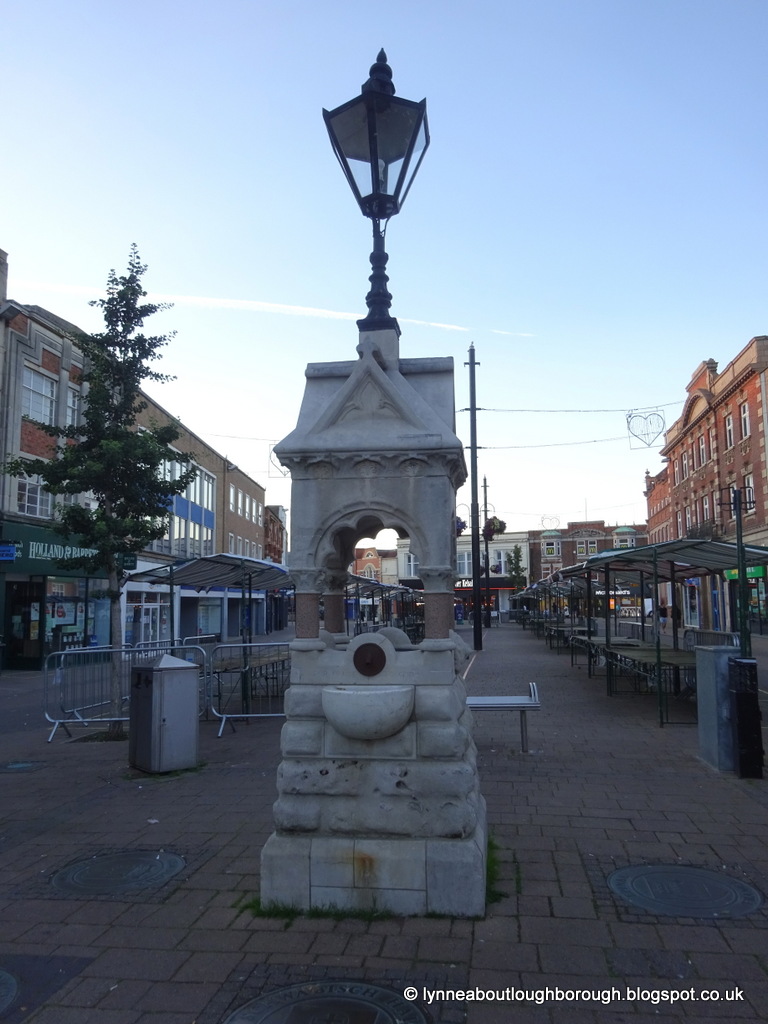
One of the main legacies of Archdeacon Fearon’s long association with Loughborough is the Fearon Fountain which stands in the Market Place. This was erected in 1870, and was presented to the town by Fearon who funded the fountain himself, and commemorates the installation of the first fresh, clean piped water supply to the town, for which Fearon had advocated so strongly.

The public dedication ceremony, which took place on Wednesday 31 August 1870, was well-attended, both by town dignitaries and other folk, the turnout being almost as good as during elections, and those who weren’t able to be in the Market Place, were apparently hanging out of their windows, looking down on the proceedings. 

Fearon’s rationale for giving the town a drinking fountain was because he strongly believed that a plentiful supply of fresh water was essential to fighting off diseases, and he was quite convinced that folk would be willing to decrease their consumption of alcohol in order to pay an extra twopence on their taxes for the water supply!

The report of the dedication ceremony that appeared in the Leicester Journal[i], describes the fountain as being made of Portland stone, and 10 foot tall. The lower section, with its inset marble drinking basins,  is joined to the upper section with polished granite columns[ii], and atop the stone canopy is a double light glove lantern. An inscription runs around the top of the lower level, and reads:

“Our common mercies loudly call,

For praise to God, who gives them all.”

a phrase that was read out in conclusion of the dedication ceremony, by Edward Chatterton Middleton, the chairman of the Board of Health.

The sculptor responsible for the creation of the fountain was James Forsyth, originally from Kelso in Scotland, but at the time of the commission, based in London and an established stonemason. James was the son of an architect, and the oldest of four children, the youngest of whom, William, was also a sculptor. By the time he came to sculpt the Fearon fountain, James was very experienced at his craft, having been involved in, amongst other things, the renovation of Wells Cathedral.   

James was present at the dedication ceremony, and was introduced to members of the Board of Health, and joined them in giving three cheers for Archdeacon Fearon.

During March 1870, the Board of Health had asked the sculptor to incorporate in the fountain design, a suitable tablet marking the donation of the fountain to the people of Loughborough, which request was duly enacted. More recently, following renovation in 1981 by local sculptor, David Tarver, a brass tablet on the fountain now reads: 

“The Fearon Fountain

Presented to the town by

Archdeacon Fearon

To mark the provision of Loughborough’s

First public water supply in 1870

Renovated as part of the

Market Place enhancement

1981”

Further renovation work took place in 1999, and another plaque installed to celebrate this:

“Archdeacon Fearon’s fountain

Restored by

Charnwood Borough Council

23rd February 1999”

Subsequent renovation took place in 2013, and a dedication service was held on 7th April, 2013, at which the Mayor of Charnwood, Diane Wise, snipped the ribbon, in the presence of many people, including representatives from the town’s Twinning Association, as water flowed through the lion’s head for the first time in many years. The stonework was again cleaned, and revealed on 31st August 2018, on the occasion of the 148th anniversary of the donation of the fountain.

The year 2020 sees the 150th anniversary of the installation of the fountain. There were to have been many celebratory events held across Loughborough, and there were plans to re-introduce a regular water supply to the fountain, however, the coronavirus pandemic has stalled these celebrations. 


The Fearon Fountain in the Market Place, Loughborough, August 2020

The plaque noting the 1981 renovation work

The plaque noting the 1999 renovation work


Snipping the ribbon at the re-dedication ceremony in 2013


Fountain detail

Fountain detail

Fountain detail

Nanpantan Reservoir

Nanpantan Reservoir

Nanpantan Reservoir

Nanpantan Reservoir

Nanpantan Reservoir


[i] Leicester Journal 2 September 1870, pg 7

[ii] Ibid. The report in the Leicester Journal suggests the polished granite columns are granite from Cornwall, while the English Heritage listing suggests they are made of Aberdeen granite. Given that the architects were from Scotland, the latter seems likely: given that the architects were working from London, the former seems likely!!

For further accounts of Fearon on this blog, please see:

So who was Henry Fearon?

Death and funeral of Henry Fearon

There's also a pictorial post about Nanpantan Reservoir

For a rather more obtuse link to Fearon see this post on Railton, Taylors and Fearon

You are welcome to quote passages from any of my posts, with appropriate credit. The correct citation for this looks as follow:


Dyer, Lynne (2020). Spotlight on the Fearon Fountain. Available fromhttps://lynneaboutloughborough.blogspot.com/2020/08/spotlight-on-fearon-fountain.html [Accessed 30 August 2020]

Take down policy:
I post no pictures that are not my own, unless I have express permission so to do. All text is my own, and not copied from any other information sources, printed or electronic, unless identified and credited as such. If you find I have posted something in contravention of these statements, or if there are photographs of you which you would prefer not to be here, please contact me at the address listed on the About Me page, and I will remove these.
Thank you for reading this blog. 

Lynne   

Sunday, 7 June 2020

Death and funeral of Reverend Henry Fearon


Reverend Henry Fearon: on the 135th anniversary of his death and funeral


On Friday 12 June, 1885 (1), at the age of 82 (2), and only 8 days off his 83rd birthday, the Reverend Henry Fearon, Rector of Loughborough, and Archdeacon of Leicester, passed away. Fearon had retired from the archdeaconry in early April, 1884, due to failing health, but had been granted permission by the Bishop of Peterborough to retain the title of archdeacon. Reverend Fearon had been in declining health for some time, and had refrained from taking part in the services of the church for several months. The final two months of his life were spent confined to his bed, under the care of Dr Eddowes (3) right up until the time of his death.


The living at Loughborough, which became vacant upon the death of Fearon, was variously described as being valued at anything from £800, through £988 to over £1,000 per year, a substantial amount, and probably one of the highest in the country at the time. It was not until the beginning of August 1885, that a successor to Fearon was appointed, when Reverend Thomas Pitts, MA and Fellow of Emmanuel College, Cambridge, accepted the living of Loughborough. Reverend Pitts had previously been a master of the Haileybury School, an independent school in Hertfordshire. By contrast, the Bishop of Peterborough was quick to confer the 8th Honorary Canonry on Reverend John Martyn Collyns, MA, and Rector of Daventry, and Reverend Collyns was installed at a service on the afternoon of Saturday 27 June 1885. Reverend Canon Assheton Pownell, MA, and graduate of Brasenose College Oxford, and Rector of South Kilworth, had been appointed to the archdeaconry of Leicester immediately upon Fearon’s resignation in April 1884.

Fearon’s death was reported widely in the press of the day (4). He was variously described as a most learned and courteous divine, and a moderate Liberal. Some newspapers reported on the admirable and kindly manner in which he performed his important duties, and how he gained the respect and esteem of the community of Loughborough. It was also said that one couldn’t over-estimate the value of his dedication to the cause of education, and his unfailing interest in the welfare of the working classes. During his time as rector, the church of All Saints had been improved, the ecclesiastical affairs of the parish had been developed, and all in a quiet and unostentatious manner. Fearon was reported to be earnest, making practical efforts to improve the condition of those around him, and a striking feature of his life was the charitable way in which he treated those of differing religious beliefs to his own.


Reverend Fearon’s funeral took place on Friday 19 June, the service being held at All Saints church, and the burial at the town cemetery on Leicester Road. The ceremony itself was simple, and the whole day was declared a day of mourning. Most of the shops in the town centre closed just before the time of the funeral, and even the blinds of private houses were drawn. All the town factories were closed for several hours so that the workers could pay their last respects to Reverend Fearon: as such thousands of townsfolk were able to attend the funeral or line the route of the funeral procession. The bells of All Saints, Holy Trinity church and Emmanuel church were tolled, and the flag on the tower of the Grammar School was mounted at half-mast.


The funeral procession was extensive, comprising both relatives and friends of Fearon; both clergy from the archdeaconry and non-conformist ministers from Loughborough; representatives from different public bodies and tenants of the reverend. In fact, so extensive was the procession that entry to the church service at All Saints was by ticket only. The cortege arrived at the church just before 2.30 on the afternoon of Friday 19 June, where, on entering through the west door, it was met by the sounds of a combined choir of over 80 voices from All Saints, Holy Trinity church and Emmanuel church, singing ‘When our heads are bowed with woe’.


Members of the congregation who were not part of the procession had been seated for over an hour before the procession entered the church. Once everyone was seated, the, which was taken by the Reverend James Mountain, the curate of All Saints, began. The lesson was read by Reverend L.L. Cooper of St John’s church in Leicester, and Dr Briggs, the organist at All Saints, brought the service to a close with a rendition of ‘Dead march’ from Handel’s Oratorio, ‘Saul’ (5).  


The funeral procession then made its way to the cemetery on Leicester Road, led by the sexton, Mr T. Grundy. Leaving the church at about 3pm, the procession went down Church Gate, passed the edge of Market Place, then along High Street and up Leicester Road to the cemetery, passing hundreds of mourners along its way. The whole journey of just under a mile-and-a half took about an hour to reach its destination. The massed choir sang ‘Jesus lives no longer now’ as the procession entered the cemetery gates, and did so also at the graveside. The service at the graveside was read first by the Reverend J. B. N. Woodroffe, followed by the Reverend Mountain, and the benediction was pronounced by the Venerable Archdeacon Lightfoot. The grave was layered with dark leaves, a cross of white flowers, and circles of daisies, and on the ledges were white blossoms fringed with ferns. The locally made oak coffin, with brass fittings and an inscribed brass plate, was covered in wreaths and crosses.

On the Sunday following Reverend Fearon’s funeral, a funeral service was held at All Saints, the sermon being preached by Reverend Lewis Clayton of St Margaret’s church in Leicester, assisted by Reverend Mountain and the Reverend R. H. Parsons. The chosen text read from the bible, was from the 9th verse of the 4th chapter of Phillippians, which was chosen for its appropriateness to the situation in Loughborough, and for its obvious application to the Reverend Fearon, a man who most certainly practised what he preached, and a man who was always ready to forgive. Later that same evening, the Reverend Martin preached to another large congregation, whilst the Reverend E. Bell held a special service at Holy Trinity church, and reference was made to the funeral of the Reverend Fearon at Emmanuel and other churches across the town.


Post-Script Further details of the life of the Reverend Henry Fearon can be found elsewhere on this blog, as can memories of happy times for the Reverend Fearon. 

Footnotes

(1) Newspaper reports of the time vary widely in their statements about the date of Reverend Fearon’s death: some quoted 7.50 on the evening of Thursday 11 June, others Friday 12 June and yet others Saturday 13 June. Friday 12 June is the date recorded in the probate record.

(2) Again, newspaper reports of the time claim the Reverend Fearon was 82, 83, 85 or even 89 at the time of his death. His birth is recorded as 20 June 1802, and he was baptised on 8 September 1802.

(3) I am unclear which Dr Eddowes was attending Reverend Fearon: this could have been John Henry (jun.) or his brother, Arthur Benjamin Jackson Eddowes. 

(4) The report of the funeral and burial of Fearon which appeared in the ‘Nottinghamshire Guardian’ of 26 June 1885, was ironically immediately followed by an article describing the opening of a new reservoir at Park Row, Nottingham, which cost around £12,000, the reservoir being capable of holding 2.25 gallons. In 1870 Fearon had been instrumental in providing Loughborough with a clean supply of fresh water from Nanpantan Reservoir, and presented the town with the Fearon Fountain, which, along with the more recent ‘Sockman’ is an iconic feature of Loughborough’s Market Place.

(5) The librettist who wrote 'Saul' was Charles Jennens, from Gopsall Hall, in Leicestershire, with whom Handel had a close friendship, and whom he visited often. 

You are welcome to quote passages from any of my posts, with appropriate credit. The correct citation for this looks as follow:

Dyer, Lynne (2020). Death and funeral of Reverend Henry Fearon. Available from:https://lynneaboutloughborough.blogspot.com/2020/06/death-and-funeral-of-reverend-henry.html  [Accessed: 7 June 2020]

Take down policy:
I post no pictures that are not my own, unless I have express permission so to do. All text is my own, and not copied from any other information sources, printed or electronic, unless identified and credited as such. If you find I have posted something in contravention of these statements, or if there are photographs of you which you would prefer not to be here, please contact me at the address listed on the About Me page, and I will remove these.

If you wish to leave a comment, please do so in the comments box that appears below this blogpost. Alternatively, you can contact me via lynneaboutloughborough[at]gmail[dot]com.

Thank you for reading this blog. 

Lynne     

Sunday, 25 August 2019

Railton, Taylors and Fearon

It all started way back when: I thought it had come to a natural conclusion last July, but it's all come back to me, again.

On Saturday last week I was unexpectedly swept up in it all over again! Despite being busy, and despite obstacles, like road closures, I nonetheless found myself in St Paul's church in Woodhouse Eaves for the last of the open sessions for this year, at which a good friend of mine was delivering a talk on ... William Railton! 

As I've just said, I've been researching Railton for quite a number of years now, and I've mentioned Railton and his Loughborough connections once or twice before on this blog. The talk re-awakened my thirst for researching and for getting to the bottom of stories, so I found it impossible to not turn on the pc and let my fingers Bing it, Yahoo it, Dogpile it, or even Google it - "it" being Railton. Seven hours later, and many, many exclamations of "Oh my goodness ...!" I finally emerged ...

The problem with "Google it" is, that if you don't delete your browsing history the search engine remembers where you've been before and assumes you want to go there again! Often this is not the case: I'm usually after new information, not stuff I've found before, but this time I didn't mind being reminded of the plans of various churches that Railton had designed, as such architectural drawings are always interesting, and sometimes simply beautiful.

This time though, I searched a little deeper, and from the same information source found an absolutely fascinating description of thousands of churches across the country, along with pictures of most of them, often cuttings taken from newspapers, sometimes postcards. I searched every one of the 30 volumes for mention of Railton's churches and was most dismayed to read the author's opinion of Railton's St Philip and St James church in Groby:


"a pathetic little church",  with "a dolls house tower and runner bean roof" 

Personally, I rather liked Groby church when I visited.


Anyway, back to the mysterious author, who had this to say about Copt Oak church: 

"...stands by itself - of dark granite in flat slabs, and rather forbidding...The church is 1837, plain E[arly].E[nglish]., by Railton."

Copt Oak Church May 2017

Copt Oak Church May 2017

After a lot of scurrying around, I discovered that the author of these wonderful descriptions was Basil Fulford Lowther Clarke, son of ordained minister, William Kemp Lowther Clarke, and was himself an ordained minister, as well as being involved in work for the Council of Churches. His description of Launde Abbey is extensive, although with regard to Railton's restorations, he merely says: "It was restored in 1846..."

Launde Abbey

Apart from this Railton connection, I couldn't help but wonder if William Kemp Lowther Clarke was in any way connected to the family of Charles Eamer Kempe, a designer of stained glass, and some from the firm of C.E. Kempe and Co. (1) grace St Paul's in Woodhouse Eaves. 

Bottom half of a Kempe window in St Paul's 

Well, my tenacity for going back generations of both these families was not holding out, but I did happen upon many other connections.

Charles Eamer Kempe worshipped at All Saints Church in Lindfield (which had previously been dedicated to St John the Baptist), but following a disagreement with folk regarding a memorial for Queen Victoria's Golden Jubilee, Kempe moved to worship at the Holy Trinity Church in Cuckfield, for which he designed the south porch. Further research into Cuckfield revealed that some of the ceiling bosses depict a chained bull, a crowned portcullis, crossed staples and the red rose of Lancaster, all of which were badges of the Neville family. The suggestion is that the ceiling may have been gifted to the church by Edward Neville, Lord Abergavenny. Edward Neville was the grandson of John of Gaunt who had a connection with Cuckfield in the mid-1600s. Lord Neville's name is associated with the hospital in Abergavenny (I haven't done any research on this, but I assume that as the hospital is called Neville Hall, that the hospital was built on the site of the former Neville Hall): this is a connection close to my heart. 

Getting ever closer to Loughborough, we find that John of Gaunt died at Leicester Castle in 1399. But the bells that Cuckfield were ringing in my head were stronger than Leicester, and I eventually reached Loughborough when I remembered that our very own Revd Henry Fearon was born in Cuckfield in 1802, a year after his father, Joseph Francis Fearon, had become vicar of Cuckfield Church! Sadly, Joseph died whilst still vicar of Cuckfield in 1816, and his role was taken up by Canon Henry Plimley. Henry would have only been 14 at the time of his father's death, and would probably have been at school in Winchester. After successfully completing his degree at Emmanuel College Cambridge, Fearon was ordained as deacon, working at Chichester, and then priest. By 1840 he was back with the Cuckfield church, and on the 1841 census he is listed as a clergyman living at The Stable, Cuckfield (2). 

Henry Fearon remained in Cuckfield until 1848 when he came to Loughborough, in the position of Rector. And the rest is history, as they say!!!

Connections with Loughborough don't end there though!!! There is a vague connection in that an architect called John Henry Taylor did some work at Cuckfield church, probably the extensive 1855 interior alterations. No relation to our own Taylors, of bellfoundry fame, but, of course, there is a connection hidden away! The bells at Lindfield church were originally made and repaired at nearby Horsham, and were later repaired and recast by the Whitechapel foundry. In celebration of Queen Victoria's Golden Jubilee (1877), the peal of 5 was increased to 8. 
"The new bells were conveyed from the railway station at Haywards Heath on a timber carriage drawn by four horses, bedecked with ribbons and bells...The bellfounders were Taylor and Co. of Loughborough, Leicestershire."    
Well, didn't you know it!!!   
Anyway, that's enough for one blogpost!


(1) The stained glass company run by Kempe was re-named C.E.Kempe and Co. after his death in 1907. It was run by Kempe's young nephew Walter Ernest Tower, and continued until 1934. Kempe's 'signature' was either a single wheatsheaf, or a trio of wheatsheaves, but once the company was run by Tower, the 'signature' changed to include a wheatsheaf with a black tower on it, and it this that can be seen on the St Paul's window pictured above.

(2) The Stable appears not to be one single dwelling, but many dwellings, but I'm not quite sure where exactly.  


You are welcome to quote passages from any of my posts, with appropriate credit. The correct citation for this looks as follow:

Dyer, Lynne (2019). Railton, Taylors and Fearon. Available from: https://lynneaboutloughborough.blogspot.com/2019/08/railton-taylors-and-fearon.html  [Accessed 25 August 2019]

Take down policy:
I post no pictures that are not my own, unless I have express permission so to do. All text is my own, and not copied from any other information sources, printed or electronic, unless identified and credited as such. If you find I have posted something in contravention of these statements, or if there are photographs of you which you would prefer not to be here, please contact me at the address listed on the About Me page, and I will remove these.
Thank you for reading this blog. 

Lynne  


Sunday, 29 July 2018

Taylors bells at St Uny church Lelant

Sticking with the holiday connections, on my final day in Cornwall I stopped off the church in Lelant on the hunt for the grave of one Bernard Walke,* an English Anglican Priest, who spent most of his life in Cornwall, in just three parishes. Now, the reason I went looking for this grave was because a few days earlier I had been at another church, this one in St Erth, where I'd come across information about, and the grave of one Annie Fearon Walke,** an artist living in Cornwall, who was born in Surrey, and who married Bernard. 

I'm sure you can see why I was interested in Annie in the first place: with a name like Fearon, was there any possibility that she was related to Henry Fearon, rector of Loughborough 1856-1885 who was born in Cuckfield, (which is bizarre because as I type this, Phil and Kirsty on Location, Location, Location are just taking a couple to Cuckfield!). A bit of research done later at home has not yet proved a connection with Henry, but there may well be, and I would find it were I to go back far enough.


Anyway, back to Bernard. The church in Lelant is a beautiful little church, overlooking the golf course and the River Hayle, and has many interesting internal features and artefacts. 


Part of what is known as the old churchyard has been designated as a 'living churchyard', which seems to mean the plants are left to take over, making memorial stone hunting quite difficult. 


Luckily, Bernard Walke was a prominent enough figure to be listed on an information board along with the position of his grave, so I managed to find it relatively easily amongst the plants. 


Having done this, I then went into the church hall which was open and serving refreshments. As well as being a meeting place the hall hosted a heritage display, showing all the research that had recently been done. One thing that I had noticed whilst looking around the local churches was the extensive information about some things like the stained glass, or the tiled floor, or the ceiling, or the Victorian restoration, but there was often a lack of information pertaining to the bells within the bell tower. 


Anyway, idling around the displays, my eye was caught by one noticeboard that seemed to be bell-related. Closer inspection revealed that indeed there was information about the bells - lots of photographs, newspaper cuttings and an order of service. Hang on, an order of service, for what exactly? Ah, a re-dedication service for the bells. This was pinned open at its middle pages, but I was able to look more closely, and discovered that some of the bells had been re-cast in 1952, by Taylors of Loughborough! The original bells had also been cast by Taylors, but in 1836 in Oxford, a few years before the first member of the Taylor family came to Loughborough. A great find!! 


The little booklet about the church (St. Uny, Lelant: the story of the parish church of St. Uny Lelant) which I also found (and bought!) had this to say:

The Bells

The peal comprises six bells, in the key of G-sharp.

Treble. Wt. 3 cwts. 2 qrs. 20 lbs.
Inscription:- "Taylor, Oxford 1836
restored 1952. Evelyn Barker and H.P Hurrell (Churchwardens)"

Second. Wt. 4 cwts. 0 qrs. 0 lbs.
Inscription:- "Taylor, fecit, Oxford 1836"

Third. Wt. 4 cwts. 3 qrs. 5 lbs.
Inscription:- "Taylor, Fecit, Oxford 1836
Obey our call the right the good old way
(Shun Schisms, wiles;) nor from it ever stray".

Fourth. Wt. 6 cwts. 0 qrs. 20 lbs.
Inscription:- "Taylor, fecit, Oxford 1836. Restored 1952
Rev. E.J. Davies-Freme, Vicar.
P.A. Clifton, Ringer's Capt."

Fifth. Wt. 6 cwts. 1 qrs. 25 lbs.
Inscription:- "Taylor, fecit, Oxford 1836."

Tenor. Wt. 8 cwts. 2 qrs. 12 lbs.
Inscription:- "Taylor, Oxford 1836. Mr William Bosustow, Churchwarden.
Glory be to God on high, The day of rest again comes round.
A day to all believers dear. The silver trumpets loudly sound,
That call the tribes of Israel near. Ye people all, obey the call,
And in Jehovah's courts appear".

Thre treble and the fourth re-cast, the peal tuned and re-hung with new fittings by John Taylor & Co., Loughborough, in 1952.
The bells were dedicated by The Lord Bishop of Truro, The Right Reverend E. R. Morgan, M.A. on Saturday, 31st May 1952.
The fifth bell was recast and returned in 1955. 

And then I spotted a bookcase in the church hall, full of books about the area, and books to interest children whilst their parents were indulging in a spot of refreshment. The book that caught my eye was, of course, a Ladybird book!


When I got home, I had a look around the Taylors bellfoundry website, and was astonished to read under their current projects that one of their works in progress is again with the church of St Uny in Lelant! 

And so, ended my Cornwall holiday, from whence I made my way to Bristol, and in the following week visited Peterborough and London - and made yet more Loughborough connections!


You are welcome to quote passages from any of my posts, with appropriate credit. The correct citation for this looks as follow:

Dyer, Lynne (2018). Taylors bells at St Uny church, Lelant. Available fromhttps://lynneaboutloughborough.blogspot.com/2018/07/taylors-bells-at-st-uny-church-lelant.html  [Accessed 29 July 2018]

Take down policy:
I post no pictures that are not my own, unless I have express permission so to do. All text is my own, and not copied from any other information sources, printed or electronic, unless identified and credited as such. If you find I have posted something in contravention of these statements, or if there are photographs of you which you would prefer not to be here, please contact me at the address listed on the About Me page, and I will remove these.
Thank you for reading this blog. 


Lynne


* St Hilary is also a church associated with Bernard Walke.

** Annie Fearon Walke also has a Facebook history (under Anne, rather than Annie).