Showing posts with label museum. Show all posts

Sunday, 21 April 2024

Ladybird at the Museum

Today I’ve been out on the allotment helping to keep in good shape, and make sure it produces lots of lovely fruit and veg! While I was there, doing a bit of weeding, I spotted a ladybird – and that got me thinking about Ladybird Books!!

I remember going to an exhibition in Leicester Museum and Art Gallery a few years ago, and our own Charnwood Museum has a Ladybird Corner, and has hosted some dedicated exhibitions, as has the local public library. So, it seems like Leicestershire are showcasing Ladybird Books across several of its museums.

I believe Melton Carnegie Museum are also going to feature Ladybird Books in a forthcoming exhibition. This will run from 4th May to 14th September 2024, and will focus on the series Well-Loved Tales. This is s0sre to be an interesting exhibition, and Melton Museum is worth a visit to see its other exhibitions which tell the story of Melton and its surrounding area.

I think the Ladybird Books exhibition at Market Harborough Museum has been and gone, but there is to soon be an exhibition in the community showcase featuring books from the At Work series, and the People Who Help Us series, and the responses of people who live in Market Harborough and around about.

Both Charnwood Museum and Melton Carnegie Museum also have a community showcase: Charnwood’s is called the Spotlight Case, and is currently hosting an exhibition called m’Other Voices. Melton’s is currently about the Observer Corps., but from May will be focussed on the battalions of paratroopers who were stationed in and around Melton Mowbray ahead of Operation Market Garden, which took place in September 1944. Some units of the 82nd Airbourne Parachute Regiment were also billeted near Melton, and in Rutland, as well as being in Quorn.

Anyway I hope you get to have a look around the museums in other parts of the county as they are well worth the trip, especially as the themes are often cahnging!

From the Ladybird exhibition at Market Harborough

____________________________________

Posted by lynneaboutloughborough

With apologies for typos which are all mine!

_______________________________________________

Thank you for reading this blog.

Copyright:

The copyright © of all content on this blog rests with me, however, you are welcome to quote passages from any of my posts, with appropriate credit. The correct citation for this looks as follows:

Dyer, Lynne (2024). Ladybird At the Museum. Available from: https://lynneaboutloughborough.blogspot.com/2024/04/ladybird-at-museum.html [Accessed 21 April 2024]

Take down policy:

I post no pictures that are not my own, unless I have express permission so to do. All text is my own, and not copied from any other information sources, printed or electronic, unless identified and credited as such. If you find I have posted something in contravention of these statements, or if there are photographs of you which you would prefer not to be here, please contact me at the address listed on the About Me page, and I will remove these.

External Links:

By including links to external sources I am not endorsing the websites, the authors, nor the information contained therein, and will not check back to update out-of-date links. Using these links to access external information is entirely the responsibility of the reader of the blog.

Blog archive and tags:

If you are viewing this blog in mobile format, you will not be able to easily access the blog archive, or the clickable links to various topics. These can be accessed if you scroll to the bottom of the page, and click 'View Web Version'. Alternatively, there is also a complete list of posts, which when clicked will take you to the page you are interested in.

Searching the blog:

You can search the blog using the dedicated search box that appears near the top of the blog when viewed in the web version. Alternatively, you can search using your usual search engine (e.g. Bing, Google, DuckDuckGo etc.) by following this example:

site: https://lynneaboutloughborough.blogspot.com/ “Radmoor House”

NOTE – the words you’re actually looking for must be in “” and the first of these must be preceded by a space

Thank you for reading this blog.

Lynne

Sunday, 25 February 2024

Loughborough's K6 telephone kiosk

Brief history of the telephone kiosk

There were several versions of the telephone kiosk created, ranging from the K1 released in 1912, through to the K8 created in 1968, to the KX100, the last to be designed in the 1980s.

The Grade II listed telephone kiosk at Loughborough railway station is of the K6 variety, and was made by the Carron Company of Stirlingshire, who were also responsible for many of the letter boxes that can still be found around the country [1].

Initially, telephone kiosks weren’t standardised, and early ones were sometimes made of wood, and looked like garden sheds! A company called the National Telephone Company (NTC) began the process of trying to standardise the kiosk design, and they created three models: the Birmingham, the Norwich, and the Wilson. Then, around 1912 the General Post Office (GPO) took over from the NTC and successfully standardised the kiosks, and began the numbering of the designs, starting with the K1, which started to appear around 1920. However, this K1 design, which had three concrete panels and a wooden door, a pyramid roof, sometimes thatched, is probably very unlike the ubiquitous red telephone kiosks like ours at Loughborough railway station.

For some reason, the K1 design wasn’t very popular and so in 1924, the GPO held a competition for a new design. The competition was won by Giles Gilbert Scott, grandson of Sir George Gilbert Scott who was responsible for Victorian renovations to many churches. The competition winner was knighted that same year after the consecration service at the new Liverpool Cathedral which he had designed, but which wasn’t completed until 1980. The new K2 kiosk was made of cast iron with a wooden door, had a domed roof and was painted red! However, the kiosk was large and expensive, and really only took off in London, so Giles Gilbert Scott then designed the K3, introduced in 1929.

The K3 was smaller than the K2 and was made from concrete. It was painted in cream, with the metal frames of the glass panels – of which there were 6 rows of three equal sized ones in each of the three glazed sides – highlighted in red. However, the K3 design only lasted for about six years, until about 1935, as the box tended to be rather brittle.

The K4 telephone kiosk, was designed by the Engineering Department of the General Post Office, and its production overlapped with that of the K3. Essentially, the kiosk followed the design of Gilbert Scott’s K2, but was constructed from cast iron, and had a stamp dispensing machine as its rear ‘wall’, so it was very large, and had to be placed so access could be gained from all four sides. The kiosk was painted entirely red, and had six rows of three panes of equal sized glass panes. However, the K4 was not hugely successful, partly due to the noise of the stamp machine which interfered with telephone conversations, the stamp machine not being waterproof, and the kiosk generally being overly large – and nicknamed the ‘Vermillion Giant’ – and only about 50 were ever produced.

The K5 can hardly be said to have been any more successful than the K4, and in fact, it never actually reached full-scale production. Had it gone into full production, the kiosk would probably be made from concrete, however, the design only ever reached the metal-faced plywood stage. In a design change from the earlier kiosks, the K5 was not fully glazed on the three normally glass sides, but had a window of two rows by two columns, rather like a house window.

Our K6 telephone kiosk

And so we come to the K6 kiosk, which is the design outside the Midland Mainline station at Loughborough. Although it looks perfectly normal, it does strike me as being a little odd because I would have expected the door to be on the front so when opened the dail and handset etc. are straight in front of you, but strangely, the door is actually on one of the sides, so you have to sidle up to the wall to get in! (see pic below). And I've just discovered why this is! In 1939, the K6 design was modified, resulting in a Mark 2 with several new versions:

Mk2 - K6A - the door is fitted opposite the back panel and is hinged, and therefore opens, to the left

Mk2 - K6B - the door is fitted opposite the back panel and is hinged, and therefore opens, to the right

Mk2 - K6C - the door is fitted as the lefthand side panel and is hinged, and therefore opens, to the left

Mk2 - K6D - the door is fitted as the righthand side panel and is hinged, and therefore opens, to the right

Interestingly, this kiosk is still in use as a telephone, but its original rotary handset and coin buttons (A for money in, B for returned coins) have been replaced. You can just about see the number punchpad through the glass on the first picture below:


What the inside would have originally looked like

There were originally detailed instructions on how to use the telephone, as well as a list of all the dialling codes, mounted inside the kiosk.

Instructions for use!

The K6 is really the one which came to be the iconic ‘red telephone box’ that we know today. It was designed in 1935, in celebration of the silver jubilee of King George V, who had come to the throne in 1911. The K6 was another box designed by Giles Gilbert Scott, who had designed the earlier boxes. The K6 was commissioned by the General Post Office, and 8,000 jubilee boxes came to our streets in jubilee year, 1936, sited in the towns and villages that actually had a Post Office.

These K6 boxes were mounted on a concrete base, and were rectangular in shape, being made of cast-iron sections (except for the door which is actually made from teak) that are bolted together. Each piece of the kiosk is numbered, perhaps to ensure that each piece was attached during construction to the right piece!


Three of the four sides of the box are glazed, with 8 rows of glass on each side, and each side having a larger glass panel sandwiched between two small panels. The box has a domed roof and a teak door, which has a metal cup-shaped handle.

A foundry plate, showing the name of the company that made the box – in our case, the Carron Company of Stirlingshire - can be found on the back of the box, towards the bottom.


The front pediment, above the door, bears a moulded St Edward’s crown. Since the K6 was produced until 1968, and as Queen Elizabeth favoured the use of the St Edward’s Crown over the Tudor Crown, kiosks produced since 1953 bear the St Edward’s Crown. This helps us to date the railway station K6 kiosk as having been produced between 1953 and 1968.


1937 was the 300th anniversary of the Post Office, and in celebration of this another 1,000 K6 boxes were installed over a period of 12 years, provided that the local authority paid a subscription of £4 over a 5-year period. Sadly, the original K6 was prone to being damaged, so a Mark II was developed and introduced in 1939, a design which was slightly more damage resistant.

Having said that the red K6 is iconic and familiar, in 1949, some rural boxes were painted in different colours, and some later ones in green and battleship grey. Over time, the K6 began to look dated, and production stopped, by which time - 1968 - around 60,000 boxes of the K6 design had been installed.

The moulded crown on the domed roof of the kiosk was originally painted in red, but since the early 1990s, in recognition of the heritage value of the iconic red telephone kiosk, British Telecom have highlighted the crown in gold paint. Ours is still red, however (see pic above).

In the late 1950s, the General Post Office began to consider a new design for the telephone kiosk, and initially chose a design for the new K7 by Nevill Conder, which was a square affair, intended to be constructed from aluminium and glass. However, the K7 never entered full-production, and only about a dozen prototypes were produced. This was mostly because aluminium became discoloured and stained in the British climate, making the K7 quite unsuitable.  Enter the K8 …

The K8 was designed by Bruce Martin, but rather than using aluminium as he suggested, the K8 was constructed of cast-iron sections which were bolted together, and mounted on a concrete base that was slightly narrower than the kiosk itself. The kiosk was three-quarter glazed on three sides, is rectangular in shape, and is painted red. In all, around 11,000 K8 kiosks were installed across the country.

When British Telecom took over the public telephone network from the General Post Office in 1985, a new kiosk, the KX100, was introduced. Its frame was made from aluminium, which was clad with stainless steel panels, the back panel which reached the ground, being made from stainless steel, and the other three sides, which didn’t quite reach the ground, and provided ventilation, were made of glass, and included a ‘modesty panel’.  Further variations of the KX100 – the KX100+ - having a domed roof, appeared between around 1996, which offered the customer the option of either paying for their call using cash or card, and also offering access to the internet. By 1999, there were just under 150,000 KX100 and its variants in existence.

Today, as people move to using mobile telephones, thus reducing the need to have a public telephone kiosk on every street, many of these public telephone kiosks have been, and are being converted. Popular conversions include use as a housing for defibrillator equipment, small libraries or book exchanges, tourist information kiosks, museums, or even small coffee vending machines!

A K6 in use as a tiny library near Carn Brea, Cornwall [2]

A K6 with a gold crown, in use as a defibrillator in Melton

News of a Leicester hero being celebrated in a tiny K6 museum in Hereford!

And here are some KX100s in Loughborough - the one on Cattle Market and those outside the Sparrow Hill post office.


More about the architect

Giles Gilbert Scott (1880-1960) grew up on a farm in Sussex, and attended a Jesuit school in Windsor.  Giles was the son of architect George Gilbert Scott (jnr.), and grandson of Sir George Gilbert Scott the Victorian architect mostly remembered for his renovation of churches. The latter was involved in the re-ordering and renovation of our own parish church, and along with W. Bonython Moffatt, also designed Loughborough’s Union Workhouse on Regent Street.

Giles’ mother was keen that he also followed the family tradition and encouraged him into the world of architecture. He was articled to the architectural firm of Temple Moore, and at the age of only 22 he won the competition to design the new cathedral at Liverpool. As Giles was a Roman Catholic, the competition committee assigned a joint architect, G. F. Bodley, but Bodley died 4 years into the build, and Giles was able to modify the original design. Liverpool Cathedral was not completed until 1980, so Giles didn’t get to see the completion of is design.

Giles was knighted in 1924, and was President of the Royal Institution of British Architecture (RIBA) for a time. Some of his other designs include religious buildings, like the Catholic Cathedral in Oban; the chapel at Charterhouse School in Godalming, Surrey, and the church for Ampleforth College. While his secular buildings include Chester House in Clarendon Place, London; Waterloo Bridge; the library for Clare College, Cambridge; the Bodleian Library at Oxford, and Battersea Power Station, which, rather like the red telephone box, is an iconic structure!

It is interesting to note that the website maintained by the Gilbert Scott family has as its logo, a red telephone box!

____________________________________

Notes

[1] I wrote a series of posts about those iconic letter boxes in October and November 2022. Here's the list:

Part 1

Part 2

Part 3

Part 4

Part 5

The case of the Burton Street box

Unusual and unreal letter boxes!

[2] Another connection with Loughborough is that the manufacturer, John Heathcoat, who took his lacemaking business to Tiverton in Devon after the Luddite riots, opened another factory in 1934, this time in Carn Brea - see picture below.

____________________________________

Posted by lynneaboutloughborough

With apologies for typos which are all mine!

_______________________________________________

Thank you for reading this blog.

Copyright:

The copyright © of all content on this blog rests with me, however, you are welcome to quote passages from any of my posts, with appropriate credit. The correct citation for this looks as follows:

Dyer, Lynne (2024). Loughborough's K6 telephone kiosk. Available from: https://lynneaboutloughborough.blogspot.com/2024/02/loughboroughs-k6-telephone-kiosk.html [Accessed 18 February 2024]

Take down policy:

I post no pictures that are not my own, unless I have express permission so to do. All text is my own, and not copied from any other information sources, printed or electronic, unless identified and credited as such. If you find I have posted something in contravention of these statements, or if there are photographs of you which you would prefer not to be here, please contact me at the address listed on the About Me page, and I will remove these.

External Links:

By including links to external sources I am not endorsing the websites, the authors, nor the information contained therein, and will not check back to update out-of-date links. Using these links to access external information is entirely the responsibility of the reader of the blog.

Blog archive and tags:

If you are viewing this blog in mobile format, you will not be able to easily access the blog archive, or the clickable links to various topics. These can be accessed if you scroll to the bottom of the page, and click 'View Web Version'. Alternatively, there is also a complete list of posts, which when clicked will take you to the page you are interested in.

Searching the blog:

You can search the blog using the dedicated search box that appears near the top of the blog when viewed in the web version. Alternatively, you can search using your usual search engine (e.g. Bing, Google, DuckDuckGo etc.) by following this example:

site: https://lynneaboutloughborough.blogspot.com/ “Radmoor House”

NOTE – the words you’re actually looking for must be in “” and the first of these must be preceded by a space

Thank you for reading this blog.

Lynne

Sunday, 18 February 2024

Loughborough's Carillon

Every year, when I ponder what to write about the Zeppelin raid on Loughborough on 31st January 1916, or when I wander through the Queen's Park, or when I think about what I can do to promote Loughborough to visitors, and when I do promote the town when I lead guided walks, one of the features that always comes up is the Carillon. And, would you believe, in the recent Art Deco talk I gave to a local history society, the Carillon even made an appearance in there!!!

The Carillon Tower and War Memorial Museum is unique in the country. True, there are other carillons, for example, that at Bournville, and there's even one down at our own bellfoundry, but the uniqueness is attributed to the one in Queen's Park being a war memorial. The carillon itself is a musical instrument that has been regularly played by the Borough Carillonneur, who was Eric Jordan at the time of the opening, and is currently Caroline Sharpe, or by visiting carillonneurs, or student carillonneurs, since the day the Carillon was opened in 1923. Regular recitals were also broadcast from the Carillon by the BBC!

Of course, such a magnificent monument, the building of which was a truly local affair - bricks by Tuckers, steelwork by Morris, bells by Taylors, and actually built by Moss - but came at a cost, some of which money was raised by the creation of a bedspread, which was awarded as a prize to the person who guessed the correct weight - or at least, came closest - of the Carillon tower! 

It was when I was doing my tour guide training, way back in 2012, that I first learned about Songster, the war horse who returned from the First World War and lived to an old age. Then, when I was a volunteer museum assistant at the Carillon for a couple of seasons, back in 2014, I encountered the life-sized Songster - well, it may not have been full size, but it seemed very large to me! - whose reins were being held by a mannequin dressed in full Leicestershire Yeomanry uniform. I have to say, both were rather scary! I also learned about trench art, which wasn't something I'd come across before. Since then, an attractive wire model of Songster has graced the flowerbed close to the Carillon!

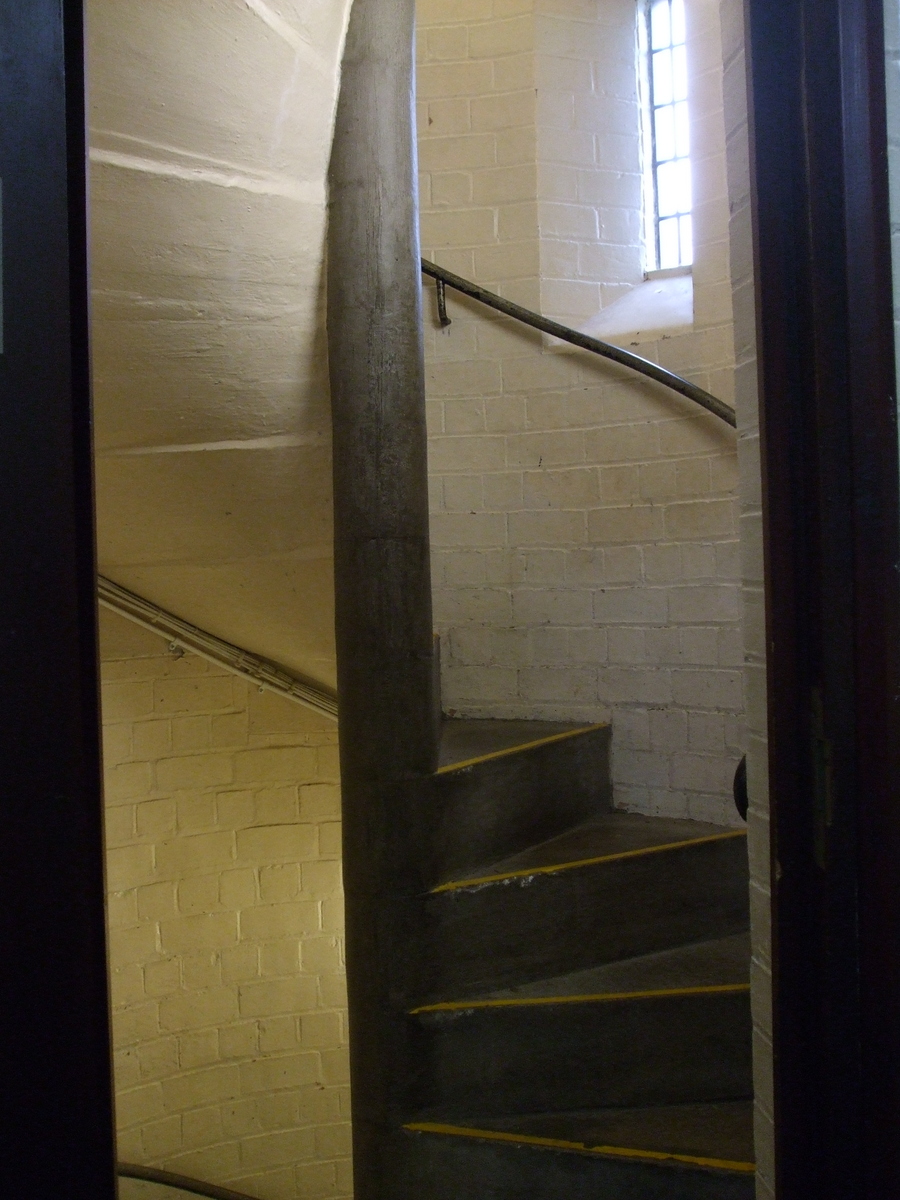
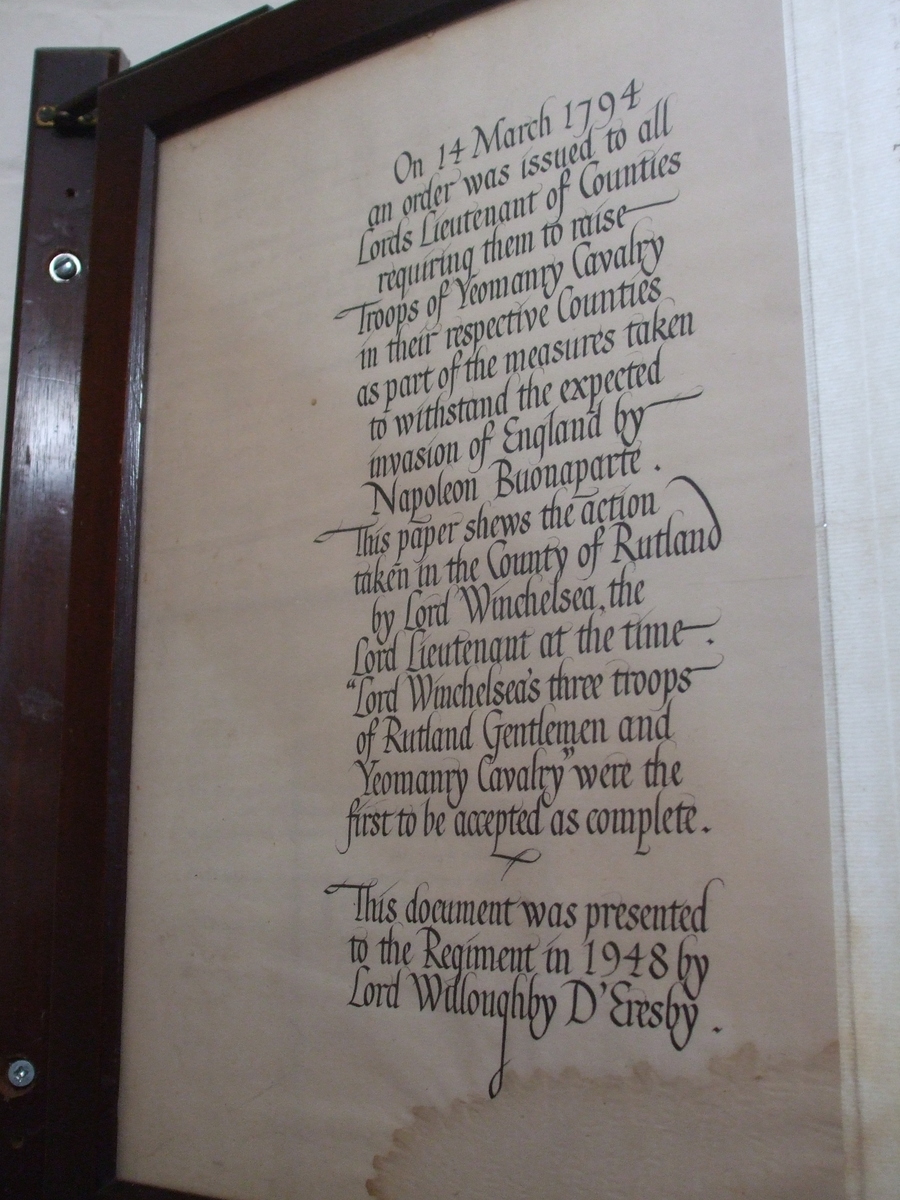
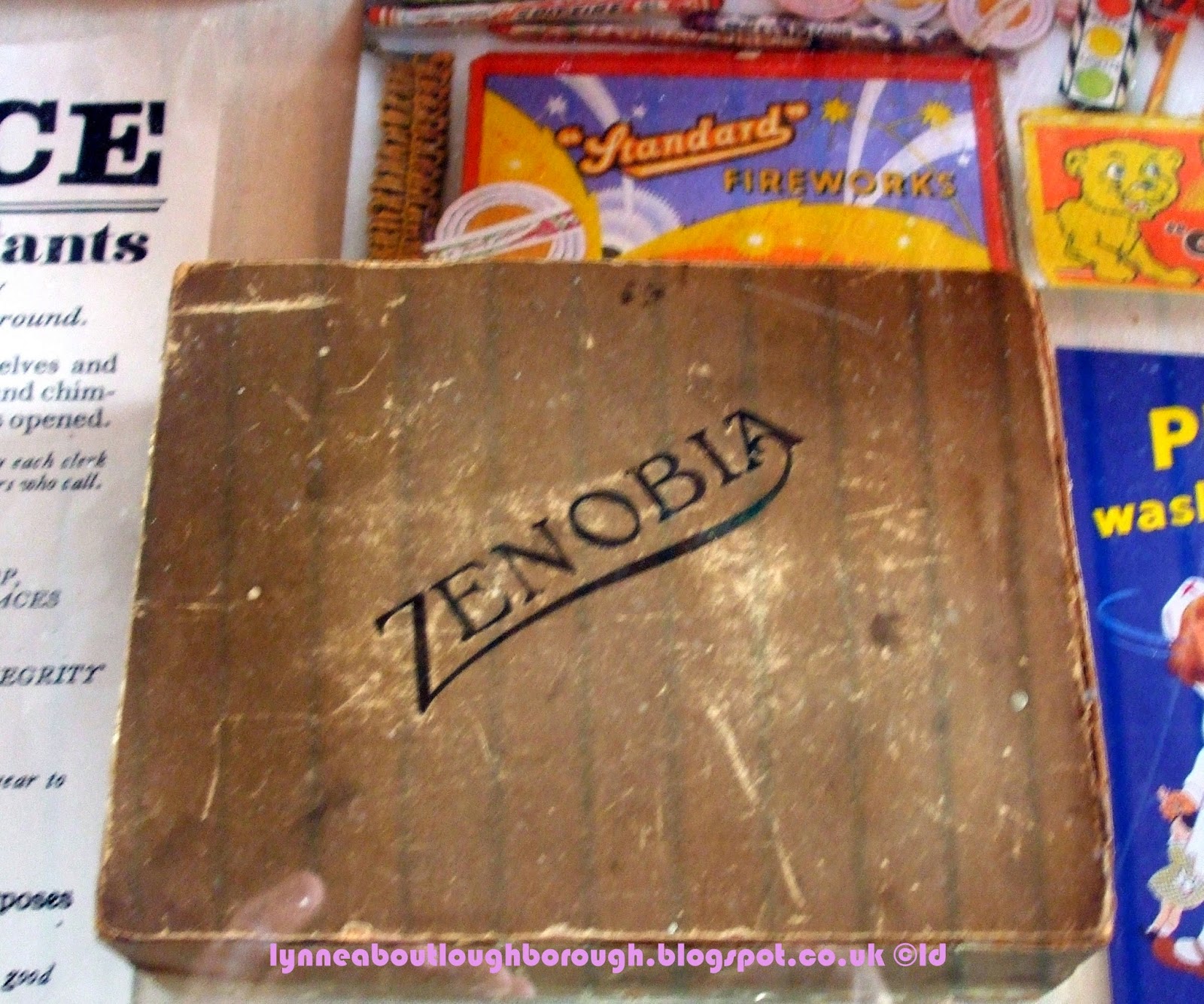
The first year I volunteered I staffed the top museum floor; the second year, I was on the first floor museum - see the end of this article for a selection of photographs of some of the artefacts that were on those floors. Access to both floors - and to the clavier room, and the actual bell chamber - is via a wonderful, spiral staircase! Who doesn't love these?! I have to put my claustrophobia to one side, and concentrate fully on putting one foot in front of the other! It's really not unlike climbing to the top of a castle turret - and who doesn't love those, too?! Or climbing the church tower, either to get to the bell chamber, or out onto the roof to see the surrounding countryside!! Or even the tower of the Loughborough Grammar School which is often open during Heritage Open Days in September. When the Carillon tower is open, it is possible to climb to the top and survey the countryside around our wonderful town, and see the actual bells in the bell chamber.

Carillon stairs

Descending the spiral stairs in the parish church

One of the bells in the bell chamber at the parish church

The spiral stairs in the Loughborough Grammar School Tower

In May 1952, the Leicester Evening Mail informed its readers that there was a "small museum inside where war relics are kept". 


In January 1964, the Illustrated Leicester Chronicle included a long description of the "unique building", saying:

 "Anyone may enter the tower to view the bells, at certain times of the day, for a small admission fee, however, one must be warned that there are 138 steps to the top of the tower! Half-way up there is a war-museum, relics brought back from the war by local men who served there." 

A comprehensive description of the contents of the museum then followed, and included both artefacts and documents.


It wasn't until Monday 5th November 1984 that the Carillon was added to the Register of Listed Buildings, and granted Grade II status. 

During the opening season, which I believe is usually Easter to October (but do please check the official website!), the Carillon receives all kinds of visitors, many of whom come from overseas on special visits. Locals and students alike climb the tower, listen to the carillon recitals, and learn from the museum exhibits, and from talking to the volunteer guides, and members of the Carillon team even go out into schools, sharing the story of the wonderful building, and taking along objects that the students can handle and learn more about.   

Last summer we celebrated the 100th anniversary of the completion of the Carillon in July 1923. I believe the weather on the occasion of the opening ceremony was quite reasonable and seasonable, however on 23 July 2023 it rained heavily and constantly! Nevertheless, enthusiasts did turn out for what was a momentous occasion. More recently, the Carillon was the destination for the replica of the Great Paul Bell, which was made from willow, and journeyed from the parish church to Queen's Park via the town centre!

Of course, every November, the Carillon is the focal point for the poignant Service of Remembrance, which is fitting, given its role as the town's war memorial, commemorating not only those who died during the First and Second World Wars, but also in subsequent, and more recent conflict.


____________________________________

Posted by lynneaboutloughborough

With apologies for typos which are all mine!

_______________________________________________

Thank you for reading this blog.

Copyright:

The copyright © of all content on this blog rests with me, however, you are welcome to quote passages from any of my posts, with appropriate credit. The correct citation for this looks as follows:

Dyer, Lynne (2023). Loughborough's Carillon. Available from: https://lynneaboutloughborough.blogspot.com/2024/02/loughboroughs-carillon.html [Accessed 18 February 2024]

Take down policy:

I post no pictures that are not my own, unless I have express permission so to do. All text is my own, and not copied from any other information sources, printed or electronic, unless identified and credited as such. If you find I have posted something in contravention of these statements, or if there are photographs of you which you would prefer not to be here, please contact me at the address listed on the About Me page, and I will remove these.

External Links:

By including links to external sources I am not endorsing the websites, the authors, nor the information contained therein, and will not check back to update out-of-date links. Using these links to access external information is entirely the responsibility of the reader of the blog.

Blog archive and tags:

If you are viewing this blog in mobile format, you will not be able to easily access the blog archive, or the clickable links to various topics. These can be accessed if you scroll to the bottom of the page, and click 'View Web Version'. Alternatively, there is also a complete list of posts, which when clicked will take you to the page you are interested in.

Searching the blog:

You can search the blog using the dedicated search box that appears near the top of the blog when viewed in the web version. Alternatively, you can search using your usual search engine (e.g. Bing, Google, DuckDuckGo etc.) by following this example:

site: https://lynneaboutloughborough.blogspot.com/ “Radmoor House”

NOTE – the words you’re actually looking for must be in “” and the first of these must be preceded by a space

Thank you for reading this blog.

Lynne

Saturday, 4 April 2015

Museums

Museums in Loughborough

Well, back in Loughborough, after a long week in Leicester, I see Spring has sprung, Easter is upon us and we all know what that means - Yes! The museums in town are now open for their summer season hours!


The Carillon Tower and War Memorial includes three rooms of artefacts, the clavier chamber, the carillon bells themselves, as well as a roll of honour to those who gave their lives in WW1 (and later conflicts). Entry to the ground floor exhibits are free, whilst the upper floors are accessible on payment of a small charge (£1). The carillon is played twice a week, at 1pm on a Thursday and Sunday (I think). The opening hours for the museum are: 1-4.30pm everyday, apart from Monday when it is closed all day. You can find the Carillon in Queen's Park Loughborough, close to the bandstand, the aviaries and the ...


... Charnwood Museum. Charnwood Museum tells the fascinating story of Loughborough and its environs, covering early history - think Walking ON dinosaurs, rather than Walking WITH dinosaurs - the geology of the area - "small areas of Precambrian and lower Cambrian rocks in Charnwood Forest and the unconformable overlying Carboniferous cover." - through framework knitting to rubbish tips, to Ladybird Books, and Edward Elgar music scripts. As well as the permanent displays, there are two exhibition areas which are used for temporary events - displays of local work, of national events, and exhibitions mostly relevant to the local area. The museum is FREE to visit, and the opening hours for the summer are: Tuesday - Saturday 10.00-4.30, Sunday 2-5pm. Beside the museum, with an entrance from the museum and from Queen's Park itself, is the Café in the Park.

Both the above museums are on facebook:

The Carillon

Charnwood Museum

Situated in the Heritage Quarter of Loughborough, next to the Parish Church (aka the Church of All Saints with Holy Trinity), is the former rectory, known as the Old Rectory, which was the home of the former vicars of the adjacent church. The building that is still standing is a 13th century stone-built manor house, which although extended many times over the years, is all that is left of the former prestigious house. Inside there is an exhibition area which houses a different display each year, whilst upstairs there are display cases which show the history of the building, the area, and even some local firms. Last year, I visited the museum and wrote about my experience. The Old Rectory Museum is FREE to enter (I think), and can be found on Rectory Place, very close to the Parish Church, and is open every Saturday, April - October, 11.00-3pm.

The final museum I would like to mention is Taylor's Bellfoundry museum. This museum is spread over two floors, and includes things like bells from different era made by different founders, artefacts pertaining to bell founding, and also has a shop which sells many bell-related items. You can take yourself around the museum, but to get the very best experience, guided tours are also offered (these must be pre-booked). The museum is a little way from the town centre, on Freehold Street, and is generally open Tuesday, Wednesday and Thursday 10.00 - 12 noon, and 2.00 - 4pm, although it is advisable to check before making the journey. There is a small charge of approx. £4 for entry.

For an account of my visit to the Great Central Railway Museum, which is open during times the station is open, please follow this link.
     

Sunday, 17 August 2014

The Old Rectory Museum

A visit to the Old Rectory Museum

If you live in Loughborough, it's possible that you might have heard of the Old Rectory Museum: In fact, you might even have played in the grounds when you were a youngster! If, however, you're a student, or you're just visiting then it's possible you might have missed this treasure, tucked away in the old part of Loughborough, near All Saints with Holy Trinity Church, close to the former Manor House, the former Guildhall, and what is probably the oldest pub in town!!

The Old Rectory is, as its name suggests, the former rectory associated with what was at the time probably known as the church of St Peter and St Paul, later All Saints, and now combined with the Holy Trinity Church (which is situated on the corner of Moor Lane and Trinity Street and is now an independent school). 

It's quite possible that there was a rectory in this place from about the early 1100s, but in the late 19th century the building looked quite different, being a substantial family home. When a new vicar was installed, he deemed the rectory too big for his and his family's needs, so a new home was built, in about 1960. The Old Rectory was then scheduled for demolition, but in the process, the old stone building that you can see today was found inside the newer building. Such was the significance of this Old Rectory, that demolition was halted, and the stone building retained and turned into a museum.

I believe that the Old Rectory and the Warner Street School are the only stone buildings to remain in the town centre, although the school has now been demolished, leaving only the former headteacher's house. Some significant stonework from the school has been housed in the Old Rectory Museum.

The Old Rectory was at one time a scheduled Ancient Monument, but is now a Grade II* listed building. The museum contains a large variety of artefacts, including archaeological finds, tiles from Garendon Abbey, has a variety of displays, including several on locally important people, and has an area devoted to an exhibition which changes each year. This year the exhibition is based around the Big Meadow in Loughborough, the oldest meadow in the country, dating back to 1762. This meadow is one of the few remaining lammas meadows in the country, and was chosen by Prince Charles to be one of the 60 coronation meadows to celebrate the Queen's reign. 

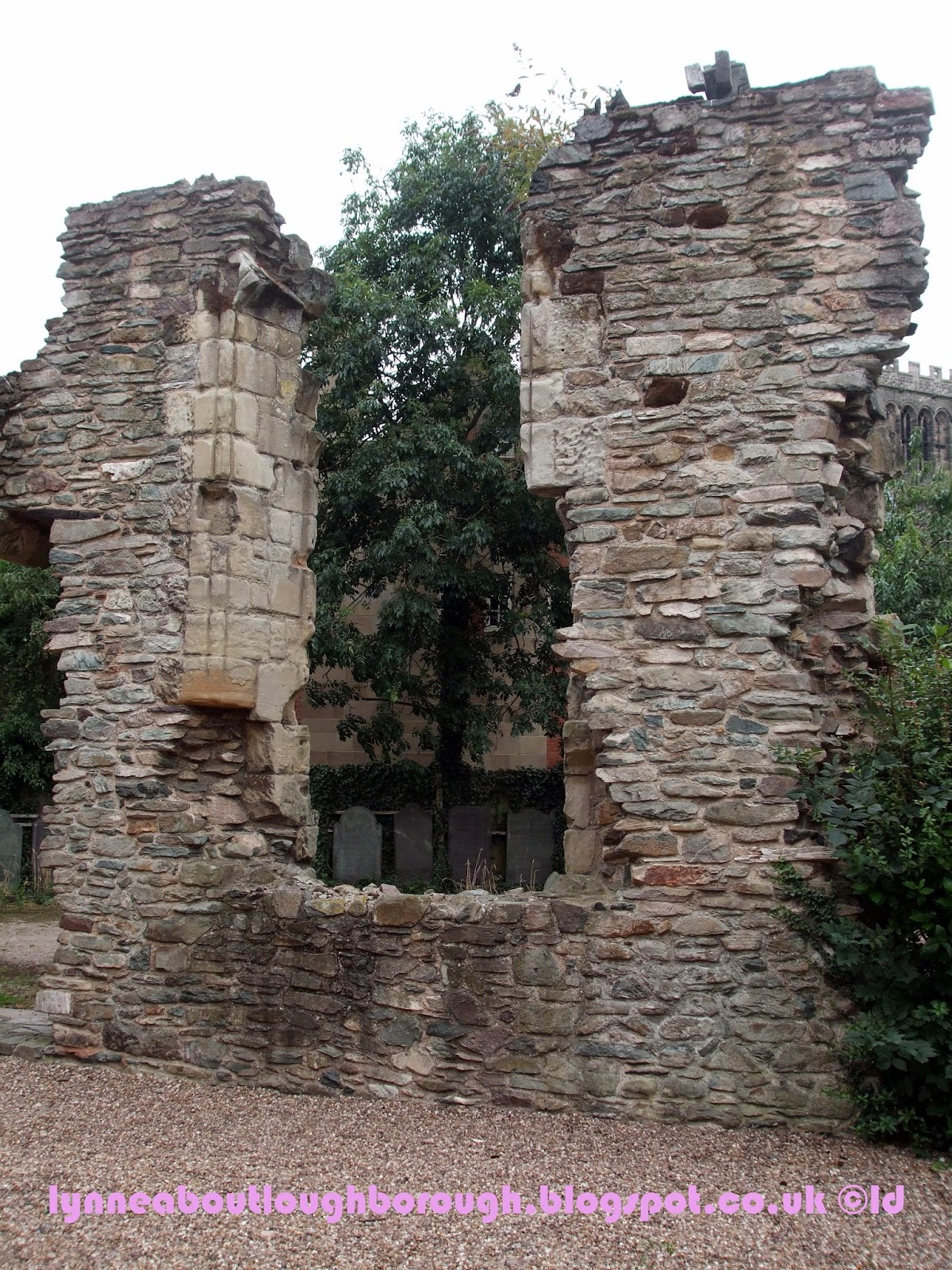
Below is a selection of photos I've taken of the Old Rectory Museum. These are probably the worst photos I've ever taken, but at least they will give you an idea of what to expect when you visit the museum, which is run by volunteers from Loughborough Archaeological and Historical Society, and which is open every Saturday from April to September, 11-3.