Showing posts with label John Boden. Show all posts

Sunday, 10 March 2019

Plaques


Exciting new green plaque for Loughborough town centre! But first an update on Maypole Dairy!


So, last week we had a look at the history of the Maypole Dairy. Since then I've had a chance to get some photographs of the former Maypole Dairy in Swadlincote, which has been revealed during renovation work. The pictures don't do the sign justice but here they are:


Another shop that has been renovated in the town, the renovation taking the shop back to its former glory is Salt's. The Salt brothers had several shops which dealt in haberdashery, menswear and hardware. Today the shop is an antique-type shop, with a beautiful tiled entrance doorway:


Whilst I was out in Swadlincote, I also spotted that they have a heritage trail (available here as a pdf 6.1mb), and lots of plaques commemorating various people. Here's a selection of the ones I saw:


Seeing these reminded me of the plaques we have in Loughborough, which I've blogged about before (sorry, I still haven't got round to making them into a proper trail, but I will soon!). And now there's another one to add to the trail. Sadly, I missed the unveiling of the latest of the Leicestershire Green Heritage plaques, which took place about 10 days ago, because I was on a work trip to Birmingham (spotted some Hathern Station Brick and Terra Cotta work while I was out, so for a work trip it was pretty good!). 

So, Loughborough's new plaque is along Market Street, mounted on a pillar that supports the Iceland store, and commemorates John Heathcoat, who had a lace factory on this site, which was later used by Wright's (who also had a big factory in Quorn, now converted into flats). Now, I did write up a trail that followed the story of the Luddites who attacked Heathcoat's and Boden's factory on the night of 28th June 1816, so you can read a bit more about it on that page. There's more of the story over on my post about the Picnic in the Park event where the Loughborough Library Local Studies Volunteers hosted a Ludd Hub, and one of their members walked from Loughborough to Tiverton in commemoration of the workers who followed Heathcoat to Tiverton to work for him after the attack.

There's also an account of a talk given by Tony Jarram on Luddites and Lace-Makers to the Friends of Charnwood Museum. You may be interested to know that it was Tony who successfully nominated Heathcoat's factory for a green plaque, which we now know was successful. As I said, I wasn't able to attend the unveiling, but here's a photo of the plaque in situ.     


Lynne

You are welcome to quote passages from any of my posts, with appropriate credit. The correct citation for this looks as follow:

Dyer, Lynne (2019). Plaques. Available from: https://lynneaboutloughborough.blogspot.com/2019/03/plaques.html  [Accessed 9 March 2019]

Take down policy:
I post no pictures that are not my own, unless I have express permission so to do. All text is my own, and not copied from any other information sources, printed or electronic, unless identified and credited as such. If you find I have posted something in contravention of these statements, or if there are photographs of you which you would prefer not to be here, please contact me at the address listed on the About Me page, and I will remove these.
Thank you for reading this blog. 

Lynne


Sunday, 26 March 2017

Luddites in Loughborough and Arnold

Deciding what to blog about that might interest you is becoming harder and harder, especially as in the last couple of weeks I've been out and about a little bit more than usual - well, when I say usual, I mean since September last year when I started my online course, which is taking up most of my spare time - and some!!

I've already told you about the branding event I went to, but I've also been to several talks recently: a Loughborough Archaeological and Historical Society talk on Luddites in Arnold; a Friends of Charnwood Museum talk on Nanpantan Hall, and a talk in Heanor about nineteenth century policing in Derbyshire. If that weren't enough, I've also been to a book launch - of the Castle Donington volume of the Victoria County History series, in Donington Hall; a play about the Luddites in Loughborough, held at the Swan in the Rushes, and a play in Stratford about a [Ro]man who was Brutally killed (1). Little wonder I'm a bit behind on my course! 

At the LAHS talk, given by Bob Massey (2), we learned of the Luddite connection to Arnold, in North Nottingham, which at the time of the attacks would have been a small, forested village, a part of Sherwood Forest. I've heard Bob speak on the topic before and he really does make it come alive: his enthusiasm for the Luddite story is catching. Bob told us that the, I don't know, let's call it the movement, was started in Arnold. He made suggestions as to why this was the case, including the fact that almost 2/3s of the population of the village was involved in framework knitting in the home. 

Around 1812, when harvests were poor, and the country was paying the price for fighting the Napoleonic wars and the 1812-15 war with the United States, Britain also experienced a trade depression. Frames became more sophisticated, and bosses began to employ unskilled labourers (colts), who commanded lower pay rates than their skilled counterparts. The products made by the colts were inferior, but skilled workers were being offered the lower pay rates associated with the colts, and it is this that the Luddites were fighting against, rather than a general disgruntlement with the advancing technology. 

Between the years of 1811 and 1812, there were many attacks which included attacks on Arnold, and there were many more both in the East Midlands and in Yorkshire. Framework breaking became a crime punishable by public hanging, and Bob told us that 29 Luddites were executed, and 34 transported.

Down at the Swan in the Rushes in Loughborough, one sunny Sunday afternoon in late March 2017, the Luddite attack on John Heathcoat and John Boden's factory in Mill Street (3) was acted out, and we witnessed one such execution, as James Towles was hung at the "New Drop", in front of the County Bridewell, Leicester (4), at the bottom of Horsepool Street (5), Leicester, for his part in the "Loughborough job". This public execution took place in November 1816, and was witnessed by large crowds. I don't know who was the Keeper of the County Bridewell at the time, but until a few years before this (until 1804) this post had been held by Daniel Lambert. 

Back to the performance of the play, Last of the Luddites, by Chorus Theatre, and based on a book of the same name by local Loughborough man, Ian Porter (6), which told the story in an imaginatively unbiased way, reporting, via short court scenes, the events from the point of view of the witnesses, the jury and the victims. Central to the movement was Ned Ludd, from whom the Luddites got their name - if, of course he was real! The true story of Ned Ludd is not known, and many and various theories were explored throughout the play. Lord Byron (7), a supporter of the cause, as he perceived the Luddites were simply trying against all odds to make ends meet, also made an appearance.

Punishment was meted out to the Luddites who attacked Heathcoat and Boden's factory in Loughborough, and Heathcoat moved his factory to Tiverton (although it is thought he had already decided to do this before the actual attack), where he built houses and facilities for his workers, on a par with those provided by Cadbury for his workers, at Bournville (8). 

At the conclusion of the play, the audience were encouraged to meet the cast, and ask questions centred around either the play itself, or the Luddite movement in Loughborough.
         
Here's a few pictures of the event.


(1) Julius Caesar by William Shakespeare

(2) http://www.arnold-history-group.org/29743483 

(3) Mill Street is now Market Street, and the factory, which later became Wright's Mill, was situated where Iceland is today.

(4) A Bridewell was a house of correction, or prison, modelled on Bridewell Prison in London. Leicester's was on Highcross Street and you can still see some remains of this today. http://familylambert.net/History/bios/daniel.html 

(5) According to an article in the Leicester Mercury, Horsepool Street is now Oxford Street in Leicester - difficult to imagine how this connected with Highcross Street, now with the underpass in the way. http://www.leicestermercury.co.uk/ringing-changes-street-names/story-12062400-detail/story.html 

(6) Porter, Ian (2015) The last of the Luddites. Loughborough: Panda Eyes Publishing. 9780957102798

(7) The poet, Lord Byron, gave a speech in the debate in the House of Lords on the 1812 Frame breaking Act. http://www.luddites200.org.uk/LordByronspeech.html see particularly the final paragraph which describes the condition of some of these frame breakers. 

(8) https://en.wikipedia.org/wiki/Bournville 

And a shameless plug for some of my previous blogposts:
Various posts about the connections between Loughborough and Tiverton, Loughborough, Luddites and Lace, Picnic in the Park 2016, etc..

If you want to explore some of the locations in Loughborough that have associations with the Luddites, pop over to my virtual walk - or, better still, go for an actual walk around the area!!  


You are welcome to quote passages from any of my posts, with appropriate credit. The correct citation for this looks as follow:

Dyer, Lynne (2017). Luddites in Loughborough and Arnold. Available from: http://lynneaboutloughborough.blogspot.com/2017/03/luddites-in-loughborough-and-arnold.html [Accessed 26 March 2017]

Sunday, 26 June 2016

Red and green houses abandoned in favour of a picnic!

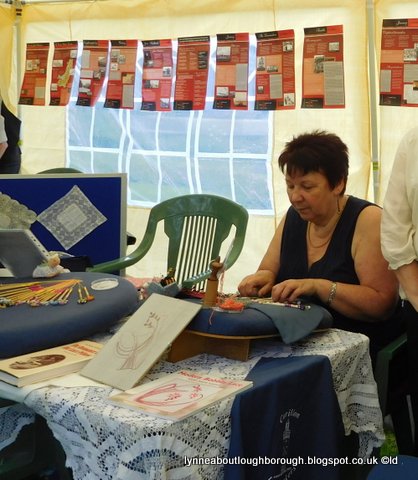
Been quite a momentous week, one way or another, and Saturday saw me spending the afternoon at the Picnic In The Park, an annual event showcasing local talent, encouraging local folk to take part in local branches of national organisations, being green and many other things. To be more precise about my role, I was helping out in the Ludd Hub, handing out leaflets, talking to folk and watching with fascination as the ladies in the tent moved left-over-right as they showed off the traditional hand craft of lace-making. The hub was created to help explain the events of 1816, and to commemorate the long walk that many Loughborough people made to take up employment in Tiverton. 

When I arrived in the park just before 12, the heavens opened and the rain came down in stair-rods, and it took me about 15 minutes to walk from the Carillon to our patch, on the grass just in front of the museum. Appropriate really, as we were there to commemorate the 1816 attack by a group of Luddites on Heathcoat and Boden's lace-making factory, which was situated where Iceland now is, a couple of streets behind where our hub was positioned.

As well as the ladies making lace, we also had an information leaflet and walking trail leaflet, which was a revised version of the one produced to accompany the exhibition in the museum in about 2007. As if that weren't enough, we had live music from the time from the Sherwood Lads, we had people in period costume, and Lord Byron delivering his maiden speech to the House of Lords, in which he argues against the death penalty for the perpetrators of frame-breaking. 

In between showers, I got out and about, accosting people and trying to give them leaflets. Well, I didn't actually accost anyone, I was very polite about it, and found the reactions of people I approached to be quite interesting. I've never been in this position before, but I was amazed at how many people were interested in the Luddites, knew something about the local events, and wanted to spend time talking to me! I met some great people, renewed some acquaintances, and generally learned quite a lot!

What you might not know is that some of the visitors at the event were actually from Tiverton, and had planned to walk back to Tiverton after the event! This is going to take about 15 days!! We believe the original workers would have walked along the Fosse Way, but today's group are walking along the canal into Somerset, then across country, I believe. I also believe a number of local folk joined them on the first leg of their journey, and some people are going to join them somewhere along the route. 

So, around three o'clock in the afternoon, I was honoured to be able to go to a reception to officially greet the Tiverton visitors, and wish them well on their journey. All-in-all, there were about eight of them, and we were also joined by descendants of John Heathcoat - Sir Ian Heathcoat-Amory and David Heathcoat-Amory - who each gave a short speech. This was followed by Lord Byron delivering his speech again, and an announcement from one of the descendants of one of Heathcoat's lace-makers, Tony Jarram, that a new local street would be named after John Heathcoat's partner, John Boden. Then we waved off the Tiverton visitors on the first leg of their journey!

If you didn't manage to get hold of a walking trail, pop over to my virtual walk, and follow that to see all the places with a connection to John Heathcoat and the Luddite raid on his factory in 1816, including Heathcoat's former house, complete with secret tunnels!

Although I spent time in the Ludd Hub, I did manage to get out and about a bit and see a little of the other things that were going on. Here's some pics of what I saw: 
The Ludd Hub
Inside the Hub
Lace-making in action  
In costume
In costume
Lord Byron delivering his speech in the rain
The Sherwood Lads
Entertainment around the Carillon
Band warming up
Band from one of our twin towns
Dancers from one of our twin towns
Band from one of our twin towns
Tommy - or is that Billy - Atkins Band, with Bill Brookman, Jan and Madeleine
Local handmade company (visit their shop on Ashby Road!)
Entertainment in the bandstand
The official event photographer!
The big send off!
The Heathcoat-Amorys at the send-off!


You are welcome to quote passages from any of my posts, with appropriate credit. The correct citation for this looks as follow:


[Dyer, Lynne (2016). Red and green houses abandoned in favour of a picnic! [Online] Available from: http://lynneaboutloughborough.blogspot.co.uk/2016/06/red-and-green-houses-abandoned-in.html [Accessed 26 June 2016]


Sunday, 12 June 2016

Birthday celebrations

Picnic in the Park is back in 2016!

Celebrate:
  • Charnwood Arts is 40 this year!
  • Loughborough's twining with Schwabisch-Hall is 50 this year!
  • Loughborough's twining with Epinal is 60 this year!
  • John Storer House is 50 this year!
  • Loughborough University is 50 this year!
  • Her Majesty the Queen is 90 this year!

Commemorate:
  • Zeppelins raided Loughborough 100 year ago this year!
  • Luddites attacked the factory of Heathcoat and Boden 200 years ago this year!

So what are we doing to celebrate and commemorate???

Preparations for BIG celebrations in Queen's Park are under-way, and there's an exciting programme of events planned! 

Some commemorations have already taken place, and we have seen the unveiling of the memorial plaque to those inhabitants of the town who died on the night of 31st January 1916, when the Zeppelin airship dropped its bombs on the town, popular accredited tour guide Bob Stephens led a walk of discovery around the sites where the bombs fell, (which has been interpreted also as a virtual walk), a vigil has been held, and there has recently been a huge commemorative event in the form of a weekend of short plays telling the story of each the town's citizens who died.

A local descendant of a family who fled the town after the Luddite attacks recently led a walk of discovery around the sites associated with Heathcoat and Boden, (which has been interpreted also as a virtual walk), and last week, on June 2nd, I attended the launch of an exhibition on the Luddite attack in 1816, at the local public library. "Loughborough's Lace and Luddite Heritage", was created by the Loughborough Library Local Studies Volunteers, and others, and after an introductory welcome by one of these, the exhibition was officially opened by Dr Robert Knight from the Politics, History and International Relations Department at Loughborough University.

This is a wonderful exhibition, and much research and thought has gone into it (as we've come to expect from the volunteers, I might add). What was even more exciting was that the Tiverton Heathcoat Walkers sent three representatives from their group to be here in Loughborough public library for the opening of the exhibition. If you don't know the story of the Luddite attack and the subsequent events, the significance is that after the attack, Heathcoat transferred his business to the town of Tiverton, and took many, if not most, of his workers with him. They travelled to Tiverton on foot, following the Fosse Way.

So, back to Picnic in the Park! During the events on the weekend of Friday 24 - Sunday 26 June (for more detail see the LoveLoughborough website) there will be a "Ludd Hub" in Queen's Park, where all-things Luddite will be happening. This will be run by the Loughborough Library Local Studies Volunteers, together with the Politics, History and International Relations Department of Loughborough University. The Tiverton Heathcoat Walkers will be attending, and after the event they will be walking back to Tiverton, just as their ancestors did in 1816, although the walkers in 2016 will be following the canals to Somerset, before taking a footpath and then picking up the canal again (I believe). The walk is expected to take 14-15 days and Loughborough people are very welcome to join the Tiverton Heathcoat Walkers on their long journey! Once you get to Tiverton, there is a local Heathcoat trail which can be followed, which links up the both the beginning and the end of the lacemakers' journey. 

In support of the commemorative events, a reprint of a publication called "The Lacemakers Story" is available from the Local Studies volunteers at Loughborough Library and costs £4.00. Free copies of "The Lace and Luddite Story" and the "Loughborough Luddite Trail" are available from the exhibition area in the library.

Here's how the local paper, the Loughborough Echo, has publicised the event, and how it has been publicised in the Exeter region.

Useful links:
  • Follow the Loughborough Library Local Studies Volunteers, and get advance notice of upcoming exhibitions: Twitter - @Loughlibvol
  • Follow Charnwood Arts on Facebook: https://www.facebook.com/groups/377722418908350/
The opening of the exhibition Loughborough's Lace and Luddite Heritage
Dr Robert Knight opening the exhibition
Just before the opening ceremony
You are welcome to quote passages from any of my posts, whilst giving appropriate credit. The correct citation for this post is as follows:

Dyer, Lynne (2016). Loughborough Union Workhouse. [Online] Available from: http://lynneaboutloughborough.blogspot.co.uk/2016/05/loughborough-union-workhouse.html [Accessed 9 June 2016]


Sunday, 19 January 2014

Loughborough, Luddites, Lace and much more!


Busy again! This week has seen me at a meeting of the Loughborough Archaeological and Historical Society, a meeting of the Friends of Charnwood Museum and a public meeting about a community hall!

The LAHS meeting was the members’ contribution meeting where, rather than having an external guest speaker, those members who are doing some interesting research present their findings to the group. And what a variety of research is going on! We were treated to some fascinating family history, from the Publicity/Secretary and Newsletter Editor, Alison Mott, who had discovered that one of her direct ancestors was one John Courtney, a Victorian playwright who wrote popular plays for the Victorian masses at a time when there was a huge demand for affordable entertainment. Although this ancestor is a recent discovery for Alison, it’s little wonder, then, that she has always felt she was meant to write!  

We also heard a fascinating tale from a member who was researching the history of the postal service in and around Loughborough. After briefly describing the evolution of our postal system there were lots of artefacts to handle, including painstakingly written information boards and photocopies of letters from / to local people which showed a fascinating insight into their personalities, which included a letter to Robert Bakewell.

If you live in the Leicestershire area you will know that the nearest National Trust properties are not in the county, so there is much interest in the National Trust’s acquisition of, and plans for the opening of Gimson’s house, Stoneywell. One of our members is now an NT volunteer guide for this house, having been a personal friend of the last owner of the house, Donald Gimson. The NT has plans to open the property during the summer of 2014,and you can follow the news related to Stoneywell on the blog.

We were also given an introduction to a proposed project which will create an online community archives hub for Loughborough and the surrounding areas. A grant has been given to the university, who hope to work in collaboration with local museums and heritage organisations to provide a one-stop-heritage-shop, a hub on the internet where you will be able to find out about all things heritage, rather like the one that has been developed in Hertfordshire. I’m really looking forwarding to supporting this initiative and the prospect of having all things heritage easily at my fingertips.


The tower of All Saints Church


Our final talk was about the WW1 project at All Saints Church which has been granted some heritage lottery funding to move the WW1 memorials from an obscure place in the church to somewhere more appropriate. I talked about this project in last week’s blogpost as this made the front page of the local paper. A public meeting is being held on Saturday February 8th at 7.30pm in the church - everyone welcome! 


Charnwood Museum

Wednesday evening saw a packed Charnwood Museum for the Friends of Charnwood Museum talk on Luddites and Lace-makers, delivered by Tony Jarram. Tony was involved in the 2007 discovery of the tunnels in Lantern House, the house on Leicester Road, which was owned by John Heathcoat, lace-maker, who developed a lace-making machine and established his factory in Loughborough.


Tony described the background to the development of lace making machines, and how Heathcoat came to be living and working in Loughborough. Once we’d heard this we were able to appreciate why Heathcoat’s factory on Malt Mill Lane (now Market Street, in the vicinity of the current Iceland shop and the Varsity Bar) was a target for a Luddite attack in 1816.

This building was once a needle-makers,
but was it also once a lace-making factory?

Same building from the side


The group known as the Luddites (possibly named after a disgruntled Leicestershire inhabitant, “Ned Ludd”) attacked factories up and down the country where they perceived that machines were taking over the jobs that were currently undertaken by them and their families, thus depriving them of much needed wages.


These wages were of course needed to provide necessities like food for working families, and lack of, or reduction in wages may well have led to some of the food riots of 1812, in places like Sheffield. 


Another building that might possibly
have been a lace-making factory


The same building from the back


According to Tony, Heathcoat’s factory was a prime target because of the efficiency of his machines and the size of his business; at one time he owned about one twelfth of all the lace-making machines in the country. He suggested that Heathcoat would have been aware of the various attacks that had already taken place in other parts of the country and the tunnels in his house on Leicester Road were purposefully built in order to provide him with a refuge in the event of an attack on his house. Perhaps because of the modest size of this house, this was not the target of an attack, the Luddites preferring to launch an assault on the lace-making factory itself.  


Directly before the attack on the factory on 28th June 1816, the Luddites drank in the Packe Horse Inn (now the Organ Grinder pub), broke windows in the Black Bull pub on High Street (now Vice Versa) on their way to the Seven Stars, a drinking house on Shakespeare Street. Fuelled by so much drinking, they took a hostage in Market Street and then attacked the guard at the factory before setting fire to it, thus destroying about 55 lace-making machines. 


The outcome of this event was that many of the protagonists were hung, a couple were sent off to Australia, and a couple escaped. Heathcoat was offered compensation on the proviso that he stayed in the town and continued with his business, but he declined this offer and transferred his business activity to Tiverton in Devon, taking with him many of his workers from Loughborough. Although many workers settled in Tiverton, many ventured further afield, some emigrating to Calais, others to Australia.    

One thing I haven’t mentioned is that Heathcoat had a partner in his Loughborough business, a man called John Boden. He followed Heathcoat to Tiverton, but the partnership was dissolved in 1821 when Heathcoat’s patent for the lace-making machine ran out. Boden then set up in Barnstaple with Heathcoat’s older brother, Thomas. And, here’s a picture of one of John Boden’s direct descendants at the exhibition in Charnwood Museum in 2007.   

I remember in 2007, going to a performance by the wonderful Mikron theatre group of a musical play about the Luddites, that took place in the Victoria Rooms in the Town Hall. This was unusual as whilst the company are performing they are based on the canals, and their usual Loughborough venue is the Swan in the Rushes. In 2012 they also created a play based on the Luddites and the cotton mills in Yorkshire. That play I didn’t see, but it’s interesting to hear that they created a song called "Nedd Ludd’s tune"!   And, just to finish off, here’s an article about Loughborough, the Luddites, the Charnwood Museum exhibition and the Mikron play!

This was a thrilling account of what was a notorious attack. And how fascinating to learn that Tony’s personal interest in Heathcoat came from being a direct descendant of John West, a Nottingham lace-makers who went to work in Calais, before returning to Loughborough!

Fearon Hall from Fearon Jitty


Finally, I spent a nice couple of hours at Fearon Hall, mingling with folk, with the aim of helping to come up with ideas for celebrating the hall’s 125th anniversary. This was a great afternoon, as although I don't use the hall myself, I re-acquainted myself with quite a number of people I have come to know over the years.


Fearon Hall


The hall was built in 1889 to celebrate the memory of Henry Fearon, Rector of All Saints, and Archdeacon of Leicester. He was a very popular character and it is him we have to thank for the first clean water to be supplied to the town, in about 1870. Archdeacon Fearon died in 1885, and Fearon Hall was built in his memory, from public subscription, and was extended in 1910.


During the 125 years of its existence, the hall has had a variety of uses -  Scout groups in the 1900s, patriotic entertainment during the WW1, a base for the Home Guard during the WW2, a base for Loughborough Art School during the 1960s, a home for Charnwood Theatre Group in the 1990s. Today, the hall is in regular use for amongst other things, exercise classes, a pre-school group, a lunch club, and a choir. Information on the running of the hall is available from the website, however, this is a little out-of-date. They also have a facebook page for you to follow.

I’d be misleading you if I said I had recently been on a trip on the Great Central Railway, but I did watch the Michael Portillo train journey programme this week when he went to Leicester, Syston and Loughborough, visiting the bellfoundry, and the Carillon! If you get a chance to watch it, it comes highly recommended! It’s probably on iplayer for a while!