Showing posts with label Wood Gate. Show all posts

Friday, 31 October 2025

Some ghosts for halloween!

So for this year’s celebration of Halloween, I thought I’d feature a few ghosts on the blog! Not real ghosts – ummm, not that I believe ghosts are real!! – but ghost signs! I’ve covered some of these in some very early blogposts, and I contributed quite a number to the Historic England ghost signs project back in 2023.

Of course, the usual definition of a ghost sign is that it is a painted sign on the side of a building, that has been left after the business or service it was advertising has gone. In my earlier posts, I extended this to cover other kinds of signs that remained on a building after the business associated with it had gone, so for example, the Messenger offices on Cumberland Road where the embossed terractotta name can still be seen; the former names of pubs like the current Organ Grinder (the Packe Horse), the Black Lion (the Tap and Clapper), and the Corporation Hotel (the Carpenters Arms); or even sandstone plaques on a building indicating the business that used to take place on the premises, like Parks Millwrights, or monograms of previous owners, for example PJM in Market Place.

Some of the ghost signs from those early blogposts are now gone, and some which weren’t really ghost signs at the time have now become such, like Putts.

So, in the last couple of weeks we have lost two of our iconic ghost signs, both of which were a long part of Loughborough’s history. The first is the sign on the Shepshed Lace Manufacturing, which was on the former factory on Great Central Road, the sign on the side facing onto the railway track. Loughborough has a long history of hosiery and lacemaking, but there are few buildings left in which this trade was worked. Shepshed Lace began in 1906, in the Bullring in Shepshed, moved to Sullington Road in 1909, opened a mill in Duffield in 1917, and eventually moved the warehouse and the manufacturing to Loughborough in 1927.


The Herbert Morris factory on Empress Road that we have seen today until very recently, was but a shadow of the former factory, which also had premises close to the Midland railway. The company were in the business of lifting gear, but in addition to the products they made, the factory on Empress Road was also known as a site which suffered from the dropping of a Zeppelin bomb on 31st January 1916. The frontage onto Empress Road was for some time a car repair garage, but lately, the original Herbert Morris sign has been revealed, and can still be seen.


Some new signs which I didn’t cover in those early blogposts include one on Biggin Street, which is on the side of the building which is now the LOROS shop. This one reads “Harry Grayson complete house furnishers”. The property looks to have been built around 1900, so I’m assuming that Harry Grayson was based there before C. E. Goodliffe, who, in the 1960s, when they moved to Church Gate (where the picture framers is now, not the restaurant), then passed the building to Pickworths. I have yet to discover if Goodliffe is related to Gascoyne and Goodliffe who were hosiery makers on Mill Street (possibly in the old Heathcoat Building).


Another new sign for this post is the one between the old India Association building and Topic hairdressers. Actually, there’s two ghost signs – or three if you count the gate!! One can be seen if heading in the direction of Tylers, the other if heading in the direction of Swancar. The first of these is a sign advertising ‘Studio 13’ which was a ladies hair salon at the back of Topic. The other sign is much older, but is in a pretty poor state, which makes it difficult to read. It even almost looks as though it’s two signs, one painted over the other. So, if the numbering on Swan Street hasn’t changed, these are the occupants of no.13 over time (although the 1901 census return seems to record 13 as 13A, and 13A as 13):

1877 – Joseph Cooper, hatter and Samuel Marsh, hatter

1881 – Charles D. Marriott, tinner and brazier and metal work master

1892 – Mrs Mary Marriott, tinner and brazier

1901 – Walter Caldwell, house furnisher, while 13A was Arthur Marriott, locksmith

1908 – Thomas C. Towell, confectioner

1911 – William Chadbourne, confectioner (sweets etc.), while 13A was John Caldwell, furniture dealer

1939 – Florence Chadbourne, confectioner (master)

1952 – still the Chadbourne family of confectioners

1962 – John Sarson and son, wine and spirit merchants. Also listed as 13, John Caldwell second-hand furniture dealer

So, my opinion is that the final line on this advert says “Made to order” and the line above that mentions “Stove”. Above that is “…ping”, and the top line seems to say “…runks”. Maybe, “Trunks”, “Piping”, “Stove …”, “Made to order” – so either associated with Charles D. Marriott, the tinner, brazier, and metal work master, or possibly Arthur Marriott the locksmith.


The final ghost sign I’d like to share is the one on Wood Gate, close to Bedford Square. Now, I do seem to remember that there might have been an Indian takeaway shop there at one time – or am I imagining that? So would the ghost sign really be saying “Balti”?


And here I must leave Halloween as the night is drawing in and ghostly happenings are beginning to, ummm, happen!!

____________________________________

Here are some of my earlier posts about ghost signs:

Ghost signs of Loughborough Part 1 https://lynneaboutloughborough.blogspot.com/2014/03/ghost-signs-of-loughborough.html

Ghost signs of Loughborough Part 2 https://lynneaboutloughborough.blogspot.com/2014/03/ghost-signs-of-loughborough-part-2.html

Loughborough building demolished – about the ghost sign on the old labour exchange on Cradock Street https://lynneaboutloughborough.blogspot.com/2022/04/loughborough-building-demolished.html

Ever-changing Loughborough – Shepshed Lace https://lynneaboutloughborough.blogspot.com/2025/10/ever-changing-loughborough.html

The Old Art College and The Generator https://lynneaboutloughborough.blogspot.com/2023/08/the-old-art-college-and-generator.html

____________________________________

Posted by lynneaboutloughborough

With apologies for typos which are all mine!

_______________________________________________

Thank you for reading this blog.

Copyright:

The copyright © of all content on this blog rests with me, however, you are welcome to quote passages from any of my posts, with appropriate credit. The correct citation for this looks as follows:

Dyer, Lynne (2025). Some ghosts for Halloween!  Available from: https://lynneaboutloughborough.blogspot.com/2025/10/some-ghosts-for-halloween.html [Accessed 31 October 2025]

Take down policy:

I post no pictures that are not my own, unless I have express permission so to do. All text is my own, and not copied from any other information sources, printed or electronic, unless identified and credited as such. If you find I have posted something in contravention of these statements, or if there are photographs of you which you would prefer not to be here, please contact me at the address listed on the About Me page, and I will remove these.

External Links:

By including links to external sources I am not endorsing the websites, the authors, nor the information contained therein, and will not check back to update out-of-date links. Using these links to access external information is entirely the responsibility of the reader of the blog.

Blog archive and tags:

If you are viewing this blog in mobile format, you will not be able to easily access the blog archive, or the clickable links to various topics. These can be accessed if you scroll to the bottom of the page, and click 'View Web Version'. Alternatively, there is also a complete list of posts, which when clicked will take you to the page you are interested in.

Searching the blog:

You can search the blog using the dedicated search box that appears near the top of the blog when viewed in the web version. Alternatively, you can search using your usual search engine (e.g. Bing, Google, DuckDuckGo etc.) by following this example:

site: https://lynneaboutloughborough.blogspot.com/ “Radmoor House”

NOTE – the words you’re actually looking for must be in “” and the first of these must be preceded by a space

Thank you for reading this blog.

Lynne

Saturday, 6 April 2024

F is for fire!

Fire is such a dreadful thing. It can cause death and injury to people, as well as devastation to buildings and their surroundings. Over the years there have been very many fires in and around Loughborough, some of which are well-known and have been well-documented. It wouldn’t be possible for me to research, list, and describe them all, so here are just a few.

Back in 2010, I wrote a post about disasters in Loughborough, which focussed mainly on listing the fires and plagues that took hold of Loughborough from about 1622 to 1999. In the very early days, buildings made of wood and roofed with thatch would have easily caught fire, and these would have spread quickly to surrounding buildings. Here’s a link to that post.

At one time there was a Co-op on Wood Gate. In 1884, there was a fire in the building, and this post looks at the effect of that fire on the shop manager. Luckily the building survived and is now a Chinese restaurant.


Who could forget that in March 2023, Loughborough’s HSBC in Market Place caught fire, and extensive damage was done not only to the bank but also to the adjoining Town Hall. This fire was one reason for the clock on the front of the Town Hall stoppingat 5.10pm!

Back in 1936, not long after the Odeon, latterly Beacon Bingo, had opened, under the management of Clarence George Starkey, there was a fire. You can read a bit about what happened in this blog post; 

In 1939 there was a fire at the garage of the Art Deco Co-op on Derby Road

There was again a fire in Wood Gate, at the Lecture Rooms belonging to the Baptist church, in 1930.

As I mentioned above, I cannot possibly cover them all, so I am sorry not to have mentioned the fire at the Caldwell factory on Church Gate, the fire at the Adorna factory in Swan Street, and so many, many others.                     

____________________________________

This post is one in a series of posts in the 2024 'Blogging from A-Z April Challenge'.


____________________________________

I'm not sure if the below will work, but if you use this blog in web mode, rather than mobile mode, you will see a set of hyperlinked tags down the right-hand side. These are taken from those tags that begin with 'F', although, as I say, I'm not sure if they will work as hyperlinks. 

Fab Friday (1) facing bricks (1) factory (1) fair (17) Fair 800th (7) fair charter (1) Fairfield (1) Fairground (2) Fairground rides (3) Fairground rides.Sockman (1) Fairmount Drive (1) Falcon Works (1) fallen (1) Falmouth (1) farm open days (1) farming (3) Farnham (1) Father Vincent (1) Fats Sam's (1) favourites (1) Fearon Fountain (10) Fearon Hall (8) Fearon Street (3) Fenian (1) Fennel Street (5) Festival of Britain (2) Festival Players (1) Field House (4) Fielding Johnson building (1) fieldwalking (1) fire (3) Fire Brigade (1) fire service (1) fire station (1) First World War (1) Fishguard (1) fishing (1) Fishpool Head (1) Fisons (2) flappers (1) floods (1) Florence Mary Goodman (1) flying boats (1) folklore (1) Football (1) footpaths (2) Forest Canal (1) Forest Green Belt (1) Forest Rise (1) Forest Road (6) Foresters (1) Forge Mill Needle Museum (2) fountain (1) fountains (1) fox (1) Fox Hunter (1) framework knitters (2) Frances Louisa Eddowes (1) Frances Scott (1) Francis Beaumont (1) Franz Stabbert (1) Frederic Stubbs (1) Freeman of the Borough (1) Freeman of the Borough of Charnwood (1) Freeman of the Borough of Loughborough (2) Freemasons (4) Freemen (1) front garden (1) fundraising (1)                                            

____________________________________

Posted by lynneaboutloughborough

With apologies for typos which are all mine!

_______________________________________________

Thank you for reading this blog.

Copyright:

The copyright © of all content on this blog rests with me, however, you are welcome to quote passages from any of my posts, with appropriate credit. The correct citation for this looks as follows:

Dyer, Lynne (2024). F is for fire. Available from: https://lynneaboutloughborough.blogspot.com/2024/04/f-is-for-fire.html  [Accessed 6 April 2024]

Take down policy:

I post no pictures that are not my own, unless I have express permission so to do. All text is my own, and not copied from any other information sources, printed or electronic, unless identified and credited as such. If you find I have posted something in contravention of these statements, or if there are photographs of you which you would prefer not to be here, please contact me at the address listed on the About Me page, and I will remove these.

External Links:

By including links to external sources I am not endorsing the websites, the authors, nor the information contained therein, and will not check back to update out-of-date links. Using these links to access external information is entirely the responsibility of the reader of the blog.

Blog archive and tags:

If you are viewing this blog in mobile format, you will not be able to easily access the blog archive, or the clickable links to various topics. These can be accessed if you scroll to the bottom of the page, and click 'View Web Version'. Alternatively, there is also a complete list of posts, which when clicked will take you to the page you are interested in.

Searching the blog:

You can search the blog using the dedicated search box that appears near the top of the blog when viewed in the web version. Alternatively, you can search using your usual search engine (e.g. Bing, Google, DuckDuckGo etc.) by following this example:

site: https://lynneaboutloughborough.blogspot.com/ “Radmoor House”

NOTE – the words you’re actually looking for must be in “” and the first of these must be preceded by a space

Thank you for reading this blog.

Lynne

Sunday, 4 December 2022

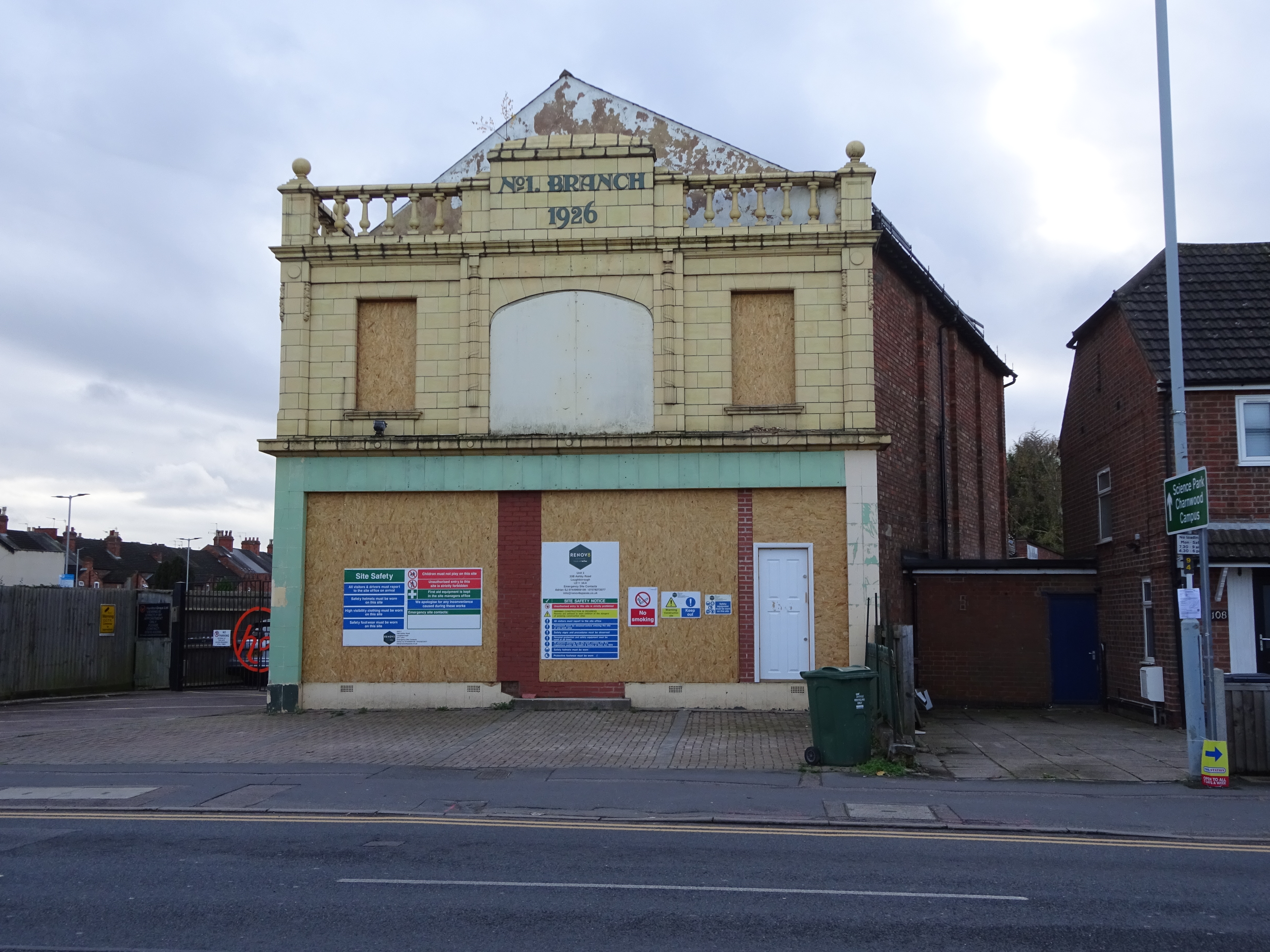
No.1 Co-op

Back in June 2021 (gosh, I thought I'd written that post only a couple of months ago, but it turns out to be nearly 18 months since it was done!) I wrote about the former No.1 Co-op store down on Derby Road, close to the new supermarket, the chip shop, and Belton Road. Before the Co-op was built, the land was close to the Charnwood Forest Railway, and adjacent to the Wood Brook. 

Pictured in 2020

Detail from 2020

I think it was sometime the year before, so, in 2020, that the former Co-op, which was then an Oriental restaurant, had been sold, and was being converted to flats: the June 2021 post was a record of progress with that conversion, but also a brief history of the Co-op stores, the movement having definitely been active in Loughborough from around 1866. The Derby Road Co-op, despite being called 'No.1' was not the first Co-op in Loughborough, that honour going to the store on Wood Gate, coincidentally, now an Oriental restaurant.

Detail of the Wood Gate store

At the time, it was a puzzle as to why the Derby Road Co-op was called the No.1 Co-op, having been built in 1926. 

Several theories had emerged:

*Was it the first Co-op in Knightthorpe? It could not have been the first Co-op store in Loughborough, as the store on Wood Gate opened in the 1860s

*Had the Loughborough Co-operative Society merged with another local society, and this was the first building to be built and occupied by the merged Society?

*Was it a road number? Perhaps intended to be the start of Alan Moss Road?

*Was it the first of Loughborough's buildings to be clad in Hathernware faience tiles?

*Was it the first to be built along the Charnwood Forest railway line, with others planned along the route?

*Was it the first self-service Co-op in the area?

A recent chance conversation on Facebook, about the No.1 Co-op in Farnborough, has led me to what I believe might be the answer. I might not quite have got the dates right, but I think it does all have to do with parish boundaries.


At one time Loughborough was surrounded by a number of different parishes, including Woodthorpe to the south, Knightthorpe, and Thorpe Acre cum, or with,  Dishley, the latter two being northwest of Loughborough. 

In 1871, Knight Thorpe is described in Wilson's 'Imperial Gazetteer of England and Wales', as "a township in Loughborough parish, Leicester; near Loughborough. Real property, £1,533. Population, 58. Houses, 12."

The same source describes Dishley-Cum-Thorpe Acre, as "a parish in the Loughborough district, Leicester; adjacent to the river Soar and the Midland railway, 1.5 miles NW of Loughborough. Post town, Loughborough. Acres, 890. Real property, £1,742. Population, 194. Houses, 54. Bakewell, the distinguished agricultural improver, lived and laboured here; and has bequeathed to the place marked benefits of his skill. The living is in the diocese of Peterborough. Value, £150. Patron, the Bishop of Peterborough. The church was built in 1845 [designed by William Railton]. A school has £11 from endowment, and other charities £11."

By 1925 this had all changed, as shown by the following extract from Kelly's 1925 directory. This explains that by an Order of the County Council, confirmed by Local Government Board Order, which came into operation on 25th March 1892, parts of the parishes of Knight Thorpe, and Dishley with Thorpe Acre were constituted the new parish of Knight Thorpe, and parts of the parishes of Garendon and Dishley with Thorpe Acre constituted the present parish of Dishley with Thorpe Acre, and parts of the parishes of Garendon, Knight Thorpe and Dishley with Thorpe Acre formed into the new parish of Garendon.

So, looking at a map of the municpal boundary, i.e. post-1888 when the borough became incorporated, it appears that the Knightthorpe boundary runs alongside the Wood Brook, down to part of what is now the university campus, and up past the site of the No.1 Co-op (X marks the spot), along what is now Belton Road.


As the No.1 Co-op built in 1926 on Derby Road, is on the Derby side of the Wood Brook, it might therefore follow that the store, being outside the boundary of Loughborough, was the first one to be built in Knightthorpe parish. But I could be wrong!

Anyway, over the years there have been, and indeed still are, various Co-op stores across town including, on Loughborough High Street and Swan Street, on Lansdowne Drive, on the site of the Maltings pub off Epinal Way, on Nottingham Road, on Derwent Drive and on Ashby Road.

And so the renovation continues ...

Photographed November 2022

____________________________________

posted by lynneaboutloughborough

With apologies for typos which are all mine!

_______________________________________________

Thank you for reading this blog. You are welcome to quote passages from any of my posts, with appropriate credit. The correct citation for this looks as follows:

Dyer, Lynne (2022). No.1 Co-op. Available from: https://lynneaboutloughborough.blogspot.com/2022/12/no1-co-op.html [Accessed 4 December 2022]

Take down policy:
I post no pictures that are not my own, unless I have express permission so to do. All text is my own, and not copied from any other information sources, printed or electronic, unless identified and credited as such. If you find I have posted something in contravention of these statements, or if there are photographs of you which you would prefer not to be here, please contact me at the address listed on the About Me page, and I will remove these.

Blog archive and tags:
If you are viewing this blog in mobile format, you will not be able to easily access the blog archive, or the clickable links to various topics. These can be accessed if you scroll to the bottom of the page, and click 'View Web Version'. Alternatively, there is also a complete list of posts, which when clicked will take you to the page you are interested in.  
 
Thank you for reading this blog. 

Lynne

Sunday, 21 August 2022

So who was Edith Annie Toogood

While Edith Annie Toogood was neither born in Loughborough nor lived in Loughborough, she was nevertheless a frequent visitor to the town.

Edith was born on 12 April 1878 in Leicester, to parents Charles Toogood and his wife Matilda (neé Lowe). Charles Toogood had been born in Horninglow, in Staffordshire, in 1849, to parents Edward, a 32-year-old sailmaker, and his wife Selina (neé Soars) aged 30, who had both been born in Nottingham around 1815, and who married in 1840 at St Modwen in Burton on Trent.

By 1869, Charles Toogood was employed by a railway company, and in 1871 he was lodging in Leicester, and working at the parcels desk, presumably at the Campbell Street Station. In 1874, in Barrow-on-Soar, Charles married Matilda Lowe who was born in 1845, in Queniborough, to parents John and Ann: John was born in Cossington, Ann in Barrow, both in the mid-1790s.

Charles and Matilda’s son, George, was born in 1876, followed by Edith Annie in 1878, but the following year, Charles’s mother, Selina died in Sawley, and Edward, Charles’s father, continued to live on Church Street, Sawley. In 1881, Charles and his family were living at 109 Tachbrook Road, Leamington Spa, where Charles was the stationmaster. In 1883, another daughter, Florence, was born, and the following year, Charles’s father, Edward died.

By 1901, the Toogoods had moved to Ambleside, near Lake Windemere, where they were living at Station House (between Church Street and High Street) as Charles was the railway station master. Edith is the only offspring to be listed with her parents on the 1901 census, but it wasn’t long before she left home for good. In September 1901, Edith Annie Toogood married Walter Herbert Folwell in St Mary’s Church, Kendal. Edith wore a silver-grey silk poplin dress, trimmed with white crepe de chine and point lave, with a grey tucked chiffon picture hat. She carried a bouquet of white flowers, and she wore a pearl necklace. Her sister Florence was a bridesmaid, and Janet Pass from Coventry was the other. Mr and Mrs Folwell caught the 4.35pm steamer at Bowness en route to the Port of Erin on the Isle of Man, where they were to honeymoon.

Walter Herbert Folwell was born on 7 September 1877, the birth being registered in Leicester. He was the son of George Folwell, and his wife Kezia (neé Muggleton). George had been born on 17 May 1836, in Great Glen, and was the son of Samuel Folwell and Ann (neé Ellingwood). Kezia had been born in Newton Harcourt in 1838, to parents Thomas and Ester, both born around 1800, Thomas in Leicestershire, Ester in Naseby, Northants. Thomas died sometime between the 1841 and 1851 census returns, because on the latter, Ester is recorded as a widow, living with her children, Charles 25, James 22, Elizabeth 17, and Keziah 12, in Newton Harcourt. The boys are farmers labourers, and the girls seamsters.


Walter’s parents, George, a pork butcher, and Keziah, married in 1858 in Leicester, and by 1871 they had seven children. When Walter was born in 1877, a further two children had been born, and he was tenth and the youngest. Sadly, Keziah died on 22 November 1877, and in 1881, George and six of his children, including the three-year-old Walter, were living at 114 Cranbourne Street, Leicester. In 1883, Walter’s father, George, marries Harriet Bell, and George’s daughter, Lizzie also married at the same time. In 1891, Walter, now aged 13, was living at home with father George, and
  George’s second wife, Harriet, and four siblings – William (28), Ada (22), Mary (20), and Louisa (18) – along with Harry, George’s grandson, home being 29 St Alban’s Road, Leicester. In 1901, just before his marriage to Edith Annie Toogood, Walter is living at home in St Alban’s Road, and working as his father’s assistant in the butchers.

Walter and Edith may well have begun married life together living at 13 Kimberley Road in Leicester, as this is where they appear to have lived between 1903 and 1907. In 1905, their son, Charles Denis Folwell, was born and registered in Leicester. By 1908, the family had moved to 74 Stretton Road, Leicester. On the 1911 census return, Walter is listed as a pork butcher, working with his father in Market Place, Leicester, where they were ham and bacon curers, and lard refiners, and sold pies, sausages and polonies. Edith and son Denis were also listed, as was companion help, Lillian Garner. From 1912 to at least 1916, pork butcher, Walter, with Edith and Denis were living in a house called Cairene, on Guilford Road, Leicester. Also in 1911, George and family were still living at 29 St Alban’s Road, and Charles Toogood and family had moved to ‘Orrest’, on Brassey Avenue Hampden Park, near Eastbourne.


Both Walter’s and Edith’s fathers died in 1919, George Folwell on 2 July, and Charles Toogood on 13 November. George’s second wife, Harriet had died in 1907, but Matilda, wife of Charles, continued to live in Eastbourne until her death in 1935.

In 1920 Walter Herbert Folwell was initiated into the John of Gaunt Lodge of Freemasons in Leicester. He was recorded in the register as being a provisions merchant. By 1928, Walter and Edith had again moved home, and were now living at 144 Knighton Church Road, Leicester, but for how long is not clear. However, by the time the 1939 register was taken, Edith Annie Folwell and Walter Herbert Folwell were living at 24 Victoria Park Road. His occupation was given as an assistant to a pork butcher, hers a Consultant Practical Psychologist. Florence Toogood, Edith’s sister, is also listed with them as a companion help.

After suffering poor health for some time, Edith Annie Folwell (neé Toogood) died on 11 October 1960, at the age of 82. Walter Herbert Folwell, whose family home address was given as 24 Victoria Park Road, Leicester, died at Hillcrest on Swain Street, a former workhouse, which had been converted to a hospital for the elderly. Edith and Walter’s only offspring, Denis, took over the Victoria Park Road property, but he died soon after, on 24 April 1971.  

So what is the Loughborough connection?

Well, apart from the fact that Denis Folwell played Jack Archer in the BBC Radio programme ‘The Archers’, which is probably familiar to Loughborough folk, Edith was also a regular visitor to the town, in her official capacity. We’ve seen from the 1939 register, that her occupation was listed as ‘Consultant Practical Psychologist’, but what exactly did that entail? In previous blogposts, we’ve also looked at practical psychology in some detail, and seen that a wide variety of talks were given, delivered by people like Mr Milton Powell, Rev. Wall, Derek Neville, and Dr Edith Annie Folwell!

Again, it’s not clear how Edith got into psychology, except that her father-in-law, George certainly delivered talks to various groups around the Midlands on a variety of topics particularly pertaining to religion. So, by 1926, Edith Folwell was the organising secretary for the Leicester Psychology Club, which opened new rooms at 38 Humberstone Road (a beautiful property that now has a Lidl opposite it), in October that year. In May 1930 she was lecturing on ‘Psychology and the child’ at the meeting of the Derby Club of Practical Psychology, and in June 1930, the 8th annual convention of the Federation of Practical Psychology Clubs of Great Britain was held at the King’s Hall in Leicester. An exhibition of dancing was given by the Children’s Health Class of the Practical Psychological Club of Leicester, the class having been founded by Edith. A demonstration of ballroom dancing was given by Marjorie Arculus and Edith’s son, Denis Folwell, who was about 25 at the time.

During the 1930s, Edith gave more and more talks – at Derby in the Cavendish Café in the Corn Market and Gilbert’s Café; at the Leicester Club meetings now being held at the Turkey Café and at the Oriental Café; at Long Eaton in the Oxford Café; at the Savoy Café and the Mikado Café in Nottingham; at Coventry in the Geisha Café; as well as slightly further afield in Regan’s Assembly rooms in Nelson, and at the Marlborough Hall and the Victoria Hall in Halifax. As well as giving talks to the practical psychology clubs, Edith also addressed groups like the Blaby Baptist Church Women’s Group; the Healing Class of Mrs Stabler at the Leeds YMCA; and to the Personal Health Association of Leicester.

1939 was a particularly busy year for Edith, and she found herself described as being a well-known lecturer. In the January she visited Scotland, where she lectured to the Dundee Practical Psychology Club, and the Fife Club. Later that year she attended a rally in Bedford, was president of the Leicester Practical Psychology Fellowship, lectured at Preston, and talked to the Adult School at Market Harborough on the occasion of their anniversary. Nearer to home, she gave a talk to the Cropston and Thurcaston WI at the memorial hall in Thurcaston, and lectured to the ARP on how to keep ‘in poise’ during difficult times. She also talked at Halifax, and attended the annual conference of the British Union of Practical Psychologists, which was held at the Grand Hotel in Leicester.

Sometime around 1939, adverts begin to appear for Edith’s talks, stating that she had gained the qualification Doctor of Psychology, and is now referred to as Dr Edith Folwell, sometimes with the postnominals, Ps.D., Ms.D, and PhD. Edith’s lectures in the early 1940s seem to take place closer to home, either in Leicester itself or in Nottingham, until in the later 1940s she again visits Scotland and Halifax. However, as well as lecturing abroad, Edith also runs psychology classes at her home, 24 Victoria Park Road, Leicester.

In January 1950,  we eventually find evidence that Edith Folwell lectured at a series of practical psychology events, when she lectured to the Loughborough Practical Psychology Group on the ‘art of resolution’, at the Lecture Room on Woodgate, which was likely to be the Wood Gate Baptist church hall. She also led what was described as a Ladies’ Class in the afternoon.  In February 1950, Edith, PsD, MsD, PhD, was again in Loughborough at the meeting of the Loughor0ugh Practical psychology Group, again in the Lecture Room on Wood Gate. This time the topic was ‘the body, psychologically and metaphysically considered’. Also in February, Edith talked to the Leicester Townswomen’s guild on ‘child psychology’ and in March to the Market Harborough Business and Professional Women’s Club. Also in March she was twice in Loughborough, talking on the topics of ‘the mind, psychologically and metaphysically considered’ and ‘the spirit, psychologically and metaphysically considered’. In May 1950, Edith’s lecture was on ‘the resolution of conflict in human experience’, and  ‘the law of compensation’. As well as talking at the June Loughborough meeting, on ‘great minds’, Edith also gave a talk to the Rothley WI, to Harby WI, and to Blaby WI.

In September 1950 Edith lectured in Loughborough on ‘hands psychologically considered’ and ‘our many selves’, and in October on ‘personal experiences’ and ‘nature as the great teacher’. Edith’s topics in November 1950 were ‘the mind of the child’, and ‘aspects of healing’, and in December the topic was ‘was mind – mature and immature’.


I’m not sure if Edith lectured in Loughborough during 1951, but she was certainly here again in 1952, for the year-long series of psychology lectures at the Wood Gate Lecture Room. January’s topic was ‘personal magnetism’; February’s ‘how to store your energy’ and ‘the psychological progress of science and religion’; April’s was ‘psychotherapy, and why’; June’s was ‘the scriptures and the human mind’; September’s was ‘people, their differences, and why’, and December’s lecture was on ‘the law of supply’.

Knowing who attended these series of lectures on practical psychology in Loughborough is not easy to find out, however, we do know from the letters of poet Philip Larkin (1), that Eva Emilie Larkin, his mother, lived in Loughborough, and certainly did go to some of the lectures, and Eva also went to Edith Folwell’s home in Leicester. Whether or not Eva went along to the talk delivered by Derek Neville in late October 1950, as had been suggested by Edith, we don’t know, but she most definitely visited Edith at her home in Leicester in July 1955.

As we know from the above biography, Edith died in 1960 after a period of ill-health. According to an obituary in the 'Leicester Evening Mail' Edith was an eminent doctor of psychology, metaphysics, and philosophy, who held degrees from various European universities, and was well-known throughout the Midlands, the north, and Scotland for her lecturing.

____________________________________

Notes

(1) Booth, James (ed.) 2018. Philip Larkin: letters home 1936-1977. London: Faber and Faber. 9780571335596

____________________________________

posted by lynneaboutloughborough

With apologies for typos which are all mine!

_______________________________________________

Thank you for reading this blog. You are welcome to quote passages from any of my posts, with appropriate credit. The correct citation for this looks as follows:

Dyer, Lynne (2022). So who was Edith Annie Toogood? Available from: https://lynneaboutloughborough.blogspot.com/2022/08/so-who-was-edith-annie-toogood.html [Accessed 21 August 2022]

Take down policy:
I post no pictures that are not my own, unless I have express permission so to do. All text is my own, and not copied from any other information sources, printed or electronic, unless identified and credited as such. If you find I have posted something in contravention of these statements, or if there are photographs of you which you would prefer not to be here, please contact me at the address listed on the About Me page, and I will remove these.

Blog archive and tags:
If you are viewing this blog in mobile format, you will not be able to easily access the blog archive, or the clickable links to various topics. These can be accessed if you scroll to the bottom of the page, and click 'View Web Version'. Alternatively, there is also a complete list of posts, which when clicked will take you to the page you are interested in.  
 
Thank you for reading this blog. 

Lynne