Showing posts with label Eric Jordan. Show all posts

Monday, 25 July 2022

Loughborough Carillon and Carilloneurs Pt 3

In Part 1 of the story of Loughborough carillon, we climbed to the top of the tower and looked out over the town and its surroundings. In Part 2 we talked about the opening of the carillon in 1923, and briefly about Eric Jordan, the first Borough Carilloneur. In this, Part 3, we will find out a little more about another one of Loughborough's early carilloneurs - or maybe that should be carilloneuse?

Eric Jordan, Borough Carilloneur with his pupil, Violet Carrier

Violet Marion Carrier was born on 1st March 1909, to parents George Henshaw Carrier and Mary Ellen (nee Monk) who had married in 1907. Both the marriage of George and Mary Ellen, and the birth of Violet Marion were registered in Nottingham: Mary Ellen had been born in Basford in 1884, and George in Bedford in 1882. By the time of the 1911 census, the family of three had moved to 68 Jakeman Road, Balsall Heath, Birmingham, where George was employed as a clerk for the National Telephone Company Ltd.. By 1913, the family had moved to Atcham, in Shropshire, and Violet now had a younger sister, Gertrude. In 1921 they were still residing in Atcham, where Violet was now aged 12, and Gertrude, 8.

Violet began her working life in the County Library service of Salop, and in August 1927 attended a summer school for library staff at the University of Aberystwyth. One of the events that she attended was the 'fancy costume dance', which took place in Alexandra Hall (1), to which Violet went attired as the 'Lido Lady'. 

It was probably after this summer school that Violet joined the staff of the County Library service at the Loughborough College, as we know that by May 1928 she was taking lessons in carillon playing from Loughborough's carillonnuer, Eric Jordan! In May 1929, the following notice appears in the 'Daily News' (London):

YOUNGEST GIRL BELL-RINGER Miss Violet Carrier, aged 19, of Loughborough, is the youngest woman carillonneur in the world, She will shortly be billed to give recitals on the famous Loughborough war memorial carillon, on which she has been receiving tuition for the past twelve months.

Miss Carrier is the only woman in Britain who has played at a public recital. Mr W. Jordan [i.e. Eric Jordan], a Loughborough carillonneur, attributes her success in carillon playing to her brilliancy as a pianist and the fact that she is a clever athlete, as carillon playing demands physical endurance.” (2)

Violet's first recital on the Loughborough carillon took place on Sunday 2 nd June 1929, and was described thus, in the Western Times’ of Friday 7th June 1929:

“Miss Violet Carrier, aged 20, who is said to be the youngest carillonneur in the world, gave her first public bell recital at Loughborough on Sunday. Miss Carrier has had a year’s training by the borough carillonneur, Mr Eric Jordan. She delighted a big crowd around the war memorial tower in Queen’s Park with her masterly manipulation of the 64 [3] bells, the heaviest of which weighs over four tons. Miss Carrier, who is an assistant in the county library at the Loughborough College, said in an interview that she found bell playing very interesting, but one has to be very fit to perform the task. And courage is needed to ascend to the top of the tower and sit alone before the clavier, hidden from the multitude below in the park.” 

In July 1929 – 24 German secondary school boys visited Loughborough as guests of the local junior college, invited by Principal Schofield, who sought permission from the Town Council for Miss Violet Carrier to give them a recital on the carillon. Violet said that she would be delighted, and loved to play for anyone who was interested. The recital was reported in the Leicester Chronicle’ on Saturday 6th July 1929:

“A unique feat was accomplished at Loughborough when Mr W.E. Jordan, the borough carillonneur, and Miss Violet Carrier, the youngest woman player in the world, played duets at a carillon recital.”

On the same day, a reporter for the 'Leicester Evening Mail' said:

“For the first time on record the German National Anthem has been sung round a British War Memorial … [Violet’s] last item [was] the German National Anthem. Then came the request, ‘Do play it again and we can sing it.’. Miss Carrier willingly obliged, and the song of the fatherland was sung.”

On 6th July 1929 the ‘Leicester Chronicle’ also reported the following:

“A unique feat was accomplished at Loughborough when Mr W.E. Jordan, the borough carillonneur, and Miss Violet Carrier, the youngest woman player in the world, played duets at a carillon recital.”

A report in the 'Daily News' (London) in July 1929 describes Violet's ambitions to give recitals on the 30 or more modern carillons which had been installed in different parts of the US. It was also reported in July that Eric Jordan (Borough Carilloneur), Sidney Potter (Deputy Borough Carillonuer), and Violet Carrier (Honorary Deputy Borough Carilloneur) all performed on the carillon at St Helens Catholic church, Liverpool.

In August 1929, Violet played a week-long series of four recitals a day on the Wellington War Memorial at the North-East Coast Exhibition in Newcastle upon Tyne (4). She was delighted to do this, and enjoyed playing to a large and interesting crowd of around 6,000 who referred to her as being a ‘clivver and canny lass’. Some of these recitals were broadcast on the BBC.

In June 1930, Violet leaves Loughborough to take up a job in a Nottingham architect's office. Despite living in Nottingham, Violet returns to Loughborough every Monday evening to play the carillon, which she does wearing thick gloves, as striking the keys needs to be done forcibly. She doesn’t use piano music, and harmonises much of the works herself, so a good knowledge of harmony is essential to carillon-playing. Loughborough carillon receives lots of overseas visitors, but although BBC broadcasts were made from the carillon in its early days, these broadcasts had been discontinued: but Violet considered that more, brighter music, like that from the carillon, ought to be broadcast on Sundays.

In January 1932, it was proposed that Violet Carrier will go on a tour of the US. Mr Fred Rock, an American carillon expert from Morristown, New Jersey, once declared that Miss Carrier was the finest woman player in the world, after he’d heard her play at Loughborough (5).

In April 1933, Eric Jordan gave an Easter recital, and the interior of the tower was open for the public to visit. Eric hoped to reach the milestone of 1,500 performances this year. Also at Easter, there was a unique recital, performed by Miss Enid Carpenter, MA, who was the honorary deputy carillonneur at Sydney War Memorial Carillon, with Miss Violet Carrier, who was now living in Shrewsbury, and Miss Alma Schepens from Loughborough, who was now one of Eric Jordan’s pupils.

Violet Carrier in 1933

In 1934, Violet Marion Carrier married Dr James Dalton from Wrexham, North Wales, at a ceremony in Shrewsbury.

What happens to Violet in the ensuing years, before her death, which I think was in 2010, at the age of 101, is hazy, but I shan't share my conclusions here. Suffice to say that eventually, in 1946, Violet married Eric George De Salvo. One of Eric's children from his previous marriage was Patrick de Salvo, who, in the early 1960s was training to become an actor.

Patrick attended the Webber-Douglas Academy of Dramatic Art, and in August 1963, he was part of the group which played “The Bubonic Plague Show” at St Andrew’s church hall in Edinburgh as part of that year’s Fringe show, with a group called the Mikron Theatre Company.


Sadly, the following report appeared in the 17th September 1964 edition of 'The Stage':


In May 1966, a memorial clock was installed in the Webber Douglas School in memory of Patrick, and of Elizabeth Davey.

Violet and Eric emigrated, and certainly by 1951 they were living in what was then called Northern Rhodesia, today known as Zambia. Although I believe Violet Carrier lived on into the twenty-first century, I have found no evidence that she continued to play the Loughborough carillon after 1934.      

______________ 

Notes

(1) Alexandra Hall had been built in 1896 and opened on 26th June that year by the Princess of Wales, Alexandra of Denmark. It was one of the first female halls of residence to be opened in the UK, and its opening coincided with the installation of the Prince of Wales (later to be Edward VII) as the chancellor of the university. Another Loughborough lady who attended Aberystwyth University (in around 1891) was Edith Gadsby, who married Bernard Nixon Wale.

(2)   According to a report in the 'Daily News' (London) in July 1929, Violet had been learning to play the piano from an early age, and it was her capabilities in this that caused Eric Jordan to initiate her into the art of playing the 47 bells of the memorial tower, and she had already given recitals on the carillon, and was viewed as the finest woman exponent of bell-playing in the world.    

(3) Loughborough carillon actually has 47 bells. 

(4) The Wellington war memorial had been built for New Zealand, but was exhibited temporarily in the UK before being sent to New Zealand

(5) You can hear the carillon of St Paul's Episcopal church Morriston, being played by my uncle.

__________________ 

posted by lynneaboutloughborough

With apologies for typos which are all mine!

Thank you for reading this blog. You are welcome to quote passages from any of my posts, with appropriate credit. The correct citation for this looks as follows:

Dyer, Lynne (2022). Loughborough Carillon and Carilloneurs Pt 3. Available from: https://lynneaboutloughborough.blogspot.com/2022/07/loughborough-carillon-and-carilloneurs.html [Accessed 25 July 2022]

Take down policy:
I post no pictures that are not my own, unless I have express permission so to do. All text is my own, and not copied from any other information sources, printed or electronic, unless identified and credited as such. If you find I have posted something in contravention of these statements, or if there are photographs of you which you would prefer not to be here, please contact me at the address listed on the About Me page, and I will remove these.

Blog archive and tags:
If you are viewing this blog in mobile format, you will not be able to easily access the blog archive, or the clickable links to various topics. These can be accessed if you scroll to the bottom of the page, and click 'View Web Version'. Alternatively, there is also a complete list of posts, which when clicked will take you to the page you are interested in.  
 
Thank you for reading this blog. 

Lynne

Wednesday, 6 July 2022

Loughborough Carillon and BBC100

This year sees the 100th anniversary of the BBC, so what better way to follow the recent posts on Loughborough Carillon, than with a post about Eric Jordan and broadcasting from Loughborough Carillon.


The history of the British Broadcasting Corporation (the BBC) is of course well-covered - for example try the
BBC's own history site, or the Wikipedia entry for the BBC. Essentially, the BBC was initially involved in radio broadcasting, which had begun around the middle of 1920, when Marconi provided the first live broadcast, featuring Dame Nellie Melba, who, as we read in the previous post, attended the opening ceremony at Loughborough's Carillon, in 1923.

As I understand it, each organisation or person who wanted to broadcast had to have a licence, and so to make the development of broadcasting services easier and more evenly spread, one licence was created, and the BBC made its first broadcast in late 1922. It seems that outside broadcasts could be made via one radio station and then transmitted to others across the country.

What follows are a few accounts of the early broadcasting of carillon recitals, some from our very own, but also some from other carillons.

The 1st May 1924 saw the inauguration of the extended Bourneville Carillon, being two recitals played by M. Antoine Nauwelaerts of Bruges. The Carillon had been built in 1908, with 22 bells, but George Cadbury Jnr. had this extended to 37 bells in memory of his father, also George Cadbury. The Birmingham Broadcasting Station (5.I.T.) was the first station – in the UK and possibly in the world - to broadcast a Carillon recital, using a microphone below the bells, and a telephone which took the sounds to 5.I.T., and from there they were successfully transmitted. The music played included Schubert’s ‘Ave Maria’, and part of Grieg’s ‘Peer Gynt’ suite.

On 31st May 1924, Loughborough’s Borough Carilloneur, Eric Jordan presented the second recital from Bourneville, and he was the first Englishman to perform such a recital, which lasted for two hours.

According to the ‘Radio Times’ of June 27th 1924, and the ‘Sunday Mirror’ of 29th June, the recital on 30th June by M. Jef Denyn, and Kamiel Lefevere from the Carillon at Mechelen (Malines) would be relayed from Mechelen, received in Canterbury, and sent by landline to London and from there on to all British radio stations except Bournemouth. The concert included ‘The British Grenadiers’, ‘The Bailiff’s Daughter of Islington’, ‘A-Hunting We Will Go’, and ‘Down Among the Dead Men’. Sadly, according to the ‘Western Morning News’, although the first notes of the recital were ‘heard with perfect distinctness’ the broadcast was far from successful, due, it was thought, to trunk line problems.

On 5th July 1924, the BBC broadcast the complete recital by M. Jef Denyn, who played the War Memorial Carillon of Ontario, that was lent to the British Empire Exhibition in Wembley.

On the evening of 20th July 1924, the first recital from Loughborough Carillon was broadcast. Eric Jordan was the carillonneur, and he was supported by Mr Anton Brees, a carillonneur from Belgium, several engineers, and Mr R. Till. 


On 13th May 1925, a recital on a carillon that had been made by Messrs. Gillett and Johnston, bellfounders of Croydon, which was due to be sent to New York, was so successful that shipping to the US was postponed by a day so another recital could be performed! The recital was presented by Mr Clifford Ball of the Bourneville carillon. Bizarrely, this performance seems to have been preceded by a broadcast talk on ‘Modern methods of teaching engineering’ given by Mr W. Birrell, who was the Registrar at Loughborough College!

In June 1925, a ‘Nottingham Post’ reporter takes forward to the radio station director at Nottingham (5.N.G.) the idea from a reader that ‘the Loughborough Carillon should be broadcast from Nottingham relay station’, and was assured that the idea was already receiving attention! However, by the end of August 1925, no broadcast had been made and a letter was sent to the ‘Nottingham Journal’ by one of its readers: “When will the BBC favour listeners with a broadcast of the carillon at Loughborough?” The Journal’s own correspondent had apparently referred to the carillon as ‘the finest in the world’. The letter-writer goes on to say: “If the authorities at Loughborough are to blame for the carillon not being broadcast, all I can say is : ‘Wake up, Loughborough.’ Loughburians boast that their carillon is famous the world over – let the world hear it then.”

In mid-November 1925, the Loughborough War Memorial Committee was corresponding with the Birmingham and Nottingham broadcasting stations concerning a carillon recital – and an important announcement was to be made soon!! Whether or not this announcement came, I have no knowledge. However, a notice appeared in the Nottingham Evening Post on 29th March 1926 announcing that there would be a broadcast recital from Loughborough carillon on May 2nd May 1926.

Before the broadcast, the ‘Nottingham Journal’ reported that this recital would be the first to be transmitted since the Birmingham station was permanently connected by landline, and thus it would be experimental. In order to ensure the broadcast would be a success, engineers had to sling a microphone from a ladder in the gallery, near the top of the tower, and above the bell chamber. They also had to make adjustments to filter circuits in the amplifier. The 15-minute recital was billed in the ‘Radio Times’ as:

LOUGHBOROUGH WAR MEMORIAL CARILLON, S.B. from Birmingham.” 

There was, however, a little trouble with the leads which were arranged outside the tower, which interfered with the broadcast.

A subsequent broadcast recital took place on Sunday 30th May 1926, and the ‘Tamworth Herald’ had this to say:

 “These recitals, which are regarded as one of the new and most attractive features of broadcast, begin with the tolling of the great bell in recognition of the purpose for which the carillon was erected, viz., as a memorial to the men of Loughborough who fell in the Great War.” 

This time the troublesome leads were brought into the building, but the microphone arrangements were as before.

This recital, again given by Eric Jordan, included ‘Introduction’ by B. Burrows, a medley of British airs (‘Rule Britannia’, ‘Annie Laurie’, ‘Kilarney’ and ‘Land of my Fathers’), and an arrangement of Mendelssohn’s ‘Spring Song’. There was also a collection of other items that were relayed to most radio stations, including ‘The Volga Boatman’, ‘The Bells of St Mary’s’, ‘Absent’, and ending with ‘Abide with Me’. This was not the end of the recital, but it was the end of the broadcast, so the large number of people who had come to Queen’s Park were treated to the rest of the music.

Another recital from Loughborough’s carillon was broadcast in July 1926. ‘Electra’, a reporter on the ‘Walsall Observer’ had the following to say: 

“The music of the carillon is finding an increasingly frequent inclusion in the broadcast programmes and a steadily growing number of listeners are becoming aware how exceptionally beautiful this music can be and how well it may, with care, be reproduced by wireless. The most frequent carillon broadcasts are from the Memorial Carillon at Loughborough, in Leicestershire, the largest and probably best-toned collection of bells in the country, from which the recitals by Mr. W.E. Jordan are relayed to Birmingham station and thence to other stations.” 

The reporter goes on to say that Mr Jordan had set himself the task of “establishing a distinctly English standard in this unrivalled form of bell music. In this, broadcasting is of course of great assistance, for it is making the beauty of the carillon known to the whole country.”  

A word of caution is given, and the following advice shared: “ …extra care [to the reception] is particularly desirable if a loud-speaker is to reproduce the transmission, because it is easy to over-amplify reception with the result that the sweet sonority of the bells is lost, and blasting occurs with some of the middle notes, which quite destroys the finer harmonic effects.”

Eric Jordan gave another broadcast recital on Sunday 19th September 1926, at which he played a variety of pieces, including ‘Solveig’s Song’ from Peer Gynt by Grieg; ‘Londonderry Air’; ‘Mother Machree’; ‘Rock of Ages’ and ‘Lead Kindly Light’. What was notable about this particular concert, although the listener would probably be unaware, was that Eric made a special journey from London to Loughborough to play, as he had been married only 4 days before, and was honeymooning in Hornsey! 

In an interview for the ‘Nottingham Evening Post’, Eric Jordan talks about the business of broadcasting: 

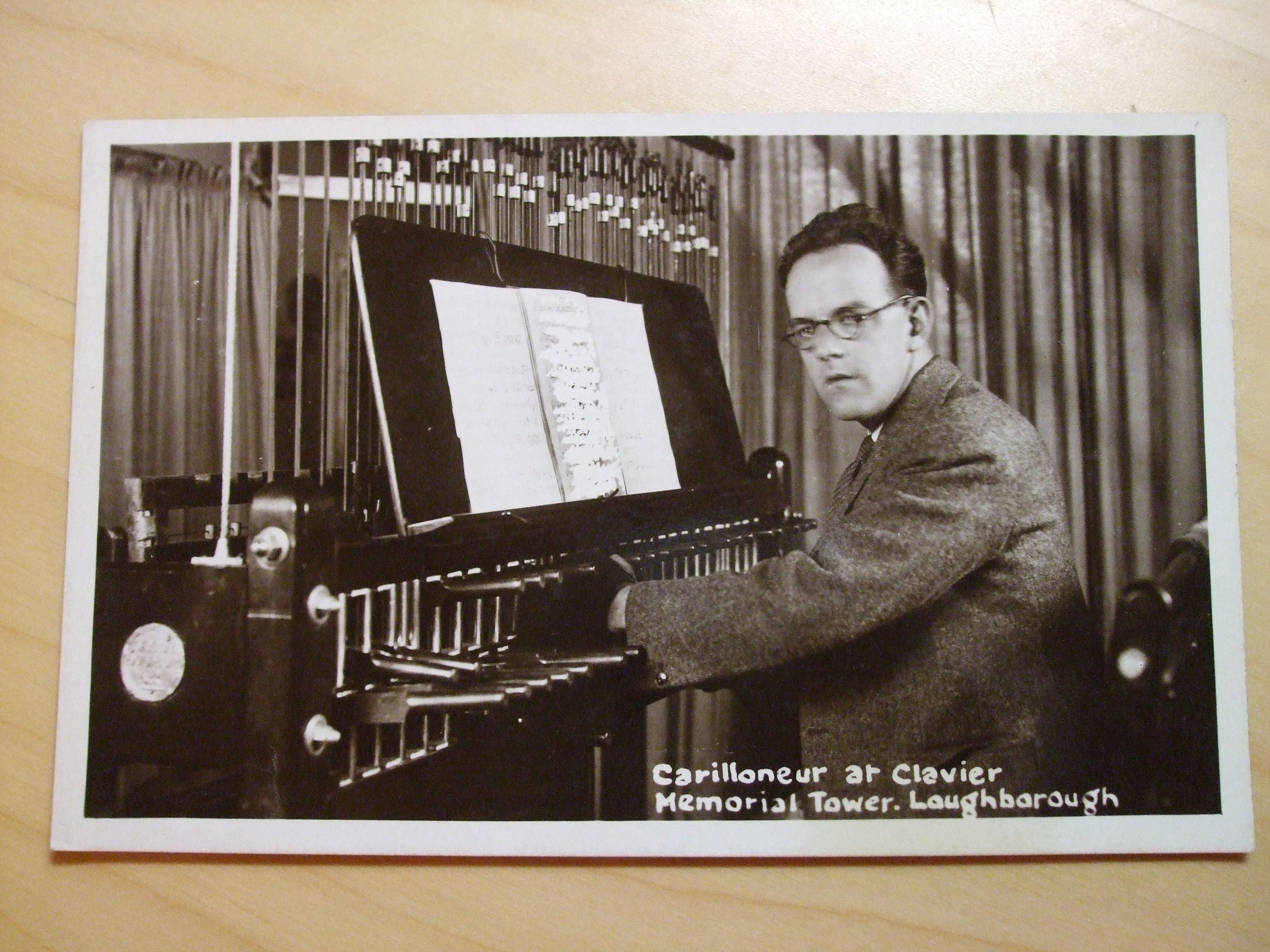
“Many do not realise the amount of work and trouble necessary for a broadcast on the carillon of even only a quarter of an hour’s duration. On the occasion of the last broadcast the engineers of Birmingham station travelled by car to Loughborough – a distance of 40 miles – together with the necessary apparatus weighing some cwts.. I met them at the tower two hours before the broadcast was due to commence, and, believe me, those two hours were very strenuous ones. Frequent journeys had to be made from a room situated half-way up the tower by all of us. Half an hour before the concert commenced, I took my seat at the clavier, and was repeatedly tested by the BBC. The test completed I received the message ‘All OK’ from the engineers. I then had in the short space of five minutes to undress and dress in my playing clothes, which consists of an athlete’s attire – cotton vests and shorts. Having received the message ‘Right away’, the programme commenced.”

Eric Jordan went on to say in that interview: “A carillonneur must possess two things, he must have good health and sound muscles, and he must have a good knowledge of music. In my case the playing on the carillon has been beneficial to my health and I like it immensely.”

Eric Jordan at the carillon

In a later interview, reported in the ‘Nottingham Evening Post’ in February 1933, Eric Jordan said that one of the most common questions he was asked, in relation to the broadcasting of recitals, was whether the weight of the heavy bells would smash loud-speakers or damage the valves on wireless apparatus. He noted that the BBC took many precautions to stop all heavy sound reaching the wireless sets. Eric Jordan’s advice to listeners was “to tune their sets to the maximum volume and then listen in another part of the house, or, if possible, outside, with the window or door open.” This particular broadcast, which was taking place on 1st March, was Loughborough’s contribution to the country’s ‘industrial week’ transmissions.  

Carillon recitals continued to be broadcast throughout the 1920s, and came from a variety of places, including, Armagh Roman Catholic Cathedral; Canberra (although this was not wholly successful); the Peace Tower of the Ottawa Parliament buildings, and the New Zealand war memorial (whilst it was on display in Newcastle-Upon-Tyne).

In August 1927, the ‘Newcastle Daily Chronicle’ carried the following headline:

“HOW WIRELESS AIDS THE SICK. DARLINGTON HOSPITAL’S SUPER-SET.” 

A wireless set was given to the Feethams Infirmary at Darlington, paid for by public subscription. A governor of the BBC outlined how successful similar installations had been at other institutions, and alluded to the influence music could have on sick patients. Apparently, a dying man, in Loughborough hospital, read that a carillon recital was to be broadcast, and so determined was he to hear this that by the time of the recital a week later, his condition had improved so much so that he was discharged in good health!

In January 1928, the ‘Nottingham Post’ reported that plans to record the Loughborough carillon had been on-going for about a year, but had finally come to fruition, and during the early part of January some well-known pieces, played on the carillon by Eric Jordan had successfully been recorded. This must have had an impact on Eric Jordan as he became the President of the Loughborough Recorded Music Society, being an active member of the society until well in his 80s.

On 28th June 1931, Eric Jordan gave his 1000th carillon recital!!! By Easter 1933, he was hoping to reach 1,500 recitals!

It is, of course, fitting that the Recorded Music Society paid tribute to Eric on his death, by playing some of his recordings, and some of his favourite music. Later that same year, 1994, Eric’s son Phillip, also played some of his favourite pieces at the last meeting of the Society in December.  

Thank you for reading this blog. You are welcome to quote passages from any of my posts, with appropriate credit. The correct citation for this looks as follows:

Dyer, Lynne (2022). Loughborough Carillon and BBC100. Available from: https://lynneaboutloughborough.blogspot.com/2022/07/loughborough-carillon-and-bbc100.html [Accessed 6 July 2022]

Take down policy:
I post no pictures that are not my own, unless I have express permission so to do. All text is my own, and not copied from any other information sources, printed or electronic, unless identified and credited as such. If you find I have posted something in contravention of these statements, or if there are photographs of you which you would prefer not to be here, please contact me at the address listed on the About Me page, and I will remove these.
Thank you for reading this blog. 

Lynne     

Monday, 4 July 2022

Loughborough Carillon and Carilloneurs Part 2

Last time on the blog we looked at the views of Queen's Park, Loughborough, and beyond from the top of the Carillon Tower and War Memorial Museum - to give it its full title!

This time, we'll have a look at some of the bells, and learn about the wonderful carilloneurs (1) who have regularly played the carillon instrument down the years. The bells really speak for themselves!


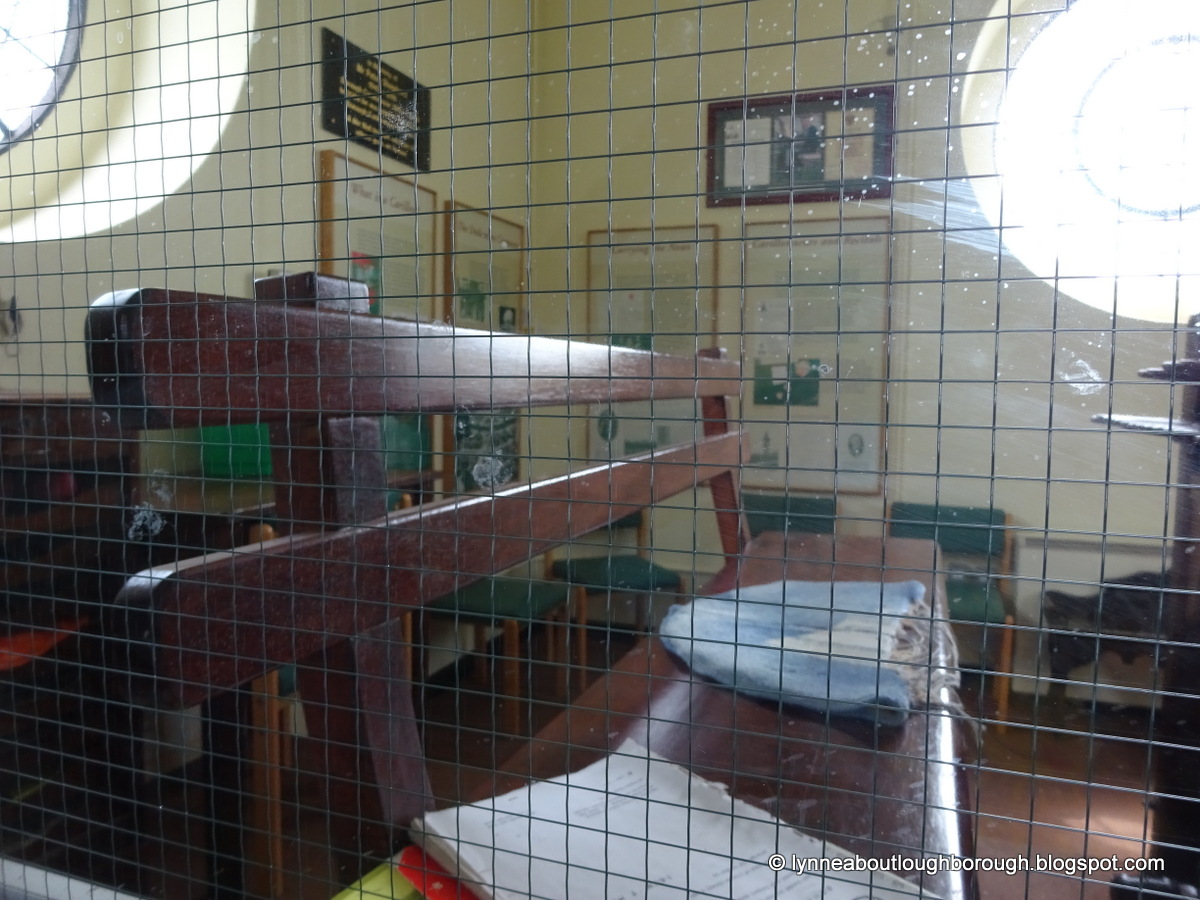
A poor quality view of the clavier room, and the carillon instrument

View of the carilloneur's seat!

The above seat has been the playing position of quite a number of carilloneurs, as well as visiting players. The first-ever recital was performed at the opening of the Carillon on 22nd July 1923, when the playing of the "Last Post" and a minute of silence had happened, 'Chevalier' (2) Jef Denyn, from Belgium played Elgar's "Land of Hope and Glory". This was followed by a rendition of the more sombre "Marche Funebre" by Chopin, then a Flemish piece, and ended with a performance of "Carillon Chimes", a piece specially written by Elgar for the occasion, before the national anthem was played. According to a report in the 'South Nottinghamshire Echo' there was a crowd of around 30,000 people in Queen's Park, and amongst the dignitaries attending, were the principals of the town colleges, headteachers from the town schools, the local clergy, members of the War Memorial committee, members of the Corporation, the mayor, mayoress (Mr and Mrs Wilfred Moss) and guests, which included Dame Nellie Melba, who had come to visit as she was hoping that a carillon could be built in Melbourne, Australia.

A year before the opening of Loughborough's Carillon, Jef Denyn had founded the Royal Carillon School "Jef Denyn" in Mechelen (3), Belgium, which was also known informally as the Mechelen Carillon School. It was the world's first and largest carillon school, and was a mecca for would-be carilloneurs.     

Following the installation of the Carillon in 1923, the borough appointed Eric Jordan as the borough carilloneur, and Sidney Potter, as the deputy borough carilloneur. Both studied at the Royal Carillon School "Jef Denyn" in Mechelen, Belgium, under the great man himself. By 1952, Eric was tutoring two local people in the art of playing the carillon, but was very keen to find more pupils!

A very short account of Eric Jordan

A couple of weeks ago I was lucky enough to meet some descendants of Loughborough's carilloneur, Eric Jordan, when they visited Loughborough and the Carillon.

Eric was born in 1901 in Loughborough to parents William Joseph Jordan and Hannah Wightman, who were married in 1884. At the time of the 1901 census, the family were living in Thorpe Acre, having previously been recorded in 1891 as living at 25 Hastings Street in Loughborough, when William Joseph was a drayman. In 1901 Eric's father was listed as a woodworking machinist, Eric's sister, Edith was aged 14, and a school teacher, his brother Charles was a school student, and sister Alice, aged 10, was at the General Hospital on Baxter Gate. Eric did not appear on the 1901 census as this was taken in April, and he was not born until September.

The 1911 census return sees Eric listed for the first time, living in Thorpe Acre with his parents, Joseph and Hannah, where his father is now a horticultural builder (a woodworking machinist), as is his brother Charles. In 1926, Eric Jordan married Edith Agnes Swift, who was born in 1900, and brought up on the main road in Hathern, where her father, Henry, was a dairyman. Henry had married Hannah Elizabeth Wightman, daughter of a joiner, Charles, and his wife, Elizabeth Street, in 1884.

I believe Eric and Edith had two sons, one born in 1929, the other in 1934, and the family lived on Lime Street. Eric's main occupation was that of insurance agent. Both Eric and his wife lived into their 90s, Edith dying in 1993 at the age of 93 in 1993, and Eric at the age of 92 in 1994. Both are buried in the church of All Saints in Long Whatton.

 
All Saints church at Long Whatton


Sadly, as usual, I have run out of time, and I have done little other than mention the basics of Eric Jordan's life, and not done him justice. There is a vast body of information to sift through, so please be assured that this is not the last I will write about Loughborough's first Borough Carilloneur, and his successors. Do pop over to this post on the Zeppelin raid of 1916 to see a likeness of Eric Jordan. 

Notes

(1) Oh dear, different reputable sources have used different spelling for this word, and now that I've looked it up in a reputable dictionary, I find I have used the incorrect spelling. However, since I have done this consistently I shall continue with using 'carilloneur' rather than the correct spelling, of 'carillonneur'.

(2) The use of the word 'Chevalier' preceding his name indicates that Jef Denyn had been granted the title "Chevalier of the Order of Leopold" by the King of Belgium.

(3) I have to apologise here for my confusion over whether to refer to the Belgium city in its Dutch form, Mechelen, or in its French name, Malines. Apparently, Belgium's linguistic diversity is potentially a hot political potato, and I wouldn't want to offend anyone, by using a non-preferred version of the name, without at least some small explanation.     

You are welcome to quote passages from any of my posts, with appropriate credit. The correct citation for this looks as follows:

Dyer, Lynne (2022). Loughborough Carillon and Carilloneurs: Part 2. Available from: https://lynneaboutloughborough.blogspot.com/2022/06/Loughborough-Carillon-and-Carilloneurs-Part-2.html [Accessed 4 July 2022]

Take down policy:
I post no pictures that are not my own, unless I have express permission so to do. All text is my own, and not copied from any other information sources, printed or electronic, unless identified and credited as such. If you find I have posted something in contravention of these statements, or if there are photographs of you which you would prefer not to be here, please contact me at the address listed on the About Me page, and I will remove these.
Thank you for reading this blog. 

Lynne