Showing posts with label workhouse. Show all posts

Sunday, 11 August 2024

Loughborough's Second Workhouse

Following her very interesting article about Mary Tate of Burleigh Hall on this blog last year, and delving more deeply than my own earlier posts on the topic [1] in this guest blog post for lynneaboutloughborough's eleventh birthday, Dr Pamela Fisher describes the circumstances which led to the construction of the Loughborough Union Workhouse, which was the second workhouse in Loughborough. This building was a familiar sight to many of us, especially if we lived, as I did, in the Oxford Street area of town, although thankfully we are unlikely to have spent any time within its confines – but we probably knew of people who had. 

Here's what Pam has to say about the workhouse ...

Loughborough's Second Workhouse

By Pamela J. Fisher  

The parish of Loughborough contained the townships of Knightthorpe and Woodthorpe, which looked after their own poor. Within Loughborough, a workhouse had been built on Sparrow Hill (as it then was) in 1749–52. This originally housed paupers who were set to work spinning and knitting, but by 1834 policies had changed and this housed only the elderly and those unable to work through disability. This blog post is about the building of Loughborough’s second workhouse in 1838, which replaced this earlier building.

By the early 19th century, the cost of poor relief was rising rapidly across the country. Parishes were managing this by employing a range of different strategies and scales of allowances. New legislation in 1834 swept away these arrangements and replaced them by a single system that grouped parishes together in Poor Law Unions. Each Union was managed by an elected board of guardians, acting under instructions issued by the London-based Poor Law Commissioners. Each would maintain a workhouse that was designed to be a deterrent, with living conditions deliberately worse than those of the poorest independent labourer. Once the workhouse was built, the Guardians were instructed not to pay any poor relief to able-bodied people, other than in cases of short-term sickness, forcing them to enter the workhouse if they had no relatives to help. Workhouse residents had to wear a workhouse uniform and have their head shaved to maintain hygiene. Families would be split up. Food and accommodation were basic, and unpleasant menial work was expected from all able-bodied residents. Anyone absconding could be prosecuted for the theft of the workhouse clothes they were wearing.

Loughborough Poor Law Union was formed in 1837 and comprised 14 parishes and townships in north Leicestershire (Loughborough, Knightthorpe, Woodthorpe, Belton, Burton-on-the-Wolds, Charley, Cotes, Hathern, Hoton, Long Whatton, Prestwold, Shepshed, Thorpe Acre with Dishley and Wymeswold) and ten in south Nottinghamshire (Costock, East Leake, Normanton-on-Soar, Rempstone, Stanford-on-Soar, Sutton Bonnington, Thorpe-in-the-Glebe, West Leake, Willoughby-on-the-Wolds and Wysall). Twenty-eight guardians were elected, four for Loughborough, one for Knightthorpe, one for Woodthorpe, two for Shepshed and one for each of the remaining 20 parishes. Loughborough’s first guardians were William Paget, John Cartwright, Benjamin Churchill and James North.

Loughborough, Shepshed and Hoton already had parish workhouses, Shepshed with accommodation for 80, Loughborough for 70 and Hoton for six, but these were too small for the new Union. When the guardians met formally as a board for the first time on 11th September 1837 they were aware that the Commissioners required them to find a site large enough to contain a workhouse for 350 men, women and children, which was to cost no more than £550. Fuller directions were issued on 6 October: the plans were to be approved by the Commissioners, the building was to cost less than £6,000 and it was to be completed within 12 months. The parishes in the union were each to contribute a share of the costs.

The guardians agreed to purchase a plot of land for £550 that stood at the edge of the town, south of Derby Road and to the west of Regent Street (then Lower Regent Street). Wood’s 1837 plan of Loughborough shows this area shortly before the purchase and identifies the owners as John and Edward Cooper (Map 1). 

Map1: Wood's Plan of Loughborough, 1837, courtesy of Loughborough Library

On 26th September 1837 the Board invited interested architects to forward their plans for the building, at a scale of one-eighth of an inch to one foot, drawings of the ‘front and side elevations – longitudinal section and perspective view of exterior’ and the rate the architect wanted to supervise the construction. These were to be ‘marked by a motto or cypher’ and sent with a sealed envelope containing the name and address of the architect. The design chosen was by George Gilbert Scott and William Bonython Moffatt.

Sir George Gilbert Scott (1811–78) was one of the leading architects of the Gothic Revival in England. His major works include many churches, the Midland Grand Hotel next to St Pancras station and the Albert Memorial in Kensington Gardens, London, but he was also responsible for the design of many workhouses. Scott trained as an architect, and in late 1834 he was contacted by a friend, Sampson Kempthorne, who had been invited by the Poor Law Commissioners to produce workhouse designs. Kempthorne advised Scott that the premises next door to Kempthorne’s, on London’s Regent Street, had become vacant, and if Scott wished to take them Kempthorne could ‘find employment for his leisure time’ helping with the designs. Scott took the premises, but in early 1835 he received news of the sudden death of his father. This prompted him to decide that his ‘chances in life’ depended upon him establishing his own architectural business.

The New Poor Law of 1834 had created over 500 Poor Law Unions in England and Wales, and a majority of these would need to build a new workhouse. This provided a huge opportunity for Scott to start a practice that could draw on his experience gained with Kempthorne. His first four commissions were for new workhouses in Buckinghamshire and Northamptonshire, where he had family contacts, and he employed William Bonython Moffatt to help with the plans. Moffatt and Scott had both been articled to the same firm, and Moffatt already had his own commission to design a new workhouse in Wiltshire. The two men soon became business partners.

Scott later recounted those early days in his Recollections, published in 1879:

‘We went every week to Peele’s coffee-house [in London] to see the country papers, and to find advertisements of pending competitions [for workhouse designs]. Moffatt then ran down to the place to get up information. On his return, we set to work, with violence, to make the design, and to prepare the competition drawings, often working all night as well as all day. He would then start off by the mail [coach – the railway network still being in the future], travel all night, meet the board of guardians, and perhaps win the competition, and return during the next night to set to work on another design.’ Between 1837 and 1841, Scott and Moffatt designed and supervised the building of at least 37 workhouses, with a further six by Scott alone, and one by Moffatt. These stretched from Cornwall through the south-western and midland counties to Lincolnshire and Essex. In Leicestershire Scott and Moffatt were also responsible for the workhouse in Lutterworth. Interestingly Scott was later employed by the parish churches of both Loughborough and Lutterworth in connection with their restorations.

The design for Loughborough workhouse is a variation on one of Kempthorne’s plans. Scott’s plans do not survive, but maps of the town show four ranges of buildings forming the sides of a square (Map 2). 

Map 2: From Ordnance Survey Plan of 1886, National Library of Scotland CC-BY (NLS)

These would probably have contained the work rooms on three sides, with the fourth side, facing Derby Road, containing the main entrance flanked by the board room (to the south) and a chapel (to the north). Three buildings stretched in a straight line across the centre, the central one containing the accommodation for the master and mistress, with the others containing the accommodation and sick wards for the poor, men on one side and women on the other. Walls at right angles to this range created four enclosed recreation areas for men, women, boys and girls. It is not clear where the children would have slept.

On 27th February 1838, following the approval of the plan by the Poor Law Commissioners, the Board of Guardians advertised for sealed tenders for the construction. The nine tenders submitted were opened on 20 March 1838 and ranged from £5,647 to £6,600. Inevitably the lowest was the preferred option, but the contractors, George Myers and Richard Wilson from Hull, were not known to the guardians, who delayed acceptance until they had made enquiries about their suitability. They were awarded the contract on 12th April. Scott later recalled ‘The contractor of a part of the work was a strange rough mason from Hull, named Myers. While engaged under me at Loughborough, he competed with success for the erection of a Roman Catholic Church at Derby, nearly the first which Pugin built’. George Myers (1803–75) had served his apprenticeship under the master mason at Beverley Minster, and after his commission for St Mary’s, Derby (awarded to Myers and Wilson), went on to build most of Pugin’s churches and four Catholic cathedrals, including Birmingham and Nottingham (mostly without Richard Wilson, following the dissolution of their partnership in 1844). Loughborough workhouse was the first large contract awarded to Myers and Wilson, and apparently their first contract outside Hull.

Iron bedsteads were purchased for the workhouse (from Bristol!) in February 1839, and the new building opened (Fig. 1). The old parish workhouse closed, and was altered to provide a barracks for a detachment of the army. James Massey and his wife were appointed master and mistress of the new workhouse when it opened, but James Massey was dismissed in October 1839 on account of his unsatisfactory ‘conduct and general efficiency’. John James, ‘an inmate of the house’, was employed as schoolmaster from the outset and given a contract in April 1839. Hannah Atherstone was appointed schoolmistress in May 1839, but was served with notice in October. Another inmate was appointed as nurse on the sick wards, under the direction of the workhouse medical officer.

Fig 1: Part of the workhouse building, courtesy of Loughborough Library

Loughborough’s overseers of the poor had advised the Poor Law Commissioners in 1834 that vagrancy was an issue in the town, and a ‘mendicity ward’ was added to the workhouse in 1839 for ‘vagrants’, where temporary relief could be given to the homeless. This was replaced by a ‘vagrants’ block’ of separate sleeping cells in 1874, designed by George Hodson of Loughborough.

Through scandals that made national headlines, some of the workhouses of the New Poor Law deserved the notorious reputation that they all gained by association, yet although Victorian society viewed some paupers as ‘undeserving’, many recognised that the elderly poor and the sick might be in the workhouse through no fault of their own. Details of the 12 ‘sick wards’ in Loughborough Union workhouse in 1867 paint a picture of a caring institution for these residents. It is possible some short-term changes were hastily introduced when the guardians were told that their wards were to be inspected as part of a parliamentary enquiry, but there is a limit to how much equipment could be acquired and brought in at short notice. Although the focus of this blog is on the building of the workhouse, it is therefore worth including some of the inspection comments here:

‘In the female sick wards each patient has the following articles for her own use exclusively; viz., a tea tray, tea cloth, towel, comb and brush, soap, wash-hand basin, basket for clothes, cup and saucer and plate, locker (with drawer, shelf, and open cupboard), urinal, and cape. There are arm chairs, easy chairs, rocking chairs, flannel gowns and slippers, coloured and other screens, tables, lockers, cupboards, water cushions, mackintosh sheeting (but without funnels), foot and chest warmers, medicine glasses and pots, bed rests, a library, prints, illustrated periodicals, benches with backs, some cushions, pottery plates and mugs, cocoa fibre matting, carpets, and clocks.’

The board of guardians assembled for a photograph at an unknown date (Fig. 2). 

Fig 2: The board of guardians outside the workhouse, courtesy of Loughborough Library

Could this be the last board marking the end of an era, or is this slightly earlier? The board was disbanded in 1930, and the premises were transferred to Loughborough Borough Council to become a public assistance institution known as Hastings House. It became an NHS hospital in 1948, and was renamed Regent Hospital c.1981. Regent Hospital closed in 1992, when Loughborough’s new Community Hospital opened on Epinal Way. The former workhouse buildings were then demolished, with the site redeveloped for housing (Pleasant Close, Speeds Pingle and Armitage Close).

Pam Fisher

Leicestershire Victoria County History Trust

____________________________________

Notes

[1] Following a visit to Southwell Workhouse, which is owned by the National Trust, I wrote a few articles about Loughborough’s Union Workhouse, and George Hodson’s connection to it 

There is a further photograph of the workhouse from the rear on the Gilbert family website. 

Aerial views can be seen on the Remember Loughborough Facebook group 

____________________________________

Image credits

Map 1, Fig. 1 and Fig. 2: Loughborough Library

Map 2: National Library of Scotland CC-BY (NLS) https://maps.nls.uk/

____________________________________

Sources

Record Office for Leicestershire, Leicester and Rutland: G/7/8a/1–2 (guardians’ minutes, Loughborough Union); G/7/8c/1 (building committee minutes, Loughborough Union); G/7/32/1 (building contract, Loughborough Union).

British Newspaper Archive: Leicester Chronicle, 30 Sept. 1837, 31 Aug. 1839; Leicester Journal, 9 Mar. 1838, 25 Oct. 1839.

Parliamentary Papers: Poor Law Commissioners, First Annual Report (1835 (500) xxxv), Appendix A; Provincial Workhouses, Report of Dr Edward Smith (1867–8 (4) lx).

G.G. Scott (ed. G. Stamp), Personal and Professional Recollections (Stamford, 1995).

K.A. Morrison, ‘The New-Poor-Law workhouses of George Gilbert Scott and William Bonython Moffatt’, Architectural History, 40 (1997), 184–203.

P. Spencer-Silver, ‘George Myers, 1803–75, stonemason, builder, contractor’, Construction History, 5 (1989), 47–57.

K. Morrison, The Workhouse: A Study of Poor-Law Buildings in England (RCHM/English Heritage, 1999).

P. Higginbotham, https://www.workhouses.org.uk/Loughborough/

____________________________________

About Dr Pamela Fisher

Dr Pamela Fisher works with Leicestershire Victoria County History Trust and is currently researching and writing a social and cultural history of Loughborough since 1750. This will be followed by a history of the town’s industries. Both will be published as part of the national Victoria County History series of books. You can follow progress on Twitter and Facebook (@LeicsVCHT) or make contact through their website https://leicestershirehistory.co.uk/ to be added to their mailing list for Newsletters and updates. 

____________________________________

Posted by lynneaboutloughborough

With apologies for typos which are all mine!

_______________________________________________

Thank you for reading this blog.

Copyright:

The copyright © of all content on this blog rests with me, or in the case of guest blogposts, with the named Guest Blogger. However, you are welcome to quote passages from any of my posts, with appropriate credit. The correct citation for this looks as follows:

Fisher, Pamela, Dr. (2024). Loughborough’s Second Workhouse. Available from: https://lynneaboutloughborough.blogspot.com/2024/08/loughboroughs-second-workhouse.html [Accessed 11 August 2024]

Take down policy:

I post no pictures that are not my own, unless I have express permission so to do. All text is my own, and not copied from any other information sources, printed or electronic, unless identified and credited as such. If you find I have posted something in contravention of these statements, or if there are photographs of you which you would prefer not to be here, please contact me at the address listed on the About Me page, and I will remove these.

Blog archive and tags:

If you are viewing this blog in mobile format, you will not be able to easily access the blog archive, or the clickable links to various topics. These can be accessed if you scroll to the bottom of the page, and click 'View Web Version'. Alternatively, there is also a complete list of posts, which when clicked will take you to the page you are interested in.

Searching the blog:

You can search the blog using the dedicated search box that appears near the top of the blog when viewed in the web version. Alternatively, you can search using your usual search engine (e.g. Bing, Google, DuckDuckGo etc.) by following this example:

site: https://lynneaboutloughborough.blogspot.com/ “Radmoor House”

NOTE – the words you’re actually looking for must be in “” and the first of these must be preceded by a space

Thank you for reading this blog.

Lynne

Sunday, 27 September 2020

Where in Loughborough is the Miff Tree?

This post features a lecture delivered by Thomas Napoleon Smith, a Baptist Minister, on the subject of “The Miff Tree”.


Loughborough Baptist church, Baxter Gate

So, let’s start with some personal information about Thomas Napoleon Smith: who was he?

Thomas Napoleon Smith’s birth at Wisbech, Lincs, was registered in the fourth quarter of 1855, and he was baptised on 4 May 1856. His parents were Thomas, born in Chesterton, Cambridge, around 1827, and Ann Eliza, born in Cambridge, around 1824.  His elder brother, Henry, had been born three years earlier, in 1852. At the time of the 1861 census, the family were living in Whittlesey, in the police station as his father was the superintendent of the police. The house next door was the Old George pub, listed as being in Old Whittlesey.

It’s possible that the Thomas Smith listed as a nephew and lodging with aunt, Mary Jane, and uncle, James, in Walcot, near Bath as appears on the 1871 census, is our Thomas Napoleon. His birthplace is given as Wisbech, and he is listed as a draper’s assistant.

It is certain that Thomas Napoleon Smith marries Annie Maria Goldsworthy on the Isle of Wight, in the fourth quarter of 1879, and daughter Anna Maud is born in 1880. At the time of the 1881 census, the family are living in Monks Kirby, a village in Warwickshire, close to Rugby, Coventry and Lutterworth.

Anyone who is familiar with family history research will realise that searching for someone with the surname of Smith is a difficult task, even when they have a forename like Napoleon! The next confirmed event in the life of TNS is the birth of son, Ludlow P. Smith, around 1890, and son, Ewart Gladstone Smith, around 1892: both were certainly born in America, and maybe more specifically at Mason, Ingham, Michigan. Whether or not there were any other children born to Thomas and Annie between 1880 and 1889, while they were in America, I have not been able to prove.

Anyway, by 1895 the family were back in Britain, and in March 1895, TNS accepted the position of Baptist minister at the Particular Baptist Chapel in Tetbury, Gloucestershire, following the Rev. Robert Bray who was minister from 1881-1892. It was in Tetbury that two more children were born, Frank in 1897, when the family was listed as living at New Church Street, and Albert in 1899. 

This post in Tetbury was not a long-standing position, and by the time of the 1901 census, the family have moved to 24 Agnes Road, Northampton, where TNS is listed as a Baptist minister, as is the head of the family living next door. Again, the family only stayed here a relatively short time, and by 1906, local directories listed TNS as living at 59 Poppleton Road, Leytonstone, Essex, where he was a Baptist minister and where he continued to live until his death. A 1910 directory listed his occupation as a non-conformist chaplain, West Ham union & Whipp’s Cross Infirmary: the Union Workhouse had been erected in 1839-41, and extended in 1845, and a 200-bed infirmary added in 1864, while the Whipp’s Cross Hospital was built between 1900-1903. This is confirmed by the census return of 1911, and this position continues to be listed until at least 1915.

On 27 September 1916, son Ewart Gladstone Smith dies, and it is around this time that TNS pens poetry, under the pseudonym, Tonosa. Entries in local trade directories in 1917, and 1922 confirm that TNS is still living at 59 Poppleton Road. Thomas Napoleon Smith died on 26 January 1941: probate was granted at Llandudno on 19 May 1941 to daughter Ada Maud Smith.

The delivery of “The Miff Tree” lecture appears to be Thomas Napoleon Smith’s life work! Some of the publicity statements that appeared in adverts for the lecture, from 1895-1931, show that it was clearly very popular wherever it was delivered:

“popular lecture”

“Come, Look, Listen, Laugh and Learn”

“all should hear the celebrated lecture”

“received with acclamation wherever it has been given and by now he [TNS] has visited places in all parts of the kingdom and has delivered in America too.”

“This will be one of the pleasantest evenings of the whole winter. Crowds in large towns have seen it and pronounce it astonishing. Repeat visits are called for wherever it goes.”

“popular lecture. Highly spoken of by the clergy and ministers and the press in all parts of the country. The title is somewhat mysterious [and] for variety, humour and practical help is unique.”

“[TNS] will deliver his amalgama on the ‘Miff Tree’, and entertainment which has evoked the highest encomiums from the press in many provincial towns. We anticipate that the great popularity of the lecturer will ensure a crowded attendance.”

“Newtonians will be afforded a rare treat … The lecture is full of wit, wisdom, pleasure and profit and should on no account be missed.”

“[delivered] with its latest improvements!”

“A rare treat! Don’t miss it!”

“this lecture has been given upwards of forty times in London alone, and is highly commended”

“unique entertainment”

As the adverts above indicate, Rev. Thomas Napoleon Smith delivered his lecture across much of Great Britain, Ireland and even in America. Many of these places were in clusters around places that TNS had either lived, or with which he had some connection. So, for example, he embarked on a lecture tour of the Isle of Wight: Ryde, Newport and Sandown in November 1897; there were many visits to Gloucestershire villages – Fairford, Cirencester, Lydney, and Stonehouse in 1895, Stroud in 1896, Gloucester in 1897, Chalford in 1898, and Nupend, near Stroud, and Stonehouse, in January 1899; and a series of deliveries in Northamptonshire – Hillmorton and Long Itchington, near Rugby, and Rugby itself in 1896, Northampton in 1900 and Long Buckby in 1903.

Other clusters of places where Rev. Thomas Napoleon Smith gave his lecture included: Blaenavon, Merthyr Tydfil, Abergavenny, and Longhope near Ross in late 1896, and Abergavenny and Brecon in the autumn of 1898. The Scottish cluster occurred in March 1896 when Smith lectured at Galashiels and Selkirk. The Ireland tour took place in late 1896, just before the visits to Merthyr and Blaenavon.   

Smith also visited a variety of other places, including many in Middlesex – Hanwell and West Drayton, both in 1898;  many in London – Lambeth in 1895, Whetstone, Woolwich and New Barnet in 1896; a few in Oxfordshire – Banbury in 1896, Faringdon in 1898 and Chipping Norton in 1899. Visits were also made to Southend, Bristol, and Reading (all in 1896), Bedford, Poole and Newton Abbot in 1899, not to mention a whole variety of other places.

Smith also lectured at places closer to Loughborough, which included Derby, Melbourne Hall and Leicester, all in 1896. Smith’s visit to Loughborough was reported in the Loughborough Monitor and News of 8 December 1898, his lecture being delivered to the Young Men’s Guild at the school rooms of the Baxter Gate Baptist Chapel. Sadly, the public library and the Record Office are currently closed, so I have been unable to read the report, but here are some examples of reports from the other of Smith’s lectures across the country: I cannot imagine that the delivery at Loughborough could have elicited anything but the same excitement as it seems to have done across the length and breadth of the country.

The following report is from ‘The Shoreditch Observer, Hackney Express and Bethnal Green Chronicle’, dated 12 November, 1904, pg.3

“’The Miff Tree’ The ‘Miff Tree and the Miffers’ was the title of a most amusing and instructive lecture, given by Rev. T. Napoleon Smith on Monday last, at the Shoreditch YMCA. A large pictorial pamphlet was before the audience. On this, was a picture of a tree whose branches were birds of different natures (16 in number), which represented those people corresponding natures, who take offence at the least thing said or done contrary to their own views. The following illustration may be given in the lecturer’s own words:

“Number four is an unconverted choir member, who says the minister is an ‘idiot’ for inviting the congregation to join in the singing, and is cross with the choir-master for not allowing her to render a solo every Sunday night, and because he has suggested that she should spend less time and more sense on the last note. To fully appreciate this lovely creature, we must hear her sing:

“That pulpit man has got no sense,

To say ‘all swell the song’:

And I can’t stand the impudence

Of that choir-master long!


I’ll leave the choir! Yes, leave again!

If I can’t have my way,

The final note I will sustain,

And give my voice fair play."

“Picture number six is of three birds who belong to the crank tribe, sometimes called ‘kickers’, Do not think they are making love to each other. They never make love to anybody …There is to be a church meeting down below, and three crows have put their heads together. Their general plans are to join loudly in singing ‘Blest be the tie that binds’, and then to ‘caw’ against the existing order of things, whatever that order may be: and to oppose every measure, good or bad, which may be proposed.”

And so right through his project, Mr Smith has a bird to represent the pugnacious attitude of so many so-called Christian people. The lecturer has a marvellous falsetto voice, which enables him to imitate different sounds, whether it be birds, dogs or instruments. The significance of the lecture lay in the important moral lessons which he drew from his ‘birds’”

The following is from the 'Oxfordshire Weekly News', of 29 March 1899, pg. 5 and reports on the lecture delivered at Chipping Norton:

“ ‘An oratorical, mimical, musical, and moral amalgama on the ‘Miff Tree, or a night with the birds’ ”  was the description of a somewhat unique entertainment … The Chairman, in introducing Mr Napoleon Smith, said he had seen a great many trees in various parts of the world, but he had never yet met with a Miff tree. That was a variety, as a florist would say, which had not come under his notice, but he and they would learn something about it before leaving the building. The Rev, Napoleon Smith then exhibited his Miff tree, which was a rough drawing of a tree on a canvas about seven feet square. The ‘birds’, 15 in number, were supposed to represent various vices, such as backbiting, slandering, envy, uncharitableness, and the numerous characteristics of the class of persons who possess the unenviable faculty of making themselves obnoxious and disagreeable, treated more particularly in religious circles and church life. All such persons are ‘up the miff tree’ and the entertainer drew their characteristics, showed their mischievous propensities and held them up as examples to be avoided. There was a good deal of racy humour in the lecturer’s remarks, whose faculty for ‘punning’ was considerable … His singing might have been curtailed with advantage, for he would hardly shine in a school room as a vocalist, but he had a very clever knack of producing familiar sounds, the whistle and puff of the locomotive, the bark of a pug, the buzzing of the bee, the voice of the peacock, and the distinctive notes of song birds …”


The review of the lecture at Faringdon was covered by the 'Faringdon Advertiser and Vale of the White Horse Gazette' 14 May 1898, pg 4, and read as follows:

“For a fortnight previous to Monday last the town was placarded with bills announcing that ‘The Miff Tree is coming”, and giving particulars of an entertainment … to b given by Rev. T. Napoleon Smith, a Nonconformist Minister. Most people were in doubt as to what kind of an entertainment would be provided, for ‘Miff Tree’ is somewhat shrouded in mystery until explained … [TNS] proceeded to give his entertainment, which consisted of a lecture upon the quibbles and crotchets of individuals who are found to be in every religious community, together with hints for the guidance of the Christian, with special reference to the drinking and smoking customs of the country, the evil results of cigarette smiling by boys being particularly enlarged upon. The ‘Miff Tree’ was represented by the picture of a tree, on the branches of which were representations of birds, which their turn were used by the lecturer to illustrate those individuals who were apt to take offence, or to be ‘miffed’ because their ideas or suggestions had been ignored. The lecture was cleverly written …”


The 'Chelmsford Chronicle' of 6 December 1895, pg 8, described the lecture thus:

“Those who turned out on Wednesday evening to attend, in the school room of the Baptist Church, the ‘Miff Tree’ lecture-entertainment. Given by the Rev. Napoleon Smith of Tetbury, enjoyed a rare treat, which they evidently appreciated, for their applause was most demonstrative … IN addition to numberless flashes of with and humour, and appropriate and striking gestures and facial expressions, the lecturer and entertainer surprised the people with some remarkable vocal imitations of musical instruments, &c., and, with his English concertina, played the accompaniment to his numerous original songs, and rendered a marriage peal, imitation of the bagpipes, and what he called ‘The Jangle’, the latter literally convulsing the audience.”


But, none of the above really explain what the lecture was all about, so here are a few snippets from the reports which are a bit more illuminating:

“Much amusement was caused by the numerous songs and recitations, supposed to be the sentiments of those, who from various causes, flew into the ‘Miff Tree’. In conclusion, those present were urged not to be so easily sent into a ‘miff’ by such trivial matters as mentioned by the lecturer.” - 'Stroud News and Gloucestershire Advertiser' 21 February 1896, pg 4


“[TNS] had to explain what ‘miff’ meant. A ‘miff’ is a huff, a slightful, resentful frame of mind. To be in a ‘miff’ is to be in a mild state of resentment, so that the audience found that miffers meant grumblers, huffed people, the cranks and crotchets who are to be found in churches and elsewhere.” - Barnet Press 10 October 1896, pg 5    (30)


This account from the 'Rugby Advertiser' 26 September 1896, pg 5, goes into great detail about what was covered in the lecture:

“Mr Smith began his lecture by saying that he met with the diagram of ‘The Miff Tree’ (an enlargement of which he paced before the audience), when he went to America … it seemed to him to be of such wide-spread application that he had devoted a good deal of attention to it, which had resulted in the composition of 7.5 verses upon it, with sixteen original tunes. The American colloquial expression ‘miff’ was explained by Webster [presumably the dictionary compiler?] as meaning ‘a slight degree of resentment’. It signified a slightly offended condition, but some who had the ‘miff’ spirit, were a good deal more than slightly offended … The late Mr Spurgeon had said that his church was so busy working for the Lord that they had no time to quarrel. Some churches might say they were so busy quarrelling that they had no time to work for the Lord … In describing some of the varieties of birds who betook themselves to the miff tree, [TNS] did not wish those present to be seeking to find whether their neighbours were included amongst them, but to ask themselves whether they themselves had anything of the ‘miffish’ spirit. If they found they had, he hoped they would receive the treatment kindly, and profit by it, not blaming the physician, but receiving the medicine for their own good. Fourteen varieties of ‘miffers’ were portrayed:

(1) The bird who was dreaming of the ‘good old times, twenty years ago’ when the sound advice of a pious deacon was not ignored by the management of the church.

(2) The brother who had ‘turned his back on the whole business’.

(3) A miffer who flew up the miff tree during an unpleasantness in a business meeting, and had been ‘jawing’ ever since.

(4) the birdie ‘soprano’ who flew up the tree because she was not allowed to sing ‘Nellie Gray’ at the memorial service of a deceased brother, although she considered it the best piece to show off her vocal powers.

(5) A bird who was too disagreeable event to explain why he took to the miff tree, and who always had a down-in-the-mouth appearance.

(6) Three birds of the crank tribe.

(7) The king of the miffers, a pastor who had taken to the tree because his curate drew larger congregations than he did himself. A minister showed his miffish spirit by resigning because one of the members told him she did not get good from his sermons, although many other did get good, and wished him to stay; also by preaching at people, instead of to them.

(8) Supremacy Longpurse, Esq. who, offended by the pastor, betook himself to the Established Church. (9) A bird belonging to the ‘giggle-much’ tribe, who generally sat in the gallery, or a sear near the door and giggled until the pastor complained.

(10) Birdie Rosebud Tenor, who was periodically offended because it gave him a chance to display his voice in other places of worship in the town, although he generally came back to his old seat in the choir sooner or later.

(11) A bird who had been offended, but who had been cured by a sermon he had heard, and was now coming down from his perch.

(12) A bird who came down from the miff tree, and bathed in tears at revivals, but at other ties was to be found amongst its branches.

(13) An owl, with spectacles on to discover all slights, real or imaginary.

(14) A bird only kept from flying up the miff tree by the chain of ‘official position’.

The lecturer described the birds at considerable length, pointing them out with  diagram, and singing verses illustrative of the sentiments of each, accompanying himself on a concertina. He incidentally introduced remarkably good vocal imitations of the notes of the chaffinch, starling, yellowhammer, nightingale, and many other birds. In conclusion, the lecturer disclaimed any local allusion; the lecture, he said, was prepared for delivery in America, and had been given word for word in many places both in that country and in England.” 

This is Rev. Mayer, who was in charge of one of the Miff Tree meetings

This review of the event that took place in the Baptist Chapel on Frogmore Street, Abergavenny explains a bit more about the ‘Miff tree’:

“The object [of the lecture] was to expose and denounce the spirit, only too prevalent in many communities, which, through over estimates of self-importance, takes offence at moral trifles or even imaginary wrongs, and results in the misery and strife which break the hearts of the faithful men and hinders the work of God. The speciality, however, of the lecture was the way in which this state of things was dealt with. Instead of mere denunciation and aggravating censure, the portrait of one after another of those individuals was so skilfully drawn in speech, gesture, and song, that the offender could hardly fail to recognise his own likeness. At first he would be led to laugh at the absurdity of his conduct, but on reflection he would surely mourn over his sin. To avoid anything like tediousness in dealing with this delicate and difficult subject, the lecturer introduced a great deal of humorous remark, and with extraordinary ability imitated the notes of many well-known birds and instruments of music &., so that he was able to sustain the interest of a large audience for nearly two hours without any signs of weariness.” - 'Abergavenny Chronicle' 11 December 1896, pg 5

And to finish with, here are some wonderful quotes following Rev. Thomas Napoleon Smith’s lectures:

“Mr Smith’s power of imitating is quite wonderful.”

“The audience were held in rapt attention”

“Mr Smith’s lecture was both intellectual and interesting.”

“There was a good attendance, and the lecture was highly appreciated.”

Hopefully, when access to physical resources is restored, I will be able to bring you details of the event that took place in Loughborough!

You are welcome to quote passages from any of my posts, with appropriate credit. The correct citation for this looks as follow:


Dyer, Lynne (2020). Where in Loughborough is the Miff Tree? Available from: https://lynneaboutloughborough.blogspot.com/2020/09/where-in-loughborough-is-miff-tree.html [Accessed 27 September 2020]

Take down policy:

I post no pictures that are not my own, unless I have express permission so to do. All text is my own, and not copied from any other information sources, printed or electronic, unless identified and credited as such. If you find I have posted something in contravention of these statements, or if there are photographs of you which you would prefer not to be here, please contact me at the address listed on the About Me page, and I will remove these.

You can leave comments below, but do check back as my reply will appear here, below your comment.

Thank you for reading this blog. 

Lynne              

Sunday, 21 July 2019

Everywhere reminds me of Loughborough

So glad to be back in sunny Loughborough after a couple of weeks away in Cornwall! As ever, things I've spotted in the many places I've visited during the holiday have been constant reminders of our lovely market town. Indeed, there have been so many interesting connections, I could use up a whole year's worth of blog posts sharing my findings with you ... but I won't!!

So, a quick look at the similarities between Launceston - which was where we broke our long journey - and Loughborough. Both were small market towns, both played a part in the Civil War. 


Costume in Launceston Museum

Launceston Museum
Costumed mannequin at one time in the Old Rectory Museum

The War Memorial in Launceston rises up in the centre of the town, unlike ours which is in the beautiful setting of Queen's Park, and is now accompanied by a memorial to Loughborough's war horse, Songster. 


The town hall clock in Loughborough is pretty special: the clock I spotted in Launceston was attached to a bank building, and was rather ornate:


Both towns had a workhouse. Loughborough's first was on the site now occupied by the Royal Mail sorting office. The Union workhouse was situated on what is now Regent Street. I've posted before about Loughborough's Workhouse, so here's some information about Launceston's:


Now, of course, almost everywhere I go I am tuned in to spot bells! Sadly, they're not always the Taylors variety, but I love to have a quiet poke around, just in case! There were two in Launceston Museum, the first of these was used to summon estate workers to meals, and the second one from a local iron foundry:


The cast of the Great Paul Bell in Queen's Park Loughborough


Another formerly Loughborough-based company is always evident, wherever I go, because I spend a lot of time in bookshops, and whether they're selling new or second-hand books, you can guarantee they've got some Ladybird Books!!! At Launceston Museum, they had a ladybird, but no Ladybird Books:


Boundary stones, milestones and fingerposts? Don't get me started on that one - something I've blogged about before!!!! Here's a boundary stone from the Bude Canal:


And ours from the boundary between Loughborough and Woodthorpe, although experts suggest that this one is not in its original location:


Pubs everywhere are of interest!!! Like Loughborough, Launceston has a White Hart pub: I don't know what the Launceston one was like inside, but it differed on the outside from Loughborough's as it actually had a 3D white hart sitting on the front of the building.


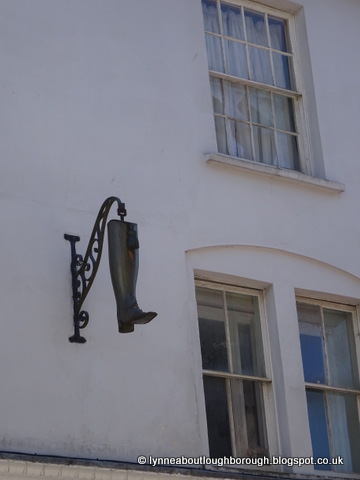
Then I thought I'd spotted another local connection, when I saw an old boot hanging from the front of a building. Did Launceston, like Loughborough, used to have an Old Boot pub?


Excitement continued to grow, until I came to the doorway of the shop, and looked at the tiled floor ... 


Ah well, Leicester's quite close!!!

Another area of employment in Loughborough was lacemaking. Local inventor John Heathcoat had a lacemaking factory on Mill Lane (now Market Street) which was attacked in 1816. The building that replaced it has recently been honoured with a Leicestershire Green Plaque. Lacemaking on display in Launceston Museum was of the Bedfordshire pillow lace type.


Another interest of mine is fire insurance plaques. I don't think there are many in Loughborough: I've only found one, on a house in Park Street. Launceston Museum had a few on display:


And finally, when I was training to be a tour guide we were encouraged to look up, in order to learn more about a town's history from its buildings. I've been used to doing this for many years, but I would also encourage you to look down, as there is a huge amount of history hidden in our streets, which we simply walk over and take for granted! Here's an example from Launceston:


And a couple from Loughborough:


Many of the things I've written about also appear in 'Secret Loughborough'.


You are welcome to quote passages from any of my posts, with appropriate credit. The correct citation for this looks as follow:

Dyer, Lynne (2019). Everywhere reminds me of Loughborough. Available from: https://lynneaboutloughborough.blogspot.com/2019/07/everywhere-reminds-me-of-loughborough.html [Accessed 21 July 2019]

Take down policy:
I post no pictures that are not my own, unless I have express permission so to do. All text is my own, and not copied from any other information sources, printed or electronic, unless identified and credited as such. If you find I have posted something in contravention of these statements, or if there are photographs of you which you would prefer not to be here, please contact me at the address listed on the About Me page, and I will remove these.
Thank you for reading this blog. 

Lynne