Showing posts with label Wales. Show all posts

Saturday, 25 May 2019

Local books local people

This week I've treated myself to perusing some of the books about Loughborough I have on my bookshelves and also some in the Local and Family History Centre, in the public library. And what a fascinating experience it's been!

'The story of Loughborough: 1888-1914' by W. Arthur Deakin, and published by the Echo Press in 1979, is a well-thumbed tome that contains extracts from the local newspapers, and is accompanied by plenty of photographs. What's particularly interesting is that my copy was once owned by George Lowe, who was at one time curator of the Old Rectory Museum, interesting because as a member of the Loughborough Archaeological and Historical Society, I volunteer at the ORM! In addition, it's also interesting that at the time he owned this book, George lived in Staveley Court, interesting because Christopher Staveley was an architect who, around 1799-1800, undertook repairs to the ORM, as well as to the parish church in 1815.



In a booklet on non-conformist Loughborough, it was interesting to note that there are so many different Paget families:


Other publications reveal other names. So, for example, in a revision to the rules of the Co-operative Society of Wood Gate, Loughborough, there are several groups of names mentioned:


And in one of the Bulletins of the Loughborough and District Archaeological Society (now the Loughborough Archaeological and Historical Society) there's an interesting list of members:


Interestingly, George H. Green, listed above in connection with the Bulletin, wrote a book about the Loughborough market and the fair, when he was the Markets Manager:


Being very keen on Wales, as well as Loughborough, it's wonderful that my book 'Wild Wales' by George Borrow, was once owned by George Green, as seen by the dedication he wrote inside it:


A lovely little map (not sure of the date) is rather tall and narrow, unlike most which are much squarer. I'm guessing because this was produced specially for Mr Mather:


And the final treat I unearthed was a copy of a book called 'Recipes and wrinkles'! I've always associated that last word with age lines on a face, but apparently, it has another meaning, as discovered in the Oxford English Dictionary: 'A piece or item of useful information, knowledge, or advice; a helpful or valuable hint; a tip'. Hence, as can be seen from the contents page, the last seciton of this book includes household tips, although I'm not quite sure what this has to do with Suffragettes!


Thank you for stopping by!

You are welcome to quote passages from any of my posts, with appropriate credit. The correct citation for this looks as follow:

Dyer, Lynne (2019). Local books local people. Available from: https://lynneaboutloughborough.blogspot.com/2019/05/local-books-local-people.html [Accessed 25 May 2019]

Take down policy:
I post no pictures that are not my own, unless I have express permission so to do. All text is my own, and not copied from any other information sources, printed or electronic, unless identified and credited as such. If you find I have posted something in contravention of these statements, or if there are photographs of you which you would prefer not to be here, please contact me at the address listed on the About Me page, and I will remove these.
Thank you for reading this blog. 

Lynne 


Sunday, 11 December 2016

Swithland slate

I've been wanting to tell you about Swithland slate for a very long time: it's been on my "to do" list almost since I started my training as a Leicestershire Tour guide in 2012, and since I started this blog way back in 2013, but it's one of those that I so wanted to do lots of research on and give you lots and lots of interesting snippets of information. Sadly, time rarely seems to be on my side, so here's a brief post which has been prompted by a talk on Swithland slate headstones, and the publication of a recent website on the same. But first, roofs!!

Swithland slate was quarried around Swithland, Woodhouse Eaves and Groby, and there were a number of quarries on land that belonged to the Martin family, who lived at The Brand in Woodhouse Eaves. In an article published in 1944, Albert Herbert (1) wrote that there were millions of roofing slates produced at these quarries in the preceding three centuries (although a certain online encyclopedia suggests the popularity of these roofing slates began as late as 1750 (2)). As was common in days of yore, building materials used in the area were usually locally made products, like bricks, made by Tuckers, or Hathern Station Brick Company, or were made of materials that were mined or quarried locally (like Swithland slate and Mountsorrel granite), partly because it was a good deal cheaper and easier to transport things only a short distance. 

A Swithland slate roof is quite distinctive. Unlike Welsh slate, Swithland slate is not easy to split, and in fact, blocks of slate were sawn with a hand saw, and smoothed with a mix of sand and water, so the slates are very thick and look quite rough. Also, whilst Welsh roofing slates are a uniform size on each roof (although different roofs have different sized slates (with differing names, like Duchess, Countess, Queen etc.)), Swithland slate roofs are distinctive because each row of slates is a different size from the others, so you get small tiles laid nearest the ridge, gradually getting bigger in size, until the largest row, at the base of the roof.

I'll show you some examples of Swithland slate roofs at various places, so you can see how distinctive they really are:
Outbuildings at Stoneywell Cottage

Outbuilding in the grounds of Stoneywell Cottage

Part of the roof of Stoneywell Cottage

Another part of the roof of Stoneywell Cottage

A Swithland slate roof at Ulverscroft Grange


Building at the University of Leicester Botanical gardens

Building at the University of Leicester Botanical gardens

Building at the University of Leicester Botanical gardens

Building at the University of Leicester Botanical gardens
The example from Ulverscroft above is quite fascinating, because the roof is at head height when approached from the road, so it's possible to get a really good look, and if you're tall enough it's possible to touch the tiles. 

There are many, many buildings in Loughborough town centre which have Swithland slate roofs. Here are just a few examples:


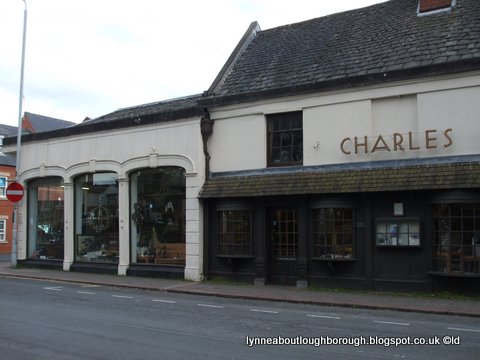
Lowe's shop on Church Gate

Caravelli's Italian restaurant on Sparrow Hill
The other part of Lowe's on Church Gate
12 Degrees West, formerly the Mundy Arms
Next time you're in town, have a look at the roofs and see which others you can spot. 

Apart from roofs, Swithland slate is also used for a whole variety of other things, like plinths, window sills, milestones, gateposts, animal troughs and many more things. Here are a few examples from Stoneywell:
Swithaland slate door frame (inscribed with G 1899)

Siwthland slate coat hanger inside Stoneywell Cottage
I have a feeling some of the fireplaces and window sills in Stoneywell were also made of Swithland slate, but my photographs are not clear enough for me to be sure.

My internet connection is not playing ball today and it keeps switching off, so I am going to post about the use of Swithland slate for gravestones another time. In the meantime, here's a photograph of some from our very own parish churchyard (All Saints with Holy Trinity) to keep you going:
Swithland slate gravestones in the churchyard of All Saints with Holy Trinity
I'll let you know when the post about Swithland slate gravestones is ready, so do pop back again!

PS I have now blogged about Swithland slate gravestones, although there will be a further post concentrating on photographs. 


You are welcome to quote passages from any of my posts, with appropriate credit. The correct citation for this looks as follow:


Dyer, Lynne (2016). Swithland slate. [Online] Available from: http://lynneaboutloughborough.blogspot.com/2016/12/swithland-slate.html [Accessed 11 December 2016]

References:
(1) Herbert, Albert (1944). Swithland slate headstones. Transactions of the Leicestershire Archaeological Society, Vol. XXII, Part III, 1943-44
(2) https://en.wikipedia.org/wiki/Swithland_Wood 


Sunday, 25 October 2015

Never far from Loughborough!

This last week has seen me staying in South West Wales, Llanteg, to be precise. At one time I used to stay at Llanteglos every October half-term holiday, until we decided that we should investigate the whole of the Welsh coastline! We've done that now, apart from Swansea, so this year we decided to go back to Llanteglos, without the children, to celebrate the fact that we finally got married 5 weeks ago.

So, this time, we decided to visit some places that we'd been to before with the children, including Pembroke, Narberth and Llawhden castles, the National Botanical Gardens of Wales, and the towns of Pembroke, Sandersfoot and Tenby. We also visited some new places, like the Heritage Museum in Pembroke, Picton and Laugharne castles, and Lamphey Bishops' Palace.  And we did some different things, like walk from Llanteg to Saundersfoot, Tenby to Saundersfoot, and from Freshwater East to Lamphey and back!

Interestingly, I learned all about flying boats and the difference between these and planes that can float, at the Pembroke Heritage Centre. I'd never heard of Sunderland boats before, but how strange to read all about them and to then go back to the holiday accommodation and find that they were being featured on the One Show!!

So, the area of South West Wales is not Richard III country, so there was much information about his adversary, Henry VII. I don't purport to be on any particular side of the Richard III argument. Being Welsh myself, one might suppose I support Henry VII. Having parents who've lived in Yorkshire for 39 years, one might suppose I support the idea that he should have been buried in Yorkshire. Having myself lived in Loughborough for 37 years, and worked in Leicester for 29, one might suppose that I support the Leicester case!


Whatever my thoughts and feelings on the matter, I was impressed to see the house in Tenby where Henry VII is reputed to have escaped to France through a tunnel, in 1471,


and equally impressed to see his birthplace in Pembroke Castle.


A couple of other Loughborough - or at least, Leicestershire - connections caught my attention whilst I was visiting Pembroke castle.


The information boards talked of Lord Hastings: was this the same family as were formerly Lords of the Manor at Loughborough?


They also talked of Simon de Montfort, a name which is very familiar to me!!

And then there was a quotation about seeing Henry VII's birthplace, from John Leland, a traveller who wrote about his journeys, which included comments about Leicester and Leicestershire, and whose words are quoted in Nichols.


In one of the rooms in the castle, there was a display about more recent wars, and it was here that I spotted the uniforms of the Pembrokeshire Yeomanry, and was reminded of our own Leicestershire Yeomanry, whose collection is in the Carillon. [Apologies for the poor quality photos].


Then there was the town hall in Laugharne: a beautiful white building with a tower and a bell which struck the hour, which reminded me of our own town hall with its bell, and of our bellfounders, Taylors.


Picton Castle has never been open when we've been past before, but this year they had extended their opening hours (as had Laugharne Castle). We went on a guided tour of the castle, and when we heard that the owners were Phillips, it did make me wonder if they were related to the De Lisles of Garendon!

Wandering around Tenby one day, we went into a bookshop, where I was very surprised to see someone from Loughborough with whom I worked in Leicester about 23 years ago!!

On our final day we visited the National Botanical Gardens of Wales, which we discovered are built on the site of Middleton Hall. I've no idea why the hall was so named, as the owner was a William Paxton, so no relation to the Middleton bankers of Loughborough!

Unfortunately, I missed all the excitement of the Loogabrooga Festival, but I hope you managed to catch some of it!