Monday evening I attended a talk in Woodhouse Eaves about windmills - well, mostly windmills, with a bit of watermills and steam mills thrown in for good measure!
Wednesday evening I was at the Friends of Charnwood Museum talk on the geology of Charnwood, which included many references to the local quarries.
Friday evening I was spellbound by a production called Murder By Gaslight,which took place in the Guildhall in Leicester: this was a professional production by Don't Go Into The Cellar, and was about Dr William Palmer and Dr Crippen.
Saturday afternoon I went along to the opening ceremony of the New Lount Industrial Trail. The nature trail has been there for quite some time, but the new industrial trail sees interpretation boards around the site, indicating where various parts of the coal mine used to be.
Sunday afternoon I visited the Shepshed watermill which was open as part of National Mills Weekend. Fabulous visit which kind of complemented Monday's talk. We were shown a map of 1826 which showed about 88 mills, but there were apparently about 130 windmill, with 4 such mills being in Loughborough.
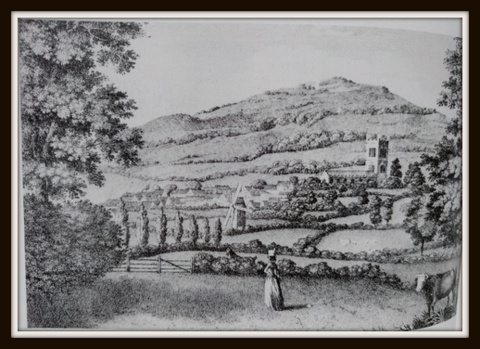
The Loughborough mills were: one in what is now the Midland Railway Station car park; one on Windmill Road, off Beeches Road, near where Ladybird Books, now Anstey Wallpapers, used to be; one on the site that is now occupied by Emmanuel Church, and one near the Windmill Inn, on Sparrow Hill. The latter, a post mill, was probably the subject of an illustration by John Throsby in 1789, in which the Church of All Saints (now with Holy Trinity) appears in the background. Of course, this is not a photographic representation of what the mill would have looked like, rather an idealised, rather romantic view, but none of the Loughborough mills still exist so there's nothing to compare the Throsby view with.
Unlike the Loughborough mills, the Shepshed mill does still exist: the mill was originally owned by the De Lisle family (of Garendon), and Henry Draper was the last miller to use it for its intended purpose. By 1956, the mill was derelict, and was bought by Bernard Foulquies, a hosier from Leicester, who eventually converted the tower mill into a dwelling, in fact it was one of the very first of such conversions. The restoration didn't go smoothly, as at one point it was possible that the route of the M1 would have meant demolition, but luckily the route of the motorway was later changed, although a subsequent earthquake did cause damage to the mill. Originally the mill had 4 sails, but here's what the mill looks like today:


The only thing I'm not sure about is the name of the windmill: I've seen references to a Blackbrook windmill, and a Fenney Spring windmill, both in Shepshed. I'm inclined to think they refer to the same windmill, but I'd be happy to put right on that!
Anyway, if having a restored windmill wasn't enough, Shepshed also has a watermill! This was also once part of the Garendon Estate, but went into other ownership in the 1970s and has more recently been restored, winning a national award for preservation in 2003. Nowadays, the mill is open a number of Sundays a year, and hosts car shows, Wartime events, and storytelling.

So, lots of restoration going on in Shepshed, apart from the milestone on the A512, but don't get me started on milestones!!!

Further resource on mills.
You are welcome to quote passages from any of my posts, with appropriate credit. The correct citation for this looks as follow:
Dyer, Lynne (2017). Windmills. Available from: http://lynneaboutloughborough.blogspot.com/2017/05/windmills.html [Accessed 14 May 2017]
Take down policy:
I post no pictures that are not my own, unless I have express permission so to do. All text is my own, and not copied from any other information sources, printed or electronic, unless identified and credited as such. If you find I have posted something in contravention of these statements, or if there are photographs of you which you would prefer not to be here, please contact me at the address listed on the About Me page, and I will remove these.
Thank you for reading this blog.
Lynne


