Showing posts with label Dishley. Show all posts

Sunday, 25 May 2025

Robert Bakewell commemorative service

The previous post on this blog was a birthday blog for the 300th anniversary of the birth of Robert Bakewell, agriculturalist of Dishley. When I wrote the blog, I hadn’t had the pleasure of attending any celebratory events (apart from a very informative and interesting talk a few weeks earlier).

To mark the anniversary, there was a lovely service held at Dishley church, led by the Reverend Tim Day, vicar of Thorpe Acre church, Thorpe Acre church being the church which was built to replace the one at Dishley, around 1845, and designed by architect, William Railton


Amongst the people who congregated for the service were many local people, and children from the Robert Bakewell School. It was a gloriously sunny day – perhaps a bit too sunny, so a few of us sought out the shade!

A buffet lunch was held at Thorpe Acre church, where there were some superb information boards relating to Robert Bakewell, produced and exhibited by the New Dishley Society, and a celebratory cake!!


It's been quite a few years since I've been to Dishley church, so it was lovely to visit again. Here are some photos from the celebratory service.


At teatime, Leicestershire bellringers rang a quarter peal at Hathern church in honour of Robert Bakewell’s anniversary.

Extract from Ringing World, with thanks (1)

____________________________________

Notes

(1) https://bb.ringingworld.co.uk/view.php?id=1855332

____________________________________

Posted by lynneaboutloughborough

With apologies for typos which are all mine!

_______________________________________________

Thank you for reading this blog.

Copyright:

The copyright © of all content on this blog rests with me, however, you are welcome to quote passages from any of my posts, with appropriate credit. The correct citation for this looks as follows:

Dyer, Lynne (2025). Robert Bakewell commemorative service. Available from: https://lynneaboutloughborough.blogspot.com/2025/05/robert-bakewell-commemorative-service.html [Accessed 25 May 2025]

Take down policy:

I post no pictures that are not my own, unless I have express permission so to do. All text is my own, and not copied from any other information sources, printed or electronic, unless identified and credited as such. If you find I have posted something in contravention of these statements, or if there are photographs of you which you would prefer not to be here, please contact me at the address listed on the About Me page, and I will remove these.

External Links:

By including links to external sources I am not endorsing the websites, the authors, nor the information contained therein, and will not check back to update out-of-date links. Using these links to access external information is entirely the responsibility of the reader of the blog.

Blog archive and tags:

If you are viewing this blog in mobile format, you will not be able to easily access the blog archive, or the clickable links to various topics. These can be accessed if you scroll to the bottom of the page, and click 'View Web Version'. Alternatively, there is also a complete list of posts, which when clicked will take you to the page you are interested in.

Searching the blog:

You can search the blog using the dedicated search box that appears near the top of the blog when viewed in the web version. Alternatively, you can search using your usual search engine (e.g. Bing, Google, DuckDuckGo etc.) by following this example:

site: https://lynneaboutloughborough.blogspot.com/ “Radmoor House”

NOTE – the words you’re actually looking for must be in “” and the first of these must be preceded by a space

Thank you for reading this blog.

Lynne

Sunday, 11 June 2023

Building Stone

Sadly, I missed a recent talk hosted by the Friends of Charnwood Museum, about stone, so, I had a look back over the blog to see what I’d already written. I must admit, I thought I’d done a piece on Coade stone, an artificial stone, but find I haven’t so I’ve only mentioned it in passing in some posts, like [quote blog posts]. So, let’s have a quick look at some real local stone, and where it’s been used.

Old Rectory, Rectory Place

The 13th-century building was once the home to the rectors of Loughborough, having been passed to the church around 1228 by the Cortlinstoke family. By the time it fell out of use, around 1959, it had been extended enormously, and would have been a substantial family home, however, once unoccupied the building fell into disrepair and was partially demolished, revealing its earlier core, which has been retained.

The building you now see is said to be made of Bromsgrove Sandstone; North Charnwood Diorite; Charnian (volcaniclastic breccia); Charnian (volcaniclastic sandstone); Swithland slate; and Charnian (banded tuff).


All Saints with Holy Trinity, Steeple Row

This church is a 14th century building, probably built on the site of an earlier church, and it is here that the rectors of Loughborough would have done most of their work. over the years the church has been subject to many alterations, most notably that by architect Sir George Gilbert Scott in the mid-19th century. 20th and 21st century renovations have included those to the pinnacles on the belltower, and various new stones in the fabric of the building. I've written more extensively on a very early blogpost.

Stone that has been used in the construction of the church includes Millstone Grit; Triassic Red Sandstone; North Charnwood Diorite; Upper Lincolnshire Limestone; Charnian (metasediments0; Swithland slate, and Mountsorrel Granodiorite.


Holy Trinity Church, Moor Lane 

This church is no longer a religious building, but was once a busy church serving the Leicester Road area of Loughborough, opened in 1878, to a design by William Arthur Blomfield. You can find out a bit more about its history on an earlier blogpost.

The range of natural stone used in the construction of the church is much less varied than the Old Rectory and Loughborough’s All Saints church, comprising only of Mountsorrel Granodiorite and Upper Lincolnshire Limestone.


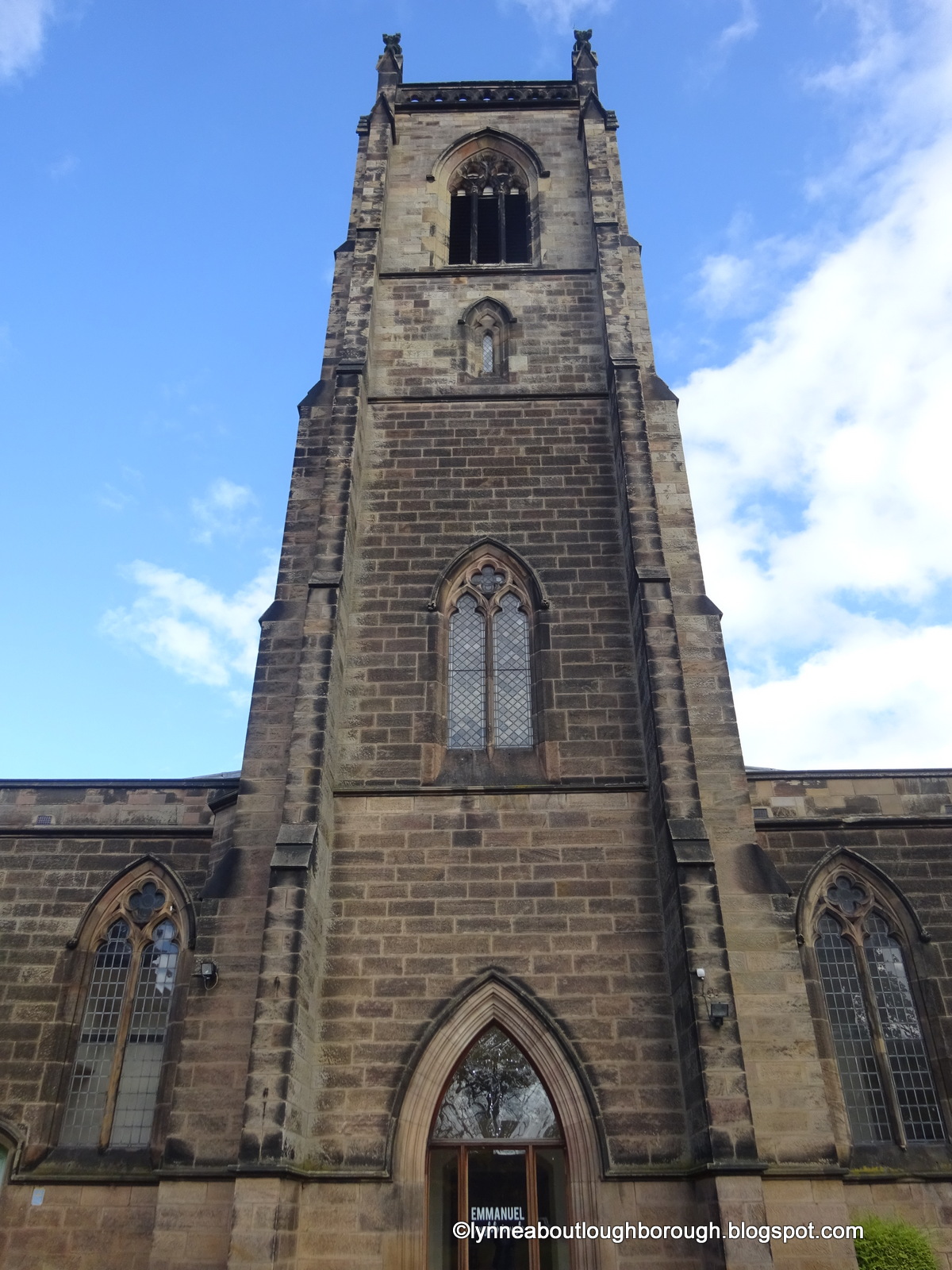
Emmanuel Church, Forest Road

The church was created around 1838, and its first rector was William Holme, who was also Rector of All Saints. The first Rector dedicated solely to Emmanuel was Reverend Bunch, who lived at the Emmanuel Rectory, on Forest Road, close to Mountfields House.  

I’ve not written much about Emmanuel church, but have done a couple of posts about the associated rectory. Part 1 and Part 2 

It appears that Emmanuel Church is constructed solely of Millstone Grit, but has a much later extension using other stone.


St Mary’s Nanpantan

St Mary’s church in Nanpantan started life as a Mission Hall, created by the Warner family of Nanpantan Hall, in 1888. Since 2015, St Mary’s has been a parish in its own right, so no longer connected to Emmanuel.

Using Charnian (volcaniclastic sandstone), St Mary’s is another church which is constructed only from one stone, that is until the 1960s when a granite Chapter House, with a flat-roofed vestry was built.


All Saints Thorpe Acre

This particular church is more usually known as Thorpe Acre church, and was built in 1845 to a design by William Railton, who was the architect responsible for the design of Nelson’s Column in London, and a number of other local Leicestershire churches. I've written extensively about Railton - here's one example post. The church, which replaced All Saints at Dishley (see below), is proud to have an east window, created in 1892 by Charles Eamer Kempe, and in the 1980s, the church was extended and joined to the school house.

All Saints, Thorpe Acre, was constructed using only Millstone Grit, until the extension was built.


All Saints Dishley

Dishley church is now a ruin, having been deconsecrated when All Saints Thorpe Acre was created in 1845. The ruins, which contain plaques to the agriculturalist, Robert Bakewell, are close to Dishley Grange Farm, which was part of the Garendon Estate.

The stone used in the construction of All Saints at Dishley includes Charnian (volcaniclastic sandstone); Diseworth Sandstone; Charnian (igneous); Triassic Red Sandstone; Cobbles (Bunter), and Bromsgrove Sandstone.  


_______________________________________________

posted by lynneaboutloughborough

With apologies for typos which are all mine!

_______________________________________________

Thank you for reading this blog.

Copyright:

The copyright © of all content on this blog rests with me, however, you are welcome to quote passages from any of my posts, with appropriate credit. The correct citation for this looks as follows:

Dyer, Lynne (2023). Building Stone. Available from: https://lynneaboutloughborough.blogspot.com/2023/06/building-stone.html [Accessed 11 June 2023]

Take down policy:

I post no pictures that are not my own, unless I have express permission so to do. All text is my own, and not copied from any other information sources, printed or electronic, unless identified and credited as such. If you find I have posted something in contravention of these statements, or if there are photographs of you which you would prefer not to be here, please contact me at the address listed on the About Me page, and I will remove these.

Blog archive and tags:

If you are viewing this blog in mobile format, you will not be able to easily access the blog archive, or the clickable links to various topics. These can be accessed if you scroll to the bottom of the page, and click 'View Web Version'. Alternatively, there is also a complete list of posts, which when clicked will take you to the page you are interested in.

Searching the blog:

You can search the blog using the dedicated search box that appears near the top of the blog when viewed in the web version. Alternatively, you can search using your usual search engine (e.g. Bing, Google, DuckDuckGo etc.) by following this example:

site: https://lynneaboutloughborough.blogspot.com/ “Radmoor House”

NOTE – the words you’re actually looking for must be in “” and the first of these must be preceded by a space

Thank you for reading this blog.

Lynne


Sunday, 2 April 2023

Garendon Park Estate Part 2

Following my accompanied walk around the Garendon Estate recently, which I shared with you a while ago, I’ve done a bit of reading up about the park.

Deer parks were very common in mediaeval times, and were a status symbol used by the lord of the manor for hunting. They were spread across England, with Leicestershire having about 46 over a period of time. Although many of these started small – perhaps an enclosure not suitable for hunting, where half a dozen or so deer might be kept – the parks often grew quite large, usually to about 100-200 acres, but could sometimes be much bigger.  

It seems that local historians [1] believe that Garendon was never a mediaeval deer hunting park, despite that deer were kept there until relatively recently.

The origins of the estate begin with the creation of an abbey – Garendon Abbey – the second Cistercian abbey to be formed in this country, sometime after 1129, which lasted until the dissolution of the monasteries in 1536. The abbey also had lands in Dishley, where deer were kept, but this was for food, rather than for hunting.

The estate passed into private ownership, and a hall was constructed, in what became known as Garendon Park. So, this was not a mediaeval park which would have been uncultivated and wooded, but more of a landscaped park, that were popular in the 1700s. Any deer introduced might have been a feature of the park at this time.

Anyway, the views from the temple of Venus and the triumphal arch were quite extensive. Had I been better at taking photographs I’d be able to show you the stunning views that I saw, but my photos are not that good, so only serve to give you an idea of the area. Also, looking back on them now, I cannot say for certain which direction I am looking in!!!


Looking towards the power station

Looking at the old Fisons R&D site

View of the obelisk


View towards the A512 and the motorway junction

Notes

[1] Squires, A.E. and Humphrey, W. ‘The Medieval Parks of Charnwood Forest’. Wymondham: Sycamore Press, 1986 AND Williams, B.C.J. ‘Garendon’ IN ‘The Bulletin of the Loughborough & District Archaeological Society’, No.7, 1964

____________________________________

posted by lynneaboutloughborough

With apologies for typos which are all mine!

_______________________________________________

Thank you for reading this blog. 

Copyright:

The copyright © of all content on this blog rests with me, however, you are welcome to quote passages from any of my posts, with appropriate credit. The correct citation for this looks as follows:

Dyer, Lynne (2023). Garendon Park Estate Part 2. Available from: https://lynneaboutloughborough.blogspot.com/2023/04/garendon-park-estate-part-2.html [Accessed 2 April 2023]

Take down policy:

I post no pictures that are not my own, unless I have express permission so to do. All text is my own, and not copied from any other information sources, printed or electronic, unless identified and credited as such. If you find I have posted something in contravention of these statements, or if there are photographs of you which you would prefer not to be here, please contact me at the address listed on the About Me page, and I will remove these.

Blog archive and tags:

If you are viewing this blog in mobile format, you will not be able to easily access the blog archive, or the clickable links to various topics. These can be accessed if you scroll to the bottom of the page, and click 'View Web Version'. Alternatively, there is also a complete list of posts, which when clicked will take you to the page you are interested in.

Searching the blog:

You can search the blog using the dedicated search box that appears near the top of the blog when viewed in the web version. Alternatively, you can search using your usual search engine (e.g. Bing, Google, DuckDuckGo etc.) by following this example:

site: https://lynneaboutloughborough.blogspot.com/ “Radmoor House”

NOTE – the words you’re actually looking for must be in “” and the first of these must be preceded by a space

Thank you for reading this blog.

Lynne

Sunday, 4 December 2022

No.1 Co-op

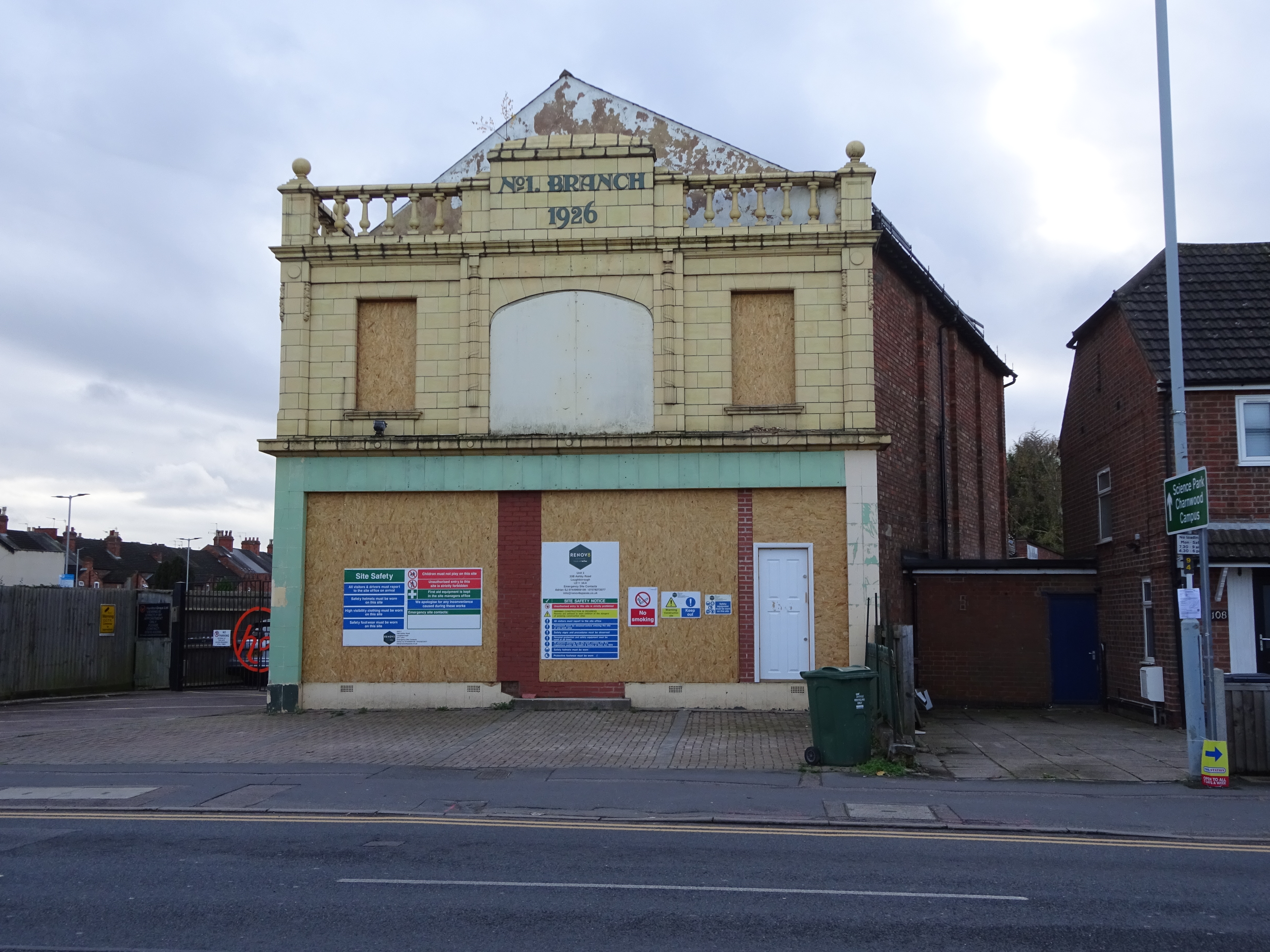
Back in June 2021 (gosh, I thought I'd written that post only a couple of months ago, but it turns out to be nearly 18 months since it was done!) I wrote about the former No.1 Co-op store down on Derby Road, close to the new supermarket, the chip shop, and Belton Road. Before the Co-op was built, the land was close to the Charnwood Forest Railway, and adjacent to the Wood Brook. 

Pictured in 2020

Detail from 2020

I think it was sometime the year before, so, in 2020, that the former Co-op, which was then an Oriental restaurant, had been sold, and was being converted to flats: the June 2021 post was a record of progress with that conversion, but also a brief history of the Co-op stores, the movement having definitely been active in Loughborough from around 1866. The Derby Road Co-op, despite being called 'No.1' was not the first Co-op in Loughborough, that honour going to the store on Wood Gate, coincidentally, now an Oriental restaurant.

Detail of the Wood Gate store

At the time, it was a puzzle as to why the Derby Road Co-op was called the No.1 Co-op, having been built in 1926. 

Several theories had emerged:

*Was it the first Co-op in Knightthorpe? It could not have been the first Co-op store in Loughborough, as the store on Wood Gate opened in the 1860s

*Had the Loughborough Co-operative Society merged with another local society, and this was the first building to be built and occupied by the merged Society?

*Was it a road number? Perhaps intended to be the start of Alan Moss Road?

*Was it the first of Loughborough's buildings to be clad in Hathernware faience tiles?

*Was it the first to be built along the Charnwood Forest railway line, with others planned along the route?

*Was it the first self-service Co-op in the area?

A recent chance conversation on Facebook, about the No.1 Co-op in Farnborough, has led me to what I believe might be the answer. I might not quite have got the dates right, but I think it does all have to do with parish boundaries.


At one time Loughborough was surrounded by a number of different parishes, including Woodthorpe to the south, Knightthorpe, and Thorpe Acre cum, or with,  Dishley, the latter two being northwest of Loughborough. 

In 1871, Knight Thorpe is described in Wilson's 'Imperial Gazetteer of England and Wales', as "a township in Loughborough parish, Leicester; near Loughborough. Real property, £1,533. Population, 58. Houses, 12."

The same source describes Dishley-Cum-Thorpe Acre, as "a parish in the Loughborough district, Leicester; adjacent to the river Soar and the Midland railway, 1.5 miles NW of Loughborough. Post town, Loughborough. Acres, 890. Real property, £1,742. Population, 194. Houses, 54. Bakewell, the distinguished agricultural improver, lived and laboured here; and has bequeathed to the place marked benefits of his skill. The living is in the diocese of Peterborough. Value, £150. Patron, the Bishop of Peterborough. The church was built in 1845 [designed by William Railton]. A school has £11 from endowment, and other charities £11."

By 1925 this had all changed, as shown by the following extract from Kelly's 1925 directory. This explains that by an Order of the County Council, confirmed by Local Government Board Order, which came into operation on 25th March 1892, parts of the parishes of Knight Thorpe, and Dishley with Thorpe Acre were constituted the new parish of Knight Thorpe, and parts of the parishes of Garendon and Dishley with Thorpe Acre constituted the present parish of Dishley with Thorpe Acre, and parts of the parishes of Garendon, Knight Thorpe and Dishley with Thorpe Acre formed into the new parish of Garendon.

So, looking at a map of the municpal boundary, i.e. post-1888 when the borough became incorporated, it appears that the Knightthorpe boundary runs alongside the Wood Brook, down to part of what is now the university campus, and up past the site of the No.1 Co-op (X marks the spot), along what is now Belton Road.


As the No.1 Co-op built in 1926 on Derby Road, is on the Derby side of the Wood Brook, it might therefore follow that the store, being outside the boundary of Loughborough, was the first one to be built in Knightthorpe parish. But I could be wrong!

Anyway, over the years there have been, and indeed still are, various Co-op stores across town including, on Loughborough High Street and Swan Street, on Lansdowne Drive, on the site of the Maltings pub off Epinal Way, on Nottingham Road, on Derwent Drive and on Ashby Road.

And so the renovation continues ...

Photographed November 2022

____________________________________

posted by lynneaboutloughborough

With apologies for typos which are all mine!

_______________________________________________

Thank you for reading this blog. You are welcome to quote passages from any of my posts, with appropriate credit. The correct citation for this looks as follows:

Dyer, Lynne (2022). No.1 Co-op. Available from: https://lynneaboutloughborough.blogspot.com/2022/12/no1-co-op.html [Accessed 4 December 2022]

Take down policy:
I post no pictures that are not my own, unless I have express permission so to do. All text is my own, and not copied from any other information sources, printed or electronic, unless identified and credited as such. If you find I have posted something in contravention of these statements, or if there are photographs of you which you would prefer not to be here, please contact me at the address listed on the About Me page, and I will remove these.

Blog archive and tags:
If you are viewing this blog in mobile format, you will not be able to easily access the blog archive, or the clickable links to various topics. These can be accessed if you scroll to the bottom of the page, and click 'View Web Version'. Alternatively, there is also a complete list of posts, which when clicked will take you to the page you are interested in.  
 
Thank you for reading this blog. 

Lynne

Saturday, 17 July 2021

Chrysanthemums and celery shows

With huge thanks to the flower lady in Tylers, Loughborough's independent department store,  for providing such beautiful props! (and to the other half for venturing into town on such a hot Saturday!) 

With the summer well and truly here, the sun shining, gardens blossoming with colour, and allotments ripe with fruit, let’s have a look at the chrysanthemum and celery shows of the early 1880s.

The Loughborough Chrysanthemum Show – which actually included displays of other flowers, and some fruit – was held on Thursday 17th November 1881, and was reported upon in the “Nottinghamshire Guardian” the next day.

Loughborough chrysanthemum show

The 7th annual exhibition in connection with the Loughborough Chrysanthemum and Fruit Society was held yesterday at the town hall, and proved unusually successful. In consequence of the prizes offered for competition, there was an unusually large number of entries, and the exhibits for the most part were equal to, even if they did not surpass, those shown at any of the previous six shows. Of course, the chrysanthemums occupied the largest share of attention, and not without reason, for a more perfect collection of blooms of almost all varieties it would be difficult to find.

The Reverend J. Bird succeeded in taking most of the first prizes for chrysanthemums, but he was run very close by W. Peachy, gardener to Mrs Hole; and in the class for untrained chrysanthemums he had to be satisfied with second honours. The show of pompones was a fine one, and resulted in a keen competition, but the prize for the best group of plants was deservedly gained by J. Cullen.

Among the fruit were some exceedingly fine apples and pears, and it was not without trouble that the judges were enabled to give their awards. This they did, however, in a way which gave general satisfaction, both to the competitors and the public. The names of the judges were as follows; Mr H. Gadd, gardener at Wollaton Hall; Mr G. R. Faire, Leicester; and Mr. T. Robert, gardener to Mr Hussey Packe.

The various exhibits had been carefully arranged around, and in the centre of the room, and with a number of primulas, and other plants lent for the occasion by Mr. J Smith, made up a very attractive show. A fine brace of cucumbers were also staged by Mr E. Warner, not for competition. During the afternoon and evening, a large number of persons visited the hall, and credit is due to the Secretary (Mr. F.H. Rowbotham) for the manner in which he, with the committee, has carried out the whole of the arrangements. The following is the prize list:”


Another Loughborough chrysanthemum and fruit show was held on 17th November 1883, and the “Nottinghamshire Guardian” carried the following report of the event:

Loughborough chrysanthemum and fruit show

On Saturday the ninth annual exhibition in connection with the Loughborough chrysanthemum and Fruit Society was held in the Corn Exchange town hall. The show was small, there being scarcely a dozen exhibitors.

In chrysanthemums the Reverend J. Bird, of Walton, carried off all the principal prizes, securing as he did the first prize in each class. Mr Maxted, gardener to Mr J. Griggs, was awarded the first prize for four pompones (distinct varieties), while Mr. J. Smith secured the first prize for two pompomes.

The most attractive feature consisted of three groups of miscellaneous plants arranged in the centre of the room. Two of these groups were shown by Mr Hussey Packe, of Prestwold, and Mr B. Paget, of Loughborough, not for competition: while the third was exhibited by Mr Maxted in competition for the prize offered for the best group of plants not to exceed 4 yards in diameter. This exhibit secured the second prize.

In the department of cut flowers, the Reverend J. Bird was again the prize-taker. There were some splendid exhibits in the fruit department, the apples and pears commanding considerable attention. For the collection of four dishes of dessert apples (four varieties), and for a dish of desert apples, Reverend J. Bird secured the first prizes, while Messrs J. and H. Hickling, and Mr McLean were awarded the second prizes respectively. For the collection of four dishes of cooking apples, Mr R. Shaw was first, and the Reverend J. Bird second. The dish of six cooking apples shown by Reverend J. Bird were truly magnificent, and just gained the first award. For the collection of four dishes of dessert pears, the first prize was given to Messrs J. and H Hickling, while the prize for the six heaviest pears was received by Mr. J Smith. There were some good exhibits of white and black grapes, the most successful competitors being Mr A. Squires and Mr R. Shaw.”

The same show was reported on in the “Gardeners’ Chronicle” of 24th November 1883, under the heading “Loughborough chrysanthemum”:

This, the ninth annual show in connection with this Society, was held in the Corn Exchange on the 17th of the month. The various productions exhibited were of that generally meritorious character for which the Society has become noted; many of the blooms, especially in the section for Japanese varieties, were the largest ever seen in Loughborough, and many of the incurved class measured 5 inches in diameter and nearly as much in depth. The competition in all classes was of the keenest, making the work of the judges one of some difficulty. Many of the gentleman's gardeners in the neighbourhood took part in the contests. The President of the Society, the Reverend John Bird, Walton Rectory, was most successful in the first four classes for pot-grown specimens, being first in each.

In the pom pom classes the most successful competitors were Mr. J Smith and Mr. J. Maxted. In cut blooms Mr Bird was awarded first for 18 incurved distinct varieties; second Messrs. J. and H. Hickling; third Mr. J Smith. For 12 incurved Mr Bird was again first; Mr H. Smith, gardener to Sir W.H. Salt, Bart, second; Messrs. J. and H. Hickling third. In the competition for 12 blooms, Japanese varieties, first Mr H. Smith, second Mr Bird. In that for six blooms, Japanese, the results were similar - first Mr H. Smith, second Mr Bird.

The fruit section of the show contained some excellent samples of grapes by several exhibitors, those of Mr Shaw and Mr Squires being adjudged the best, Messrs. Hickling, Mr. Smith, Mr McLean, Dr. Palmer, and Mr Bird taking prizes in the competition for apples and pears, as well as in the grape classes. The attendance of visitors was very good throughout the day.”


Of course, flower, fruit and vegetable shows were common across the land, not just in Loughborough. With the headline Chrysanthemum and celery exhibition, the “Leicester Chronicle” of 1 st December 1883, covered the chrysanthemum and celery show for Leicester and Leicestershire in the following report, in which several Loughborough folk took part and are mentioned in the report (my bold):


“The fourth annual exhibition of the Leicester and Leicestershire chrysanthemum and celery Society was held at the Freemans Arm’s Hotel, Aylestone Road, on Saturday last [24 November 1883]. The exhibits were staged in the handsome new club room of the hotel, which added considerably to the success of the show. The exhibits were decidedly finer and more numerous than last year, the first and second prize boxes being exceptionally fine blooms, and the judges had some difficulty in deciding to which they should give the palm.

The tables were decorated with some fine specimens of statice halfourdi, tarfugium, variegated aloes, and other plants kindly lent by Mr. J. Yates, and also other plants by Mr H. Jordan and Mr. J. Sargent. A splendid basket of chrysanthemums were sent for non-competition by Mr W.C. Burder (1) and Mr. J. Sargent, and a box of 12 fine blooms were sent through the secretary, Mr L.V Heathcote, by Mr. J. Wright, gardener to the Honourable Society of the Middle Temple, London.

A fine collection of apples, onions, and leeks were also staged for non-competition by Mr. E. Clayton, Mr W.J. Iliffe, and Mr W. Bell. A box of six Japanese chrysanthemum blooms was awarded a special prize by the judges to Mr. S. Collett, the exhibit being of exceptional merit. Mr. J. Burn, of the Abbey Park, and Mr. Forster, of the cemetery, acted as judges, and their rewards gave great satisfaction. Credit is due to the secretary, Mr L.V. Heathcote, for the arrangements of the show and the staging of the exhibits, and the committee are to be congratulated on the success attending their efforts.

The following is the prize list:

Chrysanthemums –

Class 1 (open to all England), 12 blooms distinct varieties, 1 st the Reverend J. Bird, Walton Rectory Loughborough; 2 nd Mr. A Parks, Bosworth Hall gardens, 3 rd Messrs. J.&H. Hickling, Loughborough (2).

Class 2 (amateurs), 12 blooms, distinct varieties, 1 st S. Collett, 2 nd W.J. Iliffe, 3 rd H. Jordan.

Class 3 six blooms, distinct varieties, 1 st S. Collett, 2  nd Charles Day, 3 rd H. Bell.

Class 4 three blooms, one variety, 1 st H. Bell, 2 nd S. Collett, 3 rd W.J. Iliffe.

Class 5 three specimen plants, 1 st John Sargent, 2 nd W.J. Iliffe.

Class 6 premier plant, 1  st W. J. Iliffe.

Class 7 bouquet of chrysanthemums, 1 st John Yates, 2 nd John Sargent, 3 rd A. Main.

Class 8 celery (three sticks) 1 st John Yates, 2 nd John Wiggington, 3 rd W.J. lliffe.

Class 9 beat stick, 1 st W.J. Illiffe.”

Later, in 1887, Loughborough began a dedicated celery show, and the second of these in 1888 took place in the Rose and Crown pub on Baxter Gate. However, it wasn’t actually just dedicated to celery, and there were also prizes given for leeks, red cabbage, cauliflower and collections of vegetables. The third annual show was held at the Station Hotel (now a funeral parlour and flats) on the corner of Station Street and Derby Road (I thought I'd blogged about this building, but I've now remembered I wrote about it in "Secret Loughborough").

Thanks to the stallholders on Loughborough's 800-year-old market for the props (and to the other half for venturing into town on such a hot Saturday!) 


I wonder if these groups were in any way associated with the Loughborough Agricultural Association, which was set up in 1838? There is certainly an element of flower, fruit and vegetable shows held as part of larger shows, like the Leicestershire Show (at one time held in the field at Dishley) and the Sutton Bonington Show (short report tops, and a few pictures tail this post about the cemetery chapels), alongside, things like the showing of animals, handicrafts, baking and various events. Hoping these will soon make a return to our calendar.  

Notes

(1) in 1881 Walter Chapman Burder, horticultural builder employing 65 men and 10 boys, was living at 153 Park Road. He was the owner of Messengers, and would later move to Field House.

(2) John and Henry Hickling are listed in a trade directory for 1887 as being seedsmen and nurserymen at 14 Bedford Street.  

Posted by lynneaboutloughborough 18 July 2021

You are welcome to quote passages from any of my posts, with appropriate credit. The correct citation for this looks as follow:

Dyer, Lynne (2021). Chrysanthemums and celery shows. Available fromhttps://lynneaboutloughborough.blogspot.com/2021/07/chrysanthemums-and-celery-shows.html  [Accessed 18 July 2021]

Take down policy:
I post no pictures that are not my own, unless I have express permission so to do. All text is my own, and not copied from any other information sources, printed or electronic, unless identified and credited as such. If you find I have posted something in contravention of these statements, or if there are photographs of you which you would prefer not to be here, please contact me at the address listed on the About Me page, and I will remove these.

You can leave comments below, but do check back as my reply will appear here, below your comment.

Thank you for reading this blog. 

Lynne