Showing posts with label St Ives. Show all posts

Sunday, 22 March 2020

Isolation in Loughborough


As we are all aware we are currently living through some difficult times, but I shall keep
Isolation hospital on Ling Road
going on here for as long as I can. I'm very conscious that some of us are glass half full people, and others glass half empty, so some of us will find seeing pictures of things we enjoy - spring flowers, summer beaches, family gatherings - exciting things we can look forward to when we emerge from these hard times, or things that just upset us even more. I'm just gonna have to take the plunge and, as usual, blog about things that I think are interesting, and hope I don't lose any of you along the way.


Pestilence Cottage in Woodhouse


Way back in October 2017 I wrote a few posts about the plague in Loughborough, starting with one about disasters (plague and fire), then about disasters and plague houses, and finally about plague and Dead Lane.


On a more cheery note (I jest, of course) last summer when we went to St Ives we managed to catch a show at The Minack Theatre (as we do most summers). It was called 'Roses of Eyam'. Now, this almost seems like a portent (that and the Year of the Rat, and the health warning that came with that - as a Rat myself, I found that a little bit disconcerting). We went with the usual travel company from St Ives, so that we didn't have to travel around the narrow Cornish roads late at night, but it did mean that while many people went home at the interval, we sat it out in the pouring rain, which actually made the play even more atmospheric and deeply felt. It was the Stamford Shoestring Theatre Company that delivered the play, and they did it so well. I probably took some pictures, but here are some on The Minack website.

So, the villagers of Eyam basically closed off their village and isolated themselves during the plague. There's a good article in The Guardian that explains it far better than I can and a nice article on the BBC website.

Back here in Loughborough, at one time there was apparently an isolation hospital on Cross Hill Lane, and children with infectious diseases would be taken there by horse-drawn cab. Later, from about 1901 there was an isolation hospital on Ling Road. Diseases that were around in the early 1900s included, typhoid, which was often fatal, and amongst other things, smallpox, diptheria, scarlet fever, and chicken pox. Into the 1930s and it was scarlet fever and diptheria that were most prevalent, and required isolation.      
In the county, there were other isolation hospitals including one at Nanpantan, Markfield and Melton Mowbray. Markfield have a great local history page on the web where you can find out more bout their hospital, and if you'd like more information about former hospitals in Leicestershire pop over to this site.    

That's all for this week.

Keep safe and strong,

Lynne

You are welcome to quote passages from any of my posts, with appropriate credit. The correct citation for this looks as follow:

Dyer, Lynne (2020). Isolation in Loughborough. Available fromhttps://lynneaboutloughborough.blogspot.com/2020/03/isolation-in-loughborough.html  [Accessed 22 March 2020]

Take down policy:
I post no pictures that are not my own, unless I have express permission so to do. All text is my own, and not copied from any other information sources, printed or electronic, unless identified and credited as such. If you find I have posted something in contravention of these statements, or if there are photographs of you which you would prefer not to be here, please contact me at the address listed on the About Me page, and I will remove these.
Thank you for reading this blog. 

Lynne 

Sunday, 4 August 2019

Holiday connections and anniversaries

Continuing with the holiday connection theme ...

In my last post I'd got as far as sharing with you some connections that made me think of Loughborough whilst I was in Launceston. Hmmm, this was actually the first day of my two-week holiday, and it was the 'let's stop off here for a break' place, in what was to be a 350-mile journey. My thinking now is that if I took a whole blog post to share the revelations from a 2-hour visit to Launceston, then it will take me about 14 blog posts to cover the rest of the holiday, so below are the edited highlights!!!

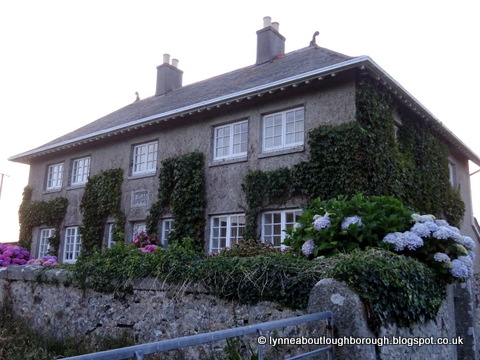
My most exciting find was on a walk in the countryside near St Ives. In previous years we've walked the coastal paths, so this year we decided to visit some of the inland footpaths and some of the small country lanes. For some reason or other, which now escapes me, I'd gone on this walk carrying with me as little as possible - so no camera, and no phone - so, of course, we had to go back another time for me to take some photos. Hence, late one evening, these are what I took:


Now, I haven't done any research into these initials, but I'm supposing they are Edward Hain, an MP for St Ives, and the owner of a shipping company. Like James Eadie, of the brewery company, remains of which affiliation can be seen on the former Station Hotel in Loughborough, Edward Hain had gone into the tea business, before switching careers. 

The significance to Loughborough of these initials is not in Edward Hain, but in Edward Hands who originally lived on Burton Walks, but moved to Castledine Street, where, if I remember rightly, he had the house extended and his initials inscribed in a plaque. Sorry for the poor quality of the photo:


Driveway into the former home of Edward hands


Edward Hands initials on Castledine Street
A couple of other connections from St Ives include this attractive house name a lovely Celtic design painted on slate, the other connection being that my children all went to Holywell School:


And just one more, so as not to bore you!! This beautiful blue enamel street sign is oh so similar to some in Loughborough, like Park Street and Charnwood Road, but what a difference - white walls and red brick walls!


The other thing which I wanted to mention today is that today is actually the 6th anniversary of this blog, which I first started on 4 August 2013! Hard to believe it's been going that long! The initial impetus for creating it still holds true: I want to promote Loughborough and show the world what's good about our lovely town, through stories of its history, its current events and everything in between. I'm so pleased you're still with me!

In the spirit of promoting knowledge and a love for our town, I've written a couple of books - 'Loughborough in 50 Buildings', and 'Secret Loughborough', and I'm having a signing event for the latter at the Old Rectory Museum on Saturday 10th August, between 11am and 3pm - everyone welcome - no purchase necessary - and if you've already bought a copy I'd be happy to sign it. 

You are welcome to quote passages from any of my posts, with appropriate credit. The correct citation for this looks as follow:

Dyer, Lynne (2019). Holiday connections and anniversaries. Available from: https://lynneaboutloughborough.blogspot.com/2019/08/holiday-connections-and-anniversaries.html [Accessed 4 August 2019]

Take down policy:
I post no pictures that are not my own, unless I have express permission so to do. All text is my own, and not copied from any other information sources, printed or electronic, unless identified and credited as such. If you find I have posted something in contravention of these statements, or if there are photographs of you which you would prefer not to be here, please contact me at the address listed on the About Me page, and I will remove these.
Thank you for reading this blog. 
Lynne  


Sunday, 8 April 2018

Finding Loughborough everywhere!

I'm ashamed to admit I've missed a couple of weeks blogging, this because I've been really busy, and been out and about rather a lot! Sorry about that!

So, I recently bumped into a friend who had been reading this blog, who asked me if I went into Loughborough town centre every day. Sadly, much as I'd like to, I don't manage to do this! I have a day job, which of course has to come first as it pays the bills, and on top of that I've been studying hard and writing a book. I'm hopeful that now my course has finished, and the book has been completed that I will have more time to investigate Loughborough, but I have a feeling the lure of study will be too great, and the call to publish too strong to avoid!

Anyway, over the last month, as I said, I've been out and about, trotting across the country, but wherever I have found myself, Loughborough has never been far from my mind. This, of course, has been made easier, by my accidentally bumping into someone from work whilst I was in Cambridge, and someone from Loughborough University whilst I was visiting Ripon Cathedral!! And, whilst perusing the bric-a-brac market in town last week, I met a stallholder who used to live in the small Welsh town where I began my life's journey! As they say, such a small world.

My travels over the last month have taken me to a number of places: Cambridge, Holywell-cum-Needingham, St Ives, Ely, Oxford, Ripon, Fountains Abbey, Attenborough Nature Reserve, Whatton House, The Outwoods, Beacon Hill and Lichfield! Where to start?!

I was sure I'd blogged about St Ives, Cambs, before, but now I come to look for the post I can't find it, so here's some of the connections with Loughborough that I spotted this time: 

Both Loughborough and St Ives have a pub called The White Hart:

The White Hart in St Ives


The White Hart in Loughborough

Sticking with pubs for a moment, in St Ives there is a pub called the Oliver Cromwell. Of course, there isn't a pub in Loughborough with that name, but the connection here is that the sign for the St Ives pub reaches out from the pub wall to the opposite side of the narrow road: at one time, the Bulls Head on High Street Loughborough did exactly the same - that is, before the road was widened in the late 1920s-early 1930s.


The Oliver Cromwell pub sign, St Ives


I'm sure both towns had a high proportion of pubs in days gone by though!


Both towns have markets: the St Ives charter goes back to 1202, whilst Loughborough's from 1221. Early trade would have been in wool:

About St Ives market

To the mid-left of photo, weights for weighing wool

More about the St Ives market
Here's how the cattle market was laid out in St Ives:


And this is part of Loughborough's cattle market:


Both towns have fairs: the St Ives fair was granted in 1107, Loughborough's in 1221. These aren't quite the dates that are displayed on the town's history panel in St Ives, but are listed elsewhere.  

St Ives history panel

St Ives history panel

In the St Ives museum there were some lovely clay pipes on display: these would have been similar to those found near what is now Wilko.

Clay pipes in the Norris Museum, St Ives

In 1769 John Wesley preached in the Market Place in Loughborough, and in St Ives in 1774.


Information board about John Wesley preaching in St Ives

St Ives history panel 

Whilst walking around the outskirts of the town, I spotted what used to be a butchers shop, now the offices of a local architecture firm, which had some beautiful tiling, which reminded me of the butchers that used to be on Moor Lane:


Butchers on Moor Lane Loughborough during demolition September 2013

Heading towards the town, I was surprised to find that St Ives was home to a property called Burleigh House, clearly not a patch on our Burleigh Hall though!! 


Burleigh House, St Ives

And their George Yard, albeit nicely painted, did not have an entrance to a pub called James' Vaults!


The George Yard, St Ives
Loughborough's George Yard

St Ives celebrated Queen Victoria's diamond jubilee by erecting a drinking fountain on Broadway in the middle of the town, called the Jubilee Memorial, with a polished granite column on a Portland stone base. The fountain in Loughborough, the Fearon fountain,  was given by the Rev'd Henry Fearon in celebration of the first piped water supply in 1872, and has polished Aberdeen granite columns. Loughborough celebrated the diamond jubilee with the creation of the Memorial Baths in Queen's Park, now the Charnwood Museum.


The Jubilee Memorial, St Ives


Re-dedication of the Fearon Fountain, Loughborough
Memorial Baths, now Charnwood Museum, Queen's Park, Loughborough

The oldest building in St Ives is the Priory Barn dating from 1320: the oldest building in Loughborough is the Old Rectory on Rectory Place, which dates back to 1228.

St Ives history panel
The Old Rectory, Loughborough

The oldest house in St Ives is the Manor House which was built around 1590. The Manor House in Loughborough (now an Italian restaurant) was built about 1477.

St Ives history panel

Loughborough's former Manor House

The railway came to St Ives in 1847, but had already come to Loughborough in 1840-1.


St Ives history panel

The war memorial in St Ives is a tall, thin monument, but totally unlike our own, which is a 153foot tall carillon tower.
The War Memorial, St Ives


The Carillon War Memorial, Loughborough
So, most towns had plenty of pubs, and also a number of banks, but how different the same bank can be when in a different town. Here's some examples, from St Ives and Loughborough:


NatWest, St Ives
NatWest, Loughborough
Lloyds Bank, St Ives

Lloyds Bank, Loughborough (ok, part of it!)

The other major difference in style comes with the Corn Exchange in St Ives, and what was the Corn Exchange, but is now the Town Hall in Loughborough.


Corn Exchange, St Ives


Loughborough Town Hall, formerly the Corn Exchange
And it is at this point that I must leave you now! So many other things to write about, but time has beaten me! Just one last note: the Carillon Tower and War Memorial Museum is closed until November 2018 for refurbishment.


You are welcome to quote passages from any of my posts, with appropriate credit. The correct citation for this looks as follow:

Dyer, Lynne (2018). Finding Loughborough everywhere. Available fromhttps://lynneaboutloughborough.blogspot.com/2018/04/finding-loughborough-everywhere.html  [Accessed 8 April 2018]

Take down policy:
I post no pictures that are not my own, unless I have express permission so to do. All text is my own, and not copied from any other information sources, printed or electronic, unless identified and credited as such. If you find I have posted something in contravention of these statements, or if there are photographs of you which you would prefer not to be here, please contact me at the address listed on the About Me page, and I will remove these.
Thank you for reading this blog. 

Lynne


Saturday, 22 July 2017

Loughborough holiday connections 2017 Part 1

Well, just returned from the annual summer holiday, which this year took a bit of a different turn.

A week booked into a cottage in St Ives, Cornwall, turned into only 5 full days, as we travelled across to Southampton for the graduation of the eldest son, and then spent 2 days discovering Dorset before returning home and discovering more about Derby and other local areas.

As ever, wherever I am, Loughborough is never far form my mind, and the less I look for, the more I find things that connect my holiday destinations with Loughborough. I've probably got enough to write a book, but I shall restrain myself and go with a short blog post! Some of the content here has already been covered in brief detail over on my #100wordsaboutloughborough page - do pop over and have a look! I'm about a third of the way through the initiative now, so need a bit of encouragement to keep going!

Setting off at just before 5am, we arrived in Penzance just before 11am. We parked in the large car park by the harbour and walked to Marazion and St Michaels Mount. Nothing to connect this to Loughborough, apart from walking next to the train line, passing a signal box, and spotting a train wash! However, when we came back towards the town centre, we spotted the lovely dome of the Lloyds Bank at the top of the street called Market Place. In reality, Lloyds of Penzance only takes up half of Market House, and is distinctive because of its lead covered dome with octagonal lantern. A quick bit of research reveals that this was a Grade I listed building when it was originally registered in 1950. Here's a snippet from the original listing description:
"1837. Architect Harris of Bristol. Large building of granite ashlar. 2 storeys. Crowned by lead-covered dome and octagonal lantern, the drum with alternating twin Tuscan columns and semi-circular headed windows, and entablature with heavy cornice. North and south elevations 9 windows, ground floor semi-circular heads, flat pilasters, 3 bay beneath dome pedimented. East end, tall Ionic tetrastyle facade. West end, central pedimented entrance, curved corner bays set back with giant engaged columns, entablature, raised pediment at centre with clock."
By contrast, our own Lloyds Bank, 37-38 High Street, is only locally listed. To my mind, it's a stunning building (I would say that, wouldn't I - leading a group of folk around our town the other day, I realised my focus is very much on banks and pubs!!)

Our Lloyds Bank is of red brick, and terracotta, the latter possibly by the Hathern Station Brick and Tile Co.. The parapet is decorated with elaborately sculpted fish, and an allegorical figure, holding in the left hand a money bag, and in the right a rolled up deed or bond. It is possible that the work is by A.E. King, a sculptor who was active between the years of 1899 and 1928. I've seen a picture of the figure from 2008, and all was well, but when I took a photograph in 2014, the left forearm and the money bag had been lost.  
Here's an extract from the local listing for our Lloyds:
"Bank & Offices Late C19/Early C20. Neoclassical/Baroque Revival. Red brick on stone plinth with expressed piers and stone string courses. Richly modelled stone embellishments include GF fascia, arched window heads with feature keystones , engaged pilasters, decorated panels between 1st and 2nd floor, cornice and upstanding parapet crowning rounded corner elevation. Pitched slate roof. 3 storeys. Generally, casement windows to GF, vertical sliding sash windows on 1st and 2nd floor. Only 2nd floor windows appear original." 
So, there were at least 60 years between the building of the Penzance bank and the Loughborough bank. A quick bit of research into Penzance reveals that the brick used in their buildings was probably of Dutch origin, as because they were a port, it was actually cheaper to buy brick in. Also, Cornish granite was not often used to build with. And, because it was a seaside resort, many of the buildings were stuccoed anyway, and apparently there was some lamenting the loss of this stucco in the 1970-1980s.

On the opposite side of the road to Lloyds Bank, at no.3 Market Place, there stands another Grade II listed building. This one was originally for the Devon and Cornwall Bank, and this can be seen on an engraved panel "D and CB" and "Est. 1832": this reminds me of our HSBC which has similar engraving on its two pillars, "1829" on one and "1893" on the other, indicating the date the original bank on this site (Middleton and Cradock) was built and the date the new bank was built.

Back to Penzance - the polished pink granite colonettes on the former Devon and Cornwall Bank are most likely to be Scottish, rather like those on the Fearon Fountain in Market Place, Loughborough.

Goodness me, so much to write, and only the end of day 1 of the holiday! This could go on for a week!

Lloyds Bank in Loughborough

You are welcome to quote passages from any of my posts, with appropriate credit. The correct citation for this looks as follow:

Dyer, Lynne (2017). Loughborough holiday connections. Available from: https://lynneaboutloughborough.blogspot.com/2017/07/loughborough-holiday-connections-2017.html [Accessed 22 July 2017]

Take down policy:
I post no pictures that are not my own, unless I have express permission so to do. All text is my own, and not copied from any other information sources, printed or electronic, unless identified and credited as such. If you find I have posted something in contravention of these statements, or if there are photographs of you which you would prefer not to be here, please contact me at the address listed on the About Me page, and I will remove these.
Thank you for reading this blog. 


Lynne 


References:


Tuesday, 19 July 2016

Loughborough and more holiday connections

Well, apologies for the radio silence: as usual things have been hectic, and I've also been on holiday for a while. Which foes someway to explaining the title of this post!

Whilst I've been away, Loughborough has not been far from my mind, and this has been particularly evident as almost everywhere I go I see something that reminds me of our little town. Places we visited were Tiverton (so many connections here, this warrants a separate post), St Ives, St Agnes, Penzance, Zennor, Newlyn, Mousehole, Lamorna, Wookey Hole, Wells, and Bristol. So, below I shall share some of these reminders with you!

Always on the lookout for something to read, when I get to my holiday location I buy the local newspapers, so I can get a feel for what's been going on in the area lately, and I also try and find an interesting magazine that I don't regularly read. So, finding myself in one of the most interesting WH Smiths I know of, I chose a couple of magazines, Scientific America: Mind (because it had a feature on dementia) and Evergreen, a magazine I've bought once before, so I knew would be a light, but interesting read. Imagine my surprise when I opened Evergreen in my holiday home and on the first page was a lovely picture taken near Beacon Hill!!
Beacon Hill from the summer issue of Evergreen
Talking of Beacons, one of the days we decided to walk around St Agnes's Head, where we passed several old tin mines, a couple of coves, a derelict church, and took a climb up to St Agnes's Beacon, from where we could see for miles around, much like a our Beacon Hill.
The toposcope on the Beacon at St Agnes
A view from the Beacon at St Agnes
And whilst we were in Wells walking around the Bishop's Palace, we happened upon a wood carving, another reminder of Beacon Hill.
Carved wooden hand at the Bishop's Palace, Wells
Also from the Bishop's Palace at Wells, we could look over from the prominent walls and see the deer park that was created by ... which reminded me of our very own Bradgate Park.
Information board about the creation of the deer park

A view towards the deer park
Bradgate is very close to Swithland, and as we were eating our lunch in the cathedral cafe at Wells we had a perfect view of one of the slate tiled roofs: clearly not Swithland, which is characterised by being very thick pieces that are laid from top to bottom with the largest ones at the top, but slate, nonetheless.
Slate roof at Wells Cathedral
Inside Wells cathedral there were very many alabaster carvings, which although not directly related to Loughborough (spar ornament makers in Loughborough used alabaster from Chellasdon to carve small items), the alabaster may well have come from Nottingham.
Alabaster memorial at Wells Cathedral
Only related to Loughborough by name, I also spotted a memorial in Wells Cathedral to one John de Middleton: no relation of our own Edward Chatterton Middleton, banker, but ...
Effigy of John de Middleton
Another name which rang a bell with me was Myrtle Cottage in Wookey Hole (actually, we passed several houses with the name Myrtle in them, either house, or cottage) which reminded me of one of the first houses to be built on Park Street.
Myrtle Cottage at Wookey hole

Myrtle Cottage in Mousehole
And then there was Tucker's Cottage in St Agnes
Tuckers Cottage in St Agnes
Shops also featured a bit in my mind. So, there was Stuarts in St Ives, a lovely little leather shop selling bags, belts and various other items, almost identical to our Stuarts on Church Gate
Stuarts leather shop in St Ives
as well as I Should Coco, a chocolatier and chocolate workshop, rather like our Chocolate Alchemy in Church Gate Mews
Chocolate shop in St Ives
and a micro-brewery, called Pilchard Press, which reminded me of our Needle and Pin on Swan Street
Pilchard Press, micro-brewery, not publishers!
Welbeck also featured, but in Newlyn
A shop in Newlyn
It seems that everywhere has an interesting body in their window!
A mask in a St Ives window
A bit closer to home, the view from the holiday house was very similar to the view from my own bedroom window!
View from the bedroom in St Ives
View from the bedroom in Loughborough
Then there were the longhorn cows in Wells, and the Leicester sheep at the Stithians Show.
Longhorn cattle at Wells
Border Leicester and Roussin sheep at Stithians Show
This blogpost could go on forever!! I also spotted a couple of wonderful water fountains like our gorgeous Fearon Fountain, an interesting weather vane, like the one on top of Rigg-Rut, numerous war memorials, though none to match our carillon, loads of lovely lamp posts, small, independent cinemas that reminded me of our Odeon (formerly Reel, Curzon etc.), and a Warwick Arms in Bristol: oh, but we haven't got one of those any more!

But, before I go, let me tell you about one last coincidence!

Perusing the books in a charity shop in Penzance, I came across half a dozen fairly old ones. Picking one up, I opened it to the first page and was so surprised to see an inscription inside to a nine year old girl from Diseworth! Not only that, the book was printed by Wills and Hepworth!! If I ever remember, I was thinking of donating the book to the lady who helps out at Diseworth Heritage Centre: last time I spoke to her, her husband was writing a book about Messengers. Oops, I think I promised you an article on green houses - or was it red?
The book
The inscription and the printers label
You are welcome to quote passages from any of my posts, with appropriate credit. The correct citation for this looks as follow:


[Dyer, Lynne (2016). Loughborough and more holiday connections. [Online] Available from: http://lynneaboutloughborough.blogspot.co.uk/2016/05/loughborough-and-more-holiday.html [Accessed 19 July 2016]