Showing posts with label Ian Castle. Show all posts

Sunday, 31 January 2021

Loughborough Zeppelin Attack Anniversary

The story of the Zeppelin raid on Loughborough, which took place on the night of 31st January 1916, and took the town and its inhabitants by surprise, is well-documented, both on this site (1) and elsewhere. The fate of the Captain of L20 was also covered in a post on this blog in February last year, written by Zeppelin raid expert, Ian Castle. But what of some of the people who were injured in the raid, but survived, and what further news came to light after the raid?     

Joseph Walter Page, whose wife and two children had been killed on Empress Road when the Zeppelin bomb descended onto the street, took out a lawsuit against the Crown in November 1929, following a petition to George V the previous year. He was seeking compensation of £6,868 for the loss of his family and his family home. He had initially received the sum of £19 in compensation, and in 1918 had claimed £1,500, but this had never been paid to him.

In January 1931, Mr Albert Edward Bowler, organist and choirmaster at Wood Gate Baptist church for 28 years, had the following memory of the 1916 Zeppelin attack on Loughborough. At the time of the Zeppelin raid, he had a shop on Empress Road selling ‘smallware’, i.e., items of haberdashery, like braid, or tape, and he was witness to the accidental death of Mr Josiah Gilbert, and Mrs Page and her two children, as well as receiving a number of wounds himself.

Miss Mary Elizabeth Askew was injured by a Zeppelin bomb when she was returning home from Caldwell’s hosiery factory on Church Gate, with some others of the workers. Her friend, Miss Ethel Higgs was killed, but two other workers, Miss Woodcock, and Miss Weston, escaped with lesser injuries than Miss Askew herself for her leg was shattered in the incident and she was thereafter unable to work and earn enough money to look after her widowed mother and her disabled sister. In mid-1917, Miss Mary Elizabeth Askew married Gerald Lovatt. In 1932 She received £69 compensation from a government fund of about £40,000,000 (2).

In the biography of Arthur Edward Shepherd, he suggests that at some point a further Zeppelin bomb was found in the canal, quite some time after the event of 31st January 1916. A comprehensive search of the local newspapers hasn’t thrown up anything, however, in January 1936, a live Zeppelin bomb was found in a nearby village. 20 years after the dropping of the bombs, a champion hedge-cutter by the name of Mr Grewcock - who had actually won 89 hedge-cutting contests – along with his fellow hedge-cutter, Mr Ison, both from Market Bosworth, were employed by Mr Burrows, who owned Cropston House Farm, to trim some hedges in a field called The Dumples (3), on Mr Burrows’ farm.

Using heavy hedge-cutting knives to do the work, the two men then cleared up the debris and made a fire. It was while they were watching the fire burn well that they spotted a long metal object lying under the remaining hedge, which they recognised as a German bomb. They carefully picked it up and carried it away from the source of the fire. It was clearly an unexploded bomb, and Mr Grewcock was of the opinion that it was one that had fallen into the canal at Loughborough during the Zeppelin raid of 1916.

So, the bomb was found in Cropston, and the two hedge-cutters handed it over to David Thomas, the police constable for Newton Linford, who took it away carefully. It was eventually taken to the Leicestershire police headquarters, and perhaps ended up at the Glen Parva depot of the Leicestershire Regiment, where I presume it was defused.

January 1941 was the 25th anniversary of the falling of the Zeppelin bombs on Loughborough, and a reporter wrote in the Leicester Chronicle of 8 February 1841 on how the event was initially reported in the newspapers and how reports changed over time. So, for example, initially, there was no mention made of any location for the attacks, more specific than The Midlands, but within a day or two reports were beginning to include the work ‘Leicestershire’. On the third day, reports were using the phrase ‘The Great Raid’, a phrase which continued to be used until reports of the event began to tail off – which took about a week.

On 31st January 2016, the centenary of the Zeppelin raid was commemorated through a number of events taking place in the town, which included a guided walk from the Carillon, to Orchard Street, where the first bomb fell in the yard of what was then the pub called the Crown and Cushion; to The Rushes, where the second bomb landed; and down to Empress Road, where the third bomb fell on a field close to Thomas Street, and the final bomb landed close to the Herbert Morris factory. This was followed in the evening by the unveiling of a new memorial plaque on The Rushes at the bottom of the stairs that leads up to The Rushes shopping area.   


The granite cross in the middle of the road called The Rushes


The plaque close to the Herbert Morris factory on Empress Road.

Taking part in the guided walk on the morning of 31st January 2016


The memorial plaque on The Rushes, unveiled on 31st January 2016


(1) A guided walk, a Commemorative Walk 2016, other Commemorative Events 2016, The Story of Josiah Gilbert Part 1 and Part 2, WW1 and the Zeppelin Raids

(2) The report is difficult to read, but it is probably £40,000,000 given that another report had suggested the total compensation likely to be paid out could reach £44,000,000. 

(3) The Dumples is an ancient path in Anstey that leads from The Martin High School on Links Road, to Cropston.

Posted by lynneaboutloughborough 31 January 2021

You are welcome to quote passages from any of my posts, with appropriate credit. The correct citation for this looks as follow:

Dyer, Lynne (2021). Loughborough Zeppelin attack anniversary. Available from: https://lynneaboutloughborough.blogspot.com/2021/01/loughborough-zeppelin-attack-anniversary.html  [Accessed 31 January 2021]

Take down policy:
I post no pictures that are not my own, unless I have express permission so to do. All text is my own, and not copied from any other information sources, printed or electronic, unless identified and credited as such. If you find I have posted something in contravention of these statements, or if there are photographs of you which you would prefer not to be here, please contact me at the address listed on the About Me page, and I will remove these.

You can leave comments below, but do check back as my reply will appear here, below your comment.

Thank you for reading this blog. 

Lynne                  

Sunday, 16 February 2020

What became of the Loughborough Zeppelin?

Local actors during 'The Night of the Zeppelin' performances, May 2016 (Lynne)


Last week I promised you an absolute corker of a blog post, and I have every confidence that my friend, Ian, has provided exactly that - and more!! Ian is an expert and published author in the field of aviation history, and is currently specialising in Zeppelin raids over Britain. I am thrilled that Ian has agreed to guest post on this humble blog. 

Please, read on and learn what Ian has to say about -  


What Became of the Loughborough Zeppelin?

Loughborough. I’ve never been to Loughborough. I’ve never been there, yet I feel I know it rather well. I know the layout of the streets and I know what many of them look like today and which ones have changed over time. And the reason I know all this is due to Zeppelins.

I have been fascinated by these early air raids for many years now, initially focusing on the raids on London, then extending my interest to raids that struck right across Britain, from Portsmouth in the south to Loch Ness in the north (we’ll come back to that later!) and all points in between. It’s a period in Britain’s history that has become known as the First Blitz but I prefer to call it the Forgotten Blitz — because many of those I talk to have no idea it ever happened. At a time when aviation was so new — the Wright brothers first manned, powered and controlled flight took place in 1903 and lasted just 12 seconds — it is incredible to consider that just 12 years after that first hesitant flight, airships and aeroplanes were at war over Britain. And in January 1916 that war came to cities, towns and villages across a wide swathe of the Midlands, including Loughborough.

While working on my latest book, ‘The First Blitz in 100 Objects’ (my publisher insisted on ‘First’ not ‘Forgotten’), I was searching for unusual items and places which could add a unique angle to my story. I was aware that Loughborough had commemorated the raid on the town by placing granite blocks bearing a German cross in two locations where bombs had claimed lives. I decided to track down photographs of the blocks for the book. I searched the internet and discovered the ‘Lynne About Loughborough’ blogs, they led me to Lynne and Lynne gave me the photos I needed which now, along with their story, have their place among 100 other objects. They find themselves alongside bombs, graves, souvenir china, postcards, plaques, monuments, clocks, painted animal bones dropped from Zeppelins, a ‘lost’ Tudor building, stained glass windows, aeroplanes, stuffed birds and so much more — each with its own special story linking it to the German air raids of WW1.


Granite square on Empress Road, Loughborough (Lynne)

Plaque on Empress Road adjacent to Morris's Empress Works and opposite the granite square (Lynne)

Granite square in the middle of the road, The Rushes (Lynne)

Location in the middle of the road of the granite square in The Rushes (Lynne)

The wooden mounting board on the wall where the original plaque was sited (Lynne)
The new memorial plaque sited on The Rushes, unveiled on the 100th anniversary of the event (Lynne)


Once I had the photos I needed it was time to revisit all the preliminary research I had carried out on the Loughborough Zeppelin raid of 31 January 1916. And that was when I got to know the highways and byways of Loughborough through the modern research tool of Google Maps Streetview. Streetview allows you to ‘walk’ along the streets of any town and I use it all the time to plot where bombs fell and to understand the geography of any particular area. This I combine with the extraordinary series of online maps available to view free at the website www.oldmapsonline.org run by the National Library of Scotland. Here you can find Ordnance Survey maps of Loughborough, and the rest of Britain, from Victorian times to the mid-20th century — but be warned, it is addictive.

The Zeppelin raid on the Midlands on the night of 31 January took the country completely by surprise. Through 1915, while the Zeppelin raiders were still gaining experience, other than London they rarely penetrated too far from the east coast. But for this raid, the first of 1916, the commander of the Naval Zeppelin Division boldly selected Liverpool as the target, far further west then previously attempted, and he selected nine Zeppelins, making it the largest raid of the war to date.  Bad weather over the North Sea, however, seriously hindered the raiders, a problem compounded over England by fog, mist and rain. Navigating a Zeppelin in the dark (Zeppelins only attacked during the darkest phase of the moon’s cycle) was never easy and in bad weather such as this it became impossible to achieve with any hope of accuracy. After the raid, Zeppelin commanders reported dropping bombs on Liverpool, Manchester, Sheffield, Nottingham, Goole, Immingham and Great Yarmouth, whereas none of these places was hit. Instead, the raiders wandered around the Midlands looking for targets of opportunity. There was no national blackout plan at this time, each town allowed to make its own decision. Loughborough did not have a blackout. While that may seem foolish now, at the time the Midlands had never been raided so the urgency wasn’t there.

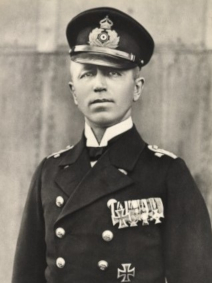
Zeppelin L 20, commanded by 34-year-old Kapitänleutnant Franz Stabbert, had come inland over southern part of The Wash at about 7.00pm and headed west. Although he passed close to Leicester, that town’s blackout was effective and he did not see it, but what he did see about 10 miles to the north was a concentration of lights and that suggested a target — the lights were shining from Loughborough. As L 20 closed in, Stabbert realised it was a town but was unaware which one. At the Technical Institute, evening classes were well-attended that night and lights in the classrooms blazed through the sloping glass roof. From where the first two of his four bombs landed, it would appear this was Stabbert’s initial target. To him, high up in the sky, the Technical Institute probably looked like a factory. Zeppelins did have bombsights, but aerial bombing was in its infancy and many Zeppelin commanders were happy to simply release their bombs over any inhabited area and get away as fast as possible to avoid becoming a target of the anti-aircraft defences. But Loughborough, like most other towns in the Midlands, had no anti-aircraft guns to defend them, so it appears Stabbert took his time and tried to aim at this target. Just after 8.00pm those two bombs landed either side of the Technical Institute, the first in the yard at the back of the Crown and Cushion Inn on Ashby Square, and the second in The Rushes. By the standards of the time that was accurate bombing. Those two bombs claimed five lives. Injured by the first bomb while standing in her doorway in Orchard Street, Martha Simpson sat down in an armchair alone and bled to death; jagged flying splinters from the bomb in The Rushes claimed four lives: Joseph and Alice Adkin, Ethel Higgs and Annie Adcock.

It seems that while over Loughborough more bright lights encouraged Stabbert to change direction and head towards the eastern edge of the town. These lights were showing from Herbert Morris’ Empress Works on Empress Road. Again, Stabbert aimed two bombs at the target. This time they both fell short, but it was close. The first fell in an orchard at the south end of Thomas Street, about 140 yards from the works, sending great clods of earth erupting into the sky, while the second exploded right in Empress Road, just the width of the road from the wall of the works. That bomb killed three of the Page family, shopkeeper Josiah Gilbert and Arthur Turnill, a fitter at the Empress Works, who had just appeared in the street.

Keeping the rest of his bombload for other targets, Stabbert and L 20 headed away to the north. Clearly he had not considered the unknown town below as a major target but, somewhat ironically, he was unaware he had passed close to the works of the Brush Electrical Engineering Company, which was in the process of building fifty Avro 504C aircraft under licence for the Royal Naval Air Service who hoped to use them in an anti-Zeppelin role. From there, L 20 went on to drop more bombs on Bennerley, Ilkeston and Burton-on-Trent, leaving the residents of Loughborough to mourn the deaths of 10 of their fellow citizens and sympathise with the 12 who bore the scars of that night of terror. In the morning, however, Loughborough became alive with huge numbers of sightseers who wanted to see for themselves the damage caused by the bombs. 

At the Crown and Cushion, where the first bomb exploded, so great were the numbers who came that the landlord, William Oram, erected collection boxes in aid of the hospital. In two days he collected almost £19 (about £1,600 today).

And so ended Loughborough’s one and only experience of the Zeppelin terror.


Map tracing the route taken by Zeppelin L 20 over England on the night of 31 January 1916, and showing the localities where she dropped her bombs (Ian Castle)
Map showing where the bombs fell in Loughborough on the night of 31 January 1916 (Ian Castle)

But what about Loch Ness, which I mentioned earlier?


Kapitänleutnant Franz Stabbert (Ian Castle)
Franz Stabbert and L 20 didn’t return to Britain for three months. Then, on the night of 2/3 May 1916, eight Navy Zeppelins set out to attack the Royal Navy base and docks at Rosyth on the Firth of Forth. Bad weather again intervened and only two of the raiders reached Scotland, the rest diverting to the Yorkshire. One of those that did reach Scotland was Stabbert’s L 20. But once they crossed the coast, L 20 faced Scotland’s terrible weapons: mist, fog and snow squalls! With no sight of the land below and misjudging the direction of the wind, rather than to the west, L 20 was being pushed north-west over the Highlands. By the time Stabbert came to the shocking conclusion of where he was, he had reached Loch Ness, about 90 miles north of Rosyth. Stabbert ordered L 20 to turn back and head towards the coast, aware that he had consumed a significant amount of his precious fuel on this wasted journey, aware he still had a long way to go to reach his home base at Tondern in Schleswig-Holstein. He didn’t make it.


At about 6.00am on the morning of 3 May, Stabbert established he was still 300 miles from home and, lacking enough fuel for the journey, he headed instead towards the coast of neutral Norway, only 95 miles away, to face internment rather than drowning. His attempt to land on the Gandsfjord, south of Stavanger, went horribly wrong when downdrafts from the mountains tossed L 20 about like a toy. The forward part of the airship smashed violently into the icy waters of the fjord, at which point Stabbert and seven of his 16-man crew leapt overboard. But lightened by this reduction in weight, L 20 shot back up into the air, now completely out of control. Stabbert and another man swam to the shore, while a fisherman rowed out and rescued the other six men floundering in the frigid waters of the fjord. Carried by the wind, L 20 smashed into high ground to the west of the fjord, which damaged the rear of the Zeppelin, spilling out five more of the desperate crew onto Norwegian soil. The broken wreck of L 20 then fell into the next body of water, the Harfsfjord, where the Norwegian navy pulled to safety the final three greatly relieved men. The short career of L 20, the Loughborough bomber, was over.

But what of Stabbert and his crew? The Norwegian authorities faced a dilemma. The country was neutral in the war that had engulfed Europe, but this German Zeppelin had violated her territory and therefore they should intern her crew. But they had caused no harm in Norway. The authorities reached an interesting compromise. Stabbert and nine of his men found themselves interned, but the six men picked up from the fjord by the civilian fisherman were considered ‘shipwrecked mariners’ and a week later repatriated to Germany. Stabbert, however, did not remain in internment long. He escaped, made his way back to Germany via Sweden and in December 1916 took command of Zeppelin L 23, followed in April 1917 by command of L 44.

On the morning of 20 October 1917, French anti-aircraft gunners opened a lethal fire on a Zeppelin returning from a raid on England. It was L 44. Engulfed in fire, she smashed down onto French soil just five miles from the front line. The whole crew, including Franz Stabbert, died in the flames.
   
The man who had brought the terror of war to the streets of Loughborough was himself now a victim of that same war.


The wreck of Zeppelin L 20, stranded in the icy waters of Hafrsfjord, about five miles west of Stavanger (Ian Castle)


Norwegian sightseers get a closeup view of the wreckage of Zeppelin L 20 in Hafrsfjord (Ian Castle)


Author: Ian Castle

If you’d like to know more about Germany’s air raid campaign against Britain during the First World War, visit my award-winning website, which you can find at www.IanCastleZeppelin.co.uk

You can also keep up to date with my work on Twitter @IanCastleRaids and on Facebook ‘Zeppelins Over Britain’.


I have also 'appeared' in an interview about the First Blitz with Dan Snow on his HistoryHit tv channel. [May require a subscription to view] 

And my latest book, ‘The First Blitz in 100 Objects’ is available now from Pen & Sword, and online at Amazon. The book is also available from other online retailers, like Waterstones and W H Smith, or you can order it from your local bookshop.


Ian also offers talks about all-things Zeppelin - see his website for more details. Although most of the talks take place in the south of England, I was lucky enough to catch Ian when he was presenting his research in Lincoln, and I can vouch that Ian's talks are both informative and exciting. 

HUGE thanks to Ian for contributing this excellent piece to the lynneaboutloughborough blog! - Lynne 


And to finish, a few poignant photographs:


The final resting place of Josiah Gilbert (Lynne)

The headstone installed in memory of Josiah Gilbert (Lynne)

And there we must end our discussion of the Zeppelin L 20 raid on the town of Loughborough on the night of 31 January 1916. Thank you for reading. 

PS You can walk, or drive the route that Zeppelin L 20 took across Loughborough if you go over to my Zeppelin trail page.

You are welcome to quote passages from any of my posts, with appropriate credit. The correct citation for this looks as follow:

Castle, Ian (2020). What became of the Loughborough Zeppelin. Available from: https://lynneaboutloughborough.blogspot.com/2020/02/what-became-of-loughborough-zeppelin.html  [Accessed 15 February 2020]

Take down policy:
I post no pictures that are not my own, unless I have express permission so to do. All text is my own, and not copied from any other information sources, printed or electronic, unless identified and credited as such. If you find I have posted something in contravention of these statements, or if there are photographs of you which you would prefer not to be here, please contact me at the address listed on the About Me page, and I will remove these.
Thank you for reading this blog. 

Lynne 

Sunday, 22 December 2019

The Carillon - a perfect setting

Well, there's nothing quite like a good book launch, and this weekend I've been lucky enough to go along to a really exciting one!

This particular book has been a long time in the making - and there's nowt wrong with that! I'm a great believer in things happening for a reason and that every experience leads to the next, so perhaps without completing an MA in Creative Writing at Loughborough University in 2011, and without following that up with a PhD, this book might not have happened. 


Karen signing copies of her new book

For her PhD, the author, Dr Karen Ette, studied and investigated modern English creative writing, and her research focused particularly on literature of the 'Great War', so is it really surprising that the novel she has now published is based on original and unpublished letters and diaries of David Adcock, a soldier in the Leicestershire Regiment (later the Royal Leicestershire Regiment), members of whom were called The Tigers.


Of course, I haven't yet had time to read this lovely book, but the synopsis hints at everything a good read should do, and the cover is beautifully designed, and evocative of the period.


The appealing front cover of Karen's book ...

... continues onto the back cover! 
There's a queue building ...


Loughborough's Carillon in Queen's Park


So, the carillon was the perfect setting in which to launch this book, surrounded by artifacts from the First World War, and to the melodious sound of the carillon being played by the Borough Carilloneur, Caroline Sharpe. 

Memories of Loughborough's war horse, Songster, were evoked as the original marker for his grave was on display (a new one was made by a member of staff at the university, and placed at his grave at a memorial service in June 2018). This also reminded me about another writer friend, Alison Mott, whose children's book called 'Songster Loughborough's own war horse' was released in October 2018, and was beautifully illustrated by Liz Waddell. 


Also on display in the carillon was a model of a Zeppelin, rather like the one which dropped its bombs on Loughborough during the evening of 31st January 1916. Hmm, and that reminds me that another writer friend, Ian Castle, has written several books about the Zeppelin raids, and I'm pretty confident that 'The First Blitz in 100 Objects', which will be published in February 2020, will contain something of interest to the people of Loughborough!


A model Zeppelin

Display case containing information on the Zeppelin raid (1)

Display case containing information on the Zeppelin raid (2) 

Display case containing information on the Zeppelin raid (3)


Many of my other friends have written books related to Loughborough too, including Bill Wells ('Billy's Book of Loughborough Boozers', to name but one of the many pub books he's written!), whom I first met in 2013; Ian Porter, who wrote 'Last of the Luddites'; Dennis Powdrill who wrote about his experience of working at Cottons for many years ('Cotton's of Loughborough') and Derrick Hewitt, who has now completed the second book in his series about the Cartwright and Warner, hosiers, called 'Cartwright and Warner'. I do hope no-one is offended if they've written a book about Loughborough, but I haven't mentioned them above


Just in case you are interested in yet more books about Loughborough, 'Loughborough in 50 Buildings' and 'Secret Loughborough' are both available in Loughborough's Waterstones and W H Smith, and online from Amazon, and other good booksellers, including the publishers. Copies will also soon be available from the Local and Family History Centre in the public library. 


You are welcome to quote passages from any of my posts, with appropriate credit. The correct citation for this looks as follow:

Dyer, Lynne (2019). The Carillon - a perfect setting. Available from: https://lynneaboutloughborough.blogspot.com/2019/12/the-carillon-perfect-setting.html
[Accessed 22 December 2019]

Take down policy:
I post no pictures that are not my own, unless I have express permission so to do. All text is my own, and not copied from any other information sources, printed or electronic, unless identified and credited as such. If you find I have posted something in contravention of these statements, or if there are photographs of you which you would prefer not to be here, please contact me at the address listed on the About Me page, and I will remove these.
Thank you for reading this blog. 

Lynne   
              

Sunday, 12 August 2018

Zeppelins Lincoln Taylor Loughborough

Before last week's post I think we were on the topic of Taylors, and bells of theirs that I'd found on my recent travels. So, let's leave the continuation of that one for next week (but do please remind me!), and let's talk Zeppelins instead!!!

I've blogged quite a bit about Zeppelins over the years, but today I want to tell you about a fantastic talk I went to last week on the subject of these airships, especially in relation to their raids on Lincoln.

Over the last couple of months I've been lucky enough to be in communication with the country's leading expert on Zeppelins of the First World War, the aviation historian and writer Ian Castle. Now, Ian lives many miles from Loughborough, but when I heard he was coming to Lincoln museum to do a talk, I was there like a shot! 

Actually, we spent the day doing a few other things first. A trip to Kelham Hall was revelatory! A beautiful Victorian Gothic Hall in a country park, designed by George Gilbert Scott, the very same architect you renovated our own church of All Saints with Holy Trinity. The hall is used as a wedding venue, but if there are no weddings going on, people are welcome to walk around the whole place! At one time the hall was home to an  Anglican order of monks, and there is still evidence of this to be seen. The grounds seem to contain a small caravan park, a maze rather like the one at Wistow, and the church and churchyard of the parish of Kelham, St Wilfred's. 


After spending a glorious couple of hours here, we went off to Upton Hall, now home to the Museum of Timekeeping. Fascinating place! Full of ticking and chiming clocks! I think it would drive me mad to stay there for long!!! But, the setting was charming, and some of the clocks, especially the long case clocks, were really beautiful. Interestingly, there were quite a few Gent (of Leicester) clocks, so it was good to see those. What I hadn't expected to see was a medium-sized bell. I suppose I should have really. And - you know what's coming - it was a Taylor's bell!!!! 


After a quick visit to the tearooms, we made our way into Lincoln city. We parked down by the canal and walked up past the cathedral before popping into a Pizza Express for tea. I'm not normally one for eating in national chains, but I wholeheartedly support PE who always seem to choose old buildings and renovate them to a great standard, like our former nurses' home, which not only did they renovate, but actually brought back into use. 


Fed and watered we then made our way to the Lincoln Museum, called The Collection where we had a guided tour around the Bastion in the Air exhibition, which focussed on the rising threat to Britain from aerial attacks by airships. The tour was led by Brian Riley, a former officer in the RAF, who really made the exhibition come alive.

And then, we excitedly made our way to the auditorium to hear all about airship attacks on Lincoln and Lincolnshire. This was absolutely fascinating! So many things chimed with me, when I compared what I was hearing to what I knew about the Zeppelin attacks on our own town. The attacks on Lincoln were many and through an interesting story, and some animated slides Ian showed us all the location of every attack on the area, named every airship and every captain, shared with us details of the killed and the injured - and told us about every sheep or cow that died in the attacks. 

It was on the night of 31st January 1916 that Zeppelin L20 dropped bombs on Loughborough, and that same night Lincolnshire was also being attacked.

To end the intensity and solemnity of the events, the speaker showed us examples of the humour adopted by the people of Britain, through postcards of the time.

All-in-all, a very exciting day!!


As if that weren't enough, the following day I was lucky to be able to attend the family event at The Grove, one of my favourite houses in Loughborough, now a student hall, but previously home to many familiar Loughborough names included Edward Chatterton Middleton. 


These visits were sandwiched between a couple of organ concerts given by visiting organists at All Saints with Holy Trinity. Tonight's concert started with a lively Bach Prelude and Fugue and finished with a contemplative piece, played by David Cowen, Associate Organist at Leicester Cathedral. 

Well, I think that's about it for tonight!! I've got a busy week next week - did I tell you about the new book launch? Do come along if you can!


You are welcome to quote passages from any of my posts, with appropriate credit. The correct citation for this looks as follow:

Dyer, Lynne (2018). Zeppelins Lincoln Taylor Loughborough. Available from: https://lynneaboutloughborough.blogspot.com/2018/08/zeppelins-lincoln-taylor-loughborough.html  [Accessed 12 August 2018]

Take down policy:
I post no pictures that are not my own, unless I have express permission so to do. All text is my own, and not copied from any other information sources, printed or electronic, unless identified and credited as such. If you find I have posted something in contravention of these statements, or if there are photographs of you which you would prefer not to be here, please contact me at the address listed on the About Me page, and I will remove these.
Thank you for reading this blog. 

Lynne