Showing posts with label Portland stone. Show all posts

Sunday, 25 July 2021

Conservatories, hot water apparatus and bandstands

Last week we learned about the chrysanthemum and celery shows that took place in Loughborough and nearby. One of the people mentioned in relation to the Leicester and Leicestershire Chrysanthemum and Celery Society Exhibition of 1883 was Walter Chapman Burder, who at the time of the shows lived at 153 Park Road, but who later moved to Field House. This show took place only a year before Burder took over the ownership of the horticultural engineering business of Thomas Messenger.

It comes as no surprise that Messengers placed advertisements in a variety of publications - newspapers, magazines and their own catalogues - for their products. This example is from the Gardeners' Chronicle of 24 November 1883:


But what of this product, referred to as the Loughborough hot water apparatus, which was advertised in the same magazine as the Messenger greenhouse above?


Is this also a Messenger product? The history of Deane & Co. is well covered on a site about the Greenwich Park bandstand, which was produced by the company in 1880. Interesting that the company was involved in the creation of the bandstand: ours in Queen's Park, which was installed in 1902, was created by Hill & Smith of Brierley Hill in the West Midlands, and was in commemoration of the coronation of Edward VII. When Queen's Park was extended, the bandstand was moved from its original position, which was close to Granby Street, to its current position in 1908. 


Hill & Smith actually created just over 40 bandstands across the country, some as far away as Exmouth and Bishop Auckland, and some as close as Kettering, Northampton, and Swadlincote. Easton Gardens, one of two gardens created in Easton on the Isle of Portland, in commemoration of Queen Victoria's Diamond Jubilee (although created somewhat later, around 1904) also has a bandstand that was created by Hill & Smith. The gardens also has a clock tower, the tower of which was made from the local Portland stone, and the clock also houses a bell cast by Taylors of Loughborough. Portland stone is also used in the construction of Loughborough's carillon.


Posted by lynneaboutloughborough 25 July 2021

You are welcome to quote passages from any of my posts, with appropriate credit. The correct citation for this looks as follow:

Dyer, Lynne (2021). Conservatories, hot water apparatus and bandstands. Available fromhttps://lynneaboutloughborough.blogspot.com/2021/07/conservatories-hot-water-apparatus-and.html   [Accessed 25 July 2021]

Take down policy:
I post no pictures that are not my own, unless I have express permission so to do. All text is my own, and not copied from any other information sources, printed or electronic, unless identified and credited as such. If you find I have posted something in contravention of these statements, or if there are photographs of you which you would prefer not to be here, please contact me at the address listed on the About Me page, and I will remove these.

You can leave comments below, but do check back as my reply will appear here, below your comment.

Thank you for reading this blog. 

Lynne

Sunday, 12 February 2017

Leicester, Swannington and Loughborough

Having difficulty deciding what to blog about tonight, so going with Leicester, Swannington and Loughborough!

Apologies for not blogging last week: my internet connection disappeared into the ether and I was without contact with the outside world - except I could phone people or visit them or send them a letter!!

I was lucky enough a couple of weeks ago to attend a lecture at the refurbished City Hall in Leicester delivered by Sir Peter Soulsby on the subject of Leicester - its history through architecture. This was part of the City Series lectures organised by the Leicester Urban Observatory, a joint venture between Leicester City Council, De Montfort University, Leicester University and Loughborough University, which aims to explore the urban development, architecture and history of Leicester. 

See the following websites for more info:

Sir Peter's page
The Leicester Urban Observatory Project page
De Montfort University's involvement

It was an interesting lecture, with an interested audience, and we romped through the centuries in Leicester, as well as learning of Sir Peter's vision for the city. Sadly, there seems little co-operation and understanding between city and county. As we know, there is to be new GCR Museum at Birstall, which is scheduled to open in 2021, Abbey Pumping Station is likely to be refurbed, a Science Park is being developed near the National Space Centre, and there are plans afoot to revamp the Jewry Wall Museum, I would imagine partly because of more Roman finds at the latest dig on High Cross Street.

Enough of Leicester!! Last weekend I was also lucky enough to attend the latest Loughborough Archaeological and Historical Society (LAHS) talk given by Roger Bisgrove, Chair of the Swannington Heritage Trust, on the industrial history of Swannington. This was simply fascinating, covering Swannington through the ages, from coal mines (bell pits) from the 12 hundreds (1200s), through coal mines (gin pits) in the fifteen hundreds (1500s), to Newcomen boilers in the 1700s, Jessop's tramway, the Charnwood Forest Canal, and the Charnwood Forest Railway.  Oh, and, of course the Hough Windmill and the Califat Spinney

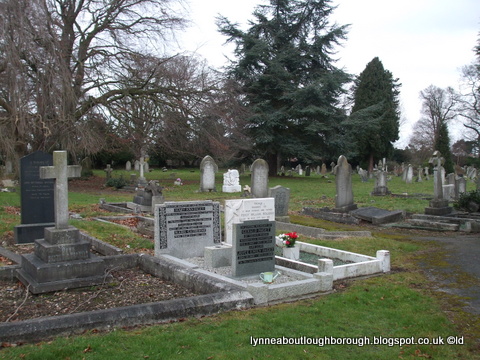
Back at work, I happened upon a book called "Vanishing Victoriana" and was particularly taken with the chapter on graves! The chapter was lamenting the poor state of many of the London cemeteries, and this made me consider our own, on Leicester Road. Loughborough Cemetery was created in about 1857, just after the peak of the popularity of Swithland slate gravestones, thus many of the headstones to be found in the cemetery are not made of slate, but rather of Carrara white marble with lead lettering, of sandstone, of polished pink granite, of Portland stone or of polished black granite. There are large memorials, small memorials, single plots and family plots, elaborate and plain, and quite a number of war graves. The grounds are maintained, although the edges can be quite overgrown in summer. The railings surrounding the cemetery, and the wrought iron birdcage turnstile are typical of the town. The chapel building, designed by the Lincolnshire architects Bellamy and Hardy, was refurbished sometime after 1994. The building had a chapel for the Church of England worshipers and one for Nonconformists. Since its refurb it has been let out to various companies.


You are welcome to quote passages from any of my posts, with appropriate credit. The correct citation for this looks as follow:

Dyer, Lynne (2017). Leicester, Swannington and Loughborough. [Online] Available from: http://lynneaboutloughborough.blogspot.com/2017/02/leicester-swannington-and-loughborough.html [Accessed 11 February 2017]


Sunday, 6 November 2016

Obelisks everywhere!

I can't remember if I mentioned to you that last weekend we walked from the centre of Loughborough to Woodhouse Eaves to visit the Woodhouse Eaves Art Group Annual Exhibition, and what a lovely show it was too! Some great paintings from some very talented local people, and a lovely cup of tea too!

 
So, this weekend, the youngest came home for a short break from uni, and looking for somewhere different for a daytrip, we plumped for the Yorkshire Sculpture Park. It was a beautiful sunny day, but crisp like the best winter days should be. We've been to the park before, but each time we see something different, sometimes because the exhibitions have changed, sometimes because we had inadvertently missed something on the previous visit, but spotted it this time.

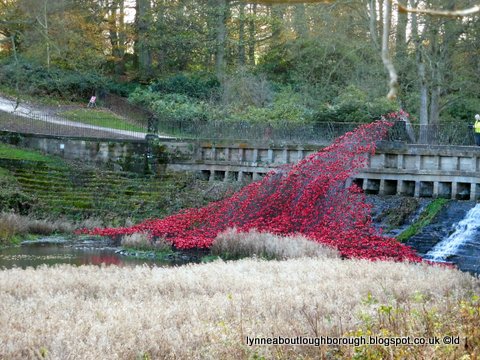
Last time we specifically went to YSP to see the poppies from the Tower of London which had just begun their tour of the country. 


So, this weekend, there was nothing specific happening that we knew of and we didn't go to see anything in particular, so we felt free to have a good old wander around the grounds of Bretton Hall. We took a map, and ended up walking along the Upper Lake path, which we'd not done before, and I was impressed with the Greek Temple, the lovely little shell grotto and the boathouse.
The Greek Temple
The Greek Temple


The Shell Grotto

The Boathouse
But, the thing that struck me most was the obelisk, not particularly tall, but, like all obelisks, striking. This particular one was built post-1720, to mark the spot where the previous Bretton Hall had been.  

The Obelisk

Information board about the obelisk
Of course, you know what I'm thinking, don't you? There's an obelisk on the Garendon Estate, built as a folly, not marking anything specific, as far as I know. And I've blogged about this briefly in a previous post. Needless to say I was surprised to come across the obelisk at YSP.

And then something else weird happened. I follow a Facebook Page about Southampton, because my eldest is a student there, and guess what appeared in my Facebook feed? Yes, another mention of an obelisk, this time in Mayfield Park in Southampton!! I do happen to be familiar with Mayfield Drive in Loughborough, but I've never been to Mayfield Park in Southampton. A further coincidence is that there is a Mayfield Bowling Green in Mayfield Park, and my son who is studying in Southampton is a bowler! I shall have to ask him next time he phones if he knows of the park and what it's like. In the meantime, I've had a quick look around the internet and found that the obelisk was erected in honour of Charles James Fox, a Whig politician, and it's made of Portland Stone, like the base of the Loughborough carillon! Wikipedia also has a [short] list of other obelisks in the country, so if you happen to want to find others, this could be useful!!
Eldest bowling, but not sure where!
Anyway, best away, and see what other coincidences next week has in store for me.      


Sunday, 21 February 2016

Loughborough and the holiday connection

So, every time I go on holiday I encounter something that reminds me of Loughborough! How odd!

In October 2015 I found myself in the tiny town of Pembroke in South West Wales. Given that Pembroke is on the coast, has a wonderful castle and a connection to Henry VII, you wouldn't think there would be anything here that could possibly evoke anything to do with the little market town of Loughborough, slap bang in the middle of the country, would you?

We decided to visit the museum/heritage centre of the Pembroke Dock Sunderland Trust, housed in the former Dockyard Chapel. There was an extremely interesting collection of artefacts concerned with battles (particularly those of the second world war) and especially with the Sunderland flying boats, as Pembroke Dock was Britain's largest base for flying boats during WW2. When we'd finished wandering around, we exited the grounds onto Meyrick Owen Way, and I was surprised to see on the corner of that road and the B4322 an old-fashioned looking shop, called - the Maypole Dairy!  


The Maypole Dairy in Pembroke Dock, October 2015
Of course, this looked familiar, because there used to be a similar place in Loughborough Market Place:  


The Maypole in Loughborough Market Place, 1960s


If you look closely to the right of the Maypole Dairy in Pembroke Dock, you might be able to work out that the attached building is called the White Hart! 
The White Hart in Pembroke Dock, October 2015
Ok, I grant you, that's a pretty common name for a pub, so it's not surprising that there is also one of these in Loughborough! 
The White Hart, Loughborough, 2015
So, I doubt it would surprise you to learn that whilst on holiday in Dorset last week, I spotted another White Hart, this time in Wimbourne:
The White Hart, Wimbourne, February 2016
Now, if this building in Wimbourne, pictured below, wasn't originally in use as a pub, I'd be surprised! I'd also be surprised if these weren't Hathernware tiles:
An Indian restaurant in Wimbourne, February 2016
Compare this to many 1930s buildings in Loughborough town centre, for example, the former offices of the Loughborough Echo:


Former offices of the Loughborough Echo, Swan Street, Loughborough
A visit to Dorchester County Museum not only reminded me of the place where I grew up, where there was a roman amphitheatre, but also of Loughborough, in the shape of church bells in the county museum. Ok, so they were not made by Taylors, but bells, to my mind, are closely associated with Taylors Bellfoundry on Freehold Street:
Bells in Dorset County Museum, Dorchester, February 2016
And as if that weren't enough, in one of the museum display cabinets was a fragment of an alabaster plaque, of the Nottingham School (and therefore, probably from Chellaston). In the nineteenth century folk in Loughborough carved ornaments to sell, probably at Skegness, from such alabaster: 
Fragment of an alabaster plaque in Dorset County Museum, Dorchester, February 2016
Of course, being in Dorset, we were near Portland, so it was no surprise to find some Portland Stone in a display case:
No.12, Portland Stone, Dorset County Museum, Dorchester, February 2016
But I must say, Portland Stone looks far better around the base of our Carillon, than it does in little chips in a glass display case!
Loughborough Carillon 
Walking around Dorchester, we found a lovely park, Borough Gardens, which was created in 1896, presumably in some way a celebration of Queen Victoria's diamond jubilee, rather like our very own Queen's Park. Borough Gardens had a lovely bandstand which rather reminded me of Loughborough's:
The bandstand created in 1897, Borough Gardens, Dorchester, February 2016
The bandstand in Queen's Park, Loughborough, 2014
Back in the town of Dorchester itself, I happened upon a beautiful post box which reminded me of the one that used to be on the corner of Burton Street and Park Street, before it was damaged by a car:
Post box in Dorchester, February 2016
By now it was getting rather late in Dorchester, so we made our way back to the car. What we hadn't seen on our way down into the town, was the bronze statue of a horse.

Bronze horse, Dorchester, February 2016

It was pretty dark so I didn't get to read what exactly he was doing there, but he reminded me of three things about Loughborough: the bronze sockman in Market place
Shona Kinloch's sockman, Loughborough
Songster, the replica war horse in the Carillon Tower and War Memorial Museum
Songster, the was horse

and the new cinema complex that is being built on the site of the old General Hospital. The Dorchester complex was on the site of the former brewery, although the building was renovated rather than demolished, but the range of eateries seemed to be similar
The development on the site of the former General Hospital
During our trip to Dorset we also visited Tolpuddle and the Tolpuddle Martyrs Museum. You may wonder what on earth I could possibly find to remind me of Loughborough, but the whole experience brought to mind the Chartist risings in the Market Place (1848) and the Luddite attacks on Heathcoat's lacemaking factory (1816). 
The Tolpuddle Martyrs Museum, February 2016

Information on the Chartist Movement in the Tolpuddle Martyrs Museum, February 2016
On our final day in Dorset we visited Cerne Abbas, the village with the giant chalk man on the hillside, and the site of an old abbey. Information provided by the Cerne Abbas Historical Society is available on the web and includes a variety of pictures. This is more-or-less what we saw:

This, of course, reminded me of our own Garendon Abbey, the Chapterhouse of which was excavated by the Loughborough Archaeological and Historical Society in about 1965. Garendon Abbey no longer exists, but the archaeological remains are on the Garendon estate and can be seen in this flyover.

On our last day we travelled to Swanage, passing near Corfe Castle with its Greyhound Pub:
Greyhound pub near Corfe Castle
Strangely, I've been through my photograph collection, but can't find a picture of our former Greyhound pub, on Nottingham Road, which used to have an athletics ground behind it.

Anyway, our last port of call in Dorset was Swanage. Even I couldn't find much of a connection with Loughborough here, as Swanage is a seaside resort with a pier, beach huts and amusement arcades. One or two comparisons could be made though! Their war memorial was quite different from ours (see Carillon above):

The War Memorial at Swanage
I was also pleased to see that they had a steam railway, a teeny bit like our own Great Central Railway, which I wasn't expecting (I really hadn't done my homework at all!):
The platform at Swanage steam railway, February 2016
The platform at the GCR Loughborough
The Town Hall at Swanage was a pretty impressive stone building with an interesting clock on the front:
Swanage Town Hall clock
similar to the one on our Town Hall, although not designed to be seen from all directions like ours:
Loughborough Town Hall clock
I was also interested to see that new houses in Swanage were given names inscribed on stone tablets, just like on some of the older houses in Loughborough. This one was built in 1989:
Stone plaque on newly built houses in Swanage
House plaque on Chestnut Street, Loughborough
Finally, I can't resist posting this picture of Victorian street furniture on the pier at Swanage:
On Swanage pier, February 2016
Sorry, did I say finally? One last one, I promise! Yesterday I went shopping in Loughborough, and picked up some books on our local area at the Age Concern bookshop. Apart from one, which was about pubs in London. Which was odd. I leafed through it before going to sleep last night and read the following passage: 
"The Clanger. The Clanger is a new pub and it has taken the Great Fire of London as its theme ...There are also some interesting items concerning insurance companies. In those days these insurance companies each had a special crest which was displayed on the wall of insured premises and the fire brigades were only allowed to put out fires where these crests were to be seen."
MacLaren, R. (1977). London pubs & inns. St Ives: James Pike Ltd., pp3-4

Fire insurance crest on a house in Swanage, February 2016

Now, I'm pretty sure I've seen one of these somewhere in Loughborough, but I can't for the life of me remember where. Can anyone help?

Hope you've enjoyed this post! And with huge apologies for the changes in type size :(

See you soon