Showing posts with label Tiverton. Show all posts

Sunday, 4 October 2020

So who was Bernard Nixon Wale?

... obviously a man with Loughborough connections!!

Bernard Nixon Wale was born in Willoughby-on-the-Wolds in 1872, to a farming family. He studied at a variety of institutions, and worked in a wide variety of places across the country in a number of different roles, before returning to Loughborough in the early 1930s. There are many connections to Loughborough, some of which are outlined below.  

Focussing on just one of his positions: in 1909 Bernard Nixon Wale was appointed to the post of Principal at the Seale-Hayne AgriculturalCollege in Newton Abbot, a college which was to be created from an endowment of Mr Seale Hayne, and which had seen much delay in its creation. When the news of his appointment was announced, Bernard Wale was described in the press very favourably:

“He is a young man for the hight post, only 37 in fact, but he has a good London degree in science, and has shown great ability successively at London University, the Midland College, and the Wye College (Kent and Surrey). He also holds the Cambridge diploma for agricultural science.” – ‘London Evening Standard’ 27 December 1909, pg 3

“In making this choice [Bernard Wale, BSc. of the South Eastern Agricultural College at Wye, Kent] the governors have no doubt selected a gentleman particularly qualified for the post. He has had a brilliant career, and has come through numerous examinations with flying colours, and, what is very important, he has a thorough practical knowledge of agriculture. Naturally, as the son of a farmer, he had every opportunity to become intimately acquainted with this work, and four years he spent exclusively on a farm of some 200 acres, where all kinds of agricultural work were carried out, including the breeding and rearing of farm stock, sheep feeding, corn and root-growing, and dairying. For eight years he had the management of the land in connection with the Brewood Grammar School, Staffs., and during that time he purchased the stock, seeds and manures which were needed. Mr Wale has, further, had extensive experience in experimental work, including the manuring of grass, roots, and cereals, pig feeding, milk production and research work on cheese discolouration by bacteria. Nor is the new Principal unknown as a writer, for in the agricultural press have frequently appeared articles from his pen touching, amongst other things, catch cropping, the financial aspect of sheep washing, and the variation in the quantity and quality of milk.” – ‘Western Times’ 26 November 1909, pg 7

But it is the report a week earlier in the same newspaper – ‘Western Times’ 20 November 1909, pg 2 – that clearly links Bernard Nixon Wale with Loughborough:

“The new Principal, who is 38 years of age, has had a distinguished career, and was highly recommended. Educated at the Grammar School, Loughborough, Leicestershire, he was for three years, 1892-1895, at Cambridge University as a student of the Cambridge and Counties Agricultural Scheme.”

According to this report he was also a student at the Midland Agricultural and Dairy College in Kingston, Derby, and at the University College, Nottingham. The article goes on to mention every possible educational attainment and accolade that Bernard Wale had ever achieved, as well as information about his practical knowledge, which it said was:

“ … extensive. As a farmer’s son he has always had a very intimate practical acquaintance with farm work and farm management of every description. Four years were exclusively spent on a farm of 200 acres … For two years (1896-1898) he was in close touch with the method of farming adopted on the Midland Agricultural and Dairy College Farm; and for eight years (1898-1907) he was managing the land in connection with the agricultural side of Brewood Grammar School, Staffs., including the purchasing of stock, seeds and manure necessary for the same. Since 1908 he has had the joint management of Wye College Farms of 460 acres.”

In addition to his lecturing work, he has been engaged in experimental work:

“In regard to his experimental work and organization he has been engaged at the Midland Agricultural and Dairy College in carrying out experiments on manuring for hay, pig feeding, and milk production; research work on cheese discolouration by bacteria; and the tabulating of results and drawing up reports on the same. Organising experimental work on the agricultural side at Brewood included – the manuring of grass, cereals and roots, a comparison of yields from different varieties of farm crops, and sheep feeding experiments. He has also been engaged in the planning of pupils’ garden and field plots, bee-keeping and poultry; in field days and demonstrations to farmers on the experimental plots, and charlock spraying on selected farms; in arranging of local classes in dairying and hedge layering (including a course of lecture to elementary school teachers on ‘Insect pests’.). Being the first agricultural instructor appointed to Brewood he had the sole organisation of classes and subjects to be taught, with the general arrangement of timetables, the drawing up of prospectuses and reports of experimental work. At Wye College he was engaged in the organisation of the agricultural teaching in the lecture room and on the farm for four assistants, the latter including the arranging of classes in ploughing,  mowing, sheep shearing, hedge layering, land draining, milking and butter making. …”

The report goes on to say that Bernard Wale also did advisory work with farmers and others, and has:

“…written a good deal for the agricultural press, his contributions including: reports on experimental work; variation in the quantity and quality of milk, catch cropping etc.; autumn cultivation as affecting the water supply of the soil; mendelism in plant and animal breeding; plants in enclosed spaces etc.; and the financial aspect of sheep washing … Mr Wale … has had a thorough theoretical and practical training … he is an enthusiastic teacher. ‘There are’ Professor Turner [says] ‘few men to whom I could more willingly commit a son of my own, as I should feel certain that his education would be well attended to, and that the moral effect of Mr Wale’s teaching would be excellent. I may add that Mrs Wale is a lady of educational experience and refinement, and that her interest in connection with the college would be of the very best.’”

The article finishes with a list of the testimonials received from many, many influential people, in support of Bernard Wales, including from Professor G D Living, MA, FRS, who was Professor of Chemistry at Cambridge University.

Reading about Bernard Wale’s experimental work and advisory work, particularly into plant and animal breeding reminds me so much of the work that Robert Bakewell of Dishley did into the breeding of sheep, cattle and heavy horses, and his work with turnips! More about Robert Bakewell is in an earlier blogpost.  

Robert Bakewell in mosaics

Back to Bernard! Although Bernard Wale was appointed to be its Principal in 1909, Seale-Hayne college was not actually built until 1919, its construction timescale being disrupted by the First World War. Thus, Bernard Wale found himself undertaking a variety of duties which included lecturing in various places, like Linfield, and Torquay Museum, and to groups like the Mutual Improvement Association of Ashburton. He also judged agricultural and horticultural shows, like that at Islington. Bernard Wale presided over the annual event of the Newton Abbott Men’s Own Brotherhood, chaired the YMCA meetings, and was part of the Royal Sanitary Institute 28th annual congress executive committee, which event took place in Exeter.

In his capacity as joint livestock officer for Devon and Cornwall he visited Helston where he explained about the government’s Development Fund to the Helston Farmers’ Union. Bernard Wale was a member of the Primrose League and attended the annual meeting in Sheffield. He also attended and presented at farming conferences, e.g. at Newton Abbott.

During the First World War, Bernard Wale wrote a letter to the “Western Morning News” of 22 February 1916 expressing astonishment that the council allowed the lights of Newton Abbott to shine out: far from being as glaring as ever, he suggested they were even more glaring than a year ago. He questioned the use of lighting in specific locations, including Wolborough and Knowles hills, which, in his opinion, would:

“… invite the attention of the enemy. This was not the time to consider the dividends of the lighting companies.”

Bernard Wale was not alone in his concerns, which were shared by various inhabitants, like Mr W Eggington suggesting that “it was indiscreet to have the place all lighted up again, just when the raids had commenced”

Unlike Loughborough, which was hit by Zeppelins bombs on the night of 31st January 1916, Newton Abbot was not targeted by Zeppelins. 

Zeppelin raid on Loughborough, commemorative plaque unveiled January 2016


As Loughborough trained women to become munitions workers, so Bernard Wale offered the opportunity to women to be trained to work the land. In a letter printed in the “Exeter and Plymouth Gazette” of  8 May 1916, pg 3, Bernard Wale makes an offer from his college:

“… it becomes increasingly important to safeguard our home-grown food supply, and if the men must go [to the Front] … women must take their place. Already there are many women who have volunteered for farm work, or have shown their readiness to learn, but many more will be required … The women of our Allies, and also of our enemies, are working on the land and thus setting free their relatives for the fighting lines, and I believe that our women will do the same …”

However, Bernard identified a problem:

“ … there is one thing lacking amongst our farmers – a more sympathetic attitude towards women’s employment on the land.”

He did however acknowledge that:

“ … Many [farmers] see quite clearly the necessity of utilising women on their own farms … some women … can do really efficient work on the land after a short training, combined with patience and sympathy on the part of the farmer.”

Bernard was keen to make an offer:

“ … with the approval of the Board of Agriculture and the County Councils of Devon and Cornwall, and also as a war emergency measure, the Governors of Seale-Hayne College are providing a month’s course of practical instruction for women in farm work on the College farm. There is to be a succession of courses, each of four weeks’ duration, and after their training it is stipulated that these students shall work on farms for a period of at least three months, provided a suitable offer of employment is made at a reasonable rate of wages”

The instruction on offer was pretty extensive and included:

“… milking, dairying, calf, pig and poultry feeding, grooming, feeding and  harnessing of horses, harrowing, rolling, hoeing and harvesting according to season, and other lighter branches of farm work.”

Following the publication of this letter in the newspaper, at meeting at Kingsteignton, both Bernard Wale and his wife Edith talked about training women to work on the land:

“… Mrs Wale … urged the women to augment the food supply by working on the land, whole or part-time, by cultivating their gardens, by keeping poultry or pigs, and by helping in the harvesting, and always do what they could to prevent waste.” – ‘Exeter and Plymouth Gazette’ 2 June 1916, pg 12

According to the ‘Military Times’ of 30th November 2018, the First World War was arguably the first ‘total war’. John Heathcoat’s factory in Tiverton, which had moved to the town in 1816, following the Luddite attacks, was Tiverton’s largest employer in 1914, and it switched from the production of the lace for which it was well-known, to the production of munitions, and with many men away from home, fighting abroad, it was women who were working the machines.

Re-enacting the Luddite attacks on Heathcoat's factory in Loughborough, Chorus Theatre

Throughout the period 1909-1914, work on the actual Seale-Hayne college buildings was either proposed or taking place. In 1911 between 60 and 70 applications were received for the college building design. Prizes of £100, £50 and £30 were offered by the college governors for the best sets of plans. The cost of the proposed building was not to exceed £20,000, although future extensions, at a cost of £10,000 were an integral part of the submissions.

In 1912 the college was inviting tenders for the laying of about 2,800 yards of 3-inch cast-iron pipes! The plans were available to view at the public library, and the exact specifications were available from Bernard Wale.  

In the event, the Seale-Hayne college buildings were completed between 1912 and 1914, but the first students did not attend until 1919.

Although we have seen some connections with Loughborough – Bernard Wale’s attendance at the Grammar School, Zeppelin bombing during 1916, and Heathcoat’s lace-making factory in Tiverton, and similarities with Robert Bakewell, come by next week to learn more about Bernard Wale’s family, his connections to many different Loughborough families and about his residence in Loughborough.

In relation to Zeppelins, Heathcoat and Robert Bakewell, you can follow the virtual plaque walk which will take you to the commemorative plaques related to these people and events, and there is a virtual walk specifically related to the Zepplin raid, and to the Luddite attacks.  

You are welcome to quote passages from any of my posts, with appropriate credit. The correct citation for this looks as follow:


Dyer, Lynne (2020). Who was Bernard Nixon Wale? Available fromhttps://lynneaboutloughborough.blogspot.com/2020/10/so-who-was-bernard-nixon-wale.html [Accessed 4 October 2020]

Take down policy:

I post no pictures that are not my own, unless I have express permission so to do. All text is my own, and not copied from any other information sources, printed or electronic, unless identified and credited as such. If you find I have posted something in contravention of these statements, or if there are photographs of you which you would prefer not to be here, please contact me at the address listed on the About Me page, and I will remove these.

You can leave comments below, but do check back as my reply will appear here, below your comment.

Thank you for reading this blog. 

Lynne             

Sunday, 10 March 2019

Plaques


Exciting new green plaque for Loughborough town centre! But first an update on Maypole Dairy!


So, last week we had a look at the history of the Maypole Dairy. Since then I've had a chance to get some photographs of the former Maypole Dairy in Swadlincote, which has been revealed during renovation work. The pictures don't do the sign justice but here they are:


Another shop that has been renovated in the town, the renovation taking the shop back to its former glory is Salt's. The Salt brothers had several shops which dealt in haberdashery, menswear and hardware. Today the shop is an antique-type shop, with a beautiful tiled entrance doorway:


Whilst I was out in Swadlincote, I also spotted that they have a heritage trail (available here as a pdf 6.1mb), and lots of plaques commemorating various people. Here's a selection of the ones I saw:


Seeing these reminded me of the plaques we have in Loughborough, which I've blogged about before (sorry, I still haven't got round to making them into a proper trail, but I will soon!). And now there's another one to add to the trail. Sadly, I missed the unveiling of the latest of the Leicestershire Green Heritage plaques, which took place about 10 days ago, because I was on a work trip to Birmingham (spotted some Hathern Station Brick and Terra Cotta work while I was out, so for a work trip it was pretty good!). 

So, Loughborough's new plaque is along Market Street, mounted on a pillar that supports the Iceland store, and commemorates John Heathcoat, who had a lace factory on this site, which was later used by Wright's (who also had a big factory in Quorn, now converted into flats). Now, I did write up a trail that followed the story of the Luddites who attacked Heathcoat's and Boden's factory on the night of 28th June 1816, so you can read a bit more about it on that page. There's more of the story over on my post about the Picnic in the Park event where the Loughborough Library Local Studies Volunteers hosted a Ludd Hub, and one of their members walked from Loughborough to Tiverton in commemoration of the workers who followed Heathcoat to Tiverton to work for him after the attack.

There's also an account of a talk given by Tony Jarram on Luddites and Lace-Makers to the Friends of Charnwood Museum. You may be interested to know that it was Tony who successfully nominated Heathcoat's factory for a green plaque, which we now know was successful. As I said, I wasn't able to attend the unveiling, but here's a photo of the plaque in situ.     


Lynne

You are welcome to quote passages from any of my posts, with appropriate credit. The correct citation for this looks as follow:

Dyer, Lynne (2019). Plaques. Available from: https://lynneaboutloughborough.blogspot.com/2019/03/plaques.html  [Accessed 9 March 2019]

Take down policy:
I post no pictures that are not my own, unless I have express permission so to do. All text is my own, and not copied from any other information sources, printed or electronic, unless identified and credited as such. If you find I have posted something in contravention of these statements, or if there are photographs of you which you would prefer not to be here, please contact me at the address listed on the About Me page, and I will remove these.
Thank you for reading this blog. 

Lynne


Sunday, 11 June 2017

Picnic in the Park

So sorry for not posting last week: I'm in the midst of completing a final assignment for my course, and it's taking a lot longer than I anticipated! Still, when it's all finished I'll be able to blog more authoritatively about trade in Loughborough during the 19th century!

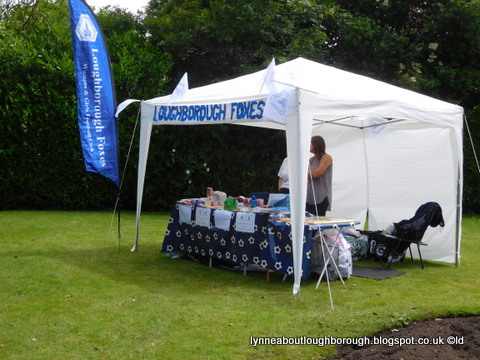
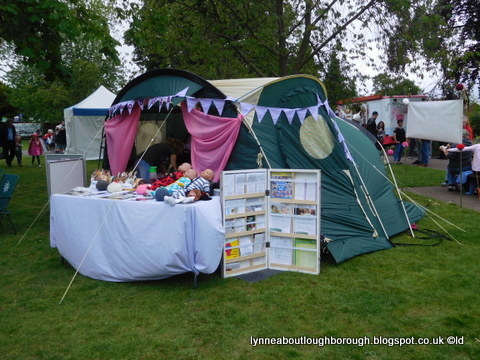
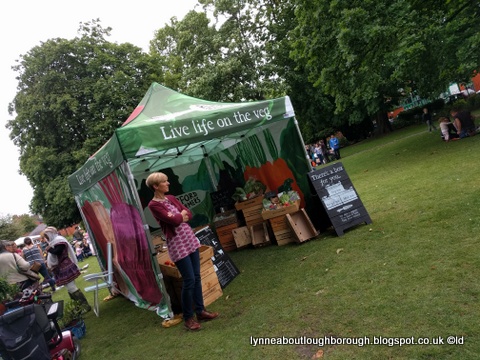
In the meantime, this week I've been out and about in Queen's Park. I say this week, but of course I don't mean all week, only Saturday! The event taking place was Picnic in the Park, an annual event that's been going for 36 years, making this the 37th event. The focus is on music, dance, street theatre, art, and stalls featuring arts and crafts and local groups. 

As part of the festivities, last year the Loughborough Library Local Studies Volunteers set up an information camp - the Ludd Hub - in commemoration of the Luddite attacks on John Heathcoat and John Boden's lace making factory on Market Street in 1816. Alongside the stall, they also had a reading - in full costume - of Lord Byron's maiden speech to the House of Lords. Visitors were invited from Tiverton Museum - Tiverton being the place that Heathcoat moved to after the attacks - and the long, nearly 200 mile journey from Loughborough to Tiverton that Heathcoat's Loughborough workers made in 1816, was re-enacted by the "Tivertonioians", accompanied by one of the LLLSVs. I believe it took them two weeks to reach their destination!

So, this year the LLLSVs information camp focused on Lord Hastings and the Civil War - hte Hastings Hub - in and around Loughborough. Looking back at my blog posts this time last year, I see there is a Civil War connection between Loughborough and Tiverton: 

"Both towns were affected by the Civil War of 1642-1651. Royalist Tiverton Castle was under siege from Parliamentarians in 1645, and in December of that year Oliver Cromwell paid it a brief visit. On 17 March 1644 there was a minor battle at Cotes Bridge, just outside Loughborough, when Parliamentarians occupied the bridge. "

Anyway, this year's LLLSV stall told the story of the Civil War in and around Loughborough, and a brief history of the Hastings family, the Lords of the Manor. 


They also had a visiting 17th century family, complete with dining table, woollen fleeces awaiting spinning, and two strapping sons, one with a pike, the other with a musket. They had some very interesting information to impart to me on the subject of dyers, and pinfolds!


During the early part of the afternoon, I was lucky enough to be able to attend a debate between parliamentarians and royalists, and with the levellers, diggers and ranters (for a better explanation of what these groups were about pop over to the Oxford Scholarship Online webpage) presenting a completely different view. The case for the beheading of Charles I was ably put by local MP, Nicky Morgan, whilst that for the case against the beheading was engagingly presented by Dr Robert Knight of Loughborough University. The case for the levellers was put by Professor Martin Bennett of Nottingham Trent University. Following the debate, questions from the floor and the rebuttals, a vote was taken, and sadly, it was agreed that Charles I would lose his head.


This was a truly exciting day, made even better as the rain held off, and the sun tried to shine a little! Of course, as well as the buzz of the picnic and stalls, it was business as usual for Loughborough Queen's Park Bowlers:


Here are some pics of the day:


You are welcome to quote passages from any of my posts, with appropriate credit. The correct citation for this looks as follow:

Dyer, Lynne (2017). Picnic in the Park. Available from: http://lynneaboutloughborough.blogspot.com/2017/06/picnic-in-park.html [Accessed 28 May 2017]

Take down policy:
I post no pictures that are not my own, unless I have express permission so to do. All text is my own, and not copied from any other information sources, printed or electronic, unless identified and credited as such. If you find I have posted something in contravention of these statements, or if there are photographs of you which you would prefer not to be here, please contact me at the address listed on the About Me page, and I will remove these.
Thank you for reading this blog. 


Lynne 


Sunday, 21 August 2016

Loughborough to Tiverton Pt 3

A third post about connections between Loughborough and Tiverton, I hear you ask? Well, yes, there were so many that I spotted while I was there that I wanted to share them all with you, but I hadn't realised I'd be doing so many other things in between posts that I haven't had time to research much else! Anyway, checkout parts 1 and 2, just to remind yourself of connections I've already covered, then read on for yet more!

So, one of the connections between our two towns is that we were both part of the second round of Mary Portas towns, that saw lots of different initiatives taking place in our towns to improve footfall, to make the towns more attractive and to ensure the towns survived and even thrived in the economic downturn.

In the mid-19th century, both towns (as did practically the whole of the British Isles) experienced deaths from the various illnesses (cholera etc.) that abounded at that time. In Tiverton, Thomas Webster Rammell was appointed to investigate and in 1849 he suggested a supply of water should be piped to every house and hydrants placed in the streets to help combat the numerous fires there were. He made lots of other recommendations, but these were rejected in 1851 as costing too much, so it wasn't until 1875 that some recommendations were acted upon. Meanwhile, in Loughborough, in 1870, the Reverend Henry Fearon arranged for Loughborough's first clean water supply, which is commemorated by the Fearon Fountain in the market place. 
Information board on public health in Tiverton Museum
Our Fearon Fountain in Market Place
Tiverton Museum of Mid-Devon Life had a lovely information board about fingerposts and milestones. This reminded me of the tale of the milestone in Loughborough, on Wood Gate, just outside the Organ Grinder pub (formerly the Old Pack Horse).
Fingerposts and milestones in Tiverton Museum
Our misplaced milestone
One of the major exhibition areas in the Tiverton Museum was a specially created room housing a wonderful collection of railway memorabilia, including a steam engine! Tiverton was on the Great Western Railway, whilst Loughborough had (and still has) the Great Central Railway.
A water fountain installed at the Great Western station 
The re-created booking office at Tiverton GWR station

The station exhibition at Tiverton

The steam engine at Tiverton Museum

The steam engine at Tiverton museum
Our GCR
Both towns are lucky enough to have canals. The canal that ends in Tiverton is the Great Western Canal, which runs from Taunton, and although the Somerset part is now closed, the stretch at Tiverton is still navigable.
The information board at Tiverton Museum
Our lovely canal
Sticking with transport, I was really excited to read that the Morrison Electricar was used in Tiverton as a milkfloat, for, this electric vehicle was developed in Leicester by the grandfather of a very close friend of mine, and at one time, until 1935, the bodies were built by the Brush.
The Morrison Electricar
Tiverton Museum also had a small section on clubs and societies. I've already talked about the Temperance Society, but there was also a bowl from the United Order of Druids in a glass case. The connection here is that our Windmill inn was home to a meeting of this society way back in 1837!
The United Order of Druids bowl
Our own Windmill Inn
Of course, the biggest connection between our two towns is John Heathcoat, owner of a lacemaking factory which was attacked by Luddites in 1816, and who left Loughborough to set up a new factory in Tiverton. Sorry, that's a bit brief, isn't it? Pop over to my virtual walk to learn more.
The Heathcoat exhibition in Tiverton Museum
  
Other connections include pubs of the same name. So, for example, both towns had a Bishop Blaize pub, a pub called the Barley Mow, a White Hart, a Cross Keys, a Three Tuns (the name of the Loughborough one was changed to the Three Nuns), a Royal Oak, a Black Horse, a Red Lion, a Railway Inn, and a White Horse. Refer to Billy's book of Loughborough boozers if you want to know more about ours, or have a go at my easy pub quiz

There are also many similarities in shops. So, for example, both towns had a Home and Colonial Stores. In Tiverton the local jewellers is called GW Pack: Loughborough's is Denhams. The drapers in Tiverton was Thorne Brothers, whilst in Loughborough it was Pilsbury's. Today, Tiverton has a bakers called Number 33: Loughborough has a deli, selling artisan bread, called Number 58!
Denhams the Jewellers on the corner of High Street and Baxter Gate

Loughborough's Home and Colonial Store in Market Place
This has certainly been an interesting series of posts to write and do hope you've found them interesting!

You are welcome to quote passages from any of my posts, with appropriate credit. The correct citation for this looks as follow:


[Dyer, Lynne (2016). Loughborough Union Workhouse. [Online] Available from: 
http://lynneaboutloughborough.blogspot.co.uk/2016/08/loughborough-to-tiverton-pt-3.html [Accessed 21 August 2016]